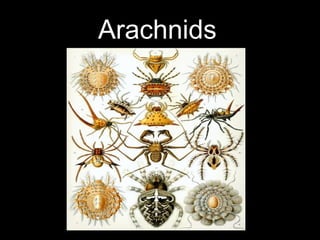
Arachnids
We, the Arachnida class, are part of the Arthropoda phylum.  Are the first things you look at when you see your potential mate his/her legs?  Well, we have  EIGHT LEGS !!!!!!!!!!!!!!!!!!!!!!!!!!!!!!  Like the feel of silk?  Spiders will gladly wrap you in some!  Want protection?  Many of us fight with venom!  Last but not least, there would be no Spider-Man without us!
Habitat WE’RE EVERYWHERE (except for the pelagic zone); like us or not, there’s no escape >:] All we need are insects, small animals, and plants (for mites) so we can eat them.
Favorite Activities This is what happens when you give too much free time to spiders. => Nobody tends to get a picture of a scorpion attacking something because they attack so fast (duh), so here’s one in attack mode! BLOOOOD!
Geneology  . Segmented body Prosoma (cephalothorax) – fusion of head and thorax; sense organs, mouthparts, limbs Opisthosama (abdomen) – genital opening, book lungs, other structures, such as spiders’ SPINNERETS (Spiderman’s are on his wrists) External skeleton (exoskeleton) No antennae or wings Partly or wholly breaking down food by secreted fluids Sexual reproduction; give birth to live young or eggs (like Charlotte!)
Unique? 6 pairs of appendages: two for feeding, sensing, and ATTACKING // four for locomotion VENOM (too bad Spiderman didn’t get those glands) Respiration – tracheal system, book lungs, or how about both? Circulatory – open; heart pumps hemolymph into sinuses surrounding internal organs and back Excretory: Malpighian tubule system - absorbs solutes, water, waste;  releases waste as nitrogenous compound Coxal gland – collects and excretes urine; helps Malpighian system release waste Nervous – brain and a chain of paired ganglia
Ideal Mate Love at first sight ~ (a.k.a. one-night stands) We’re  antisocial  and enjoy living  alone  in moisturized areas, such as caves This is actually why Spiderman never takes off his mask and Peter Parker has trouble when it comes to women We prefer to mate and never see you again :D
Annotated Bibliography &quot;Arachnid.&quot;  Britannica . 28 Apr. 2008 <http://www.britannica.com/eb/article-9110513/arachnid>. This site has a lot of detailed information on the arachnid class.  It provided much of my information, such as arachnids’ reproduction and nervous systems.  It is quite easy to understand and very intricate. &quot;Arachnid.&quot;  Everything About . 2007. 28 Apr. 2008 <http://www.everythingabout.net/articles/biology/animals/arthropods/arachnids/>.  This site also has lots of detailed information, but not as much as that of Britannica.  It provided extensive detail on the characteristics and behaviors of arachnids.  It is also easy to understand and suitable for any age.
Annotated Bibliography cont. &quot;Arachnida.&quot;  Tree of Life Web Project . 1995. 28 Apr. 2008 <http://tolweb.org/Arachnida>.  This site has a nice tree of evolution of the arthropod phylum, branching down far.  It also has many clear pictures from which I copied some into my presentation.  It doesn’t have much information apart from the evolution trees, however. Dunlop, Jason. &quot;Arachnid Origins and Evolution.&quot; 31 Mar. 1999. 28 Apr. 2008 <http://members.tripod.com/~DrJasonDunlop/index.html>. This website had some interesting images and had interesting random facts on the world of arachnids.  It is the website of Dr. Jason Dunlop, who studied arachnids and did research on their evolution and such.

Arachnids

  • 1.
  • 2.
    We, the Arachnidaclass, are part of the Arthropoda phylum. Are the first things you look at when you see your potential mate his/her legs? Well, we have EIGHT LEGS !!!!!!!!!!!!!!!!!!!!!!!!!!!!!! Like the feel of silk? Spiders will gladly wrap you in some! Want protection? Many of us fight with venom! Last but not least, there would be no Spider-Man without us!
  • 3.
    Habitat WE’RE EVERYWHERE(except for the pelagic zone); like us or not, there’s no escape >:] All we need are insects, small animals, and plants (for mites) so we can eat them.
  • 4.
    Favorite Activities Thisis what happens when you give too much free time to spiders. => Nobody tends to get a picture of a scorpion attacking something because they attack so fast (duh), so here’s one in attack mode! BLOOOOD!
  • 5.
    Geneology .Segmented body Prosoma (cephalothorax) – fusion of head and thorax; sense organs, mouthparts, limbs Opisthosama (abdomen) – genital opening, book lungs, other structures, such as spiders’ SPINNERETS (Spiderman’s are on his wrists) External skeleton (exoskeleton) No antennae or wings Partly or wholly breaking down food by secreted fluids Sexual reproduction; give birth to live young or eggs (like Charlotte!)
  • 6.
    Unique? 6 pairsof appendages: two for feeding, sensing, and ATTACKING // four for locomotion VENOM (too bad Spiderman didn’t get those glands) Respiration – tracheal system, book lungs, or how about both? Circulatory – open; heart pumps hemolymph into sinuses surrounding internal organs and back Excretory: Malpighian tubule system - absorbs solutes, water, waste; releases waste as nitrogenous compound Coxal gland – collects and excretes urine; helps Malpighian system release waste Nervous – brain and a chain of paired ganglia
  • 7.
    Ideal Mate Loveat first sight ~ (a.k.a. one-night stands) We’re antisocial and enjoy living alone in moisturized areas, such as caves This is actually why Spiderman never takes off his mask and Peter Parker has trouble when it comes to women We prefer to mate and never see you again :D
  • 8.
    Annotated Bibliography &quot;Arachnid.&quot; Britannica . 28 Apr. 2008 <http://www.britannica.com/eb/article-9110513/arachnid>. This site has a lot of detailed information on the arachnid class. It provided much of my information, such as arachnids’ reproduction and nervous systems. It is quite easy to understand and very intricate. &quot;Arachnid.&quot; Everything About . 2007. 28 Apr. 2008 <http://www.everythingabout.net/articles/biology/animals/arthropods/arachnids/>. This site also has lots of detailed information, but not as much as that of Britannica. It provided extensive detail on the characteristics and behaviors of arachnids. It is also easy to understand and suitable for any age.
  • 9.
    Annotated Bibliography cont.&quot;Arachnida.&quot; Tree of Life Web Project . 1995. 28 Apr. 2008 <http://tolweb.org/Arachnida>. This site has a nice tree of evolution of the arthropod phylum, branching down far. It also has many clear pictures from which I copied some into my presentation. It doesn’t have much information apart from the evolution trees, however. Dunlop, Jason. &quot;Arachnid Origins and Evolution.&quot; 31 Mar. 1999. 28 Apr. 2008 <http://members.tripod.com/~DrJasonDunlop/index.html>. This website had some interesting images and had interesting random facts on the world of arachnids. It is the website of Dr. Jason Dunlop, who studied arachnids and did research on their evolution and such.