MICROSCOPY
MICROSCOPE
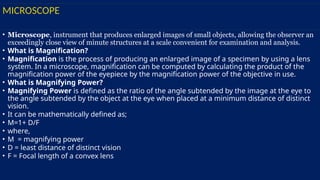
• Microscope, instrument that produces enlarged images of small objects, allowing the observer an
exceedingly close view of minute structures at a scale convenient for examination and analysis.
• What is Magnification?
• Magnification is the process of producing an enlarged image of a specimen by using a lens
system. In a microscope, magnification can be computed by calculating the product of the
magnification power of the eyepiece by the magnification power of the objective in use.
• What is Magnifying Power?
• Magnifying Power is defined as the ratio of the angle subtended by the image at the eye to
the angle subtended by the object at the eye when placed at a minimum distance of distinct
vision.
• It can be mathematically defined as;
• M=1+ D/F
• where,
• M = magnifying power
• D = least distance of distinct vision
• F = Focal length of a convex lens
CONT’
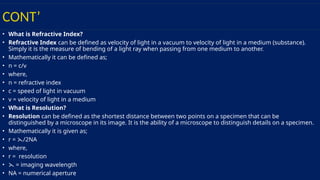
• What is Refractive Index?
• Refractive Index can be defined as velocity of light in a vacuum to velocity of light in a medium (substance).
Simply it is the measure of bending of a light ray when passing from one medium to another.
• Mathematically it can be defined as;
• n = c/v
• where,
• n = refractive index
• c = speed of light in vacuum
• v = velocity of light in a medium
• What is Resolution?
• Resolution can be defined as the shortest distance between two points on a specimen that can be
distinguished by a microscope in its image. It is the ability of a microscope to distinguish details on a specimen.
• Mathematically it is given as;
• r = /2NA
⋋
• where,
• r = resolution
• ⋋ = imaging wavelength
• NA = numerical aperture
MICROSCOPY
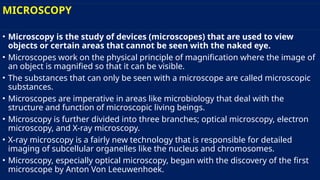
• Microscopy is the study of devices (microscopes) that are used to view
objects or certain areas that cannot be seen with the naked eye.
• Microscopes work on the physical principle of magnification where the image of
an object is magnified so that it can be visible.
• The substances that can only be seen with a microscope are called microscopic
substances.
• Microscopes are imperative in areas like microbiology that deal with the
structure and function of microscopic living beings.
• Microscopy is further divided into three branches; optical microscopy, electron
microscopy, and X-ray microscopy.
• X-ray microscopy is a fairly new technology that is responsible for detailed
imaging of subcellular organelles like the nucleus and chromosomes.
• Microscopy, especially optical microscopy, began with the discovery of the first
microscope by Anton Von Leeuwenhoek.
MICROSCOPY
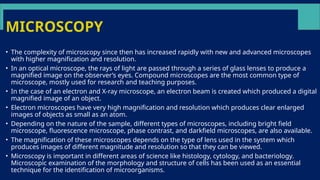
• The complexity of microscopy since then has increased rapidly with new and advanced microscopes
with higher magnification and resolution.
• In an optical microscope, the rays of light are passed through a series of glass lenses to produce a
magnified image on the observer’s eyes. Compound microscopes are the most common type of
microscope, mostly used for research and teaching purposes.
• In the case of an electron and X-ray microscope, an electron beam is created which produced a digital
magnified image of an object.
• Electron microscopes have very high magnification and resolution which produces clear enlarged
images of objects as small as an atom.
• Depending on the nature of the sample, different types of microscopes, including bright field
microscope, fluorescence microscope, phase contrast, and darkfield microscopes, are also available.
• The magnification of these microscopes depends on the type of lens used in the system which
produces images of different magnitude and resolution so that they can be viewed.
• Microscopy is important in different areas of science like histology, cytology, and bacteriology.
Microscopic examination of the morphology and structure of cells has been used as an essential
technique for the identification of microorganisms.
TYPES OF MICROSCOPES
• 1. Simple Microscope
• A simple microscope is a type of microscope that uses a single lens
for magnification. It uses a single convex lens of a small focal length
for magnification. In general, its magnification is about 10X. Its
magnifying power (m) is given by;
• m=1+ D/F
• where,
• D = least distance of distinct vision
• F = focal length of the lens of a microscope
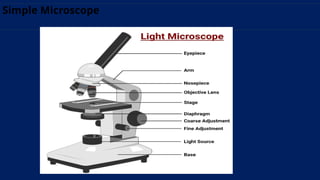
Simple Microscope
Simple Microscope Working Principle
• Simple Microscope Working Principle
• when a sample is placed in the focus of the
convex lens of a microscope, a virtual,
erect, and magnified image is formed at
the least distance of the distinct vision.
Parts of a simple microscope; mirror as
illuminator, convex lens for magnification,
stage and metallic stand with base.
• Uses of Simple Microscope
• Used to study morphology of insects,
algae, and fungi
• Used in studying soil type and components
• Used in electronic repairing workshops for
repairing watches, mobile phones and
other micro devices and components
• Used by jewelers to check quality of
diamonds, rubies and other gem stones
• Used to study details of engravings,
scripts with smaller letters, etc.
• Limitation of Simple Microscope
• Have very low magnification; upto 10X
• Mirror for illumination and lack of
mechanical stage
• Require thin stained specimen for clear
vision
• Very low resolution and image contrast
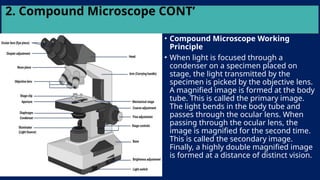
2. Compound Microscope
• Compound Microscope is a type
of microscope that used visible
light for illumination and multiple
lenses system for magnification
of specimen. Generally, it consists
of two lenses; objective lens and
ocular lens. It can magnify
images up to 1000X. Its
magnifying power is equal to the
product of magnifying power of
the objective lens in use and the
ocular lens. Mathematically it is
expressed as;
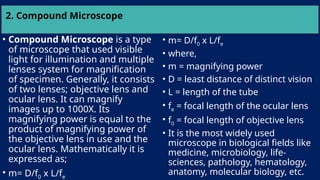
• m= D/f0 x L/fe
• m= D/f0 x L/fe
• where,
• m = magnifying power
• D = least distance of distinct vision
• L = length of the tube
• fe = focal length of the ocular lens
• f0 = focal length of objective lens
• It is the most widely used
microscope in biological fields like
medicine, microbiology, life-
sciences, pathology, hematology,
anatomy, molecular biology, etc.
2. Compound Microscope CONT’
• Compound Microscope Working
Principle
• When light is focused through a
condenser on a specimen placed on
stage, the light transmitted by the
specimen is picked by the objective lens.
A magnified image is formed at the body
tube. This is called the primary image.
The light bends in the body tube and
passes through the ocular lens. When
passing through the ocular lens, the
image is magnified for the second time.
This is called the secondary image.
Finally, a highly double magnified image
is formed at a distance of distinct vision.
2. Compound Microscope CONT’
• Uses of Compound Microscope
• Used in microbiology to study the
morphology of microorganisms
• Used in histopathology to study
tissue, cytopathic effects, tumor,
etc.
• Used in cytology to study cellular
structure of different types of cells
• Used by biologist to observe
slides of cells, tissues or segments
of biological components
• Limitations of Compound
Microscope
• Can’t produce image of objects
smaller than wavelength of
visible light (0.4 μm)
• Has lower resolution and image
contrast
• Can’t be used to view living
internal structures
• Require thin, and stained
specimen
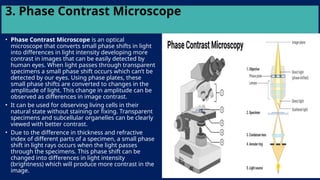
3. Phase Contrast Microscope
• Phase Contrast Microscope is an optical
microscope that converts small phase shifts in light
into differences in light intensity developing more
contrast in images that can be easily detected by
human eyes. When light passes through transparent
specimens a small phase shift occurs which can’t be
detected by our eyes. Using phase plates, these
small phase shifts are converted to changes in the
amplitude of light. This change in amplitude can be
observed as differences in image contrast.
• It can be used for observing living cells in their
natural state without staining or fixing. Transparent
specimens and subcellular organelles can be clearly
viewed with better contrast.
• Due to the difference in thickness and refractive
index of different parts of a specimen, a small phase
shift in light rays occurs when the light passes
through the specimens. This phase shift can be
changed into differences in light intensity
(brightness) which will produce more contrast in the
image.
3. Phase Contrast Microscope
• Phase Contrast Microscope Principle
• Light from the illuminator is focused on
the specimen through the condenser
annulus. This light passes through
different regions of the specimen having
different refractive indexes and
thicknesses. The light rays that pass
through an area of higher refractive index
and thickness, will experience larger phase
retardation than those rays passing
through an area of lower refractive index
and thickness. These phase shifts are
undetectable to the normal human eye. An
optical device like a phase plate converts
these phase shifts into brightness change
which creates observable contrast
differences in the final image.
• Uses of Phase Contrast Microscope
• Observing living cells in its natural form
• Used in microbiology to observe
protozoans, diatoms, planktons, cysts,
helminths and larvae.
• Used to study subcellular structures and
cellular processes
• Used to study thin tissue slices
• Used to study lithographic pattern and latex
dispersion, glass fragments and crystals.
• Limitations of Phase Contrast Microscope
• Not ideal for thick specimen
• Halo effect and shade-off are common
• Condenser annulus limit the aperture,
hence decrease resolution
4. Fluorescence Microscope
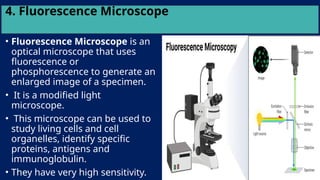
• Fluorescence Microscope is an
optical microscope that uses
fluorescence or
phosphorescence to generate an
enlarged image of a specimen.
• It is a modified light
microscope.
• This microscope can be used to
study living cells and cell
organelles, identify specific
proteins, antigens and
immunoglobulin.
• They have very high sensitivity.
• Fluorescence Microscope Principle
• It works on the principle of fluorescence. When
monochromatic light is passed on an object stained with a
fluorophore, it re-emits the light. The emitted light is
detected to form an enlarged image of the specimen.
• The specimen is stained with a fluorophore and placed on
the stage. High energy light is generated and passed
through an excitation filter. This filter allows only the light
of a particular short wavelength (UV region) capable of
exciting the fluorescent molecule to pass through and
block all other wavelength light.
• The filtered light is reflected to the sample using a dichroic
filter. The fluorophore absorbs the light rays which cause
the electron to excite in a higher energy state. The excited
electrons return to the ground state releasing the excited
energy in form of light rays with a longer wavelength.
• The emitted light passes through the dichroic mirror and
hits the emission filter. This filter blocks the short-
wavelength light and allows longer wavelength light to
pass through ocular lenses to a detector system.
• In the detector, an enlarged image is formed. The
background is observed as dark and the image appears as
bright.
• Types of Fluorescence Microscope
• There are different types of fluorescence microscopes.
Some common types are;
1. Epifluorescence Microscope
• Epifluorescence Microscope is the most common type
of fluorescence microscope. In this type, the excitation of
fluorophore and detection of the fluorescence are done
through the same light path i.e. exciting light and
emitted light both passes through an objective lens.
2. Confocal Microscope
• Confocal Microscope is a microscope that uses a spatial
pinhole to block out-of-focus light and uses only light
from the plane of focus to develop a 3-D image with
higher resolution and image contrast. It is also called a
confocal laser scanning microscope.
• It is a type of fluorescence microscope that is used to
produce 2-D or 3-D images of relatively thick specimens.
In this type, the excitation light is focused on a specific
spot of sample lying on the focal plane. The focus spot is
optically manipulated to scan the entire sample and
generate a 3-D image. A high-resolution image with
better contrast is obtained.
• This type of microscope uses laser light for
illumination. The use of a confocal aperture and
oscillating mirror made it possible to focus the
laser light on a particular spot. They neglect the
background noise from unfocused spots and
prevent fast photo-bleaching and light
scattering.
• It is based on the optical sectioning technique
where multiple 2-D images are combined to
form a 3-D image.
• Laser light is used for illumination. Laser is
passed over the fluorophore stained sample.
The emitted fluorescent light is passed through
a pinhole located in the optical path. It
selectively allows emitted light from the focused
point to pass blocking all other background
lights. The light is converted to an electrical
signal by a photomultiplier tube. Computer
software analyzes the electrical signal and
produces a 3-D image.
• Confocal Microscope Applications
• Used for detecting eye corneal diseases and fungal cells in
corneal scrapings
• Used in quality control of pharma products
• Used in optical 3-D scanning and imaging
• Confocal Microscope Limitations
• Limited excitation wavelength and narrow bands
• Expensive system
4. Multiphoton Microscope
• It is a type of fluorescence microscope that uses more than
one photon for exciting fluorophore molecules. The
multiphoton fluorescence excitation results in a high-
resolution 3-D image. The most common types are two-
photon and three-photon excitation microscopy.
5. Total Internal Reflection Fluorescence (TIRF) Microscope
• It is a type of fluorescence microscope that is used for
selectively imaging fluorophore molecules in an aqueous
environment close to a solid surface with a high refractive
index. High-resolution images with better contrast
decreased background and brighter clearer images are its
advantages.
FLOURESCENCE MICROSCOPY
• Uses of Fluorescence Microscope
• Study structure of fixed and live cells and cell organelles
• Used to measure physiological state of cells
• Detection of acid fast bacteria, malarial parasites and other microorganisms
in clinical samples
• Used in immunology and biochemistry to study macromolecules and nucleic
acids
• Used in Fluorescent In-situ Hybridization (FISH) technique in study of
microbial ecology
• Limitations of Fluorescence Microscope
• Photo-bleaching limits the time interval for observation of specimen
• Phototoxic effects of fluorophore
• Need of specific fluorophore for staining specific structures
5. Electron Microscope
• Electron Microscope is a microscope
that uses accelerated electron,
beams instead of light rays, to
illuminate the specimen and get the
highly magnified image. In this
microscope, glass lenses are replaced
by electromagnets. Due to the very
short wavelength of electrons, this
microscope produces a very high-
resolution image with magnification
up to 10,000,000X. Very high-quality
images with very high contrast,
revealing detailed structures are
produced. Specimen up to 0.2 nm
can be clearly viewed using an
electron microscope.
• Electron Microscope Principle
• An electron microscope uses accelerated electrons
with a wavelength of about 100,000 times shorter
than visible light to illuminate specimens and
produce images. The electron gun, usually a heated
tungsten or field emission filament, is used to
generate a stream of high voltage (100 – 1000 kV)
electrons. These electrons are accelerated using an
anode plate in a vacuum system and focused on the
specimen using aperture and electromagnetic
lenses.
• The electron beam passes through the specimen
and interacts with sample components. Upon
striking the specimen, the electrons are scattered.
The degree of scattering depends on the refractive
index or thickness of the specimen.
• The scattered electrons from the sample are
collected and passed through objective and ocular
electromagnetic lenses. These scattered beams are
detected and transformed into highly magnified
images by the magnetic lenses.
Types of Electron Microscope
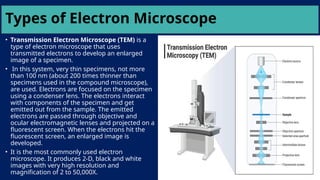
• Transmission Electron Microscope (TEM) is a
type of electron microscope that uses
transmitted electrons to develop an enlarged
image of a specimen.
• In this system, very thin specimens, not more
than 100 nm (about 200 times thinner than
specimens used in the compound microscope),
are used. Electrons are focused on the specimen
using a condenser lens. The electrons interact
with components of the specimen and get
emitted out from the sample. The emitted
electrons are passed through objective and
ocular electromagnetic lenses and projected on a
fluorescent screen. When the electrons hit the
fluorescent screen, an enlarged image is
developed.
• It is the most commonly used electron
microscope. It produces 2-D, black and white
images with very high resolution and
magnification of 2 to 50,000X.
Scanning Electron Microscope (SEM)
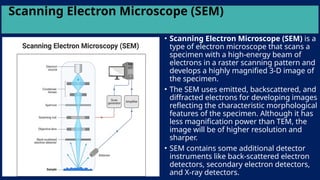
• Scanning Electron Microscope (SEM) is a
type of electron microscope that scans a
specimen with a high-energy beam of
electrons in a raster scanning pattern and
develops a highly magnified 3-D image of
the specimen.
• The SEM uses emitted, backscattered, and
diffracted electrons for developing images
reflecting the characteristic morphological
features of the specimen. Although it has
less magnification power than TEM, the
image will be of higher resolution and
sharper.
• SEM contains some additional detector
instruments like back-scattered electron
detectors, secondary electron detectors,
and X-ray detectors.
ELECTRON MICROSCOPE CONT’
3.Reflection Electron Microscope (REM)
• It is the electron microscope that uses the
reflected beams of scattered electrons to
develop an image. It is a combination of
diffraction, imaging, and spectroscopy
technique.
4.Scanning Transmission Electron Microscope
(STEM)
• It is an electron microscope that combines SEM
and TEM technology to develop an image.
5.Scanning Tunneling Microscope (STM)
• It is an electron microscope used to reveal
atomic and molecular details of specimen
surfaces using a phenomenon of tunneling
electrons. Rather than penetrating the specimen
and imaging the details of the specimen, only
the atoms on the surface of the specimen are
scanned and projected as 3-D images.
• Uses of Electron Microscope
• Used in microbiology to study structure of
viruses, flagella, pili, and bacterial cells.
• Used in crystallography, and nano-technology
• To study morphology of cellular organelles
• Used in forensics for ballistic study of gunshots
• Used in geology for studying rocks, minerals
and gems
• Used in quality control, detection of fracture
and cracks, drug development and analysis of
atomic structure.
• Limitations of Electron Microscope
• Highly expensive and complex system
• Images are in black and white
• TEM requires very thin specimen
• Need of vacuum system
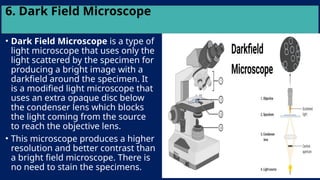
6. Dark Field Microscope
• Dark Field Microscope is a type of
light microscope that uses only the
light scattered by the specimen for
producing a bright image with a
darkfield around the specimen. It
is a modified light microscope that
uses an extra opaque disc below
the condenser lens which blocks
the light coming from the source
to reach the objective lens.
• This microscope produces a higher
resolution and better contrast than
a bright field microscope. There is
no need to stain the specimens.
DARK FIELD MICROSCOPE
• Uses of Dark Field Microscope
• Used in microbiology to observe microbial motility, and spirochetes and
other very thin bacteria.
• Used to study capsulated organisms
• Used in cytology to study internal organelles
• Used in computer mouse to allow the mouse to work over transparent
medium
• It is coupled with hyperspectral imaging for characterizing nano particles
• Limitations of Dark Field Microscope
• Any contaminants like dust particles can scatter light giving false image
• Thin spreading of sample is mandatory
• Samples must be wet and moist and strongly illuminated
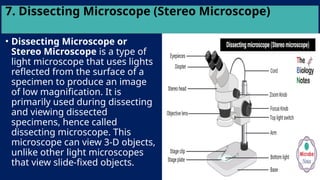
7. Dissecting Microscope (Stereo Microscope)
• Dissecting Microscope or
Stereo Microscope is a type of
light microscope that uses lights
reflected from the surface of a
specimen to produce an image
of low magnification. It is
primarily used during dissecting
and viewing dissected
specimens, hence called
dissecting microscope. This
microscope can view 3-D objects,
unlike other light microscopes
that view slide-fixed objects.
DISECTING MICROSCOPE CONT’
• Dissecting Microscope or Stereo
Microscope Principle
• A stereo microscope uses two ocular
lenses which focus on two different
light paths and produce a
stereoscopic image. They have top
light used for dissecting and bottom
light used for viewing. Objective
lenses of a stereo microscope are
inside the cylindrical cone and hence
can’t be viewed like in compound light
microscopes. The stage is also larger
than a usual compound microscope.
Usually, there is a groove to prevent
the sample from moving.
• Uses of Dissecting Microscope or
Stereo Microscope
• They are used in dissecting and micro-
surgery procedure
• Examining archaeological artifacts and
geological samples
• Used in nano electric appliance
manufacture and repairing like watches,
microchips, mobile phones, circuit
boards, etc.
• Limitations of Dissecting Microscope
or Stereo Microscope
• Has limited use
• Low magnification
• Costly system
8. Digital Microscope
• Digital Microscope is a type of microscope that
lack an ocular lens and instead contains a digital
camera and screen to display image digitally. This is
a modern microscope which is a computerized
system combining microscope with camera,
monitor and computer software, and processor.
• The image or video of a specimen can be captured
and edited or shared. The software can perform
different analyses on the specimen like measuring
size, magnifying, and focusing on specific details as
well as color correction and editing.
• Besides the general parts of a compound
microscope, it used a camera replacing eyepieces
and an additional display system.
• The computer may be inbuilt or externally
connected to operate the camera and image
processing software system. They can project 2-D
and 3-D images. The software allows color contrast,
brightness control, graphic and video recording
and sharing, and other manipulation of images.
• Applications of Digital
Microscope
• They are being used in several
fields including microbiology,
pathology, cytology, surgical
procedures, nanotechnology,
forensics, industrial sectors, etc.
They are used in place of
compound microscopes because
of their image processing and
displaying capability.
9. Scanning Probe Microscope (SPM)
• Scanning Probe Microscope (SPM) is a type of
microscope that uses a scanning probe to scan the
surface of the specimen and record the interaction to
develop an image. It projects the details of surface
atoms and molecules.
• It includes Scanning Tunneling microscopes, Atomic
Force microscopes, Fluid Field microscopes, Scanning
Electrochemical Microscopy, Scanning Thermal
microscopes, etc. Atomic force field and scanning
tunneling microscope are mostly used type.
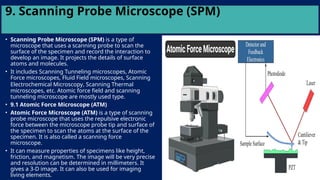
• 9.1 Atomic Force Microscope (ATM)
• Atomic Force Microscope (ATM) is a type of scanning
probe microscope that uses the repulsive electronic
force between the microscope probe tip and surface of
the specimen to scan the atoms at the surface of the
specimen. It is also called a scanning force
microscope.
• It can measure properties of specimens like height,
friction, and magnetism. The image will be very precise
and resolution can be determined in millimeters. It
gives a 3-D image. It can also be used for imaging
living elements.
• Atomic Force Microscope (ATM) Principle
• It works by measuring intermolecular forces and
observing surface atoms by using a scanning
probe. It functions on the basis of its three
major abilities; surface sensing, detecting
surface, and imaging.
• It performs surface sensing by using a cantilever.
The cantilever scans the surface of the specimen
by creating a force of attraction between the
surface and its tip. The cantilever deflects away
from the surface when it reaches too near the
surface of the specimen. When the cantilever
deflects, there is a change in direction of the
reflection of the beam striking the surface. A
positive sensitive photodiode (PSPD) records the
cantilever deflection and change in direction of
reflection of the beam. This deflection and
change in reflection of the beam are used to
produce an accurate image of the surface of the
specimen.
• Uses of Atomic Force Microscope (ATM)
• Used for analyzing physical properties like
magnetism, friction, electric property,
viscoelasticity, etc.
• Used in identification of compounds, crystals
and elements.
• Used in pathology to study cancer cells
• Used in imaging and studying
macromolecules like proteins and nucleic
acids
• Limitations of Atomic Force Microscope
(ATM)
• Analysis takes longer time so thermal drifting
of sample is a great challenge
• Limited magnification
• At a time it produce image of very small area
(only about 150 nm ×150 nm)
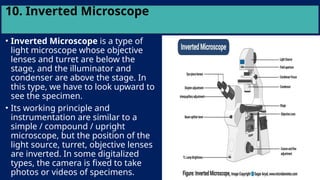
10. Inverted Microscope
• Inverted Microscope is a type of
light microscope whose objective
lenses and turret are below the
stage, and the illuminator and
condenser are above the stage. In
this type, we have to look upward to
see the specimen.
• Its working principle and
instrumentation are similar to a
simple / compound / upright
microscope, but the position of the
light source, turret, objective lenses
are inverted. In some digitalized
types, the camera is fixed to take
photos or videos of specimens.
10. Inverted Microscope
• Uses of Inverted Microscope
• Used in metallurgical processes for observing metals and minerals
• Used in cytology to study cell division process and observe minute
living organisms
• Used in microbiology to detect M. tuberculosis, Phytopthora spp. in
culture
• Limitations of Inverted Microscope
• Very limited in number and expensive
• Thickness of slide or petri dish used to hold specimen affects in
imaging
11. Acoustic Microscope
• Acoustic Microscope is a type of
microscope that uses a very
high-frequency ultrasound wave
instead of light or electrons to
develop an enlarged image of an
object. It uses sound waves to
scan the specimen and the
reflected sound is electronically
processed to develop an image.
Hence it is called acoustic. It uses
ultrasonic audio, so it is also
called Ultrasonic Microscope.
Sound waves of 5 MHz to 400
MHz are generally used.
• Acoustic Microscope Principle
• The transducer converts the electric signal
into ultrasonic sound. The sound waves are
focused on the specimen using a coupling
fluid. The sound hits the specimen and
some waves get reflected and others get
transmitted.
• Imaging is done by two methods; Pulse-
Echo mode and Transmission Mode. In
Pulse-Echo mode, a single transducer is
used and the amplitude, phase, and time of
the return of the reflected sound (echo) are
processed. While in Transmission Mode, two
transducers are used. One receives a
transmitted sound wave and another
receives a reflected sound wave. In both
methods, a sample is scanned pixel by pixel
and a planar (2-D) image is developed.
11. Acoustic Microscope
• Uses of Acoustic Microscope
• Used mainly in quality control and
production of electronic devices, imaging
circuit boards, detecting cracks in
microchips, etc.
• Used in chemical industry, pharmaceutical
industry, ceramic industry, etc. for quality
checking of products.
• Used in cytological and histological
examination to study cells internal
structures, cell motility, elasticity, etc.
• Limitations of Acoustic Microscope
• Sound needs medium to travel
• It is difficult to manipulate sounds
• Slow processing time
• Expensive
• 12. X-Ray Microscope
• X-Ray Microscope is a type of
optical microscope that uses an X-
rays beam to illuminate samples
and produce their enlarged image.
An X-ray can easily penetrate most
of the objects, so it can be used to
get images of any objects without
any special preparations or
staining. X-rays of energy 100 –
1,000 eV which corresponds to a
wavelength of about 1 nm are
generally used. Modern X-ray
microscopes use X-rays of the
wavelength of 0.1 to 10 nm.
12. X-Ray Microscope
• X-Ray Microscope Principle
• It is developed based on the fact that
when molecules of a matter interact with
X-rays, they get ionized. The electrons of
atoms of ionized molecules get excited to
a higher energy state. The excited
electrons return to their ground state
emitting the excitation energy in form of
X-rays. These emitted X-rays are of specific
energy and wavelength corresponding to
the characteristic of the element.
• X-rays are produced in an X-ray tube and
focused on the specimen for illumination
of the specimen. When the high-energy X-
rays hit the sample, some of it is
scattered, some penetrate the sample and
some get absorbed.
• The molecules get ionized and the
electrons get excited to a higher energy
state. The excited sample emits the X-rays
of a certain wavelength corresponding to
the type of atoms in the specimen.
• The image of the specimen is developed
either by the photograph method or by the
detector system. In photographs, method
image is developed when the emitted X-ray
hits on X-ray plate or phosphorescent
plate. In a detector system, a Charged-
coupled device or scintillator detector, or
other X-ray detectors are used to detect
the emitted x-ray and convert them to
electrical signals. The electrical signals are
processed by a computer and the image is
developed on a monitor.
CONT’
• Uses of X-Ray Microscope
• Used for identification and
characterization of crystals and
polymers
• Used in metallurgy, petroleum,
ceramics and glass manufacturing
industries for quality control
• Used in geology to study rocks,
minerals and soil composition
• Limitations of X-Ray Microscope
• Difficulty in imaging
• Expensive, time consuming process
and complex instrumentation
13. Polarizing Microscope
• Polarizing Microscope is a
special type of light microscope
that uses polarized light to
illuminate a specimen and
develop its magnified image. It
is similar to a regular optical
microscope but uses polarized
light instead of normal natural
light. It enhances image quality
and image contrast. They are
also called petrographic
microscopes.
• Polarizing Microscope Principle
• Normal light produced from illuminator is
passed through polarizer which converts
the normal light into plane-polarized light.
The polarizing microscope focuses the
plane-polarized light on anisotropic
(substance having multiple refractive
indexes) specimen. When the polarized
light waves strike such anisotropic
specimen, birefringence (double
reflection) occurs generating two waves,
ordinary and extraordinary waves, which
are perpendicular to each other. These
two waves get transmitted in different
phases. An analyzer combines these two
waves and passes through the ocular lens
to develop an enlarged image.
POLARIZING MICROSCOPE
• Uses of Polarizing Microscope
• Used in geological studies to study rocks, minerals and soil
components.
• Used is studying internal structures of transparent planktons,
diatoms, protozoans, etc.
• Limitations of Polarizing Microscope
• Require anisotropic specimen
• Have limited applications
14. Metallurgical Microscope
• Metallurgical Microscope is a type
of microscope that uses reflected
light for observing metals to study
their structure and organization. It
is used to study metallography.
• Its instrumentation and design are
similar to an optical microscope. The
only difference is that this
microscope uses reflected light
instead of transmitted light for
imaging.
• Its application is limited to the
observation of metallic objects,
alloys, rocks, ceramics, and other
opaque objects.
• 15. Pocket Microscope
• Pocket Microscope is a small portable
microscope designed to carry easily. It is a
simple microscope containing an
eyepiece, LED as light source and battery
for LED operation, a mirror, and a stage
for sample holding. In some types, there
is a camera for recording images digitally.
• This is for general uses like observing
jewelry, stones, watchmaking, electronics,
insects, and other objects at size on
millimeter-scale.
• Since magnification is low, up to 100X, it
can’t be used for observing microscopic
samples like microorganisms and others.

MICROSCOPY AND TYPES OF MICROSCOPES.pptx

  • 1.
  • 2.
    MICROSCOPE • Microscope, instrumentthat produces enlarged images of small objects, allowing the observer an exceedingly close view of minute structures at a scale convenient for examination and analysis. • What is Magnification? • Magnification is the process of producing an enlarged image of a specimen by using a lens system. In a microscope, magnification can be computed by calculating the product of the magnification power of the eyepiece by the magnification power of the objective in use. • What is Magnifying Power? • Magnifying Power is defined as the ratio of the angle subtended by the image at the eye to the angle subtended by the object at the eye when placed at a minimum distance of distinct vision. • It can be mathematically defined as; • M=1+ D/F • where, • M = magnifying power • D = least distance of distinct vision • F = Focal length of a convex lens
  • 3.
    CONT’ • What isRefractive Index? • Refractive Index can be defined as velocity of light in a vacuum to velocity of light in a medium (substance). Simply it is the measure of bending of a light ray when passing from one medium to another. • Mathematically it can be defined as; • n = c/v • where, • n = refractive index • c = speed of light in vacuum • v = velocity of light in a medium • What is Resolution? • Resolution can be defined as the shortest distance between two points on a specimen that can be distinguished by a microscope in its image. It is the ability of a microscope to distinguish details on a specimen. • Mathematically it is given as; • r = /2NA ⋋ • where, • r = resolution • ⋋ = imaging wavelength • NA = numerical aperture
  • 4.
    MICROSCOPY • Microscopy isthe study of devices (microscopes) that are used to view objects or certain areas that cannot be seen with the naked eye. • Microscopes work on the physical principle of magnification where the image of an object is magnified so that it can be visible. • The substances that can only be seen with a microscope are called microscopic substances. • Microscopes are imperative in areas like microbiology that deal with the structure and function of microscopic living beings. • Microscopy is further divided into three branches; optical microscopy, electron microscopy, and X-ray microscopy. • X-ray microscopy is a fairly new technology that is responsible for detailed imaging of subcellular organelles like the nucleus and chromosomes. • Microscopy, especially optical microscopy, began with the discovery of the first microscope by Anton Von Leeuwenhoek.
  • 5.
    MICROSCOPY • The complexityof microscopy since then has increased rapidly with new and advanced microscopes with higher magnification and resolution. • In an optical microscope, the rays of light are passed through a series of glass lenses to produce a magnified image on the observer’s eyes. Compound microscopes are the most common type of microscope, mostly used for research and teaching purposes. • In the case of an electron and X-ray microscope, an electron beam is created which produced a digital magnified image of an object. • Electron microscopes have very high magnification and resolution which produces clear enlarged images of objects as small as an atom. • Depending on the nature of the sample, different types of microscopes, including bright field microscope, fluorescence microscope, phase contrast, and darkfield microscopes, are also available. • The magnification of these microscopes depends on the type of lens used in the system which produces images of different magnitude and resolution so that they can be viewed. • Microscopy is important in different areas of science like histology, cytology, and bacteriology. Microscopic examination of the morphology and structure of cells has been used as an essential technique for the identification of microorganisms.
  • 6.
    TYPES OF MICROSCOPES •1. Simple Microscope • A simple microscope is a type of microscope that uses a single lens for magnification. It uses a single convex lens of a small focal length for magnification. In general, its magnification is about 10X. Its magnifying power (m) is given by; • m=1+ D/F • where, • D = least distance of distinct vision • F = focal length of the lens of a microscope
  • 7.
  • 8.
    Simple Microscope WorkingPrinciple • Simple Microscope Working Principle • when a sample is placed in the focus of the convex lens of a microscope, a virtual, erect, and magnified image is formed at the least distance of the distinct vision. Parts of a simple microscope; mirror as illuminator, convex lens for magnification, stage and metallic stand with base. • Uses of Simple Microscope • Used to study morphology of insects, algae, and fungi • Used in studying soil type and components • Used in electronic repairing workshops for repairing watches, mobile phones and other micro devices and components • Used by jewelers to check quality of diamonds, rubies and other gem stones • Used to study details of engravings, scripts with smaller letters, etc. • Limitation of Simple Microscope • Have very low magnification; upto 10X • Mirror for illumination and lack of mechanical stage • Require thin stained specimen for clear vision • Very low resolution and image contrast
  • 9.
    2. Compound Microscope •Compound Microscope is a type of microscope that used visible light for illumination and multiple lenses system for magnification of specimen. Generally, it consists of two lenses; objective lens and ocular lens. It can magnify images up to 1000X. Its magnifying power is equal to the product of magnifying power of the objective lens in use and the ocular lens. Mathematically it is expressed as; • m= D/f0 x L/fe • m= D/f0 x L/fe • where, • m = magnifying power • D = least distance of distinct vision • L = length of the tube • fe = focal length of the ocular lens • f0 = focal length of objective lens • It is the most widely used microscope in biological fields like medicine, microbiology, life- sciences, pathology, hematology, anatomy, molecular biology, etc.
  • 10.
    2. Compound MicroscopeCONT’ • Compound Microscope Working Principle • When light is focused through a condenser on a specimen placed on stage, the light transmitted by the specimen is picked by the objective lens. A magnified image is formed at the body tube. This is called the primary image. The light bends in the body tube and passes through the ocular lens. When passing through the ocular lens, the image is magnified for the second time. This is called the secondary image. Finally, a highly double magnified image is formed at a distance of distinct vision.
  • 11.
    2. Compound MicroscopeCONT’ • Uses of Compound Microscope • Used in microbiology to study the morphology of microorganisms • Used in histopathology to study tissue, cytopathic effects, tumor, etc. • Used in cytology to study cellular structure of different types of cells • Used by biologist to observe slides of cells, tissues or segments of biological components • Limitations of Compound Microscope • Can’t produce image of objects smaller than wavelength of visible light (0.4 μm) • Has lower resolution and image contrast • Can’t be used to view living internal structures • Require thin, and stained specimen
  • 12.
    3. Phase ContrastMicroscope • Phase Contrast Microscope is an optical microscope that converts small phase shifts in light into differences in light intensity developing more contrast in images that can be easily detected by human eyes. When light passes through transparent specimens a small phase shift occurs which can’t be detected by our eyes. Using phase plates, these small phase shifts are converted to changes in the amplitude of light. This change in amplitude can be observed as differences in image contrast. • It can be used for observing living cells in their natural state without staining or fixing. Transparent specimens and subcellular organelles can be clearly viewed with better contrast. • Due to the difference in thickness and refractive index of different parts of a specimen, a small phase shift in light rays occurs when the light passes through the specimens. This phase shift can be changed into differences in light intensity (brightness) which will produce more contrast in the image.
  • 13.
    3. Phase ContrastMicroscope • Phase Contrast Microscope Principle • Light from the illuminator is focused on the specimen through the condenser annulus. This light passes through different regions of the specimen having different refractive indexes and thicknesses. The light rays that pass through an area of higher refractive index and thickness, will experience larger phase retardation than those rays passing through an area of lower refractive index and thickness. These phase shifts are undetectable to the normal human eye. An optical device like a phase plate converts these phase shifts into brightness change which creates observable contrast differences in the final image. • Uses of Phase Contrast Microscope • Observing living cells in its natural form • Used in microbiology to observe protozoans, diatoms, planktons, cysts, helminths and larvae. • Used to study subcellular structures and cellular processes • Used to study thin tissue slices • Used to study lithographic pattern and latex dispersion, glass fragments and crystals. • Limitations of Phase Contrast Microscope • Not ideal for thick specimen • Halo effect and shade-off are common • Condenser annulus limit the aperture, hence decrease resolution
  • 14.
    4. Fluorescence Microscope •Fluorescence Microscope is an optical microscope that uses fluorescence or phosphorescence to generate an enlarged image of a specimen. • It is a modified light microscope. • This microscope can be used to study living cells and cell organelles, identify specific proteins, antigens and immunoglobulin. • They have very high sensitivity.
  • 15.
    • Fluorescence MicroscopePrinciple • It works on the principle of fluorescence. When monochromatic light is passed on an object stained with a fluorophore, it re-emits the light. The emitted light is detected to form an enlarged image of the specimen. • The specimen is stained with a fluorophore and placed on the stage. High energy light is generated and passed through an excitation filter. This filter allows only the light of a particular short wavelength (UV region) capable of exciting the fluorescent molecule to pass through and block all other wavelength light. • The filtered light is reflected to the sample using a dichroic filter. The fluorophore absorbs the light rays which cause the electron to excite in a higher energy state. The excited electrons return to the ground state releasing the excited energy in form of light rays with a longer wavelength. • The emitted light passes through the dichroic mirror and hits the emission filter. This filter blocks the short- wavelength light and allows longer wavelength light to pass through ocular lenses to a detector system. • In the detector, an enlarged image is formed. The background is observed as dark and the image appears as bright. • Types of Fluorescence Microscope • There are different types of fluorescence microscopes. Some common types are; 1. Epifluorescence Microscope • Epifluorescence Microscope is the most common type of fluorescence microscope. In this type, the excitation of fluorophore and detection of the fluorescence are done through the same light path i.e. exciting light and emitted light both passes through an objective lens. 2. Confocal Microscope • Confocal Microscope is a microscope that uses a spatial pinhole to block out-of-focus light and uses only light from the plane of focus to develop a 3-D image with higher resolution and image contrast. It is also called a confocal laser scanning microscope. • It is a type of fluorescence microscope that is used to produce 2-D or 3-D images of relatively thick specimens. In this type, the excitation light is focused on a specific spot of sample lying on the focal plane. The focus spot is optically manipulated to scan the entire sample and generate a 3-D image. A high-resolution image with better contrast is obtained.
  • 16.
    • This typeof microscope uses laser light for illumination. The use of a confocal aperture and oscillating mirror made it possible to focus the laser light on a particular spot. They neglect the background noise from unfocused spots and prevent fast photo-bleaching and light scattering. • It is based on the optical sectioning technique where multiple 2-D images are combined to form a 3-D image. • Laser light is used for illumination. Laser is passed over the fluorophore stained sample. The emitted fluorescent light is passed through a pinhole located in the optical path. It selectively allows emitted light from the focused point to pass blocking all other background lights. The light is converted to an electrical signal by a photomultiplier tube. Computer software analyzes the electrical signal and produces a 3-D image. • Confocal Microscope Applications • Used for detecting eye corneal diseases and fungal cells in corneal scrapings • Used in quality control of pharma products • Used in optical 3-D scanning and imaging • Confocal Microscope Limitations • Limited excitation wavelength and narrow bands • Expensive system 4. Multiphoton Microscope • It is a type of fluorescence microscope that uses more than one photon for exciting fluorophore molecules. The multiphoton fluorescence excitation results in a high- resolution 3-D image. The most common types are two- photon and three-photon excitation microscopy. 5. Total Internal Reflection Fluorescence (TIRF) Microscope • It is a type of fluorescence microscope that is used for selectively imaging fluorophore molecules in an aqueous environment close to a solid surface with a high refractive index. High-resolution images with better contrast decreased background and brighter clearer images are its advantages.
  • 17.
    FLOURESCENCE MICROSCOPY • Usesof Fluorescence Microscope • Study structure of fixed and live cells and cell organelles • Used to measure physiological state of cells • Detection of acid fast bacteria, malarial parasites and other microorganisms in clinical samples • Used in immunology and biochemistry to study macromolecules and nucleic acids • Used in Fluorescent In-situ Hybridization (FISH) technique in study of microbial ecology • Limitations of Fluorescence Microscope • Photo-bleaching limits the time interval for observation of specimen • Phototoxic effects of fluorophore • Need of specific fluorophore for staining specific structures
  • 18.
    5. Electron Microscope •Electron Microscope is a microscope that uses accelerated electron, beams instead of light rays, to illuminate the specimen and get the highly magnified image. In this microscope, glass lenses are replaced by electromagnets. Due to the very short wavelength of electrons, this microscope produces a very high- resolution image with magnification up to 10,000,000X. Very high-quality images with very high contrast, revealing detailed structures are produced. Specimen up to 0.2 nm can be clearly viewed using an electron microscope. • Electron Microscope Principle • An electron microscope uses accelerated electrons with a wavelength of about 100,000 times shorter than visible light to illuminate specimens and produce images. The electron gun, usually a heated tungsten or field emission filament, is used to generate a stream of high voltage (100 – 1000 kV) electrons. These electrons are accelerated using an anode plate in a vacuum system and focused on the specimen using aperture and electromagnetic lenses. • The electron beam passes through the specimen and interacts with sample components. Upon striking the specimen, the electrons are scattered. The degree of scattering depends on the refractive index or thickness of the specimen. • The scattered electrons from the sample are collected and passed through objective and ocular electromagnetic lenses. These scattered beams are detected and transformed into highly magnified images by the magnetic lenses.
  • 19.
    Types of ElectronMicroscope • Transmission Electron Microscope (TEM) is a type of electron microscope that uses transmitted electrons to develop an enlarged image of a specimen. • In this system, very thin specimens, not more than 100 nm (about 200 times thinner than specimens used in the compound microscope), are used. Electrons are focused on the specimen using a condenser lens. The electrons interact with components of the specimen and get emitted out from the sample. The emitted electrons are passed through objective and ocular electromagnetic lenses and projected on a fluorescent screen. When the electrons hit the fluorescent screen, an enlarged image is developed. • It is the most commonly used electron microscope. It produces 2-D, black and white images with very high resolution and magnification of 2 to 50,000X.
  • 20.
    Scanning Electron Microscope(SEM) • Scanning Electron Microscope (SEM) is a type of electron microscope that scans a specimen with a high-energy beam of electrons in a raster scanning pattern and develops a highly magnified 3-D image of the specimen. • The SEM uses emitted, backscattered, and diffracted electrons for developing images reflecting the characteristic morphological features of the specimen. Although it has less magnification power than TEM, the image will be of higher resolution and sharper. • SEM contains some additional detector instruments like back-scattered electron detectors, secondary electron detectors, and X-ray detectors.
  • 21.
    ELECTRON MICROSCOPE CONT’ 3.ReflectionElectron Microscope (REM) • It is the electron microscope that uses the reflected beams of scattered electrons to develop an image. It is a combination of diffraction, imaging, and spectroscopy technique. 4.Scanning Transmission Electron Microscope (STEM) • It is an electron microscope that combines SEM and TEM technology to develop an image. 5.Scanning Tunneling Microscope (STM) • It is an electron microscope used to reveal atomic and molecular details of specimen surfaces using a phenomenon of tunneling electrons. Rather than penetrating the specimen and imaging the details of the specimen, only the atoms on the surface of the specimen are scanned and projected as 3-D images. • Uses of Electron Microscope • Used in microbiology to study structure of viruses, flagella, pili, and bacterial cells. • Used in crystallography, and nano-technology • To study morphology of cellular organelles • Used in forensics for ballistic study of gunshots • Used in geology for studying rocks, minerals and gems • Used in quality control, detection of fracture and cracks, drug development and analysis of atomic structure. • Limitations of Electron Microscope • Highly expensive and complex system • Images are in black and white • TEM requires very thin specimen • Need of vacuum system
  • 22.
    6. Dark FieldMicroscope • Dark Field Microscope is a type of light microscope that uses only the light scattered by the specimen for producing a bright image with a darkfield around the specimen. It is a modified light microscope that uses an extra opaque disc below the condenser lens which blocks the light coming from the source to reach the objective lens. • This microscope produces a higher resolution and better contrast than a bright field microscope. There is no need to stain the specimens.
  • 23.
    DARK FIELD MICROSCOPE •Uses of Dark Field Microscope • Used in microbiology to observe microbial motility, and spirochetes and other very thin bacteria. • Used to study capsulated organisms • Used in cytology to study internal organelles • Used in computer mouse to allow the mouse to work over transparent medium • It is coupled with hyperspectral imaging for characterizing nano particles • Limitations of Dark Field Microscope • Any contaminants like dust particles can scatter light giving false image • Thin spreading of sample is mandatory • Samples must be wet and moist and strongly illuminated
  • 24.
    7. Dissecting Microscope(Stereo Microscope) • Dissecting Microscope or Stereo Microscope is a type of light microscope that uses lights reflected from the surface of a specimen to produce an image of low magnification. It is primarily used during dissecting and viewing dissected specimens, hence called dissecting microscope. This microscope can view 3-D objects, unlike other light microscopes that view slide-fixed objects.
  • 25.
    DISECTING MICROSCOPE CONT’ •Dissecting Microscope or Stereo Microscope Principle • A stereo microscope uses two ocular lenses which focus on two different light paths and produce a stereoscopic image. They have top light used for dissecting and bottom light used for viewing. Objective lenses of a stereo microscope are inside the cylindrical cone and hence can’t be viewed like in compound light microscopes. The stage is also larger than a usual compound microscope. Usually, there is a groove to prevent the sample from moving. • Uses of Dissecting Microscope or Stereo Microscope • They are used in dissecting and micro- surgery procedure • Examining archaeological artifacts and geological samples • Used in nano electric appliance manufacture and repairing like watches, microchips, mobile phones, circuit boards, etc. • Limitations of Dissecting Microscope or Stereo Microscope • Has limited use • Low magnification • Costly system
  • 26.
    8. Digital Microscope •Digital Microscope is a type of microscope that lack an ocular lens and instead contains a digital camera and screen to display image digitally. This is a modern microscope which is a computerized system combining microscope with camera, monitor and computer software, and processor. • The image or video of a specimen can be captured and edited or shared. The software can perform different analyses on the specimen like measuring size, magnifying, and focusing on specific details as well as color correction and editing. • Besides the general parts of a compound microscope, it used a camera replacing eyepieces and an additional display system. • The computer may be inbuilt or externally connected to operate the camera and image processing software system. They can project 2-D and 3-D images. The software allows color contrast, brightness control, graphic and video recording and sharing, and other manipulation of images. • Applications of Digital Microscope • They are being used in several fields including microbiology, pathology, cytology, surgical procedures, nanotechnology, forensics, industrial sectors, etc. They are used in place of compound microscopes because of their image processing and displaying capability.
  • 27.
    9. Scanning ProbeMicroscope (SPM) • Scanning Probe Microscope (SPM) is a type of microscope that uses a scanning probe to scan the surface of the specimen and record the interaction to develop an image. It projects the details of surface atoms and molecules. • It includes Scanning Tunneling microscopes, Atomic Force microscopes, Fluid Field microscopes, Scanning Electrochemical Microscopy, Scanning Thermal microscopes, etc. Atomic force field and scanning tunneling microscope are mostly used type. • 9.1 Atomic Force Microscope (ATM) • Atomic Force Microscope (ATM) is a type of scanning probe microscope that uses the repulsive electronic force between the microscope probe tip and surface of the specimen to scan the atoms at the surface of the specimen. It is also called a scanning force microscope. • It can measure properties of specimens like height, friction, and magnetism. The image will be very precise and resolution can be determined in millimeters. It gives a 3-D image. It can also be used for imaging living elements.
  • 28.
    • Atomic ForceMicroscope (ATM) Principle • It works by measuring intermolecular forces and observing surface atoms by using a scanning probe. It functions on the basis of its three major abilities; surface sensing, detecting surface, and imaging. • It performs surface sensing by using a cantilever. The cantilever scans the surface of the specimen by creating a force of attraction between the surface and its tip. The cantilever deflects away from the surface when it reaches too near the surface of the specimen. When the cantilever deflects, there is a change in direction of the reflection of the beam striking the surface. A positive sensitive photodiode (PSPD) records the cantilever deflection and change in direction of reflection of the beam. This deflection and change in reflection of the beam are used to produce an accurate image of the surface of the specimen. • Uses of Atomic Force Microscope (ATM) • Used for analyzing physical properties like magnetism, friction, electric property, viscoelasticity, etc. • Used in identification of compounds, crystals and elements. • Used in pathology to study cancer cells • Used in imaging and studying macromolecules like proteins and nucleic acids • Limitations of Atomic Force Microscope (ATM) • Analysis takes longer time so thermal drifting of sample is a great challenge • Limited magnification • At a time it produce image of very small area (only about 150 nm ×150 nm)
  • 29.
    10. Inverted Microscope •Inverted Microscope is a type of light microscope whose objective lenses and turret are below the stage, and the illuminator and condenser are above the stage. In this type, we have to look upward to see the specimen. • Its working principle and instrumentation are similar to a simple / compound / upright microscope, but the position of the light source, turret, objective lenses are inverted. In some digitalized types, the camera is fixed to take photos or videos of specimens.
  • 30.
    10. Inverted Microscope •Uses of Inverted Microscope • Used in metallurgical processes for observing metals and minerals • Used in cytology to study cell division process and observe minute living organisms • Used in microbiology to detect M. tuberculosis, Phytopthora spp. in culture • Limitations of Inverted Microscope • Very limited in number and expensive • Thickness of slide or petri dish used to hold specimen affects in imaging
  • 31.
    11. Acoustic Microscope •Acoustic Microscope is a type of microscope that uses a very high-frequency ultrasound wave instead of light or electrons to develop an enlarged image of an object. It uses sound waves to scan the specimen and the reflected sound is electronically processed to develop an image. Hence it is called acoustic. It uses ultrasonic audio, so it is also called Ultrasonic Microscope. Sound waves of 5 MHz to 400 MHz are generally used. • Acoustic Microscope Principle • The transducer converts the electric signal into ultrasonic sound. The sound waves are focused on the specimen using a coupling fluid. The sound hits the specimen and some waves get reflected and others get transmitted. • Imaging is done by two methods; Pulse- Echo mode and Transmission Mode. In Pulse-Echo mode, a single transducer is used and the amplitude, phase, and time of the return of the reflected sound (echo) are processed. While in Transmission Mode, two transducers are used. One receives a transmitted sound wave and another receives a reflected sound wave. In both methods, a sample is scanned pixel by pixel and a planar (2-D) image is developed.
  • 32.
    11. Acoustic Microscope •Uses of Acoustic Microscope • Used mainly in quality control and production of electronic devices, imaging circuit boards, detecting cracks in microchips, etc. • Used in chemical industry, pharmaceutical industry, ceramic industry, etc. for quality checking of products. • Used in cytological and histological examination to study cells internal structures, cell motility, elasticity, etc. • Limitations of Acoustic Microscope • Sound needs medium to travel • It is difficult to manipulate sounds • Slow processing time • Expensive • 12. X-Ray Microscope • X-Ray Microscope is a type of optical microscope that uses an X- rays beam to illuminate samples and produce their enlarged image. An X-ray can easily penetrate most of the objects, so it can be used to get images of any objects without any special preparations or staining. X-rays of energy 100 – 1,000 eV which corresponds to a wavelength of about 1 nm are generally used. Modern X-ray microscopes use X-rays of the wavelength of 0.1 to 10 nm.
  • 33.
    12. X-Ray Microscope •X-Ray Microscope Principle • It is developed based on the fact that when molecules of a matter interact with X-rays, they get ionized. The electrons of atoms of ionized molecules get excited to a higher energy state. The excited electrons return to their ground state emitting the excitation energy in form of X-rays. These emitted X-rays are of specific energy and wavelength corresponding to the characteristic of the element. • X-rays are produced in an X-ray tube and focused on the specimen for illumination of the specimen. When the high-energy X- rays hit the sample, some of it is scattered, some penetrate the sample and some get absorbed. • The molecules get ionized and the electrons get excited to a higher energy state. The excited sample emits the X-rays of a certain wavelength corresponding to the type of atoms in the specimen. • The image of the specimen is developed either by the photograph method or by the detector system. In photographs, method image is developed when the emitted X-ray hits on X-ray plate or phosphorescent plate. In a detector system, a Charged- coupled device or scintillator detector, or other X-ray detectors are used to detect the emitted x-ray and convert them to electrical signals. The electrical signals are processed by a computer and the image is developed on a monitor.
  • 34.
    CONT’ • Uses ofX-Ray Microscope • Used for identification and characterization of crystals and polymers • Used in metallurgy, petroleum, ceramics and glass manufacturing industries for quality control • Used in geology to study rocks, minerals and soil composition • Limitations of X-Ray Microscope • Difficulty in imaging • Expensive, time consuming process and complex instrumentation
  • 35.
    13. Polarizing Microscope •Polarizing Microscope is a special type of light microscope that uses polarized light to illuminate a specimen and develop its magnified image. It is similar to a regular optical microscope but uses polarized light instead of normal natural light. It enhances image quality and image contrast. They are also called petrographic microscopes. • Polarizing Microscope Principle • Normal light produced from illuminator is passed through polarizer which converts the normal light into plane-polarized light. The polarizing microscope focuses the plane-polarized light on anisotropic (substance having multiple refractive indexes) specimen. When the polarized light waves strike such anisotropic specimen, birefringence (double reflection) occurs generating two waves, ordinary and extraordinary waves, which are perpendicular to each other. These two waves get transmitted in different phases. An analyzer combines these two waves and passes through the ocular lens to develop an enlarged image.
  • 36.
    POLARIZING MICROSCOPE • Usesof Polarizing Microscope • Used in geological studies to study rocks, minerals and soil components. • Used is studying internal structures of transparent planktons, diatoms, protozoans, etc. • Limitations of Polarizing Microscope • Require anisotropic specimen • Have limited applications
  • 37.
    14. Metallurgical Microscope •Metallurgical Microscope is a type of microscope that uses reflected light for observing metals to study their structure and organization. It is used to study metallography. • Its instrumentation and design are similar to an optical microscope. The only difference is that this microscope uses reflected light instead of transmitted light for imaging. • Its application is limited to the observation of metallic objects, alloys, rocks, ceramics, and other opaque objects. • 15. Pocket Microscope • Pocket Microscope is a small portable microscope designed to carry easily. It is a simple microscope containing an eyepiece, LED as light source and battery for LED operation, a mirror, and a stage for sample holding. In some types, there is a camera for recording images digitally. • This is for general uses like observing jewelry, stones, watchmaking, electronics, insects, and other objects at size on millimeter-scale. • Since magnification is low, up to 100X, it can’t be used for observing microscopic samples like microorganisms and others.