TARGETED DRUG DELIVERY SYSTEM
Ms. Shubhangi B Khade
Assistant Professor
Department of Pharmaceutics
Sanjivani College of Pharmaceutical Education &
Research(Autonomous),
Kopargaon, Ahmednagar, Maharashtra
CONTENTS
 Introduction
 Concept of targeted Drug delivery
 Advantages and disadvantages
 Strategies of drug targeting
 Carriers for targeting drugs
 Liposomes
 Niosomes
 Nanoparticles
 Monoclonal Antibodies
Introduction
 The concept of drug targeting was put forwarded by Dr. Paul Ehrlich.
 Dr. Ehrlich imagined that tiny drug loaded, magic bullets could be introduced into
the human body to target the required site of action, while non target site would
be largely exempted from the effect of the drug.
 Definition:
Targeted drug delivery system is a special form of drug delivery system where
the medicament is selectively targeted or delivered only to its site of action or
absorption and not to the non target organs or tissues or cells.
 Rationale For Targeted Drug Delivery
 Targeted drug delivery system is preferred over conventional drug delivery
systems due to three main reasons
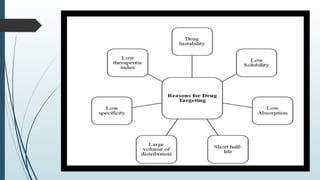
 The first being pharmaceutical reason. Conventional drugs have low solubility
and more drug instability in comparison to targeted drug delivery systems.
 Conventional drugs also have poor absorption, shorter half-life and require
large volume of distribution. These constitute its pharmacokinetic properties.
 The third reason constitutes the pharmacodynamics properties of drugs. The
conventional drugs have low specificity and low therapeutic index as compared
to targeted drug delivery system.
Characteristics of Targeted drug Delivery System
 Should be biochemically inert.
 Should be non immunogenic.
 Should be physically and chemically stable in vivo and in vitro conditions.
 Should have therapeutic amount of drug release.
 Should have minimal drug leakage during transit.
 Carriers used should be biodegradable or readily eliminated from the body
Advantages
• Prolong the drug effect by ensuring a longer circulation time.
• Increasing the drug concentration at the required site of action.
• Reduce drug toxicity in the tissue.
• Protect the drug from the metabolism.
• Dose is less compared to conventional drug delivery.
• Confine the drug delivery system to the chosen anatomical compartment by
selecting an appropriate particle size.
• Retain the drug within particle while in transit and release the drug at the target
site at appropriate rate.
Disadvantages
• Require highly sophisticated technology for formulation.
• Require skills to manufacture and administration.
• Drug loading is usually is low.
• Difficult to maintain Stability of dosage form
Approaches to Drug Targeting
There are 3 approaches to drug targeting
1. Use of biologically active agents that are potent and selective
2. Preparation of pharmacologically inert forms of active drugs (prodrug
approach)
3. Delivery of drug by specially designed drug delivery system
Drug carrier Delivery Systems For drug targeting
• The basic rationale behind using particulate carriers in intravenous application is
that drugs included in the system gets distributed according to the properties of
carrier.
• The carrier expected to seek out the preferred site and consequently the drug is
directed to the intended site of action.
• Drug carrier delivery systems employ biologically inert macromolecules
(polymers) to direct a drug to its target site in the body.
• The major advantage of drug carrier delivery system is that distribution of drugs
in the body depends on the physicochemical properties of carrier and not of the
drugs.
Carriers
• Targeted drug delivery can be achieved by using carrier system.
• Carrier is one of the special molecule or system essentially required for effective
transportation of loaded drug up to the pre selected sites.
• There are various carriers such as,
• Polymers
• Microcapsules
• Micro particles
• Liposomes
• Niosomes
etc
• The various mechanism used by the drug delivery system to vector the drug to the
target site can be broadly classified as
• Passive Targeting
• Inverse targeting
• Active targeting
• Double targeting
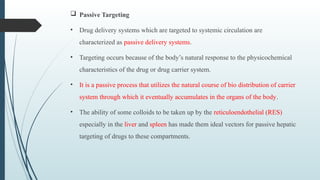
 Passive Targeting
• Drug delivery systems which are targeted to systemic circulation are
characterized as passive delivery systems.
• Targeting occurs because of the body’s natural response to the physicochemical
characteristics of the drug or drug carrier system.
• It is a passive process that utilizes the natural course of bio distribution of carrier
system through which it eventually accumulates in the organs of the body.
• The ability of some colloids to be taken up by the reticuloendothelial (RES)
especially in the liver and spleen has made them ideal vectors for passive hepatic
targeting of drugs to these compartments.
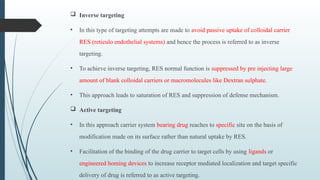
 Inverse targeting
• In this type of targeting attempts are made to avoid passive uptake of colloidal carrier
RES (reticulo endothelial systems) and hence the process is referred to as inverse
targeting.
• To achieve inverse targeting, RES normal function is suppressed by pre injecting large
amount of blank colloidal carriers or macromolecules like Dextran sulphate.
• This approach leads to saturation of RES and suppression of defense mechanism.
 Active targeting
• In this approach carrier system bearing drug reaches to specific site on the basis of
modification made on its surface rather than natural uptake by RES.
• Facilitation of the binding of the drug carrier to target cells by using ligands or
engineered homing devices to increase receptor mediated localization and target specific
delivery of drug is referred to as active targeting.
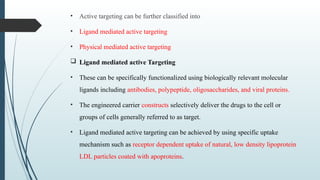
• Active targeting can be further classified into
• Ligand mediated active targeting
• Physical mediated active targeting
 Ligand mediated active Targeting
• These can be specifically functionalized using biologically relevant molecular
ligands including antibodies, polypeptide, oligosaccharides, and viral proteins.
• The engineered carrier constructs selectively deliver the drugs to the cell or
groups of cells generally referred to as target.
• Ligand mediated active targeting can be achieved by using specific uptake
mechanism such as receptor dependent uptake of natural, low density lipoprotein
LDL particles coated with apoproteins.
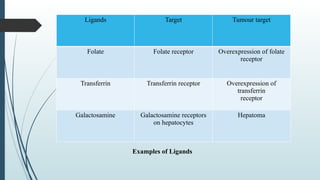
Ligands Target Tumour target
Folate Folate receptor Overexpression of folate
receptor
Transferrin Transferrin receptor Overexpression of
transferrin
receptor
Galactosamine Galactosamine receptors
on hepatocytes
Hepatoma
Examples of Ligands
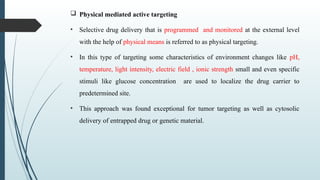
 Physical mediated active targeting
• Selective drug delivery that is programmed and monitored at the external level
with the help of physical means is referred to as physical targeting.
• In this type of targeting some characteristics of environment changes like pH,
temperature, light intensity, electric field , ionic strength small and even specific
stimuli like glucose concentration are used to localize the drug carrier to
predetermined site.
• This approach was found exceptional for tumor targeting as well as cytosolic
delivery of entrapped drug or genetic material.
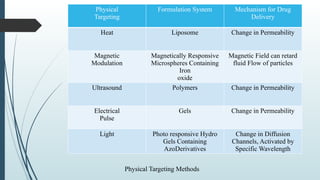
Physical
Targeting
Formulation System Mechanism for Drug
Delivery
Heat Liposome Change in Permeability
Magnetic
Modulation
Magnetically Responsive
Microspheres Containing
Iron
oxide
Magnetic Field can retard
fluid Flow of particles
Ultrasound Polymers Change in Permeability
Electrical
Pulse
Gels Change in Permeability
Light Photo responsive Hydro
Gels Containing
AzoDerivatives
Change in Diffusion
Channels, Activated by
Specific Wavelength
Physical Targeting Methods
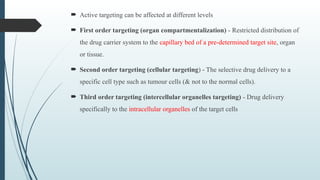
 Active targeting can be affected at different levels
 First order targeting (organ compartmentalization) - Restricted distribution of
the drug carrier system to the capillary bed of a pre-determined target site, organ
or tissue.
 Second order targeting (cellular targeting) - The selective drug delivery to a
specific cell type such as tumour cells (& not to the normal cells).
 Third order targeting (intercellular organelles targeting) - Drug delivery
specifically to the intracellular organelles of the target cells
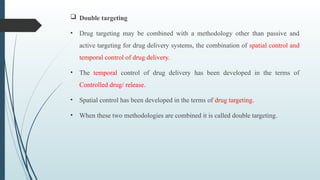
 Double targeting
• Drug targeting may be combined with a methodology other than passive and
active targeting for drug delivery systems, the combination of spatial control and
temporal control of drug delivery.
• The temporal control of drug delivery has been developed in the terms of
Controlled drug/ release.
• Spatial control has been developed in the terms of drug targeting.
• When these two methodologies are combined it is called double targeting.
CARRIERS FOR TARGETING DRUGS
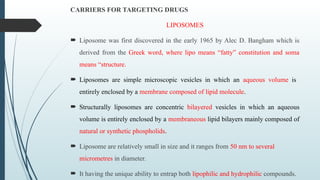
LIPOSOMES
 Liposome was first discovered in the early 1965 by Alec D. Bangham which is
derived from the Greek word, where lipo means “fatty” constitution and soma
means “structure.
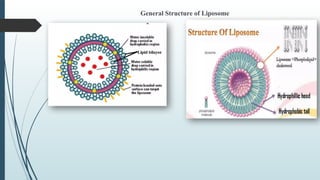
 Liposomes are simple microscopic vesicles in which an aqueous volume is
entirely enclosed by a membrane composed of lipid molecule.
 Structurally liposomes are concentric bilayered vesicles in which an aqueous
volume is entirely enclosed by a membraneous lipid bilayers mainly composed of
natural or synthetic phospholids.
 Liposome are relatively small in size and it ranges from 50 nm to several
micrometres in diameter.
 It having the unique ability to entrap both lipophilic and hydrophilic compounds.
General Structure of Liposome
Advantages of Liposomes
 Suitable for delivery of hydrophobic (e.g. amphotericin B) hydrophilic (e.g.
cytrabine) and amphipathic agents.
 Liposome increases efficacy and therapeutic index of drug
 Liposome increase stability via encapsulation
 Suitable for targeted drug delivery
 Suitable to give localized action in particular tissue
 Liposomes help to reduce the exposure of sensitive tissue to toxic drug
 Suitable to administer via various routes
Disadvantages Of Liposomes
 Once administrated, liposome cannot be removed.
 Leakage of encapsulated drug during storage.
 Production cost is high
 Possibility of dumping, due to faulty administration
 Low solubility
CLASSIFICATION
Based on structural parameters
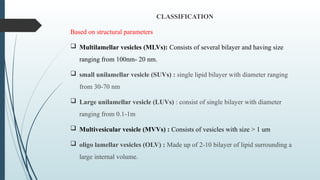
 Multilamellar vesicles (MLVs): Consists of several bilayer and having size
ranging from 100nm- 20 nm.
 small unilamellar vesicle (SUVs) : single lipid bilayer with diameter ranging
from 30-70 nm
 Large unilamellar vesicle (LUVs) : consist of single bilayer with diameter
ranging from 0.1-1m
 Multivesicular vesicle (MVVs) : Consists of vesicles with size > 1 um
 oligo lamellar vesicles (OLV) : Made up of 2-10 bilayer of lipid surrounding a
large internal volume.
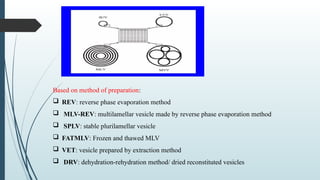
Based on method of preparation:
 REV: reverse phase evaporation method
 MLV-REV: multilamellar vesicle made by reverse phase evaporation method
 SPLV: stable plurilamellar vesicle
 FATMLV: Frozen and thawed MLV
 VET: vesicle prepared by extraction method
 DRV: dehydration-rehydration method/ dried reconstituted vesicles
 Based on composition and application
 Conventional Liposomes (CL)
 Fusogenic Liposomes (RSVE)
 pH sensitive Liposomes
 Cationic Liposomes
 Long Circulatory (stealth) Liposomes (LCL)
 Immuno-Liposomes
Composition of Liposomes
• There are number of components of liposomes such as lecithin (mixture of
phospholipids) and cholesterol.
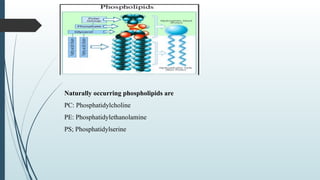
 Phospholipids
• Are fatty substances the major structural components of cell wall & biological
membranes.
• Phospholipids are amphipathic moieties with a hydrophilic head group and two
hydrophobic tails.
• Two types of phospholipids 1. phosphodiglycerides 2. sphingolipids
• Phospholipids have phosphatidyl moiety (tail) with different head
groups(choline, ethanolamine, serine).
• The most common phospholipid is phophatdylcholine.
Naturally occurring phospholipids are
PC: Phosphatidylcholine
PE: Phosphatidylethanolamine
PS; Phosphatidylserine
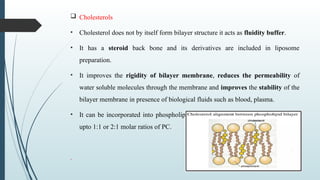
 Cholesterols
• Cholesterol does not by itself form bilayer structure it acts as fluidity buffer.
• It has a steroid back bone and its derivatives are included in liposome
preparation.
• It improves the rigidity of bilayer membrane, reduces the permeability of
water soluble molecules through the membrane and improves the stability of the
bilayer membrane in presence of biological fluids such as blood, plasma.
• It can be incorporated into phospholipid membranes in very high concentration
upto 1:1 or 2:1 molar ratios of PC.
.
Methods of Liposome Preparation
Methods can be categorized on the basis of lipid dispersion
 Physical dispersion technique
1. Lipid hydration by hand shaking method (MLV) and non hand shaking method(LUV)
2. High shear homogenization/ sonication
3. Membrane extrusion
4. Micro fluidizer techniques for microemlsification
5. French pressure cell
6. Dried reconstituted vesicles.
7. Fusion method
 Solvent dispersion Technique
1. Ethanol Injection
2. Ether injection
3. Flurocarbon Injection
4. Reverse phase evaporation vesicles.
 Detergent solubilization technique
 Physical dispersion technique
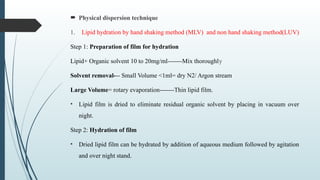
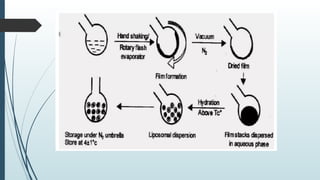
1. Lipid hydration by hand shaking method (MLV) and non hand shaking method(LUV)
Step 1: Preparation of film for hydration
Lipid+ Organic solvent 10 to 20mg/ml-------Mix thoroughly
Solvent removal--- Small Volume <1ml= dry N2/ Argon stream
Large Volume= rotary evaporation-------Thin lipid film.
• Lipid film is dried to eliminate residual organic solvent by placing in vacuum over
night.
Step 2: Hydration of film
• Dried lipid film can be hydrated by addition of aqueous medium followed by agitation
and over night stand.
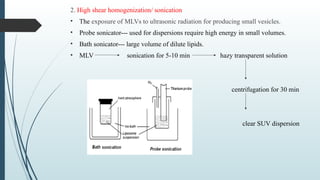
2. High shear homogenization/ sonication
• The exposure of MLVs to ultrasonic radiation for producing small vesicles.
• Probe sonicator--- used for dispersions require high energy in small volumes.
• Bath sonicator--- large volume of dilute lipids.
• MLV sonication for 5-10 min hazy transparent solution
centrifugation for 30 min
clear SUV dispersion
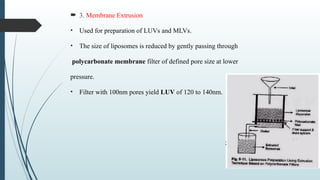
 3. Membrane Extrusion
• Used for preparation of LUVs and MLVs.
• The size of liposomes is reduced by gently passing through
polycarbonate membrane filter of defined pore size at lower
pressure.
• Filter with 100nm pores yield LUV of 120 to 140nm.
 4. Micro fluidizer techniques for microemlsification
• Microfluidizer is used to prepare small ULV/MLVs from concentrated lipid
dispersion.
• The lipids are introduced into fluidizers either as a dispersion of large MLVs or
a as a slurry of unhydrated lipids in organic medium.
• Microfluidizer pumps the fluid at very high pressure (10,000psi) through a 5um
orifice.
• Then it is forced along defined micro channels which direct two streams of fluid
to collide together at right angles at a very high velocity, thereby affecting an
efficient transfer of energy.
• The fluid collected to be recycled through the pump and interaction chamber until
vesicles of spherical dimension are obtained.
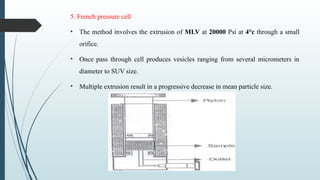
5. French pressure cell
• The method involves the extrusion of MLV at 20000 Psi at 4°c through a small
orifice.
• Once pass through cell produces vesicles ranging from several micrometers in
diameter to SUV size.
• Multiple extrusion result in a progressive decrease in mean particle size.
6. Dried reconstituted vesicles
• This method involves freeze drying the dispersion of empty SUV followed by
rehydration with aqueous fluid, which have material to be entrapped.
• Useful for preparation of small unilamellar and oligo lamellar vesicles.
7. Fusion method
• This method protects lipids and entrapped material from harmful physicochemical
environment.
• Used for preparation of ULV in large quantities.
• Fusogenic agents are used for fusion of SUV for increasing entrapment
efficiency.
 Solvent dispersion Technique
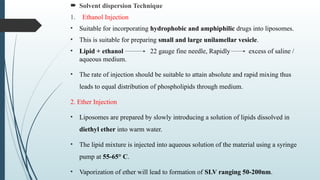
1. Ethanol Injection
• Suitable for incorporating hydrophobic and amphiphilic drugs into liposomes.
• This is suitable for preparing small and large unilamellar vesicle.
• Lipid + ethanol 22 gauge fine needle, Rapidly excess of saline /
aqueous medium.
• The rate of injection should be suitable to attain absolute and rapid mixing thus
leads to equal distribution of phospholipids through medium.
2. Ether Injection
• Liposomes are prepared by slowly introducing a solution of lipids dissolved in
diethyl ether into warm water.
• The lipid mixture is injected into aqueous solution of the material using a syringe
pump at 55-65° C.
• Vaporization of ether will lead to formation of SLV ranging 50-200nm.
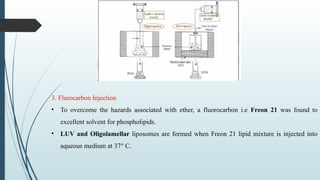
3. Flurocarbon Injection
• To overcome the hazards associated with ether, a fluorocarbon i.e Freon 21 was found to
excellent solvent for phospholipids.
• LUV and Oligolamellar liposomes are formed when Freon 21 lipid mixture is injected into
aqueous medium at 37° C.
3. Reverse Phase Evaporation Vesicles
• A W/O emulsion is prepared consisting of lipid phase and an aqueous phase
with excess of organic phase.
• Two phases are emulsified by mechanical methods or by sonication.
• The organic solvents are removed by rotary evaporation there is just enough
lipid material left to form a monolayer around each of the microdroplets.
• At this phase emulsion inversion takes place, and aqueous phase forms new
continuous phase and lipid layer forms a leaflet around the micelles, resulting in
formation of inverted micelles in vesicular form.
• High encapsulation efficiency of 65% can be achieved.
 Detergent solubilization technique
• Removal of detergent molecules from aqueous dispersions of phospholipid/
detergent mixed micelles.
• As the detergent is removed the micelle becomes rich with phospholipids to form
closed single bilayered vesicles.
• The detergents can be removed by dialysis or gel chromatography.
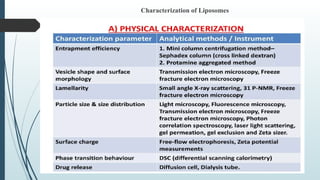
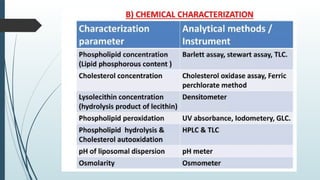
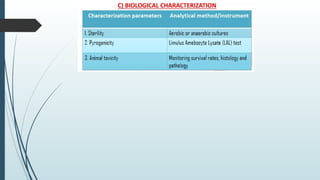
Characterization of Liposomes
Applications of Liposomes
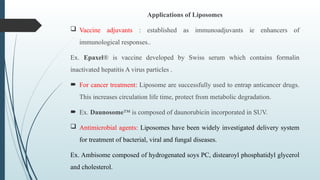
 Vaccine adjuvants : established as immunoadjuvants ie enhancers of
immunological responses..
Ex. Epaxel® is vaccine developed by Swiss serum which contains formalin
inactivated hepatitis A virus particles .
 For cancer treatment: Liposome are successfully used to entrap anticancer drugs.
This increases circulation life time, protect from metabolic degradation.
 Ex. Daunosome™ is composed of daunorubicin incorporated in SUV.
 Antimicrobial agents: Liposomes have been widely investigated delivery system
for treatment of bacterial, viral and fungal diseases.
Ex. Ambisome composed of hydrogenated soys PC, distearoyl phosphatidyl glycerol
and cholesterol.
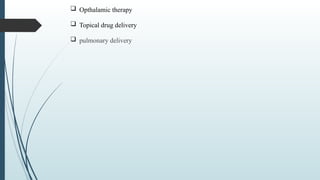
 Opthalamic therapy
 Topical drug delivery
 pulmonary delivery
Niosomes
Definition
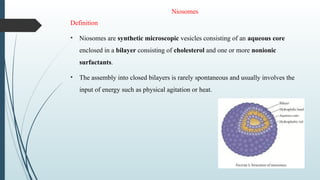
• Niosomes are synthetic microscopic vesicles consisting of an aqueous core
enclosed in a bilayer consisting of cholesterol and one or more nonionic
surfactants.
• The assembly into closed bilayers is rarely spontaneous and usually involves the
input of energy such as physical agitation or heat.
 Advantages
• Targeted drug delivery can be achieved using niosome
• Reduced frequency and dose
• Can be used to encapsulate both types of drugs i.e hydrophilic as well as
lipophilic.
• Improve the oral bioavailability of poorly soluble drugs.
• Enhance the skin permeability when applied topically.
• Provide advantage of usage through various routes such as oral, parentral, topical,
ocular.
 Disadvantage
• Aqueous suspension of nisome may exhibit fusion, aggregation, leaching of
entrapped drug , thus limiting the shelf life of noisome dispersion.
• Time consuming
• Requires specialized equipment
• Inefficient drug loading.
 Structure of Niosome
• Niosomes are microscopic lamellar structures.
• Basic structural components are,
• Non ionic surfactant
• Cholesterol
• Charge inducing molecule.
• A number on non ionic surfactants used are
Polyglycerol alkyl ether, glucosyl dialkyl ethers, crown ethers, ester linked
surfactants, polyoxyethylene alkyl ether and a series of spans and tweens.
 Non ionic surfactants
• Niosome formation requires the presence of a particular class of amphiphile and
an aqueous solvents.
• These amphiphiles possess a hydrophilic head group and a hydrophobic tail.
• The hydrophobic moiety consists of one or two alkyl or perfluroalkyl groupsor in
certain cases a single steroidal group.
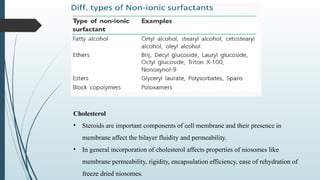
• Mainly following types of non ionic surfactants are used,
• 1. Alkyl ethers
• 2. Alkyl Esters
• 3. Alkyl Amides.
• 4. Fatty Acid and Amino acid compounds
Cholesterol
• Steroids are important components of cell membrane and their presence in
membrane affect the bilayer fluidity and permeability.
• In general incorporation of cholesterol affects properties of niosomes like
membrane permeability, rigidity, encapsulation efficiency, ease of rehydration of
freeze dried niosomes.
 Charge Inducing Molecule
• Some charged molecules are added to increase the stability of niosomes by
electrostatic repulsion which prevents aggregation and coalescence.
• The negatively charged molecules used are Diacetyl phosphate (DCP) and
phosphatidic acid,.
• Similarly Stearylamine and Stearyl pyridinium chloride are the well known
positively charged molecules used.
Classification Of Niosome
Based on vesicle size can be divided into 3 groups
1. Small Unilamellar Vesicles( SUV) – Size 0.025 to 0.05um
 These small unilamellar vesicles are mostly prepared from multilamellar vesicles by
sonication method, French press extrusion electrostatic stabilization is the inclusion
of dicetyl phosphate in 5(6)-carboxyfluorescein (CF) loaded Span 60 based niosomes.
 Multilamellar vesicles ( MLV)- It consists of a number of bilayer surrounding the
aqueous lipid compartment separately. The approximate size of these vesicles is 0.5-
10 μm diameter. Multilamellar vesicles are the most widely used niosomes. These
vesicles are highly suited as drug carrier for lipophilic compounds.
 Large unilamellar vesicles (LUV) – Niosomes of this type have a high
aqueous/lipid compartment ratio, so that larger volumes of bio-active materials can be
entrapped with a very economical use of membrane lipids.
 Method of Preparation
1. Ether Injection method (LUV)
2. Hand Shaking method (MLV)
3. Reverse Phase Evaporation Method (LUV)
4. Formation of Niosomes from Proniosomes
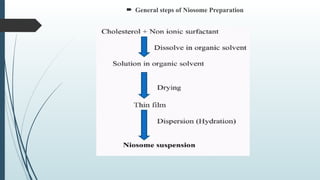
 General steps of Niosome Preparation
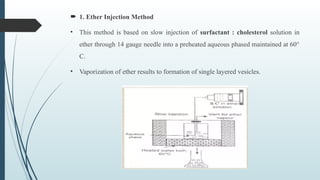
 1. Ether Injection Method
• This method is based on slow injection of surfactant : cholesterol solution in
ether through 14 gauge needle into a preheated aqueous phased maintained at 60°
C.
• Vaporization of ether results to formation of single layered vesicles.
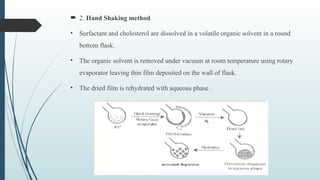
 2. Hand Shaking method
• Surfactant and cholesterol are dissolved in a volatile organic solvent in a round
bottom flask.
• The organic solvent is removed under vacuum at room temperature using rotary
evaporator leaving thin film deposited on the wall of flask.
• The dried film is rehydrated with aqueous phase .
 3. Reverse Phase Evaporation Method
• An O/W emulsion is formed from aqueous solution of the drug.
• The organic solvent is then evaporated to leave Niosomes dispersed in the
aqueous phase.
• In certain cases the resulting gel has to be further hydrated to yield niosomes.
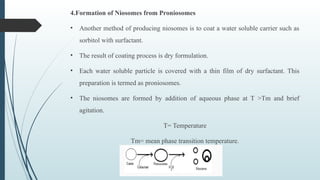
4.Formation of Niosomes from Proniosomes
• Another method of producing niosomes is to coat a water soluble carrier such as
sorbitol with surfactant.
• The result of coating process is dry formulation.
• Each water soluble particle is covered with a thin film of dry surfactant. This
preparation is termed as proniosomes.
• The niosomes are formed by addition of aqueous phase at T >Tm and brief
agitation.
T= Temperature
Tm= mean phase transition temperature.
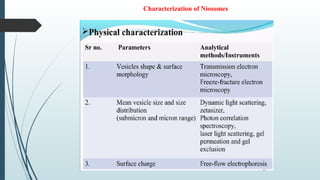
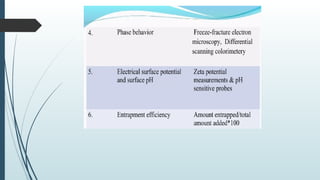
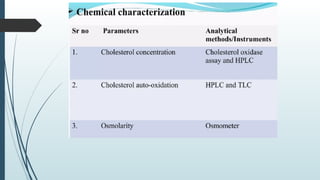
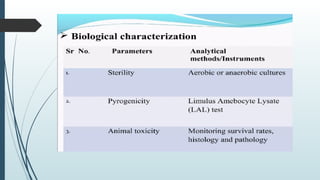
Characterization of Niosomes
Applications of Niosomes
 Encapsulation of various antineoplastic agents minimizes drug induced toxicity.
 Has good control over release rate of drug particularly for treating brain
malignant cancer.
 Provides better drug concentration at the site of action.
 Can be applied drugs with low therapeutic index and water solubility.
 Niosomal systems can be used as diagnostic agents.
Nanoparticles
Definition
• Nanoparticles are solid, colloidal particles ranging from 10- 1000nm in size.
• They consist of macromolecular materials in which the active ingredient is
dissolved, entrapped or encapsulated, and /or adsorbed or attached.
• Depending on the process used for their preparation classified as
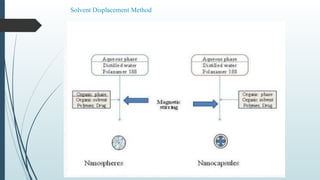
• NANOSPHERES are matrix systems in which the drug is physically and
uniformly dispersed.
• NANOCAPSULES are systems in which the drug is confined to a cavity
surrounded by a unique polymer membrane.
Advantages
• Site specific delivery of drugs.
• Helps to achieve maximum therapeutic response with minimum adverse effects.
• Can be administered by parentral, oral, nasal.
• By attaching specific ligands onto their surfaces, nanoparticles can be used for directing the
drugs to specific target cells.
Disadvantages
• Limited drug loading
• Susceptible to bursting and leakage of contents
• Handling of nanoparticles is difficult.
• Small size & large surface area can lead to particle aggregation
• Toxic metabolites may form.
Ideal Characteristics
 It should be biochemical inert, non toxic and non immunogenic
 It should be stable both physically and chemically.
 Restrict drug distribution to non target cells or tissues or organs and should have
uniform distribution.
 Controllable & predictable drug delivery rate
 Simple, reproducible and cost effective.
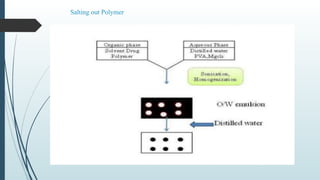
 Method of preparation
A. Cross Linking Methods
 By cross linking of Amphiphilic macromolecules
 By cross linking in W/O emulsion
 By emulsion chemical dehydration
 By Phase separation
 By pH induced aggregation
B. Polymerization Methods
 Emulsion polymerization
 Dispersion polymerization
Cross Linking Methods
1. By cross linking of Amphiphilic macromolecules:
 Nanoparticles can be prepared from Amphiphilic macromolecules, proteins and polysaccharides (which
affinity for aqueous and lipid solvents).
 The method involves aggregation of Amphiphiles followed by stabilization either by heat denaturation or
chemical cross linking.
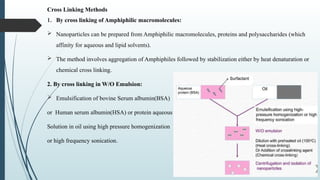
2. By cross linking in W/O Emulsion:
 Emulsification of bovine Serum albumin(BSA)
or Human serum albumin(HSA) or protein aqueous
Solution in oil using high pressure homogenization
or high frequency sonication.
3. Emulsion Chemical Dehydration:
 Stabilization can also be achieved by emulsion chemical dehydration.
 HPC solution in chloroform is used as a continuous phase, while a chemical dehydrating agent,
2,2 di methyl propane is used to disperse into the internal aqueous phase to form an emulsion.
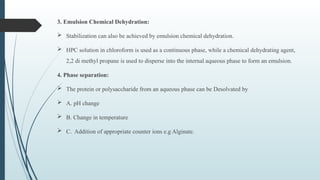
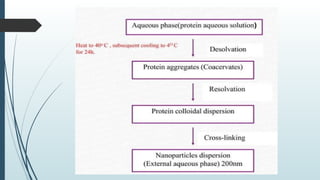
4. Phase separation:
 The protein or polysaccharide from an aqueous phase can be Desolvated by
 A. pH change
 B. Change in temperature
 C. Addition of appropriate counter ions e.g Alginate.
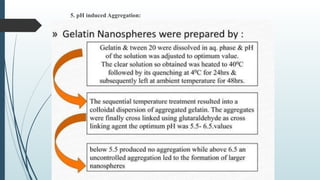
5. pH induced Aggregation:
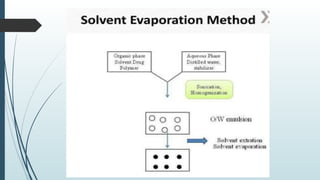
Solvent Displacement Method
Salting out Polymer
Applications of nanoparticles
 Vaccine adjuvant. DNA delivery
 Ocular delivery.
 Transport of peptides, nucleic acids and other drug molecules
 Cancer therapy:
 Diagnostic purposes
MONOCLONAL ANTIBODIES
 An antibody is a protein used by immune system to identify and neutralize foreign
objects like bacteria and virus
 Each antibody recognizes a specific antigen unique to its target
 The high specificity of antibodies makes them an excellent tool for detecting and
quantifying a broad array of targets, from drugs to serum proteins to microorganisms.
 Monoclonal antibodies (mAB) are single type of immunoglobulin that are identical
and are directed against a specific epitope (antigen, antigenic determinant) and are
produced by B- cell clones of a single parent or a single hybridoma cell line.
 A hybridoma cell line is formed by the fusion of one B-cell lymphocyte with a myeloma
cell.
 Polyclonal antibodies are antibodies that are derived from different cell lines. They differ
in amino acid sequences
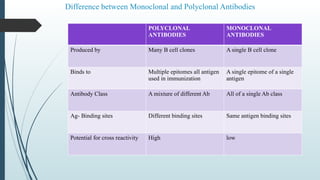
Difference between Monoclonal and Polyclonal Antibodies
POLYCLONAL
ANTIBODIES
MONOCLONAL
ANTIBODIES
Produced by Many B cell clones A single B cell clone
Binds to Multiple epitomes all antigen
used in immunization
A single epitome of a single
antigen
Antibody Class A mixture of different Ab All of a single Ab class
Ag- Binding sites Different binding sites Same antigen binding sites
Potential for cross reactivity High low
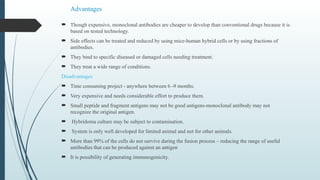
Advantages
 Though expensive, monoclonal antibodies are cheaper to develop than conventional drugs because it is
based on tested technology.
 Side effects can be treated and reduced by using mice-human hybrid cells or by using fractions of
antibodies.
 They bind to specific diseased or damaged cells needing treatment.
 They treat a wide range of conditions.
Disadvantages
 Time consuming project - anywhere between 6 -9 months.
 Very expensive and needs considerable effort to produce them.
 Small peptide and fragment antigens may not be good antigens-monoclonal antibody may not
recognize the original antigen.
 Hybridoma culture may be subject to contamination.
 System is only well developed for limited animal and not for other animals.
 More than 99% of the cells do not survive during the fusion process – reducing the range of useful
antibodies that can be produced against an antigen
 It is possibility of generating immunogenicity.
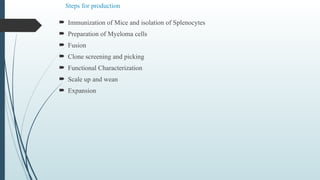
Steps for production
 Immunization of Mice and isolation of Splenocytes
 Preparation of Myeloma cells
 Fusion
 Clone screening and picking
 Functional Characterization
 Scale up and wean
 Expansion
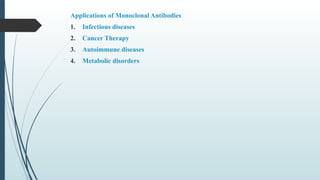
Applications of Monoclonal Antibodies
1. Infectious diseases
2. Cancer Therapy
3. Autoimmune diseases
4. Metabolic disorders

NDDS Targeted Drug Delivery System .pptx

  • 1.
    TARGETED DRUG DELIVERYSYSTEM Ms. Shubhangi B Khade Assistant Professor Department of Pharmaceutics Sanjivani College of Pharmaceutical Education & Research(Autonomous), Kopargaon, Ahmednagar, Maharashtra
  • 2.
    CONTENTS  Introduction  Conceptof targeted Drug delivery  Advantages and disadvantages  Strategies of drug targeting  Carriers for targeting drugs  Liposomes  Niosomes  Nanoparticles  Monoclonal Antibodies
  • 3.
    Introduction  The conceptof drug targeting was put forwarded by Dr. Paul Ehrlich.  Dr. Ehrlich imagined that tiny drug loaded, magic bullets could be introduced into the human body to target the required site of action, while non target site would be largely exempted from the effect of the drug.  Definition: Targeted drug delivery system is a special form of drug delivery system where the medicament is selectively targeted or delivered only to its site of action or absorption and not to the non target organs or tissues or cells.
  • 4.
     Rationale ForTargeted Drug Delivery  Targeted drug delivery system is preferred over conventional drug delivery systems due to three main reasons  The first being pharmaceutical reason. Conventional drugs have low solubility and more drug instability in comparison to targeted drug delivery systems.  Conventional drugs also have poor absorption, shorter half-life and require large volume of distribution. These constitute its pharmacokinetic properties.  The third reason constitutes the pharmacodynamics properties of drugs. The conventional drugs have low specificity and low therapeutic index as compared to targeted drug delivery system.
  • 6.
    Characteristics of Targeteddrug Delivery System  Should be biochemically inert.  Should be non immunogenic.  Should be physically and chemically stable in vivo and in vitro conditions.  Should have therapeutic amount of drug release.  Should have minimal drug leakage during transit.  Carriers used should be biodegradable or readily eliminated from the body
  • 7.
    Advantages • Prolong thedrug effect by ensuring a longer circulation time. • Increasing the drug concentration at the required site of action. • Reduce drug toxicity in the tissue. • Protect the drug from the metabolism. • Dose is less compared to conventional drug delivery. • Confine the drug delivery system to the chosen anatomical compartment by selecting an appropriate particle size. • Retain the drug within particle while in transit and release the drug at the target site at appropriate rate.
  • 8.
    Disadvantages • Require highlysophisticated technology for formulation. • Require skills to manufacture and administration. • Drug loading is usually is low. • Difficult to maintain Stability of dosage form
  • 9.
    Approaches to DrugTargeting There are 3 approaches to drug targeting 1. Use of biologically active agents that are potent and selective 2. Preparation of pharmacologically inert forms of active drugs (prodrug approach) 3. Delivery of drug by specially designed drug delivery system
  • 10.
    Drug carrier DeliverySystems For drug targeting • The basic rationale behind using particulate carriers in intravenous application is that drugs included in the system gets distributed according to the properties of carrier. • The carrier expected to seek out the preferred site and consequently the drug is directed to the intended site of action. • Drug carrier delivery systems employ biologically inert macromolecules (polymers) to direct a drug to its target site in the body. • The major advantage of drug carrier delivery system is that distribution of drugs in the body depends on the physicochemical properties of carrier and not of the drugs.
  • 11.
    Carriers • Targeted drugdelivery can be achieved by using carrier system. • Carrier is one of the special molecule or system essentially required for effective transportation of loaded drug up to the pre selected sites. • There are various carriers such as, • Polymers • Microcapsules • Micro particles • Liposomes • Niosomes etc
  • 12.
    • The variousmechanism used by the drug delivery system to vector the drug to the target site can be broadly classified as • Passive Targeting • Inverse targeting • Active targeting • Double targeting
  • 13.
     Passive Targeting •Drug delivery systems which are targeted to systemic circulation are characterized as passive delivery systems. • Targeting occurs because of the body’s natural response to the physicochemical characteristics of the drug or drug carrier system. • It is a passive process that utilizes the natural course of bio distribution of carrier system through which it eventually accumulates in the organs of the body. • The ability of some colloids to be taken up by the reticuloendothelial (RES) especially in the liver and spleen has made them ideal vectors for passive hepatic targeting of drugs to these compartments.
  • 14.
     Inverse targeting •In this type of targeting attempts are made to avoid passive uptake of colloidal carrier RES (reticulo endothelial systems) and hence the process is referred to as inverse targeting. • To achieve inverse targeting, RES normal function is suppressed by pre injecting large amount of blank colloidal carriers or macromolecules like Dextran sulphate. • This approach leads to saturation of RES and suppression of defense mechanism.  Active targeting • In this approach carrier system bearing drug reaches to specific site on the basis of modification made on its surface rather than natural uptake by RES. • Facilitation of the binding of the drug carrier to target cells by using ligands or engineered homing devices to increase receptor mediated localization and target specific delivery of drug is referred to as active targeting.
  • 15.
    • Active targetingcan be further classified into • Ligand mediated active targeting • Physical mediated active targeting  Ligand mediated active Targeting • These can be specifically functionalized using biologically relevant molecular ligands including antibodies, polypeptide, oligosaccharides, and viral proteins. • The engineered carrier constructs selectively deliver the drugs to the cell or groups of cells generally referred to as target. • Ligand mediated active targeting can be achieved by using specific uptake mechanism such as receptor dependent uptake of natural, low density lipoprotein LDL particles coated with apoproteins.
  • 16.
    Ligands Target Tumourtarget Folate Folate receptor Overexpression of folate receptor Transferrin Transferrin receptor Overexpression of transferrin receptor Galactosamine Galactosamine receptors on hepatocytes Hepatoma Examples of Ligands
  • 17.
     Physical mediatedactive targeting • Selective drug delivery that is programmed and monitored at the external level with the help of physical means is referred to as physical targeting. • In this type of targeting some characteristics of environment changes like pH, temperature, light intensity, electric field , ionic strength small and even specific stimuli like glucose concentration are used to localize the drug carrier to predetermined site. • This approach was found exceptional for tumor targeting as well as cytosolic delivery of entrapped drug or genetic material.
  • 18.
    Physical Targeting Formulation System Mechanismfor Drug Delivery Heat Liposome Change in Permeability Magnetic Modulation Magnetically Responsive Microspheres Containing Iron oxide Magnetic Field can retard fluid Flow of particles Ultrasound Polymers Change in Permeability Electrical Pulse Gels Change in Permeability Light Photo responsive Hydro Gels Containing AzoDerivatives Change in Diffusion Channels, Activated by Specific Wavelength Physical Targeting Methods
  • 19.
     Active targetingcan be affected at different levels  First order targeting (organ compartmentalization) - Restricted distribution of the drug carrier system to the capillary bed of a pre-determined target site, organ or tissue.  Second order targeting (cellular targeting) - The selective drug delivery to a specific cell type such as tumour cells (& not to the normal cells).  Third order targeting (intercellular organelles targeting) - Drug delivery specifically to the intracellular organelles of the target cells
  • 20.
     Double targeting •Drug targeting may be combined with a methodology other than passive and active targeting for drug delivery systems, the combination of spatial control and temporal control of drug delivery. • The temporal control of drug delivery has been developed in the terms of Controlled drug/ release. • Spatial control has been developed in the terms of drug targeting. • When these two methodologies are combined it is called double targeting.
  • 21.
    CARRIERS FOR TARGETINGDRUGS LIPOSOMES  Liposome was first discovered in the early 1965 by Alec D. Bangham which is derived from the Greek word, where lipo means “fatty” constitution and soma means “structure.  Liposomes are simple microscopic vesicles in which an aqueous volume is entirely enclosed by a membrane composed of lipid molecule.  Structurally liposomes are concentric bilayered vesicles in which an aqueous volume is entirely enclosed by a membraneous lipid bilayers mainly composed of natural or synthetic phospholids.  Liposome are relatively small in size and it ranges from 50 nm to several micrometres in diameter.  It having the unique ability to entrap both lipophilic and hydrophilic compounds.
  • 22.
  • 23.
    Advantages of Liposomes Suitable for delivery of hydrophobic (e.g. amphotericin B) hydrophilic (e.g. cytrabine) and amphipathic agents.  Liposome increases efficacy and therapeutic index of drug  Liposome increase stability via encapsulation  Suitable for targeted drug delivery  Suitable to give localized action in particular tissue  Liposomes help to reduce the exposure of sensitive tissue to toxic drug  Suitable to administer via various routes
  • 24.
    Disadvantages Of Liposomes Once administrated, liposome cannot be removed.  Leakage of encapsulated drug during storage.  Production cost is high  Possibility of dumping, due to faulty administration  Low solubility
  • 25.
    CLASSIFICATION Based on structuralparameters  Multilamellar vesicles (MLVs): Consists of several bilayer and having size ranging from 100nm- 20 nm.  small unilamellar vesicle (SUVs) : single lipid bilayer with diameter ranging from 30-70 nm  Large unilamellar vesicle (LUVs) : consist of single bilayer with diameter ranging from 0.1-1m  Multivesicular vesicle (MVVs) : Consists of vesicles with size > 1 um  oligo lamellar vesicles (OLV) : Made up of 2-10 bilayer of lipid surrounding a large internal volume.
  • 26.
    Based on methodof preparation:  REV: reverse phase evaporation method  MLV-REV: multilamellar vesicle made by reverse phase evaporation method  SPLV: stable plurilamellar vesicle  FATMLV: Frozen and thawed MLV  VET: vesicle prepared by extraction method  DRV: dehydration-rehydration method/ dried reconstituted vesicles
  • 27.
     Based oncomposition and application  Conventional Liposomes (CL)  Fusogenic Liposomes (RSVE)  pH sensitive Liposomes  Cationic Liposomes  Long Circulatory (stealth) Liposomes (LCL)  Immuno-Liposomes
  • 28.
    Composition of Liposomes •There are number of components of liposomes such as lecithin (mixture of phospholipids) and cholesterol.  Phospholipids • Are fatty substances the major structural components of cell wall & biological membranes. • Phospholipids are amphipathic moieties with a hydrophilic head group and two hydrophobic tails. • Two types of phospholipids 1. phosphodiglycerides 2. sphingolipids • Phospholipids have phosphatidyl moiety (tail) with different head groups(choline, ethanolamine, serine). • The most common phospholipid is phophatdylcholine.
  • 29.
    Naturally occurring phospholipidsare PC: Phosphatidylcholine PE: Phosphatidylethanolamine PS; Phosphatidylserine
  • 30.
     Cholesterols • Cholesteroldoes not by itself form bilayer structure it acts as fluidity buffer. • It has a steroid back bone and its derivatives are included in liposome preparation. • It improves the rigidity of bilayer membrane, reduces the permeability of water soluble molecules through the membrane and improves the stability of the bilayer membrane in presence of biological fluids such as blood, plasma. • It can be incorporated into phospholipid membranes in very high concentration upto 1:1 or 2:1 molar ratios of PC. .
  • 31.
    Methods of LiposomePreparation Methods can be categorized on the basis of lipid dispersion  Physical dispersion technique 1. Lipid hydration by hand shaking method (MLV) and non hand shaking method(LUV) 2. High shear homogenization/ sonication 3. Membrane extrusion 4. Micro fluidizer techniques for microemlsification 5. French pressure cell 6. Dried reconstituted vesicles. 7. Fusion method  Solvent dispersion Technique 1. Ethanol Injection 2. Ether injection 3. Flurocarbon Injection 4. Reverse phase evaporation vesicles.  Detergent solubilization technique
  • 32.
     Physical dispersiontechnique 1. Lipid hydration by hand shaking method (MLV) and non hand shaking method(LUV) Step 1: Preparation of film for hydration Lipid+ Organic solvent 10 to 20mg/ml-------Mix thoroughly Solvent removal--- Small Volume <1ml= dry N2/ Argon stream Large Volume= rotary evaporation-------Thin lipid film. • Lipid film is dried to eliminate residual organic solvent by placing in vacuum over night. Step 2: Hydration of film • Dried lipid film can be hydrated by addition of aqueous medium followed by agitation and over night stand.
  • 34.
    2. High shearhomogenization/ sonication • The exposure of MLVs to ultrasonic radiation for producing small vesicles. • Probe sonicator--- used for dispersions require high energy in small volumes. • Bath sonicator--- large volume of dilute lipids. • MLV sonication for 5-10 min hazy transparent solution centrifugation for 30 min clear SUV dispersion
  • 35.
     3. MembraneExtrusion • Used for preparation of LUVs and MLVs. • The size of liposomes is reduced by gently passing through polycarbonate membrane filter of defined pore size at lower pressure. • Filter with 100nm pores yield LUV of 120 to 140nm.
  • 36.
     4. Microfluidizer techniques for microemlsification • Microfluidizer is used to prepare small ULV/MLVs from concentrated lipid dispersion. • The lipids are introduced into fluidizers either as a dispersion of large MLVs or a as a slurry of unhydrated lipids in organic medium. • Microfluidizer pumps the fluid at very high pressure (10,000psi) through a 5um orifice. • Then it is forced along defined micro channels which direct two streams of fluid to collide together at right angles at a very high velocity, thereby affecting an efficient transfer of energy. • The fluid collected to be recycled through the pump and interaction chamber until vesicles of spherical dimension are obtained.
  • 37.
    5. French pressurecell • The method involves the extrusion of MLV at 20000 Psi at 4°c through a small orifice. • Once pass through cell produces vesicles ranging from several micrometers in diameter to SUV size. • Multiple extrusion result in a progressive decrease in mean particle size.
  • 38.
    6. Dried reconstitutedvesicles • This method involves freeze drying the dispersion of empty SUV followed by rehydration with aqueous fluid, which have material to be entrapped. • Useful for preparation of small unilamellar and oligo lamellar vesicles. 7. Fusion method • This method protects lipids and entrapped material from harmful physicochemical environment. • Used for preparation of ULV in large quantities. • Fusogenic agents are used for fusion of SUV for increasing entrapment efficiency.
  • 39.
     Solvent dispersionTechnique 1. Ethanol Injection • Suitable for incorporating hydrophobic and amphiphilic drugs into liposomes. • This is suitable for preparing small and large unilamellar vesicle. • Lipid + ethanol 22 gauge fine needle, Rapidly excess of saline / aqueous medium. • The rate of injection should be suitable to attain absolute and rapid mixing thus leads to equal distribution of phospholipids through medium. 2. Ether Injection • Liposomes are prepared by slowly introducing a solution of lipids dissolved in diethyl ether into warm water. • The lipid mixture is injected into aqueous solution of the material using a syringe pump at 55-65° C. • Vaporization of ether will lead to formation of SLV ranging 50-200nm.
  • 40.
    3. Flurocarbon Injection •To overcome the hazards associated with ether, a fluorocarbon i.e Freon 21 was found to excellent solvent for phospholipids. • LUV and Oligolamellar liposomes are formed when Freon 21 lipid mixture is injected into aqueous medium at 37° C.
  • 41.
    3. Reverse PhaseEvaporation Vesicles • A W/O emulsion is prepared consisting of lipid phase and an aqueous phase with excess of organic phase. • Two phases are emulsified by mechanical methods or by sonication. • The organic solvents are removed by rotary evaporation there is just enough lipid material left to form a monolayer around each of the microdroplets. • At this phase emulsion inversion takes place, and aqueous phase forms new continuous phase and lipid layer forms a leaflet around the micelles, resulting in formation of inverted micelles in vesicular form. • High encapsulation efficiency of 65% can be achieved.
  • 42.
     Detergent solubilizationtechnique • Removal of detergent molecules from aqueous dispersions of phospholipid/ detergent mixed micelles. • As the detergent is removed the micelle becomes rich with phospholipids to form closed single bilayered vesicles. • The detergents can be removed by dialysis or gel chromatography.
  • 43.
  • 46.
    Applications of Liposomes Vaccine adjuvants : established as immunoadjuvants ie enhancers of immunological responses.. Ex. Epaxel® is vaccine developed by Swiss serum which contains formalin inactivated hepatitis A virus particles .  For cancer treatment: Liposome are successfully used to entrap anticancer drugs. This increases circulation life time, protect from metabolic degradation.  Ex. Daunosome™ is composed of daunorubicin incorporated in SUV.  Antimicrobial agents: Liposomes have been widely investigated delivery system for treatment of bacterial, viral and fungal diseases. Ex. Ambisome composed of hydrogenated soys PC, distearoyl phosphatidyl glycerol and cholesterol.
  • 47.
     Opthalamic therapy Topical drug delivery  pulmonary delivery
  • 48.
    Niosomes Definition • Niosomes aresynthetic microscopic vesicles consisting of an aqueous core enclosed in a bilayer consisting of cholesterol and one or more nonionic surfactants. • The assembly into closed bilayers is rarely spontaneous and usually involves the input of energy such as physical agitation or heat.
  • 49.
     Advantages • Targeteddrug delivery can be achieved using niosome • Reduced frequency and dose • Can be used to encapsulate both types of drugs i.e hydrophilic as well as lipophilic. • Improve the oral bioavailability of poorly soluble drugs. • Enhance the skin permeability when applied topically. • Provide advantage of usage through various routes such as oral, parentral, topical, ocular.
  • 50.
     Disadvantage • Aqueoussuspension of nisome may exhibit fusion, aggregation, leaching of entrapped drug , thus limiting the shelf life of noisome dispersion. • Time consuming • Requires specialized equipment • Inefficient drug loading.
  • 51.
     Structure ofNiosome • Niosomes are microscopic lamellar structures. • Basic structural components are, • Non ionic surfactant • Cholesterol • Charge inducing molecule. • A number on non ionic surfactants used are Polyglycerol alkyl ether, glucosyl dialkyl ethers, crown ethers, ester linked surfactants, polyoxyethylene alkyl ether and a series of spans and tweens.
  • 52.
     Non ionicsurfactants • Niosome formation requires the presence of a particular class of amphiphile and an aqueous solvents. • These amphiphiles possess a hydrophilic head group and a hydrophobic tail. • The hydrophobic moiety consists of one or two alkyl or perfluroalkyl groupsor in certain cases a single steroidal group. • Mainly following types of non ionic surfactants are used, • 1. Alkyl ethers • 2. Alkyl Esters • 3. Alkyl Amides. • 4. Fatty Acid and Amino acid compounds
  • 53.
    Cholesterol • Steroids areimportant components of cell membrane and their presence in membrane affect the bilayer fluidity and permeability. • In general incorporation of cholesterol affects properties of niosomes like membrane permeability, rigidity, encapsulation efficiency, ease of rehydration of freeze dried niosomes.
  • 54.
     Charge InducingMolecule • Some charged molecules are added to increase the stability of niosomes by electrostatic repulsion which prevents aggregation and coalescence. • The negatively charged molecules used are Diacetyl phosphate (DCP) and phosphatidic acid,. • Similarly Stearylamine and Stearyl pyridinium chloride are the well known positively charged molecules used.
  • 55.
    Classification Of Niosome Basedon vesicle size can be divided into 3 groups 1. Small Unilamellar Vesicles( SUV) – Size 0.025 to 0.05um  These small unilamellar vesicles are mostly prepared from multilamellar vesicles by sonication method, French press extrusion electrostatic stabilization is the inclusion of dicetyl phosphate in 5(6)-carboxyfluorescein (CF) loaded Span 60 based niosomes.  Multilamellar vesicles ( MLV)- It consists of a number of bilayer surrounding the aqueous lipid compartment separately. The approximate size of these vesicles is 0.5- 10 μm diameter. Multilamellar vesicles are the most widely used niosomes. These vesicles are highly suited as drug carrier for lipophilic compounds.  Large unilamellar vesicles (LUV) – Niosomes of this type have a high aqueous/lipid compartment ratio, so that larger volumes of bio-active materials can be entrapped with a very economical use of membrane lipids.
  • 56.
     Method ofPreparation 1. Ether Injection method (LUV) 2. Hand Shaking method (MLV) 3. Reverse Phase Evaporation Method (LUV) 4. Formation of Niosomes from Proniosomes
  • 57.
     General stepsof Niosome Preparation
  • 58.
     1. EtherInjection Method • This method is based on slow injection of surfactant : cholesterol solution in ether through 14 gauge needle into a preheated aqueous phased maintained at 60° C. • Vaporization of ether results to formation of single layered vesicles.
  • 59.
     2. HandShaking method • Surfactant and cholesterol are dissolved in a volatile organic solvent in a round bottom flask. • The organic solvent is removed under vacuum at room temperature using rotary evaporator leaving thin film deposited on the wall of flask. • The dried film is rehydrated with aqueous phase .
  • 60.
     3. ReversePhase Evaporation Method • An O/W emulsion is formed from aqueous solution of the drug. • The organic solvent is then evaporated to leave Niosomes dispersed in the aqueous phase. • In certain cases the resulting gel has to be further hydrated to yield niosomes.
  • 61.
    4.Formation of Niosomesfrom Proniosomes • Another method of producing niosomes is to coat a water soluble carrier such as sorbitol with surfactant. • The result of coating process is dry formulation. • Each water soluble particle is covered with a thin film of dry surfactant. This preparation is termed as proniosomes. • The niosomes are formed by addition of aqueous phase at T >Tm and brief agitation. T= Temperature Tm= mean phase transition temperature.
  • 62.
  • 66.
    Applications of Niosomes Encapsulation of various antineoplastic agents minimizes drug induced toxicity.  Has good control over release rate of drug particularly for treating brain malignant cancer.  Provides better drug concentration at the site of action.  Can be applied drugs with low therapeutic index and water solubility.  Niosomal systems can be used as diagnostic agents.
  • 67.
    Nanoparticles Definition • Nanoparticles aresolid, colloidal particles ranging from 10- 1000nm in size. • They consist of macromolecular materials in which the active ingredient is dissolved, entrapped or encapsulated, and /or adsorbed or attached. • Depending on the process used for their preparation classified as • NANOSPHERES are matrix systems in which the drug is physically and uniformly dispersed. • NANOCAPSULES are systems in which the drug is confined to a cavity surrounded by a unique polymer membrane.
  • 68.
    Advantages • Site specificdelivery of drugs. • Helps to achieve maximum therapeutic response with minimum adverse effects. • Can be administered by parentral, oral, nasal. • By attaching specific ligands onto their surfaces, nanoparticles can be used for directing the drugs to specific target cells. Disadvantages • Limited drug loading • Susceptible to bursting and leakage of contents • Handling of nanoparticles is difficult. • Small size & large surface area can lead to particle aggregation • Toxic metabolites may form.
  • 69.
    Ideal Characteristics  Itshould be biochemical inert, non toxic and non immunogenic  It should be stable both physically and chemically.  Restrict drug distribution to non target cells or tissues or organs and should have uniform distribution.  Controllable & predictable drug delivery rate  Simple, reproducible and cost effective.
  • 70.
     Method ofpreparation A. Cross Linking Methods  By cross linking of Amphiphilic macromolecules  By cross linking in W/O emulsion  By emulsion chemical dehydration  By Phase separation  By pH induced aggregation B. Polymerization Methods  Emulsion polymerization  Dispersion polymerization
  • 71.
    Cross Linking Methods 1.By cross linking of Amphiphilic macromolecules:  Nanoparticles can be prepared from Amphiphilic macromolecules, proteins and polysaccharides (which affinity for aqueous and lipid solvents).  The method involves aggregation of Amphiphiles followed by stabilization either by heat denaturation or chemical cross linking. 2. By cross linking in W/O Emulsion:  Emulsification of bovine Serum albumin(BSA) or Human serum albumin(HSA) or protein aqueous Solution in oil using high pressure homogenization or high frequency sonication.
  • 72.
    3. Emulsion ChemicalDehydration:  Stabilization can also be achieved by emulsion chemical dehydration.  HPC solution in chloroform is used as a continuous phase, while a chemical dehydrating agent, 2,2 di methyl propane is used to disperse into the internal aqueous phase to form an emulsion. 4. Phase separation:  The protein or polysaccharide from an aqueous phase can be Desolvated by  A. pH change  B. Change in temperature  C. Addition of appropriate counter ions e.g Alginate.
  • 74.
    5. pH inducedAggregation:
  • 76.
  • 77.
  • 78.
    Applications of nanoparticles Vaccine adjuvant. DNA delivery  Ocular delivery.  Transport of peptides, nucleic acids and other drug molecules  Cancer therapy:  Diagnostic purposes
  • 79.
    MONOCLONAL ANTIBODIES  Anantibody is a protein used by immune system to identify and neutralize foreign objects like bacteria and virus  Each antibody recognizes a specific antigen unique to its target  The high specificity of antibodies makes them an excellent tool for detecting and quantifying a broad array of targets, from drugs to serum proteins to microorganisms.  Monoclonal antibodies (mAB) are single type of immunoglobulin that are identical and are directed against a specific epitope (antigen, antigenic determinant) and are produced by B- cell clones of a single parent or a single hybridoma cell line.  A hybridoma cell line is formed by the fusion of one B-cell lymphocyte with a myeloma cell.  Polyclonal antibodies are antibodies that are derived from different cell lines. They differ in amino acid sequences
  • 80.
    Difference between Monoclonaland Polyclonal Antibodies POLYCLONAL ANTIBODIES MONOCLONAL ANTIBODIES Produced by Many B cell clones A single B cell clone Binds to Multiple epitomes all antigen used in immunization A single epitome of a single antigen Antibody Class A mixture of different Ab All of a single Ab class Ag- Binding sites Different binding sites Same antigen binding sites Potential for cross reactivity High low
  • 81.
    Advantages  Though expensive,monoclonal antibodies are cheaper to develop than conventional drugs because it is based on tested technology.  Side effects can be treated and reduced by using mice-human hybrid cells or by using fractions of antibodies.  They bind to specific diseased or damaged cells needing treatment.  They treat a wide range of conditions. Disadvantages  Time consuming project - anywhere between 6 -9 months.  Very expensive and needs considerable effort to produce them.  Small peptide and fragment antigens may not be good antigens-monoclonal antibody may not recognize the original antigen.  Hybridoma culture may be subject to contamination.  System is only well developed for limited animal and not for other animals.  More than 99% of the cells do not survive during the fusion process – reducing the range of useful antibodies that can be produced against an antigen  It is possibility of generating immunogenicity.
  • 82.
    Steps for production Immunization of Mice and isolation of Splenocytes  Preparation of Myeloma cells  Fusion  Clone screening and picking  Functional Characterization  Scale up and wean  Expansion
  • 83.
    Applications of MonoclonalAntibodies 1. Infectious diseases 2. Cancer Therapy 3. Autoimmune diseases 4. Metabolic disorders