Unit II
Microencapsulation
Presented By:-
Mrs. Gunjan P. Malode
M. Pharm, Pharmaceutics
Dr. Rajendra Gode Institute of Pharmacy, Amravati
Introduction:_
 The first research leading to the development of microencapsulation procedures for the Pharmaceuticals
was published by Bungen burg de Jong and Kan in 1931 and dealt with the preparation of gelatine
spheres and the use of a gelatine Coacervation process.
 Definition:- MICROENCAPSULATION is a process by which very tiny droplets or particles of liquid or
solid material are surrounded or coated with a continuous film of polymeric material. The product obtained
by this process is called as Microcapsules.
 Microencapsulation is defined as a process of enclosing or enveloping solids, liquids or even gases within
second material with a continuous coating of polymeric materials yielding microscopic particles
(ranging from less than 1 micron to several hundred microns in size).
 In this process, small discrete solid particles or small liquid droplets and dispersions are surrounded and
enclosed by applying thin coating for the purposes of providing environmental protection and controlling
the release characteristics or availability of coated active ingredients.
 Microencapsulation is a technique in which one or more substances (e.g. a core substance, an active
material or a separate phase in a mixture) are surrounded or immobilized by one or more materials (e.g.
a shell, polymer matrix, support or wall material) and protected from biotic and abiotic factors.
 Common coating materials are water soluble/insoluble resins, waxes, and lipids. Microencapsulation
techniques include air suspension, coacervation, spray drying, pan coating, solvent evaporation, and
polymerization. The drug release kinetics depend on factors like coating thickness, porosity and
permeability.
 Modern microencapsulation techniques are employed to protect active molecules or substances such as
vitamins, pigments, antimicrobials, and flavorings, among others, from the environment.
 The encapsulation efficiency of the microparticle or microsphere or microcapsule depends upon different
factors like concentration of the polymer, solubility of polymer in solvent, rate of solvent removal, solubility
of organic solvent in water, etc.
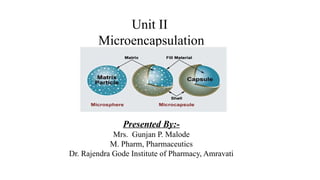
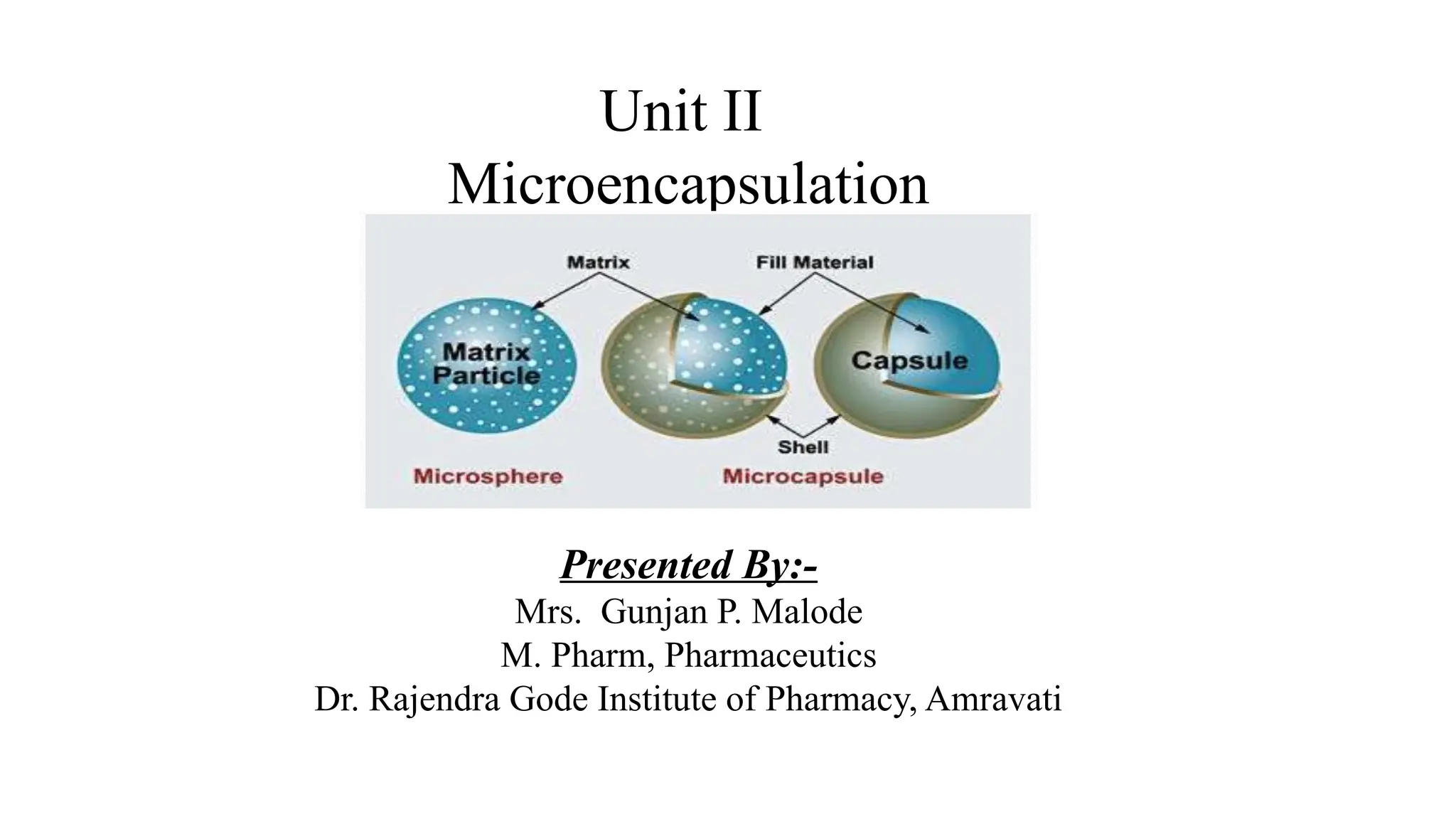
 The term “microcapsule” is defined, as a spherical particle with the size varying between 50 nm to 2
mm containing a core substance. Microspheres are in strict sense, spherically empty particles.
Reasons for microencapsulation:-
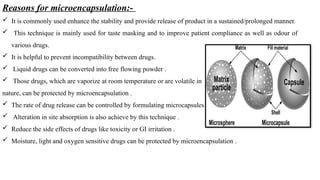
 It is commonly used enhance the stability and provide release of product in a sustained/prolonged manner.
 This technique is mainly used for taste masking and to improve patient compliance as well as odour of
various drugs.
 It is helpful to prevent incompatibility between drugs.
 Liquid drugs can be converted into free flowing powder .
 Those drugs, which are vaporize at room temperature or are volatile in
nature, can be protected by microencapsulation .
 The rate of drug release can be controlled by formulating microcapsules .
 Alteration in site absorption is also achieve by this technique .
 Reduce the side effects of drugs like toxicity or GI irritation .
 Moisture, light and oxygen sensitive drugs can be protected by microencapsulation .
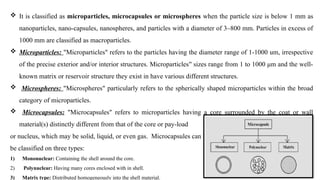
 It is classified as microparticles, microcapsules or microspheres when the particle size is below 1 mm as
nanoparticles, nano-capsules, nanospheres, and particles with a diameter of 3–800 mm. Particles in excess of
1000 mm are classified as macroparticles.
 Microparticles: "Microparticles" refers to the particles having the diameter range of 1-1000 um, irrespective
of the precise exterior and/or interior structures. Microparticles sizes range from 1 to 1000 μm and the well-
‟
known matrix or reservoir structure they exist in have various different structures.
 Microspheres: "Microspheres" particularly refers to the spherically shaped microparticles within the broad
category of microparticles.
 Microcapsules: "Microcapsules" refers to microparticles having a core surrounded by the coat or wall
material(s) distinctly different from that of the core or pay-load
or nucleus, which may be solid, liquid, or even gas. Microcapsules can
be classified on three types:
1) Mononuclear: Containing the shell around the core.
2) Polynuclear: Having many cores enclosed with in shell.
3) Matrix type: Distributed homogeneously into the shell material.
Advantages of microencapsulation:
i). Providing environmental protection to the encapsulated active agents or core materials.
ii). Liquids and gases can be changed into solid particles in the form of microcapsules.
ii). Surface as well as colloidal characteristics of various active agents can be changed.
iv). Modify and delayed drug release form different pharmaceutical dosage forms .
v). Formulation of sustained controlled release dosage forms can be done by modifying or
delaying release of encapsulated active agents or core materials.
Disadvantages of microencapsulation:
i). Expensive techniques.
ii). This causes reduction in shelf-life of hygroscopic agents.
iii). Microencapsulation coating may not be uniform and this can influence the release of
encapsulated materials
 Microencapsulation process is widely employed to modify and delayed drug release form different
pharmaceutical dosage forms. The materials enclosed or enveloped within the microcapsules are known as core
materials or pay-load materials or nucleus, and the enclosing materials are known as coating materials or wall
material or shell or membrane. There are two elements of microparticles or microcapsules, namely base layer
and cover or shield content. Core content requires an active ingredient when coating or securing the core
material is the paint or hell material. Different substances such as active drug additives, hormones, peptides,
reactive fats, meat products, pigments, paints, etc. may be embedded with various kinds of covering or shell
materials such as ethylcellulose (EC), (HPMC), (Na CMC), (PLGA), polyester, chitosan, etc
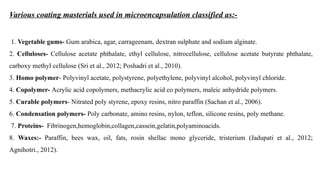
Various coating masterials used in microencapsulation classified as:-
1. Vegetable gums- Gum arabica, agar, carrageenam, dextran sulphate and sodium alginate.
2. Celluloses- Cellulose acetate phthalate, ethyl cellulose, nitrocellulose, cellulose acetate butyrate phthalate,
carboxy methyl cellulose (Sri et al., 2012; Poshadri et al., 2010).
3. Homo polymer- Polyvinyl acetate, polystyrene, polyethylene, polyvinyl alcohol, polyvinyl chloride.
4. Copolymer- Acrylic acid copolymers, methacrylic acid co polymers, maleic anhydride polymers.
5. Curable polymers- Nitrated poly styrene, epoxy resins, nitro paraffin (Sachan et al., 2006).
6. Condensation polymers- Poly carbonate, amino resins, nylon, teflon, silicone resins, poly methane.
7. Proteins- Fibrinogen,hemoglobin,collagen,cassein,gelatin,polyaminoacids.
8. Waxes:- Paraffin, bees wax, oil, fats, rosin shellac mono glyceride, tristerium (Jadupati et al., 2012;
Agnihotri., 2012).
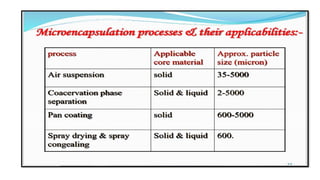
 Microencapsulation Techniques:-
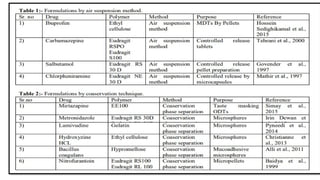
1. Air Suspension Technique (Fluidized Bed Coating)
2. Pan Coating
3. Spray Drying (Spray Congealing & Spray Cooling)
4. Coacervation ( Simple Coacervation & Complex Coacervation)
5. Ionotropic Gelation Technique
6. Solvent Evaporation (Simple Emulsion & Double Emulsion)
7. Polymerization
8. Multiorific Centrifugal Process
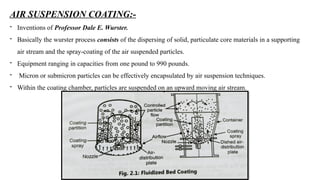
AIR SUSPENSION COATING:-
- Inventions of Professor Dale E. Wurster.
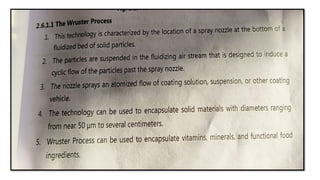
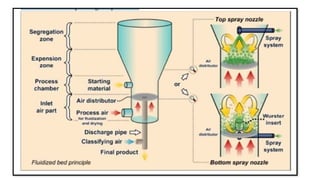
- Basically the wurster process consists of the dispersing of solid, particulate core materials in a supporting
air stream and the spray-coating of the air suspended particles.
- Equipment ranging in capacities from one pound to 990 pounds.
- Micron or submicron particles can be effectively encapsulated by air suspension techniques.
- Within the coating chamber, particles are suspended on an upward moving air stream.
Disadvantage- Agglomeration of the particles to some larger size is normally achieved.
Processing variables for efficient, effective encapsulation by air suspension techniques:
1.Density, surface area, melting point, solubility, friability, volatility, Crystallinity, and
flowability of core the core material.
2.Coating material concentration (or melting point if not a solution).
3.Coating material application rate.
4.Volume of air required to support and fluidizes the core material.
5.Amount of coating material required.
6.Inlet and outlet operating temperatures.
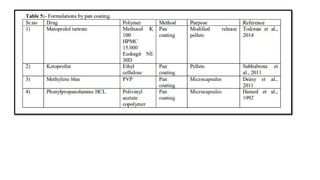
PAN COATING:-
 Oldest industrial procedures for forming small, coated particles or
tablets.
 The particles are tumbled in a pan or other device while the
coating material is applied slowly.
 Solid particles greater than 600 microns in size are generally considered
essential for effective coating.
 Medicaments are usually coated onto various spherical substrates such as nonpareil sugar seeds, and then coated with
protective layers of various polymers.
 It is used for preparation of controlled release beads.
 Coating is applied as solution by automized spray to desired solid core material in coating pan.
 Usually warm air is passed over the coated material as the coaing are being applied in the coating pan.
 Solid particles are mixed with a drying coating material.
 The temperature is raised so that the coating materials melts and encloses the core particles and then is solidified by
cooling.
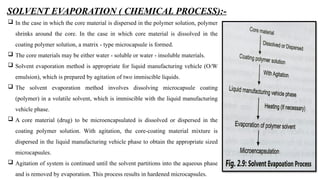
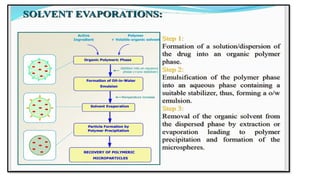
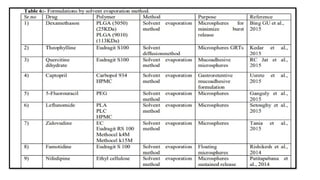
SOLVENT EVAPORATION ( CHEMICAL PROCESS):-
 In the case in which the core material is dispersed in the polymer solution, polymer
shrinks around the core. In the case in which core material is dissolved in the
coating polymer solution, a matrix - type microcapsule is formed.
 The core materials may be either water - soluble or water - insoluble materials.
 Solvent evaporation method is appropriate for liquid manufacturing vehicle (O/W
emulsion), which is prepared by agitation of two immiscible liquids.
 The solvent evaporation method involves dissolving microcapsule coating
(polymer) in a volatile solvent, which is immiscible with the liquid manufacturing
vehicle phase.
 A core material (drug) to be microencapsulated is dissolved or dispersed in the
coating polymer solution. With agitation, the core-coating material mixture is
dispersed in the liquid manufacturing vehicle phase to obtain the appropriate sized
microcapsules.
 Agitation of system is continued until the solvent partitions into the aqueous phase
and is removed by evaporation. This process results in hardened microcapsules.
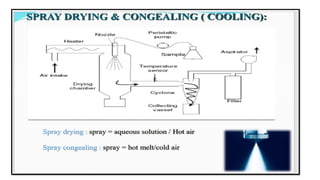
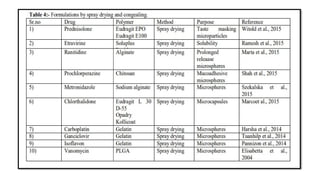
Spray Drying and Spray Congealing
• Spray drying and spray congealing methods of microencapsulation are almost similar in that both the
methods entail the dispersion of core material in a liquefied coating agent and spraying or introducing
the core coating mixture into some environmental condition, whereby relatively rapid solidification of
the coating is influenced.
• The basic difference in these two methods is the means by which coating solidification is
accomplished.
• In case of spray drying the coating solidification affected by rapid evaporation of solvent in which
coating material is dissolved whereas, in case of spray congealing method the coating solidification is
accomplished by thermally congealing a molten coating material or by introducing the core material
into a non solvent.
• Few examples of food ingredients which can be microencapsulated by spray drying are encapsulation
of flavors, lipids and cartenoids. One of the most important step in case of spray drying is the selection
of atomiser which put significant effect on size of distribution of final formulation having dried
 The coating solidification affected by rapid evaporating of solvent in which coating material is dissolved.
 Spray Congealing: The coating solidification is affected by thermally congealing a molten coating material.
 The removal of solvent is done by sorption, technique. or extraction evaporationIn modern spray dryers the
viscosity of the solutions to be sprayed can be as high as 300 mPa.
 Spray drying and spray congealing dispersing the core material in a liquefied coating substance and
spraying.
 Spray drying is affected by rapid evaporation of a solvent in which the coating material is dissolved.
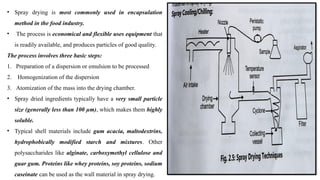
 The equipment components of a standard spray dryer include:
 an air heater
 main spray chamber
 atomizer
 blower or fan
 product collector
 Cyclone
 Microencapsulation by spray-drying is a low-cost commercial process which is mostly used for the
encapsulation of fragrances, oils and flavors.
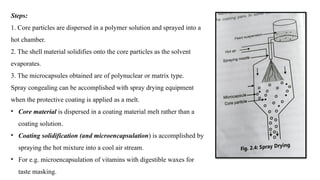
Steps:
1. Core particles are dispersed in a polymer solution and sprayed into a
hot chamber.
2. The shell material solidifies onto the core particles as the solvent
evaporates.
3. The microcapsules obtained are of polynuclear or matrix type.
Spray congealing can be accomplished with spray drying equipment
when the protective coating is applied as a melt.
• Core material is dispersed in a coating material melt rather than a
coating solution.
• Coating solidification (and microencapsulation) is accomplished by
spraying the hot mixture into a cool air stream.
• For e.g. microencapsulation of vitamins with digestible waxes for
taste masking.
• Spray drying is most commonly used in encapsulation
method in the food industry.
• The process is economical and flexible uses equipment that
is readily available, and produces particles of good quality.
The process involves three basic steps:
1. Preparation of a dispersion or emulsion to be processed
2. Homogenization of the dispersion
3. Atomization of the mass into the drying chamber.
• Spray dried ingredients typically have a very small particle
size (generally less than 100 µm), which makes them highly
soluble.
• Typical shell materials include gum acacia, maltodextrins,
hydrophobically modified starch and mixtures. Other
polysaccharides like alginate, carboxymethyl cellulose and
guar gum. Proteins like whey proteins, soy proteins, sodium
caseinate can be used as the wall material in spray drying.
 Spray cooling/chilling is the least expensive encapsulation technology.
 It is used for the encapsulation of organic and inorganic salts, textural ingredients,
enzymes, flavors and other ingredients.
 It improves heat stability, delay release in wet environments, and/or convert liquid
hydrophilic ingredient into free-flowing powders.
 Spray cooling/chilling is typically referred to as 'matrix' encapsulation because the
particles are more adequately described as aggregates of active ingredient particles
buried in the fat matrix.
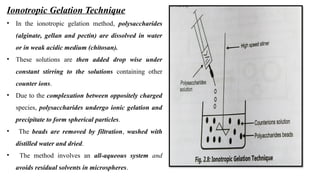
Ionotropic Gelation Technique
• In the ionotropic gelation method, polysaccharides
(alginate, gellan and pectin) are dissolved in water
or in weak acidic medium (chitosan).
• These solutions are then added drop wise under
constant stirring to the solutions containing other
counter ions.
• Due to the complexation between oppositely charged
species, polysaccharides undergo ionic gelation and
precipitate to form spherical particles.
• The beads are removed by filtration, washed with
distilled water and dried.
• The method involves an all-aqueous system and
avoids residual solvents in microspheres.
Schematic Representation of Preparation of Polysaccharides Particles by Ionic Gelation
Method
 Counter ions used for ionotropic gelation can be divided in two major categories:
 The Low molecular weight counter ions (e.g. CaCl2, BaCl2, MgCl2, CuCl2, ZnCl2,
CoCl2, pyrophosphate, tripolyphosphate, tetrapolyphosphate, octapolyphosphate,
hexameta- phosphate and [Fe (CN)6]-4/ [Fe(CN)6]-3).
 High molecular weight ions (e.g. Octyl sulphate, lauryl sulphate, hexadecyl sulphate,
cetylstearyl sulphate).
 The ionotropic gelation method is very simple and mild. In addition, reversible physical
crosslinking by electrostatic interaction instead of chemical crosslinking avoids the
possible toxicity of reagents and other undesirable effects.
Coacervation
 Coacervation microencapsulation is the phase separation of one or many hydrocolloids from the initial
solution and the subsequent deposition of the newly formed coacervate phase around the active ingredient
suspended or emulsified in the same reaction media.
 Coacervation is a unique microencapsulation technology because of the very high pay loads achievable up to
99% and the controlled release possibilities based on mechanical stress, temperature or sustained release.
 Coacervation is typically used to encapsulate flavor oil and can also be adapted for the encapsulation of fish
oils, nutrients, vitamins, preservatives and enzymes.
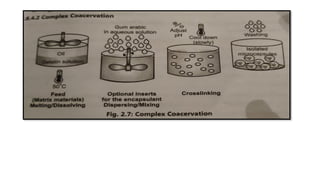
 There are two methods for coacervation are available, namely simple and complex processes. The mechanism
of microcapsule formation for both processes is identical, except for the way in which the phase separation is
carried out.
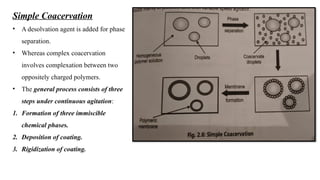
Simple Coacervation
• A desolvation agent is added for phase
separation.
• Whereas complex coacervation
involves complexation between two
oppositely charged polymers.
• The general process consists of three
steps under continuous agitation:
1. Formation of three immiscible
chemical phases.
2. Deposition of coating.
3. Rigidization of coating.
Step 1:
Three immiscible phases are as:
(a) Liquid manufacturing vehicle phase.
(b) Core material phase.
(c) Coating material phase.
Coating material phase formed by utilizing
following methods:
(d) Temperature change.
(e) By addition of incompatible polymer.
(f) By non-solvent addition.
(g) By salt addition.
(h) Polymer-polymer interaction.
Step 2:
In step 2, the deposition of the liquid polymer around the
interface formed between the core material and the liquid
vehicle phase. In many cases physical or chemical
changes in the coating polymer solution can be induced
so that phase separation of the polymer will occur. Finally
the prepared microcapsules are stabilized by crosslinking,
desolvation or thermal treatment. Equipment required for
microencapsulation; this method is relatively simple; it
consists mainly of jacketed tank with variable speed
agitator.
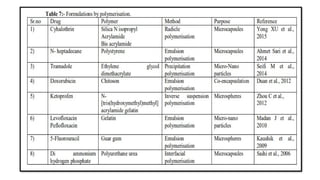
Polymerization
• A relatively new microencapsulation method utilizes polymerization techniques to fromprotective microcapsule
coatings in situ.
• The method involves the reaction of monomeric unit located at the interface existingbetween a core material
substance and continuous phase in which the core material is disperse.
• The core material supporting phase is usually a liquid or gas, and therefore polymerization reaction occurs at
liquid-liquid, liquid-gas, solid-liquid, or solid-gas interface.
• For e.g. in the formation of polyamide (Nylon) polymeric reaction occurring at liquid- liquid interface existing
between aliphatic diamine and dicarboxylic acid halide.
1. Interfacial polymer: In Interfacial polymerization, the two reactants in a polycondensation meet at an interface
and react rapidly.
2. In-situ polymerization: In a few microencapsulation processes, the direct polymerization of a single monomer
is carried out on the particle surface. For e.g. Cellulose fibers are encapsulated in polyethylene while immersed
in dry toluene. Usual deposition rates are about 0.5µm/min. Coating thickness ranges 0.2-75 μm.
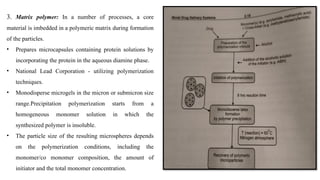
3. Matrix polymer: In a number of processes, a core
material is imbedded in a polymeric matrix during formation
of the particles.
• Prepares microcapsules containing protein solutions by
incorporating the protein in the aqueous diamine phase.
• National Lead Corporation - utilizing polymerization
techniques.
• Monodisperse microgels in the micron or submicron size
range.Precipitation polymerization starts from a
homogeneous monomer solution in which the
synthesized polymer is insoluble.
• The particle size of the resulting microspheres depends
on the polymerization conditions, including the
monomer/co monomer composition, the amount of
initiator and the total monomer concentration.
Multiorific – Centrifugal Process
• The Southwest Research Institute (SWRI) has developed a mechanical process for producing
microcapsules that utilizes.
• Centrifugal forces to hurl a core material particle through an enveloping microencapsulation membrane
thereby effecting mechanical microencapsulation.
• Processing variables include;
 The rotational speed of the cylinder,
 The flow rate of the core and coating materials,
 The concentration and viscosity and surface tension of the core material.
• The multiorifice-centrifugal process is capable for microencapsulating liquids and solids of varied size
ranges, with diverse coating materials.
• The encapsulated product can be supplied as slurry in the hardening media or as a dry powder.
• Production rates of 50 to 75 pounds per our have been achieved with the process.
Different applications of microencapsulation are:
 Microencapsulation can be used to formulate various sustained controlled release dosage forms by
modifying or delaying release of encapsulated active agents or core materials.
 Microencapsulation can also be employed to formulate enteric-coated dosage forms, so that the
drugs will be selectively absorbed in the intestine rather than the stomach.
 Gastric irritant drugs are being microencapsulated to reduce the chances of gastric irritation.
 The taste of bitter drug candidates can be masked by employing microencapsulation techniques.
 Through microencapsulation, liquids and gases can be changed into solid particles in the form of
microcapsules.
 Microencapsulation can employed to aid in the addition of oily medicines to tableted dosage forms
to overcome the problems of tacky granulations and in direct compression.
 Microencapsulation can be used to decrease the volatility. A microencapsulated volatile substance
can be stored for longer times without any substantial evaporation.
 Microencapsulation provides environmental protection to the encapsulated active agents from
various environmental issues, such as light, heat, humidity, oxidation, etc.
 The hygroscopic characteristics of many core materials can be reduced by
microencapsulation.
 The separations of incompatible substances can be achieved by microencapsulation. For
example, pharmaceutical eutectics can be separated by microencapsulation. This is a case
where direct contact of materials brings about liquid formation. The stability enhancement of
incompatible aspirin-chlorpheniramine maleate mixture is accomplished by
microencapsulating both of them before mixing.
 Microencapsulation is used to lessen the potential danger of toxic substance handling. The
toxicity owing to handling of herbicides, insecticides. pesticides and fumigants, etc., can be
usefully lessened after microencapsulation.
General Application
1. Cell immobilization: In plant cell cultures, Human tissue is turned into bio-artificial organs, in continuous
fermentation processes.
2. Beverage production
3. Protection of molecules from other compounds:
4. Quality and safety in food, agricultural and environmental sectors.
5. Soil inoculation.
6. In textiles: means of imparting finishes.
7. Protection of liquid crystals
8. 8. Most flavoring is volatile; therefore encapsulation of these components extends the shelflife of products by
retaining within the food flavours that would otherwise evaporate out and be lost.
Radioactive microsphere’s application
9. Can be used for radioembolisation of liver and spleen tumours.
10. Used for radiosynvectomy of arthiritis joint, local radiotherapy, interactivity treatement
Controlled Release and Sustained Release Dosage Forms
1. To mask the bitter taste of drugs like Paracetamol, Nitrofurantoin etc.
2. To reduce gastric and other gastro intestinal (G.I) tract irritations, e.g., sustained release Aspirin
preparations have been reported to cause significantly less G.I. bleeding than conventional preparations.
3. A liquid can be converted to a pseudo-solid for easy handling and storage e.g. eprazinone.
4. Hygroscopic properties of core materials may be reduced by microencapsulation e.g., Sodium chloride.
5. Carbon tetrachloride and a number of other substances have been microencapsulated to reduce their odor
and volatility.
6. Microencapsulation has been employed to provide protection to the core materials against atmospheric
effects, e.g., Vitamin-A Palmitate.
7. Separation of incompatible substance has been achieved by encapsulation
• Cosmetics :
• For cosmetic applications, organic acids are usually good solvents; chitin and chitosan have fungicidal and fungistatic
properties.
• Chitosan is the only natural cationic gum that becomes viscous on being neutralized with acid.
• These materials are used in creams, lotions and permanent waving lotions and several derivatives have also been
reported as nail lacquers.
• Photography:
• Chitosan has important applications in photography due to its resistance to abrasion, its optical characteristics, and film
forming ability.
• Silver complexes are not appreciably retained by chitosan and therefore can easily be penetrated from one layer to
another of a film by diffusion.
Unit II  Microencapsulation Presented By:- Mrs.  Gunjan P. Malode Assistant Professor

Unit II Microencapsulation Presented By:- Mrs. Gunjan P. Malode Assistant Professor

  • 1.
    Unit II Microencapsulation Presented By:- Mrs.Gunjan P. Malode M. Pharm, Pharmaceutics Dr. Rajendra Gode Institute of Pharmacy, Amravati
  • 2.
    Introduction:_  The firstresearch leading to the development of microencapsulation procedures for the Pharmaceuticals was published by Bungen burg de Jong and Kan in 1931 and dealt with the preparation of gelatine spheres and the use of a gelatine Coacervation process.  Definition:- MICROENCAPSULATION is a process by which very tiny droplets or particles of liquid or solid material are surrounded or coated with a continuous film of polymeric material. The product obtained by this process is called as Microcapsules.  Microencapsulation is defined as a process of enclosing or enveloping solids, liquids or even gases within second material with a continuous coating of polymeric materials yielding microscopic particles (ranging from less than 1 micron to several hundred microns in size).  In this process, small discrete solid particles or small liquid droplets and dispersions are surrounded and enclosed by applying thin coating for the purposes of providing environmental protection and controlling the release characteristics or availability of coated active ingredients.
  • 3.
     Microencapsulation isa technique in which one or more substances (e.g. a core substance, an active material or a separate phase in a mixture) are surrounded or immobilized by one or more materials (e.g. a shell, polymer matrix, support or wall material) and protected from biotic and abiotic factors.  Common coating materials are water soluble/insoluble resins, waxes, and lipids. Microencapsulation techniques include air suspension, coacervation, spray drying, pan coating, solvent evaporation, and polymerization. The drug release kinetics depend on factors like coating thickness, porosity and permeability.  Modern microencapsulation techniques are employed to protect active molecules or substances such as vitamins, pigments, antimicrobials, and flavorings, among others, from the environment.  The encapsulation efficiency of the microparticle or microsphere or microcapsule depends upon different factors like concentration of the polymer, solubility of polymer in solvent, rate of solvent removal, solubility of organic solvent in water, etc.  The term “microcapsule” is defined, as a spherical particle with the size varying between 50 nm to 2 mm containing a core substance. Microspheres are in strict sense, spherically empty particles.
  • 4.
    Reasons for microencapsulation:- It is commonly used enhance the stability and provide release of product in a sustained/prolonged manner.  This technique is mainly used for taste masking and to improve patient compliance as well as odour of various drugs.  It is helpful to prevent incompatibility between drugs.  Liquid drugs can be converted into free flowing powder .  Those drugs, which are vaporize at room temperature or are volatile in nature, can be protected by microencapsulation .  The rate of drug release can be controlled by formulating microcapsules .  Alteration in site absorption is also achieve by this technique .  Reduce the side effects of drugs like toxicity or GI irritation .  Moisture, light and oxygen sensitive drugs can be protected by microencapsulation .
  • 5.
     It isclassified as microparticles, microcapsules or microspheres when the particle size is below 1 mm as nanoparticles, nano-capsules, nanospheres, and particles with a diameter of 3–800 mm. Particles in excess of 1000 mm are classified as macroparticles.  Microparticles: "Microparticles" refers to the particles having the diameter range of 1-1000 um, irrespective of the precise exterior and/or interior structures. Microparticles sizes range from 1 to 1000 μm and the well- ‟ known matrix or reservoir structure they exist in have various different structures.  Microspheres: "Microspheres" particularly refers to the spherically shaped microparticles within the broad category of microparticles.  Microcapsules: "Microcapsules" refers to microparticles having a core surrounded by the coat or wall material(s) distinctly different from that of the core or pay-load or nucleus, which may be solid, liquid, or even gas. Microcapsules can be classified on three types: 1) Mononuclear: Containing the shell around the core. 2) Polynuclear: Having many cores enclosed with in shell. 3) Matrix type: Distributed homogeneously into the shell material.
  • 6.
    Advantages of microencapsulation: i).Providing environmental protection to the encapsulated active agents or core materials. ii). Liquids and gases can be changed into solid particles in the form of microcapsules. ii). Surface as well as colloidal characteristics of various active agents can be changed. iv). Modify and delayed drug release form different pharmaceutical dosage forms . v). Formulation of sustained controlled release dosage forms can be done by modifying or delaying release of encapsulated active agents or core materials. Disadvantages of microencapsulation: i). Expensive techniques. ii). This causes reduction in shelf-life of hygroscopic agents. iii). Microencapsulation coating may not be uniform and this can influence the release of encapsulated materials
  • 7.
     Microencapsulation processis widely employed to modify and delayed drug release form different pharmaceutical dosage forms. The materials enclosed or enveloped within the microcapsules are known as core materials or pay-load materials or nucleus, and the enclosing materials are known as coating materials or wall material or shell or membrane. There are two elements of microparticles or microcapsules, namely base layer and cover or shield content. Core content requires an active ingredient when coating or securing the core material is the paint or hell material. Different substances such as active drug additives, hormones, peptides, reactive fats, meat products, pigments, paints, etc. may be embedded with various kinds of covering or shell materials such as ethylcellulose (EC), (HPMC), (Na CMC), (PLGA), polyester, chitosan, etc
  • 8.
    Various coating masterialsused in microencapsulation classified as:- 1. Vegetable gums- Gum arabica, agar, carrageenam, dextran sulphate and sodium alginate. 2. Celluloses- Cellulose acetate phthalate, ethyl cellulose, nitrocellulose, cellulose acetate butyrate phthalate, carboxy methyl cellulose (Sri et al., 2012; Poshadri et al., 2010). 3. Homo polymer- Polyvinyl acetate, polystyrene, polyethylene, polyvinyl alcohol, polyvinyl chloride. 4. Copolymer- Acrylic acid copolymers, methacrylic acid co polymers, maleic anhydride polymers. 5. Curable polymers- Nitrated poly styrene, epoxy resins, nitro paraffin (Sachan et al., 2006). 6. Condensation polymers- Poly carbonate, amino resins, nylon, teflon, silicone resins, poly methane. 7. Proteins- Fibrinogen,hemoglobin,collagen,cassein,gelatin,polyaminoacids. 8. Waxes:- Paraffin, bees wax, oil, fats, rosin shellac mono glyceride, tristerium (Jadupati et al., 2012; Agnihotri., 2012).
  • 9.
     Microencapsulation Techniques:- 1.Air Suspension Technique (Fluidized Bed Coating) 2. Pan Coating 3. Spray Drying (Spray Congealing & Spray Cooling) 4. Coacervation ( Simple Coacervation & Complex Coacervation) 5. Ionotropic Gelation Technique 6. Solvent Evaporation (Simple Emulsion & Double Emulsion) 7. Polymerization 8. Multiorific Centrifugal Process
  • 10.
    AIR SUSPENSION COATING:- -Inventions of Professor Dale E. Wurster. - Basically the wurster process consists of the dispersing of solid, particulate core materials in a supporting air stream and the spray-coating of the air suspended particles. - Equipment ranging in capacities from one pound to 990 pounds. - Micron or submicron particles can be effectively encapsulated by air suspension techniques. - Within the coating chamber, particles are suspended on an upward moving air stream.
  • 14.
    Disadvantage- Agglomeration ofthe particles to some larger size is normally achieved. Processing variables for efficient, effective encapsulation by air suspension techniques: 1.Density, surface area, melting point, solubility, friability, volatility, Crystallinity, and flowability of core the core material. 2.Coating material concentration (or melting point if not a solution). 3.Coating material application rate. 4.Volume of air required to support and fluidizes the core material. 5.Amount of coating material required. 6.Inlet and outlet operating temperatures.
  • 15.
    PAN COATING:-  Oldestindustrial procedures for forming small, coated particles or tablets.  The particles are tumbled in a pan or other device while the coating material is applied slowly.  Solid particles greater than 600 microns in size are generally considered essential for effective coating.  Medicaments are usually coated onto various spherical substrates such as nonpareil sugar seeds, and then coated with protective layers of various polymers.  It is used for preparation of controlled release beads.  Coating is applied as solution by automized spray to desired solid core material in coating pan.  Usually warm air is passed over the coated material as the coaing are being applied in the coating pan.  Solid particles are mixed with a drying coating material.  The temperature is raised so that the coating materials melts and encloses the core particles and then is solidified by cooling.
  • 16.
    SOLVENT EVAPORATION (CHEMICAL PROCESS):-  In the case in which the core material is dispersed in the polymer solution, polymer shrinks around the core. In the case in which core material is dissolved in the coating polymer solution, a matrix - type microcapsule is formed.  The core materials may be either water - soluble or water - insoluble materials.  Solvent evaporation method is appropriate for liquid manufacturing vehicle (O/W emulsion), which is prepared by agitation of two immiscible liquids.  The solvent evaporation method involves dissolving microcapsule coating (polymer) in a volatile solvent, which is immiscible with the liquid manufacturing vehicle phase.  A core material (drug) to be microencapsulated is dissolved or dispersed in the coating polymer solution. With agitation, the core-coating material mixture is dispersed in the liquid manufacturing vehicle phase to obtain the appropriate sized microcapsules.  Agitation of system is continued until the solvent partitions into the aqueous phase and is removed by evaporation. This process results in hardened microcapsules.
  • 18.
    Spray Drying andSpray Congealing • Spray drying and spray congealing methods of microencapsulation are almost similar in that both the methods entail the dispersion of core material in a liquefied coating agent and spraying or introducing the core coating mixture into some environmental condition, whereby relatively rapid solidification of the coating is influenced. • The basic difference in these two methods is the means by which coating solidification is accomplished. • In case of spray drying the coating solidification affected by rapid evaporation of solvent in which coating material is dissolved whereas, in case of spray congealing method the coating solidification is accomplished by thermally congealing a molten coating material or by introducing the core material into a non solvent. • Few examples of food ingredients which can be microencapsulated by spray drying are encapsulation of flavors, lipids and cartenoids. One of the most important step in case of spray drying is the selection of atomiser which put significant effect on size of distribution of final formulation having dried
  • 19.
     The coatingsolidification affected by rapid evaporating of solvent in which coating material is dissolved.  Spray Congealing: The coating solidification is affected by thermally congealing a molten coating material.  The removal of solvent is done by sorption, technique. or extraction evaporationIn modern spray dryers the viscosity of the solutions to be sprayed can be as high as 300 mPa.  Spray drying and spray congealing dispersing the core material in a liquefied coating substance and spraying.  Spray drying is affected by rapid evaporation of a solvent in which the coating material is dissolved.  The equipment components of a standard spray dryer include:  an air heater  main spray chamber  atomizer  blower or fan  product collector  Cyclone  Microencapsulation by spray-drying is a low-cost commercial process which is mostly used for the encapsulation of fragrances, oils and flavors.
  • 20.
    Steps: 1. Core particlesare dispersed in a polymer solution and sprayed into a hot chamber. 2. The shell material solidifies onto the core particles as the solvent evaporates. 3. The microcapsules obtained are of polynuclear or matrix type. Spray congealing can be accomplished with spray drying equipment when the protective coating is applied as a melt. • Core material is dispersed in a coating material melt rather than a coating solution. • Coating solidification (and microencapsulation) is accomplished by spraying the hot mixture into a cool air stream. • For e.g. microencapsulation of vitamins with digestible waxes for taste masking.
  • 21.
    • Spray dryingis most commonly used in encapsulation method in the food industry. • The process is economical and flexible uses equipment that is readily available, and produces particles of good quality. The process involves three basic steps: 1. Preparation of a dispersion or emulsion to be processed 2. Homogenization of the dispersion 3. Atomization of the mass into the drying chamber. • Spray dried ingredients typically have a very small particle size (generally less than 100 µm), which makes them highly soluble. • Typical shell materials include gum acacia, maltodextrins, hydrophobically modified starch and mixtures. Other polysaccharides like alginate, carboxymethyl cellulose and guar gum. Proteins like whey proteins, soy proteins, sodium caseinate can be used as the wall material in spray drying.
  • 23.
     Spray cooling/chillingis the least expensive encapsulation technology.  It is used for the encapsulation of organic and inorganic salts, textural ingredients, enzymes, flavors and other ingredients.  It improves heat stability, delay release in wet environments, and/or convert liquid hydrophilic ingredient into free-flowing powders.  Spray cooling/chilling is typically referred to as 'matrix' encapsulation because the particles are more adequately described as aggregates of active ingredient particles buried in the fat matrix.
  • 25.
    Ionotropic Gelation Technique •In the ionotropic gelation method, polysaccharides (alginate, gellan and pectin) are dissolved in water or in weak acidic medium (chitosan). • These solutions are then added drop wise under constant stirring to the solutions containing other counter ions. • Due to the complexation between oppositely charged species, polysaccharides undergo ionic gelation and precipitate to form spherical particles. • The beads are removed by filtration, washed with distilled water and dried. • The method involves an all-aqueous system and avoids residual solvents in microspheres.
  • 26.
    Schematic Representation ofPreparation of Polysaccharides Particles by Ionic Gelation Method  Counter ions used for ionotropic gelation can be divided in two major categories:  The Low molecular weight counter ions (e.g. CaCl2, BaCl2, MgCl2, CuCl2, ZnCl2, CoCl2, pyrophosphate, tripolyphosphate, tetrapolyphosphate, octapolyphosphate, hexameta- phosphate and [Fe (CN)6]-4/ [Fe(CN)6]-3).  High molecular weight ions (e.g. Octyl sulphate, lauryl sulphate, hexadecyl sulphate, cetylstearyl sulphate).  The ionotropic gelation method is very simple and mild. In addition, reversible physical crosslinking by electrostatic interaction instead of chemical crosslinking avoids the possible toxicity of reagents and other undesirable effects.
  • 27.
    Coacervation  Coacervation microencapsulationis the phase separation of one or many hydrocolloids from the initial solution and the subsequent deposition of the newly formed coacervate phase around the active ingredient suspended or emulsified in the same reaction media.  Coacervation is a unique microencapsulation technology because of the very high pay loads achievable up to 99% and the controlled release possibilities based on mechanical stress, temperature or sustained release.  Coacervation is typically used to encapsulate flavor oil and can also be adapted for the encapsulation of fish oils, nutrients, vitamins, preservatives and enzymes.  There are two methods for coacervation are available, namely simple and complex processes. The mechanism of microcapsule formation for both processes is identical, except for the way in which the phase separation is carried out.
  • 28.
    Simple Coacervation • Adesolvation agent is added for phase separation. • Whereas complex coacervation involves complexation between two oppositely charged polymers. • The general process consists of three steps under continuous agitation: 1. Formation of three immiscible chemical phases. 2. Deposition of coating. 3. Rigidization of coating.
  • 29.
    Step 1: Three immisciblephases are as: (a) Liquid manufacturing vehicle phase. (b) Core material phase. (c) Coating material phase. Coating material phase formed by utilizing following methods: (d) Temperature change. (e) By addition of incompatible polymer. (f) By non-solvent addition. (g) By salt addition. (h) Polymer-polymer interaction. Step 2: In step 2, the deposition of the liquid polymer around the interface formed between the core material and the liquid vehicle phase. In many cases physical or chemical changes in the coating polymer solution can be induced so that phase separation of the polymer will occur. Finally the prepared microcapsules are stabilized by crosslinking, desolvation or thermal treatment. Equipment required for microencapsulation; this method is relatively simple; it consists mainly of jacketed tank with variable speed agitator.
  • 31.
    Polymerization • A relativelynew microencapsulation method utilizes polymerization techniques to fromprotective microcapsule coatings in situ. • The method involves the reaction of monomeric unit located at the interface existingbetween a core material substance and continuous phase in which the core material is disperse. • The core material supporting phase is usually a liquid or gas, and therefore polymerization reaction occurs at liquid-liquid, liquid-gas, solid-liquid, or solid-gas interface. • For e.g. in the formation of polyamide (Nylon) polymeric reaction occurring at liquid- liquid interface existing between aliphatic diamine and dicarboxylic acid halide. 1. Interfacial polymer: In Interfacial polymerization, the two reactants in a polycondensation meet at an interface and react rapidly. 2. In-situ polymerization: In a few microencapsulation processes, the direct polymerization of a single monomer is carried out on the particle surface. For e.g. Cellulose fibers are encapsulated in polyethylene while immersed in dry toluene. Usual deposition rates are about 0.5µm/min. Coating thickness ranges 0.2-75 μm.
  • 32.
    3. Matrix polymer:In a number of processes, a core material is imbedded in a polymeric matrix during formation of the particles. • Prepares microcapsules containing protein solutions by incorporating the protein in the aqueous diamine phase. • National Lead Corporation - utilizing polymerization techniques. • Monodisperse microgels in the micron or submicron size range.Precipitation polymerization starts from a homogeneous monomer solution in which the synthesized polymer is insoluble. • The particle size of the resulting microspheres depends on the polymerization conditions, including the monomer/co monomer composition, the amount of initiator and the total monomer concentration.
  • 33.
    Multiorific – CentrifugalProcess • The Southwest Research Institute (SWRI) has developed a mechanical process for producing microcapsules that utilizes. • Centrifugal forces to hurl a core material particle through an enveloping microencapsulation membrane thereby effecting mechanical microencapsulation. • Processing variables include;  The rotational speed of the cylinder,  The flow rate of the core and coating materials,  The concentration and viscosity and surface tension of the core material. • The multiorifice-centrifugal process is capable for microencapsulating liquids and solids of varied size ranges, with diverse coating materials. • The encapsulated product can be supplied as slurry in the hardening media or as a dry powder. • Production rates of 50 to 75 pounds per our have been achieved with the process.
  • 34.
    Different applications ofmicroencapsulation are:  Microencapsulation can be used to formulate various sustained controlled release dosage forms by modifying or delaying release of encapsulated active agents or core materials.  Microencapsulation can also be employed to formulate enteric-coated dosage forms, so that the drugs will be selectively absorbed in the intestine rather than the stomach.  Gastric irritant drugs are being microencapsulated to reduce the chances of gastric irritation.  The taste of bitter drug candidates can be masked by employing microencapsulation techniques.  Through microencapsulation, liquids and gases can be changed into solid particles in the form of microcapsules.  Microencapsulation can employed to aid in the addition of oily medicines to tableted dosage forms to overcome the problems of tacky granulations and in direct compression.  Microencapsulation can be used to decrease the volatility. A microencapsulated volatile substance can be stored for longer times without any substantial evaporation.
  • 35.
     Microencapsulation providesenvironmental protection to the encapsulated active agents from various environmental issues, such as light, heat, humidity, oxidation, etc.  The hygroscopic characteristics of many core materials can be reduced by microencapsulation.  The separations of incompatible substances can be achieved by microencapsulation. For example, pharmaceutical eutectics can be separated by microencapsulation. This is a case where direct contact of materials brings about liquid formation. The stability enhancement of incompatible aspirin-chlorpheniramine maleate mixture is accomplished by microencapsulating both of them before mixing.  Microencapsulation is used to lessen the potential danger of toxic substance handling. The toxicity owing to handling of herbicides, insecticides. pesticides and fumigants, etc., can be usefully lessened after microencapsulation.
  • 36.
    General Application 1. Cellimmobilization: In plant cell cultures, Human tissue is turned into bio-artificial organs, in continuous fermentation processes. 2. Beverage production 3. Protection of molecules from other compounds: 4. Quality and safety in food, agricultural and environmental sectors. 5. Soil inoculation. 6. In textiles: means of imparting finishes. 7. Protection of liquid crystals 8. 8. Most flavoring is volatile; therefore encapsulation of these components extends the shelflife of products by retaining within the food flavours that would otherwise evaporate out and be lost. Radioactive microsphere’s application 9. Can be used for radioembolisation of liver and spleen tumours. 10. Used for radiosynvectomy of arthiritis joint, local radiotherapy, interactivity treatement
  • 37.
    Controlled Release andSustained Release Dosage Forms 1. To mask the bitter taste of drugs like Paracetamol, Nitrofurantoin etc. 2. To reduce gastric and other gastro intestinal (G.I) tract irritations, e.g., sustained release Aspirin preparations have been reported to cause significantly less G.I. bleeding than conventional preparations. 3. A liquid can be converted to a pseudo-solid for easy handling and storage e.g. eprazinone. 4. Hygroscopic properties of core materials may be reduced by microencapsulation e.g., Sodium chloride. 5. Carbon tetrachloride and a number of other substances have been microencapsulated to reduce their odor and volatility. 6. Microencapsulation has been employed to provide protection to the core materials against atmospheric effects, e.g., Vitamin-A Palmitate. 7. Separation of incompatible substance has been achieved by encapsulation
  • 38.
    • Cosmetics : •For cosmetic applications, organic acids are usually good solvents; chitin and chitosan have fungicidal and fungistatic properties. • Chitosan is the only natural cationic gum that becomes viscous on being neutralized with acid. • These materials are used in creams, lotions and permanent waving lotions and several derivatives have also been reported as nail lacquers. • Photography: • Chitosan has important applications in photography due to its resistance to abrasion, its optical characteristics, and film forming ability. • Silver complexes are not appreciably retained by chitosan and therefore can easily be penetrated from one layer to another of a film by diffusion.