Topic- Microencapsulation
Presented by
Hariom Jaiswal
Asst. Pro. B.PH 4th
Year/ 7th
Sam
NDDS
Rajiv Gandhi College of Pharmacy Nautanwa, Maharajganj
UP 273164
CONTENTS
 Introduction of micro encapsulation
Core material and coating material
 Need of micro encapsulation
 Advantages and disadvantages of microencapsulation
 Termaology and definition
 Method of preparation microencapsulation
 Application of micro encapsulation
INTRODUCTION OF MICROENCAPSULATION
"Microencapsulation may be defined as the process of
surrounding or enveloping one substance within
another substance on a very small scale, yielding
capsules ranging from less than one micron to several
hundred microns in size"
"It is define has an substance or pharmaceutical
material is encapsulated over the surface of solid
droplet of liquid and dispersion of medium is known
has microencapsulation"
It is mean of applying thin coating to small particle of
solid or droplet of liquid & dispersion.
Particle size: 1-1000 micron.
 2 phases:
a. Core Material
b. Coating Material
Also known as microcapsule, microsphere, coated granules, pellets
CORE & COATING MATERIALS
1. CORE MATERIALS: The core material is the specific material to be coated. It can be liquid or
solid in nature.
E.g., acetaminophen, activated charcoal, aspirin, urease, potassium chloride, vitamin palmitate
etc.
2. COATING MATERIALS: Selection of coating materials decides the physical & chemical
properties of the resultant microcapsule/microsphere.
E.g.,
a. Water soluble resins: gelatine, starch, polyvinyl alcohol, polyacrylic acid, hydroxy
methylcellulose etc.
b. Water Insoluble resins:- ethyl cellulose, polyethylene, polymethacrylate, cellulose nitrate etc.
c. Waxes & lipids:- Paraffin, stearic acid, stearyl alcohol etc.
d. Enteric Resins:- Shellac, cellulose acetate phthalate (CAP), zein etc.
NEED OF MICROENCAPSULATION
1. To protect reactive substances from the environment.
2. To convert liquid active components into a dry solid system.
3. To separate incompatible components for functional reasons
4. To protect the immediate environment of the microcapsules from the active
components.
5. Isolation of core from its surroundings, as in isolating vitamins from the deteriorating
effects of oxygen.
6. Retarding evaporation of a volatile core.
7. Improving the handling properties of a sticky material.
8. Isolating a reactive core from chemical attack.
9. For safe handling of the toxic materials.
10. To get targeted release of the drug.
11. To control release of the active components for delayed (timed)
release or long-acting (sustained) release.
12. The problem may be as simple as masking the taste or odor of the
core.
13. To Increase of bioavailability.
14. To produce a targeted drug delivery.
15. Protects the GIT from irritant effects of the drug.
16. Extension of duration of activity for an equal level of active agent.
ADVANTAGES & DISADVANTAGES
MICROENCAPSULATION
Advantages
1. To Increase of bioavailability.
2. To produce a targeted drug delivery
3. To provide environmental protection of the core material from moisture, light, and
oxygen.
4. It enhances the solubility of poorly soluble drugs and the safe handling of toxic
medications.
5. It Masks the taste of bitter drugs to make them more palatable and improving
patient compliance.
6. To decrease evaporation rate of the core material. (Reduction of volatility)
Disadvantages
1. The cost of the materials used and the formulation process might be
higher than standard formulations.
2. Reproducibility is less
3. The effect of the polymer matrix, polymer additives, and their degradation
products on the environment in response to heat, hydrolysis, or biological
agents vary significantly.
4. The core particle's stability is affected by the change in the process
conditions like change in temperature, pH, solvent addition, or
evaporation of the solvent
TERMINOLOGY AND DEFINITION OF
MICROENCAPSULATION
1. Microparticles: Microparticles are tiny solid particles (size usually 1-1000 µm) made of natural
or synthetic polymers that can encapsulate a drug. They act as carriers to control how and when
the drug is released in the body.
2. Microspheres: Microspheres are solid spherical particles made up of polymer substances, in
which the drug is dispersed through out the microsphere matrix, its size ranges from 1-1000μm.
3. Microcapsules: Microcapsules are small particles that contain drug or core material surrounded
by a shell or coating of polymer.
Microcapsules can be classified on three types
a. Mononuclear: Containing the shell around the core.
b. Polynuclear: Having many cores enclosed with in shell.
c. Matrix type: Distributed homogeneously into the shell material.
METHOD OF PREPARATION MICROENCAPSULTION
 There are two type of preparation of microencapsulation.
1. Physical Method:
a. Air suspension
b. Coacervation phase Separation
c. Pan coating
d. Spray Drying and Congealing
e. Single Emulsion Technique.
f. Double Emulsion Technique.
2. Chemical Method:
g. Solvent Evaporation
h. Polymerization
1. PHYSICAL METHOD
a. Air Suspension (Wurster Method)
Within the coating chamber, particles are
suspended on an upward moving air stream.
Spraying of coating material on the air suspended
particles.
The cyclic process is repeated depending upon
purpose of microencapsulation.
Air stream serves to dry the product.
b. Coacervation phase separation
The general process consist of 3 steps under continuous agitation:
1. Formation of 3 immiscible chemical phase
2. Deposition of coating
3. Rigidization of coating.
Step:
1) Three immiscible phases are as:
a) Liquid manufacturing vehicle phase
b) Core material phase
c) Coating material phase.
Coating material phase formed
by utilizing following methods:
A) Temperature change.
B) By addition of incompatible
polymer
C) By non-solvent addition
D) By salt addition
Aq. / organic solution of polymer
add drug
Drug dispersed or dissolved in the polymer solution
Phase separation induced by different means
Polymer rich globules
solidify
Microspheres in aq/ organic phase
Separate, wash and dry
microspheres
c. Pan coating
Solid particle greater than 600 micron size are
generally consider for effective coating.
It is used for preparation of controlled-release
beads.
Coating is applied as solution by automized
spray to desired solid core material in coating
pan.
Usually warm air is passed over the coated
material as the coating are being applied in the
coating pan.
d. Spray Drying And Congealing
Polymer dissolved in organic phase(acetone)
Drug is dispersed in polymer solution under high speed homogenization/
Atomized in a stream of hot air
Formation of small droplets
Solvent evaporation
microspheres
Separated by cyclone separator and traces of solvent is removed by vacuum drying
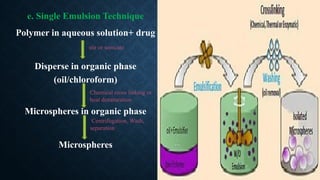
e. Single Emulsion Technique
Polymer in aqueous solution+ drug
Disperse in organic phase
(oil/chloroform)
Microspheres in organic phase
Microspheres
Chemical cross linking or
heat denaturation
Centrifugation, Wash,
separation
stir or sonicate
f. Double Emulsion Technique
Polymer in aq. solution + Drug
Disperse in organic phase
First emulsion (W/O)
Multiple emulsion(W/O/W)
Microspheres in solution
Microspheres
Addition of aq. sol of PVA
Addition to large aq. Phase
Separation, wash, dry
homogenization or
Sonication
2. CHEMICAL METHOD
a. Solvent Evaporation
Core material
Coating polymer solution
Core material disperse in liquid manufacturing vehicle phase
Evaporation of polymer solvent
Microspheres
Dissolved or dispersed
Agitation
Heating (if need)
b. POLYMERIZATION
 There are two types-
1. Normal
a. Bulk polymerization
b. Suspension polymerization
c. Emulsion polymerization
2. Interfacial
1. NORMAL POLYMERIZATION
a. Bulk polymerization
Monomer / mixture of monomer + initiator
Heated to initiate polymerization
Polymer obtained is moulded /fragmented
Microspheres
b. SUSPENSION POLYMERIZATION
Monomer or composition of monomers are heated and dispersed in
water
Droplets
(vigorous agitation)
Microspheres
c EMULSION
POLYMERIZATION
Monomer + aq. Solution of NaOH + initiator (stir)
Micelles solution of polymer in aq. medium
Polymerization occurs, microspheres are formed
2. INTERFACIAL
Monomer
A+ water Oil Phase
W/O emulsion
Add monomer B
Microspheres in aq. Medium
Microspheres
High pressure
homogenization
Ppolymerization
APPLICATION OF MICROENCAPSULATION
1. For sustained or prolonged drug release.
2. For masking taste and odor of many drugs to improve patient
compliance.
3. For converting liquid drugs in a free flowing powder.
4. To reduce toxicity and GI irritation
5. Incompatibility among the drugs can be prevented by
microencapsulation.
6. The drugs, which are sensitive to oxygen, moisture or light, can be
stabilized by microencapsulation
THANK
YOU

Microencapsulation. pptx

  • 1.
    Topic- Microencapsulation Presented by HariomJaiswal Asst. Pro. B.PH 4th Year/ 7th Sam NDDS Rajiv Gandhi College of Pharmacy Nautanwa, Maharajganj UP 273164
  • 2.
    CONTENTS  Introduction ofmicro encapsulation Core material and coating material  Need of micro encapsulation  Advantages and disadvantages of microencapsulation  Termaology and definition  Method of preparation microencapsulation  Application of micro encapsulation
  • 3.
    INTRODUCTION OF MICROENCAPSULATION "Microencapsulationmay be defined as the process of surrounding or enveloping one substance within another substance on a very small scale, yielding capsules ranging from less than one micron to several hundred microns in size" "It is define has an substance or pharmaceutical material is encapsulated over the surface of solid droplet of liquid and dispersion of medium is known has microencapsulation" It is mean of applying thin coating to small particle of solid or droplet of liquid & dispersion.
  • 5.
    Particle size: 1-1000micron.  2 phases: a. Core Material b. Coating Material Also known as microcapsule, microsphere, coated granules, pellets
  • 6.
    CORE & COATINGMATERIALS 1. CORE MATERIALS: The core material is the specific material to be coated. It can be liquid or solid in nature. E.g., acetaminophen, activated charcoal, aspirin, urease, potassium chloride, vitamin palmitate etc. 2. COATING MATERIALS: Selection of coating materials decides the physical & chemical properties of the resultant microcapsule/microsphere. E.g., a. Water soluble resins: gelatine, starch, polyvinyl alcohol, polyacrylic acid, hydroxy methylcellulose etc. b. Water Insoluble resins:- ethyl cellulose, polyethylene, polymethacrylate, cellulose nitrate etc. c. Waxes & lipids:- Paraffin, stearic acid, stearyl alcohol etc. d. Enteric Resins:- Shellac, cellulose acetate phthalate (CAP), zein etc.
  • 8.
    NEED OF MICROENCAPSULATION 1.To protect reactive substances from the environment. 2. To convert liquid active components into a dry solid system. 3. To separate incompatible components for functional reasons 4. To protect the immediate environment of the microcapsules from the active components. 5. Isolation of core from its surroundings, as in isolating vitamins from the deteriorating effects of oxygen. 6. Retarding evaporation of a volatile core. 7. Improving the handling properties of a sticky material. 8. Isolating a reactive core from chemical attack. 9. For safe handling of the toxic materials.
  • 9.
    10. To gettargeted release of the drug. 11. To control release of the active components for delayed (timed) release or long-acting (sustained) release. 12. The problem may be as simple as masking the taste or odor of the core. 13. To Increase of bioavailability. 14. To produce a targeted drug delivery. 15. Protects the GIT from irritant effects of the drug. 16. Extension of duration of activity for an equal level of active agent.
  • 10.
    ADVANTAGES & DISADVANTAGES MICROENCAPSULATION Advantages 1.To Increase of bioavailability. 2. To produce a targeted drug delivery 3. To provide environmental protection of the core material from moisture, light, and oxygen. 4. It enhances the solubility of poorly soluble drugs and the safe handling of toxic medications. 5. It Masks the taste of bitter drugs to make them more palatable and improving patient compliance. 6. To decrease evaporation rate of the core material. (Reduction of volatility)
  • 11.
    Disadvantages 1. The costof the materials used and the formulation process might be higher than standard formulations. 2. Reproducibility is less 3. The effect of the polymer matrix, polymer additives, and their degradation products on the environment in response to heat, hydrolysis, or biological agents vary significantly. 4. The core particle's stability is affected by the change in the process conditions like change in temperature, pH, solvent addition, or evaporation of the solvent
  • 12.
    TERMINOLOGY AND DEFINITIONOF MICROENCAPSULATION 1. Microparticles: Microparticles are tiny solid particles (size usually 1-1000 µm) made of natural or synthetic polymers that can encapsulate a drug. They act as carriers to control how and when the drug is released in the body. 2. Microspheres: Microspheres are solid spherical particles made up of polymer substances, in which the drug is dispersed through out the microsphere matrix, its size ranges from 1-1000μm. 3. Microcapsules: Microcapsules are small particles that contain drug or core material surrounded by a shell or coating of polymer. Microcapsules can be classified on three types a. Mononuclear: Containing the shell around the core. b. Polynuclear: Having many cores enclosed with in shell. c. Matrix type: Distributed homogeneously into the shell material.
  • 14.
    METHOD OF PREPARATIONMICROENCAPSULTION  There are two type of preparation of microencapsulation. 1. Physical Method: a. Air suspension b. Coacervation phase Separation c. Pan coating d. Spray Drying and Congealing e. Single Emulsion Technique. f. Double Emulsion Technique. 2. Chemical Method: g. Solvent Evaporation h. Polymerization
  • 15.
    1. PHYSICAL METHOD a.Air Suspension (Wurster Method) Within the coating chamber, particles are suspended on an upward moving air stream. Spraying of coating material on the air suspended particles. The cyclic process is repeated depending upon purpose of microencapsulation. Air stream serves to dry the product.
  • 16.
    b. Coacervation phaseseparation The general process consist of 3 steps under continuous agitation: 1. Formation of 3 immiscible chemical phase 2. Deposition of coating 3. Rigidization of coating. Step: 1) Three immiscible phases are as: a) Liquid manufacturing vehicle phase b) Core material phase c) Coating material phase.
  • 17.
    Coating material phaseformed by utilizing following methods: A) Temperature change. B) By addition of incompatible polymer C) By non-solvent addition D) By salt addition
  • 18.
    Aq. / organicsolution of polymer add drug Drug dispersed or dissolved in the polymer solution Phase separation induced by different means Polymer rich globules solidify Microspheres in aq/ organic phase Separate, wash and dry microspheres
  • 19.
    c. Pan coating Solidparticle greater than 600 micron size are generally consider for effective coating. It is used for preparation of controlled-release beads. Coating is applied as solution by automized spray to desired solid core material in coating pan. Usually warm air is passed over the coated material as the coating are being applied in the coating pan.
  • 20.
    d. Spray DryingAnd Congealing Polymer dissolved in organic phase(acetone) Drug is dispersed in polymer solution under high speed homogenization/ Atomized in a stream of hot air Formation of small droplets Solvent evaporation microspheres Separated by cyclone separator and traces of solvent is removed by vacuum drying
  • 22.
    e. Single EmulsionTechnique Polymer in aqueous solution+ drug Disperse in organic phase (oil/chloroform) Microspheres in organic phase Microspheres Chemical cross linking or heat denaturation Centrifugation, Wash, separation stir or sonicate
  • 23.
    f. Double EmulsionTechnique Polymer in aq. solution + Drug Disperse in organic phase First emulsion (W/O) Multiple emulsion(W/O/W) Microspheres in solution Microspheres Addition of aq. sol of PVA Addition to large aq. Phase Separation, wash, dry homogenization or Sonication
  • 24.
    2. CHEMICAL METHOD a.Solvent Evaporation Core material Coating polymer solution Core material disperse in liquid manufacturing vehicle phase Evaporation of polymer solvent Microspheres Dissolved or dispersed Agitation Heating (if need)
  • 25.
    b. POLYMERIZATION  Thereare two types- 1. Normal a. Bulk polymerization b. Suspension polymerization c. Emulsion polymerization 2. Interfacial
  • 26.
    1. NORMAL POLYMERIZATION a.Bulk polymerization Monomer / mixture of monomer + initiator Heated to initiate polymerization Polymer obtained is moulded /fragmented Microspheres
  • 27.
    b. SUSPENSION POLYMERIZATION Monomeror composition of monomers are heated and dispersed in water Droplets (vigorous agitation) Microspheres
  • 28.
    c EMULSION POLYMERIZATION Monomer +aq. Solution of NaOH + initiator (stir) Micelles solution of polymer in aq. medium Polymerization occurs, microspheres are formed
  • 29.
    2. INTERFACIAL Monomer A+ waterOil Phase W/O emulsion Add monomer B Microspheres in aq. Medium Microspheres High pressure homogenization Ppolymerization
  • 31.
    APPLICATION OF MICROENCAPSULATION 1.For sustained or prolonged drug release. 2. For masking taste and odor of many drugs to improve patient compliance. 3. For converting liquid drugs in a free flowing powder. 4. To reduce toxicity and GI irritation 5. Incompatibility among the drugs can be prevented by microencapsulation. 6. The drugs, which are sensitive to oxygen, moisture or light, can be stabilized by microencapsulation
  • 32.