PREPARED BY: PROF. SHASHANK CHAURASIYA
BANSAL COLLEGE OF PHARMAY, BHOPAL
MICROENCAPSULATION
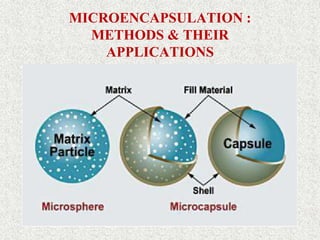
MICROENCAPSULATION :
METHODS & THEIR
APPLICATIONS
Defination
Microencapsulation is a process by which very tiny droplets or particles
of liquid or solid material are surrounded or coated with a continuous film
of polymeric material.
Microencapsulation may be defined as the process of surrounding or
enveloping one substance within another substance on a very small scale,
yielding capsules ranging from less than one micron to several hundred
microns in size.”
It is mean of applying thin coating to small particle of solid or droplet of
liquid & dispersion.
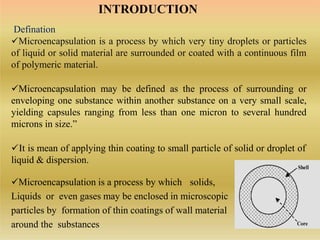
Microencapsulation is a process by which solids,
Liquids or even gases may be enclosed in microscopic
particles by formation of thin coatings of wall material
around the substances
INTRODUCTION
• Particle size: 50-5000 micron.
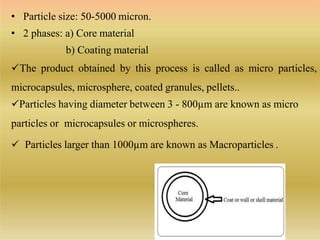
• 2 phases: a) Core material
b) Coating material
The product obtained by this process is called as micro particles,
microcapsules, microsphere, coated granules, pellets..
Particles having diameter between 3 - 800µm are known as micro
particles or microcapsules or microspheres.
 Particles larger than 1000µm are known as Macroparticles .
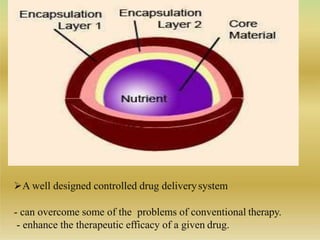
A well designed controlled drug deliverysystem
- can overcome some of the problems of conventional therapy.
- enhance the therapeutic efficacy of a given drug.
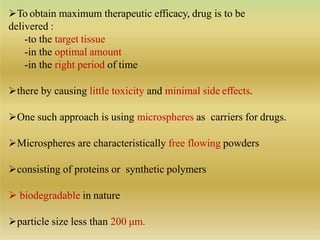
To obtain maximum therapeutic efficacy, drug is to be
delivered :
-to the target tissue
-in the optimal amount
-in the right period of time
there by causing little toxicity and minimal side effects.
One such approach is using microspheres as carriers for drugs.
Microspheres are characteristically free flowing powders
consisting of proteins or synthetic polymers
 biodegradable in nature
particle size less than 200 μm.
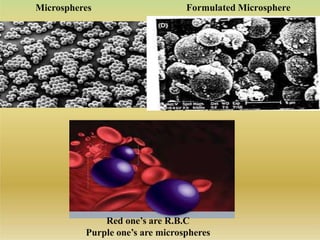
Microspheres Formulated Microsphere
Red one’s are R.B.C
Purple one’s are microspheres
REASONS FOR MICROENCAPSULATION
1. To protect reactive substances from the environment,
2. To convert liquid active components into a dry solid system,
3. To separate incompatible components for functional reasons,
4. To protect the immediate environment of the microcapsules from the
active components.
as in isolating vitamins from the5. Isolation of core from its surroundings,
deteriorating effects of oxygen.
6. retarding evaporation of a volatile core.
7. improving the handling properties of a sticky material.
8. isolating a reactive core from chemical attack.
9. for safe handling of the toxic materials.
10. to get targeted release of the drug
11. To control release of the active components for delayed (timed) release or
long-acting (sustained) release,
12. The problem may be as simple as masking the taste or odor of the core,
13. To Increase of bioavailability,
14. To produce a targeted drug delivery,
15. Protects the GIT from irritant effects of the drug,
16. Extension of duration of activity for an equal level of active agent.
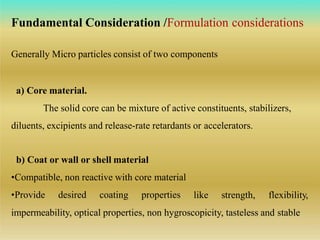
Generally Micro particles consist of two components
a) Core material.
The solid core can be mixture of active constituents, stabilizers,
diluents, excipients and release-rate retardants or accelerators.
b) Coat or wall or shell material
•Compatible, non reactive with core material
•Provide desired coating properties like strength, flexibility,
impermeability, optical properties, non hygroscopicity, tasteless and stable
Fundamental Consideration /Formulation considerations
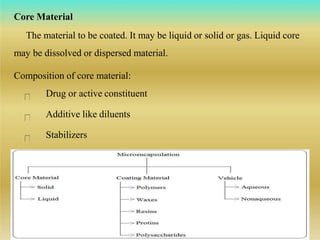
Core Material
The material to be coated. It may be liquid or solid or gas. Liquid core
may be dissolved or dispersed material.
Composition of core material:
Drug or active constituent
Additive like diluents
Stabilizers
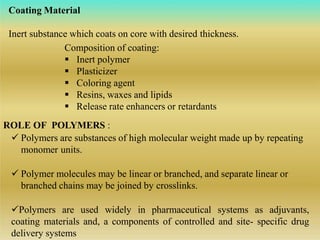
Coating Material
Inert substance which coats on core with desired thickness.
Composition of coating:
 Inert polymer
 Plasticizer
 Coloring agent
 Resins, waxes and lipids
 Release rate enhancers or retardants
ROLE OF POLYMERS :
 Polymers are substances of high molecular weight made up by repeating
monomer units.
 Polymer molecules may be linear or branched, and separate linear or
branched chains may be joined by crosslinks.
Polymers are used widely in pharmaceutical systems as adjuvants,
coating materials and, a components of controlled and site- specific drug
delivery systems
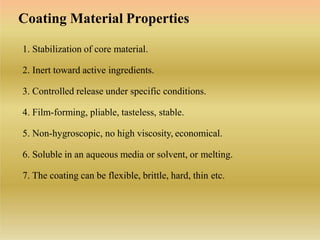
1. Stabilization of core material.
2. Inert toward active ingredients.
3. Controlled release under specific conditions.
4. Film-forming, pliable, tasteless, stable.
5. Non-hygroscopic, no high viscosity, economical.
6. Soluble in an aqueous media or solvent, or melting.
7. The coating can be flexible, brittle, hard, thin etc.
Coating Material Properties
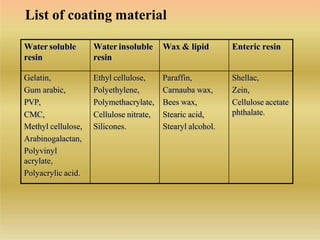
List of coating material
Water soluble
resin
Water insoluble
resin
Wax & lipid Enteric resin
Gelatin, Ethyl cellulose, Paraffin, Shellac,
Gum arabic, Polyethylene, Carnauba wax, Zein,
PVP,
CMC,
Polymethacrylate,
Cellulose nitrate,
Bees wax,
Stearic acid,
Cellulose acetate
phthalate.
Methyl cellulose, Silicones. Stearyl alcohol.
Arabinogalactan,
Polyvinyl
acrylate,
Polyacrylic acid.
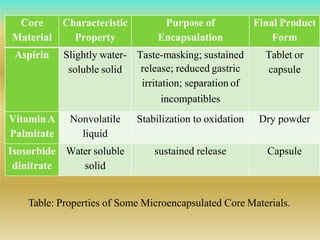
Core
Material
Characteristic
Property
Purpose of
Encapsulation
Final Product
Form
Aspirin Slightly water-
soluble solid
Taste-masking; sustained
release; reduced gastric
irritation; separation of
incompatibles
Tablet or
capsule
Vitamin A
Palmitate
Nonvolatile
liquid
Stabilization to oxidation Dry powder
Isosorbide
dinitrate
Water soluble
solid
sustained release Capsule
Table: Properties of Some Microencapsulated Core Materials.
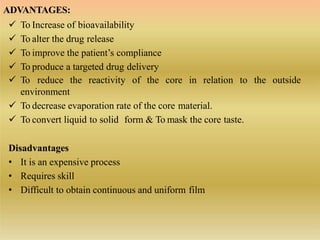
ADVANTAGES:
 To Increase of bioavailability
 To alter the drug release
 To improve the patient’s compliance
 To produce a targeted drug delivery
the outside To reduce the reactivity of the core in relation to
environment
 To decrease evaporation rate of the core material.
 To convert liquid to solid form & To mask the core taste.
Disadvantages
• It is an expensive process
• Requires skill
• Difficult to obtain continuous and uniform film
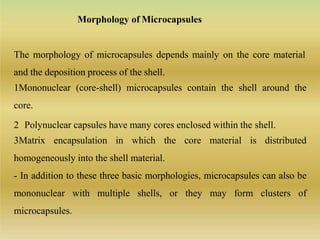
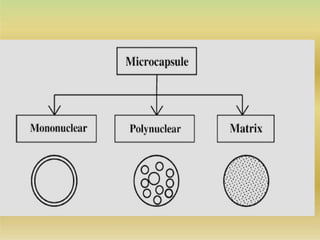
Morphology of Microcapsules
The morphology of microcapsules depends mainly on the core material
and the deposition process of the shell.
1Mononuclear (core-shell) microcapsules contain the shell around the
core.
2 Polynuclear capsules have many cores enclosed within the shell.
3Matrix encapsulation in which the core material is distributed
homogeneously into the shell material.
- In addition to these three basic morphologies, microcapsules can also be
mononuclear with multiple shells, or they may form clusters of
microcapsules.
RELEASE MECHANISMS
Even when the aim of a microencapsulation application is the isolation of
the core from its surrounding, the wall must be ruptured at the time of use.
A variety of release mechanisms have been proposed for microcapsules :
by pressure or shear stress.
by melting the wall.
by dissolving it under particular conditions, as in the case of an enteric
drug coating.
by solvent action
by enzyme attack
by chemical reaction
by hydrolysis or slow disintegration.
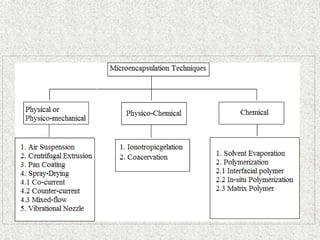
MICROENCAPSULATION TECHNIQUES:
1. Air suspension techniques(Wurster)
2. Coacervation process
3. Spray drying & congealing
4. Pan coating
5. Solvent evaporation
6. Polymerization
7. Multiorific-centrifugal
8. Extrusion
9. Single & double emulsion techniques
10. Supercritical fluid anti solvent method (SAS)
11. Nozzle vibration technology
I] Physical or Physico-mechanical methods
16
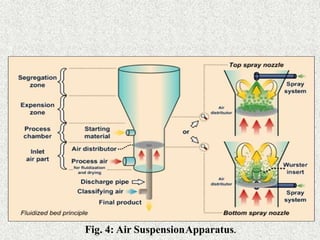
1. Air-suspension coating
 Inventions of Professor Dale E. Wurster
 Basically the wurster process consists of the dispersing of solid,
particulate core materials in a supporting air stream and the
spray-coating of the air suspended particles.
 Equipment ranging in capacities from one pound to 990 pounds.
 Micron or submicron particles can be effectively encapsulated
by air suspension techniques.
 Disadvantage-
Agglomeration of the particles tosome larger size is normally
achieved
18
Processing variables for efficient, effective encapsulation by air
suspension techniques:
1.Density, surface area, melting point, solubility, friability,
volatility, Crystallinity, and flow-ability of core the core material.
2.Coating material concentration (or melting point if not a
solution).
3.Coating material application rate.
4.Volume of air required to support and fluidizes the core material.
5.Amount of coating material required.
6.Inlet and outlet operating temperatures.
19
Fig. 4: Air SuspensionApparatus.
20
2. Centrifugal extrusion
 Liquids are encapsulated using a rotating extrusion head
containing concentric nozzles.
 This process is excellent for forming particles 400–2,000 μm in
diameter.
 Since the drops are formed by the breakup of a liquid jet, the
process is only suitable for liquid or slurry.
 A high production rate can be achieved, i.e., up to 22.5 kg of
microcapsules can be produced per nozzle per hour per head.
 Heads containing 16 nozzles are available.
21
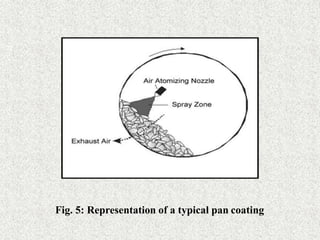
3. Pan coating
 Oldest industrial procedures for forming small, coated particles
or tablets.
 The particles are tumbled in a pan or other device while the
coating material is applied slowly.
 Solid particles greater than 600 microns in size are generally
considered essential for effective coating.
 Medicaments are usually coated onto various spherical substrates
such as nonpareil sugar seeds, and then coated with protective
layers of various polymers.
22
Fig. 5: Representation of a typical pan coating
23
4. Spray-drying
 In modern spray dryers the viscosity of the solutions to be
sprayed can be as high as 300mPa.s
 Spray drying and spray congealing- dispersing the core
material in a liquefied coating substance and spraying.
 Spray drying is effected by rapid evaporation of a solvent in
which the coating material is dissolved.
24
The equipment components of a standard spray dryer
include
1. an air heater,
2. atomizer,
3. main spray chamber,
4. blower or fan,
5. cyclone and
6. product collector.
25
 Spray congealing can be accomplished with spray drying
equipment when the protective coating is applied as a melt.
 Core material is dispersed in a coating material melt rather than
a coating solution.
 Coating solidification (and microencapsulation) is accomplished
by spraying the hot mixture into a cool air stream.
26
Airflow
There are three modes of contact:
1. Co-current
2. Counter-current
3. Mixed-flow
27
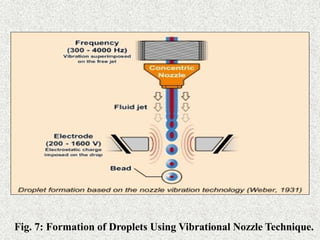
5. Vibrational Nozzle
 The process works very well for generating droplets between
100–5,000 µm
 Units are deployed in industries and research mostly with
capacities of 1–10,000 kg per hour at working temperatures of
20–1500 C.
 Nozzles heads are available from one up to several hundred
thousand are available.
28
Fig. 7: Formation of Droplets Using Vibrational Nozzle Technique.
II] Physico-chemical methods
29
1. Ionotropic gelation
 Chemical reaction between sodium alginate and calcium
chloride or other Counter ion solution such as barium chloride.
 Verapamil hydrochloride causes gastric irritation on sudden
release. It is usually administered as conventional tablets
containing 40-120 mg, 3 times a day. Due to its ready solubility
in water and shorter half-life.
 Microparticulate system of verapamil hydrochloride for
prolonged release delivery system.
30
2. Coacervation-Phase Separation
 Patents of B.K. Green et al.
 Three steps carried out under continuous agitation:
1) Formation of three immiscible chemical phases
2) Deposition of the coating
3) Rigidization of the coating
31
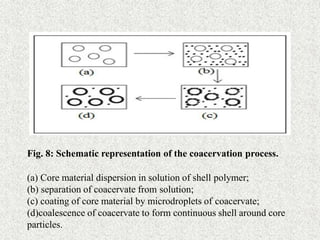
Fig. 8: Schematic representation of the coacervation process.
(a) Core material dispersion in solution of shell polymer;
(b) separation of coacervate from solution;
(c) coating of core material by microdroplets of coacervate;
(d)coalescence of coacervate to form continuous shell around core
particles.
III] Chemical process
32
1. Solvent Evaporation
 In the case in which the core material is dispersed in the
polymer solution, polymer shrinks around the core. In the case
in which core material is dissolved in the coating polymer
solution, a matrix - type microcapsule is formed.
 The core materials may be either
water - soluble or
water - insoluble materials.
 A variety of film - forming polymers can be used as coatings.
33  Used by companies including the
NCR Company,
Gavaert Photo - Production NV, and
Fuji Photo Film Co., Ltd.
eg. Evaluation of Sucrose Esters as Alternative Surfactants in
Microencapsulation of Proteins by the Solvent Evaporation
Method.
34
2. Polymerization
1) Interfacial polymer
In Interfacial polymerization, the two reactants in a
polycondensation meet at an interface and react rapidly.
2) In-situ polymerization
In a few microencapsulation processes, the direct
polymerization of a single monomer is carried out on the
particle surface.
Continue…
35
e.g. Cellulose fibers are encapsulated in polyethylene while
immersed in dry toluene. Usual deposition rates are about
0.5μm/min. Coating thickness ranges 0.2-75μm.
3) Matrix polymer
In a number of processes, a core material is imbedded in a
polymeric matrix during formation of the particles.
 Prepares microcapsules containing protein solutions by
incorporating the protein in the aqueous diamine phase.
 National Lead Corporation- utilizing polymerization techniques
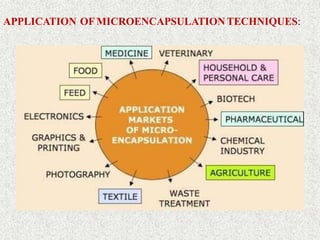
APPLICATION OFMICROENCAPSULATION TECHNIQUES:
Applications of Microcapsules and Microspheres
1. AgriculturalApplications
 Reduce insect populations by disrupting their mating process.
 Protects the pheromone from oxidation and light during storage and
release.
2. Catalysis
 Safe handling, easy recovery, reuse and disposal at an acceptable
economic cost.
 Metal species such as palladium (II) acetate and osmium tetroxide
have been encapsulated in polyurea microcapsules and used
successfully as recoverable and reusable catalysts without
significant leaching and loss of activity.
3. Food Industry
 Adding ingredients to food products to improve nutritional value
can compromise their taste, colour, texture and aroma.
 Sometimes they slowly degrade and lose their activity, or become
hazardous by oxidation reactions.
 Ingredients can also react with components present in the food
system, which may limit bioavailability.
4. PharmaceuticalApplications
 Potential applications of this drug delivery system are
replacement of therapeutic agents (not taken orally today like
insulin), gene therapy and in use of vaccines for treating AIDS,
tumors, cancer and diabetes.
 The delivery of corrective gene sequences in the form of plasmid
DNA could provide convenient therapy for a number of genetic
diseases such as cystic fibrosis and hemophilia.
 Lupin has already launched in the market worlds first Cephalexin
(Ceff-ER) and Cefadroxil (Odoxil OD) antibiotic tablets for
treatment of bacterial infections.
 Aspirin controlled release version ZORprin CR tablets are used
for relieving arthritis symptoms.
 Quinidine gluconate CR tablets are used for treating and
preventing abnormal heart rhythms.
 Niaspan CR tablet is used for improving cholesterol levels and
thus reducing the risk for a heart attack.
 Some of the applications of microencapsulation can be
described in detail as given below:
1. Prolonged release dosage forms.
selectively2.Prepare enteric-coated dosage forms
absorbed in the intestine rather than the stomach.
3. It can be used to mask the taste of bitter drugs.
4. To reduce gastric irritation.
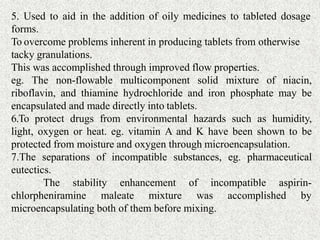
5. Used to aid in the addition of oily medicines to tableted dosage
forms.
To overcome problems inherent in producing tablets from otherwise
tacky granulations.
This was accomplished through improved flow properties.
eg. The non-flowable multicomponent solid mixture of niacin,
riboflavin, and thiamine hydrochloride and iron phosphate may be
encapsulated and made directly into tablets.
6.To protect drugs from environmental hazards such as humidity,
light, oxygen or heat. eg. vitamin A and K have been shown to be
protected from moisture and oxygen through microencapsulation.
7.The separations of incompatible substances, eg. pharmaceutical
eutectics.
The stability enhancement of incompatible aspirin-
accomplished bychlorpheniramine maleate mixture was
microencapsulating both of them before mixing.
67
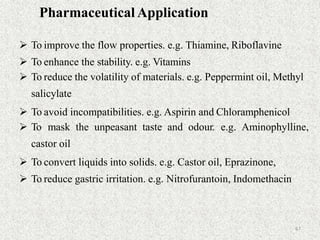
Pharmaceutical Application
 To improve the flow properties. e.g. Thiamine, Riboflavine
 To enhance the stability. e.g. Vitamins
 To reduce the volatility of materials. e.g. Peppermint oil, Methyl
salicylate
 To avoid incompatibilities. e.g. Aspirin and Chloramphenicol
 To mask the unpeasant taste and odour. e.g. Aminophylline,
castor oil
 To convert liquids into solids. e.g. Castor oil, Eprazinone,
 To reduce gastric irritation. e.g. Nitrofurantoin, Indomethacin
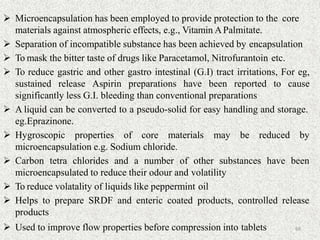
 Microencapsulation has been employed to provide protection to the core
materials against atmospheric effects, e.g., Vitamin APalmitate.
 Separation of incompatible substance has been achieved by encapsulation
 To mask the bitter taste of drugs like Paracetamol, Nitrofurantoin etc.
 To reduce gastric and other gastro intestinal (G.I) tract irritations, For eg,
sustained release Aspirin preparations have been reported to cause
significantly less G.I. bleeding than conventional preparations
 A liquid can be converted to a pseudo-solid for easy handling and storage.
eg.Eprazinone.
 Hygroscopic properties of core materials may be reduced by
microencapsulation e.g. Sodium chloride.
 Carbon tetra chlorides and a number of other substances have been
microencapsulated to reduce their odour and volatility
 To reduce volatality of liquids like peppermint oil
 Helps to prepare SRDF and enteric coated products, controlled release
products
 Used to improve flow properties before compression into tablets 68
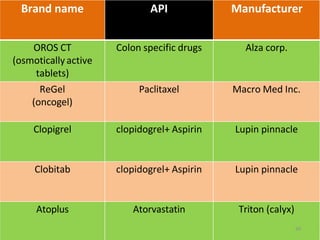
Brand name API Manufacturer
OROS CT
(osmotically active
tablets)
Colon specific drugs Alza corp.
ReGel
(oncogel)
Paclitaxel Macro Med Inc.
Clopigrel clopidogrel+ Aspirin Lupin pinnacle
Clobitab clopidogrel+ Aspirin Lupin pinnacle
Atoplus Atorvastatin Triton (calyx)
69
.
THANK YOU…

Ndds 4 MICROENCAPSULATION DRUG DELIVERY SYSTEM

  • 1.
    PREPARED BY: PROF.SHASHANK CHAURASIYA BANSAL COLLEGE OF PHARMAY, BHOPAL MICROENCAPSULATION
  • 2.
  • 3.
    Defination Microencapsulation is aprocess by which very tiny droplets or particles of liquid or solid material are surrounded or coated with a continuous film of polymeric material. Microencapsulation may be defined as the process of surrounding or enveloping one substance within another substance on a very small scale, yielding capsules ranging from less than one micron to several hundred microns in size.” It is mean of applying thin coating to small particle of solid or droplet of liquid & dispersion. Microencapsulation is a process by which solids, Liquids or even gases may be enclosed in microscopic particles by formation of thin coatings of wall material around the substances INTRODUCTION
  • 4.
    • Particle size:50-5000 micron. • 2 phases: a) Core material b) Coating material The product obtained by this process is called as micro particles, microcapsules, microsphere, coated granules, pellets.. Particles having diameter between 3 - 800µm are known as micro particles or microcapsules or microspheres.  Particles larger than 1000µm are known as Macroparticles .
  • 5.
    A well designedcontrolled drug deliverysystem - can overcome some of the problems of conventional therapy. - enhance the therapeutic efficacy of a given drug.
  • 6.
    To obtain maximumtherapeutic efficacy, drug is to be delivered : -to the target tissue -in the optimal amount -in the right period of time there by causing little toxicity and minimal side effects. One such approach is using microspheres as carriers for drugs. Microspheres are characteristically free flowing powders consisting of proteins or synthetic polymers  biodegradable in nature particle size less than 200 μm.
  • 7.
    Microspheres Formulated Microsphere Redone’s are R.B.C Purple one’s are microspheres
  • 8.
    REASONS FOR MICROENCAPSULATION 1.To protect reactive substances from the environment, 2. To convert liquid active components into a dry solid system, 3. To separate incompatible components for functional reasons, 4. To protect the immediate environment of the microcapsules from the active components. as in isolating vitamins from the5. Isolation of core from its surroundings, deteriorating effects of oxygen. 6. retarding evaporation of a volatile core. 7. improving the handling properties of a sticky material. 8. isolating a reactive core from chemical attack. 9. for safe handling of the toxic materials. 10. to get targeted release of the drug 11. To control release of the active components for delayed (timed) release or long-acting (sustained) release, 12. The problem may be as simple as masking the taste or odor of the core, 13. To Increase of bioavailability, 14. To produce a targeted drug delivery, 15. Protects the GIT from irritant effects of the drug, 16. Extension of duration of activity for an equal level of active agent.
  • 9.
    Generally Micro particlesconsist of two components a) Core material. The solid core can be mixture of active constituents, stabilizers, diluents, excipients and release-rate retardants or accelerators. b) Coat or wall or shell material •Compatible, non reactive with core material •Provide desired coating properties like strength, flexibility, impermeability, optical properties, non hygroscopicity, tasteless and stable Fundamental Consideration /Formulation considerations
  • 10.
    Core Material The materialto be coated. It may be liquid or solid or gas. Liquid core may be dissolved or dispersed material. Composition of core material: Drug or active constituent Additive like diluents Stabilizers
  • 11.
    Coating Material Inert substancewhich coats on core with desired thickness. Composition of coating:  Inert polymer  Plasticizer  Coloring agent  Resins, waxes and lipids  Release rate enhancers or retardants ROLE OF POLYMERS :  Polymers are substances of high molecular weight made up by repeating monomer units.  Polymer molecules may be linear or branched, and separate linear or branched chains may be joined by crosslinks. Polymers are used widely in pharmaceutical systems as adjuvants, coating materials and, a components of controlled and site- specific drug delivery systems
  • 12.
    1. Stabilization ofcore material. 2. Inert toward active ingredients. 3. Controlled release under specific conditions. 4. Film-forming, pliable, tasteless, stable. 5. Non-hygroscopic, no high viscosity, economical. 6. Soluble in an aqueous media or solvent, or melting. 7. The coating can be flexible, brittle, hard, thin etc. Coating Material Properties
  • 13.
    List of coatingmaterial Water soluble resin Water insoluble resin Wax & lipid Enteric resin Gelatin, Ethyl cellulose, Paraffin, Shellac, Gum arabic, Polyethylene, Carnauba wax, Zein, PVP, CMC, Polymethacrylate, Cellulose nitrate, Bees wax, Stearic acid, Cellulose acetate phthalate. Methyl cellulose, Silicones. Stearyl alcohol. Arabinogalactan, Polyvinyl acrylate, Polyacrylic acid.
  • 14.
    Core Material Characteristic Property Purpose of Encapsulation Final Product Form AspirinSlightly water- soluble solid Taste-masking; sustained release; reduced gastric irritation; separation of incompatibles Tablet or capsule Vitamin A Palmitate Nonvolatile liquid Stabilization to oxidation Dry powder Isosorbide dinitrate Water soluble solid sustained release Capsule Table: Properties of Some Microencapsulated Core Materials.
  • 15.
    ADVANTAGES:  To Increaseof bioavailability  To alter the drug release  To improve the patient’s compliance  To produce a targeted drug delivery the outside To reduce the reactivity of the core in relation to environment  To decrease evaporation rate of the core material.  To convert liquid to solid form & To mask the core taste. Disadvantages • It is an expensive process • Requires skill • Difficult to obtain continuous and uniform film
  • 16.
    Morphology of Microcapsules Themorphology of microcapsules depends mainly on the core material and the deposition process of the shell. 1Mononuclear (core-shell) microcapsules contain the shell around the core. 2 Polynuclear capsules have many cores enclosed within the shell. 3Matrix encapsulation in which the core material is distributed homogeneously into the shell material. - In addition to these three basic morphologies, microcapsules can also be mononuclear with multiple shells, or they may form clusters of microcapsules.
  • 18.
    RELEASE MECHANISMS Even whenthe aim of a microencapsulation application is the isolation of the core from its surrounding, the wall must be ruptured at the time of use. A variety of release mechanisms have been proposed for microcapsules : by pressure or shear stress. by melting the wall. by dissolving it under particular conditions, as in the case of an enteric drug coating. by solvent action by enzyme attack by chemical reaction by hydrolysis or slow disintegration.
  • 19.
    MICROENCAPSULATION TECHNIQUES: 1. Airsuspension techniques(Wurster) 2. Coacervation process 3. Spray drying & congealing 4. Pan coating 5. Solvent evaporation 6. Polymerization 7. Multiorific-centrifugal 8. Extrusion 9. Single & double emulsion techniques 10. Supercritical fluid anti solvent method (SAS) 11. Nozzle vibration technology
  • 21.
    I] Physical orPhysico-mechanical methods 16 1. Air-suspension coating  Inventions of Professor Dale E. Wurster  Basically the wurster process consists of the dispersing of solid, particulate core materials in a supporting air stream and the spray-coating of the air suspended particles.  Equipment ranging in capacities from one pound to 990 pounds.  Micron or submicron particles can be effectively encapsulated by air suspension techniques.  Disadvantage- Agglomeration of the particles tosome larger size is normally achieved
  • 22.
    18 Processing variables forefficient, effective encapsulation by air suspension techniques: 1.Density, surface area, melting point, solubility, friability, volatility, Crystallinity, and flow-ability of core the core material. 2.Coating material concentration (or melting point if not a solution). 3.Coating material application rate. 4.Volume of air required to support and fluidizes the core material. 5.Amount of coating material required. 6.Inlet and outlet operating temperatures.
  • 23.
    19 Fig. 4: AirSuspensionApparatus.
  • 24.
    20 2. Centrifugal extrusion Liquids are encapsulated using a rotating extrusion head containing concentric nozzles.  This process is excellent for forming particles 400–2,000 μm in diameter.  Since the drops are formed by the breakup of a liquid jet, the process is only suitable for liquid or slurry.  A high production rate can be achieved, i.e., up to 22.5 kg of microcapsules can be produced per nozzle per hour per head.  Heads containing 16 nozzles are available.
  • 25.
    21 3. Pan coating Oldest industrial procedures for forming small, coated particles or tablets.  The particles are tumbled in a pan or other device while the coating material is applied slowly.  Solid particles greater than 600 microns in size are generally considered essential for effective coating.  Medicaments are usually coated onto various spherical substrates such as nonpareil sugar seeds, and then coated with protective layers of various polymers.
  • 26.
    22 Fig. 5: Representationof a typical pan coating
  • 27.
    23 4. Spray-drying  Inmodern spray dryers the viscosity of the solutions to be sprayed can be as high as 300mPa.s  Spray drying and spray congealing- dispersing the core material in a liquefied coating substance and spraying.  Spray drying is effected by rapid evaporation of a solvent in which the coating material is dissolved.
  • 28.
    24 The equipment componentsof a standard spray dryer include 1. an air heater, 2. atomizer, 3. main spray chamber, 4. blower or fan, 5. cyclone and 6. product collector.
  • 29.
    25  Spray congealingcan be accomplished with spray drying equipment when the protective coating is applied as a melt.  Core material is dispersed in a coating material melt rather than a coating solution.  Coating solidification (and microencapsulation) is accomplished by spraying the hot mixture into a cool air stream.
  • 30.
    26 Airflow There are threemodes of contact: 1. Co-current 2. Counter-current 3. Mixed-flow
  • 31.
    27 5. Vibrational Nozzle The process works very well for generating droplets between 100–5,000 µm  Units are deployed in industries and research mostly with capacities of 1–10,000 kg per hour at working temperatures of 20–1500 C.  Nozzles heads are available from one up to several hundred thousand are available.
  • 32.
    28 Fig. 7: Formationof Droplets Using Vibrational Nozzle Technique.
  • 33.
    II] Physico-chemical methods 29 1.Ionotropic gelation  Chemical reaction between sodium alginate and calcium chloride or other Counter ion solution such as barium chloride.  Verapamil hydrochloride causes gastric irritation on sudden release. It is usually administered as conventional tablets containing 40-120 mg, 3 times a day. Due to its ready solubility in water and shorter half-life.  Microparticulate system of verapamil hydrochloride for prolonged release delivery system.
  • 34.
    30 2. Coacervation-Phase Separation Patents of B.K. Green et al.  Three steps carried out under continuous agitation: 1) Formation of three immiscible chemical phases 2) Deposition of the coating 3) Rigidization of the coating
  • 35.
    31 Fig. 8: Schematicrepresentation of the coacervation process. (a) Core material dispersion in solution of shell polymer; (b) separation of coacervate from solution; (c) coating of core material by microdroplets of coacervate; (d)coalescence of coacervate to form continuous shell around core particles.
  • 36.
    III] Chemical process 32 1.Solvent Evaporation  In the case in which the core material is dispersed in the polymer solution, polymer shrinks around the core. In the case in which core material is dissolved in the coating polymer solution, a matrix - type microcapsule is formed.  The core materials may be either water - soluble or water - insoluble materials.  A variety of film - forming polymers can be used as coatings.
  • 37.
    33  Usedby companies including the NCR Company, Gavaert Photo - Production NV, and Fuji Photo Film Co., Ltd. eg. Evaluation of Sucrose Esters as Alternative Surfactants in Microencapsulation of Proteins by the Solvent Evaporation Method.
  • 38.
    34 2. Polymerization 1) Interfacialpolymer In Interfacial polymerization, the two reactants in a polycondensation meet at an interface and react rapidly. 2) In-situ polymerization In a few microencapsulation processes, the direct polymerization of a single monomer is carried out on the particle surface.
  • 39.
    Continue… 35 e.g. Cellulose fibersare encapsulated in polyethylene while immersed in dry toluene. Usual deposition rates are about 0.5μm/min. Coating thickness ranges 0.2-75μm. 3) Matrix polymer In a number of processes, a core material is imbedded in a polymeric matrix during formation of the particles.  Prepares microcapsules containing protein solutions by incorporating the protein in the aqueous diamine phase.  National Lead Corporation- utilizing polymerization techniques
  • 40.
  • 41.
    Applications of Microcapsulesand Microspheres 1. AgriculturalApplications  Reduce insect populations by disrupting their mating process.  Protects the pheromone from oxidation and light during storage and release. 2. Catalysis  Safe handling, easy recovery, reuse and disposal at an acceptable economic cost.  Metal species such as palladium (II) acetate and osmium tetroxide have been encapsulated in polyurea microcapsules and used successfully as recoverable and reusable catalysts without significant leaching and loss of activity.
  • 42.
    3. Food Industry Adding ingredients to food products to improve nutritional value can compromise their taste, colour, texture and aroma.  Sometimes they slowly degrade and lose their activity, or become hazardous by oxidation reactions.  Ingredients can also react with components present in the food system, which may limit bioavailability. 4. PharmaceuticalApplications  Potential applications of this drug delivery system are replacement of therapeutic agents (not taken orally today like insulin), gene therapy and in use of vaccines for treating AIDS, tumors, cancer and diabetes.  The delivery of corrective gene sequences in the form of plasmid DNA could provide convenient therapy for a number of genetic diseases such as cystic fibrosis and hemophilia.
  • 43.
     Lupin hasalready launched in the market worlds first Cephalexin (Ceff-ER) and Cefadroxil (Odoxil OD) antibiotic tablets for treatment of bacterial infections.  Aspirin controlled release version ZORprin CR tablets are used for relieving arthritis symptoms.  Quinidine gluconate CR tablets are used for treating and preventing abnormal heart rhythms.  Niaspan CR tablet is used for improving cholesterol levels and thus reducing the risk for a heart attack.  Some of the applications of microencapsulation can be described in detail as given below: 1. Prolonged release dosage forms. selectively2.Prepare enteric-coated dosage forms absorbed in the intestine rather than the stomach. 3. It can be used to mask the taste of bitter drugs. 4. To reduce gastric irritation.
  • 44.
    5. Used toaid in the addition of oily medicines to tableted dosage forms. To overcome problems inherent in producing tablets from otherwise tacky granulations. This was accomplished through improved flow properties. eg. The non-flowable multicomponent solid mixture of niacin, riboflavin, and thiamine hydrochloride and iron phosphate may be encapsulated and made directly into tablets. 6.To protect drugs from environmental hazards such as humidity, light, oxygen or heat. eg. vitamin A and K have been shown to be protected from moisture and oxygen through microencapsulation. 7.The separations of incompatible substances, eg. pharmaceutical eutectics. The stability enhancement of incompatible aspirin- accomplished bychlorpheniramine maleate mixture was microencapsulating both of them before mixing.
  • 45.
    67 Pharmaceutical Application  Toimprove the flow properties. e.g. Thiamine, Riboflavine  To enhance the stability. e.g. Vitamins  To reduce the volatility of materials. e.g. Peppermint oil, Methyl salicylate  To avoid incompatibilities. e.g. Aspirin and Chloramphenicol  To mask the unpeasant taste and odour. e.g. Aminophylline, castor oil  To convert liquids into solids. e.g. Castor oil, Eprazinone,  To reduce gastric irritation. e.g. Nitrofurantoin, Indomethacin
  • 46.
     Microencapsulation hasbeen employed to provide protection to the core materials against atmospheric effects, e.g., Vitamin APalmitate.  Separation of incompatible substance has been achieved by encapsulation  To mask the bitter taste of drugs like Paracetamol, Nitrofurantoin etc.  To reduce gastric and other gastro intestinal (G.I) tract irritations, For eg, sustained release Aspirin preparations have been reported to cause significantly less G.I. bleeding than conventional preparations  A liquid can be converted to a pseudo-solid for easy handling and storage. eg.Eprazinone.  Hygroscopic properties of core materials may be reduced by microencapsulation e.g. Sodium chloride.  Carbon tetra chlorides and a number of other substances have been microencapsulated to reduce their odour and volatility  To reduce volatality of liquids like peppermint oil  Helps to prepare SRDF and enteric coated products, controlled release products  Used to improve flow properties before compression into tablets 68
  • 47.
    Brand name APIManufacturer OROS CT (osmotically active tablets) Colon specific drugs Alza corp. ReGel (oncogel) Paclitaxel Macro Med Inc. Clopigrel clopidogrel+ Aspirin Lupin pinnacle Clobitab clopidogrel+ Aspirin Lupin pinnacle Atoplus Atorvastatin Triton (calyx) 69
  • 48.