MUCOSAL DRUG DELIVERY
SYSTEM
Ms. Shubhangi B Khade
Assistant Professor
Department of pharmaceutics
Sanjivani College of Pharmaceutical Education &
Research(Autonomous),
Kopargaon
Maharashtra
CONTENTS
 Introduction
 Principles of bio adhesion/mucoadhesion
 Concepts
 Advantages
 Disadvantages
 Trans mucosal Permeability
 Formulation consideration of buccal delivery systems
What is mucoadhesive Drug delivery system
 Mucoadhesive delivery system is the part of Controlled Drug Delivery System.
 Mucoadhesive drug delivery system interact with the mucus layer covering the mucosal
epithelial surface and increase the residence time of the dosage form at the site of
absorption.
 The ability to maintain a delivery system at a particular location for an extended
period of time has great appeal for both local as well as systemic drug bioavailability.
 Mucoadhesive drug delivery systems facilitate the possibility of avoiding either
`r destruction by gastrointestinal contents or hepatic first-pass inactivation of drug.
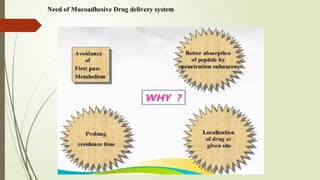
Need of Mucoadhesive Drug delivery system
 Prolong residence time of the dosage form at the site of application or
absorption.
 Intimate contact of the dosage form with the underlying absorption.
 Improve the therapeutic performance of the drug.
 High drug loading capacity.
Mucus Membrane
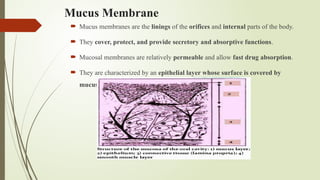
 Mucus membranes are the linings of the orifices and internal parts of the body.
 They cover, protect, and provide secretory and absorptive functions.
 Mucosal membranes are relatively permeable and allow fast drug absorption.
 They are characterized by an epithelial layer whose surface is covered by
mucus.
 Mucus
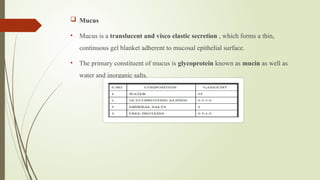
• Mucus is a translucent and visco elastic secretion , which forms a thin,
continuous gel blanket adherent to mucosal epithelial surface.
• The primary constituent of mucus is glycoprotein known as mucin as well as
water and inorganic salts.
Introduction
 Recent years, the drug delivery via mucosal drug delivery system has become
highly popular.
 Certain drugs have lack of efficacy due to decreased bioavailability,
gastrointestinal intolerance, unpredictable and erratic absorption or pre-
systemic elimination of other potential route for administration.
 Typically, mucosal drug delivery systems can be classified as:
 Non-attached mucosal drug delivery systems:
These systems are being formulated to be absorbed through the mucosa within the
oral cavity. Examples: Sublingual tablets, Fast dissolving tablets (Melt-in-mouth or
orally disintegrating tablets), etc
 Attached or immobilized mucosal drug delivery systems
These systems are being formulated to be remained attached onto the mucosal
surface by the adhesive properties.
These systems are also known as mucoadhesive systems.
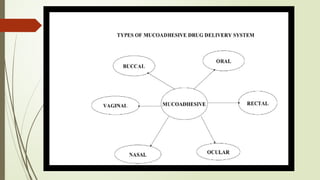
Examples: Buccal drug delivery systems, rectal drug delivery systems, vaginal drug
delivery, nasal drug delivery systems systems, etc.
 Different strategies have been adopted for controlled mucosal delivery and are
based on:
1. Prolonging solely the duration of absorption process.
2. Developing unidirectional delivery systems
3. Preparing user-friendly mucosal delivery systems
Bioadhesion:
 Bioadhesion or Mucoadhesion is the ability of a material to adhere to a
biological tissue for an extended period of time.
 The term ‘bioadhesive/ Mucoadhesives’ describes materials that bind or
adhere to the biological substrates.
 Bioadhesive’ can be defined as a material that is capable of interacting with
biological material and being retained on them or holding them together for
extended period of time.
Principles of bioadhesion /mucoadhesion
 For bioadhesion /mucoadhesion, 3 stages are involved:
 i). An intimate contact in-between a bio adhesive/mucoadhesive and a membrane
either from a good wetting of the bio adhesive/mucoadhesive and a membrane or
from the swelling of bio adhesive/mucoadhesive.
 ii). Penetration of the bio adhesive/mucoadhesive into the tissue takes place.
 iii). Inter penetration of the chains of bio adhesives/mucoadhesives with
mucous takes place and then, low chemical bonds can settle
 Theories Of Bio adhesion:
1. Electronic Theory
2. The wetting theory
3. The adsorption Theory
4. The diffusion Theory
5. The mechanical theory
6. The cohesive theory
7. The fracture theory
 Electronic Theory
 Proposes transfer of electrons amongst the surfaces due to difference in their
electrical structure resulting in the formation of an electrical double layer
thereby giving rise to attractive forces.
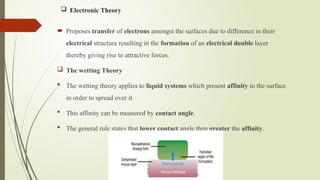
 The wetting Theory
 The wetting theory applies to liquid systems which present affinity to the surface
in order to spread over it.
 This affinity can be measured by contact angle.
 The general rule states that lower contact angle then greater the affinity.
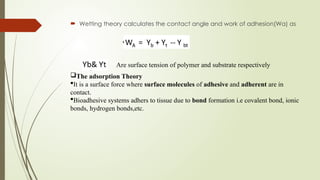
 Wetting theory calculates the contact angle and work of adhesion(Wa) as
Are surface tension of polymer and substrate respectively
The adsorption Theory
It is a surface force where surface molecules of adhesive and adherent are in
contact.
Bioadhesive systems adhers to tissue due to bond formation i.e covalent bond, ionic
bonds, hydrogen bonds,etc.
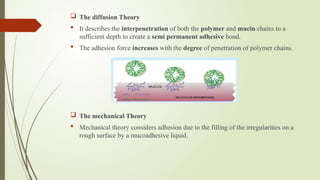
 The diffusion Theory
 It describes the interpenetration of both the polymer and mucin chains to a
sufficient depth to create a semi permanent adhesive bond.
 The adhesion force increases with the degree of penetration of polymer chains.
 The mechanical Theory
 Mechanical theory considers adhesion due to the filling of the irregularities on a
rough surface by a mucoadhesive liquid.
 Cohesive theory
 Proposes that the phenomena of bioadhesion are mainly due to the intermolecular
interactions amongst like molecules.
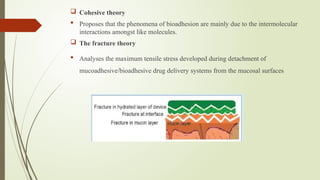
 The fracture theory
 Analyses the maximum tensile stress developed during detachment of
mucoadhesive/bioadhesive drug delivery systems from the mucosal surfaces
Advantages and disadvantages
 Advantages:
 These systems allow the developing of contact in-between the dosage forms and the
mucosa (mucoadhesion/bioadhesion)
 High drug concentration can be maintained at the absorptive surface for a prolonged
period.
 Dosage forms can be immobilized specifically at any part of the oral mucosa, buccal
mucosa, sublingual or gingival mucosa, etc
 Ease of administration
 Offers an excellent route for the systemic delivery of drugs with high first pass metabolism
, thereby offering a greater bioavailability.
 Permits localization of the drug to the oral cavity for a prolonged period of time.
 Less dosing frequency
Disadvantages:
 Small mucosal surface for contact
 Lack of flexibility of dosage forms
 Difficult to achieve high drug release rates required for some drugs.
 Extent and frequency and frequency of attachment may cause local irritation
 Drugs which irritate the oral mucosa , having bitter or unpleasant taste, odour, can
not be administered.
 Swallowing of the formulation by the patient may be possible.
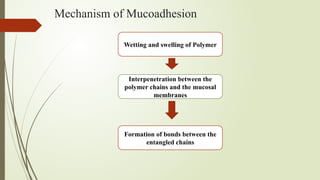
Mechanism of Mucoadhesion
Wetting and swelling of Polymer
Interpenetration between the
polymer chains and the mucosal
membranes
Formation of bonds between the
entangled chains
Step 1
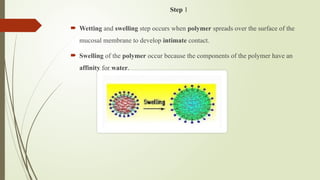
 Wetting and swelling step occurs when polymer spreads over the surface of the
mucosal membrane to develop intimate contact.
 Swelling of the polymer occur because the components of the polymer have an
affinity for water.
Step 2
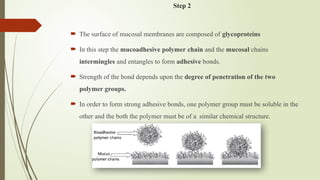
 The surface of mucosal membranes are composed of glycoproteins
 In this step the mucoadhesive polymer chain and the mucosal chains
intermingles and entangles to form adhesive bonds.
 Strength of the bond depends upon the degree of penetration of the two
polymer groups.
 In order to form strong adhesive bonds, one polymer group must be soluble in the
other and the both the polymer must be of a similar chemical structure.
Step 3
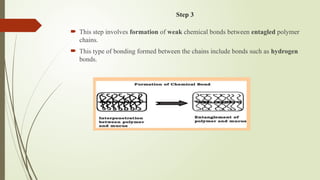
 This step involves formation of weak chemical bonds between entagled polymer
chains.
 This type of bonding formed between the chains include bonds such as hydrogen
bonds.
Transmucosal permeability
 The mucosal lining of the oral cavity is referred to as the oral mucosa.
 The oral mucosa comprises the buccal, sublingual, gingival, palatal and labial
mucosa.
 The unique environment of the transmucosal route offers its potential as an
effective route for the delivery of a variety of drugs.
 Due to rich blood supply, higher bioavailability and direct access to systemic
circulation, the transmucosal route is suitable for drugs, which are generally
susceptible to acid-hydrolysis in the gastrointestinal tract or extensively
metabolized in liver.
 oral mucosa facilitates an advantage of retaining drug delivery systems in
contact with the absorptive mucosal surface for a longer period (i.e.,
mucoadhesion) and thus, optimizing the drug concentration gradient across
the mucosal membrane with the reduction of differential pathways.
 Thus, the delivery of drugs through the transmucosal route has attracted particular
attention due to its potential for high patient compliance and unique
physiological features.
 The drugs to be administered through the transmucosal route need to be released
from the dosage forms to the effective delivery site (e.g., buccal or sublingual
area) and pass through the mucosal layers to enter the systemic circulation.
 Certain physiological features of the transmucosal route play significant roles in
this process, including pH, enzyme activity, fluid volume and the permeability of
oral mucosa.
 The secretion of saliva is also an important determinant for the performance of
transmucosal drug delivery
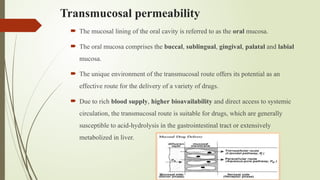
 The main mechanisms responsible for the penetration of various molecules
include two routes i.e
Transcellular Route
Paracellular Route
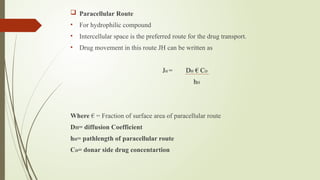
 Paracellular Route
• For hydrophilic compound
• Intercellular space is the preferred route for the drug transport.
• Drug movement in this route JH can be written as
JH = DH € CD
hH
Where € = Fraction of surface area of paracellular route
DH= diffusion Coefficient
hH= pathlength of paracellular route
CD= donar side drug concentartion
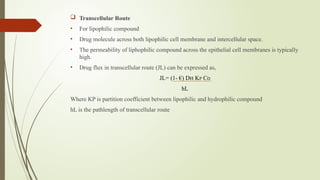
 Transcellular Route
• For lipophilic compound
• Drug molecule across both lipophilic cell membrane and intercellular space.
• The permeability of liphophilic compound across the epithelial cell membranes is typically
high.
• Drug flux in transcellular route (JL) can be expressed as,
JL= (1- €) DH KP CD
hL
Where KP is partition coefficient between lipophilic and hydrophilic compound
hL is the pathlength of transcellular route
Mucoadhesive Polymer
 Polymers which adhere to mucin epithelial surface are broadly classified as
1. Polymers that become sticky when placed in water and owe their
mucoadhesion to stickiness.
2. Polymers that adhere through non specific, non covalent interactions.
3. Polymers that bind to specific receptors sites on the cell surface.
Ideal characterisitcs of Mucoadhesive
Polymer
 The polymer and its degradation product should be non toxic.
 Non irritant to mucous membrane.
 Should adhere quickly to moist tissue.
 Should allow easy incorporation of drug.
 Should be economic
 Should have an optimum degree of cross linking density , pH, and hydration.
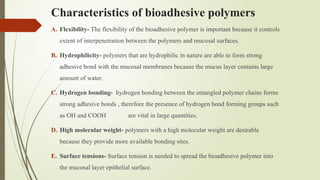
Characteristics of bioadhesive polymers
A. Flexibility- The flexibility of the bioadhesive polymer is important because it controls
extent of interpenetration between the polymers and mucosal surfaces.
B. Hydrophilicity- polymers that are hydrophilic in nature are able to form strong
adhesive bond with the mucosal membranes because the mucus layer contains large
amount of water.
C. Hydrogen bonding- hydrogen bonding between the entangled polymer chains forms
strong adhesive bonds , therefore the presence of hydrogen bond forming groups such
as OH and COOH are vital in large quantities.
D. High molecular weight- polymers with a high molecular weight are desirable
because they provide more available bonding sites.
E. Surface tensions- Surface tension is needed to spread the bioadhesive polymer into
the mucosal layer epithelial surface.
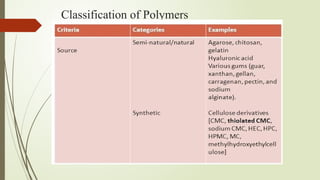
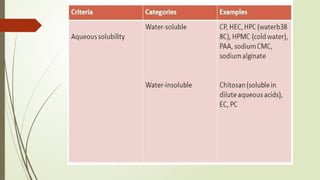
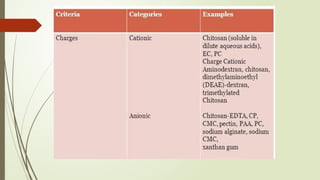
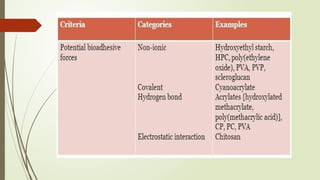
Classification of Polymers
Formulation considerations of buccal
delivery systems
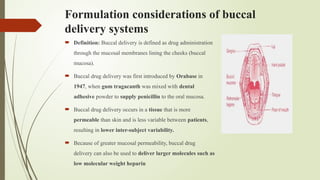
 Definition: Buccal delivery is defined as drug administration
through the mucosal membranes lining the cheeks (buccal
mucosa).
 Buccal drug delivery was first introduced by Orabase in
1947, when gum tragacanth was mixed with dental
adhesive powder to supply penicillin to the oral mucosa.
 Buccal drug delivery occurs in a tissue that is more
permeable than skin and is less variable between patients,
resulting in lower inter-subject variability.
 Because of greater mucosal permeability, buccal drug
delivery can also be used to deliver larger molecules such as
low molecular weight heparin
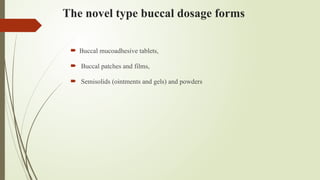
The novel type buccal dosage forms
 Buccal mucoadhesive tablets,
 Buccal patches and films,
 Semisolids (ointments and gels) and powders
Buccal Mucoadhesive tablets
 The bioadhesive tablets are most preferable mucoadhesive device in order to
improve bioavailability.
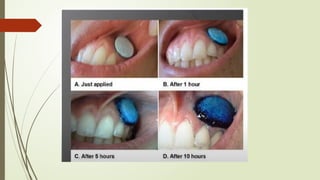
 Buccal tablets are small, flat, and oval shaped dosage form.
 They soften, adhere to the mucosa, and are retained in position until dissolution
and or release is complete.
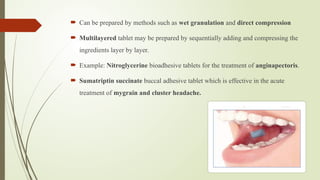
 Tablets are placed in buccal pouch below the muscles of teeth.
 These tablets can be applied to different sites in the oral cavity, including the
palate, the mucosa lining, the cheek, as well as the lip and the gum.
 Mechanism of drug release is erosion.
 Can be prepared by methods such as wet granulation and direct compression
 Multilayered tablet may be prepared by sequentially adding and compressing the
ingredients layer by layer.
 Example: Nitroglycerine bioadhesive tablets for the treatment of anginapectoris.
 Sumatriptin succinate buccal adhesive tablet which is effective in the acute
treatment of mygrain and cluster headache.
Evaluation tests of mucoadhesive tablets
 Weight variation
 Friability
 Hardness
 Content Uniformity
 Drug release study
 Swelling index
 Water sorption studies
 Mucoadhesive strength
Buccal patches and films
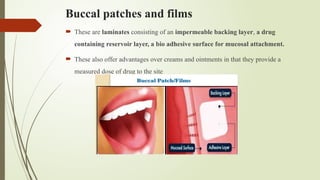
 These are laminates consisting of an impermeable backing layer, a drug
containing reservoir layer, a bio adhesive surface for mucosal attachment.
 These also offer advantages over creams and ointments in that they provide a
measured dose of drug to the site
 Two methods are used to prepare adhesive patches include Solvent casting and direct
milling
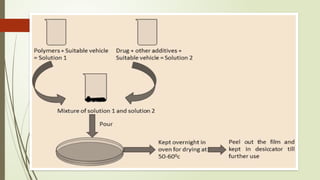
 Solvent casting method
• In this method the intermediate sheet from which patches are prepared by casting the
solution of the drug and polymer onto a backing layer sheet and subsequently allowing the
solvents to evaporate
• The drug and excipients is dissolved in appropriate solvent and water soluble polymers
are dissolved in water and these solutions are stirred and at last casted into the petri plate
and dries.
 Direct milling
• In this method formulation constituents are homogenously mixed and
compressed to the desired thickness, and patches of predetermined size and
shape are then cut or punched out.
• Recent years, buccal patches and films have received the greatest attention for
buccal delivery of drugs .
• They present a greater patient compliance compared with tablets owing to their
physical flexibility that causes only minor discomfort to the patient.
Structure and design of buccal patches
 Buccal patches are of two types on the basis of their release characteristics:
i). Unidirectional buccal patches and
ii). Bidirectional buccal patches
• Unidirectional patches release the drug only into the mucosa, while
bidirectional patches release drug in both the mucosa and the mouth
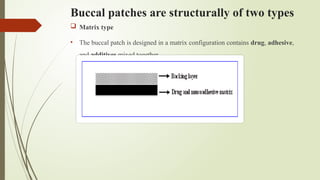
Buccal patches are structurally of two types
 Matrix type
• The buccal patch is designed in a matrix configuration contains drug, adhesive,
and additives mixed together
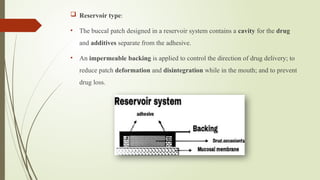
 Reservoir type:
• The buccal patch designed in a reservoir system contains a cavity for the drug
and additives separate from the adhesive.
• An impermeable backing is applied to control the direction of drug delivery; to
reduce patch deformation and disintegration while in the mouth; and to prevent
drug loss.
Composition of Buccal patches
 Drugs
The selection of suitable drug for the design of buccal drug delivery systems should be based
on pharmacokinetic properties of the drugs to be administered.
The drug should have following characteristics for the designing of effective buccal patches:
The conventional single dose of the drug should be small.
 The drugs having biological half-life between 2-8 h are good candidates for controlled
drug delivery.
 Through oral route drug may exhibit first pass effect or pre-systemic drug elimination.
 The drug absorption should be passive when given orally
Polymers (adhesive layer)
 Bioadhesive polymers play a major role in the designing of buccal patches.
 These polymers enable retention of dosage form at the buccal mucosal surface
and thereby provide intimate contact between the dosage form and the absorbing
tissue.
 Drug release from a polymeric material takes place either by the diffusion or by
polymer degradation or by a combination of the both
 Polymer degradation generally takes place by the enzymes or hydrolysis either in
the form of bulk erosion or surface erosion.
 An ideal bioadhesive polymer for buccal patches should have following
characteristics
• The polymer should be inert and compatible with the buccal environment.
• It should allow easy incorporation of drug in to the formulation.
• The polymer and its degradation products should be non-toxic absorbable from the
mucous layer.
• It should adhere quickly to moist tissue surface and should possess the site
specificity.
• It should form a strong non covalent bond with the mucine or epithelial surface
and should possess sufficient mechanical strength.
• The polymer must not decompose on storage or during the shelf life of the dosage
form.
• It must have high molecular weight
• The polymer should be easily available in the market and economical.
• The polymer should have good spreadability, wetting, swelling and solubility and
biodegradability properties.
• The pH of the polymer should be biocompatible and should possess good
viscoelastic properties.
• It should demonstrate local enzyme inhibition and penetration enhancement
properties.
• It should demonstrate acceptable shelf life.
 Backing layer
 Backing layer plays a major role in the attachment of buccal patches to the
mucus membrane.
 The materials used as backing membrane should be inert, and impermeable to
the drug and penetration enhancer.
 Such impermeable membrane on buccoadhesive patches prevents the drug loss
and offers better patient compliance.
 The commonly used materials in backing membrane include water insoluble
polymers such as ethylcellulose, Eudrajit RL and RS, etc.
 Penetration enhancer
 Substances that facilitate the permeation through buccal mucosa are referred as
permeation enhancers.
 Selection of the appropriate permeation enhancer and its efficacy depends on the
physicochemical properties of the drug, site of administration, nature of the vehicle
and other excipients.
 Permeation enhancers used for designing buccal patches must be nonirritant and
have a reversible effect.
 The epithelium should recover its barrier properties after the drug has been
absorbed.
 The most common classes of buccal penetration enhancers include fatty acids that
act by disrupting intercellular lipid packing, surfactants, bile salts, and alcohols.
 Example: Sodium lauryl Sulpate, polysorbate 80
 Plasticizers:
 To impart appropriate plasticity of the buccal patches, suitable plasticizers are required
to add in the formulation of buccal patches.
 Typically, the plasticizers are used in the concentration of 0-20 % w/w of dry polymer.
 Plasticizer is an important ingredient of the film, which improves the flexibility of the
film and reduces the bitterness of the film by reducing the glass transition temperature
of the film.
 The selection of plasticizer depends upon the compatibility with the polymer and type
of solvent employed in the casting of film.
 Plasticizers should be carefully selected because improper use of the plasticizers
affects the mechanical properties of the film.
 Widely used plasticizers in buccal patches and films are PEG100, 400, propylene
glycol, glycerol, castor oil etc
 Taste masking agents
 Taste masking agents or taste masking methods should be used in the formulation
if the drugs have bitter taste, as the bitter drugs makes the formulation
unpalatable, especially for pediatric preparations.
 Various methods can be used to improve the palatability of the formulation, such
as complexation technology`
Evaluation tests of buccal patches
 Mass uniformity and thickness
 Folding endurance
 Drug content
 Swelling index
 Measurement of surface pH
 Residence time
 Bioadhesion test
 Permeability test
 Release rate study
 Semisolids (ointments and gels):
 Bioadhesive gels or ointments have less patient acceptability than solid
bioadhesive dosage forms, and most of the dosage forms are used only for
localized drug therapy within the oral cavity.
Mechanism of Buccal absorption
 Buccal absorption leads systemic or local action via the buccal mucosa.
 occurs by passive diffusion of the non ionized species, a process governed
primarily by a concentration gradient, through the intercellular spaces of the
epithelium.
Factors affecting Buccal absorption
1. Membrane Factors
 surface area available for absorption, mucus layer of salivary pellicle,
intercellular lipids of epithelium, basement membrane and lamina propria.
 In addition, the absorptive membrane thickness, blood supply/ lymph drainage,
cell renewal and enzyme content will all contribute to reducing the rate and
amount of drug entering the systemic circulation.
Environmental Factors
Saliva:
• The thin film of saliva coats throughout the lining of buccal mucosa and is called
salivary pellicle or film.
• The thickness of salivary film is 0.07-0.10 mm.
• The thickness, composition and movement of this film affect the rate of buccal
absorption
 Salivary glands
 located in epithelial or deep epithelial region of buccal mucosa.
 They constantly secrete mucus on surface of buccal mucosa. Although, mucus helps
Advantages of buccal drug delivery systems
 Sustained drug delivery.
 Increased ease of drug administration.
 Excellent accessibility.
 Drug absorption through the passive diffusion.
 Low enzymatic activity, suitability for drugs or excipients that mildly and reversibly
damages or irritates the mucosa, painless administration, easy drug withdrawal, facility
to include permeation.
 Versatility in designing as multidirectional or unidirectional release systems for local
or systemic actions, etc.
 The drug is protected from degradation due to pH and digestive enzymes of the middle
gastrointestinal tract.
 Improved patient compliance.
Limitations of buccal drug delivery systems
 For local action the rapid elimination of drugs due to the flushing action of saliva
or the ingestion of foods stuffs may lead to the requirement for frequent dosing.
 The non-uniform distribution of drugs within saliva on release from a solid or
semisolid delivery system could mean that some areas of the oral cavity may not
receive effective levels.
 For both local and systemic action, patient acceptability in terms of taste,
irritancy and ‘mouth feel’ is an issue.
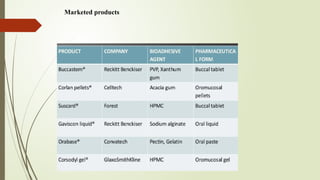
Marketed products
THANK YOU