Cubosomes: A Cutting-edge Nanostructured
Drug Delivery Technological innovation for Controlled and
Targeted Release
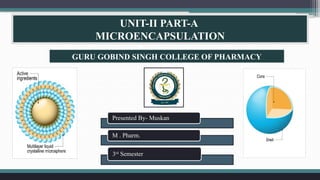
UNIT-II PART-A
MICROENCAPSULATION
Presented By- Muskan
M . Pharm.
3rd
Semester
GURU GOBIND SINGH COLLEGE OF PHARMACY
Content
â—Ź Introduction
â—Ź Advantages & Disadvantages
â—Ź Core material & Coating material
â—Ź Polymers used
â—Ź Microsphere, Microcapsule, Micro particles
â—Ź Classification of microcapsule
â—Ź Methods of microencapsulation
â—Ź Applications
Introduction
Microencapsulation is a technique by which thin
coatings of wall material are formed around the
substances which may be solids, liquids or even
gases, enclosed in microscopic particles.
Microencapsulation is described as a process of
enclosing micron sized particles of solids or
droplets of liquids or gasses in an inert shell,
which in turn isolates and protects them from the
external environment as well as control the drug
release profile.
Size of the microencapsulated products is
considered 1- 1000 um in diameter.
Commercially available microparticles contain
10-90% w/w core.
Advantages
â—Ź To Increase of bioavailability.
â—Ź To produce a targeted drug delivery
â—Ź To provide environmental protection of the core material from moisture, light, and
oxygen.
â—Ź It enhances the solubility of poorly soluble drugs and the safe handling of toxic
medications.
â—Ź It Masks the taste of bitter drugs to make them more palatable and improving patient
compliance.
â—Ź To decrease evaporation rate of the core material. (Reduction of volatility).
â—Ź Formulation of sustained controlled release dosage forms can be done by modifying
or delaying release of encapsulated active agents or core materials.
Disadvantages
â—Ź The core particle's stability is affected by the change in the process conditions like
change in temperature, pH, solvent addition, or evaporation of the solvent
â—Ź Expensive technique.
â—Ź This causes reduction in shelf-life of hygroscopic agents.
â—Ź Microencapsulation coating may not be uniform and this can influence the release of
encapsulated materials
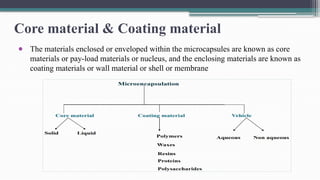
Core material & Coating material
â—Ź The materials enclosed or enveloped within the microcapsules are known as core
materials or pay-load materials or nucleus, and the enclosing materials are known as
coating materials or wall material or shell or membrane
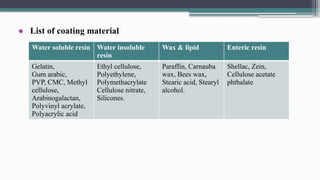
â—Ź List of coating material
Water soluble resin Water insoluble
resin
Wax & lipid Enteric resin
Gelatin,
Gum arabic,
PVP, CMC, Methyl
cellulose,
Arabinogalactan,
Polyvinyl acrylate,
Polyacrylic acid
Ethyl cellulose,
Polyethylene,
Polymethacrylate
Cellulose nitrate,
Silicones.
Paraffin, Carnauba
wax, Bees wax,
Stearic acid, Stearyl
alcohol.
Shellac, Zein,
Cellulose acetate
phthalate
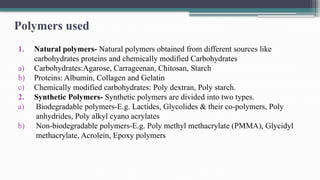
Polymers used
1. Natural polymers- Natural polymers obtained from different sources like
carbohydrates proteins and chemically modified Carbohydrates
a) Carbohydrates:Agarose, Carrageenan, Chitosan, Starch
b) Proteins: Albumin, Collagen and Gelatin
c) Chemically modified carbohydrates: Poly dextran, Poly starch.
2. Synthetic Polymers- Synthetic polymers are divided into two types.
a) Biodegradable polymers-E.g. Lactides, Glycolides & their co-polymers, Poly
anhydrides, Poly alkyl cyano acrylates
b) Non-biodegradable polymers-E.g. Poly methyl methacrylate (PMMA), Glycidyl
methacrylate, Acrolein, Epoxy polymers
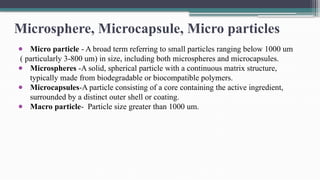
Microsphere, Microcapsule, Micro particles
â—Ź Micro particle - A broad term referring to small particles ranging below 1000 um
( particularly 3-800 um) in size, including both microspheres and microcapsules.
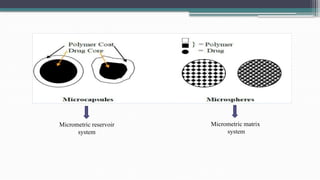
â—Ź Microspheres -A solid, spherical particle with a continuous matrix structure,
typically made from biodegradable or biocompatible polymers.
â—Ź Microcapsules-A particle consisting of a core containing the active ingredient,
surrounded by a distinct outer shell or coating.
â—Ź Macro particle- Particle size greater than 1000 um.
Micrometric reservoir
system
Micrometric matrix
system
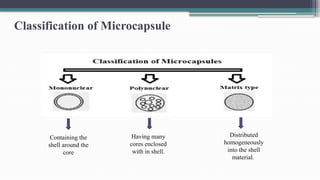
Classification of Microcapsule
Containing the
shell around the
core
Having many
cores enclosed
with in shell.
Distributed
homogeneously
into the shell
material.
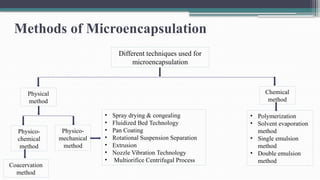
Methods of Microencapsulation
Different techniques used for
microencapsulation
Physical
method
Chemical
method
Physico-
chemical
method
Physico-
mechanical
method
• Polymerization
• Solvent evaporation
method
• Single emulsion
method
• Double emulsion
method
Coacervation
method
• Spray drying & congealing
• Fluidized Bed Technology
• Pan Coating
• Rotational Suspension Separation
• Extrusion
• Nozzle Vibration Technology
• Multiorifice Centrifugal Process
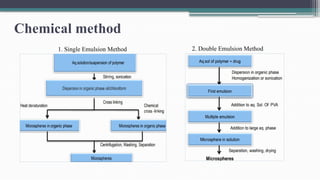
Chemical method
1. Single Emulsion Method 2. Double Emulsion Method
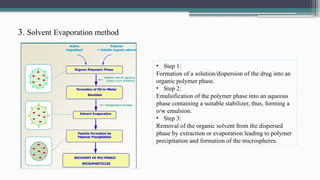
3. Solvent Evaporation method
• Step 1:
Formation of a solution/dispersion of the drug into an
organic polymer phase.
• Step 2:
Emulsification of the polymer phase into an aqueous
phase containing a suitable stabilizer, thus, forming a
o/w emulsion.
• Step 3:
Removal of the organic solvent from the dispersed
phase by extraction or evaporation leading to polymer
precipitation and formation of the microspheres.
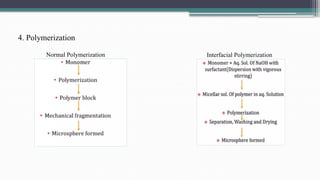
4. Polymerization
Normal Polymerization Interfacial Polymerization
Physical method
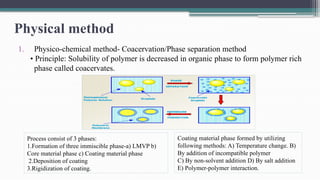
1. Physico-chemical method- Coacervation/Phase separation method
• Principle: Solubility of polymer is decreased in organic phase to form polymer rich
phase called coacervates.
Process consist of 3 phases:
1.Formation of three immiscible phase-a) LMVP b)
Core material phase c) Coating material phase
2.Deposition of coating
3.Rigidization of coating.
Coating material phase formed by utilizing
following methods: A) Temperature change. B)
By addition of incompatible polymer
C) By non-solvent addition D) By salt addition
E) Polymer-polymer interaction.
2.Physico-mechanical method
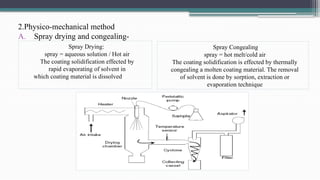
A. Spray drying and congealing-
Spray Drying:
spray = aqueous solution / Hot air
The coating solidification effected by
rapid evaporating of solvent in
which coating material is dissolved
Spray Congealing
spray = hot melt/cold air
The coating solidification is effected by thermally
congealing a molten coating material. The removal
of solvent is done by sorption, extraction or
evaporation technique
B. Pan Coating method
• Pan coating is a physical method of
preparing microencapsulation and it can
only be used for particles greater than 600
microns in diameter.
• The coating solution is applied as
atomized spray to the solid core material
in the coating pan.
• To remove the coating solvent warm air
is passed over the coated material
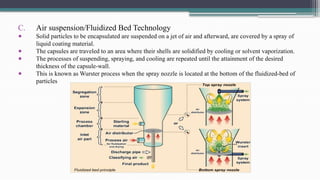
C. Air suspension/Fluidized Bed Technology
â—Ź Solid particles to be encapsulated are suspended on a jet of air and afterward, are covered by a spray of
liquid coating material.
â—Ź The capsules are traveled to an area where their shells are solidified by cooling or solvent vaporization.
â—Ź The processes of suspending, spraying, and cooling are repeated until the attainment of the desired
thickness of the capsule-wall.
â—Ź This is known as Wurster process when the spray nozzle is located at the bottom of the fluidized-bed of
particles
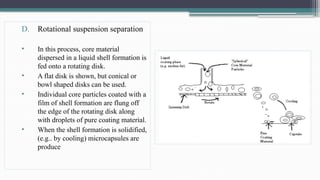
D. Rotational suspension separation
• In this process, core material
dispersed in a liquid shell formation is
fed onto a rotating disk.
• A flat disk is shown, but conical or
bowl shaped disks can be used.
• Individual core particles coated with a
film of shell formation are flung off
the edge of the rotating disk along
with droplets of pure coating material.
• When the shell formation is solidified,
(e.g.. by cooling) microcapsules are
produce
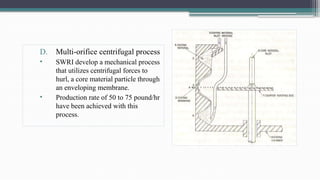
D. Multi-orifice centrifugal process
• SWRI develop a mechanical process
that utilizes centrifugal forces to
hurl, a core material particle through
an enveloping membrane.
• Production rate of 50 to 75 pound/hr
have been achieved with this
process.
E. Extrusion-
Process involves following steps-
i. Core Material Dispersion → Core material is
mixed with a molten carbohydrate mass.
ii. Extrusion → The mixture is forced through dies
into a dehydrating liquid bath.
iii. Hardening → The carbohydrate case hardens
upon contact with the liquid, entrapping the core.
iv. Separation → The hardened filaments are
separated from the liquid bath.
v. Drying → The filaments are dried using an anti-
caking agent (e.g., calcium tri polyphosphate).
vi. Final Product → Microencapsulated particles
formed
F. Nozzle Vibration technology-
Applications
â—Ź Can be used to formulate various sustained controlled release dosage forms by modifying or
delaying release of encapsulated active agents or core materials
â—Ź Employed to formulate enteric-coated dosage forms,
â—Ź Gastric irritant drugs are being microencapsulated to reduce the chances of gastric irritation- eg.
sustained release Aspirin preparations have been reported to cause significantly less G.I.
bleeding than conventional preparations.
â—Ź The taste of bitter drug candidates can be masked- eg. Paracetamol, Nitrofurantoin
â—Ź liquids and gases can be changed into solid particles in the form of microcapsules.
â—Ź Provides environmental protection to the encapsulated active agents from various environmental
issues, such as light, heat, humidity, oxidation e.g., Vitamin-A Palmitate.
â—Ź Microencapsulation can be used to decrease the volatility. A microencapsulated volatile
substance can be stored for longer times without any substantial evaporation.
â—Ź The hygroscopic characteristics of many core materials can be reduced by microencapsulation
e.g., Sodium chloride.
THANKYOU