MICROENCAPSULATION
By
SANA TABASSUM
(B.Pharm)
Under the guidance of
Mrs.Ch.S VIJAYA VANI,M.Pharm.
Associate Professor,
Department of Pharmaceutics.
A
Presentation
On
CMR COLLEGE OF PHARMACY
DEFINITION
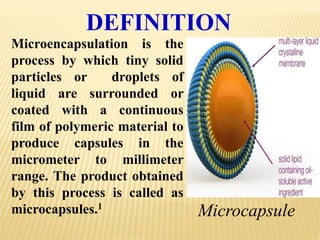
Microencapsulation is the
process by which tiny solid
particles or droplets of
liquid are surrounded or
coated with a continuous
film of polymeric material to
produce capsules in the
micrometer to millimeter
range. The product obtained
by this process is called as
microcapsules.1
Microcapsule
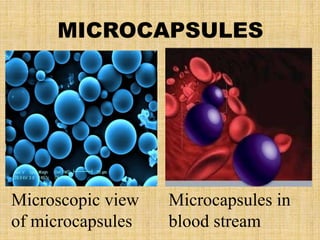
MICROCAPSULES
Microcapsules in
blood stream
Microscopic view
of microcapsules
Advantages of microencapsulation
Masking of bitter taste drugs. Eg: Ofloxacin.
Conversion of liquid to pseudo solid.
Eg: Eprazinone.2
Environmental protection.
Eg: Vit.A.Palmitate.
 Reduction of hygroscopicity .Eg: NaCl.
 Reduction of vaporization of volatile drugs.
Eg: Methyl salicylate.
Prevention of incompatibilities among drugs.
Eg: Aspirin and Chlorpheniramine maleate .2
Disadvantages of Microencapsulation.
Possible cross reaction between core and
shell material.
Difficult to achieve continuous and uniform
film.
Shelf life of hygroscopic drugs is
reduced.
More production costs.
More skill and knowledge is required.2
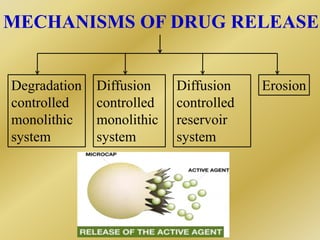
MECHANISMS OF DRUG RELEASE
Degradation
controlled
monolithic
system
Diffusion
controlled
monolithic
system
Diffusion
controlled
reservoir
system
Erosion
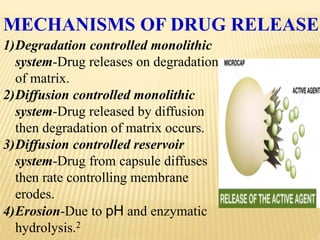
MECHANISMS OF DRUG RELEASE
1)Degradation controlled monolithic
system-Drug releases on degradation
of matrix.
2)Diffusion controlled monolithic
system-Drug released by diffusion
then degradation of matrix occurs.
3)Diffusion controlled reservoir
system-Drug from capsule diffuses
then rate controlling membrane
erodes.
4)Erosion-Due to pH and enzymatic
hydrolysis.2
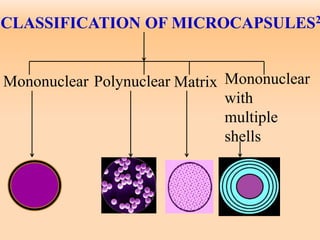
CLASSIFICATION OF MICROCAPSULES2
Mononuclear Polynuclear Matrix Mononuclear
with
multiple
shells
MATERIALS INVOLVED IN FORMULATION
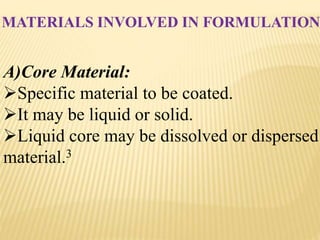
A)Core Material:
Specific material to be coated.
It may be liquid or solid.
Liquid core may be dissolved or dispersed
material.3
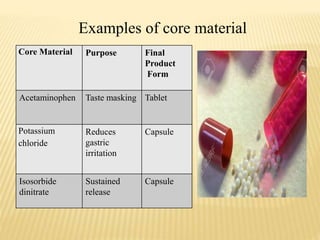
Core Material Purpose Final
Product
Form
Acetaminophen Taste masking Tablet
Potassium
chloride
Reduces
gastric
irritation
Capsule
Isosorbide
dinitrate
Sustained
release
Capsule
Examples of core material
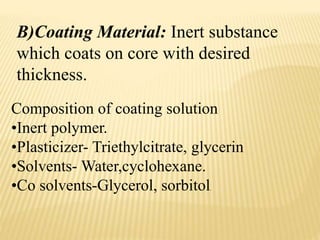
B)Coating Material: Inert substance
which coats on core with desired
thickness.
Composition of coating solution
•Inert polymer.
•Plasticizer- Triethylcitrate, glycerin
•Solvents- Water,cyclohexane.
•Co solvents-Glycerol, sorbitol.
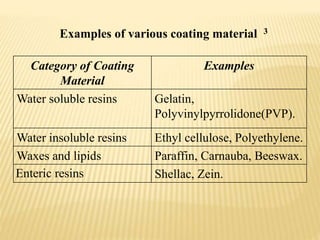
Examples of various coating material 3
Category of Coating
Material
Examples
Water soluble resins Gelatin,
Polyvinylpyrrolidone(PVP).
Water insoluble resins Ethyl cellulose, Polyethylene.
Waxes and lipids Paraffin, Carnauba, Beeswax.
Enteric resins Shellac, Zein.
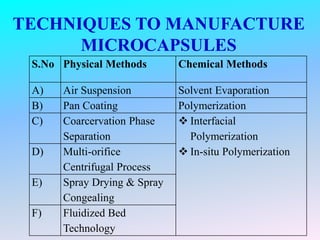
TECHNIQUES TO MANUFACTURE
MICROCAPSULES
S.No Physical Methods Chemical Methods
A) Air Suspension Solvent Evaporation
B) Pan Coating Polymerization
C) Coarcervation Phase
Separation
 Interfacial
Polymerization
 In-situ PolymerizationD) Multi-orifice
Centrifugal Process
E) Spray Drying & Spray
Congealing
F) Fluidized Bed
Technology
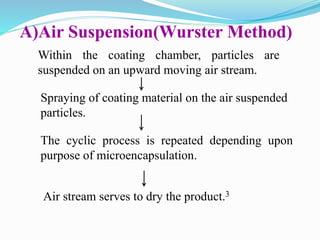
A)Air Suspension(Wurster Method)
Within the coating chamber, particles are
suspended on an upward moving air stream.
Spraying of coating material on the air suspended
particles.
The cyclic process is repeated depending upon
purpose of microencapsulation.
Air stream serves to dry the product.3
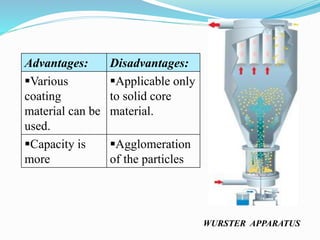
Advantages: Disadvantages:
Various
coating
material can be
used.
Applicable only
to solid core
material.
Capacity is
more
Agglomeration
of the particles
WURSTER APPARATUS
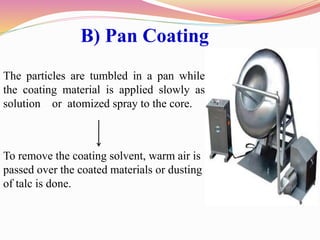
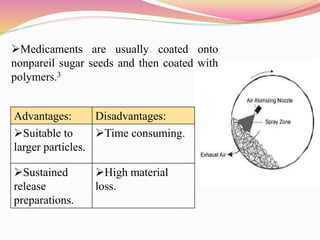
B) Pan Coating
The particles are tumbled in a pan while
the coating material is applied slowly as
solution or atomized spray to the core.
To remove the coating solvent, warm air is
passed over the coated materials or dusting
of talc is done.
Medicaments are usually coated onto
nonpareil sugar seeds and then coated with
polymers.3
Advantages: Disadvantages:
Suitable to
larger particles.
Time consuming.
Sustained
release
preparations.
High material
loss.
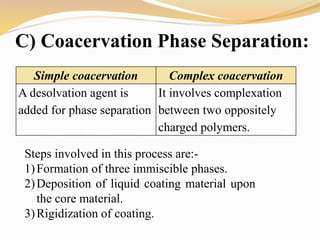
C) Coacervation Phase Separation:
Simple coacervation Complex coacervation
A desolvation agent is
added for phase separation
It involves complexation
between two oppositely
charged polymers.
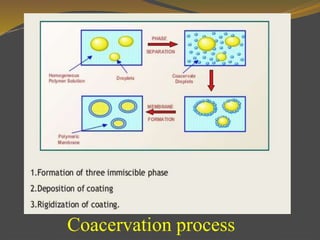
Steps involved in this process are:-
1)Formation of three immiscible phases.
2)Deposition of liquid coating material upon
the core material.
3)Rigidization of coating.
Coacervation process
Various methods to obtain three immiscible phases:
1) Temperature change
2) Incompatible Polymer Addition
3) Non-Solvent Addition
4) Salt Addition
5) Polymer-Polymer Interaction(Complex Coacervation)
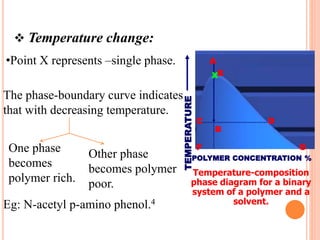
 Temperature change:
Temperature-composition
phase diagram for a binary
system of a polymer and a
solvent.
TEMPERATURE
POLYMER CONCENTRATION %
X
A
B
C D
E
F G
•Point X represents –single phase.
The phase-boundary curve indicates
that with decreasing temperature.
One phase
becomes
polymer rich.
Other phase
becomes polymer
poor.
Eg: N-acetyl p-amino phenol.4
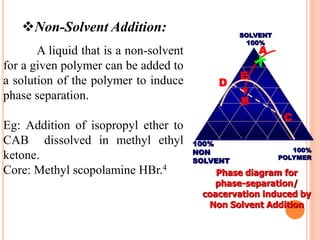
Non-Solvent Addition:
A liquid that is a non-solvent
for a given polymer can be added to
a solution of the polymer to induce
phase separation.
Eg: Addition of isopropyl ether to
CAB dissolved in methyl ethyl
ketone.
Core: Methyl scopolamine HBr.4
A
B
C
D
E
SOLVENT
100%
100%
POLYMER
100%
NON
SOLVENT
Phase diagram for
phase-separation/
coacervation induced by
Non Solvent Addition
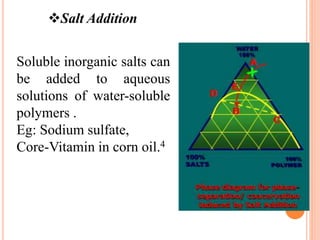
Salt Addition
Soluble inorganic salts can
be added to aqueous
solutions of water-soluble
polymers .
Eg: Sodium sulfate,
Core-Vitamin in corn oil.4
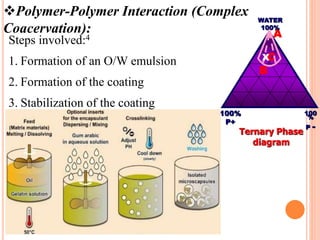
Polymer-Polymer Interaction (Complex
Coacervation):
Steps involved:4
1. Formation of an O/W emulsion
2. Formation of the coating
3. Stabilization of the coating
A
C
B
WATER
100%
100
%
P -
100%
P+
Ternary Phase
diagram
X
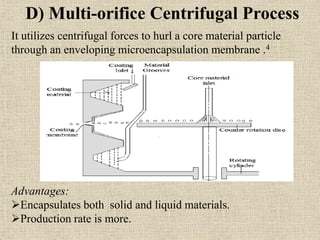
D) Multi-orifice Centrifugal Process
Advantages:
Encapsulates both solid and liquid materials.
Production rate is more.
It utilizes centrifugal forces to hurl a core material particle
through an enveloping microencapsulation membrane .4
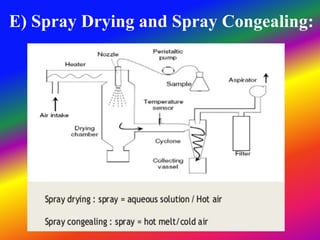
E) Spray Drying and Spray Congealing:
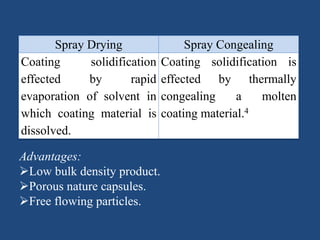
Spray Drying Spray Congealing
Coating solidification
effected by rapid
evaporation of solvent in
which coating material is
dissolved.
Coating solidification is
effected by thermally
congealing a molten
coating material.4
Advantages:
Low bulk density product.
Porous nature capsules.
Free flowing particles.
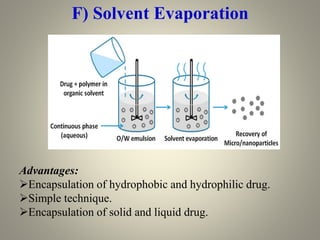
F) Solvent Evaporation
Advantages:
Encapsulation of hydrophobic and hydrophilic drug.
Simple technique.
Encapsulation of solid and liquid drug.
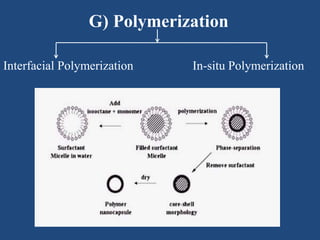
G) Polymerization
Interfacial Polymerization In-situ Polymerization
NOVEL METHODS
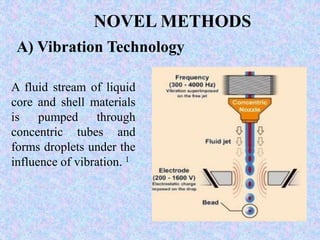
A) Vibration Technology
A fluid stream of liquid
core and shell materials
is pumped through
concentric tubes and
forms droplets under the
influence of vibration. 1
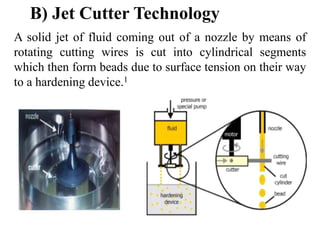
B) Jet Cutter Technology
A solid jet of fluid coming out of a nozzle by means of
rotating cutting wires is cut into cylindrical segments
which then form beads due to surface tension on their way
to a hardening device.1
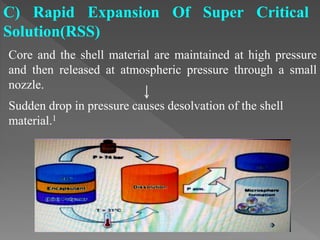
C) Rapid Expansion Of Super Critical
Solution(RSS)
Core and the shell material are maintained at high pressure
and then released at atmospheric pressure through a small
nozzle.
Sudden drop in pressure causes desolvation of the shell
material.1
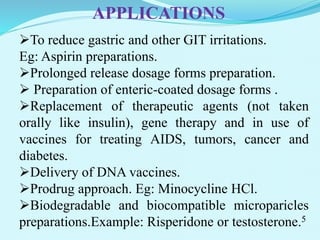
APPLICATIONS
To reduce gastric and other GIT irritations.
Eg: Aspirin preparations.
Prolonged release dosage forms preparation.
 Preparation of enteric-coated dosage forms .
Replacement of therapeutic agents (not taken
orally like insulin), gene therapy and in use of
vaccines for treating AIDS, tumors, cancer and
diabetes.
Delivery of DNA vaccines.
Prodrug approach. Eg: Minocycline HCl.
Biodegradable and biocompatible microparicles
preparations.Example: Risperidone or testosterone.5
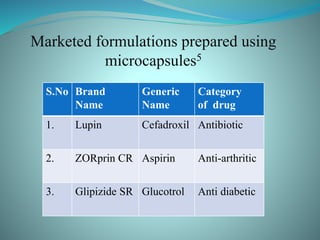
Marketed formulations prepared using
microcapsules5
S.No Brand
Name
Generic
Name
Category
of drug
1. Lupin Cefadroxil Antibiotic
2. ZORprin CR Aspirin Anti-arthritic
3. Glipizide SR Glucotrol Anti diabetic
REFERENCES
1. http://www.authorstream.com/Presentation/vivekchauhan-
1147305-microencapsulation.
2. Hammad umer et.al,” International Journal of Research in
Pharmaceutical and Biomedical Sciences” ISSN: 2229-
3701.
3. S. S. Bansode et.al,” Institute of Pharmaceutical Education
And Research”, Volume 1, Issue 2, March –April 2010;
Article 008 .
4. Lachman LA, Liberman HA, Kanig JL. The Theory and
Practice of Industrial Pharmacy. Mumbai, India: Varghese
Publishing House; 3:414-415.
5. http://www.authorstream.com/Presentation/thokesagar-
1295371-shree/
Ppt microencapsulation

Ppt microencapsulation

  • 1.
    MICROENCAPSULATION By SANA TABASSUM (B.Pharm) Under theguidance of Mrs.Ch.S VIJAYA VANI,M.Pharm. Associate Professor, Department of Pharmaceutics. A Presentation On CMR COLLEGE OF PHARMACY
  • 2.
    DEFINITION Microencapsulation is the processby which tiny solid particles or droplets of liquid are surrounded or coated with a continuous film of polymeric material to produce capsules in the micrometer to millimeter range. The product obtained by this process is called as microcapsules.1 Microcapsule
  • 3.
  • 4.
    Advantages of microencapsulation Maskingof bitter taste drugs. Eg: Ofloxacin. Conversion of liquid to pseudo solid. Eg: Eprazinone.2 Environmental protection. Eg: Vit.A.Palmitate.  Reduction of hygroscopicity .Eg: NaCl.  Reduction of vaporization of volatile drugs. Eg: Methyl salicylate. Prevention of incompatibilities among drugs. Eg: Aspirin and Chlorpheniramine maleate .2
  • 5.
    Disadvantages of Microencapsulation. Possiblecross reaction between core and shell material. Difficult to achieve continuous and uniform film. Shelf life of hygroscopic drugs is reduced. More production costs. More skill and knowledge is required.2
  • 6.
    MECHANISMS OF DRUGRELEASE Degradation controlled monolithic system Diffusion controlled monolithic system Diffusion controlled reservoir system Erosion
  • 7.
    MECHANISMS OF DRUGRELEASE 1)Degradation controlled monolithic system-Drug releases on degradation of matrix. 2)Diffusion controlled monolithic system-Drug released by diffusion then degradation of matrix occurs. 3)Diffusion controlled reservoir system-Drug from capsule diffuses then rate controlling membrane erodes. 4)Erosion-Due to pH and enzymatic hydrolysis.2
  • 8.
    CLASSIFICATION OF MICROCAPSULES2 MononuclearPolynuclear Matrix Mononuclear with multiple shells
  • 9.
    MATERIALS INVOLVED INFORMULATION A)Core Material: Specific material to be coated. It may be liquid or solid. Liquid core may be dissolved or dispersed material.3
  • 10.
    Core Material PurposeFinal Product Form Acetaminophen Taste masking Tablet Potassium chloride Reduces gastric irritation Capsule Isosorbide dinitrate Sustained release Capsule Examples of core material
  • 11.
    B)Coating Material: Inertsubstance which coats on core with desired thickness. Composition of coating solution •Inert polymer. •Plasticizer- Triethylcitrate, glycerin •Solvents- Water,cyclohexane. •Co solvents-Glycerol, sorbitol.
  • 12.
    Examples of variouscoating material 3 Category of Coating Material Examples Water soluble resins Gelatin, Polyvinylpyrrolidone(PVP). Water insoluble resins Ethyl cellulose, Polyethylene. Waxes and lipids Paraffin, Carnauba, Beeswax. Enteric resins Shellac, Zein.
  • 13.
    TECHNIQUES TO MANUFACTURE MICROCAPSULES S.NoPhysical Methods Chemical Methods A) Air Suspension Solvent Evaporation B) Pan Coating Polymerization C) Coarcervation Phase Separation  Interfacial Polymerization  In-situ PolymerizationD) Multi-orifice Centrifugal Process E) Spray Drying & Spray Congealing F) Fluidized Bed Technology
  • 14.
    A)Air Suspension(Wurster Method) Withinthe coating chamber, particles are suspended on an upward moving air stream. Spraying of coating material on the air suspended particles. The cyclic process is repeated depending upon purpose of microencapsulation. Air stream serves to dry the product.3
  • 15.
    Advantages: Disadvantages: Various coating material canbe used. Applicable only to solid core material. Capacity is more Agglomeration of the particles WURSTER APPARATUS
  • 16.
    B) Pan Coating Theparticles are tumbled in a pan while the coating material is applied slowly as solution or atomized spray to the core. To remove the coating solvent, warm air is passed over the coated materials or dusting of talc is done.
  • 17.
    Medicaments are usuallycoated onto nonpareil sugar seeds and then coated with polymers.3 Advantages: Disadvantages: Suitable to larger particles. Time consuming. Sustained release preparations. High material loss.
  • 18.
    C) Coacervation PhaseSeparation: Simple coacervation Complex coacervation A desolvation agent is added for phase separation It involves complexation between two oppositely charged polymers. Steps involved in this process are:- 1)Formation of three immiscible phases. 2)Deposition of liquid coating material upon the core material. 3)Rigidization of coating.
  • 19.
  • 20.
    Various methods toobtain three immiscible phases: 1) Temperature change 2) Incompatible Polymer Addition 3) Non-Solvent Addition 4) Salt Addition 5) Polymer-Polymer Interaction(Complex Coacervation)
  • 21.
     Temperature change: Temperature-composition phasediagram for a binary system of a polymer and a solvent. TEMPERATURE POLYMER CONCENTRATION % X A B C D E F G •Point X represents –single phase. The phase-boundary curve indicates that with decreasing temperature. One phase becomes polymer rich. Other phase becomes polymer poor. Eg: N-acetyl p-amino phenol.4
  • 22.
    Non-Solvent Addition: A liquidthat is a non-solvent for a given polymer can be added to a solution of the polymer to induce phase separation. Eg: Addition of isopropyl ether to CAB dissolved in methyl ethyl ketone. Core: Methyl scopolamine HBr.4 A B C D E SOLVENT 100% 100% POLYMER 100% NON SOLVENT Phase diagram for phase-separation/ coacervation induced by Non Solvent Addition
  • 23.
    Salt Addition Soluble inorganicsalts can be added to aqueous solutions of water-soluble polymers . Eg: Sodium sulfate, Core-Vitamin in corn oil.4
  • 24.
    Polymer-Polymer Interaction (Complex Coacervation): Stepsinvolved:4 1. Formation of an O/W emulsion 2. Formation of the coating 3. Stabilization of the coating A C B WATER 100% 100 % P - 100% P+ Ternary Phase diagram X
  • 25.
    D) Multi-orifice CentrifugalProcess Advantages: Encapsulates both solid and liquid materials. Production rate is more. It utilizes centrifugal forces to hurl a core material particle through an enveloping microencapsulation membrane .4
  • 26.
    E) Spray Dryingand Spray Congealing:
  • 27.
    Spray Drying SprayCongealing Coating solidification effected by rapid evaporation of solvent in which coating material is dissolved. Coating solidification is effected by thermally congealing a molten coating material.4 Advantages: Low bulk density product. Porous nature capsules. Free flowing particles.
  • 28.
    F) Solvent Evaporation Advantages: Encapsulationof hydrophobic and hydrophilic drug. Simple technique. Encapsulation of solid and liquid drug.
  • 29.
  • 30.
    NOVEL METHODS A) VibrationTechnology A fluid stream of liquid core and shell materials is pumped through concentric tubes and forms droplets under the influence of vibration. 1
  • 31.
    B) Jet CutterTechnology A solid jet of fluid coming out of a nozzle by means of rotating cutting wires is cut into cylindrical segments which then form beads due to surface tension on their way to a hardening device.1
  • 32.
    C) Rapid ExpansionOf Super Critical Solution(RSS) Core and the shell material are maintained at high pressure and then released at atmospheric pressure through a small nozzle. Sudden drop in pressure causes desolvation of the shell material.1
  • 33.
    APPLICATIONS To reduce gastricand other GIT irritations. Eg: Aspirin preparations. Prolonged release dosage forms preparation.  Preparation of enteric-coated dosage forms . Replacement of therapeutic agents (not taken orally like insulin), gene therapy and in use of vaccines for treating AIDS, tumors, cancer and diabetes. Delivery of DNA vaccines. Prodrug approach. Eg: Minocycline HCl. Biodegradable and biocompatible microparicles preparations.Example: Risperidone or testosterone.5
  • 34.
    Marketed formulations preparedusing microcapsules5 S.No Brand Name Generic Name Category of drug 1. Lupin Cefadroxil Antibiotic 2. ZORprin CR Aspirin Anti-arthritic 3. Glipizide SR Glucotrol Anti diabetic
  • 35.
    REFERENCES 1. http://www.authorstream.com/Presentation/vivekchauhan- 1147305-microencapsulation. 2. Hammadumer et.al,” International Journal of Research in Pharmaceutical and Biomedical Sciences” ISSN: 2229- 3701. 3. S. S. Bansode et.al,” Institute of Pharmaceutical Education And Research”, Volume 1, Issue 2, March –April 2010; Article 008 . 4. Lachman LA, Liberman HA, Kanig JL. The Theory and Practice of Industrial Pharmacy. Mumbai, India: Varghese Publishing House; 3:414-415. 5. http://www.authorstream.com/Presentation/thokesagar- 1295371-shree/