CONTROLLED DRUG
DELIVERY SYSTEMS
By: Arzoo Jamadar
Maratha Mandal’s College of Pharmacy
CONTROLLED DRUG DELIVERY SYSTEMS
Controlled drug delivery is that type of system which release the
medicaments from the dosage form at a predetermined specified rate
for locally or systemically for a specified period of time.
ADVANTAGES
The main advantages of controlled drug delivery are:
1. Less dosing frequency
2. Less gastrointestinal side effects
3. Low amount of administered doses
4. Improved patient acceptance & compliance
5. Less ups & downs in plasma drug concentration
6. Highly uniform drug action & effect
7. Enhanced efficacy & drug safety.
LIMITATIONS
The potential limitations of controlled drug delivery are:
1. Delay in onset of drug action
2. Possibility of dose dumping in the case of a poor formulation
strategy
3. Increased potential for first pass metabolism
4. Greater dependence on GI residence time of dosage form
5. Possibility of less accurate dose adjustment
6. Cost per unit dose is higher when compared with conventional
doses
7. Not all drugs are suitable for formulating into extended release
dosage form.
RATIONALE OF CONTROLLED DRUG DELIVERY
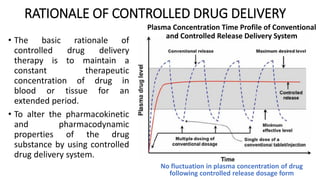
• The basic rationale of
controlled drug delivery
therapy is to maintain a
constant therapeutic
concentration of drug in
blood or tissue for an
extended period.
• To alter the pharmacokinetic
and pharmacodynamic
properties of the drug
substance by using controlled
drug delivery system.
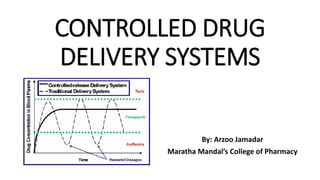
Plasma Concentration Time Profile of Conventional
and Controlled Release Delivery System
No fluctuation in plasma concentration of drug
following controlled release dosage form
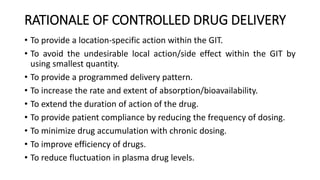
• To provide a location-specific action within the GIT.
• To avoid the undesirable local action/side effect within the GIT by
using smallest quantity.
• To provide a programmed delivery pattern.
• To increase the rate and extent of absorption/bioavailability.
• To extend the duration of action of the drug.
• To provide patient compliance by reducing the frequency of dosing.
• To minimize drug accumulation with chronic dosing.
• To improve efficiency of drugs.
• To reduce fluctuation in plasma drug levels.
RATIONALE OF CONTROLLED DRUG DELIVERY
SELECTION OF DRUG CANDIDATES / PHYSICOCHEMICAL
AND BIOLOGICAL PROPERTIES OF DRUGS RELEVANT TO
CONTROLLED RELEASE FORMULATIONS
All the drugs cannot be formulated in the form of controlled release
dosage forms. A drug must have the following physicochemical and
biological properties for the formulation of controlled release dosage
forms:
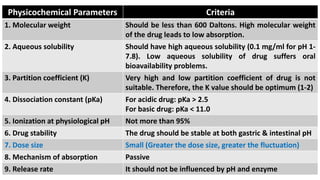
Physicochemical Parameters Criteria
1. Molecular weight Should be less than 600 Daltons. High molecular weight
of the drug leads to low absorption.
2. Aqueous solubility Should have high aqueous solubility (0.1 mg/ml for pH 1-
7.8). Low aqueous solubility of drug suffers oral
bioavailability problems.
3. Partition coefficient (K) Very high and low partition coefficient of drug is not
suitable. Therefore, the K value should be optimum (1-2)
4. Dissociation constant (pKa) For acidic drug: pKa > 2.5
For basic drug: pKa < 11.0
5. Ionization at physiological pH Not more than 95%
6. Drug stability The drug should be stable at both gastric & intestinal pH
7. Dose size Small (Greater the dose size, greater the fluctuation)
8. Mechanism of absorption Passive
9. Release rate It should not be influenced by pH and enzyme
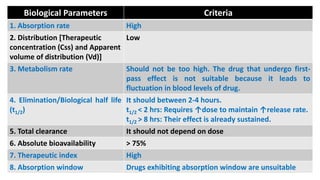
Biological Parameters Criteria
1. Absorption rate High
2. Distribution [Therapeutic
concentration (Css) and Apparent
volume of distribution (Vd)]
Low
3. Metabolism rate Should not be too high. The drug that undergo first-
pass effect is not suitable because it leads to
fluctuation in blood levels of drug.
4. Elimination/Biological half life
(t1/2)
It should between 2-4 hours.
t1/2 < 2 hrs: Requires ↑dose to maintain ↑release rate.
t1/2 > 8 hrs: Their effect is already sustained.
5. Total clearance It should not depend on dose
6. Absolute bioavailability > 75%
7. Therapeutic index High
8. Absorption window Drugs exhibiting absorption window are unsuitable
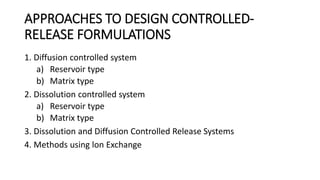
APPROACHES TO DESIGN CONTROLLED-
RELEASE FORMULATIONS
1. Diffusion controlled system
a) Reservoir type
b) Matrix type
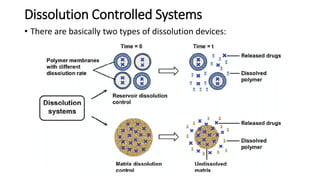
2. Dissolution controlled system
a) Reservoir type
b) Matrix type
3. Dissolution and Diffusion Controlled Release Systems
4. Methods using lon Exchange
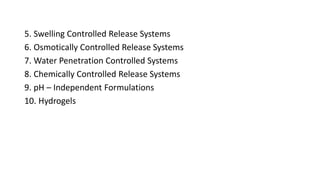
5. Swelling Controlled Release Systems
6. Osmotically Controlled Release Systems
7. Water Penetration Controlled Systems
8. Chemically Controlled Release Systems
9. pH – Independent Formulations
10. Hydrogels
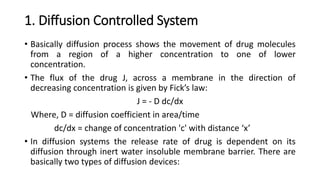
1. Diffusion Controlled System
• Basically diffusion process shows the movement of drug molecules
from a region of a higher concentration to one of lower
concentration.
• The flux of the drug J, across a membrane in the direction of
decreasing concentration is given by Fick’s law:
J = - D dc/dx
Where, D = diffusion coefficient in area/time
dc/dx = change of concentration 'c' with distance ‘x’
• In diffusion systems the release rate of drug is dependent on its
diffusion through inert water insoluble membrane barrier. There are
basically two types of diffusion devices:
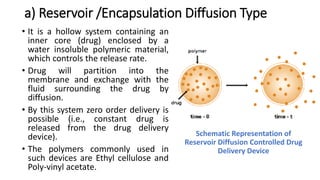
a) Reservoir /Encapsulation Diffusion Type
• It is a hollow system containing an
inner core (drug) enclosed by a
water insoluble polymeric material,
which controls the release rate.
• Drug will partition into the
membrane and exchange with the
fluid surrounding the drug by
diffusion.
• By this system zero order delivery is
possible (i.e., constant drug is
released from the drug delivery
device).
• The polymers commonly used in
such devices are Ethyl cellulose and
Poly-vinyl acetate.
Schematic Representation of
Reservoir Diffusion Controlled Drug
Delivery Device
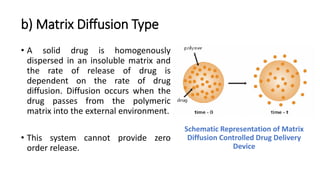
b) Matrix Diffusion Type
• A solid drug is homogenously
dispersed in an insoluble matrix and
the rate of release of drug is
dependent on the rate of drug
diffusion. Diffusion occurs when the
drug passes from the polymeric
matrix into the external environment.
• This system cannot provide zero
order release.
Schematic Representation of Matrix
Diffusion Controlled Drug Delivery
Device
2. Dissolution Controlled Systems
• Drugs having high aqueous solubility and dissolution rate, shows
challenge in controlling their dissolution rate.
• Dissolution-controlled release can be obtained by slowing the
dissolution rate of a drug in the GI medium, and incorporating the
drug in tablet with slowly dissolving polymer or coating drug particles
with a slowly dissolving polymeric material of varying thickness.
Dissolution Controlled Systems
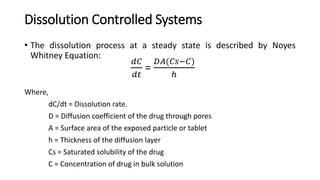
• The dissolution process at a steady state is described by Noyes
Whitney Equation:
Where,
dC/dt = Dissolution rate.
D = Diffusion coefficient of the drug through pores
A = Surface area of the exposed particle or tablet
h = Thickness of the diffusion layer
Cs = Saturated solubility of the drug
C = Concentration of drug in bulk solution
𝑑𝐶
𝑑𝑡
=
𝐷𝐴(𝐶𝑠−𝐶)
ℎ
Dissolution Controlled Systems
• There are basically two types of dissolution devices:
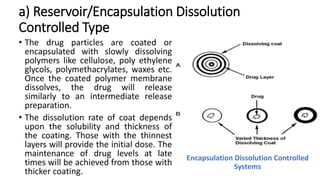
a) Reservoir/Encapsulation Dissolution
Controlled Type
• The drug particles are coated or
encapsulated with slowly dissolving
polymers like cellulose, poly ethylene
glycols, polymethacrylates, waxes etc.
Once the coated polymer membrane
dissolves, the drug will release
similarly to an intermediate release
preparation.
• The dissolution rate of coat depends
upon the solubility and thickness of
the coating. Those with the thinnest
layers will provide the initial dose. The
maintenance of drug levels at late
times will be achieved from those with
thicker coating.
Encapsulation Dissolution Controlled
Systems
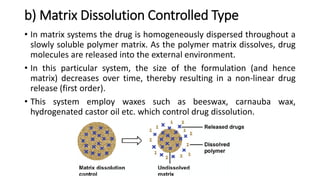
b) Matrix Dissolution Controlled Type
• In matrix systems the drug is homogeneously dispersed throughout a
slowly soluble polymer matrix. As the polymer matrix dissolves, drug
molecules are released into the external environment.
• In this particular system, the size of the formulation (and hence
matrix) decreases over time, thereby resulting in a non-linear drug
release (first order).
• This system employ waxes such as beeswax, carnauba wax,
hydrogenated castor oil etc. which control drug dissolution.
3. Dissolution and Diffusion Controlled Release
Systems
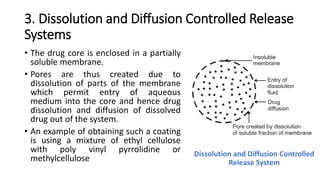
• The drug core is enclosed in a partially
soluble membrane.
• Pores are thus created due to
dissolution of parts of the membrane
which permit entry of aqueous
medium into the core and hence drug
dissolution and diffusion of dissolved
drug out of the system.
• An example of obtaining such a coating
is using a mixture of ethyl cellulose
with poly vinyl pyrrolidine or
methylcellulose
Dissolution and Diffusion Controlled
Release System
4. Methods using Ion Exchange
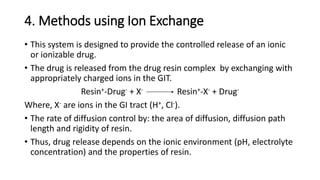
• This system is designed to provide the controlled release of an ionic
or ionizable drug.
• The drug is released from the drug resin complex by exchanging with
appropriately charged ions in the GIT.
Resin+-Drug- + X- Resin+-X- + Drug-
Where, X- are ions in the GI tract (H+, Cl-).
• The rate of diffusion control by: the area of diffusion, diffusion path
length and rigidity of resin.
• Thus, drug release depends on the ionic environment (pH, electrolyte
concentration) and the properties of resin.
• Types of Ion Exchange resins:
They are mainly of 2 types:
a) Cation exchange resin
b) Anion exchange resin.
Methods using Ion Exchange
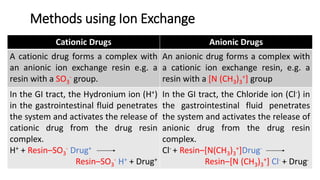
Cationic Drugs Anionic Drugs
A cationic drug forms a complex with
an anionic ion exchange resin e.g. a
resin with a SO3
- group.
An anionic drug forms a complex with
a cationic ion exchange resin, e.g. a
resin with a [N (CH3)3
+] group
In the GI tract, the Hydronium ion (H+)
in the gastrointestinal fluid penetrates
the system and activates the release of
cationic drug from the drug resin
complex.
H+ + Resin–SO3
- Drug+
Resin–SO3
- H+ + Drug+
In the GI tract, the Chloride ion (Cl-) in
the gastrointestinal fluid penetrates
the system and activates the release of
anionic drug from the drug resin
complex.
Cl- + Resin–[N(CH3)3
+]Drug-
Resin–[N (CH3)3
+] Cl- + Drug-
Methods using Ion Exchange
THANK YOU