Maharajgunj Medical
Campus, Nepal
Bikash Sapkota
B. Optometry
16th Batch
PRESENTATION LAYOUT
 Introduction
 History
 Physics
 Principles & instrumentation
 Terminologies
 Indications &
contraindications
 Methods
- A-Scan
- B-Scan
 Interpretation
INTRODUCTION
 Sound has been used clinically as an alternative to light in
the diagnostic evaluation of variety of conditions
 Advantage of sound over light is it can pass through opaque
tissue
 An important tool in terms of diagnosis and management
 Is a non-invasive investigation of choice to study eye in
opaque media
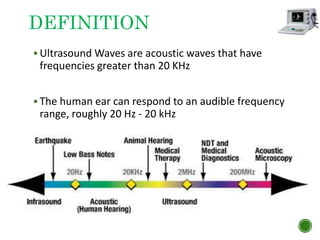
 Ultrasound Waves are acoustic waves that have
frequencies greater than 20 KHz
 The human ear can respond to an audible frequency
range, roughly 20 Hz - 20 kHz
DEFINITION
HISTORY
• In 1956
• First time: Mundt and Hughes, American Oph.
• A-scan (Time Amplitude ) to demonstrate various ocular
disease
• Oksala et al in Finland
• Ultrasound Basic Principle (Pulse-Echo Technique)
• Studied reflective properties of globe
• In 1958, Baum and Greenwood
• Developed the first two-dimensional(immersion) (B-scan)
ultrasound instrument for ophthalmology
• In the early 1960s, Jansson and associates, in Sweden,
• Used ultrasound to measure the distances between structures
in the eye
 In the 1960s, Ossoinig, an Austrian ophthalmologist
 First emphasized the importance of standardizing
instrumentation and technique
 Developed standardized A-scan
 In 1972, Coleman and associates made
 First commercially available immersion B -scan
instrument
 Refined techniques for measuring axial length, AC depth,
lens thickness
 Bronson in 1974 made contact B scan machine
ADVANTAGES OF USG
 Easy to use
 No ionizing radiation
 Excellent tissue differentiation
 Cost effectiveness
Primary uses in ophthalmology
 Posterior segment evaluation in hazy media / orbit
- Structural integrity of eye but no functional integrity
 Detection and differentiation of intraocular and orbital lesions
 Tissue thickness measurements
 Location of intra ocular foreign body
 Ocular biometry for IOL power calculations
PHYSICS
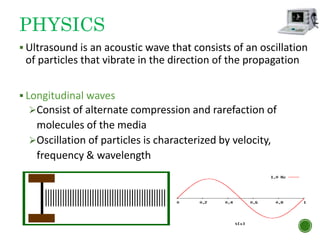
 Ultrasound is an acoustic wave that consists of an oscillation
of particles that vibrate in the direction of the propagation
 Longitudinal waves
Consist of alternate compression and rarefaction of
molecules of the media
Oscillation of particles is characterized by velocity,
frequency & wavelength
8
VELOCITY
 Velocity=wavelength*frequency
v=λ * μ
 Depends on the density of the media
 Takes 33 micro sec to come back from posterior pole
to transducer
 About 1500 m/sec average velocity in phakic eye and
1532 m/sec in aphakic eye
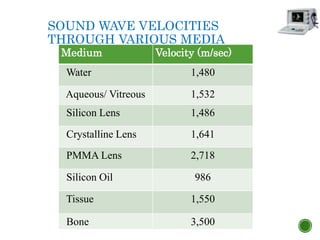
SOUND WAVE VELOCITIES
THROUGH VARIOUS MEDIA
Medium Velocity (m/sec)
Water 1,480
Aqueous/ Vitreous 1,532
Silicon Lens 1,486
Crystalline Lens 1,641
PMMA Lens 2,718
Silicon Oil 986
Tissue 1,550
Bone 3,500
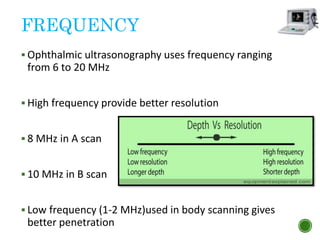
FREQUENCY
 Ophthalmic ultrasonography uses frequency ranging
from 6 to 20 MHz
 High frequency provide better resolution
 8 MHz in A scan
 10 MHz in B scan
 Low frequency (1-2 MHz)used in body scanning gives
better penetration
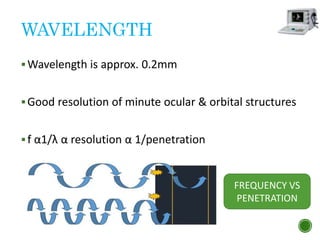
WAVELENGTH
Wavelength is approx. 0.2mm
Good resolution of minute ocular & orbital structures
f α1/λ α resolution α 1/penetration
FREQUENCY VS
PENETRATION
REFLECTIVITY
 When sound travels from one medium to another medium of
different density, part of the sound is back into the probe
 This is known as an echo; the greater the density difference at
that interface
- the stronger the echo, or
- the higher the reflectivity
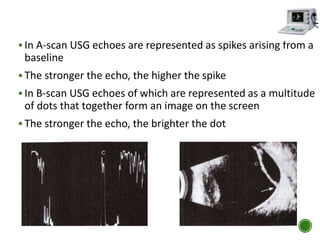
 In A-scan USG echoes are represented as spikes arising from a
baseline
 The stronger the echo, the higher the spike
 In B-scan USG echoes of which are represented as a multitude
of dots that together form an image on the screen
 The stronger the echo, the brighter the dot
ABSORPTION
 Ultrasound is absorbed by every medium through which it
passes
 The more dense the medium, the greater the amount of
absorption
 The density of the solid lid structure results in absorption of
part of the sound wave when B-scan is performed through
the closed eye
- thereby compromising the image of the posterior segment
 B-scan should be performed on the open eye unless
the patient is a small child or has an open wound
 When performing an USG through a dense cataract,
- more of the sound is absorbed by the dense cataractous
lens
- less is able to pass through to the next medium
- resulting in weaker echoes and images on both A-scan
and B-scan
The best images of the posterior segment are obtained when
the probe is in contact with the sclera rather than the corneal
surface, bypassing the crystalline lens or IOL implant
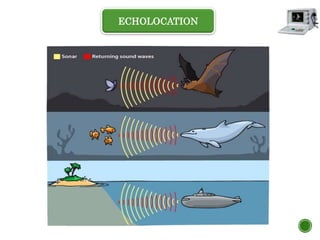
ECHOLOCATION
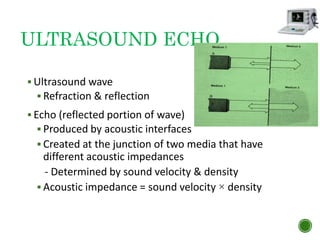
ULTRASOUND ECHO
 Ultrasound wave
 Refraction & reflection
 Echo (reflected portion of wave)
 Produced by acoustic interfaces
 Created at the junction of two media that have
different acoustic impedances
- Determined by sound velocity & density
 Acoustic impedance = sound velocity × density
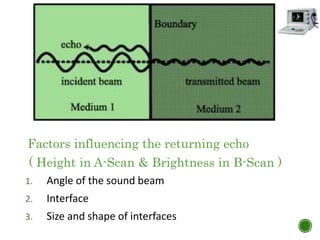
Factors influencing the returning echo
( Height in A-Scan & Brightness in B-Scan )
1. Angle of the sound beam
2. Interface
3. Size and shape of interfaces
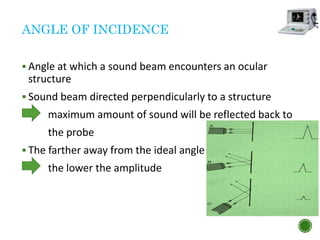
ANGLE OF INCIDENCE
 Angle at which a sound beam encounters an ocular
structure
 Sound beam directed perpendicularly to a structure
maximum amount of sound will be reflected back to
the probe
 The farther away from the ideal angle
the lower the amplitude
INTERFACE
 Relative difference between various tissues that the sound
beam encounters
 Strong or weak echoes due to the significance of tissue
interface
 For example:
- The difference in interface between vitreous and fresh
blood is very slight resulting in small echo
- The difference between a detached retina and the
vitreous is great producing a large echo
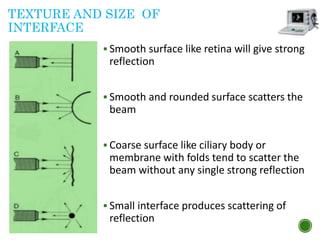
 Smooth surface like retina will give strong
reflection
 Smooth and rounded surface scatters the
beam
 Coarse surface like ciliary body or
membrane with folds tend to scatter the
beam without any single strong reflection
 Small interface produces scattering of
reflection
TEXTURE AND SIZE OF
INTERFACE
PRINCIPLE
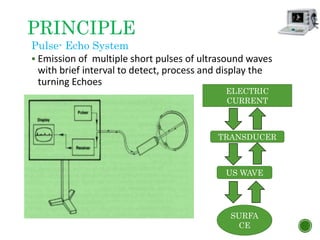
Pulse- Echo System
 Emission of multiple short pulses of ultrasound waves
with brief interval to detect, process and display the
turning Echoes
ELECTRIC
CURRENT
TRANSDUCER
US WAVE
SURFA
CE
 Ophthalmic USG uses high-frequency sound waves
transmitted from a probe into the eye
 As the sound waves strike intraocular structures,
they are reflected back to the probe and converted into
an electric signal
 The signal is subsequently reconstructed as an image on a
monitor
EMITED SOUND BEAM
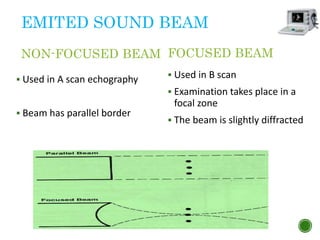
NON-FOCUSED BEAM
 Used in A scan echography
 Beam has parallel border
FOCUSED BEAM
 Used in B scan
 Examination takes place in a
focal zone
 The beam is slightly diffracted
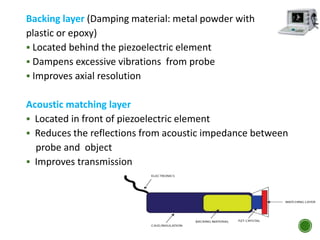
PROBE
 Consists of piezoelectric transducer
 Device which converts electrical energy to sound energy
[Pulse ] and vice versa [Echo]
 Basic Components –
Piezoelectric plate
Backing layer
Acoustic matching layer
Acoustic lens
INSTRUMEN
TATION
PIEZOELECTRIC ELEMENT
 Essential part generates ultrasonic waves
 Coated on both sides with electrodes to which a voltage
is applied
 Oscillation of element with repeat expansion and
contraction generates a sound wave
 Most common: Piezoelectric ceramic ( Lead zirconate,
titanate)
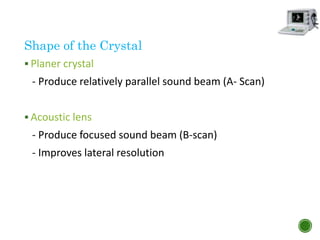
Shape of the Crystal
 Planer crystal
- Produce relatively parallel sound beam (A- Scan)
 Acoustic lens
- Produce focused sound beam (B-scan)
- Improves lateral resolution
Backing layer (Damping material: metal powder with
plastic or epoxy)
 Located behind the piezoelectric element
 Dampens excessive vibrations from probe
 Improves axial resolution
Acoustic matching layer
 Located in front of piezoelectric element
 Reduces the reflections from acoustic impedance between
probe and object
 Improves transmission
Axial Resolution
(longitudinal resolution or azimuthal resolution )
 Resolution in the direction parallel to the ultrasound beam
 The resolution at any point along the beam is the same;
therefore axial resolution is not affected by depth of imaging
 Increasing the frequency of the pulse improves axial
resolution
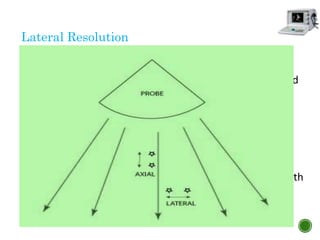
Lateral Resolution
 Ability of the system to distinguish two points in the
direction perpendicular to the direction of the ultrasound
beam
 Affected by the width of the beam and the depth of
imaging
 Wider beams typically diverge further in the far field and
any ultrasound beam diverges at greater depth,
decreasing lateral resolution
 Lateral resolution is best at shallow depths and worse with
deeper imaging
RECEIVER (computer unit)
 Receives returning echoes
 Produces electrical signal that undergoes complex
processing
 Amplification, Compensation, Compression,
Demodulation and Rejection
GAIN
 Relative unit of Ultrasound intensity
 Expressed in Decibel (db)
 Adjust of gain doesn't change the amount of energy
emitted by transducer
- but change in intensity of the returning echoes for
display
 Higher the gain – Greater the sensitivity of the
instrument in displaying weaker echoes (i.e Vitreous
opacities)
 Lower the gain – Weaker the depth of sound
penetration
TERMINOLO
GIES
Acoustic impedance mismatch
- Resistance of tissue to passage of sound waves
- Difference of two tissues at the interface
Homogeneous ( Vitreous)- Sound passes through tissue
with no returning signal
Heterogeneous (Orbital Fat) - Different levels of acoustic
impedance mismatch within tissue
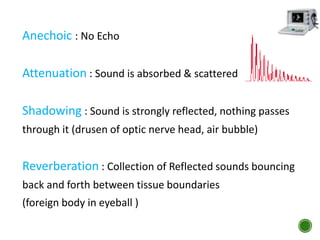
Anechoic : No Echo
Attenuation : Sound is absorbed & scattered
Shadowing : Sound is strongly reflected, nothing passes
through it (drusen of optic nerve head, air bubble)
Reverberation : Collection of Reflected sounds bouncing
back and forth between tissue boundaries
(foreign body in eyeball )
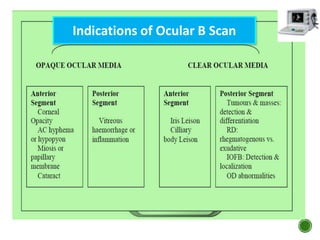
Indications of Ocular B Scan
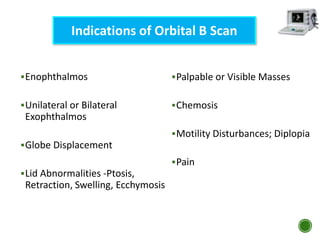
Enophthalmos
Unilateral or Bilateral
Exophthalmos
Globe Displacement
Lid Abnormalities -Ptosis,
Retraction, Swelling, Ecchymosis
Indications of Orbital B Scan
Palpable or Visible Masses
Chemosis
Motility Disturbances; Diplopia
Pain
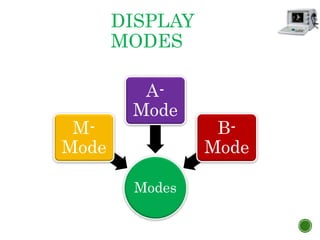
DISPLAY
MODES
Modes
M-
Mode
A-
Mode
B-
Mode
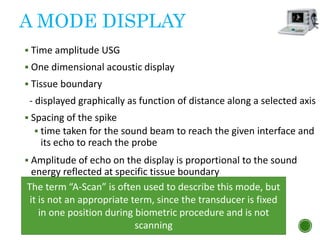
A MODE DISPLAY
 Time amplitude USG
 One dimensional acoustic display
 Tissue boundary
- displayed graphically as function of distance along a selected axis
 Spacing of the spike
 time taken for the sound beam to reach the given interface and
its echo to reach the probe
 Amplitude of echo on the display is proportional to the sound
energy reflected at specific tissue boundary
 8 MHz
 Probe emits unfocused beam
40
The term “A-Scan” is often used to describe this mode, but
it is not an appropriate term, since the transducer is fixed
in one position during biometric procedure and is not
scanning
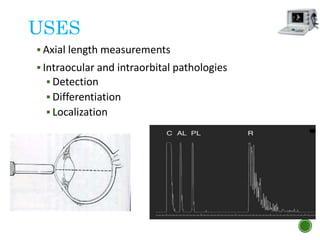
USES
 Axial length measurements
 Intraocular and intraorbital pathologies
 Detection
 Differentiation
 Localization
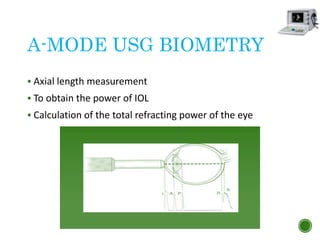
A-MODE USG BIOMETRY
 Axial length measurement
 To obtain the power of IOL
 Calculation of the total refracting power of the eye
PROBE POSITION
 Just touch the cornea
 Aligned with optical axis of eye
- Aimed towards the macula
 Corneal compression
- A 0.4mm compression causes 1 D error in the calculated
IOL power
- Contact Vs immersion method
43
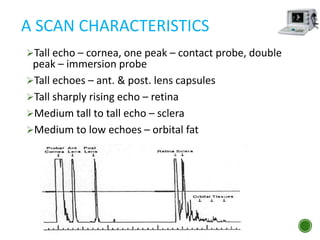
Tall echo – cornea, one peak – contact probe, double
peak – immersion probe
Tall echoes – ant. & post. lens capsules
Tall sharply rising echo – retina
Medium tall to tall echo – sclera
Medium to low echoes – orbital fat
A SCAN CHARACTERISTICS
M MODE DISPLAY
 Motion mode or time motion mode
 Dilation and constriction of blood vessel
 Accommodation fluctuation
 Vascular pulsation in ocular tumor
 Motion of detached retina
- PVD vs RD
B MODE DISPLAY
 Intensity modulated USG
 B Stands for Brightness modulation
 Presents a cross sectional or 2D image
 True scanning
 Probe emits focused beam
 10 MHz
 Each echo
oRepresented as a dot on display screen
oStrength of the echo brightness of the dot
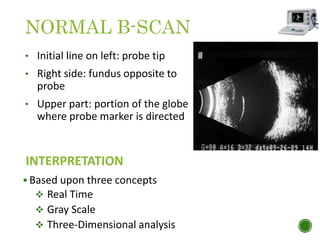
NORMAL B-SCAN
• Initial line on left: probe tip
• Right side: fundus opposite to
probe
• Upper part: portion of the globe
where probe marker is directed
INTERPRETATION
 Based upon three concepts
 Real Time
 Gray Scale
 Three-Dimensional analysis
REAL TIME
 Images can be visualized at approximately 32 frames/sec,
allowing motion of the globe and vitreous to be easily
detected
 B scan allows real time evaluation of any ocular
pathology
 Real time ultrasonic information frequently aids in
vitreoretinal surgery
GRAY SCALE
 Displays the returning echoes as a 2D image
 Strong echoes are displayed brightly at high gain and remain
visible even when the gain is reduced
 Weaker echoes are seen as lighter shades of gray that
disappear when the gain is reduced
 Comparing echo strengths during examination is the basis
for qualitative tissue analysis
THREE-DIMENSIONAL
ANALYSIS
 Developing a mental 3D image or anatomical map from
multiple 2D B-scan images is the most difficult concept
to master
 This is essential, because it provides the vital architectural
information that is the basis for B-scan diagnosis
 Especially important in the preoperative evaluation of
complex retinal detachments and intraocular or orbital
tumors
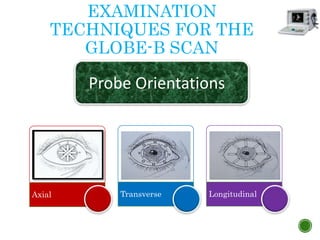
EXAMINATION
TECHNIQUES FOR THE
GLOBE-B SCAN
Axial Transverse Longitudinal
Probe Orientations
AXIAL
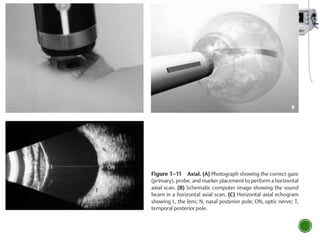
 Probe directly over cornea and directed axially
 Pt. fixating in primary gaze
 Posterior lens surface and optic nerve head are placed in
the centre of the echogram
 Optic nerve head is used as an echographic centre section
 Easiest to perform
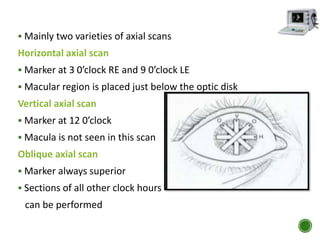
 Mainly two varieties of axial scans
Horizontal axial scan
 Marker at 3 0’clock RE and 9 0’clock LE
 Macular region is placed just below the optic disk
Vertical axial scan
 Marker at 12 0’clock
 Macula is not seen in this scan
Oblique axial scan
 Marker always superior
 Sections of all other clock hours
can be performed
POINTS TO BE NOTED
 Higher decibel gain levels are needed to show structures at
the posterior segment
 Because of scatter and strong sound attenuation created by
the lens
- In pseudophakia strong artifacts created by the lens
implant hampers the adequate visualization
Significance
Easy orientation and demonstration of posterior pole lesions
and attachments of membranes to optic nerve head
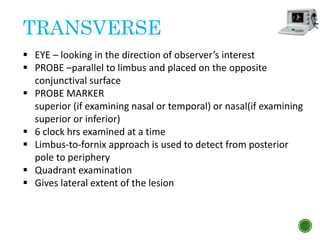
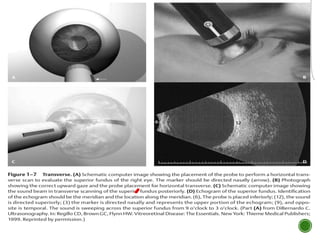
TRANSVERSE
 EYE – looking in the direction of observer’s interest
 PROBE –parallel to limbus and placed on the opposite
conjunctival surface
 PROBE MARKER
superior (if examining nasal or temporal) or nasal(if examining
superior or inferior)
 6 clock hrs examined at a time
 Limbus-to-fornix approach is used to detect from posterior
pole to periphery
 Quadrant examination
 Gives lateral extent of the lesion
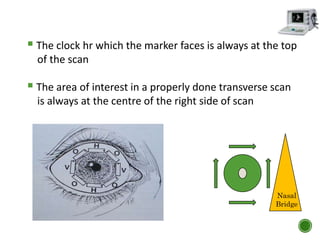
 The clock hr which the marker faces is always at the top
of the scan
 The area of interest in a properly done transverse scan
is always at the centre of the right side of scan
Nasal
Bridge
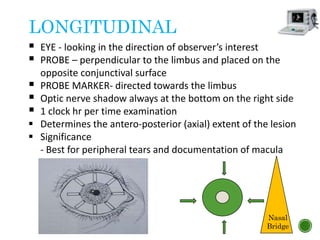
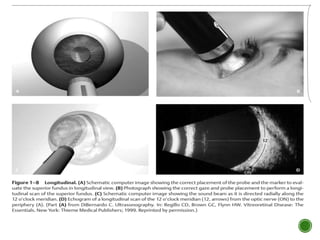
LONGITUDINAL
 EYE - looking in the direction of observer’s interest
 PROBE – perpendicular to the limbus and placed on the
opposite conjunctival surface
 PROBE MARKER- directed towards the limbus
 Optic nerve shadow always at the bottom on the right side
 1 clock hr per time examination
 Determines the antero-posterior (axial) extent of the lesion
 Significance
- Best for peripheral tears and documentation of macula
Nasal
Bridge
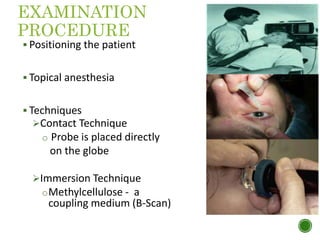
EXAMINATION
PROCEDURE
 Positioning the patient
 Topical anesthesia
 Techniques
Contact Technique
o Probe is placed directly
on the globe
Immersion Technique
oMethylcellulose - a
coupling medium (B-Scan)
Sources of Error in contact technique
 Corneal compression (Shorter Axial length)
- 1mm error in Axial length – 2.5 to 3.0 Ds error in IOL
Power
 Misalignment of sound beam
Source of error in immersion technique
 Small air bubbles in the fluid gives falsely long AL
measurement
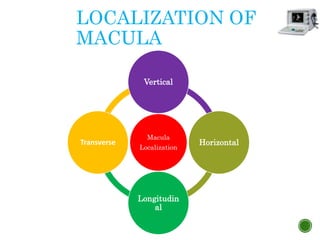
LOCALIZATION OF
MACULA
Macula
Localization
Vertical
Horizontal
Longitudin
al
Transverse
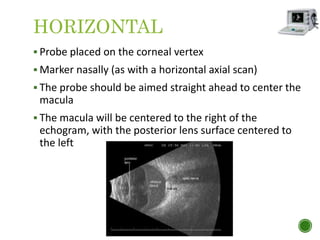
HORIZONTAL
 Probe placed on the corneal vertex
 Marker nasally (as with a horizontal axial scan)
 The probe should be aimed straight ahead to center the
macula
 The macula will be centered to the right of the
echogram, with the posterior lens surface centered to
the left
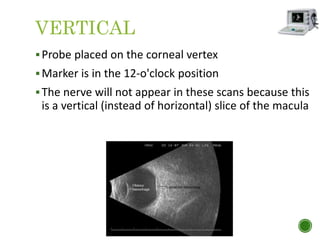
VERTICAL
Probe placed on the corneal vertex
Marker is in the 12-o'clock position
The nerve will not appear in these scans because this
is a vertical (instead of horizontal) slice of the macula
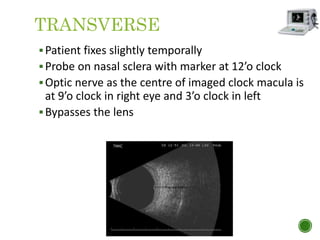
TRANSVERSE
Patient fixes slightly temporally
Probe on nasal sclera with marker at 12’o clock
Optic nerve as the centre of imaged clock macula is
at 9’o clock in right eye and 3’o clock in left
Bypasses the lens
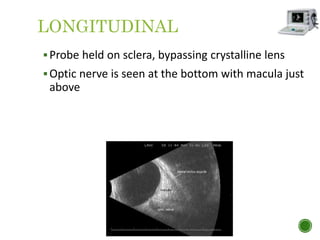
LONGITUDINAL
Probe held on sclera, bypassing crystalline lens
Optic nerve is seen at the bottom with macula just
above
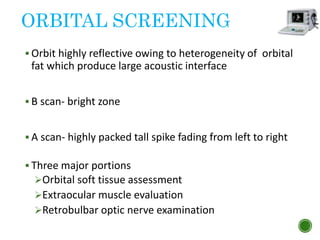
ORBITAL SCREENING
 Orbit highly reflective owing to heterogeneity of orbital
fat which produce large acoustic interface
 B scan- bright zone
 A scan- highly packed tall spike fading from left to right
 Three major portions
Orbital soft tissue assessment
Extraocular muscle evaluation
Retrobulbar optic nerve examination
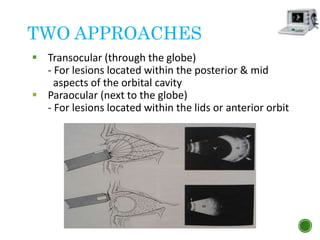
TWO APPROACHES
 Transocular (through the globe)
- For lesions located within the posterior & mid
aspects of the orbital cavity
 Paraocular (next to the globe)
- For lesions located within the lids or anterior orbit
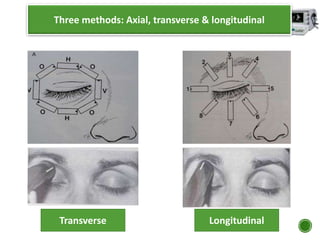
Three methods: Axial, transverse & longitudinal
Transverse Longitudinal
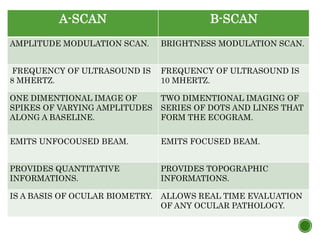
A-SCAN B-SCAN
AMPLITUDE MODULATION SCAN. BRIGHTNESS MODULATION SCAN.
FREQUENCY OF ULTRASOUND IS
8 MHERTZ.
FREQUENCY OF ULTRASOUND IS
10 MHERTZ.
ONE DIMENTIONAL IMAGE OF
SPIKES OF VARYING AMPLITUDES
ALONG A BASELINE.
TWO DIMENTIONAL IMAGING OF
SERIES OF DOTS AND LINES THAT
FORM THE ECOGRAM.
EMITS UNFOCOUSED BEAM. EMITS FOCUSED BEAM.
PROVIDES QUANTITATIVE
INFORMATIONS.
PROVIDES TOPOGRAPHIC
INFORMATIONS.
IS A BASIS OF OCULAR BIOMETRY. ALLOWS REAL TIME EVALUATION
OF ANY OCULAR PATHOLOGY.
ANTERIOR SEGMENT
EVALUATION
Immersion
Technique
High Resolution
Technique
IMMERSION TECHNIQUE
 Examining the anterior segment with a standard 10
MHz contact probe can be accomplished only with the
use of a scleral shell
 This shifts the anterior segment to the right and into
the area of focus of the sound beam, improving
resolution of anterior segment pathology
 The shell is filled with methylcellulose or some other
viscous solution to a meniscus, avoiding air bubbles
within the shell
 The probe is placed on top of the shell
 This produces an echolucent area on the left side of the
echogram corresponding to the shell and methylcellulose
 Diagnostic A-scan also can be performed through the shell,
directly over the lesion, for tissue differentiation.
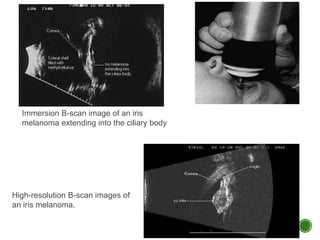
Immersion B-scan image of an iris
melanoma extending into the ciliary body
High-resolution B-scan images of
an iris melanoma.
HIGH RESOLUTION
TECHNIQUE
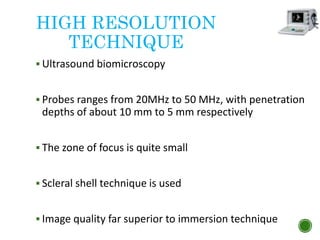
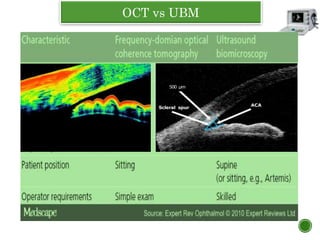
 Ultrasound biomicroscopy
 Probes ranges from 20MHz to 50 MHz, with penetration
depths of about 10 mm to 5 mm respectively
 The zone of focus is quite small
 Scleral shell technique is used
 Image quality far superior to immersion technique
OCT vs UBM
NORMAL USG
CHARACTERISTICS
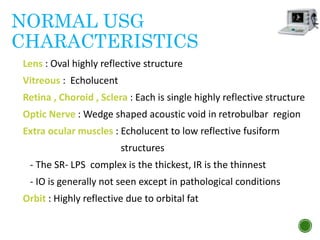
Lens : Oval highly reflective structure
Vitreous : Echolucent
Retina , Choroid , Sclera : Each is single highly reflective structure
Optic Nerve : Wedge shaped acoustic void in retrobulbar region
Extra ocular muscles : Echolucent to low reflective fusiform
structures
- The SR- LPS complex is the thickest, IR is the thinnest
- IO is generally not seen except in pathological conditions
Orbit : Highly reflective due to orbital fat
TOPOGRAPHIC
ECHOGRAPHY
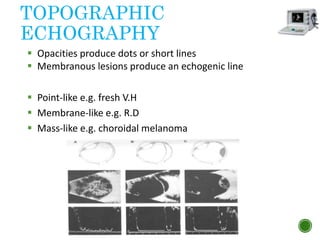
 Point-like e.g. fresh V.H
 Membrane-like e.g. R.D
 Mass-like e.g. choroidal melanoma
 Opacities produce dots or short lines
 Membranous lesions produce an echogenic line
INTERPRETATIONS
AND
CLINICAL EXAMPLES
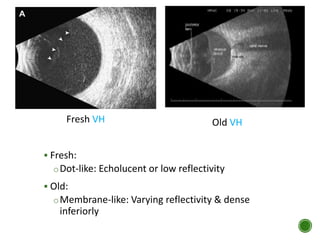
 Fresh:
oDot-like: Echolucent or low reflectivity
 Old:
oMembrane-like: Varying reflectivity & dense
inferiorly
Fresh VH Old VH
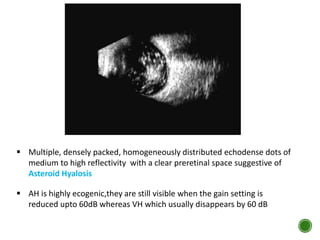
 Multiple, densely packed, homogeneously distributed echodense dots of
medium to high reflectivity with a clear preretinal space suggestive of
Asteroid Hyalosis
 AH is highly ecogenic,they are still visible when the gain setting is
reduced upto 60dB whereas VH which usually disappears by 60 dB
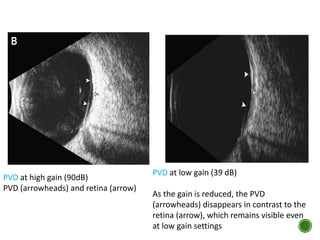
PVD at high gain (90dB)
PVD (arrowheads) and retina (arrow)
PVD at low gain (39 dB)
As the gain is reduced, the PVD
(arrowheads) disappears in contrast to the
retina (arrow), which remains visible even
at low gain settings
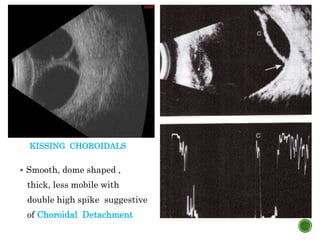
KISSING CHOROIDALS
 Smooth, dome shaped ,
thick, less mobile with
double high spike suggestive
of Choroidal Detachment
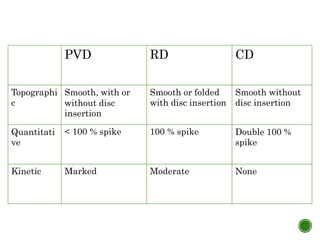
PVD RD CD
Topographi
c
Smooth, with or
without disc
insertion
Smooth or folded
with disc insertion
Smooth without
disc insertion
Quantitati
ve
< 100 % spike 100 % spike Double 100 %
spike
Kinetic Marked Moderate None
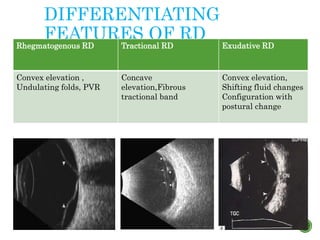
DIFFERENTIATING
FEATURES OF RD
Rhegmatogenous RD Tractional RD Exudative RD
Convex elevation ,
Undulating folds, PVR
Concave
elevation,Fibrous
tractional band
Convex elevation,
Shifting fluid changes
Configuration with
postural change
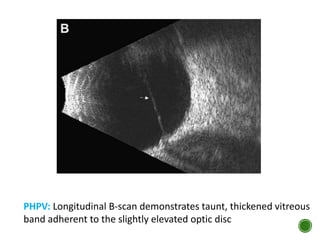
PHPV: Longitudinal B-scan demonstrates taunt, thickened vitreous
band adherent to the slightly elevated optic disc
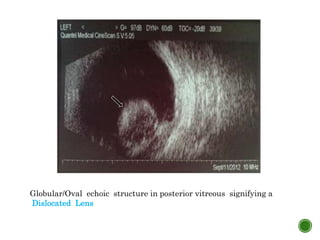
Globular/Oval echoic structure in posterior vitreous signifying a
Dislocated Lens
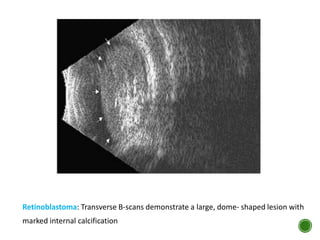
Retinoblastoma: Transverse B-scans demonstrate a large, dome- shaped lesion with
marked internal calcification
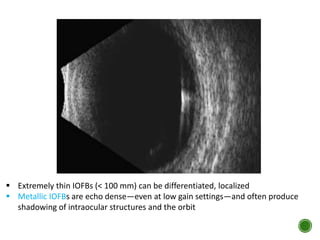
 Extremely thin IOFBs (< 100 mm) can be differentiated, localized
 Metallic IOFBs are echo dense—even at low gain settings—and often produce
shadowing of intraocular structures and the orbit
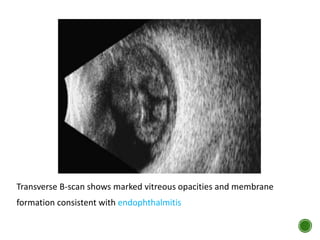
Transverse B-scan shows marked vitreous opacities and membrane
formation consistent with endophthalmitis
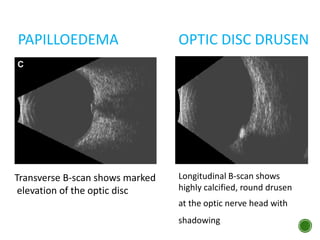
PAPILLOEDEMA
Transverse B-scan shows marked
elevation of the optic disc
OPTIC DISC DRUSEN
Longitudinal B-scan shows
highly calcified, round drusen
at the optic nerve head with
shadowing
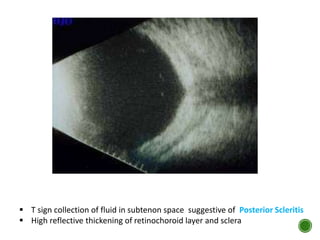
 T sign collection of fluid in subtenon space suggestive of Posterior Scleritis
 High reflective thickening of retinochoroid layer and sclera
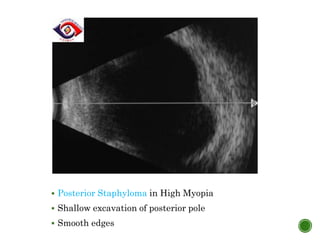
 Posterior Staphyloma in High Myopia
 Shallow excavation of posterior pole
 Smooth edges
REFERENCES
 Clinical Procedures in Optometry by J. D. Barlett, J. B.
Eskridge & J. F. Amos
 Ophthalmic Ultrasound: A Diagnostic Atlas by C. W.
DiBernardo & E. F. Greenberg
 Internet
 Previous presentations
Ocular Ultrasonography/ Ophthalmic Ultrasonography (Ocular USG/ Ophthalmic USG/ Ophthalmic Ultrasound/ Ocular Ultrasound) (healthkura.com)

Ocular Ultrasonography/ Ophthalmic Ultrasonography (Ocular USG/ Ophthalmic USG/ Ophthalmic Ultrasound/ Ocular Ultrasound) (healthkura.com)

  • 1.
    Maharajgunj Medical Campus, Nepal BikashSapkota B. Optometry 16th Batch
  • 2.
    PRESENTATION LAYOUT  Introduction History  Physics  Principles & instrumentation  Terminologies  Indications & contraindications  Methods - A-Scan - B-Scan  Interpretation
  • 3.
    INTRODUCTION  Sound hasbeen used clinically as an alternative to light in the diagnostic evaluation of variety of conditions  Advantage of sound over light is it can pass through opaque tissue  An important tool in terms of diagnosis and management  Is a non-invasive investigation of choice to study eye in opaque media
  • 4.
     Ultrasound Wavesare acoustic waves that have frequencies greater than 20 KHz  The human ear can respond to an audible frequency range, roughly 20 Hz - 20 kHz DEFINITION
  • 5.
    HISTORY • In 1956 •First time: Mundt and Hughes, American Oph. • A-scan (Time Amplitude ) to demonstrate various ocular disease • Oksala et al in Finland • Ultrasound Basic Principle (Pulse-Echo Technique) • Studied reflective properties of globe • In 1958, Baum and Greenwood • Developed the first two-dimensional(immersion) (B-scan) ultrasound instrument for ophthalmology • In the early 1960s, Jansson and associates, in Sweden, • Used ultrasound to measure the distances between structures in the eye
  • 6.
     In the1960s, Ossoinig, an Austrian ophthalmologist  First emphasized the importance of standardizing instrumentation and technique  Developed standardized A-scan  In 1972, Coleman and associates made  First commercially available immersion B -scan instrument  Refined techniques for measuring axial length, AC depth, lens thickness  Bronson in 1974 made contact B scan machine
  • 7.
    ADVANTAGES OF USG Easy to use  No ionizing radiation  Excellent tissue differentiation  Cost effectiveness Primary uses in ophthalmology  Posterior segment evaluation in hazy media / orbit - Structural integrity of eye but no functional integrity  Detection and differentiation of intraocular and orbital lesions  Tissue thickness measurements  Location of intra ocular foreign body  Ocular biometry for IOL power calculations
  • 8.
    PHYSICS  Ultrasound isan acoustic wave that consists of an oscillation of particles that vibrate in the direction of the propagation  Longitudinal waves Consist of alternate compression and rarefaction of molecules of the media Oscillation of particles is characterized by velocity, frequency & wavelength 8
  • 9.
    VELOCITY  Velocity=wavelength*frequency v=λ *μ  Depends on the density of the media  Takes 33 micro sec to come back from posterior pole to transducer  About 1500 m/sec average velocity in phakic eye and 1532 m/sec in aphakic eye
  • 10.
    SOUND WAVE VELOCITIES THROUGHVARIOUS MEDIA Medium Velocity (m/sec) Water 1,480 Aqueous/ Vitreous 1,532 Silicon Lens 1,486 Crystalline Lens 1,641 PMMA Lens 2,718 Silicon Oil 986 Tissue 1,550 Bone 3,500
  • 11.
    FREQUENCY  Ophthalmic ultrasonographyuses frequency ranging from 6 to 20 MHz  High frequency provide better resolution  8 MHz in A scan  10 MHz in B scan  Low frequency (1-2 MHz)used in body scanning gives better penetration
  • 12.
    WAVELENGTH Wavelength is approx.0.2mm Good resolution of minute ocular & orbital structures f α1/λ α resolution α 1/penetration FREQUENCY VS PENETRATION
  • 13.
    REFLECTIVITY  When soundtravels from one medium to another medium of different density, part of the sound is back into the probe  This is known as an echo; the greater the density difference at that interface - the stronger the echo, or - the higher the reflectivity
  • 14.
     In A-scanUSG echoes are represented as spikes arising from a baseline  The stronger the echo, the higher the spike  In B-scan USG echoes of which are represented as a multitude of dots that together form an image on the screen  The stronger the echo, the brighter the dot
  • 15.
    ABSORPTION  Ultrasound isabsorbed by every medium through which it passes  The more dense the medium, the greater the amount of absorption  The density of the solid lid structure results in absorption of part of the sound wave when B-scan is performed through the closed eye - thereby compromising the image of the posterior segment
  • 16.
     B-scan shouldbe performed on the open eye unless the patient is a small child or has an open wound  When performing an USG through a dense cataract, - more of the sound is absorbed by the dense cataractous lens - less is able to pass through to the next medium - resulting in weaker echoes and images on both A-scan and B-scan The best images of the posterior segment are obtained when the probe is in contact with the sclera rather than the corneal surface, bypassing the crystalline lens or IOL implant
  • 17.
  • 18.
    ULTRASOUND ECHO  Ultrasoundwave  Refraction & reflection  Echo (reflected portion of wave)  Produced by acoustic interfaces  Created at the junction of two media that have different acoustic impedances - Determined by sound velocity & density  Acoustic impedance = sound velocity × density
  • 19.
    Factors influencing thereturning echo ( Height in A-Scan & Brightness in B-Scan ) 1. Angle of the sound beam 2. Interface 3. Size and shape of interfaces
  • 20.
    ANGLE OF INCIDENCE Angle at which a sound beam encounters an ocular structure  Sound beam directed perpendicularly to a structure maximum amount of sound will be reflected back to the probe  The farther away from the ideal angle the lower the amplitude
  • 21.
    INTERFACE  Relative differencebetween various tissues that the sound beam encounters  Strong or weak echoes due to the significance of tissue interface  For example: - The difference in interface between vitreous and fresh blood is very slight resulting in small echo - The difference between a detached retina and the vitreous is great producing a large echo
  • 22.
     Smooth surfacelike retina will give strong reflection  Smooth and rounded surface scatters the beam  Coarse surface like ciliary body or membrane with folds tend to scatter the beam without any single strong reflection  Small interface produces scattering of reflection TEXTURE AND SIZE OF INTERFACE
  • 23.
    PRINCIPLE Pulse- Echo System Emission of multiple short pulses of ultrasound waves with brief interval to detect, process and display the turning Echoes ELECTRIC CURRENT TRANSDUCER US WAVE SURFA CE
  • 24.
     Ophthalmic USGuses high-frequency sound waves transmitted from a probe into the eye  As the sound waves strike intraocular structures, they are reflected back to the probe and converted into an electric signal  The signal is subsequently reconstructed as an image on a monitor
  • 25.
    EMITED SOUND BEAM NON-FOCUSEDBEAM  Used in A scan echography  Beam has parallel border FOCUSED BEAM  Used in B scan  Examination takes place in a focal zone  The beam is slightly diffracted
  • 26.
    PROBE  Consists ofpiezoelectric transducer  Device which converts electrical energy to sound energy [Pulse ] and vice versa [Echo]  Basic Components – Piezoelectric plate Backing layer Acoustic matching layer Acoustic lens INSTRUMEN TATION
  • 27.
    PIEZOELECTRIC ELEMENT  Essentialpart generates ultrasonic waves  Coated on both sides with electrodes to which a voltage is applied  Oscillation of element with repeat expansion and contraction generates a sound wave  Most common: Piezoelectric ceramic ( Lead zirconate, titanate)
  • 28.
    Shape of theCrystal  Planer crystal - Produce relatively parallel sound beam (A- Scan)  Acoustic lens - Produce focused sound beam (B-scan) - Improves lateral resolution
  • 29.
    Backing layer (Dampingmaterial: metal powder with plastic or epoxy)  Located behind the piezoelectric element  Dampens excessive vibrations from probe  Improves axial resolution Acoustic matching layer  Located in front of piezoelectric element  Reduces the reflections from acoustic impedance between probe and object  Improves transmission
  • 30.
    Axial Resolution (longitudinal resolutionor azimuthal resolution )  Resolution in the direction parallel to the ultrasound beam  The resolution at any point along the beam is the same; therefore axial resolution is not affected by depth of imaging  Increasing the frequency of the pulse improves axial resolution
  • 31.
    Lateral Resolution  Abilityof the system to distinguish two points in the direction perpendicular to the direction of the ultrasound beam  Affected by the width of the beam and the depth of imaging  Wider beams typically diverge further in the far field and any ultrasound beam diverges at greater depth, decreasing lateral resolution  Lateral resolution is best at shallow depths and worse with deeper imaging
  • 32.
    RECEIVER (computer unit) Receives returning echoes  Produces electrical signal that undergoes complex processing  Amplification, Compensation, Compression, Demodulation and Rejection
  • 33.
    GAIN  Relative unitof Ultrasound intensity  Expressed in Decibel (db)  Adjust of gain doesn't change the amount of energy emitted by transducer - but change in intensity of the returning echoes for display  Higher the gain – Greater the sensitivity of the instrument in displaying weaker echoes (i.e Vitreous opacities)  Lower the gain – Weaker the depth of sound penetration TERMINOLO GIES
  • 34.
    Acoustic impedance mismatch -Resistance of tissue to passage of sound waves - Difference of two tissues at the interface Homogeneous ( Vitreous)- Sound passes through tissue with no returning signal Heterogeneous (Orbital Fat) - Different levels of acoustic impedance mismatch within tissue
  • 35.
    Anechoic : NoEcho Attenuation : Sound is absorbed & scattered Shadowing : Sound is strongly reflected, nothing passes through it (drusen of optic nerve head, air bubble) Reverberation : Collection of Reflected sounds bouncing back and forth between tissue boundaries (foreign body in eyeball )
  • 36.
  • 37.
    Enophthalmos Unilateral or Bilateral Exophthalmos GlobeDisplacement Lid Abnormalities -Ptosis, Retraction, Swelling, Ecchymosis Indications of Orbital B Scan Palpable or Visible Masses Chemosis Motility Disturbances; Diplopia Pain
  • 39.
  • 40.
    A MODE DISPLAY Time amplitude USG  One dimensional acoustic display  Tissue boundary - displayed graphically as function of distance along a selected axis  Spacing of the spike  time taken for the sound beam to reach the given interface and its echo to reach the probe  Amplitude of echo on the display is proportional to the sound energy reflected at specific tissue boundary  8 MHz  Probe emits unfocused beam 40 The term “A-Scan” is often used to describe this mode, but it is not an appropriate term, since the transducer is fixed in one position during biometric procedure and is not scanning
  • 41.
    USES  Axial lengthmeasurements  Intraocular and intraorbital pathologies  Detection  Differentiation  Localization
  • 42.
    A-MODE USG BIOMETRY Axial length measurement  To obtain the power of IOL  Calculation of the total refracting power of the eye
  • 43.
    PROBE POSITION  Justtouch the cornea  Aligned with optical axis of eye - Aimed towards the macula  Corneal compression - A 0.4mm compression causes 1 D error in the calculated IOL power - Contact Vs immersion method 43
  • 44.
    Tall echo –cornea, one peak – contact probe, double peak – immersion probe Tall echoes – ant. & post. lens capsules Tall sharply rising echo – retina Medium tall to tall echo – sclera Medium to low echoes – orbital fat A SCAN CHARACTERISTICS
  • 45.
    M MODE DISPLAY Motion mode or time motion mode  Dilation and constriction of blood vessel  Accommodation fluctuation  Vascular pulsation in ocular tumor  Motion of detached retina - PVD vs RD
  • 46.
    B MODE DISPLAY Intensity modulated USG  B Stands for Brightness modulation  Presents a cross sectional or 2D image  True scanning  Probe emits focused beam  10 MHz  Each echo oRepresented as a dot on display screen oStrength of the echo brightness of the dot
  • 47.
    NORMAL B-SCAN • Initialline on left: probe tip • Right side: fundus opposite to probe • Upper part: portion of the globe where probe marker is directed INTERPRETATION  Based upon three concepts  Real Time  Gray Scale  Three-Dimensional analysis
  • 48.
    REAL TIME  Imagescan be visualized at approximately 32 frames/sec, allowing motion of the globe and vitreous to be easily detected  B scan allows real time evaluation of any ocular pathology  Real time ultrasonic information frequently aids in vitreoretinal surgery
  • 49.
    GRAY SCALE  Displaysthe returning echoes as a 2D image  Strong echoes are displayed brightly at high gain and remain visible even when the gain is reduced  Weaker echoes are seen as lighter shades of gray that disappear when the gain is reduced  Comparing echo strengths during examination is the basis for qualitative tissue analysis
  • 50.
    THREE-DIMENSIONAL ANALYSIS  Developing amental 3D image or anatomical map from multiple 2D B-scan images is the most difficult concept to master  This is essential, because it provides the vital architectural information that is the basis for B-scan diagnosis  Especially important in the preoperative evaluation of complex retinal detachments and intraocular or orbital tumors
  • 51.
    EXAMINATION TECHNIQUES FOR THE GLOBE-BSCAN Axial Transverse Longitudinal Probe Orientations
  • 52.
    AXIAL  Probe directlyover cornea and directed axially  Pt. fixating in primary gaze  Posterior lens surface and optic nerve head are placed in the centre of the echogram  Optic nerve head is used as an echographic centre section  Easiest to perform
  • 53.
     Mainly twovarieties of axial scans Horizontal axial scan  Marker at 3 0’clock RE and 9 0’clock LE  Macular region is placed just below the optic disk Vertical axial scan  Marker at 12 0’clock  Macula is not seen in this scan Oblique axial scan  Marker always superior  Sections of all other clock hours can be performed
  • 55.
    POINTS TO BENOTED  Higher decibel gain levels are needed to show structures at the posterior segment  Because of scatter and strong sound attenuation created by the lens - In pseudophakia strong artifacts created by the lens implant hampers the adequate visualization Significance Easy orientation and demonstration of posterior pole lesions and attachments of membranes to optic nerve head
  • 56.
    TRANSVERSE  EYE –looking in the direction of observer’s interest  PROBE –parallel to limbus and placed on the opposite conjunctival surface  PROBE MARKER superior (if examining nasal or temporal) or nasal(if examining superior or inferior)  6 clock hrs examined at a time  Limbus-to-fornix approach is used to detect from posterior pole to periphery  Quadrant examination  Gives lateral extent of the lesion
  • 57.
     The clockhr which the marker faces is always at the top of the scan  The area of interest in a properly done transverse scan is always at the centre of the right side of scan Nasal Bridge
  • 59.
    LONGITUDINAL  EYE -looking in the direction of observer’s interest  PROBE – perpendicular to the limbus and placed on the opposite conjunctival surface  PROBE MARKER- directed towards the limbus  Optic nerve shadow always at the bottom on the right side  1 clock hr per time examination  Determines the antero-posterior (axial) extent of the lesion  Significance - Best for peripheral tears and documentation of macula Nasal Bridge
  • 61.
    EXAMINATION PROCEDURE  Positioning thepatient  Topical anesthesia  Techniques Contact Technique o Probe is placed directly on the globe Immersion Technique oMethylcellulose - a coupling medium (B-Scan)
  • 62.
    Sources of Errorin contact technique  Corneal compression (Shorter Axial length) - 1mm error in Axial length – 2.5 to 3.0 Ds error in IOL Power  Misalignment of sound beam Source of error in immersion technique  Small air bubbles in the fluid gives falsely long AL measurement
  • 63.
  • 64.
    HORIZONTAL  Probe placedon the corneal vertex  Marker nasally (as with a horizontal axial scan)  The probe should be aimed straight ahead to center the macula  The macula will be centered to the right of the echogram, with the posterior lens surface centered to the left
  • 65.
    VERTICAL Probe placed onthe corneal vertex Marker is in the 12-o'clock position The nerve will not appear in these scans because this is a vertical (instead of horizontal) slice of the macula
  • 66.
    TRANSVERSE Patient fixes slightlytemporally Probe on nasal sclera with marker at 12’o clock Optic nerve as the centre of imaged clock macula is at 9’o clock in right eye and 3’o clock in left Bypasses the lens
  • 67.
    LONGITUDINAL Probe held onsclera, bypassing crystalline lens Optic nerve is seen at the bottom with macula just above
  • 68.
    ORBITAL SCREENING  Orbithighly reflective owing to heterogeneity of orbital fat which produce large acoustic interface  B scan- bright zone  A scan- highly packed tall spike fading from left to right  Three major portions Orbital soft tissue assessment Extraocular muscle evaluation Retrobulbar optic nerve examination
  • 69.
    TWO APPROACHES  Transocular(through the globe) - For lesions located within the posterior & mid aspects of the orbital cavity  Paraocular (next to the globe) - For lesions located within the lids or anterior orbit
  • 70.
    Three methods: Axial,transverse & longitudinal Transverse Longitudinal
  • 71.
    A-SCAN B-SCAN AMPLITUDE MODULATIONSCAN. BRIGHTNESS MODULATION SCAN. FREQUENCY OF ULTRASOUND IS 8 MHERTZ. FREQUENCY OF ULTRASOUND IS 10 MHERTZ. ONE DIMENTIONAL IMAGE OF SPIKES OF VARYING AMPLITUDES ALONG A BASELINE. TWO DIMENTIONAL IMAGING OF SERIES OF DOTS AND LINES THAT FORM THE ECOGRAM. EMITS UNFOCOUSED BEAM. EMITS FOCUSED BEAM. PROVIDES QUANTITATIVE INFORMATIONS. PROVIDES TOPOGRAPHIC INFORMATIONS. IS A BASIS OF OCULAR BIOMETRY. ALLOWS REAL TIME EVALUATION OF ANY OCULAR PATHOLOGY.
  • 72.
  • 73.
    IMMERSION TECHNIQUE  Examiningthe anterior segment with a standard 10 MHz contact probe can be accomplished only with the use of a scleral shell  This shifts the anterior segment to the right and into the area of focus of the sound beam, improving resolution of anterior segment pathology  The shell is filled with methylcellulose or some other viscous solution to a meniscus, avoiding air bubbles within the shell
  • 74.
     The probeis placed on top of the shell  This produces an echolucent area on the left side of the echogram corresponding to the shell and methylcellulose  Diagnostic A-scan also can be performed through the shell, directly over the lesion, for tissue differentiation.
  • 75.
    Immersion B-scan imageof an iris melanoma extending into the ciliary body High-resolution B-scan images of an iris melanoma.
  • 76.
    HIGH RESOLUTION TECHNIQUE  Ultrasoundbiomicroscopy  Probes ranges from 20MHz to 50 MHz, with penetration depths of about 10 mm to 5 mm respectively  The zone of focus is quite small  Scleral shell technique is used  Image quality far superior to immersion technique
  • 77.
  • 78.
    NORMAL USG CHARACTERISTICS Lens :Oval highly reflective structure Vitreous : Echolucent Retina , Choroid , Sclera : Each is single highly reflective structure Optic Nerve : Wedge shaped acoustic void in retrobulbar region Extra ocular muscles : Echolucent to low reflective fusiform structures - The SR- LPS complex is the thickest, IR is the thinnest - IO is generally not seen except in pathological conditions Orbit : Highly reflective due to orbital fat
  • 79.
    TOPOGRAPHIC ECHOGRAPHY  Point-like e.g.fresh V.H  Membrane-like e.g. R.D  Mass-like e.g. choroidal melanoma  Opacities produce dots or short lines  Membranous lesions produce an echogenic line
  • 80.
  • 81.
     Fresh: oDot-like: Echolucentor low reflectivity  Old: oMembrane-like: Varying reflectivity & dense inferiorly Fresh VH Old VH
  • 82.
     Multiple, denselypacked, homogeneously distributed echodense dots of medium to high reflectivity with a clear preretinal space suggestive of Asteroid Hyalosis  AH is highly ecogenic,they are still visible when the gain setting is reduced upto 60dB whereas VH which usually disappears by 60 dB
  • 83.
    PVD at highgain (90dB) PVD (arrowheads) and retina (arrow) PVD at low gain (39 dB) As the gain is reduced, the PVD (arrowheads) disappears in contrast to the retina (arrow), which remains visible even at low gain settings
  • 84.
    KISSING CHOROIDALS  Smooth,dome shaped , thick, less mobile with double high spike suggestive of Choroidal Detachment
  • 85.
    PVD RD CD Topographi c Smooth,with or without disc insertion Smooth or folded with disc insertion Smooth without disc insertion Quantitati ve < 100 % spike 100 % spike Double 100 % spike Kinetic Marked Moderate None
  • 86.
    DIFFERENTIATING FEATURES OF RD RhegmatogenousRD Tractional RD Exudative RD Convex elevation , Undulating folds, PVR Concave elevation,Fibrous tractional band Convex elevation, Shifting fluid changes Configuration with postural change
  • 87.
    PHPV: Longitudinal B-scandemonstrates taunt, thickened vitreous band adherent to the slightly elevated optic disc
  • 88.
    Globular/Oval echoic structurein posterior vitreous signifying a Dislocated Lens
  • 89.
    Retinoblastoma: Transverse B-scansdemonstrate a large, dome- shaped lesion with marked internal calcification
  • 90.
     Extremely thinIOFBs (< 100 mm) can be differentiated, localized  Metallic IOFBs are echo dense—even at low gain settings—and often produce shadowing of intraocular structures and the orbit
  • 91.
    Transverse B-scan showsmarked vitreous opacities and membrane formation consistent with endophthalmitis
  • 92.
    PAPILLOEDEMA Transverse B-scan showsmarked elevation of the optic disc OPTIC DISC DRUSEN Longitudinal B-scan shows highly calcified, round drusen at the optic nerve head with shadowing
  • 93.
     T signcollection of fluid in subtenon space suggestive of Posterior Scleritis  High reflective thickening of retinochoroid layer and sclera
  • 94.
     Posterior Staphylomain High Myopia  Shallow excavation of posterior pole  Smooth edges
  • 95.
    REFERENCES  Clinical Proceduresin Optometry by J. D. Barlett, J. B. Eskridge & J. F. Amos  Ophthalmic Ultrasound: A Diagnostic Atlas by C. W. DiBernardo & E. F. Greenberg  Internet  Previous presentations