DR. K.N.M.I.P.E.R.
MODINAGAR
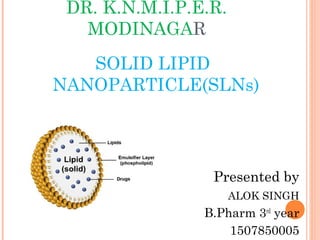
SOLID LIPID
NANOPARTICLE(SLNs)
Presented by
ALOK SINGH
B.Pharm 3rd
year
1507850005
NANOPARTICLES
 Nanoparticles are particles between 1 and
100 nanometres (nm) in size with a surrounding
interfacial layer.
 The interfacial layer is an integral part of
nanoscale matter, fundamentally affecting all of
its properties.
 The interfacial layer typically consists of ions,
inorganic and organic molecules.
 Organic molecules coating inorganic
nanoparticles are known as stabilizers, capping
and surface ligands.
TYPES OF NANOPARTICLES
 Polymeric Micelles
 Nanosuspension and Nanocrystals
 Ceramic NPs
 Liposomes
 Niomoses
Solid-Lipid Nanoparticles
 Dendrimers
 Magnetic Nanoparticles
DIFFERENT NANOPARTICLES
SOLID LIPID NANOPARTICLE
 Solid-lipid Nanoparticles (SLNs) are submicron
colloidal carriers composed of a single lipid core
matrix that is solid at body temperature, and is
coated with a surfactant acting as stabilizer.
 A solid lipid nanoparticle is typically spherical with -an
average diameter between 10 and 1000 nanometers.
 Solid lipid nanoparticles possess a solid lipid core
matrix that can solubilize lipophilic molecules.
 The lipid core is stabilized by surfactants (emulsifiers).
 The term lipid is used here in a broader sense and
includes Mono , Di and Triglycerides, fatty
acids , steroids  and waxes .
 All classes of emulsifiers  have been used to stabilize the
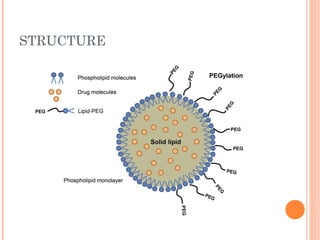
STRUCTURE
TYPES OF SOLID LIPID NANOPARTICLES
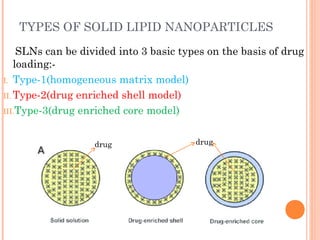
SLNs can be divided into 3 basic types on the basis of drug
loading:-
I. Type-1(homogeneous matrix model)
II. Type-2(drug enriched shell model)
III.Type-3(drug enriched core model)
drugdrug
1. HIGH PRESSURE HOMOGENIZATION
ADVANTAGES
 The SLNs bypass liver and spleen filtration.
 Controlled release of the incorporated drug can be achieved
for up to several weeks .
 SLN formulations stable for even three years has been
developed.
 The feasibility of incorporating both hydrophilic and
hydrophobic drugs .
 The carrier lipids are biodegradable and hence safe .
 Generally less toxic as compared to some polymeric
nanoparticles because physiological and biocompatible lipids
are used .
 Protecting the labile and sensitive drugs from chemical,
photochemical or oxidative degradation, due to
immobilization of drug molecules by solid lipids .
DISADVANTAGES
 Poor drug loading capacity.
 Drug expulsion during storage.
 Low capacity to load Hydrophilic drugs due to
partitioning effect during production procss.
 Particle growth.
USES/APPLICATIONS OF SLNS
Solid lipid nanoparticles

Solid lipid nanoparticles

  • 1.
  • 2.
    NANOPARTICLES  Nanoparticles are particlesbetween 1 and 100 nanometres (nm) in size with a surrounding interfacial layer.  The interfacial layer is an integral part of nanoscale matter, fundamentally affecting all of its properties.  The interfacial layer typically consists of ions, inorganic and organic molecules.  Organic molecules coating inorganic nanoparticles are known as stabilizers, capping and surface ligands.
  • 3.
    TYPES OF NANOPARTICLES Polymeric Micelles  Nanosuspension and Nanocrystals  Ceramic NPs  Liposomes  Niomoses Solid-Lipid Nanoparticles  Dendrimers  Magnetic Nanoparticles
  • 4.
  • 5.
    SOLID LIPID NANOPARTICLE Solid-lipid Nanoparticles (SLNs) are submicron colloidal carriers composed of a single lipid core matrix that is solid at body temperature, and is coated with a surfactant acting as stabilizer.  A solid lipid nanoparticle is typically spherical with -an average diameter between 10 and 1000 nanometers.  Solid lipid nanoparticles possess a solid lipid core matrix that can solubilize lipophilic molecules.  The lipid core is stabilized by surfactants (emulsifiers).  The term lipid is used here in a broader sense and includes Mono , Di and Triglycerides, fatty acids , steroids  and waxes .  All classes of emulsifiers  have been used to stabilize the
  • 6.
  • 7.
    TYPES OF SOLIDLIPID NANOPARTICLES SLNs can be divided into 3 basic types on the basis of drug loading:- I. Type-1(homogeneous matrix model) II. Type-2(drug enriched shell model) III.Type-3(drug enriched core model) drugdrug
  • 10.
    1. HIGH PRESSUREHOMOGENIZATION
  • 12.
    ADVANTAGES  The SLNsbypass liver and spleen filtration.  Controlled release of the incorporated drug can be achieved for up to several weeks .  SLN formulations stable for even three years has been developed.  The feasibility of incorporating both hydrophilic and hydrophobic drugs .  The carrier lipids are biodegradable and hence safe .  Generally less toxic as compared to some polymeric nanoparticles because physiological and biocompatible lipids are used .  Protecting the labile and sensitive drugs from chemical, photochemical or oxidative degradation, due to immobilization of drug molecules by solid lipids .
  • 13.
    DISADVANTAGES  Poor drugloading capacity.  Drug expulsion during storage.  Low capacity to load Hydrophilic drugs due to partitioning effect during production procss.  Particle growth.
  • 14.