PRESENTER: Tittu Joseph
MODERATOR: Dr. Beena Anthony
Definitions
Aetiology
Laboratory Diagnosis
Summary
Diarrhoea :Passage of 3 or more loose
or liquid stools per day, or more
frequently than is normal for the
individual.
Gastroenteritis : Inflammation of
mucous membrane of stomach &
intestine resulting in frequent loose
motions with or without mucous & with
or without blood, pain abdomen and
with or without fever.
Dysentery : Passage of blood and
mucous with motion, often associated
with tenesmus.
A) Bacteria
Invasive Bacterial
Pathogens:
 Salmonella sp
 Shigella sp
 Enteroinvasive Esch. coli
(EIEC)
 Enterohaemorrhagic Esch.
coli (EHEC)
 Vibrio parahaemolytius
 Campylobacter jejuni
 Yersinia enterocolitica
Non-invasive Bacterial
Pathogens:
 Enterotoxigenic Esch. coli
(ETEC)
 Enteropathogenic Esch.
coli (EPEC)
 Vibrio cholerae
 Shigella dysentriae type 1
 Staphylococcus aureus
 Clostridium perfringens
 Clostridium difficile
B)Viruses:
 Rotavirus
 Norwalk virus
 Adenovirus
 Astrovirus
 Calicivirus
C) Protozoa:
 Entamoeba histolytica
 Giardia lamblia
 Cryptosporidium parvum
 D)Immuno-
compromised
patients:
 Salmonella sp
 Clostridium difficile
 Mycobacterium avium
complex (MAC)
 Cryptosporidium
 Microsporidium
 Giardia
 Entamoeba histolytica
 Isospora belli
 Enterovirus
 Cytomegalovirus
 SPECIMENS:
Watery stool
 COLLECTION AND TRANSPORT:
 Preferably prior to the start of antibiotics.
 Should be immediately transported.
 Transport media - Venkatraman-Ramakrishnan (VR)
fluid, Cary-Blair medium, alkaline peptone water
/Monsur’s medium.
 DIRECT MICROSCOPY:
 For rapid diagnosis.
 Dark field or phase contrast microscope.
 Darting motility.
 CULTURE:
 Selective media - Alkaline Bile Salt
Agar(BSA), Thiosulphate Citrate Bile
Sucrose agar(TCBS) or Monsur’s Gelatin
Taurocholate Tryticase Tellurite
agar(GTTA).
 Non-selective media - Blood agar and
MacConkey’s agar.
 Incubated at 37°C for overnight.
 COLONY MORPHOLOGY AND STAINING:
 Pale colonies on MacConkey’s agar, TCBS
shows yellow colonies & BSA translucent
colonies are present.
 Gram staining: Gram negative comma
shaped bacilli.
 BIOCHEMICAL REACTION:
 Ferments glucose, mannitol, sucrose,
maltose, mannose with acid production.
 Catalase and oxidase positive.
SPECIMENS:
 Fresh stool is collected.
 Ideal specimen is a direct swab of an ucler taken under
sigmoidoscopic examination.
 TRASPORT:
 Should be transported immediately.
 Sach’s buffered glycerol saline, pH 7.0-7.4
 Alkaline transport media used for vibrios are inhibitory
to Shigella.
 DIRECT MICROSCOPY:
 Saline and iodine preparation shows large number of
pus cells, RBCs and macrophages.
 CULTURE:
 Selective media - MacConkey’s agar,Deoxycholate
citrate agar(DCA) or Xylose Lysine Deoxycholate
agar(XLD).
 Selenite F broth is used as enrichment media which
inhibits growth of normal flora like Esch. coli and helps
in the rapid growth of enteric pathogens.
 Incubated for 24hrs at 37°C.
 COLONY MORPHOLOGY AND STAINING:
 Non-lactose fermenting colonies on MacConkey’s agar.
 Gram negative bacilli and are non-motile.
 BIOCHEMICAL REACTIONS:
 Glucose fermentation without gas production, catalase
positive, oxidase negative.
 SLIDE AGGLUTINATION TEST:
 Slide agglutination with polyvalent antisera and
monovalent sera.
FEATURE: AMOEBIC
DYSENTRY:
BACILLARY
DYSENTRY:
Number 6-8 motions/day >10 motions/day
Amount Copious Small
Odour Offensive Odourless
Colour Dark red Bright red
Reaction Acidic Alkaline
Nature Blood & mucous
mixed with
faeces.
Blood & mucous
but no faeces.
Consistency Not adherent to
container.
Adherent to
container.
FEATURE: AMOEBIC
DYSENTRY:
BACILLARY
DYSENTRY:
RBCs In clumps Discrete or in
rouleaux formation
Pus cells Scanty Numerous
Eosinophils Present Scarce
Macrophages Very few Numerous; many of
them contain RBCs;
hence mistaken for
E.histolytica
Ghost cells Absent Numerous
Pyknotic bodies Present Absent
Charcot-Leyden
crystals
Present Absent
Parasite Trophozoites of
E.histolytica
present
Absent
Bacteria Many motile
bacteria
Absent
 SPECIMEN:
 Faeces
 DIRECT MICROSCOPY:
 Gram staining: Gram negative, curved bacilli.
 Dark ground or phase contrast microscopy: Darting or
tumbling motility of the spiral rods.
 CULTURE:
 Transport media: Cary-Blair media.
 Selective media: Butzler’s selective medium, Skirrow’s
Campylobacter selective medium and Campy BAP
selective media.
 Campy BAP: Lysed blood agar, vamcomycin, polymyxin
B, trimethoprim, cephalothin and amphotericin B.
 Incubated at 42°C for 48hrs.
 BIOCHEMICAL REACTIONS: Oxidase and catalase
positive .
 SPECIMEN:
 Faeces.
 CULTURE:
 Selective medium: Cycloserine-cefoxitin-fructose
agar(CCFA).
 Colonies appear yellow due to fructose fermentation.
 DEMONSTRATION OF TOXIN:
 Toxin can be demonstrated in the faeces of patients by
its characteristic effects on Hep-2 and human diploid
cell cultures, or by ELISA.
 Toxin is specifically neutralized by atiserum of
Clostridium sordelli.
 SPECIMEN:
 Faeces
 CULTURE:
 Blood agar and MacConkey’s agar.
 Incubated at 37°C for 24hrs.
 Colonies show β-haemolysis on Blood agar.
 Pink lactose fermenting colonies seen on MacConkey’s
agar.
 Identification of ETEC depends upon the demonstration
of Heat Labile toxin and Heat Stable toxin using
methods like ELISA, Radioimmunoassay(RIA).
 Verocytotoxin producing Esch. coli(VTEC) can be
detected by its cytotoxic effect on Vero and HeLa cells.
 Sereny test: Done by inoculating suspension of bacteria
into guinea pig's eye. Severe
mucopurulent conjunctivitis and
severe keratitis indicates a positive test.
 Done for identification of EIEC.
 BIOCHEMICAL REACTIONS:
 Glucose ,lactose, mannitol and indole positive with
acid and gas production.
 Sucrose, urease and citrate negative.
 Rotavirus And Norwalk Virus:
 Demonstration of viruses:
 During the acute stage of the disease, virus particles
may be present in the faeces and can be demonstrated
by:
 ELISA
 Latex Agglutination Test
 Counterimmunoelectrophoresis(CIEP)
 Electron microscopy
 Immunoelectron microscopy
 Antibody Detection:
 IgM and IgG antibodies can be detected in the blood by
ELISA and compliment fixation test.
 Polymerase Chain Reaction(PCR)
 STOOL EXAMINATION: (Microscopic examination)
 Normal saline preparation: Actively motile
trophozoites.
 Iodine preparation: Cysts or dead trophozoites.
[Excretion of cysts in the stool is often intermittent,
therefore, at least three consecutive specimens should
be examined]
 Charcot-Leyden crystals may appear in saline
preparation. These are diamond-shaped crystals, clear
and refractile.
 Concentration method such as formal ether may be
used for concentration of amoebic cysts in the stool
when the number of amoebae are scanty.
 STOOL ANTIGEN DETECTION:
 ELISA is used to detect antigens of E.histolytica in
faeces.
 BLOOD EXAMINATION: Leucocytosis.
 Serological tests:
 In early cases, its always negative.
 Indirect haemagglutination assay(IHA), indirect
fluorescent antibody(IFA) and ELISA.
 DNA probes
 Polymerase Chain Reaction
 Stool Examination: (Microscopic examination)
 Cysts in formed stools and trophozoites of the parasite
in diarrhoeal stools by wet preparation(Normal saline
and iodine)
 Multiple stool samples may not show any parasites as
they are attached firmly to the mucosa by means of
suckling disc.
 Concentration techniques like zinc sulphate floatation
or formalin ethyl acetate are used if the cysts are
sparse.
 Antigen Detection:
 Fluorescent method using monoclonal antibodies and
ELISA test are done for detection of Giardia antigen in
faeces.
 Not in routine use.
 Antibody Detection:
 Anti-Giardia antibodies may be detected in the patient
serum by using ELISA and indirect fluorescent antibody
tests.
 May indicate present or past infection and hence not
useful in diagnosis.
Stool Examination:
 Three consecutive stool specimens should be examined.
 Direct wet mount – Highly refractile, spherical oocysts.
 Staining methods – Modified Ziehl-Neelsen staining.
 Oocysts appear bright red(acid-fast).
 Immunofluorescent Antibody (IFA) test :
 Specific and most sensitive method for identification of
C.parvum in the faeces.
 Concentration technique – Sheather’s sugar
concentration technique.
 ANTIGEN DETECTION IN FAECES:
 ELISA- To detect Cryptosporidial antigen in the faeces.
 Immunochromatographic test- simple and rapid.
 Direct Microscopy: Gram Staining, Simple Staining.
 Blood agar
 MacConkey’s Agar
 Selective Media: TCBS agar- V.cholerae
DCA – Shigella
CCFA – C.difficile
 Parasites: Saline preparation
Iodine preparation – Cysts
Modified acid-fast staining – Cryptosporidia
- Microsporidia
 Antigen Detection: Viruses – Rotavirus, Norwalk virus.
 Toxin Detection: C.difficile
Microbiological Aspects Of Diarrhoea

Microbiological Aspects Of Diarrhoea

  • 1.
  • 2.
  • 3.
    Diarrhoea :Passage of3 or more loose or liquid stools per day, or more frequently than is normal for the individual. Gastroenteritis : Inflammation of mucous membrane of stomach & intestine resulting in frequent loose motions with or without mucous & with or without blood, pain abdomen and with or without fever. Dysentery : Passage of blood and mucous with motion, often associated with tenesmus.
  • 4.
    A) Bacteria Invasive Bacterial Pathogens: Salmonella sp  Shigella sp  Enteroinvasive Esch. coli (EIEC)  Enterohaemorrhagic Esch. coli (EHEC)  Vibrio parahaemolytius  Campylobacter jejuni  Yersinia enterocolitica Non-invasive Bacterial Pathogens:  Enterotoxigenic Esch. coli (ETEC)  Enteropathogenic Esch. coli (EPEC)  Vibrio cholerae  Shigella dysentriae type 1  Staphylococcus aureus  Clostridium perfringens  Clostridium difficile
  • 5.
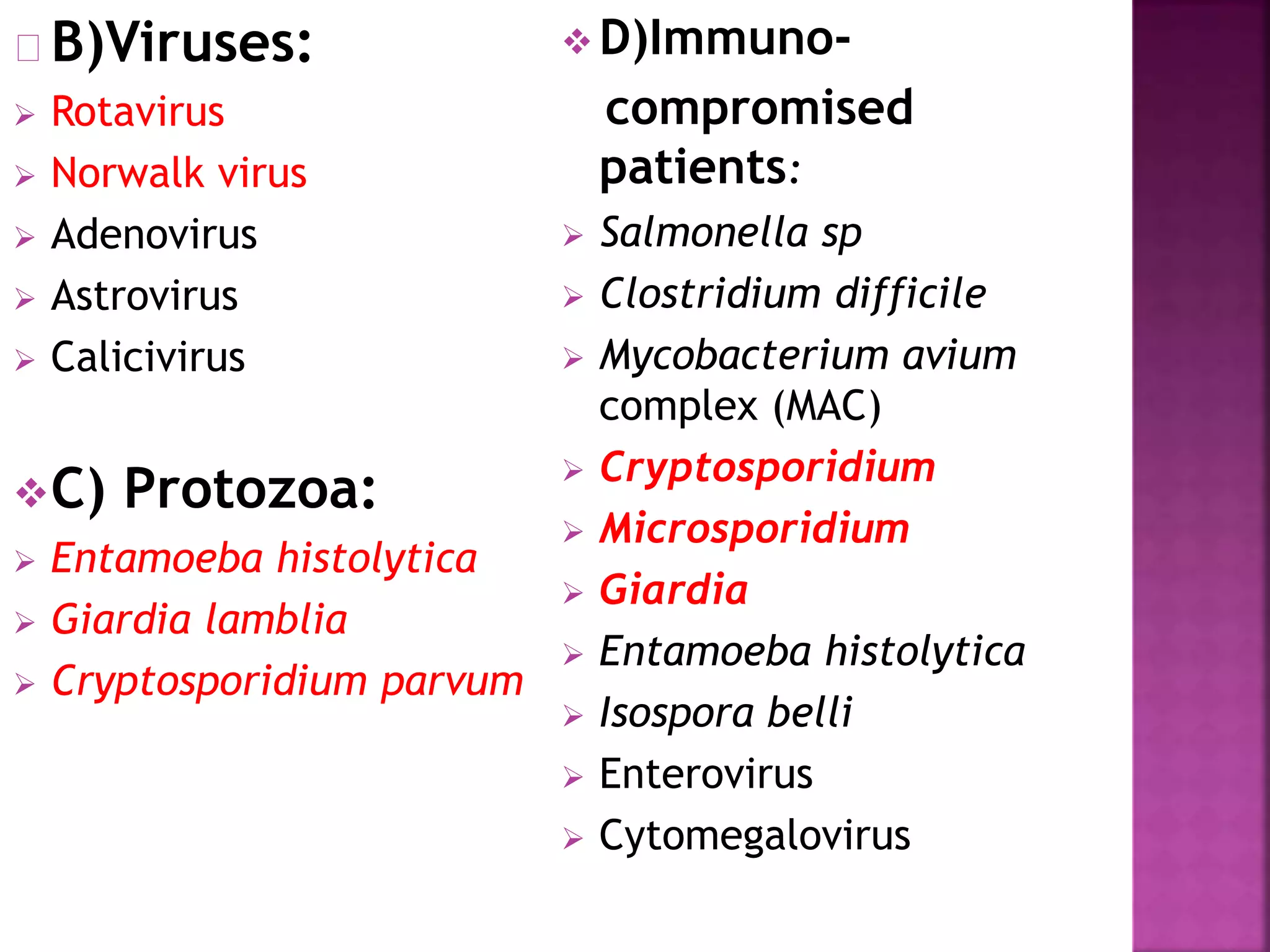
    B)Viruses:  Rotavirus  Norwalkvirus  Adenovirus  Astrovirus  Calicivirus C) Protozoa:  Entamoeba histolytica  Giardia lamblia  Cryptosporidium parvum  D)Immuno- compromised patients:  Salmonella sp  Clostridium difficile  Mycobacterium avium complex (MAC)  Cryptosporidium  Microsporidium  Giardia  Entamoeba histolytica  Isospora belli  Enterovirus  Cytomegalovirus
  • 6.
     SPECIMENS: Watery stool COLLECTION AND TRANSPORT:  Preferably prior to the start of antibiotics.  Should be immediately transported.  Transport media - Venkatraman-Ramakrishnan (VR) fluid, Cary-Blair medium, alkaline peptone water /Monsur’s medium.  DIRECT MICROSCOPY:  For rapid diagnosis.  Dark field or phase contrast microscope.  Darting motility.
  • 7.
     CULTURE:  Selectivemedia - Alkaline Bile Salt Agar(BSA), Thiosulphate Citrate Bile Sucrose agar(TCBS) or Monsur’s Gelatin Taurocholate Tryticase Tellurite agar(GTTA).  Non-selective media - Blood agar and MacConkey’s agar.  Incubated at 37°C for overnight.
  • 8.
     COLONY MORPHOLOGYAND STAINING:  Pale colonies on MacConkey’s agar, TCBS shows yellow colonies & BSA translucent colonies are present.  Gram staining: Gram negative comma shaped bacilli.  BIOCHEMICAL REACTION:  Ferments glucose, mannitol, sucrose, maltose, mannose with acid production.  Catalase and oxidase positive.
  • 10.
    SPECIMENS:  Fresh stoolis collected.  Ideal specimen is a direct swab of an ucler taken under sigmoidoscopic examination.  TRASPORT:  Should be transported immediately.  Sach’s buffered glycerol saline, pH 7.0-7.4  Alkaline transport media used for vibrios are inhibitory to Shigella.  DIRECT MICROSCOPY:  Saline and iodine preparation shows large number of pus cells, RBCs and macrophages.
  • 11.
     CULTURE:  Selectivemedia - MacConkey’s agar,Deoxycholate citrate agar(DCA) or Xylose Lysine Deoxycholate agar(XLD).  Selenite F broth is used as enrichment media which inhibits growth of normal flora like Esch. coli and helps in the rapid growth of enteric pathogens.  Incubated for 24hrs at 37°C.  COLONY MORPHOLOGY AND STAINING:  Non-lactose fermenting colonies on MacConkey’s agar.  Gram negative bacilli and are non-motile.  BIOCHEMICAL REACTIONS:  Glucose fermentation without gas production, catalase positive, oxidase negative.  SLIDE AGGLUTINATION TEST:  Slide agglutination with polyvalent antisera and monovalent sera.
  • 12.
    FEATURE: AMOEBIC DYSENTRY: BACILLARY DYSENTRY: Number 6-8motions/day >10 motions/day Amount Copious Small Odour Offensive Odourless Colour Dark red Bright red Reaction Acidic Alkaline Nature Blood & mucous mixed with faeces. Blood & mucous but no faeces. Consistency Not adherent to container. Adherent to container.
  • 13.
    FEATURE: AMOEBIC DYSENTRY: BACILLARY DYSENTRY: RBCs Inclumps Discrete or in rouleaux formation Pus cells Scanty Numerous Eosinophils Present Scarce Macrophages Very few Numerous; many of them contain RBCs; hence mistaken for E.histolytica Ghost cells Absent Numerous Pyknotic bodies Present Absent Charcot-Leyden crystals Present Absent
  • 14.
  • 15.
     SPECIMEN:  Faeces DIRECT MICROSCOPY:  Gram staining: Gram negative, curved bacilli.  Dark ground or phase contrast microscopy: Darting or tumbling motility of the spiral rods.  CULTURE:  Transport media: Cary-Blair media.  Selective media: Butzler’s selective medium, Skirrow’s Campylobacter selective medium and Campy BAP selective media.  Campy BAP: Lysed blood agar, vamcomycin, polymyxin B, trimethoprim, cephalothin and amphotericin B.  Incubated at 42°C for 48hrs.  BIOCHEMICAL REACTIONS: Oxidase and catalase positive .
  • 16.
     SPECIMEN:  Faeces. CULTURE:  Selective medium: Cycloserine-cefoxitin-fructose agar(CCFA).  Colonies appear yellow due to fructose fermentation.  DEMONSTRATION OF TOXIN:  Toxin can be demonstrated in the faeces of patients by its characteristic effects on Hep-2 and human diploid cell cultures, or by ELISA.  Toxin is specifically neutralized by atiserum of Clostridium sordelli.
  • 18.
     SPECIMEN:  Faeces CULTURE:  Blood agar and MacConkey’s agar.  Incubated at 37°C for 24hrs.  Colonies show β-haemolysis on Blood agar.  Pink lactose fermenting colonies seen on MacConkey’s agar.  Identification of ETEC depends upon the demonstration of Heat Labile toxin and Heat Stable toxin using methods like ELISA, Radioimmunoassay(RIA).  Verocytotoxin producing Esch. coli(VTEC) can be detected by its cytotoxic effect on Vero and HeLa cells.
  • 20.
     Sereny test:Done by inoculating suspension of bacteria into guinea pig's eye. Severe mucopurulent conjunctivitis and severe keratitis indicates a positive test.  Done for identification of EIEC.  BIOCHEMICAL REACTIONS:  Glucose ,lactose, mannitol and indole positive with acid and gas production.  Sucrose, urease and citrate negative.
  • 21.
     Rotavirus AndNorwalk Virus:  Demonstration of viruses:  During the acute stage of the disease, virus particles may be present in the faeces and can be demonstrated by:  ELISA  Latex Agglutination Test  Counterimmunoelectrophoresis(CIEP)  Electron microscopy  Immunoelectron microscopy  Antibody Detection:  IgM and IgG antibodies can be detected in the blood by ELISA and compliment fixation test.  Polymerase Chain Reaction(PCR)
  • 22.
     STOOL EXAMINATION:(Microscopic examination)  Normal saline preparation: Actively motile trophozoites.  Iodine preparation: Cysts or dead trophozoites. [Excretion of cysts in the stool is often intermittent, therefore, at least three consecutive specimens should be examined]  Charcot-Leyden crystals may appear in saline preparation. These are diamond-shaped crystals, clear and refractile.  Concentration method such as formal ether may be used for concentration of amoebic cysts in the stool when the number of amoebae are scanty.  STOOL ANTIGEN DETECTION:  ELISA is used to detect antigens of E.histolytica in faeces.
  • 23.
     BLOOD EXAMINATION:Leucocytosis.  Serological tests:  In early cases, its always negative.  Indirect haemagglutination assay(IHA), indirect fluorescent antibody(IFA) and ELISA.  DNA probes  Polymerase Chain Reaction
  • 25.
     Stool Examination:(Microscopic examination)  Cysts in formed stools and trophozoites of the parasite in diarrhoeal stools by wet preparation(Normal saline and iodine)  Multiple stool samples may not show any parasites as they are attached firmly to the mucosa by means of suckling disc.  Concentration techniques like zinc sulphate floatation or formalin ethyl acetate are used if the cysts are sparse.  Antigen Detection:  Fluorescent method using monoclonal antibodies and ELISA test are done for detection of Giardia antigen in faeces.  Not in routine use.
  • 26.
     Antibody Detection: Anti-Giardia antibodies may be detected in the patient serum by using ELISA and indirect fluorescent antibody tests.  May indicate present or past infection and hence not useful in diagnosis.
  • 27.
    Stool Examination:  Threeconsecutive stool specimens should be examined.  Direct wet mount – Highly refractile, spherical oocysts.  Staining methods – Modified Ziehl-Neelsen staining.  Oocysts appear bright red(acid-fast).  Immunofluorescent Antibody (IFA) test :  Specific and most sensitive method for identification of C.parvum in the faeces.  Concentration technique – Sheather’s sugar concentration technique.  ANTIGEN DETECTION IN FAECES:  ELISA- To detect Cryptosporidial antigen in the faeces.  Immunochromatographic test- simple and rapid.
  • 29.
     Direct Microscopy:Gram Staining, Simple Staining.  Blood agar  MacConkey’s Agar  Selective Media: TCBS agar- V.cholerae DCA – Shigella CCFA – C.difficile  Parasites: Saline preparation Iodine preparation – Cysts Modified acid-fast staining – Cryptosporidia - Microsporidia  Antigen Detection: Viruses – Rotavirus, Norwalk virus.  Toxin Detection: C.difficile