Diarrhoea
By : Najihah
Definition
• Increased in daily stool weight more than
200gm.
• Typically the patient may also describe an
increase in stool liquidity and frequency of
more than 3 times per day.
• Even one episode of liquid / semiformed stool
it is considered as diarrhoea.
Mechanism of diarrhoea
• Osmotic diarrhoea : due to poorly absorbable
osmotically active solutes in the gut lumen.
• Secretoy diarrhoea : secretion of cl and water with or
without inhibition of normal active sodium and water
absorption.
• Inflammation : exudation of mucus, blood and protein
into bowel lumen.
• Abnormal intestinal motility : increased or decreased
contact between luminal contents and mucosal
surface.
Osmotic Diarrhoea
• when patient fasts.
• Serum osmolality < osmolality of the stool
fluid.
• Osmotic gap > 125 milliosm/L
• eg : malabsorption
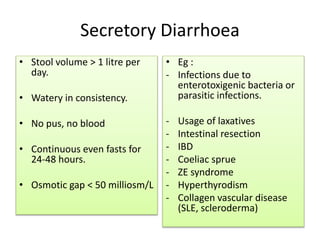
Secretory Diarrhoea
• Stool volume > 1 litre per
day.
• Watery in consistency.
• No pus, no blood
• Continuous even fasts for
24-48 hours.
• Osmotic gap < 50 milliosm/L
• Eg :
- Infections due to
enterotoxigenic bacteria or
parasitic infections.
- Usage of laxatives
- Intestinal resection
- IBD
- Coeliac sprue
- ZE syndrome
- Hyperthyrodism
- Collagen vascular disease
(SLE, scleroderma)
Clinical Classification of Diarrhoea
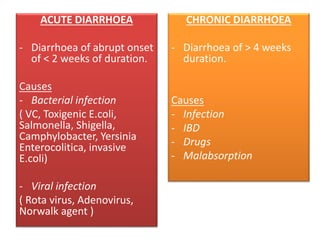
ACUTE DIARRHOEA
- Diarrhoea of abrupt onset
of < 2 weeks of duration.
Causes
- Bacterial infection
( VC, Toxigenic E.coli,
Salmonella, Shigella,
Camphylobacter, Yersinia
Enterocolitica, invasive
E.coli)
- Viral infection
( Rota virus, Adenovirus,
Norwalk agent )
CHRONIC DIARRHOEA
- Diarrhoea of > 4 weeks
duration.
Causes
- Infection
- IBD
- Drugs
- Malabsorption
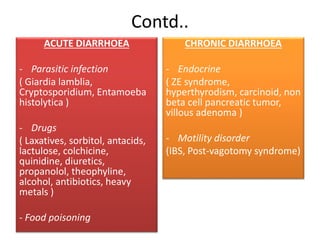
Contd..
ACUTE DIARRHOEA
- Parasitic infection
( Giardia lamblia,
Cryptosporidium, Entamoeba
histolytica )
- Drugs
( Laxatives, sorbitol, antacids,
lactulose, colchicine,
quinidine, diuretics,
propanolol, theophyline,
alcohol, antibiotics, heavy
metals )
- Food poisoning
CHRONIC DIARRHOEA
- Endocrine
( ZE syndrome,
hyperthyrodism, carcinoid, non
beta cell pancreatic tumor,
villous adenoma )
- Motility disorder
(IBS, Post-vagotomy syndrome)
• Diarrhoea in HIV
- It is due to Cryptosporidium, microsporidium,
CMV, Mycobacterium avium complex, TB,
intestinal lymphoma and Kaposi Sarcoma.
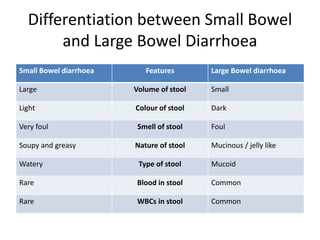
Differentiation between Small Bowel
and Large Bowel Diarrhoea
Small Bowel diarrhoea Features Large Bowel diarrhoea
Large Volume of stool Small
Light Colour of stool Dark
Very foul Smell of stool Foul
Soupy and greasy Nature of stool Mucinous / jelly like
Watery Type of stool Mucoid
Rare Blood in stool Common
Rare WBCs in stool Common
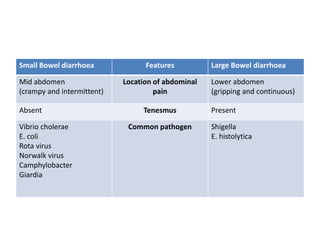
Small Bowel diarrhoea Features Large Bowel diarrhoea
Mid abdomen
(crampy and intermittent)
Location of abdominal
pain
Lower abdomen
(gripping and continuous)
Absent Tenesmus Present
Vibrio cholerae
E. coli
Rota virus
Norwalk virus
Camphylobacter
Giardia
Common pathogen Shigella
E. histolytica
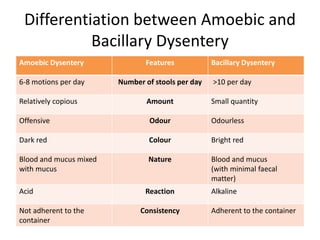
Differentiation between Amoebic and
Bacillary Dysentery
Amoebic Dysentery Features Bacillary Dysentery
6-8 motions per day Number of stools per day >10 per day
Relatively copious Amount Small quantity
Offensive Odour Odourless
Dark red Colour Bright red
Blood and mucus mixed
with mucus
Nature Blood and mucus
(with minimal faecal
matter)
Acid Reaction Alkaline
Not adherent to the
container
Consistency Adherent to the container
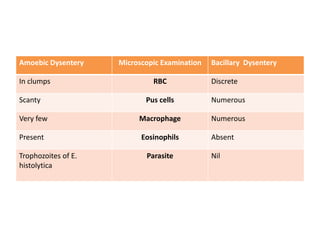
Amoebic Dysentery Microscopic Examination Bacillary Dysentery
In clumps RBC Discrete
Scanty Pus cells Numerous
Very few Macrophage Numerous
Present Eosinophils Absent
Trophozoites of E.
histolytica
Parasite Nil
Clinical Assesment
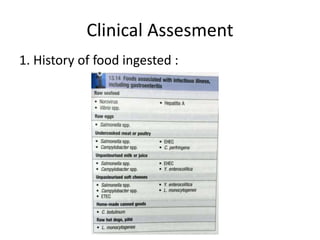
1. History of food ingested :
2. Duration , frequency , presence of blood or steatorrhea ,
abdominal pain , tenesmus, travelling and whether other
people have been affected.
3. An incubation period of <18hrs suggest toxin-mediated
food poisoning
4. If longer than >5days suggest that the diarrhoea is caused
by protozoa or helminths.
5. Person to person spread suggests certain infection, such as
shigellosis or cholera
Examination
• Assesment of the degree of dehydration by
skin turgor , pulse , and BP measurement.
• Monitor urine output and ongoing stool
losses.
Investigation
1. Examination of the stool :
a) Presence of WBC
- Suggest intestinal inflammation as a result of
mucosal invasion with bacteria, parasite, or toxins
also in IBD and ischemic colitis.
b) Absence of WBC
- Suggest non-inflammatory, non-invasive process
(viral, giardiasis, drug related).
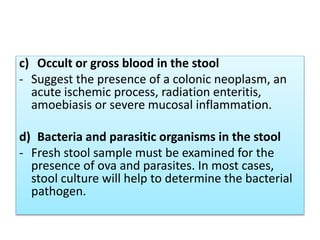
c) Occult or gross blood in the stool
- Suggest the presence of a colonic neoplasm, an
acute ischemic process, radiation enteritis,
amoebiasis or severe mucosal inflammation.
d) Bacteria and parasitic organisms in the stool
- Fresh stool sample must be examined for the
presence of ova and parasites. In most cases,
stool culture will help to determine the bacterial
pathogen.
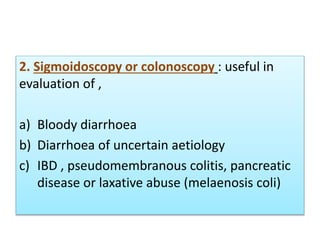
2. Sigmoidoscopy or colonoscopy : useful in
evaluation of ,
a) Bloody diarrhoea
b) Diarrhoea of uncertain aetiology
c) IBD , pseudomembranous colitis, pancreatic
disease or laxative abuse (melaenosis coli)
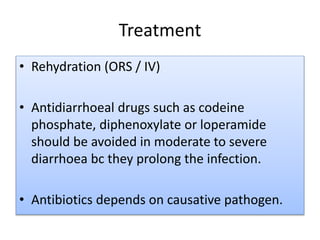
Treatment
• Rehydration (ORS / IV)
• Antidiarrhoeal drugs such as codeine
phosphate, diphenoxylate or loperamide
should be avoided in moderate to severe
diarrhoea bc they prolong the infection.
• Antibiotics depends on causative pathogen.
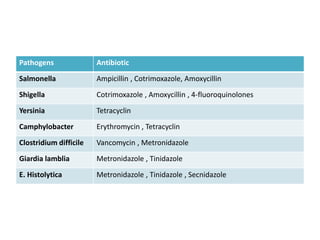
Pathogens Antibiotic
Salmonella Ampicillin , Cotrimoxazole, Amoxycillin
Shigella Cotrimoxazole , Amoxycillin , 4-fluoroquinolones
Yersinia Tetracyclin
Camphylobacter Erythromycin , Tetracyclin
Clostridium difficile Vancomycin , Metronidazole
Giardia lamblia Metronidazole , Tinidazole
E. Histolytica Metronidazole , Tinidazole , Secnidazole
• Racecadotril :
- Decreases hypersecretion of water and electrolyte into
the intestinal lumen by preventing degradation of
enkephalins.
- It is a potent inhibitor of enkephalinase.
- 100 mg TID in acute watery diarrhoea of either
bacterial / viral aetiology.
- C/I in renal insufficiency, pregnancy and BF.
• Octreotide :
- Useful in hormone induced secretory
diarrhoea and refractory diarrhoea.
Reference
• R Alagappan Manual of Practical Medicine ,
Fifth edition.
• Davidson’s principles and practice of
medicine, 22nd edition.
THANK YOU

Diarrhea

  • 1.
  • 2.
    Definition • Increased indaily stool weight more than 200gm. • Typically the patient may also describe an increase in stool liquidity and frequency of more than 3 times per day. • Even one episode of liquid / semiformed stool it is considered as diarrhoea.
  • 3.
    Mechanism of diarrhoea •Osmotic diarrhoea : due to poorly absorbable osmotically active solutes in the gut lumen. • Secretoy diarrhoea : secretion of cl and water with or without inhibition of normal active sodium and water absorption. • Inflammation : exudation of mucus, blood and protein into bowel lumen. • Abnormal intestinal motility : increased or decreased contact between luminal contents and mucosal surface.
  • 4.
    Osmotic Diarrhoea • whenpatient fasts. • Serum osmolality < osmolality of the stool fluid. • Osmotic gap > 125 milliosm/L • eg : malabsorption
  • 5.
    Secretory Diarrhoea • Stoolvolume > 1 litre per day. • Watery in consistency. • No pus, no blood • Continuous even fasts for 24-48 hours. • Osmotic gap < 50 milliosm/L • Eg : - Infections due to enterotoxigenic bacteria or parasitic infections. - Usage of laxatives - Intestinal resection - IBD - Coeliac sprue - ZE syndrome - Hyperthyrodism - Collagen vascular disease (SLE, scleroderma)
  • 6.
  • 7.
    ACUTE DIARRHOEA - Diarrhoeaof abrupt onset of < 2 weeks of duration. Causes - Bacterial infection ( VC, Toxigenic E.coli, Salmonella, Shigella, Camphylobacter, Yersinia Enterocolitica, invasive E.coli) - Viral infection ( Rota virus, Adenovirus, Norwalk agent ) CHRONIC DIARRHOEA - Diarrhoea of > 4 weeks duration. Causes - Infection - IBD - Drugs - Malabsorption
  • 8.
    Contd.. ACUTE DIARRHOEA - Parasiticinfection ( Giardia lamblia, Cryptosporidium, Entamoeba histolytica ) - Drugs ( Laxatives, sorbitol, antacids, lactulose, colchicine, quinidine, diuretics, propanolol, theophyline, alcohol, antibiotics, heavy metals ) - Food poisoning CHRONIC DIARRHOEA - Endocrine ( ZE syndrome, hyperthyrodism, carcinoid, non beta cell pancreatic tumor, villous adenoma ) - Motility disorder (IBS, Post-vagotomy syndrome)
  • 9.
    • Diarrhoea inHIV - It is due to Cryptosporidium, microsporidium, CMV, Mycobacterium avium complex, TB, intestinal lymphoma and Kaposi Sarcoma.
  • 10.
    Differentiation between SmallBowel and Large Bowel Diarrhoea Small Bowel diarrhoea Features Large Bowel diarrhoea Large Volume of stool Small Light Colour of stool Dark Very foul Smell of stool Foul Soupy and greasy Nature of stool Mucinous / jelly like Watery Type of stool Mucoid Rare Blood in stool Common Rare WBCs in stool Common
  • 11.
    Small Bowel diarrhoeaFeatures Large Bowel diarrhoea Mid abdomen (crampy and intermittent) Location of abdominal pain Lower abdomen (gripping and continuous) Absent Tenesmus Present Vibrio cholerae E. coli Rota virus Norwalk virus Camphylobacter Giardia Common pathogen Shigella E. histolytica
  • 12.
    Differentiation between Amoebicand Bacillary Dysentery Amoebic Dysentery Features Bacillary Dysentery 6-8 motions per day Number of stools per day >10 per day Relatively copious Amount Small quantity Offensive Odour Odourless Dark red Colour Bright red Blood and mucus mixed with mucus Nature Blood and mucus (with minimal faecal matter) Acid Reaction Alkaline Not adherent to the container Consistency Adherent to the container
  • 13.
    Amoebic Dysentery MicroscopicExamination Bacillary Dysentery In clumps RBC Discrete Scanty Pus cells Numerous Very few Macrophage Numerous Present Eosinophils Absent Trophozoites of E. histolytica Parasite Nil
  • 14.
  • 15.
    2. Duration ,frequency , presence of blood or steatorrhea , abdominal pain , tenesmus, travelling and whether other people have been affected. 3. An incubation period of <18hrs suggest toxin-mediated food poisoning 4. If longer than >5days suggest that the diarrhoea is caused by protozoa or helminths. 5. Person to person spread suggests certain infection, such as shigellosis or cholera
  • 16.
    Examination • Assesment ofthe degree of dehydration by skin turgor , pulse , and BP measurement. • Monitor urine output and ongoing stool losses.
  • 17.
    Investigation 1. Examination ofthe stool : a) Presence of WBC - Suggest intestinal inflammation as a result of mucosal invasion with bacteria, parasite, or toxins also in IBD and ischemic colitis. b) Absence of WBC - Suggest non-inflammatory, non-invasive process (viral, giardiasis, drug related).
  • 18.
    c) Occult orgross blood in the stool - Suggest the presence of a colonic neoplasm, an acute ischemic process, radiation enteritis, amoebiasis or severe mucosal inflammation. d) Bacteria and parasitic organisms in the stool - Fresh stool sample must be examined for the presence of ova and parasites. In most cases, stool culture will help to determine the bacterial pathogen.
  • 19.
    2. Sigmoidoscopy orcolonoscopy : useful in evaluation of , a) Bloody diarrhoea b) Diarrhoea of uncertain aetiology c) IBD , pseudomembranous colitis, pancreatic disease or laxative abuse (melaenosis coli)
  • 20.
    Treatment • Rehydration (ORS/ IV) • Antidiarrhoeal drugs such as codeine phosphate, diphenoxylate or loperamide should be avoided in moderate to severe diarrhoea bc they prolong the infection. • Antibiotics depends on causative pathogen.
  • 21.
    Pathogens Antibiotic Salmonella Ampicillin, Cotrimoxazole, Amoxycillin Shigella Cotrimoxazole , Amoxycillin , 4-fluoroquinolones Yersinia Tetracyclin Camphylobacter Erythromycin , Tetracyclin Clostridium difficile Vancomycin , Metronidazole Giardia lamblia Metronidazole , Tinidazole E. Histolytica Metronidazole , Tinidazole , Secnidazole
  • 22.
    • Racecadotril : -Decreases hypersecretion of water and electrolyte into the intestinal lumen by preventing degradation of enkephalins. - It is a potent inhibitor of enkephalinase. - 100 mg TID in acute watery diarrhoea of either bacterial / viral aetiology. - C/I in renal insufficiency, pregnancy and BF.
  • 23.
    • Octreotide : -Useful in hormone induced secretory diarrhoea and refractory diarrhoea.
  • 24.
    Reference • R AlagappanManual of Practical Medicine , Fifth edition. • Davidson’s principles and practice of medicine, 22nd edition. THANK YOU

Editor's Notes

  • #5 Osmolality = [particles]