Microteaching Skills
Materials taken and adapted from the works of:
Dr. Pratibha Gupta, Lucknow, India
and
Dr. S. Thangarajathi, Coimbatore, India
Dr. C. J. Dubash
Educational Consultant
Lahore
1
What is Teaching?
• Teaching is not merely imparting knowledge to students,
nor merely giving advice.
• Teaching is not passing information to the students.
• Teaching is not sharing one’s own experience.
• The best approach to understanding the nature of
teaching is establishing a harmonious relationship
between teacher, student and subject.
• Teaching is the activity of facilitating learning.
• Effectiveness in teaching does not relate to teacher’s
age, sex, and teaching experience.
• One can become an effective teacher irrespective of
his/her age, sex and experience.
2
Defective Teaching Learning Process
3
Mistakes and Errors
 treated as Teachable Moments
• opportunities to help students learn
• prevent repetition of similar errors
• build self-confidence of students
• promote student self-worth
These are not the instructor’s chances
to punish and demean the students
4
What is Learning?
• Learning – Knowledge acquired by study
• Learning happens and knowledge is
generated
There is a famous saying:
I hear … I forget;
I see … I remember;
I do … I understand.
5
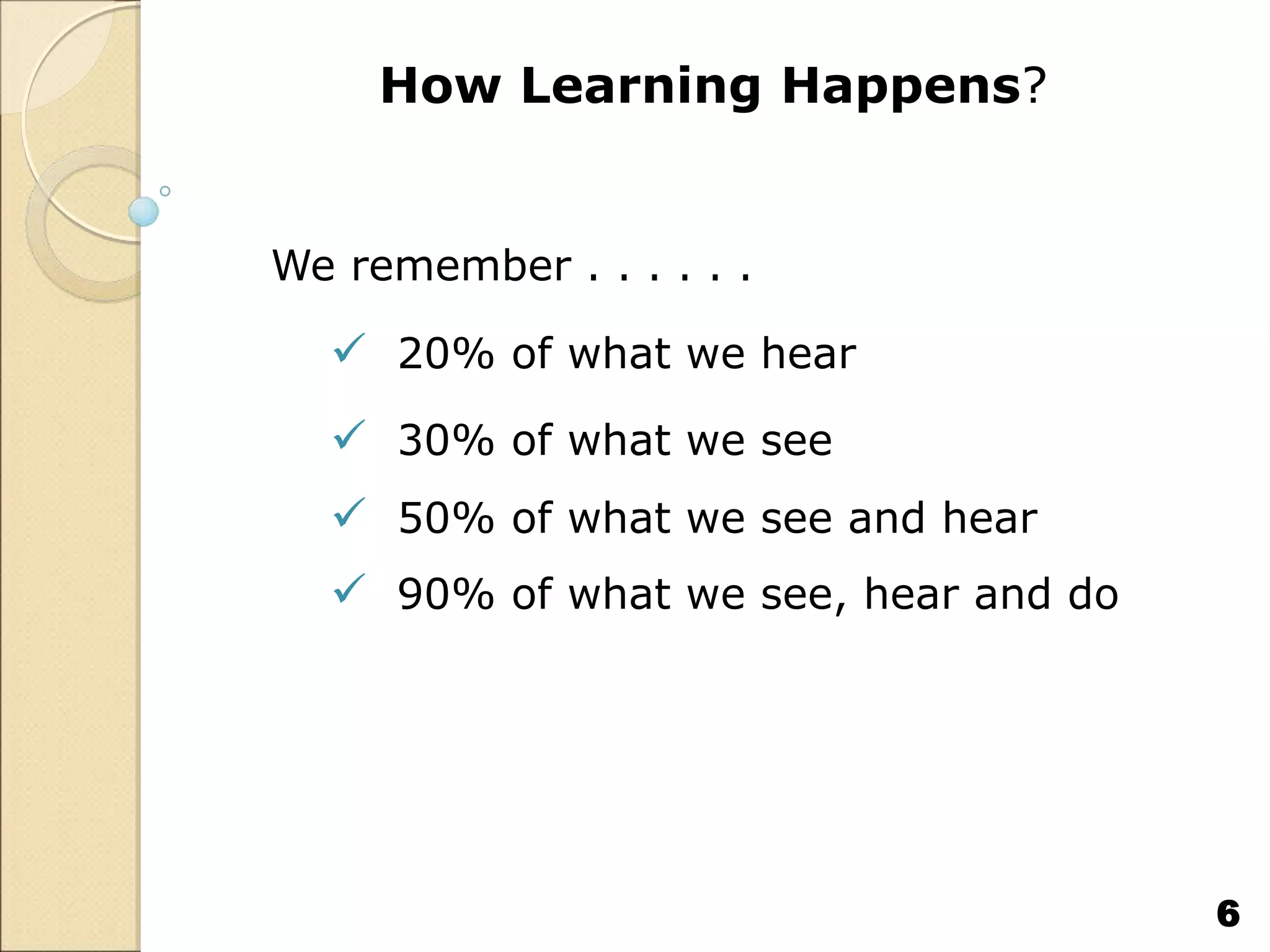
How Learning Happens?
We remember . . . . . .
 20% of what we hear
 30% of what we see
 50% of what we see and hear
 90% of what we see, hear and do
6
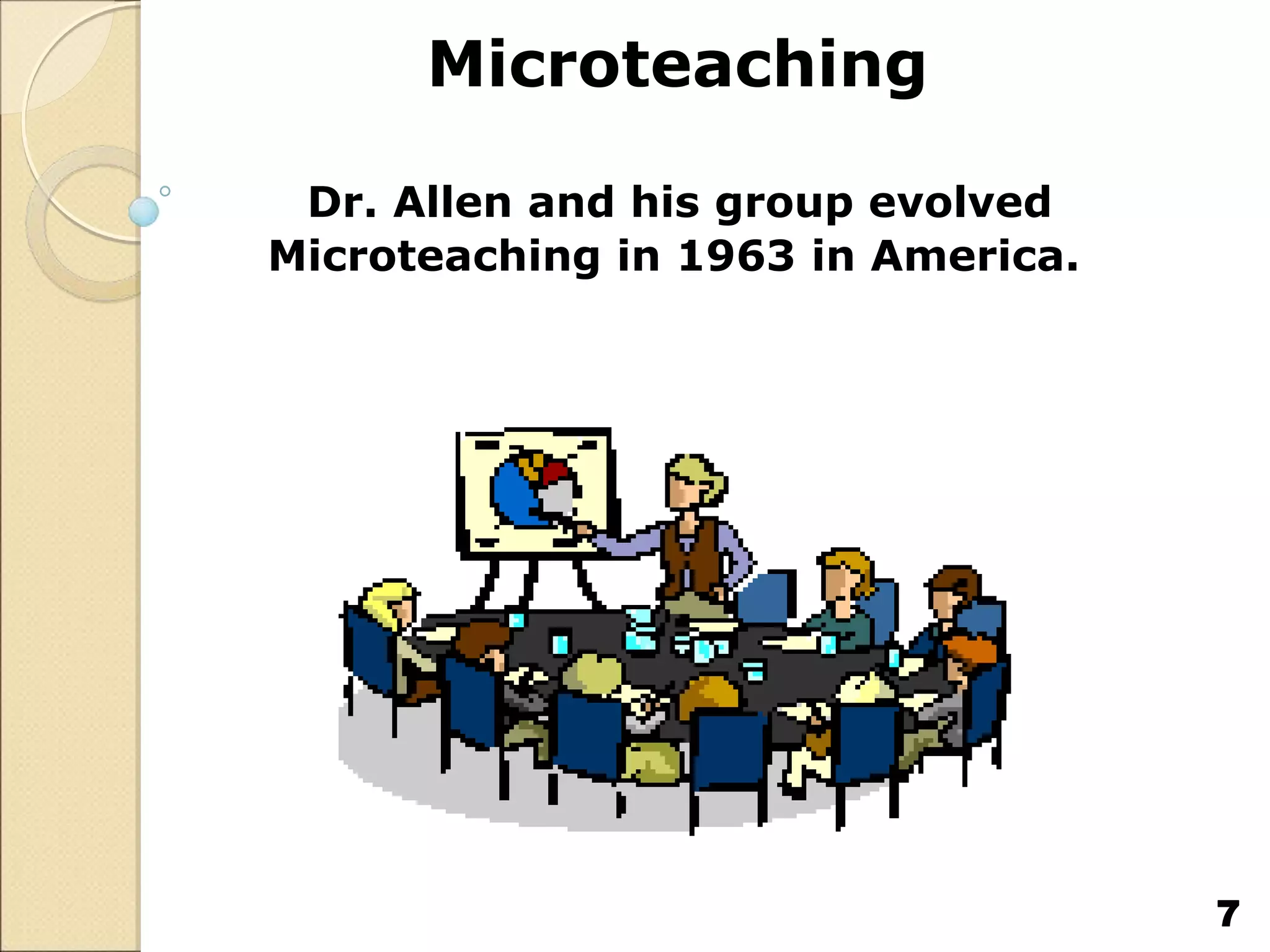
Microteaching
Dr. Allen and his group evolved
Microteaching in 1963 in America.
7
What is Microteaching?
• Teaching of a small unit of content to the
small group of students (10 – 15 number) in
a small amount of time (5 – 7 minutes)
• To train inexperience student-teachers for
acquiring teaching skills
• To improve the skills of experience teachers
8
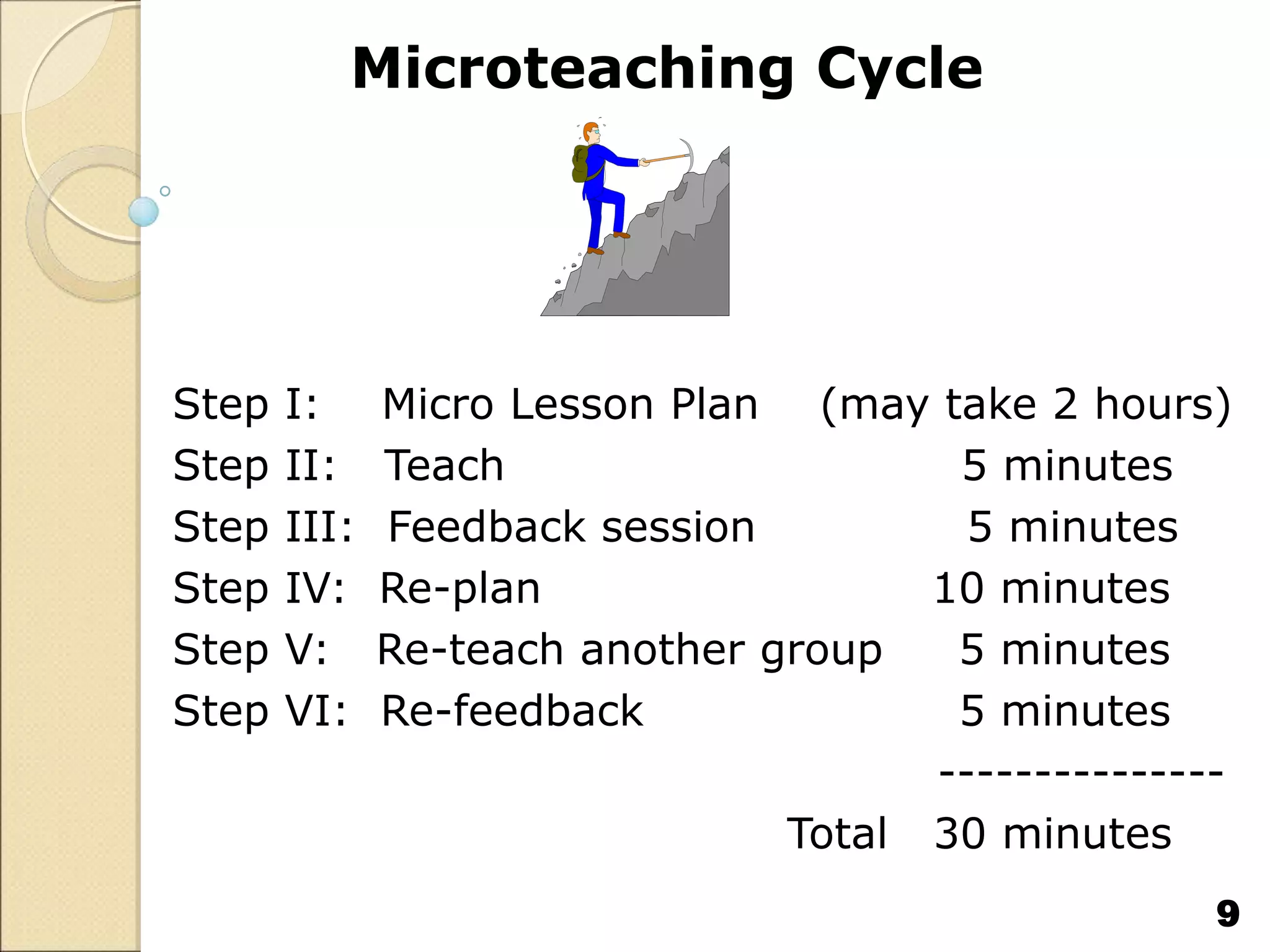
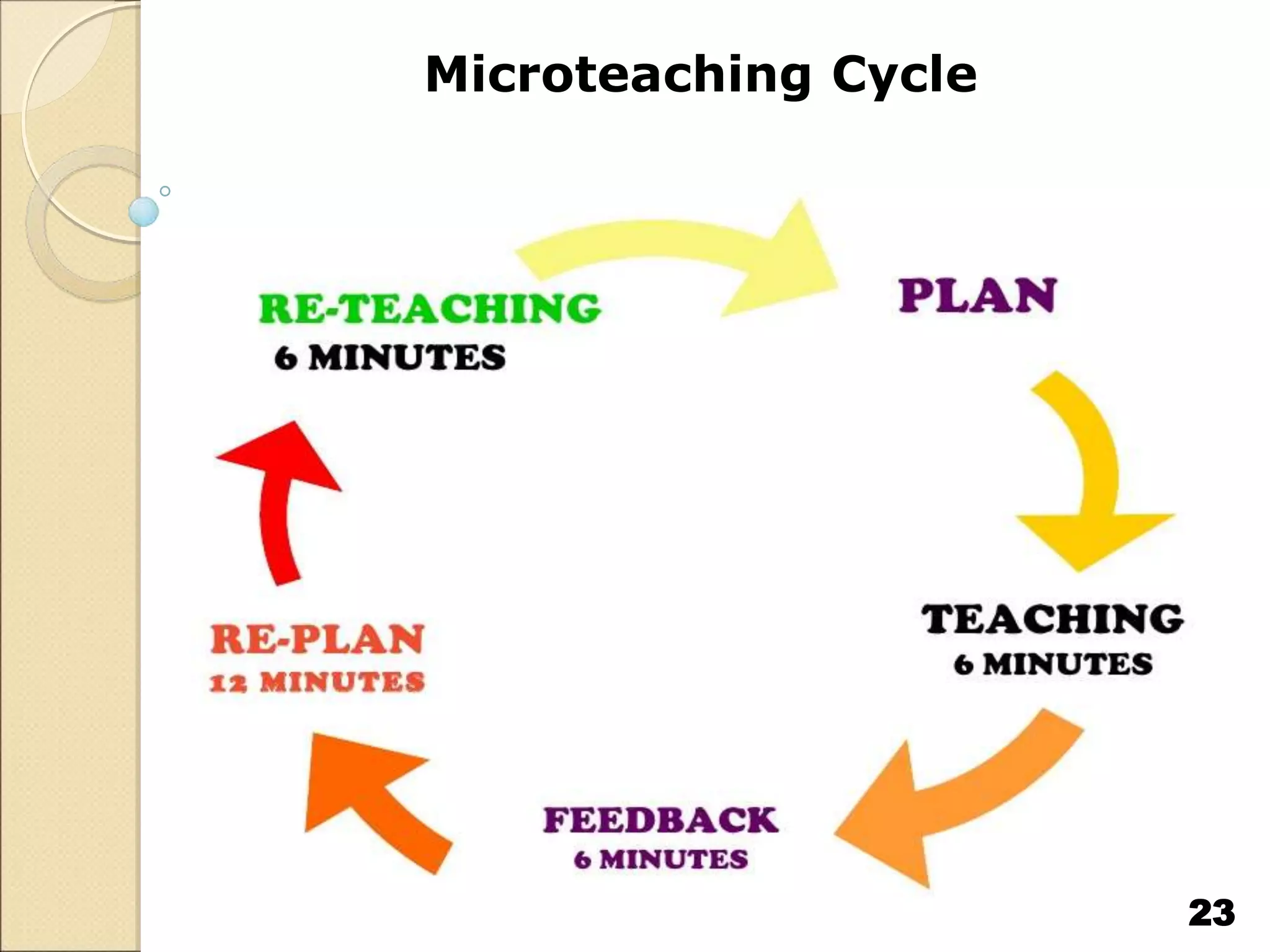
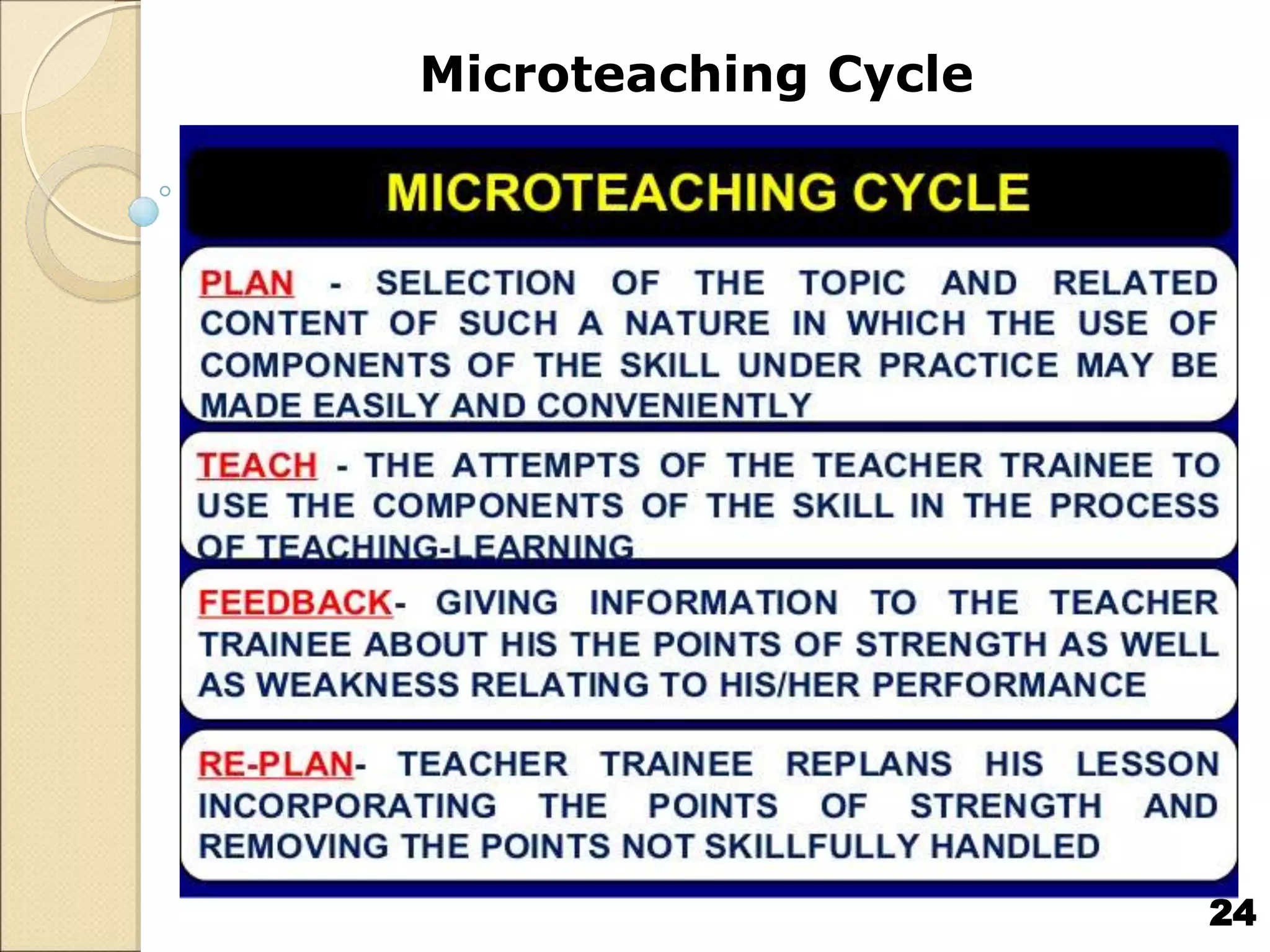
Microteaching Cycle
9
Step I: Micro Lesson Plan (may take 2 hours)
Step II: Teach 5 minutes
Step III: Feedback session 5 minutes
Step IV: Re-plan 10 minutes
Step V: Re-teach another group 5 minutes
Step VI: Re-feedback 5 minutes
---------------
Total 30 minutes
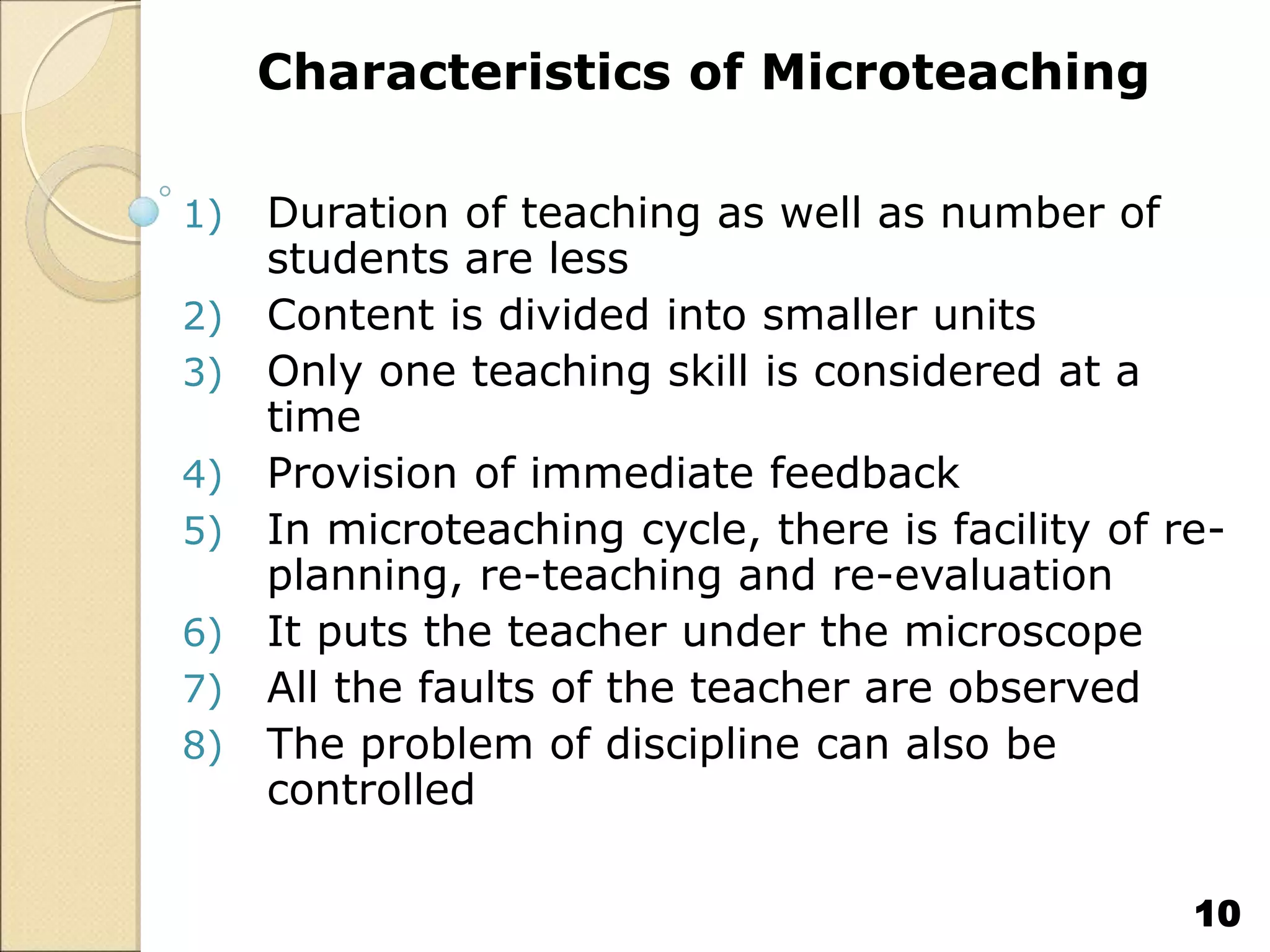
Characteristics of Microteaching
1) Duration of teaching as well as number of
students are less
2) Content is divided into smaller units
3) Only one teaching skill is considered at a
time
4) Provision of immediate feedback
5) In microteaching cycle, there is facility of re-
planning, re-teaching and re-evaluation
6) It puts the teacher under the microscope
7) All the faults of the teacher are observed
8) The problem of discipline can also be
controlled
10
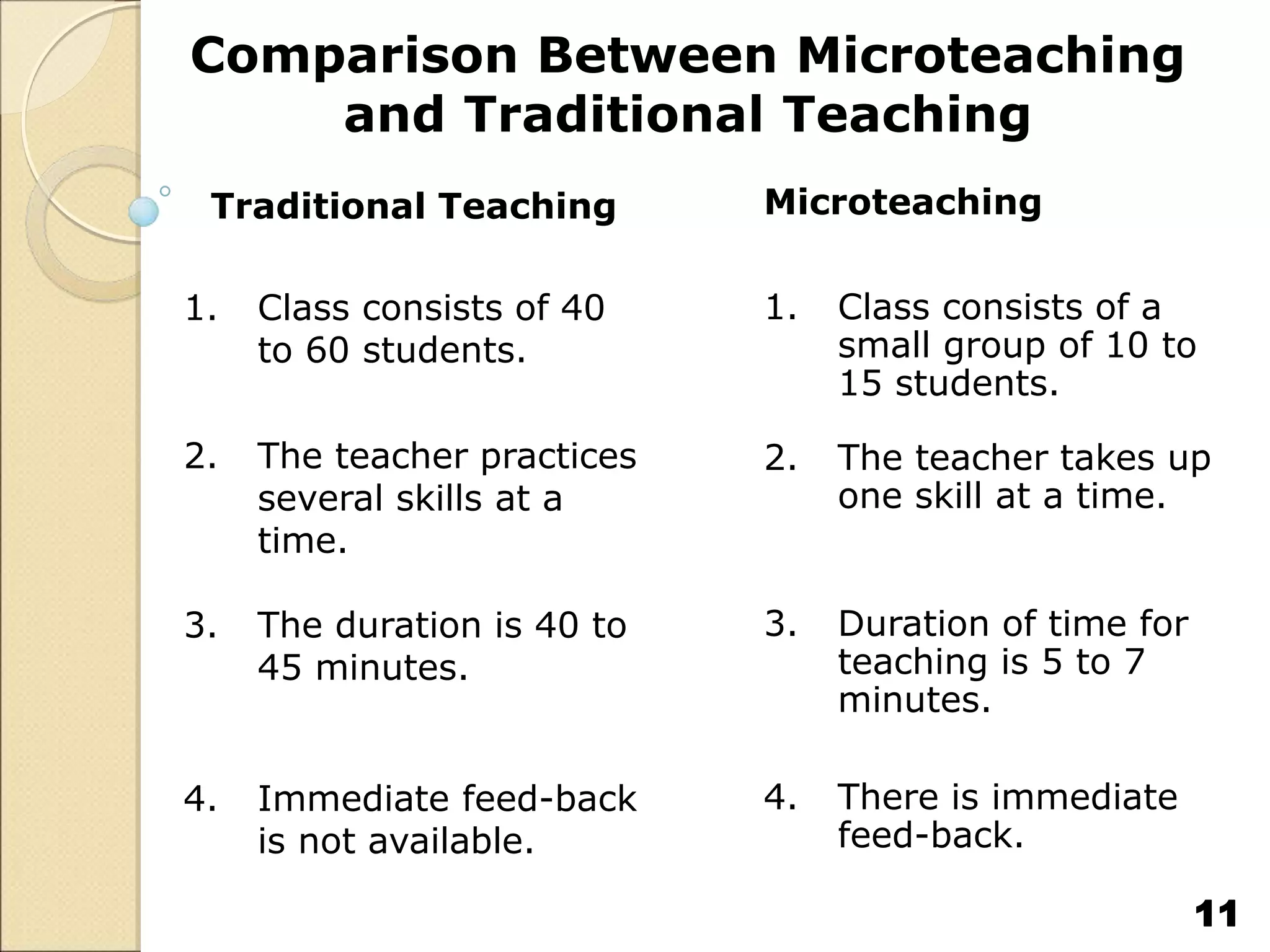
Comparison Between Microteaching
and Traditional Teaching
Microteaching
1. Class consists of a
small group of 10 to
15 students.
2. The teacher takes up
one skill at a time.
3. Duration of time for
teaching is 5 to 7
minutes.
4. There is immediate
feed-back.
11
Traditional Teaching
1. Class consists of 40
to 60 students.
2. The teacher practices
several skills at a
time.
3. The duration is 40 to
45 minutes.
4. Immediate feed-back
is not available.
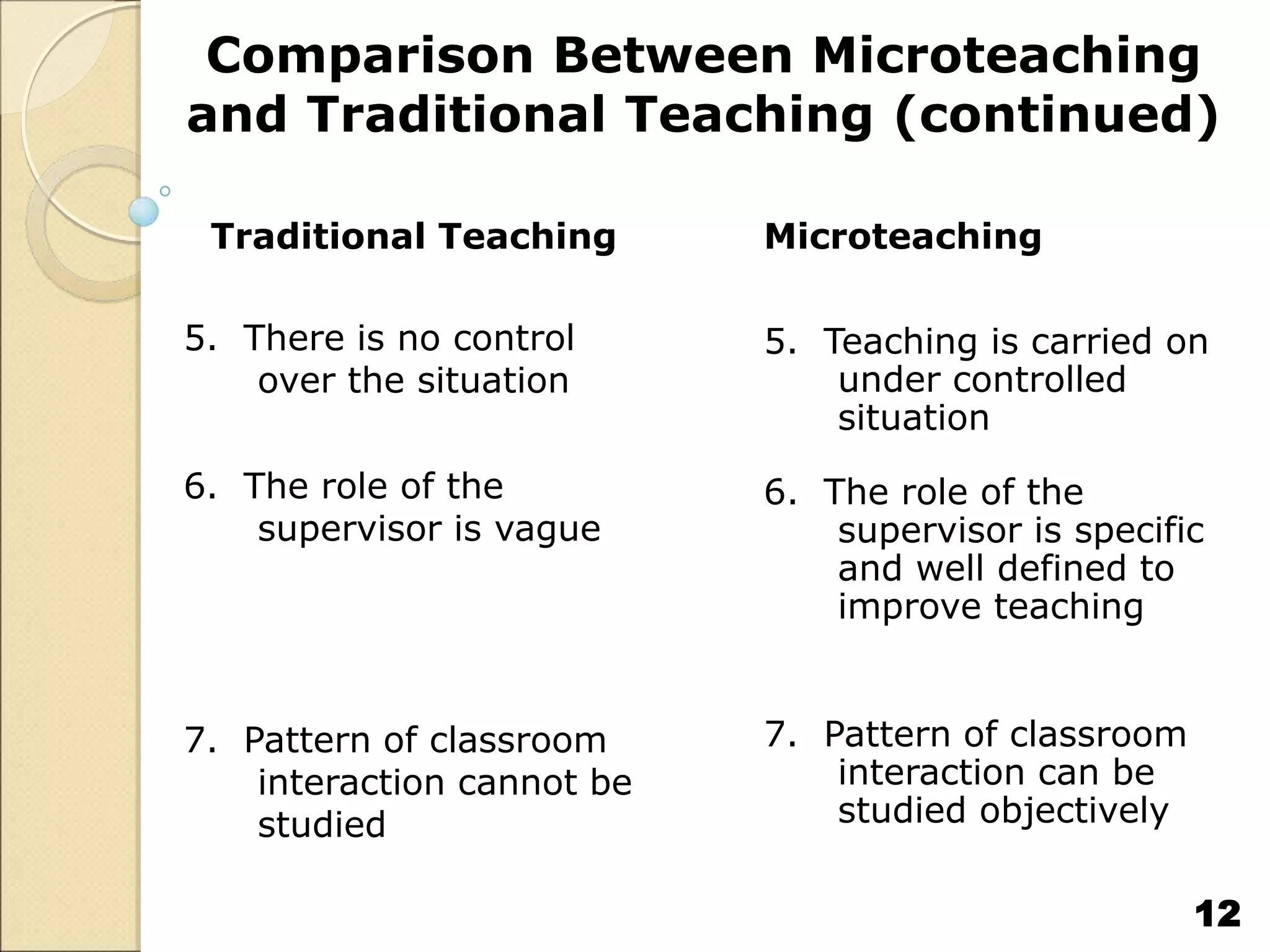
Comparison Between Microteaching
and Traditional Teaching (continued)
Microteaching
5. Teaching is carried on
under controlled
situation
6. The role of the
supervisor is specific
and well defined to
improve teaching
7. Pattern of classroom
interaction can be
studied objectively
12
Traditional Teaching
5. There is no control
over the situation
6. The role of the
supervisor is vague
7. Pattern of classroom
interaction cannot be
studied
Skills of Microteaching
1. Introduction Skill
2. Skill of Probing Questions
3. Skill of Explanation
4. Skill of Stimulus Variation
5. Skill of Blackboard Writing
6. Skill of Technology Integration
7. Skill of Achieving Closure 13
1. Introduction Skill
 Establishing rapport with the learners
 Linking with past experiences
 link between introduction and main parts
 Use of appropriate devices / techniques
like questioning, examples, etc.
14
2. Skill of Probing Questions
• Probing questions are those which help
the learners to think in depth about the
various aspects of the problem
• By asking such questions again, the
teacher makes the pupils more
thoughtful
• Enable the students to understand the
subject deeply
15
3. Skill of Explanation
It involves the ability of a teacher to
describe logically ‘How’, ‘Why’ and ‘What’
of the concept
Precautions for Skill of Explaining:
a) in simple language
b) should not be given the shape of an
advice
c) should be in a sequence
d) should be according to the age,
experience and mental level of the
students
16
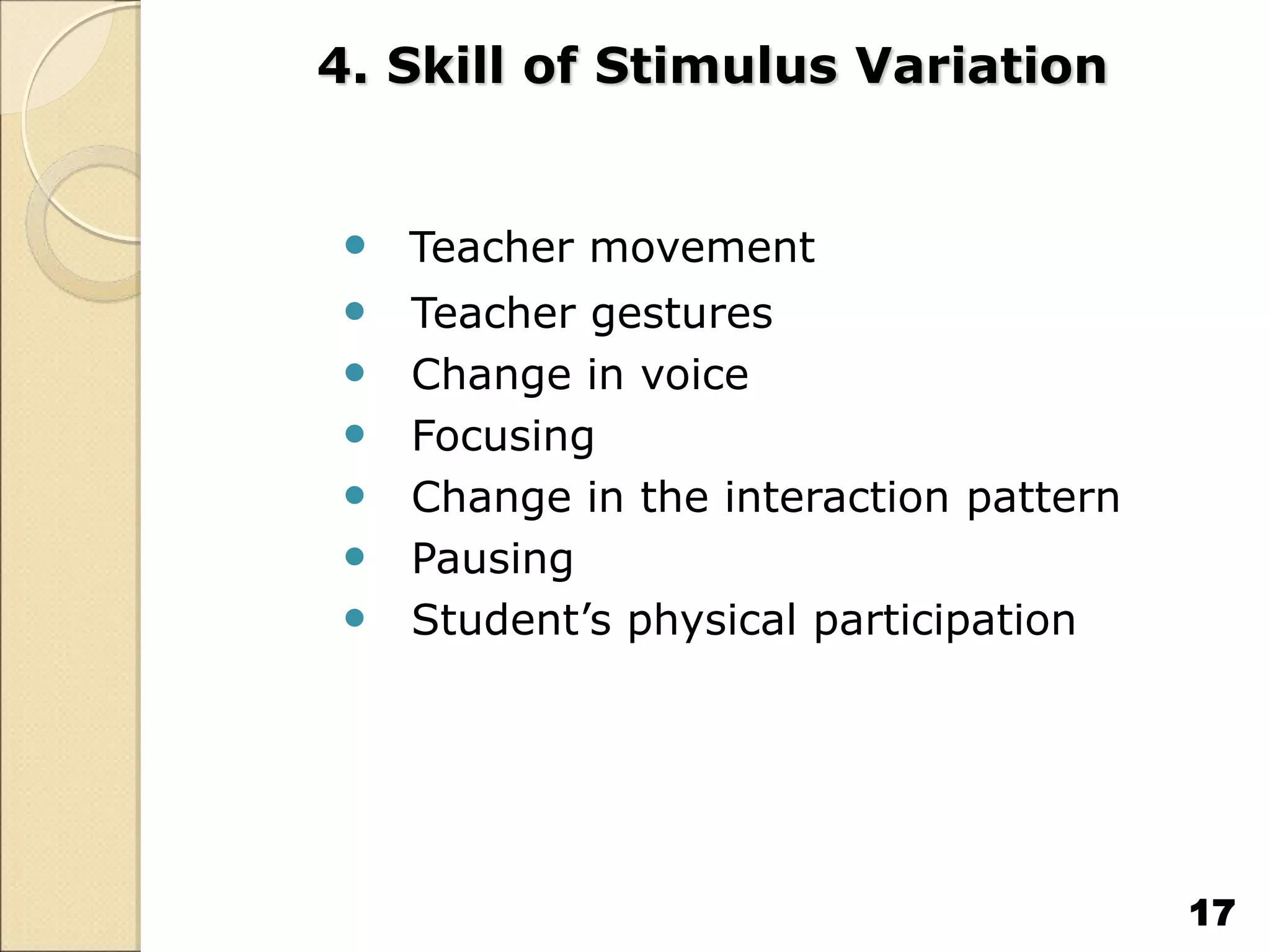
4. Skill of Stimulus Variation
 Teacher movement
 Teacher gestures
 Change in voice
 Focusing
 Change in the interaction pattern
 Pausing
 Student’s physical participation
17
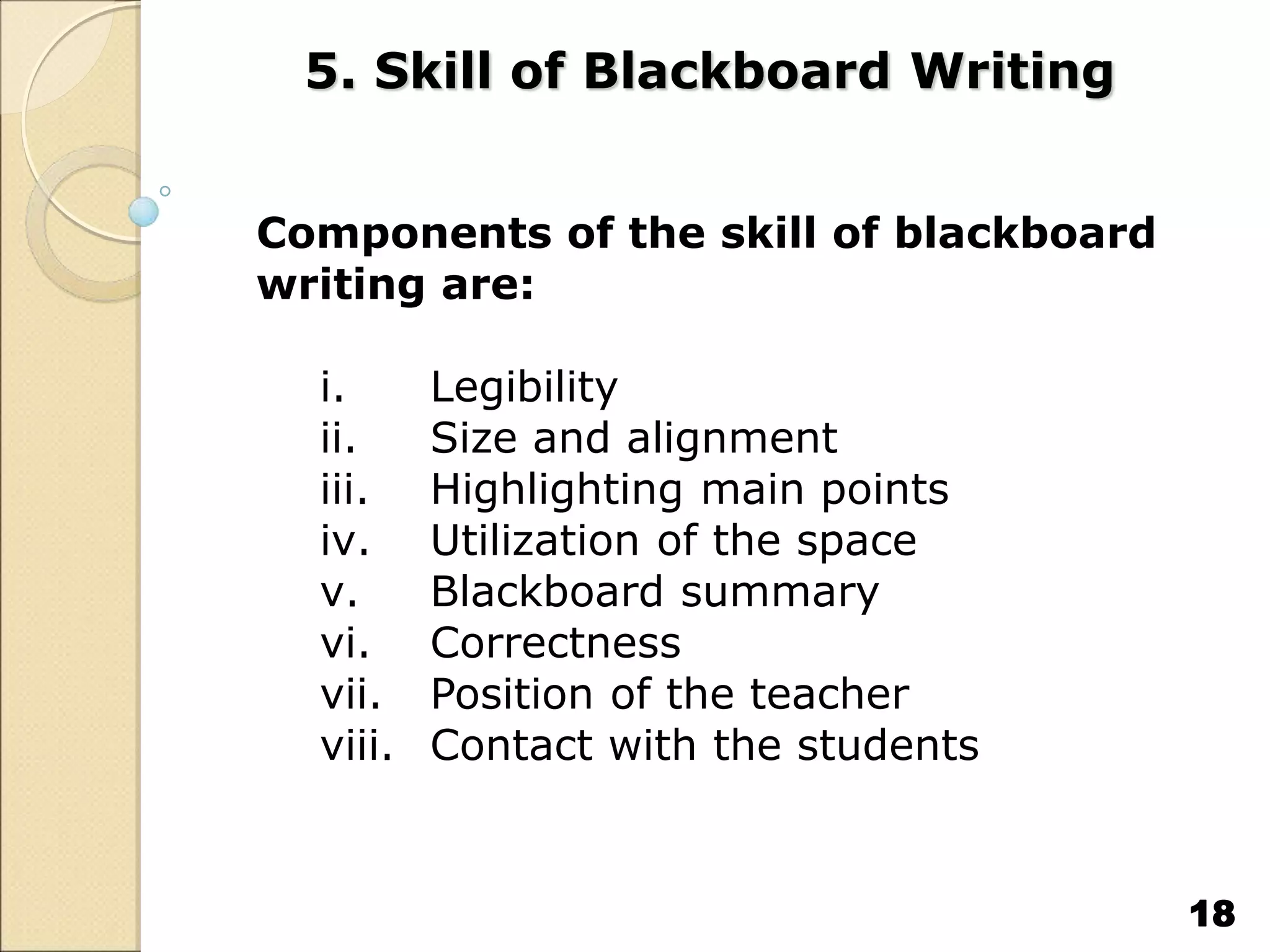
5. Skill of Blackboard Writing
Components of the skill of blackboard
writing are:
i. Legibility
ii. Size and alignment
iii. Highlighting main points
iv. Utilization of the space
v. Blackboard summary
vi. Correctness
vii. Position of the teacher
viii. Contact with the students
18
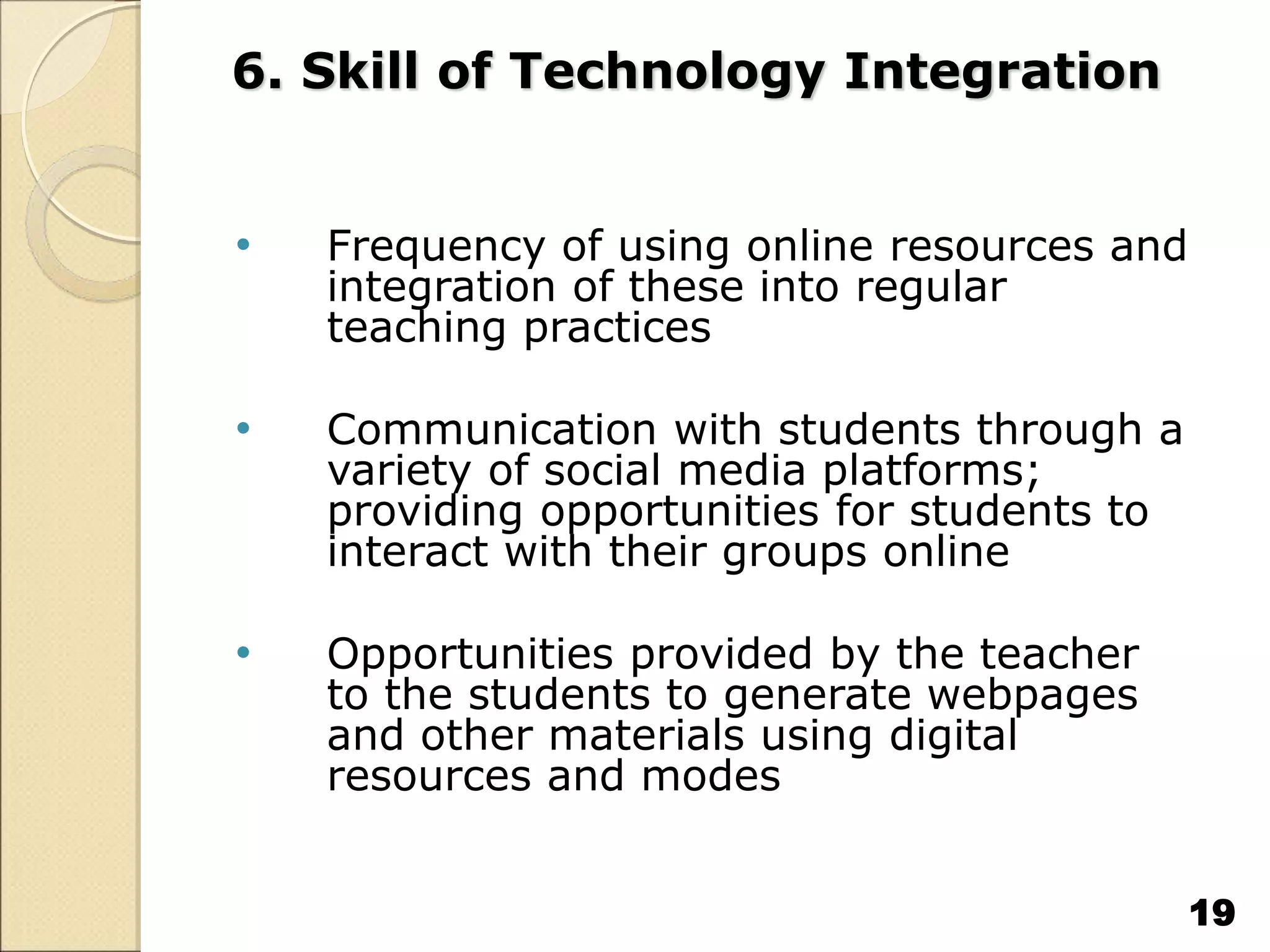
6. Skill of Technology Integration
• Frequency of using online resources and
integration of these into regular
teaching practices
• Communication with students through a
variety of social media platforms;
providing opportunities for students to
interact with their groups online
• Opportunities provided by the teacher
to the students to generate webpages
and other materials using digital
resources and modes
19
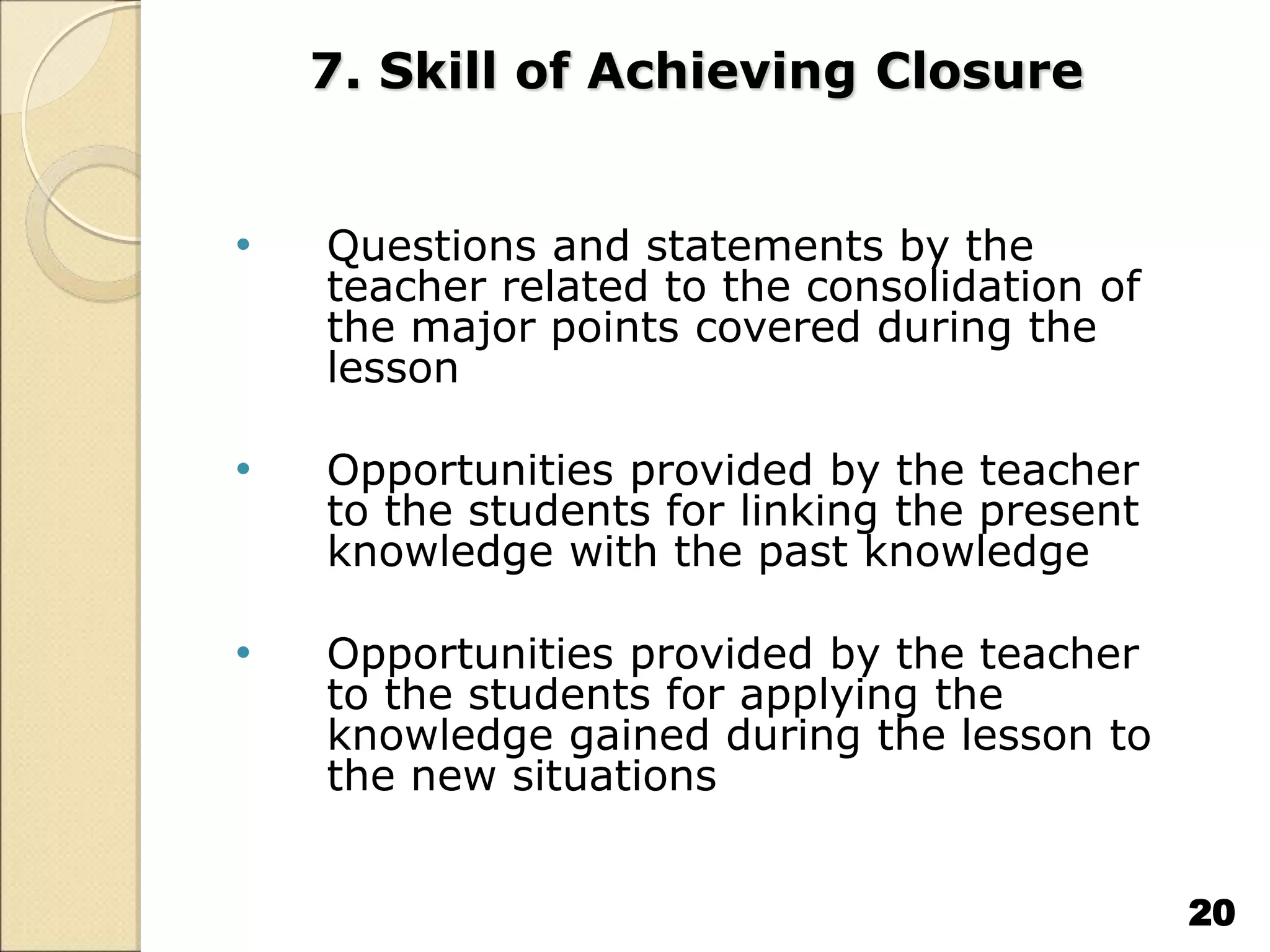
7. Skill of Achieving Closure
• Questions and statements by the
teacher related to the consolidation of
the major points covered during the
lesson
• Opportunities provided by the teacher
to the students for linking the present
knowledge with the past knowledge
• Opportunities provided by the teacher
to the students for applying the
knowledge gained during the lesson to
the new situations
20
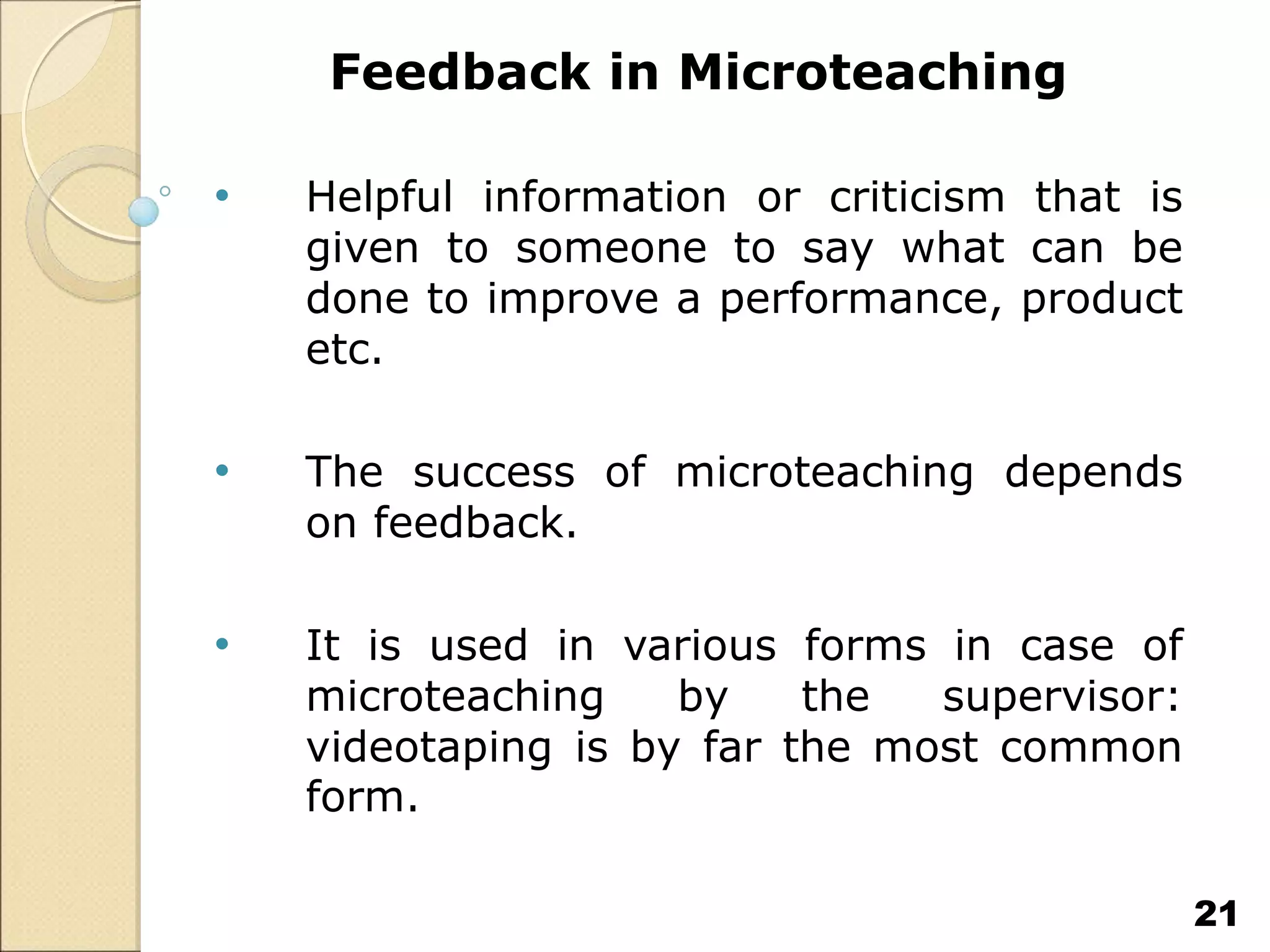
Feedback in Microteaching
• Helpful information or criticism that is
given to someone to say what can be
done to improve a performance, product
etc.
• The success of microteaching depends
on feedback.
• It is used in various forms in case of
microteaching by the supervisor:
videotaping is by far the most common
form.
21
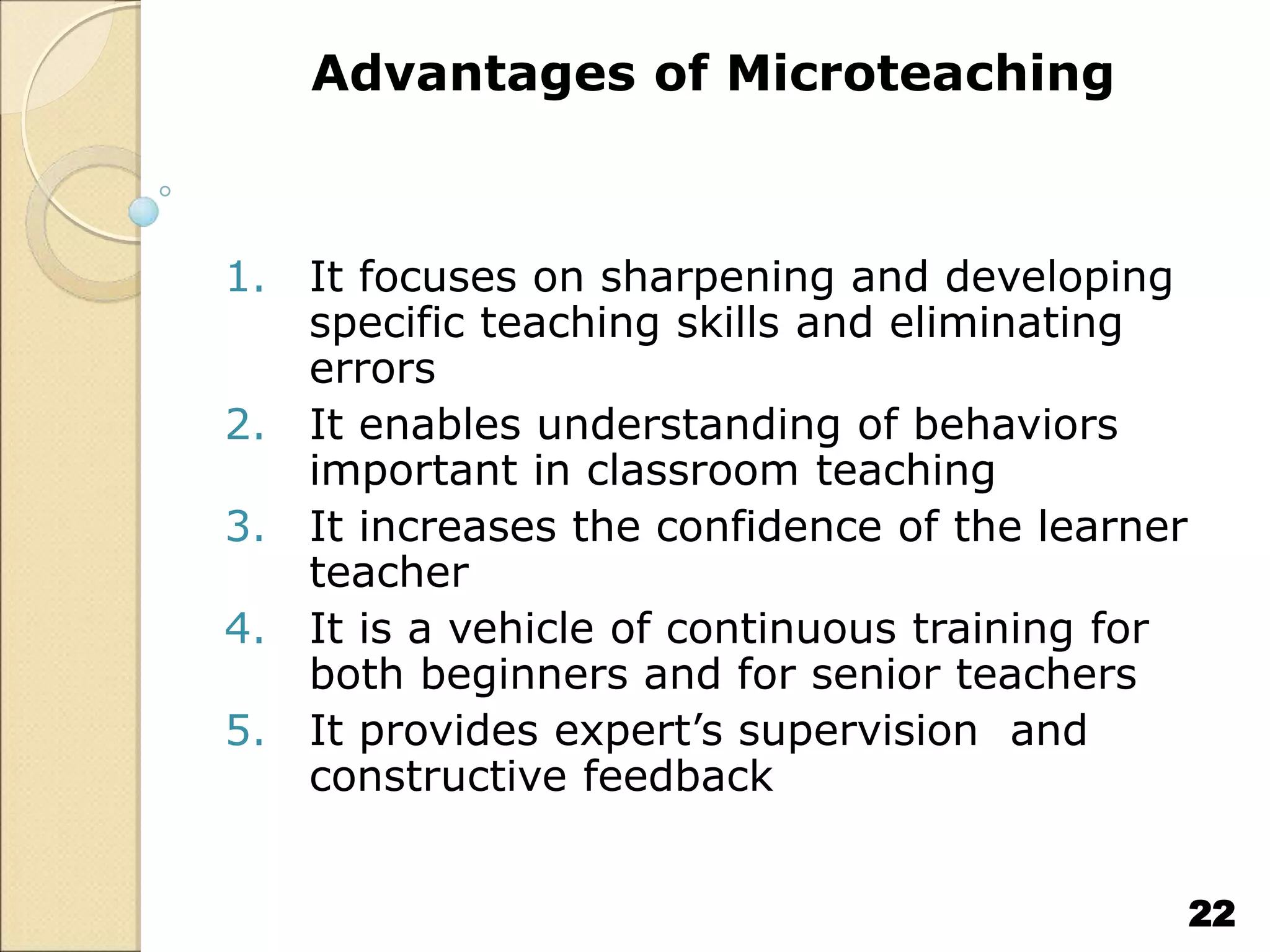
Advantages of Microteaching
1. It focuses on sharpening and developing
specific teaching skills and eliminating
errors
2. It enables understanding of behaviors
important in classroom teaching
3. It increases the confidence of the learner
teacher
4. It is a vehicle of continuous training for
both beginners and for senior teachers
5. It provides expert’s supervision and
constructive feedback
22
Microteaching Cycle
23
Microteaching Cycle
24
Remember!!!
Even the best teacher can
learn a great deal from
his or her students
25
Secret
26
Need of the Hour
27
Working together, we can achieve our goal
and expected qualities in higher education
27
Food for Thought
“Spoon Feeding in the Long Run Teaches
Us Nothing but the Shape of the Spoon”
This quote outlines the importance of discovery
and learning.
Rather than providing all the information to a
learner, it is suggested that effective learning
comes from the exploration of information,
otherwise they will only know the vessel that
informs them rather than learning content.
E. M. Forster
28
Food for Thought
“I think the big mistake in educational
institutions is trying to teach children
anything, and by using fear as the basic
motivation. Fear of getting failing
grades, fear of not staying with the
class, etc. Interest can produce learning
on a scale compared to fear as a nuclear
explosion to a firecracker.”
Stanley Kubrick 29
The Question
Are U willing to change?
For change begins with U
30

Microteaching Skills.ppt

  • 1.
    Microteaching Skills Materials takenand adapted from the works of: Dr. Pratibha Gupta, Lucknow, India and Dr. S. Thangarajathi, Coimbatore, India Dr. C. J. Dubash Educational Consultant Lahore 1
  • 2.
    What is Teaching? •Teaching is not merely imparting knowledge to students, nor merely giving advice. • Teaching is not passing information to the students. • Teaching is not sharing one’s own experience. • The best approach to understanding the nature of teaching is establishing a harmonious relationship between teacher, student and subject. • Teaching is the activity of facilitating learning. • Effectiveness in teaching does not relate to teacher’s age, sex, and teaching experience. • One can become an effective teacher irrespective of his/her age, sex and experience. 2
  • 3.
  • 4.
    Mistakes and Errors treated as Teachable Moments • opportunities to help students learn • prevent repetition of similar errors • build self-confidence of students • promote student self-worth These are not the instructor’s chances to punish and demean the students 4
  • 5.
    What is Learning? •Learning – Knowledge acquired by study • Learning happens and knowledge is generated There is a famous saying: I hear … I forget; I see … I remember; I do … I understand. 5
  • 6.
    How Learning Happens? Weremember . . . . . .  20% of what we hear  30% of what we see  50% of what we see and hear  90% of what we see, hear and do 6
  • 7.
    Microteaching Dr. Allen andhis group evolved Microteaching in 1963 in America. 7
  • 8.
    What is Microteaching? •Teaching of a small unit of content to the small group of students (10 – 15 number) in a small amount of time (5 – 7 minutes) • To train inexperience student-teachers for acquiring teaching skills • To improve the skills of experience teachers 8
  • 9.
    Microteaching Cycle 9 Step I:Micro Lesson Plan (may take 2 hours) Step II: Teach 5 minutes Step III: Feedback session 5 minutes Step IV: Re-plan 10 minutes Step V: Re-teach another group 5 minutes Step VI: Re-feedback 5 minutes --------------- Total 30 minutes
  • 10.
    Characteristics of Microteaching 1)Duration of teaching as well as number of students are less 2) Content is divided into smaller units 3) Only one teaching skill is considered at a time 4) Provision of immediate feedback 5) In microteaching cycle, there is facility of re- planning, re-teaching and re-evaluation 6) It puts the teacher under the microscope 7) All the faults of the teacher are observed 8) The problem of discipline can also be controlled 10
  • 11.
    Comparison Between Microteaching andTraditional Teaching Microteaching 1. Class consists of a small group of 10 to 15 students. 2. The teacher takes up one skill at a time. 3. Duration of time for teaching is 5 to 7 minutes. 4. There is immediate feed-back. 11 Traditional Teaching 1. Class consists of 40 to 60 students. 2. The teacher practices several skills at a time. 3. The duration is 40 to 45 minutes. 4. Immediate feed-back is not available.
  • 12.
    Comparison Between Microteaching andTraditional Teaching (continued) Microteaching 5. Teaching is carried on under controlled situation 6. The role of the supervisor is specific and well defined to improve teaching 7. Pattern of classroom interaction can be studied objectively 12 Traditional Teaching 5. There is no control over the situation 6. The role of the supervisor is vague 7. Pattern of classroom interaction cannot be studied
  • 13.
    Skills of Microteaching 1.Introduction Skill 2. Skill of Probing Questions 3. Skill of Explanation 4. Skill of Stimulus Variation 5. Skill of Blackboard Writing 6. Skill of Technology Integration 7. Skill of Achieving Closure 13
  • 14.
    1. Introduction Skill Establishing rapport with the learners  Linking with past experiences  link between introduction and main parts  Use of appropriate devices / techniques like questioning, examples, etc. 14
  • 15.
    2. Skill ofProbing Questions • Probing questions are those which help the learners to think in depth about the various aspects of the problem • By asking such questions again, the teacher makes the pupils more thoughtful • Enable the students to understand the subject deeply 15
  • 16.
    3. Skill ofExplanation It involves the ability of a teacher to describe logically ‘How’, ‘Why’ and ‘What’ of the concept Precautions for Skill of Explaining: a) in simple language b) should not be given the shape of an advice c) should be in a sequence d) should be according to the age, experience and mental level of the students 16
  • 17.
    4. Skill ofStimulus Variation  Teacher movement  Teacher gestures  Change in voice  Focusing  Change in the interaction pattern  Pausing  Student’s physical participation 17
  • 18.
    5. Skill ofBlackboard Writing Components of the skill of blackboard writing are: i. Legibility ii. Size and alignment iii. Highlighting main points iv. Utilization of the space v. Blackboard summary vi. Correctness vii. Position of the teacher viii. Contact with the students 18
  • 19.
    6. Skill ofTechnology Integration • Frequency of using online resources and integration of these into regular teaching practices • Communication with students through a variety of social media platforms; providing opportunities for students to interact with their groups online • Opportunities provided by the teacher to the students to generate webpages and other materials using digital resources and modes 19
  • 20.
    7. Skill ofAchieving Closure • Questions and statements by the teacher related to the consolidation of the major points covered during the lesson • Opportunities provided by the teacher to the students for linking the present knowledge with the past knowledge • Opportunities provided by the teacher to the students for applying the knowledge gained during the lesson to the new situations 20
  • 21.
    Feedback in Microteaching •Helpful information or criticism that is given to someone to say what can be done to improve a performance, product etc. • The success of microteaching depends on feedback. • It is used in various forms in case of microteaching by the supervisor: videotaping is by far the most common form. 21
  • 22.
    Advantages of Microteaching 1.It focuses on sharpening and developing specific teaching skills and eliminating errors 2. It enables understanding of behaviors important in classroom teaching 3. It increases the confidence of the learner teacher 4. It is a vehicle of continuous training for both beginners and for senior teachers 5. It provides expert’s supervision and constructive feedback 22
  • 23.
  • 24.
  • 25.
    Remember!!! Even the bestteacher can learn a great deal from his or her students 25
  • 26.
  • 27.
    Need of theHour 27 Working together, we can achieve our goal and expected qualities in higher education 27
  • 28.
    Food for Thought “SpoonFeeding in the Long Run Teaches Us Nothing but the Shape of the Spoon” This quote outlines the importance of discovery and learning. Rather than providing all the information to a learner, it is suggested that effective learning comes from the exploration of information, otherwise they will only know the vessel that informs them rather than learning content. E. M. Forster 28
  • 29.
    Food for Thought “Ithink the big mistake in educational institutions is trying to teach children anything, and by using fear as the basic motivation. Fear of getting failing grades, fear of not staying with the class, etc. Interest can produce learning on a scale compared to fear as a nuclear explosion to a firecracker.” Stanley Kubrick 29
  • 30.
    The Question Are Uwilling to change? For change begins with U 30