MAHATMA JYOTIBA PHULEROHILKHAND UNIVERSITY
TOPIC- MICROTEACHING
SUBMITTED TO
DR.PRATIBHA SAGAR
SUBMITTED BY
SHALINI KUMARI
M.Ed.IIIrd Semester
2.
Micro-teaching: A Teacher
TrainingPowerhouse
This presentation will delve into micro-teaching, a powerful teacher training
technique that allows educators to hone their skills in a controlled
environment. We will explore the core concepts, benefits, and practical
implementation of micro-teaching. Join us as we uncover the value of this
method for enhancing teaching proficiency.
by shalini kumari
3.
Understanding the Concept
BeyondKnowledge Transfer
Teaching goes beyond simple knowledge transfer; it's a
complex process that facilitates and influences learning. Micro-
teaching aims to modify teachers' behavior to meet specific
objectives.
Controlled Practice
This technique provides a controlled environment for practicing
teaching skills, reducing the complexities of a real classroom
setting. It allows for focused feedback and improvement.
4.
Definitions and
Perspectives
Bush (1968)
Micro-teachingallows teachers
to practice specific skills in
short, planned sessions with
real students, often with video
recording for analysis.
Allen (1976)
Micro-teaching involves a
scaled-down teaching
encounter, reducing class size
and time.
Singh, LC (1977)
Micro-teaching provides a space for both experienced and
inexperienced teachers to acquire new skills and refine existing ones.
5.
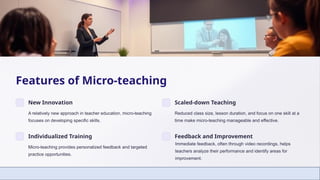
Features of Micro-teaching
NewInnovation
A relatively new approach in teacher education, micro-teaching
focuses on developing specific skills.
Scaled-down Teaching
Reduced class size, lesson duration, and focus on one skill at a
time make micro-teaching manageable and effective.
Individualized Training
Micro-teaching provides personalized feedback and targeted
practice opportunities.
Feedback and Improvement
Immediate feedback, often through video recordings, helps
teachers analyze their performance and identify areas for
improvement.
6.
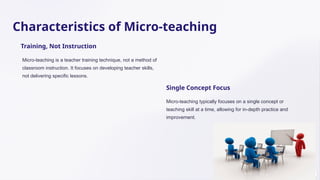
Characteristics of Micro-teaching
Training,Not Instruction
Micro-teaching is a teacher training technique, not a method of
classroom instruction. It focuses on developing teacher skills,
not delivering specific lessons.
Single Concept Focus
Micro-teaching typically focuses on a single concept or
teaching skill at a time, allowing for in-depth practice and
improvement.
7.
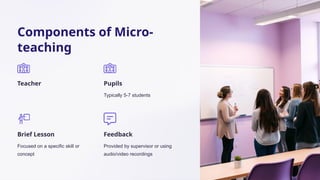
Components of Micro-
teaching
TeacherPupils
Typically 5-7 students
Brief Lesson
Focused on a specific skill or
concept
Feedback
Provided by supervisor or using
audio/video recordings
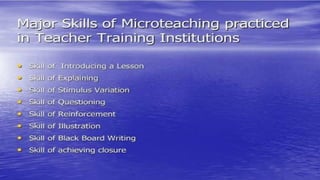
• First onthe list of the kinds of micro-teaching skills is the skill of introduction.
Teachers must possess the skill of giving students a great introduction before they
begin teaching a lesson or topic. It’s an art that helps engage students and tell them
exactly what they can expect from a lesson.
• Teachers must provide their students with a framework that they can work upon. It’s
a great way to ensure that students understand what a topic or lesson is about.
• Through the introduction skill, teachers can use interesting or engaging words to get
their students hooked on and interested in a topic from the very beginning. Without
a good introduction, teachers won’t be able to capture their students’ attention
• The major elements of micro-teaching skills of introduction are:
• Maximum use of students’ previous knowledge
• Using the appropriate device
• Maintaining continuity
1. Relevant statements
SKILL OF INTRODUCTION
10.
• Next onthe list of teaching skills in microteaching is the skill of explanation. The skill of
explanation is an intellectual activity that teachers must possess when it comes to micro-
teaching skills.
• Ideas, phenomena and concepts must be communicated well to students to help them
understand a topic well.
• Teachers should give examples by highlighting relationships among different events and ideas
SKILL OF EXPLANATION
11.
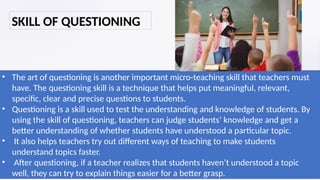
• The artof questioning is another important micro-teaching skill that teachers must
have. The questioning skill is a technique that helps put meaningful, relevant,
specific, clear and precise questions to students.
• Questioning is a skill used to test the understanding and knowledge of students. By
using the skill of questioning, teachers can judge students’ knowledge and get a
better understanding of whether students have understood a particular topic.
• It also helps teachers try out different ways of teaching to make students
understand topics faster.
• After questioning, if a teacher realizes that students haven’t understood a topic
well, they can try to explain things easier for a better grasp.
SKILL OF QUESTIONING
12.
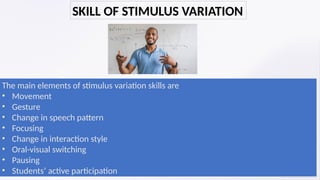
The main elementsof stimulus variation skills are
• Movement
• Gesture
• Change in speech pattern
• Focusing
• Change in interaction style
• Oral-visual switching
• Pausing
• Students’ active participation
SKILL OF STIMULUS VARIATION
13.
• The skillof reinforcement is another important component of microlearning skills.
• Teachers use this skill to encourage responses from their students using non-verbal
actions, such as nods and smiles, or verbal praises.
• It’s a response technique based on the concept of feedback.
• The reinforcement skill helps to reinforce student behavior using positive reinforcers
rather than negative ones for maximum participation.
SKILL OF REINFORCEMENT
14.
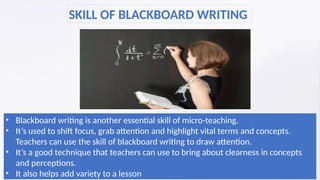
• Blackboard writingis another essential skill of micro-teaching.
• It’s used to shift focus, grab attention and highlight vital terms and concepts.
Teachers can use the skill of blackboard writing to draw attention.
• It’s a good technique that teachers can use to bring about clearness in concepts
and perceptions.
• It also helps add variety to a lesson
SKILL OF BLACKBOARD WRITING
15.
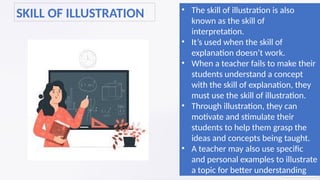
SKILL OF ILLUSTRATION• The skill of illustration is also
known as the skill of
interpretation.
• It’s used when the skill of
explanation doesn’t work.
• When a teacher fails to make their
students understand a concept
with the skill of explanation, they
must use the skill of illustration.
• Through illustration, they can
motivate and stimulate their
students to help them grasp the
ideas and concepts being taught.
• A teacher may also use specific
and personal examples to illustrate
a topic for better understanding
16.
• Just likethe skill of introduction, the skill of achieving closure is also essential.
Introducing a topic or lesson is easy, but giving a good closure to a topic can
sometimes be tricky.
• Teachers should ensure they’re closing a topic systematically and clearly.
• They must give enough assignments to their students to help them remember the
topic or lesson well without overburdening them.
SKILL OF ACHIEVING CLOSURE
17.
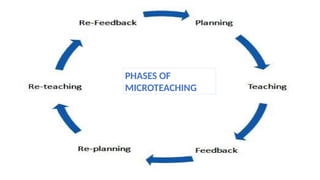
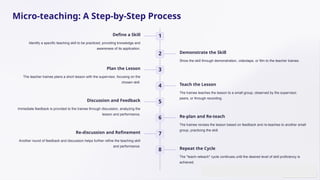
Micro-teaching: A Step-by-StepProcess
1
Define a Skill
Identify a specific teaching skill to be practiced, providing knowledge and
awareness of its application.
2 Demonstrate the Skill
Show the skill through demonstration, videotape, or film to the teacher trainee.
3
Plan the Lesson
The teacher trainee plans a short lesson with the supervisor, focusing on the
chosen skill.
4 Teach the Lesson
The trainee teaches the lesson to a small group, observed by the supervisor,
peers, or through recording.
5
Discussion and Feedback
Immediate feedback is provided to the trainee through discussion, analyzing the
lesson and performance.
6 Re-plan and Re-teach
The trainee revises the lesson based on feedback and re-teaches to another small
group, practicing the skill.
7
Re-discussion and Refinement
Another round of feedback and discussion helps further refine the teaching skill
and performance.
8 Repeat the Cycle
The "teach-reteach" cycle continues until the desired level of skill proficiency is
achieved.
19.
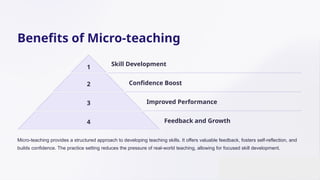
Benefits of Micro-teaching
1
SkillDevelopment
2 Confidence Boost
3 Improved Performance
4 Feedback and Growth
Micro-teaching provides a structured approach to developing teaching skills. It offers valuable feedback, fosters self-reflection, and
builds confidence. The practice setting reduces the pressure of real-world teaching, allowing for focused skill development.
20.
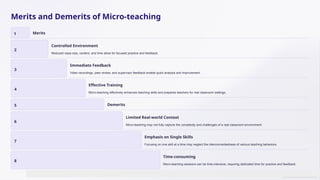
Merits and Demeritsof Micro-teaching
1 Merits
2
Controlled Environment
Reduced class size, content, and time allow for focused practice and feedback.
3
Immediate Feedback
Video recordings, peer review, and supervisor feedback enable quick analysis and improvement.
4
Effective Training
Micro-teaching effectively enhances teaching skills and prepares teachers for real classroom settings.
5 Demerits
6
Limited Real-world Context
Micro-teaching may not fully capture the complexity and challenges of a real classroom environment.
7
Emphasis on Single Skills
Focusing on one skill at a time may neglect the interconnectedness of various teaching behaviors.
8
Time-consuming
Micro-teaching sessions can be time-intensive, requiring dedicated time for practice and feedback.
21.
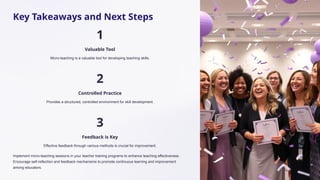
Key Takeaways andNext Steps
1
Valuable Tool
Micro-teaching is a valuable tool for developing teaching skills.
2
Controlled Practice
Provides a structured, controlled environment for skill development.
3
Feedback is Key
Effective feedback through various methods is crucial for improvement.
Implement micro-teaching sessions in your teacher training programs to enhance teaching effectiveness.
Encourage self-reflection and feedback mechanisms to promote continuous learning and improvement
among educators.