MICRO TEACHING
 --A VEHICLE OF TEACHER TRAINING

      Knowledge is a process, not a

      product


             Dr.L.Mishra
          M.Sc(Math),M.A(Eco),M.Ed, NET, Ph.D,
         PGDDE, PGDHE ,PGDEA ,Dip-in-Bengalee
PRINCIPAL VIVEK COLLEGE OF EDUCATION ,BIJNOR ,UP ,INDIA
What is Teaching?
Teaching is not merely imparting knowledge to
students, nor merely giving advice.
Teaching is not passing information to the
students.

Teaching is not sharing one’s own experience.


                                                 2
What is Teaching?


The best approach to understanding the nature of
teaching is establishing a harmonious relationship
between teacher, student and subject.
Teaching is the activity of facilitating learning.
Effectiveness in teaching does relate to teacher’s
age, , and teaching experience.
One can become an effective teacher irrespective
of his/her age, sex and experience.
                                                      3
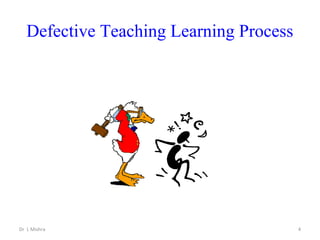
Defective Teaching Learning Process


Dr L Mishra                              4
TEACHER
• Mediocre teachers     tells
• Good teachers         explains
• Superior teacher      Illustrates
• Exceptional teacher    Inspires
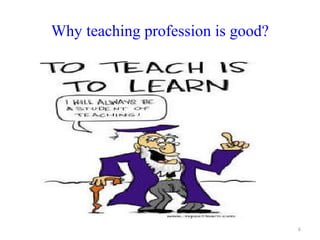
Why teaching profession is good?


                                   6
Remember!!!
 Even the best teacher can
learn a great deal from his
or her students


                              7
Need of the hour


Working Together, We Can achieve our goal and
expected qualities in Teacher education

                                                8
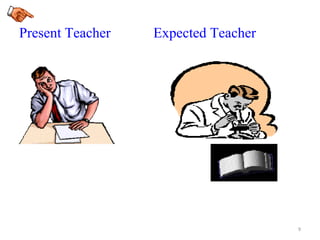
Present Teacher   Expected Teacher


                                     9
Origin and Development of Micro-
              teaching

• Origin and Development of Micro-teaching
  The idea of micro-teaching originated for the
  first time at Stanford University in USA. The
  team of experts was assigned the
  development of testing and evaluation tools
  to measure the attainment of teaching skills
MICROTEACHING

• Evolved by Allen and his group in late sixties

• To improve the skills of teachers

• Is an excellent vehicle of providing medical
  teachers with an opportunity to improve their
  teaching skills
This lead to the development of a systematic
  and accurate method of giving feedback to
  the teacher trainee.
All the steps of micro-teaching technique
  :Teach → Feedback → Re plan → Re teach →
  Re feedback were formulated.
Meaning and Definition of Micro-Teaching :


• Micro teaching is a procedure in which a
  student teacher practices teaching with a
  reduce number of pupils in a reduced period
  of time with emphasis on a narrow and
  specific teaching skill.
• Definition “Microteaching is a scaled down
  teaching encounter in class size and time-
  D.W.Allen(1966)
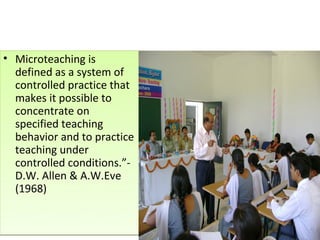
• Microteaching is
  defined as a system of
  controlled practice that
  makes it possible to
  concentrate on
  specified teaching
  behavior and to practice
  teaching under
  controlled conditions.”-
  D.W. Allen & A.W.Eve
  (1968)
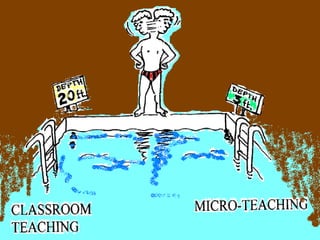
LEARNING TO SWIM

            CLASS ROOM          MICROTEACHING


• Learning to swim
at deeper end of pool           Opportunity to

  practice at the shallower

                                 and less risky side
Objectives of Micro-teaching :

• Objectives of Micro-teaching
• To enable teacher trainees to learn and
   assimilate new teaching skills under controlled
   conditions.
• To enable teacher trainees to master a
   number of teaching skills.
 • To enable teacher trainees to gain confidence
   in teaching.
Characteristics of Micro-teaching :


• Microteaching is a highly individualized
  training device
• Microteaching is an experiment in the field of
  teacher education which has been
  incorporated in the practice teaching schedule
• It is a student teaching skill training technique
  and not a teaching technique or method
WHAT IS MICRO TEACHING
• IT is a procedure in which a pupil teacher
  practice teaching within small group
• It is a skill based approach to teacher training

• It is a technique of presenting small portion of
  the lesson
• Microteaching is micro in the sense that it
   scale down the complexities of real teaching
• Practicing one skill at a time
• Reducing the class size to 5 – 10 pupil
 • Reducing the duration of lesson to 5 – 10
   minutes
• Limiting the content to a single concept
• Immediate feedback helps in improving, fixing
  and motivating learning
• The student are providing immediate feedback
  in terms of peer group feedback, tape
  recorded/CCTV
• Microteaching advocates the choice and
  practice of one skill at a time
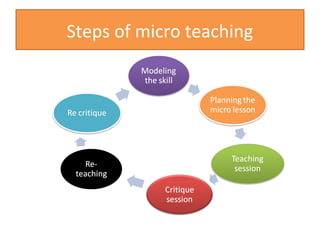
Steps of micro teaching
Steps of Micro-teaching :

• Step I- Particular skill to be practiced is
  explained to the teacher trainees in terms of
  the purpose and components of the skill with
  suitable examples.
• Step II -The teacher trainer gives the
  demonstration of the skill in Micro-teaching in
  simulated conditions to the teacher trainees
• Step III- The teacher trainee plans a short
  lesson plan on the basis of the demonstrated
  skill for his/her practice.
• Step IV- The teacher trainee teaches the
  lesson to a small group of pupils. His lesson is
  supervised by the supervisor and peers.
• Step V- On the basis of the observation of a
  lesson, the supervisor gives feedback to the
  teacher trainee.
• The supervisor reinforces the instances of effective use of the skill
  and draws attention of the teacher trainee to the points where he
  could not do well.
• Step VI- In the light of the feed-back given by the supervisor, the
  teacher trainee re-plans the lesson plan in order to use the skill in
  more effective manner in the second trial.
• Step VII -The revised lesson is taught to another comparable group
  of pupils.

• Step VIII -The supervisor observes the re-teach lesson and gives re-
  feed back to the teacher trainee with convincing arguments and
  reasons.
• Step IX -The ‘teach – re-teach’ cycle may be repeated several times
  till adequate mastery level is achieved
Merits of Micro-teaching :
• It helps to develop and master important teaching
   skills.
• It helps to accomplish specific teacher competencies.
• It caters the need of individual differences in the
   teacher training.
• It is more effective in modifying teacher behavior.
• It is an individualized training technique.
• It employs real teaching situation for developing skills.
• It reduces the complexity of teaching process as it is a
   scaled down teaching.
• It helps to get deeper knowledge regarding the art of
Limitations of Micro-teaching :

• It is skill oriented; Content not emphasized.
 • A large number of trainees cannot be given the
   opportunity for re-teaching and re-planning.
• It is very time consuming technique.
• It requires special classroom setting.
• It covers only a few specific skills.
• It deviates from normal classroom teaching.
• It may raise administrative problem while
   arranging micro lessons
Comparison Between Micro Teaching and
        Traditional Teaching :
• Traditional Teaching Class consists of 40 to 60 students. The
  teacher practices several skills at a time. The duration is 40 to 45
  minutes. Immediate feed-back is not available.
• Micro teaching Class consists of a small group of 6 to 10 students.
  The teacher takes up one skill at a time. Duration of time for
  teaching is 5 to 7 minutes. There is immediate feed-back.
•
  Traditional Teaching There is no control over situation. Teaching
  becomes complex. The role of the supervisor is vague ( not clear).
  Pattern of classroom interaction cannot be studied.
• Micro teaching Teaching is carried on under controlled situation.
  Teaching is relatively simple. The role of the supervisor is specific
  and well defined to improve teaching. Pattern of classroom
  interaction can be studied objectively.
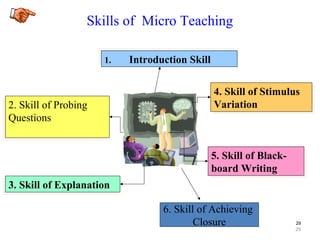
Skills of Micro Teaching

                       1.
                        1.   Introduction Skill
                              Introduction Skill


                                                   4. Skill of Stimulus
                                                    4. Skill of Stimulus
 2. Skill of Probing
2. Skill of Probing                                Variation
                                                    Variation
 Questions
Questions


                                                   5. Skill of Black-
                                                    5. Skill of Black-
                                                   board Writing
                                                    board Writing
 3. Skill of Explanation
3. Skill of Explanation

                                     6. Skill of Achieving
                                             Closure                     29
                                                                         29
What Induction


• Set induction is about preparation, usually for a
  formal lesson. When the students are set, they are
  ready to learn ('are you set?'). Set induction is thus
  about getting them ready, inducing them into the
  right mind-set
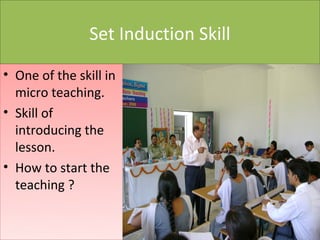
Set Induction Skill

• One of the skill in
  micro teaching.
• Skill of
  introducing the
  lesson.
• How to start the
  teaching ?
• Do not start teaching directly.
• Complete the formality.
• Write the date on top-left corner, name of
  subject on the top and middle and standard
  on right-corner of the board.

• Do not tell the title of the unit. (chapter)

• Be pleasant.
SUB-SKILLS
• Arousing curiosity.     •   Linking with unit.
• Revival of previous     •   Creative.
  knowledge.              •   Time management.
• Use of teaching aids.   •   Overall impression.
• Effectiveness.
• Statement of aim.
• Title writing.
Revival of previous knowledge :

   • Sub-skills

 Knowledge required to understand present content.

e.g. To understand Adjective – noun.
    IInd world war – Ist world war.
    Types of rainfall – rainfall.
    types of triangular – angles
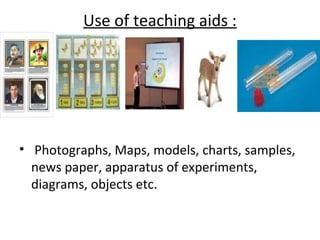
Use of teaching aids :


• Photographs, Maps, models, charts, samples,
  news paper, apparatus of experiments,
  diagrams, objects etc.
STATEMENT OF AIM
This is the closing the statement and disclosing the
  title and author.
“Let’s study about the ‘Volcano !”
“Let’s study about the poem ‘Cuckoo’ written by
  Wordsworth!”
“Let’s study about the ‘formula for area”
“Let’s study about the ‘types of software
Title Writing :

• Do it after making a statement of aim.
Write in the following manner –
Date – 16/11/10                          Std – 6
  th

 Subject – English
 Country Mouse
       -- B.T.Robert
• Linking with unit : link between introduction
  and statement of aim.

• Creative :


• Time management : 5 min.

• Overall impression – confidence, appearance,
  communication style etc.
THANK U

Michro teaching.ppt2003

  • 1.
    MICRO TEACHING --AVEHICLE OF TEACHER TRAINING Knowledge is a process, not a product Dr.L.Mishra M.Sc(Math),M.A(Eco),M.Ed, NET, Ph.D, PGDDE, PGDHE ,PGDEA ,Dip-in-Bengalee PRINCIPAL VIVEK COLLEGE OF EDUCATION ,BIJNOR ,UP ,INDIA
  • 2.
    What is Teaching? Teachingis not merely imparting knowledge to students, nor merely giving advice. Teaching is not passing information to the students. Teaching is not sharing one’s own experience. 2
  • 3.
    What is Teaching? Thebest approach to understanding the nature of teaching is establishing a harmonious relationship between teacher, student and subject. Teaching is the activity of facilitating learning. Effectiveness in teaching does relate to teacher’s age, , and teaching experience. One can become an effective teacher irrespective of his/her age, sex and experience. 3
  • 4.
    Defective Teaching LearningProcess Dr L Mishra 4
  • 5.
    TEACHER • Mediocre teachers tells • Good teachers explains • Superior teacher Illustrates • Exceptional teacher Inspires
  • 6.
  • 7.
    Remember!!! Even thebest teacher can learn a great deal from his or her students 7
  • 8.
    Need of thehour Working Together, We Can achieve our goal and expected qualities in Teacher education 8
  • 9.
    Present Teacher Expected Teacher 9
  • 10.
    Origin and Developmentof Micro- teaching • Origin and Development of Micro-teaching The idea of micro-teaching originated for the first time at Stanford University in USA. The team of experts was assigned the development of testing and evaluation tools to measure the attainment of teaching skills
  • 11.
    MICROTEACHING • Evolved byAllen and his group in late sixties • To improve the skills of teachers • Is an excellent vehicle of providing medical teachers with an opportunity to improve their teaching skills
  • 12.
    This lead tothe development of a systematic and accurate method of giving feedback to the teacher trainee. All the steps of micro-teaching technique :Teach → Feedback → Re plan → Re teach → Re feedback were formulated.
  • 13.
    Meaning and Definitionof Micro-Teaching : • Micro teaching is a procedure in which a student teacher practices teaching with a reduce number of pupils in a reduced period of time with emphasis on a narrow and specific teaching skill. • Definition “Microteaching is a scaled down teaching encounter in class size and time- D.W.Allen(1966)
  • 14.
    • Microteaching is defined as a system of controlled practice that makes it possible to concentrate on specified teaching behavior and to practice teaching under controlled conditions.”- D.W. Allen & A.W.Eve (1968)
  • 16.
    LEARNING TO SWIM CLASS ROOM MICROTEACHING • Learning to swim at deeper end of pool Opportunity to practice at the shallower and less risky side
  • 17.
    Objectives of Micro-teaching: • Objectives of Micro-teaching • To enable teacher trainees to learn and assimilate new teaching skills under controlled conditions. • To enable teacher trainees to master a number of teaching skills. • To enable teacher trainees to gain confidence in teaching.
  • 18.
    Characteristics of Micro-teaching: • Microteaching is a highly individualized training device • Microteaching is an experiment in the field of teacher education which has been incorporated in the practice teaching schedule • It is a student teaching skill training technique and not a teaching technique or method
  • 19.
    WHAT IS MICROTEACHING • IT is a procedure in which a pupil teacher practice teaching within small group • It is a skill based approach to teacher training • It is a technique of presenting small portion of the lesson
  • 20.
    • Microteaching ismicro in the sense that it scale down the complexities of real teaching • Practicing one skill at a time • Reducing the class size to 5 – 10 pupil • Reducing the duration of lesson to 5 – 10 minutes • Limiting the content to a single concept
  • 21.
    • Immediate feedbackhelps in improving, fixing and motivating learning • The student are providing immediate feedback in terms of peer group feedback, tape recorded/CCTV • Microteaching advocates the choice and practice of one skill at a time
  • 22.
  • 23.
    Steps of Micro-teaching: • Step I- Particular skill to be practiced is explained to the teacher trainees in terms of the purpose and components of the skill with suitable examples. • Step II -The teacher trainer gives the demonstration of the skill in Micro-teaching in simulated conditions to the teacher trainees
  • 24.
    • Step III-The teacher trainee plans a short lesson plan on the basis of the demonstrated skill for his/her practice. • Step IV- The teacher trainee teaches the lesson to a small group of pupils. His lesson is supervised by the supervisor and peers. • Step V- On the basis of the observation of a lesson, the supervisor gives feedback to the teacher trainee.
  • 25.
    • The supervisorreinforces the instances of effective use of the skill and draws attention of the teacher trainee to the points where he could not do well. • Step VI- In the light of the feed-back given by the supervisor, the teacher trainee re-plans the lesson plan in order to use the skill in more effective manner in the second trial. • Step VII -The revised lesson is taught to another comparable group of pupils. • Step VIII -The supervisor observes the re-teach lesson and gives re- feed back to the teacher trainee with convincing arguments and reasons. • Step IX -The ‘teach – re-teach’ cycle may be repeated several times till adequate mastery level is achieved
  • 26.
    Merits of Micro-teaching: • It helps to develop and master important teaching skills. • It helps to accomplish specific teacher competencies. • It caters the need of individual differences in the teacher training. • It is more effective in modifying teacher behavior. • It is an individualized training technique. • It employs real teaching situation for developing skills. • It reduces the complexity of teaching process as it is a scaled down teaching. • It helps to get deeper knowledge regarding the art of
  • 27.
    Limitations of Micro-teaching: • It is skill oriented; Content not emphasized. • A large number of trainees cannot be given the opportunity for re-teaching and re-planning. • It is very time consuming technique. • It requires special classroom setting. • It covers only a few specific skills. • It deviates from normal classroom teaching. • It may raise administrative problem while arranging micro lessons
  • 28.
    Comparison Between MicroTeaching and Traditional Teaching : • Traditional Teaching Class consists of 40 to 60 students. The teacher practices several skills at a time. The duration is 40 to 45 minutes. Immediate feed-back is not available. • Micro teaching Class consists of a small group of 6 to 10 students. The teacher takes up one skill at a time. Duration of time for teaching is 5 to 7 minutes. There is immediate feed-back. • Traditional Teaching There is no control over situation. Teaching becomes complex. The role of the supervisor is vague ( not clear). Pattern of classroom interaction cannot be studied. • Micro teaching Teaching is carried on under controlled situation. Teaching is relatively simple. The role of the supervisor is specific and well defined to improve teaching. Pattern of classroom interaction can be studied objectively.
  • 29.
    Skills of MicroTeaching 1. 1. Introduction Skill Introduction Skill 4. Skill of Stimulus 4. Skill of Stimulus 2. Skill of Probing 2. Skill of Probing Variation Variation Questions Questions 5. Skill of Black- 5. Skill of Black- board Writing board Writing 3. Skill of Explanation 3. Skill of Explanation 6. Skill of Achieving Closure 29 29
  • 30.
    What Induction • Setinduction is about preparation, usually for a formal lesson. When the students are set, they are ready to learn ('are you set?'). Set induction is thus about getting them ready, inducing them into the right mind-set
  • 31.
    Set Induction Skill •One of the skill in micro teaching. • Skill of introducing the lesson. • How to start the teaching ?
  • 32.
    • Do notstart teaching directly. • Complete the formality. • Write the date on top-left corner, name of subject on the top and middle and standard on right-corner of the board. • Do not tell the title of the unit. (chapter) • Be pleasant.
  • 33.
    SUB-SKILLS • Arousing curiosity. • Linking with unit. • Revival of previous • Creative. knowledge. • Time management. • Use of teaching aids. • Overall impression. • Effectiveness. • Statement of aim. • Title writing.
  • 34.
    Revival of previousknowledge : • Sub-skills Knowledge required to understand present content. e.g. To understand Adjective – noun. IInd world war – Ist world war. Types of rainfall – rainfall. types of triangular – angles
  • 35.
    Use of teachingaids : • Photographs, Maps, models, charts, samples, news paper, apparatus of experiments, diagrams, objects etc.
  • 36.
    STATEMENT OF AIM Thisis the closing the statement and disclosing the title and author. “Let’s study about the ‘Volcano !” “Let’s study about the poem ‘Cuckoo’ written by Wordsworth!” “Let’s study about the ‘formula for area” “Let’s study about the ‘types of software
  • 37.
    Title Writing : •Do it after making a statement of aim. Write in the following manner – Date – 16/11/10 Std – 6 th Subject – English Country Mouse -- B.T.Robert
  • 38.
    • Linking withunit : link between introduction and statement of aim. • Creative : • Time management : 5 min. • Overall impression – confidence, appearance, communication style etc.
  • 39.

Editor's Notes