II B.Sc (SEMESTER-IV)
STABILITY OF METAL
COMPLEXES
PRESENTED
BY
RAMBABU VASAMSETTI
LECTURER IN CHEMISTRY
P.R.GOVERNMENT COLLEGE(A)
KAKINADA
CONTENTS
THERMODYNAMIC AND
KINETIC STABILITY
FACTORS EFFECTING
STABILITY OF METAL
COMPLEXES
DETERMINATION OF
COMPOSITION OF METAL
COMPLEXES
THERMODYNAMIC AND KINETICSTABILITY OF
METAL COMPLEXES
To define the stability of the complex compound formed in the
solution, two types of the stability concept can be used which are
given below
Thermodynamic stability concept of the complexes
When the stability of the complexes formed in the solution is
defined by the thermodynamic parameters like bond energy,
stability constant or formation constant then such type of the
stability concept is called as thermodynamic stability concept of
the complexes.
According to the thermodynamic stability concept, complex
compound can be deluded into 2 different types
Stable complexes:
Those complexes which exhibit very high formation
constant in the solution are known as stable complexes.
Unstable complexes:
Those complexes which exhibit low formation constant in
the solution are known as unstable complexes.
Kinetic stability concept of the complexes
When the stability of the complexes formed in the solution is
defined by the kinetic parameter then the stability concept is
called as kinetic stability concept of the complexes. According
to the kinetic stability concept, complex compounds in the
solution can be divided into two types
Inert Complex: Those complexes which exhibit very low or
negligible rate of replacement reaction in the solution are known
as inert complexes.
Labile Complex: Those complexes which exhibit very high rate
of replacement reaction in the solution are known as labile
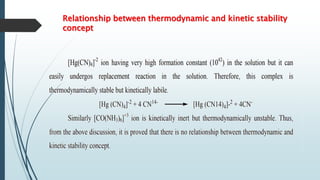
Relationship between thermodynamic and kinetic stability
concept
Stepwise formation of the complexes and
stepwise formation constant
Relationship between stepwise formation constant
and
overall formation constant
To give the relationship between stepwise formation
constants and overall formation constant, let us consider
the formation of ML3 complex by the stepwise formation
method and overall formation method.
According to stepwise formation method:
Thus, from the above equation, it is observed that the
product of stepwise formation constant is always equal to the
overall formation constant for any particular complex.
β4 = K1x K2 x K3 x K4
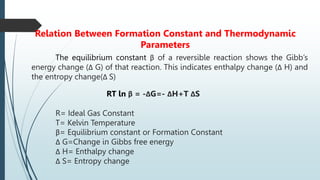
The equilibrium constant β of a reversible reaction shows the Gibb’s
energy change (Δ G) of that reaction. This indicates enthalpy change (Δ H) and
the entropy change(Δ S)
RT ln β = -ΔG=- ΔH+T ΔS
R= Ideal Gas Constant
T= Kelvin Temperature
β= Equilibrium constant or Formation Constant
Δ G=Change in Gibbs free energy
Δ H= Enthalpy change
Δ S= Entropy change
Relation Between Formation Constant and Thermodynamic
Parameters
FACTORS AFFECTING THE STABILITY OF THE
COMPLEXES
There are two different factors which can affect the
stability of complexes formed in the solution given as
below:
• Nature of the central metal ion (CMI)
• Nature of the ligands
Nature of central metal atom (CMA)
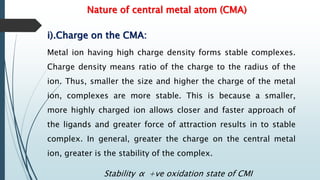
i).Charge on the CMA:
Metal ion having high charge density forms stable complexes.
Charge density means ratio of the charge to the radius of the
ion. Thus, smaller the size and higher the charge of the metal
ion, complexes are more stable. This is because a smaller,
more highly charged ion allows closer and faster approach of
the ligands and greater force of attraction results in to stable
complex. In general, greater the charge on the central metal
ion, greater is the stability of the complex.
Stability α +ve oxidation state of CMI
iii).Electronegativity:
This is another factor which determines stability of a complex.
We can classify the metal ions in to two types:
Class ‘a’ metals:
These are electropositive metals and include the alkali metals,
alkaline earth metals, most of the non-transition metals and
those transition metals having only a few d-valence electrons
(such as Sc, Ti, V). Such metals have relatively few electrons
beyond an inert gas core.
Class ‘b’ metals:
These are less electropositive heavy metals such as Rh, Pd,
Ag, Ir, Pt, Au, Hg, Pb, etc. These have relatively large number
of d electrons.
Class ‘a’ metals, which attract electrons weakly, form most
stable complexes with the ligands having electronegative
atom such as nitrogen, oxygen and fluorine.
Class ‘b’ metals form most stable complexes with π acceptor
ligands containing P, S, As, Br and I.
Stability of the complexes is increases with the increase in the
electronegativity of CMA.
iv).Polarizing power: With the increases in the polarizing
power of CMA, stability of complexes also increases.
Stability α Polarizing power of CMA
Nature of ligand
i) Size and charge of the ligands:
In general Ligands with less charge and more size are less stable
and form less stable coordination compounds. Ligands with
higher charge have small size and form more stable compounds.
With the increase in the – ve charge value of the ligand stability
of complexes is increase i.e.
Stability α –ve charge at the ligand
For example: F- forms more stable complexes with Fe+3 than Cl-, Br-
or I-. Thus, a small fluoride F- ion forms more stable Fe+3 complex
as compared to the large Cl- ion. This is due to easy approach of the
ligand towards metal ion.
ii).Basic character:
Higher the basic character or strength of the ligand, higher will
be the stability of coordination compounds. It is defined that a
strong base or higher basic strength of the ligand means it
forms more stable compounds or its donating tendency of
electrons to central metal ion is higher.
Stability α Basic character of ligand
For example: Aromatic diamines form unstable coordination compounds
while aliphatic diamines form stable coordination compounds. Ligands
like NH , CN- etc. have more basic character and thus, they form more
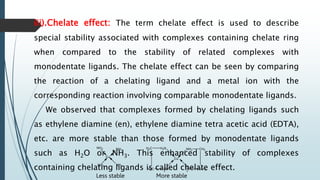
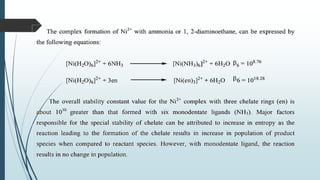
iii).Chelate effect: The term chelate effect is used to describe
special stability associated with complexes containing chelate ring
when compared to the stability of related complexes with
monodentate ligands. The chelate effect can be seen by comparing
the reaction of a chelating ligand and a metal ion with the
corresponding reaction involving comparable monodentate ligands.
We observed that complexes formed by chelating ligands such
as ethylene diamine (en), ethylene diamine tetra acetic acid (EDTA),
etc. are more stable than those formed by monodentate ligands
such as H2O or NH3. This enhanced stability of complexes
containing chelating ligands is called chelate effect.
Less stable More stable
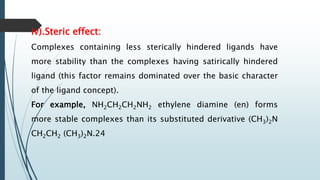
iv).Steric effect:
Complexes containing less sterically hindered ligands have
more stability than the complexes having satirically hindered
ligand (this factor remains dominated over the basic character
of the ligand concept).
For example, NH2CH2CH2NH2 ethylene diamine (en) forms
more stable complexes than its substituted derivative (CH3)2N
CH2CH2 (CH3)2N.24
Crystal field stabilization energy (CFSE)
The crystal field stabilization energy (CFSE) is one of the most important factors that decides the
stability of the metal complexes.
CFSE is the stability that arises when a metal ion coordinates to a set of ligands, which is due to the
generation of a crystal field by the ligands. Thus, a higher value of CFSE means that the complex is
thermodynamically stable and kinetically inert.
Some of the notable examples of complexes that have high CFSE are low spin 5d6 complexes of
Pt4+ and Ir3+ and square planar 5d8 complexes of Pt2+.
All these complexes are thermodynamically stable and kinetically inert, which undergo ligand
substitution reactions extremely slowly
DETERMINATION OF COMPOSITION OF METAL
COMPLEXES (JOB’S METHOD)
The chemical composition of metal complexes is determined by
Spectrophotometric methods. Among the spectrophotometric
methods in use, Job's continuous variation method and mole-
ratio method are very widely used. We shall learn about these
methods now.
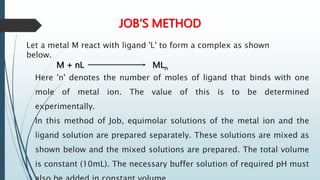
JOB’S METHOD
Let a metal M react with ligand 'L' to form a complex as shown
below.
Here 'n' denotes the number of moles of ligand that binds with one
mole of metal ion. The value of this is to be determined
experimentally.
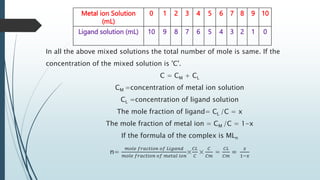
In this method of Job, equimolar solutions of the metal ion and the
ligand solution are prepared separately. These solutions are mixed as
shown below and the mixed solutions are prepared. The total volume
is constant (10mL). The necessary buffer solution of required pH must
M + nL MLn
Metal ion Solution
(mL)
0 1 2 3 4 5 6 7 8 9 10
Ligand solution (mL) 10 9 8 7 6 5 4 3 2 1 0
In all the above mixed solutions the total number of mole is same. If the
concentration of the mixed solution is 'C'.
C = CM + CL
CM =concentration of metal ion solution
CL =concentration of ligand solution
The mole fraction of ligand= CL /C = x
The mole fraction of metal ion = CM /C = 1-x
If the formula of the complex is MLn
n=
𝑚𝑜𝑙𝑒 𝑓𝑟𝑎𝑐𝑡𝑖𝑜𝑛 𝑜𝑓 𝐿𝑖𝑔𝑎𝑛𝑑
𝑚𝑜𝑙𝑒 𝑓𝑟𝑎𝑐𝑡𝑖𝑜𝑛 𝑜𝑓 𝑚𝑒𝑡𝑎𝑙 𝑖𝑜𝑛
×
𝐶𝐿
𝐶
×
𝐶
𝐶𝑚
=
𝐶𝐿
𝐶𝑚
=
𝑥
1−𝑥
The wavelength at which the metal
complex formed exhibits maximum
absorbance must be first
experimentally established. At this
wavelength (λmax) the absorbance (A)
of each of the mixed solution is
measured with a spectrophotometer.
A graph is drawn between the
absorbance (A) and the mole fraction
of the ligand.
The mole fraction of ligand corresponding to this maximum point is
identified and it denotes x.
𝑥
1 − 𝑥
= 𝑛 𝑔𝑖𝑣𝑒𝑠 ′𝑛′ 𝑉𝑎𝑙𝑢𝑒
If more than one complex is formed under the experimental
conditions, this method may not be suitable.
A curve shown in the figure is obtained. The mole
fraction of the ligand corresponding to the point of
maximum absorbance is obtained from the graph by
extrapolation method.
సర్వే జనాః సుఖినోభవంతు
ధర్మో రక్షతి రక్షితాః

Stability of metal complexes.pptx notes for chemistry

  • 1.
    II B.Sc (SEMESTER-IV) STABILITYOF METAL COMPLEXES PRESENTED BY RAMBABU VASAMSETTI LECTURER IN CHEMISTRY P.R.GOVERNMENT COLLEGE(A) KAKINADA
  • 2.
    CONTENTS THERMODYNAMIC AND KINETIC STABILITY FACTORSEFFECTING STABILITY OF METAL COMPLEXES DETERMINATION OF COMPOSITION OF METAL COMPLEXES
  • 3.
    THERMODYNAMIC AND KINETICSTABILITYOF METAL COMPLEXES To define the stability of the complex compound formed in the solution, two types of the stability concept can be used which are given below Thermodynamic stability concept of the complexes When the stability of the complexes formed in the solution is defined by the thermodynamic parameters like bond energy, stability constant or formation constant then such type of the stability concept is called as thermodynamic stability concept of the complexes.
  • 4.
    According to thethermodynamic stability concept, complex compound can be deluded into 2 different types Stable complexes: Those complexes which exhibit very high formation constant in the solution are known as stable complexes. Unstable complexes: Those complexes which exhibit low formation constant in the solution are known as unstable complexes.
  • 5.
    Kinetic stability conceptof the complexes When the stability of the complexes formed in the solution is defined by the kinetic parameter then the stability concept is called as kinetic stability concept of the complexes. According to the kinetic stability concept, complex compounds in the solution can be divided into two types Inert Complex: Those complexes which exhibit very low or negligible rate of replacement reaction in the solution are known as inert complexes. Labile Complex: Those complexes which exhibit very high rate of replacement reaction in the solution are known as labile
  • 6.
    Relationship between thermodynamicand kinetic stability concept
  • 7.
    Stepwise formation ofthe complexes and stepwise formation constant
  • 8.
    Relationship between stepwiseformation constant and overall formation constant To give the relationship between stepwise formation constants and overall formation constant, let us consider the formation of ML3 complex by the stepwise formation method and overall formation method. According to stepwise formation method:
  • 9.
    Thus, from theabove equation, it is observed that the product of stepwise formation constant is always equal to the overall formation constant for any particular complex. β4 = K1x K2 x K3 x K4
  • 10.
    The equilibrium constantβ of a reversible reaction shows the Gibb’s energy change (Δ G) of that reaction. This indicates enthalpy change (Δ H) and the entropy change(Δ S) RT ln β = -ΔG=- ΔH+T ΔS R= Ideal Gas Constant T= Kelvin Temperature β= Equilibrium constant or Formation Constant Δ G=Change in Gibbs free energy Δ H= Enthalpy change Δ S= Entropy change Relation Between Formation Constant and Thermodynamic Parameters
  • 12.
    FACTORS AFFECTING THESTABILITY OF THE COMPLEXES There are two different factors which can affect the stability of complexes formed in the solution given as below: • Nature of the central metal ion (CMI) • Nature of the ligands
  • 13.
    Nature of centralmetal atom (CMA) i).Charge on the CMA: Metal ion having high charge density forms stable complexes. Charge density means ratio of the charge to the radius of the ion. Thus, smaller the size and higher the charge of the metal ion, complexes are more stable. This is because a smaller, more highly charged ion allows closer and faster approach of the ligands and greater force of attraction results in to stable complex. In general, greater the charge on the central metal ion, greater is the stability of the complex. Stability α +ve oxidation state of CMI
  • 15.
    iii).Electronegativity: This is anotherfactor which determines stability of a complex. We can classify the metal ions in to two types: Class ‘a’ metals: These are electropositive metals and include the alkali metals, alkaline earth metals, most of the non-transition metals and those transition metals having only a few d-valence electrons (such as Sc, Ti, V). Such metals have relatively few electrons beyond an inert gas core.
  • 16.
    Class ‘b’ metals: Theseare less electropositive heavy metals such as Rh, Pd, Ag, Ir, Pt, Au, Hg, Pb, etc. These have relatively large number of d electrons. Class ‘a’ metals, which attract electrons weakly, form most stable complexes with the ligands having electronegative atom such as nitrogen, oxygen and fluorine. Class ‘b’ metals form most stable complexes with π acceptor ligands containing P, S, As, Br and I. Stability of the complexes is increases with the increase in the electronegativity of CMA.
  • 17.
    iv).Polarizing power: Withthe increases in the polarizing power of CMA, stability of complexes also increases. Stability α Polarizing power of CMA
  • 18.
    Nature of ligand i)Size and charge of the ligands: In general Ligands with less charge and more size are less stable and form less stable coordination compounds. Ligands with higher charge have small size and form more stable compounds. With the increase in the – ve charge value of the ligand stability of complexes is increase i.e. Stability α –ve charge at the ligand For example: F- forms more stable complexes with Fe+3 than Cl-, Br- or I-. Thus, a small fluoride F- ion forms more stable Fe+3 complex as compared to the large Cl- ion. This is due to easy approach of the ligand towards metal ion.
  • 19.
    ii).Basic character: Higher thebasic character or strength of the ligand, higher will be the stability of coordination compounds. It is defined that a strong base or higher basic strength of the ligand means it forms more stable compounds or its donating tendency of electrons to central metal ion is higher. Stability α Basic character of ligand For example: Aromatic diamines form unstable coordination compounds while aliphatic diamines form stable coordination compounds. Ligands like NH , CN- etc. have more basic character and thus, they form more
  • 20.
    iii).Chelate effect: Theterm chelate effect is used to describe special stability associated with complexes containing chelate ring when compared to the stability of related complexes with monodentate ligands. The chelate effect can be seen by comparing the reaction of a chelating ligand and a metal ion with the corresponding reaction involving comparable monodentate ligands. We observed that complexes formed by chelating ligands such as ethylene diamine (en), ethylene diamine tetra acetic acid (EDTA), etc. are more stable than those formed by monodentate ligands such as H2O or NH3. This enhanced stability of complexes containing chelating ligands is called chelate effect. Less stable More stable
  • 22.
    iv).Steric effect: Complexes containingless sterically hindered ligands have more stability than the complexes having satirically hindered ligand (this factor remains dominated over the basic character of the ligand concept). For example, NH2CH2CH2NH2 ethylene diamine (en) forms more stable complexes than its substituted derivative (CH3)2N CH2CH2 (CH3)2N.24
  • 23.
    Crystal field stabilizationenergy (CFSE) The crystal field stabilization energy (CFSE) is one of the most important factors that decides the stability of the metal complexes. CFSE is the stability that arises when a metal ion coordinates to a set of ligands, which is due to the generation of a crystal field by the ligands. Thus, a higher value of CFSE means that the complex is thermodynamically stable and kinetically inert. Some of the notable examples of complexes that have high CFSE are low spin 5d6 complexes of Pt4+ and Ir3+ and square planar 5d8 complexes of Pt2+. All these complexes are thermodynamically stable and kinetically inert, which undergo ligand substitution reactions extremely slowly
  • 24.
    DETERMINATION OF COMPOSITIONOF METAL COMPLEXES (JOB’S METHOD) The chemical composition of metal complexes is determined by Spectrophotometric methods. Among the spectrophotometric methods in use, Job's continuous variation method and mole- ratio method are very widely used. We shall learn about these methods now.
  • 25.
    JOB’S METHOD Let ametal M react with ligand 'L' to form a complex as shown below. Here 'n' denotes the number of moles of ligand that binds with one mole of metal ion. The value of this is to be determined experimentally. In this method of Job, equimolar solutions of the metal ion and the ligand solution are prepared separately. These solutions are mixed as shown below and the mixed solutions are prepared. The total volume is constant (10mL). The necessary buffer solution of required pH must M + nL MLn
  • 26.
    Metal ion Solution (mL) 01 2 3 4 5 6 7 8 9 10 Ligand solution (mL) 10 9 8 7 6 5 4 3 2 1 0 In all the above mixed solutions the total number of mole is same. If the concentration of the mixed solution is 'C'. C = CM + CL CM =concentration of metal ion solution CL =concentration of ligand solution The mole fraction of ligand= CL /C = x The mole fraction of metal ion = CM /C = 1-x If the formula of the complex is MLn n= 𝑚𝑜𝑙𝑒 𝑓𝑟𝑎𝑐𝑡𝑖𝑜𝑛 𝑜𝑓 𝐿𝑖𝑔𝑎𝑛𝑑 𝑚𝑜𝑙𝑒 𝑓𝑟𝑎𝑐𝑡𝑖𝑜𝑛 𝑜𝑓 𝑚𝑒𝑡𝑎𝑙 𝑖𝑜𝑛 × 𝐶𝐿 𝐶 × 𝐶 𝐶𝑚 = 𝐶𝐿 𝐶𝑚 = 𝑥 1−𝑥
  • 27.
    The wavelength atwhich the metal complex formed exhibits maximum absorbance must be first experimentally established. At this wavelength (λmax) the absorbance (A) of each of the mixed solution is measured with a spectrophotometer. A graph is drawn between the absorbance (A) and the mole fraction of the ligand.
  • 28.
    The mole fractionof ligand corresponding to this maximum point is identified and it denotes x. 𝑥 1 − 𝑥 = 𝑛 𝑔𝑖𝑣𝑒𝑠 ′𝑛′ 𝑉𝑎𝑙𝑢𝑒 If more than one complex is formed under the experimental conditions, this method may not be suitable. A curve shown in the figure is obtained. The mole fraction of the ligand corresponding to the point of maximum absorbance is obtained from the graph by extrapolation method.
  • 29.