Prepared by:
Nestor Unito Sr., Ed.D.
METHODS OF
TEACHING
Different Teaching Methodologies
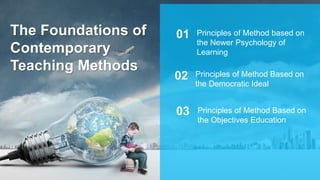
The Foundations of
Contemporary
Teaching Methods
Principles of Method based on
the Newer Psychology of
Learning
01
Principles of Method Based on
the Democratic Ideal
02
Principles of Method Based on
the Objectives Education
03
Traditional Method
-the traditional method of study utilized
by the learner was memorizing and the
classroom procedure was the
recitation method.
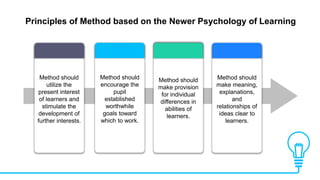
Method should
utilize the
present interest
of learners and
stimulate the
development of
further interests.
Principles of Method based on the Newer Psychology of Learning
Method should
encourage the
pupil
established
worthwhile
goals toward
which to work.
Method should
make provision
for individual
differences in
abilities of
learners.
Method should
make meaning,
explanations,
and
relationships of
ideas clear to
learners.
• Infographic Style
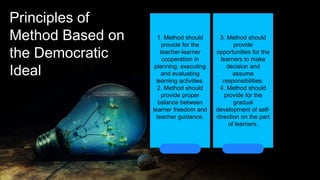
Principles of
Method Based on
the Democratic
Ideal
1. Method should
provide for the
teacher-learner
cooperation in
planning, executing
and evaluating
learning activities.
2. Method should
provide proper
balance between
learner freedom and
teacher guidance.
3. Method should
provide
opportunities for the
learners to make
decision and
assume
responsibilities.
4. Method should
provide for the
gradual
development of self-
direction on the part
of learners.
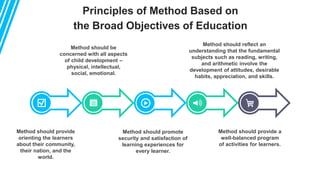
Principles of Method Based on
the Broad Objectives of Education
Method should provide a
well-balanced program
of activities for learners.
Method should promote
security and satisfaction of
learning experiences for
every learner.
Method should be
concerned with all aspects
of child development –
physical, intellectual,
social, emotional.
Method should provide
orienting the learners
about their community,
their nation, and the
world.
Method should reflect an
understanding that the fundamental
subjects such as reading, writing,
and arithmetic involve the
development of attitudes, desirable
habits, appreciation, and skills.
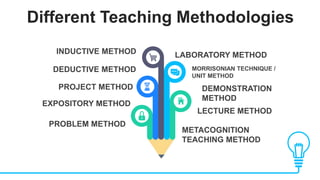
Different Teaching Methodologies
LABORATORY METHOD
MORRISONIAN TECHNIQUE /
UNIT METHOD
INDUCTIVE METHOD
DEDUCTIVE METHOD
PROJECT METHOD
EXPOSITORY METHOD
PROBLEM METHOD
DEMONSTRATION
METHOD
LECTURE METHOD
METACOGNITION
TEACHING METHOD
INDUCTIVE
METHOD
Simply an investigation method.
A method of drawing general
conclusions from particular or
individual differences.
Starts with a series of specific examples
of the concept or principle to be learned
and ends with generalization which may
be rule or definition.
Usually used in mathematics,
language and laboratory subjects.
PRESENTATION
COMPARISON AND
ABSTRACTION
GENERALIZATION
05
02
03
04
01
FIVE STEPS
APPLICATION
PREPARATION
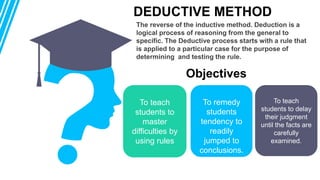
The reverse of the inductive method. Deduction is a
logical process of reasoning from the general to
specific. The Deductive process starts with a rule that
is applied to a particular case for the purpose of
determining and testing the rule.
DEDUCTIVE METHOD
To teach
students to
master
difficulties by
using rules
To remedy
students
tendency to
readily
jumped to
conclusions.
To teach
students to delay
their judgment
until the facts are
carefully
examined.
01 02 03
Objectives
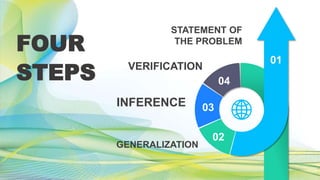
GENERALIZATION
INFERENCE
VERIFICATION
02
03
04
01
FOUR
STEPS
STATEMENT OF
THE PROBLEM
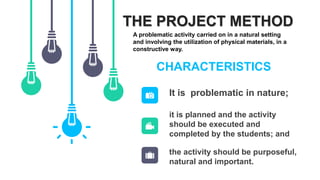
THE PROJECT METHOD
A problematic activity carried on in a natural setting
and involving the utilization of physical materials, in a
constructive way.
CHARACTERISTICS
it is planned and the activity
should be executed and
completed by the students; and
the activity should be purposeful,
natural and important.
It is problematic in nature;
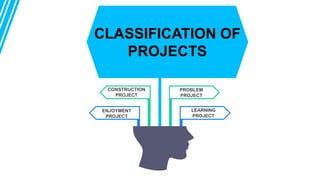
CLASSIFICATION OF
PROJECTS
CONSTRUCTION
PROJECT
ENJOYMENT
PROJECT
LEARNING
PROJECT
PROBLEM
PROJECT
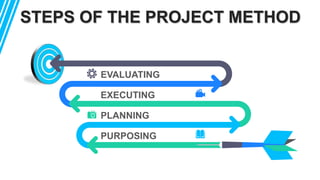
STEPS OF THE PROJECT METHOD
EVALUATING
EXECUTING
PLANNING
PURPOSING
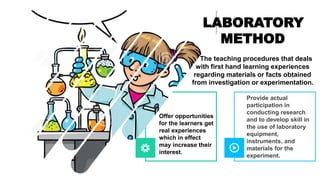
Provide actual
participation in
conducting research
and to develop skill in
the use of laboratory
equipment,
instruments, and
materials for the
experiment.
LABORATORY
METHOD
The teaching procedures that deals
with first hand learning experiences
regarding materials or facts obtained
from investigation or experimentation.
Offer opportunities
for the learners get
real experiences
which in effect
may increase their
interest.
D
D
D
D
D
TYPES OF
LABORATORY
METHOD
EXPERIMENTAL
TYPE
OBSERVATIONAL
TYPE
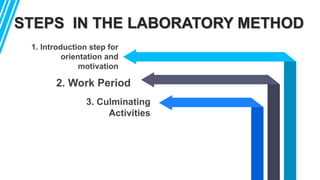
STEPS IN THE LABORATORY METHOD
1. Introduction step for
orientation and
motivation
2. Work Period
3. Culminating
Activities
MORRISONIAN TECHNIQUE METHOD /
UNIT METHOD
Henry C. Morrison, the proponent of this
method.
The Morrisonian plan of instruction is the
process of taking the contents of a particular
subject as big blocks and as isolated and
fragmentary bits of information. This method is
often used in the teaching of history,
geography, government and economics.
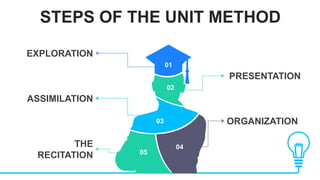
STEPS OF THE UNIT METHOD
THE
RECITATION
EXPLORATION
PRESENTATION
ORGANIZATION
ASSIMILATION
01
02
03
05
04
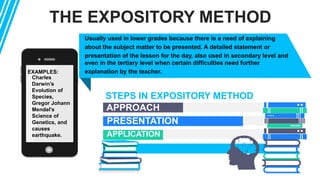
THE EXPOSITORY METHOD
APPROACH
PRESENTATION
APPLICATION
Usually used in lower grades because there is a need of explaining
about the subject matter to be presented. A detailed statement or
presentation of the lesson for the day, also used in secondary level and
even in the tertiary level when certain difficulties need further
explanation by the teacher.
STEPS IN EXPOSITORY METHOD
D
D
D
D
D
EXAMPLES:
Charles
Darwin’s
Evolution of
Species,
Gregor Johann
Mendel’s
Science of
Genetics, and
causes
earthquake.
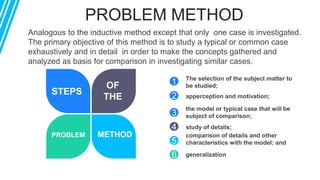
PROBLEM METHOD
STEPS
OF
THE
PROBLEM METHOD
Analogous to the inductive method except that only one case is investigated.
The primary objective of this method is to study a typical or common case
exhaustively and in detail in order to make the concepts gathered and
analyzed as basis for comparison in investigating similar cases.
3
4
5
6
The selection of the subject matter to
be studied;
study of details;
comparison of details and other
characteristics with the model; and
generalization
1
2 apperception and motivation;
the model or typical case that will be
subject of comparison;
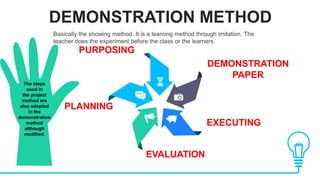
DEMONSTRATION METHOD
DEMONSTRATION
PAPER
EXECUTING
PURPOSING
PLANNING
EVALUATION
Basically the showing method. It is a learning method through imitation. The
teacher does the experiment before the class or the learners.
The steps
used in
the project
method are
also adopted
in the
demonstration
method
although
modified.
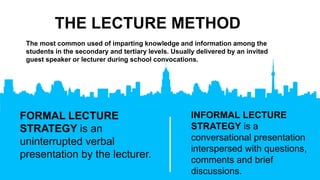
THE LECTURE METHOD
INFORMAL LECTURE
STRATEGY is a
conversational presentation
interspersed with questions,
comments and brief
discussions.
The most common used of imparting knowledge and information among the
students in the secondary and tertiary levels. Usually delivered by an invited
guest speaker or lecturer during school convocations.
FORMAL LECTURE
STRATEGY is an
uninterrupted verbal
presentation by the lecturer.
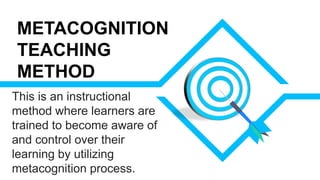
This is an instructional
method where learners are
trained to become aware of
and control over their
learning by utilizing
metacognition process.
METACOGNITION
TEACHING
METHOD
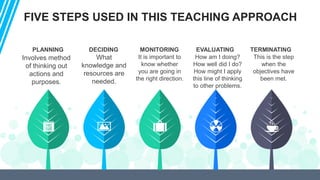
FIVE STEPS USED IN THIS TEACHING APPROACH
What
knowledge and
resources are
needed.
DECIDING
It is important to
know whether
you are going in
the right direction.
MONITORING
How am I doing?
How well did I do?
How might I apply
this line of thinking
to other problems.
EVALUATING
This is the step
when the
objectives have
been met.
TERMINATING
Involves method
of thinking out
actions and
purposes.
PLANNING
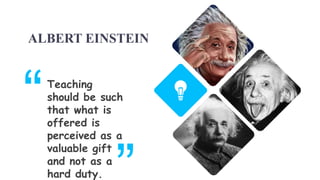
ALBERT EINSTEIN
Teaching
should be such
that what is
offered is
perceived as a
valuable gift
and not as a
hard duty.
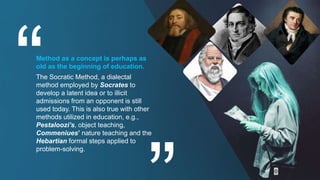
Method as a concept is perhaps as
old as the beginning of education.
The Socratic Method, a dialectal
method employed by Socrates to
develop a latent idea or to illicit
admissions from an opponent is still
used today. This is also true with other
methods utilized in education, e.g.,
Pestaloozi’s, object teaching,
Commeniues’ nature teaching and the
Hebartian formal steps applied to
problem-solving.
Thank You
and God
Bless.

PPT FOR REVIEW PROF ED.pptx

  • 1.
    Prepared by: Nestor UnitoSr., Ed.D. METHODS OF TEACHING Different Teaching Methodologies
  • 2.
    The Foundations of Contemporary TeachingMethods Principles of Method based on the Newer Psychology of Learning 01 Principles of Method Based on the Democratic Ideal 02 Principles of Method Based on the Objectives Education 03
  • 3.
    Traditional Method -the traditionalmethod of study utilized by the learner was memorizing and the classroom procedure was the recitation method.
  • 4.
    Method should utilize the presentinterest of learners and stimulate the development of further interests. Principles of Method based on the Newer Psychology of Learning Method should encourage the pupil established worthwhile goals toward which to work. Method should make provision for individual differences in abilities of learners. Method should make meaning, explanations, and relationships of ideas clear to learners.
  • 5.
    • Infographic Style Principlesof Method Based on the Democratic Ideal 1. Method should provide for the teacher-learner cooperation in planning, executing and evaluating learning activities. 2. Method should provide proper balance between learner freedom and teacher guidance. 3. Method should provide opportunities for the learners to make decision and assume responsibilities. 4. Method should provide for the gradual development of self- direction on the part of learners.
  • 6.
    Principles of MethodBased on the Broad Objectives of Education Method should provide a well-balanced program of activities for learners. Method should promote security and satisfaction of learning experiences for every learner. Method should be concerned with all aspects of child development – physical, intellectual, social, emotional. Method should provide orienting the learners about their community, their nation, and the world. Method should reflect an understanding that the fundamental subjects such as reading, writing, and arithmetic involve the development of attitudes, desirable habits, appreciation, and skills.
  • 7.
    Different Teaching Methodologies LABORATORYMETHOD MORRISONIAN TECHNIQUE / UNIT METHOD INDUCTIVE METHOD DEDUCTIVE METHOD PROJECT METHOD EXPOSITORY METHOD PROBLEM METHOD DEMONSTRATION METHOD LECTURE METHOD METACOGNITION TEACHING METHOD
  • 8.
    INDUCTIVE METHOD Simply an investigationmethod. A method of drawing general conclusions from particular or individual differences. Starts with a series of specific examples of the concept or principle to be learned and ends with generalization which may be rule or definition. Usually used in mathematics, language and laboratory subjects.
  • 9.
  • 10.
    The reverse ofthe inductive method. Deduction is a logical process of reasoning from the general to specific. The Deductive process starts with a rule that is applied to a particular case for the purpose of determining and testing the rule. DEDUCTIVE METHOD To teach students to master difficulties by using rules To remedy students tendency to readily jumped to conclusions. To teach students to delay their judgment until the facts are carefully examined. 01 02 03 Objectives
  • 11.
  • 12.
    THE PROJECT METHOD Aproblematic activity carried on in a natural setting and involving the utilization of physical materials, in a constructive way. CHARACTERISTICS it is planned and the activity should be executed and completed by the students; and the activity should be purposeful, natural and important. It is problematic in nature;
  • 13.
  • 14.
    STEPS OF THEPROJECT METHOD EVALUATING EXECUTING PLANNING PURPOSING
  • 15.
    Provide actual participation in conductingresearch and to develop skill in the use of laboratory equipment, instruments, and materials for the experiment. LABORATORY METHOD The teaching procedures that deals with first hand learning experiences regarding materials or facts obtained from investigation or experimentation. Offer opportunities for the learners get real experiences which in effect may increase their interest.
  • 16.
  • 17.
    STEPS IN THELABORATORY METHOD 1. Introduction step for orientation and motivation 2. Work Period 3. Culminating Activities
  • 18.
    MORRISONIAN TECHNIQUE METHOD/ UNIT METHOD Henry C. Morrison, the proponent of this method. The Morrisonian plan of instruction is the process of taking the contents of a particular subject as big blocks and as isolated and fragmentary bits of information. This method is often used in the teaching of history, geography, government and economics.
  • 19.
    STEPS OF THEUNIT METHOD THE RECITATION EXPLORATION PRESENTATION ORGANIZATION ASSIMILATION 01 02 03 05 04
  • 20.
    THE EXPOSITORY METHOD APPROACH PRESENTATION APPLICATION Usuallyused in lower grades because there is a need of explaining about the subject matter to be presented. A detailed statement or presentation of the lesson for the day, also used in secondary level and even in the tertiary level when certain difficulties need further explanation by the teacher. STEPS IN EXPOSITORY METHOD D D D D D EXAMPLES: Charles Darwin’s Evolution of Species, Gregor Johann Mendel’s Science of Genetics, and causes earthquake.
  • 21.
    PROBLEM METHOD STEPS OF THE PROBLEM METHOD Analogousto the inductive method except that only one case is investigated. The primary objective of this method is to study a typical or common case exhaustively and in detail in order to make the concepts gathered and analyzed as basis for comparison in investigating similar cases. 3 4 5 6 The selection of the subject matter to be studied; study of details; comparison of details and other characteristics with the model; and generalization 1 2 apperception and motivation; the model or typical case that will be subject of comparison;
  • 22.
    DEMONSTRATION METHOD DEMONSTRATION PAPER EXECUTING PURPOSING PLANNING EVALUATION Basically theshowing method. It is a learning method through imitation. The teacher does the experiment before the class or the learners. The steps used in the project method are also adopted in the demonstration method although modified.
  • 23.
    THE LECTURE METHOD INFORMALLECTURE STRATEGY is a conversational presentation interspersed with questions, comments and brief discussions. The most common used of imparting knowledge and information among the students in the secondary and tertiary levels. Usually delivered by an invited guest speaker or lecturer during school convocations. FORMAL LECTURE STRATEGY is an uninterrupted verbal presentation by the lecturer.
  • 24.
    This is aninstructional method where learners are trained to become aware of and control over their learning by utilizing metacognition process. METACOGNITION TEACHING METHOD
  • 25.
    FIVE STEPS USEDIN THIS TEACHING APPROACH What knowledge and resources are needed. DECIDING It is important to know whether you are going in the right direction. MONITORING How am I doing? How well did I do? How might I apply this line of thinking to other problems. EVALUATING This is the step when the objectives have been met. TERMINATING Involves method of thinking out actions and purposes. PLANNING
  • 26.
    ALBERT EINSTEIN Teaching should besuch that what is offered is perceived as a valuable gift and not as a hard duty.
  • 27.
    Method as aconcept is perhaps as old as the beginning of education. The Socratic Method, a dialectal method employed by Socrates to develop a latent idea or to illicit admissions from an opponent is still used today. This is also true with other methods utilized in education, e.g., Pestaloozi’s, object teaching, Commeniues’ nature teaching and the Hebartian formal steps applied to problem-solving.
  • 28.