Co-curricular Activities in
Science
Dr. Jaganmohana Rao Gurugubelli
Faculty of Education
MITE, Kohima
Co-curricular activities
Co-curricular activities are an important part of the
curriculum that allows students to develop specific skills
or demonstrate their non academic abilities. These
activities are compulsory activities which are important
for every child to participate. Co-curricular activities
are designed and balanced with academic curriculum so
that every student gets to learn beyond subjects.
Co-curricular activities are meant to bring social
skills, intellectual skills, moral values, personality
progress and character appeal in students. It includes
athletics, cultural events, Library activities, scientific
experiment activities in laboratory, classroom activities,
creative arts and meditation etc.
Meaning of Co-curricular Activities
Co-curricular Activities are defined as the activities
that enable to supplement and complement the
curricular or main syllabi activities. These are the very
important part and parcel of educational institutions to
develop the students’ personality as well as to strengthen
the classroom learning.
Co-curricular activities (CCAs) are the components
of non-academic curriculum helps to develop various
facets of the personality development of the child and
students. For all-round development of the child, there is
a need of emotional, physical, spiritual and moral
development that is complemented and supplemented
by Co-curricular Activities.
Types of Co-curricular Activities
⚫Science Clubs
⚫Science Fairs/Exhibitions
⚫Field Trips/ Educational Tours
⚫Science Museums
⚫Science Projects
⚫Debate and discussion
⚫Story writing competition
⚫Essay writing competition
⚫Writes ups for school magazine
⚫Preparation of chart & models
⚫Album making
⚫Photography
⚫Clay modeling
⚫Toy making
⚫Organization exhibitions.
⚫Celebration of festival
Science Club
The word ‘Science Club’ denotes association of
young enthusiasts interested in furthering their
knowledge of science through plethora of activities. In
other words, a science club could be defined as a
platform of young enthusiasts or young scientists to
share acquired knowledge and to engage in creative
activities in science for joy and understanding of
scientific principles.
Thus, science clubs in schools could be
considered as an extension of classroom teaching for
better understanding and application of knowledge. It
also makes the task of a teacher easier in the
classroom.
Objectives of a science club
 To develop creativity among students
 To enable the students to apply their knowledge of
science into daily life situations
 To encourage critical thinking
 To inculcate scientific attitude and provide
opportunities for training in scientific method
 To develop interest in scientific hobbies like
photography
 To have healthy academic interaction between the
students and science teachers
 To motivate the students to work in cooperation
with each other
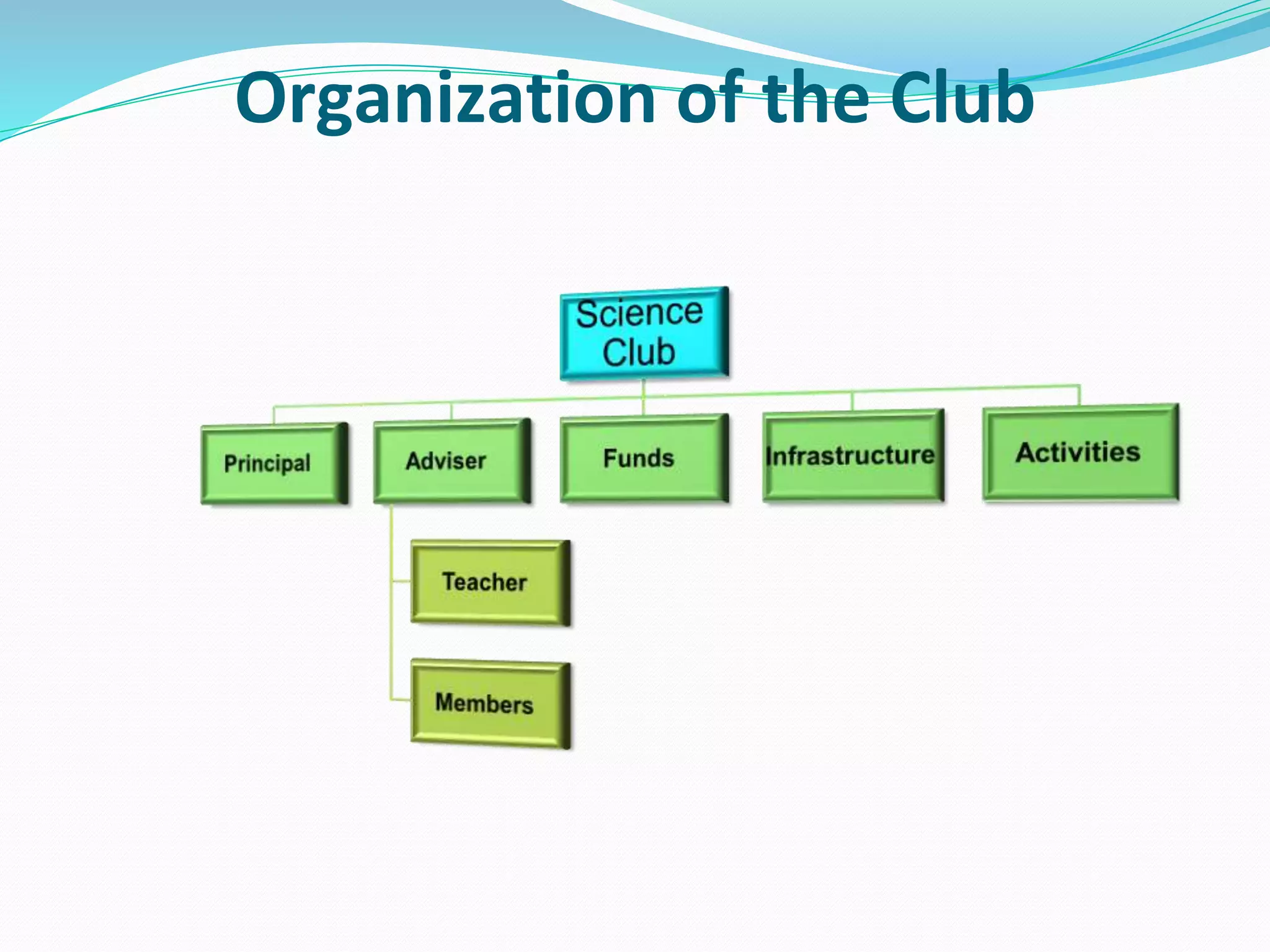
Organization of the Club
Science Fairs/Exhibition
Science fair is an important activity to present the
efforts of science students to others. A science fair
develops a scientific attitude and interest among the
people involved. Young students get a chance to meet
the people of all ages and present their projects to them.
This exposure to varied group of people acts as an
impetus to the growth and development of their talent.
Science fairs and exhibitions should be an annual
feature of the school. Further, intra-school fairs and
exhibitions can also be organized. Besides projects,
science fairs can have many other types of activities
which are debates, talks by experts, group discussions,
essay competitions, quiz, film shows, puppet shows, etc.
Objectives of Science Fairs
 To encourage public interest in science
 To develop scientific hobbies and creativity
among students
 To encourage and motivate the students to try
out their ideas into exhibits and projects
 To develop relationship between parents,
society and school
 To identify and give impetus to young
scientists
 To create awareness about the correlation
between science and daily life
Science Educational Tour/Field Trip
It is the visit of students accompanied by
teachers to the places of historical, scientific,
cultural, geographical, educational and national
interests. Educational tours provide the real
experience in natural settings and thus, widen the
view points of students. They are able to acquire
through knowledge by observation and
imagination.
An educational tour also leads to the
development of cooperation, leadership, group
living, etc. Thus, learning becomes more
interesting, more accurate and meaningful by the
participation of students in educational
tours/excursion.
Objectives of Science Educational Tours/Field Trip
Following are the main objectives of a science educational
tour/Field Trip:
 To provide first hand observation and experience
 To provide knowledge regarding all those things which
cannot be shown in the class rooms easily
 To create an interest in scientific subjects
 To draw conclusions from the exercise conducted in a
natural environment
 To develop the observation skills of students
 To teach the students how to make a proper use of a
vacation or leisure time
SCIENCE MUSEUMS
Museums are those places where different objects
and specimens are assembled, constructed, improvised,
labeled and displayed. Museums can be organized for all
the subjects, but here we are concerned with science
museums. For science related objects, there are two
types of museums—science museums and natural
history museums.
The main objectives of organizing a science museum are :
• To evoke a sense of curiosity in the students
• To provide them with a variety of experiences
• To develop an appreciation for the beauty of nature
• To display and exhibit such objects or specimens which
are difficult to be found
• To present the complex processes in a simplified
manner
Need & Importance of Co-curricular Activities
Co-curricular activities are an essential part of
school life and help in enhancing the learning process of
students at school. Co-Curricular activities are
compulsory activities that are important for every
student to participate in. These activities are designed
and balanced with the academic curriculum so that
every student gets to learn beyond subjects.
 To Develop Learning Experience
 To Develop observation skills
 To Develop better understanding about concepts
 To Develop physical & Mental Health
 To Develop sense of responsibility & confidence
 To Develop Values and Skills
 To provide better Educational Opportunities
THANK YOU

6 co-curricular activities in science

  • 1.
    Co-curricular Activities in Science Dr.Jaganmohana Rao Gurugubelli Faculty of Education MITE, Kohima
  • 2.
    Co-curricular activities Co-curricular activitiesare an important part of the curriculum that allows students to develop specific skills or demonstrate their non academic abilities. These activities are compulsory activities which are important for every child to participate. Co-curricular activities are designed and balanced with academic curriculum so that every student gets to learn beyond subjects. Co-curricular activities are meant to bring social skills, intellectual skills, moral values, personality progress and character appeal in students. It includes athletics, cultural events, Library activities, scientific experiment activities in laboratory, classroom activities, creative arts and meditation etc.
  • 3.
    Meaning of Co-curricularActivities Co-curricular Activities are defined as the activities that enable to supplement and complement the curricular or main syllabi activities. These are the very important part and parcel of educational institutions to develop the students’ personality as well as to strengthen the classroom learning. Co-curricular activities (CCAs) are the components of non-academic curriculum helps to develop various facets of the personality development of the child and students. For all-round development of the child, there is a need of emotional, physical, spiritual and moral development that is complemented and supplemented by Co-curricular Activities.
  • 4.
    Types of Co-curricularActivities ⚫Science Clubs ⚫Science Fairs/Exhibitions ⚫Field Trips/ Educational Tours ⚫Science Museums ⚫Science Projects ⚫Debate and discussion ⚫Story writing competition ⚫Essay writing competition ⚫Writes ups for school magazine ⚫Preparation of chart & models ⚫Album making ⚫Photography ⚫Clay modeling ⚫Toy making ⚫Organization exhibitions. ⚫Celebration of festival
  • 5.
    Science Club The word‘Science Club’ denotes association of young enthusiasts interested in furthering their knowledge of science through plethora of activities. In other words, a science club could be defined as a platform of young enthusiasts or young scientists to share acquired knowledge and to engage in creative activities in science for joy and understanding of scientific principles. Thus, science clubs in schools could be considered as an extension of classroom teaching for better understanding and application of knowledge. It also makes the task of a teacher easier in the classroom.
  • 6.
    Objectives of ascience club  To develop creativity among students  To enable the students to apply their knowledge of science into daily life situations  To encourage critical thinking  To inculcate scientific attitude and provide opportunities for training in scientific method  To develop interest in scientific hobbies like photography  To have healthy academic interaction between the students and science teachers  To motivate the students to work in cooperation with each other
  • 7.
  • 8.
    Science Fairs/Exhibition Science fairis an important activity to present the efforts of science students to others. A science fair develops a scientific attitude and interest among the people involved. Young students get a chance to meet the people of all ages and present their projects to them. This exposure to varied group of people acts as an impetus to the growth and development of their talent. Science fairs and exhibitions should be an annual feature of the school. Further, intra-school fairs and exhibitions can also be organized. Besides projects, science fairs can have many other types of activities which are debates, talks by experts, group discussions, essay competitions, quiz, film shows, puppet shows, etc.
  • 9.
    Objectives of ScienceFairs  To encourage public interest in science  To develop scientific hobbies and creativity among students  To encourage and motivate the students to try out their ideas into exhibits and projects  To develop relationship between parents, society and school  To identify and give impetus to young scientists  To create awareness about the correlation between science and daily life
  • 10.
    Science Educational Tour/FieldTrip It is the visit of students accompanied by teachers to the places of historical, scientific, cultural, geographical, educational and national interests. Educational tours provide the real experience in natural settings and thus, widen the view points of students. They are able to acquire through knowledge by observation and imagination. An educational tour also leads to the development of cooperation, leadership, group living, etc. Thus, learning becomes more interesting, more accurate and meaningful by the participation of students in educational tours/excursion.
  • 11.
    Objectives of ScienceEducational Tours/Field Trip Following are the main objectives of a science educational tour/Field Trip:  To provide first hand observation and experience  To provide knowledge regarding all those things which cannot be shown in the class rooms easily  To create an interest in scientific subjects  To draw conclusions from the exercise conducted in a natural environment  To develop the observation skills of students  To teach the students how to make a proper use of a vacation or leisure time
  • 12.
    SCIENCE MUSEUMS Museums arethose places where different objects and specimens are assembled, constructed, improvised, labeled and displayed. Museums can be organized for all the subjects, but here we are concerned with science museums. For science related objects, there are two types of museums—science museums and natural history museums. The main objectives of organizing a science museum are : • To evoke a sense of curiosity in the students • To provide them with a variety of experiences • To develop an appreciation for the beauty of nature • To display and exhibit such objects or specimens which are difficult to be found • To present the complex processes in a simplified manner
  • 13.
    Need & Importanceof Co-curricular Activities Co-curricular activities are an essential part of school life and help in enhancing the learning process of students at school. Co-Curricular activities are compulsory activities that are important for every student to participate in. These activities are designed and balanced with the academic curriculum so that every student gets to learn beyond subjects.  To Develop Learning Experience  To Develop observation skills  To Develop better understanding about concepts  To Develop physical & Mental Health  To Develop sense of responsibility & confidence  To Develop Values and Skills  To provide better Educational Opportunities
  • 14.