Dr.G.BALARKISHNAN
Assistant Professor
Dept. of Chemistry
Vivekananda College, Madurai
Mail: mathi1bala1@gmail.com
______________________________________________________________________
Metallurgy
Metallurgy: Metallurgy is defined as a process that is used for the extraction of
metals in their pure form.
(The compounds of metals mixed with soil, limestone, sand, and rocks are known as minerals.
Metals are commercially extracted from minerals at low cost and minimum effort. These
minerals are known as ores.)
Types of Ore
Ores can be classified majorly into four types:
1. Native ore: These are the type of ores which are non-reactive and contains metal in a free
state. Examples: Silver, gold etc.
2. Oxidized ore: These contain oxides or oxysalts, i.e. carbonates, phosphate and silicate of
metal. Examples: Oxide ores (Fe2O3, Al2O3 etc.), Carbonate ores (CaCO3, ZnCO3 etc.).
3. Sulphurized ore: These contain sulphides of metal like iron, and lead. Examples: FeS2 (Iron
pyrites), PbS (Galena), HgS (Cinnabar) etc.
4. Halide ore: These contain halide of metals. Examples: Chloride ore: AgCl (Horn silver),
CaF2 (Fluorspar) etc.
Methods of the Concentration of Ore:
As the ore is found in the earth’s ground surface, it contains unwanted earthy materials
like rocks, sand, silt, and many other impurities colloquially termed as gangue.
Physical Methods separation:
The physical methods include traditional handpicking, hydraulic washing, magnetic
separation, and froth floatation for the ore concentration.
(i) Hand-picking
It was the traditional method of concentrating ore directly with hands. In this method, the
gangue or adhering solid matrix is separated from the ore with a hammer’s help.
(The separation and identification of gangue are made based on the differences
in colour or lump shape.)
Dr.G.BALARKISHNAN
Assistant Professor
Dept. of Chemistry
Vivekananda College, Madurai
Mail: mathi1bala1@gmail.com
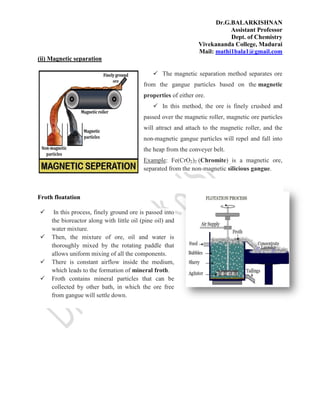
(ii) Magnetic separation
 The magnetic separation method separates ore
from the gangue particles based on the magnetic
properties of either ore.
 In this method, the ore is finely crushed and
passed over the magnetic roller, magnetic ore particles
will attract and attach to the magnetic roller, and the
non-magnetic gangue particles will repel and fall into
the heap from the conveyer belt.
Example: Fe(CrO2)2 (Chromite) is a magnetic ore,
separated from the non-magnetic silicious gangue.
Froth floatation
 In this process, finely ground ore is passed into
the bioreactor along with little oil (pine oil) and
water mixture.
 Then, the mixture of ore, oil and water is
thoroughly mixed by the rotating paddle that
allows uniform mixing of all the components.
 There is constant airflow inside the medium,
which leads to the formation of mineral froth.
 Froth contains mineral particles that can be
collected by other bath, in which the ore free
from gangue will settle down.
Dr.G.BALARKISHNAN
Assistant Professor
Dept. of Chemistry
Vivekananda College, Madurai
Mail: mathi1bala1@gmail.com
Chemical Methods Separation:
The chemical methods include calcination, roasting and leaching for the concentration of ore.
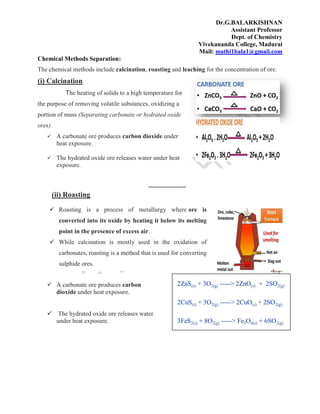
(i) Calcination
The heating of solids to a high temperature for
the purpose of removing volatile substances, oxidizing a
portion of mass (Separating carbonate or hydrated oxide
ores).
 A carbonate ore produces carbon dioxide under
heat exposure.
 The hydrated oxide ore releases water under heat
exposure.
------------------
(ii) Roasting
 Roasting is a process of metallurgy where ore is
converted into its oxide by heating it below its melting
point in the presence of excess air.
 While calcination is mostly used in the oxidation of
carbonates, roasting is a method that is used for converting
sulphide ores.
 A carbonate ore produces carbon
dioxide under heat exposure.
 The hydrated oxide ore releases water
under heat exposure.
Dr.G.BALARKISHNAN
Assistant Professor
Dept. of Chemistry
Vivekananda College, Madurai
Mail: mathi1bala1@gmail.com
(iii) Leaching: Ore is treated with chemicals to convert the valuable metals within
into soluble salts while the impurity remains insoluble.
Ex: gold, silver in the presence of a dilute aqueous solution of sodium or
potassium cyanide in the presence of air
------------
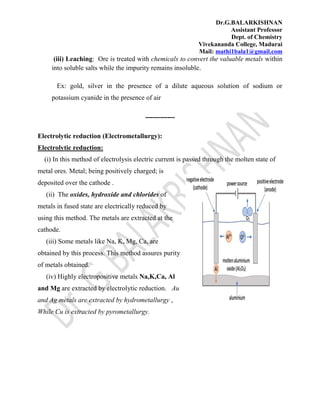
Electrolytic reduction (Electrometallurgy):
Electrolytic reduction:
(i) In this method of electrolysis electric current is passed through the molten state of
metal ores. Metal; being positively charged; is
deposited over the cathode .
(ii) The oxides, hydroxide and chlorides of
metals in fused state are electrically reduced by
using this method. The metals are extracted at the
cathode.
(iii) Some metals like Na, K, Mg, Ca, are
obtained by this process. This method assures purity
of metals obtained.
(iv) Highly electropositive metals Na,K,Ca, Al
and Mg are extracted by electrolytic reduction. Au
and Ag metals are extracted by hydrometallurgy ,
While Cu is extracted by pyrometallurgy.
Dr.G.BALARKISHNAN
Assistant Professor
Dept. of Chemistry
Vivekananda College, Madurai
Mail: mathi1bala1@gmail.com
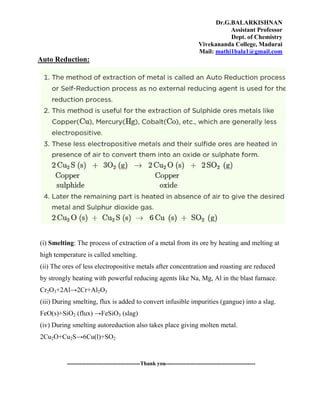
Auto Reduction:
(i) Smelting: The process of extraction of a metal from its ore by heating and melting at
high temperature is called smelting.
(ii) The ores of less electropositíve metals after concentration and roasting are reduced
by strongly heating with powerful reducing agents like Na, Mg, Al in the blast furnace.
Cr2O3+2Al→2Cr+Al2O3
(iii) During smelting, flux is added to convert infusible impurities (gangue) into a slag.
FeO(s)+SiO2 (flux) →FeSiO3 (slag)
(iv) During smelting autoreduction also takes place giving molten metal.
2Cu2O+Cu2S→6Cu(l)+SO2
----------------------------------------Thank you-------------------------------------------------

Metallurgy: Purification methods of ores.pdf

  • 1.
    Dr.G.BALARKISHNAN Assistant Professor Dept. ofChemistry Vivekananda College, Madurai Mail: mathi1bala1@gmail.com ______________________________________________________________________ Metallurgy Metallurgy: Metallurgy is defined as a process that is used for the extraction of metals in their pure form. (The compounds of metals mixed with soil, limestone, sand, and rocks are known as minerals. Metals are commercially extracted from minerals at low cost and minimum effort. These minerals are known as ores.) Types of Ore Ores can be classified majorly into four types: 1. Native ore: These are the type of ores which are non-reactive and contains metal in a free state. Examples: Silver, gold etc. 2. Oxidized ore: These contain oxides or oxysalts, i.e. carbonates, phosphate and silicate of metal. Examples: Oxide ores (Fe2O3, Al2O3 etc.), Carbonate ores (CaCO3, ZnCO3 etc.). 3. Sulphurized ore: These contain sulphides of metal like iron, and lead. Examples: FeS2 (Iron pyrites), PbS (Galena), HgS (Cinnabar) etc. 4. Halide ore: These contain halide of metals. Examples: Chloride ore: AgCl (Horn silver), CaF2 (Fluorspar) etc. Methods of the Concentration of Ore: As the ore is found in the earth’s ground surface, it contains unwanted earthy materials like rocks, sand, silt, and many other impurities colloquially termed as gangue. Physical Methods separation: The physical methods include traditional handpicking, hydraulic washing, magnetic separation, and froth floatation for the ore concentration. (i) Hand-picking It was the traditional method of concentrating ore directly with hands. In this method, the gangue or adhering solid matrix is separated from the ore with a hammer’s help. (The separation and identification of gangue are made based on the differences in colour or lump shape.)
  • 2.
    Dr.G.BALARKISHNAN Assistant Professor Dept. ofChemistry Vivekananda College, Madurai Mail: mathi1bala1@gmail.com (ii) Magnetic separation  The magnetic separation method separates ore from the gangue particles based on the magnetic properties of either ore.  In this method, the ore is finely crushed and passed over the magnetic roller, magnetic ore particles will attract and attach to the magnetic roller, and the non-magnetic gangue particles will repel and fall into the heap from the conveyer belt. Example: Fe(CrO2)2 (Chromite) is a magnetic ore, separated from the non-magnetic silicious gangue. Froth floatation  In this process, finely ground ore is passed into the bioreactor along with little oil (pine oil) and water mixture.  Then, the mixture of ore, oil and water is thoroughly mixed by the rotating paddle that allows uniform mixing of all the components.  There is constant airflow inside the medium, which leads to the formation of mineral froth.  Froth contains mineral particles that can be collected by other bath, in which the ore free from gangue will settle down.
  • 3.
    Dr.G.BALARKISHNAN Assistant Professor Dept. ofChemistry Vivekananda College, Madurai Mail: mathi1bala1@gmail.com Chemical Methods Separation: The chemical methods include calcination, roasting and leaching for the concentration of ore. (i) Calcination The heating of solids to a high temperature for the purpose of removing volatile substances, oxidizing a portion of mass (Separating carbonate or hydrated oxide ores).  A carbonate ore produces carbon dioxide under heat exposure.  The hydrated oxide ore releases water under heat exposure. ------------------ (ii) Roasting  Roasting is a process of metallurgy where ore is converted into its oxide by heating it below its melting point in the presence of excess air.  While calcination is mostly used in the oxidation of carbonates, roasting is a method that is used for converting sulphide ores.  A carbonate ore produces carbon dioxide under heat exposure.  The hydrated oxide ore releases water under heat exposure.
  • 4.
    Dr.G.BALARKISHNAN Assistant Professor Dept. ofChemistry Vivekananda College, Madurai Mail: mathi1bala1@gmail.com (iii) Leaching: Ore is treated with chemicals to convert the valuable metals within into soluble salts while the impurity remains insoluble. Ex: gold, silver in the presence of a dilute aqueous solution of sodium or potassium cyanide in the presence of air ------------ Electrolytic reduction (Electrometallurgy): Electrolytic reduction: (i) In this method of electrolysis electric current is passed through the molten state of metal ores. Metal; being positively charged; is deposited over the cathode . (ii) The oxides, hydroxide and chlorides of metals in fused state are electrically reduced by using this method. The metals are extracted at the cathode. (iii) Some metals like Na, K, Mg, Ca, are obtained by this process. This method assures purity of metals obtained. (iv) Highly electropositive metals Na,K,Ca, Al and Mg are extracted by electrolytic reduction. Au and Ag metals are extracted by hydrometallurgy , While Cu is extracted by pyrometallurgy.
  • 5.
    Dr.G.BALARKISHNAN Assistant Professor Dept. ofChemistry Vivekananda College, Madurai Mail: mathi1bala1@gmail.com Auto Reduction: (i) Smelting: The process of extraction of a metal from its ore by heating and melting at high temperature is called smelting. (ii) The ores of less electropositíve metals after concentration and roasting are reduced by strongly heating with powerful reducing agents like Na, Mg, Al in the blast furnace. Cr2O3+2Al→2Cr+Al2O3 (iii) During smelting, flux is added to convert infusible impurities (gangue) into a slag. FeO(s)+SiO2 (flux) →FeSiO3 (slag) (iv) During smelting autoreduction also takes place giving molten metal. 2Cu2O+Cu2S→6Cu(l)+SO2 ----------------------------------------Thank you-------------------------------------------------