Metallurgy
Metals andmetallurgical principle
Alkali metal and compounds
Alkaline earth metals and compounds
By:Govinda Pathak
3.
Metals and metallurgicalprinciple:
NEB syllabus
Characteristics of metals, non metals and metalloids.
Minerals and ores
Important minerals deposit in Nepal
Different processes involved in metallurgical process.
Concentration
Calcination and roasting
Smelting (carbon reduction)
Thermite process
Electrochemical reduction
Refining of metals ( Poling, electrochemical refining etc.)
4.
Comparative study ofmetal non metal and metalloid
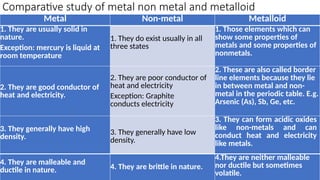
Metal Non-metal Metalloid
1. They are usually solid in
nature.
Exception: mercury is liquid at
room temperature
1. They do exist usually in all
three states
1. Those elements which can
show some properties of
metals and some properties of
nonmetals.
2. They are good conductor of
heat and electricity.
2. They are poor conductor of
heat and electricity
Exception: Graphite
conducts electricity
2. These are also called border
line elements because they lie
in between metal and non-
metal in the periodic table. E.g.
Arsenic (As), Sb, Ge, etc.
3. They generally have high
density.
3. They generally have low
density.
3. They can form acidic oxides
like non-metals and can
conduct heat and electricity
like metals.
4. They are malleable and
ductile in nature. 4. They are brittle in nature.
4.They are neither malleable
nor ductile but sometimes
volatile.
5.
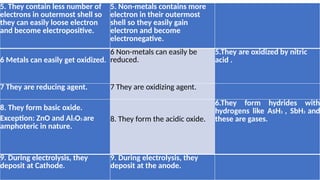
5. They containless number of
electrons in outermost shell so
they can easily loose electron
and become electropositive.
5. Non-metals contains more
electron in their outermost
shell so they easily gain
electron and become
electronegative.
6 Metals can easily get oxidized.
6 Non-metals can easily be
reduced.
5.They are oxidized by nitric
acid .
7 They are reducing agent. 7 They are oxidizing agent.
8. They form basic oxide.
Exception: ZnO and Al2O3 are
amphoteric in nature.
8. They form the acidic oxide.
6.They form hydrides with
hydrogens like AsH3 , SbH3 and
these are gases.
9. During electrolysis, they
deposit at Cathode.
9. During electrolysis, they
deposit at the anode.
6.
Minerals and ores:
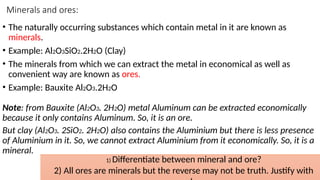
•The naturally occurring substances which contain metal in it are known as
minerals.
• Example: Al2O3SiO2.2H2O (Clay)
• The minerals from which we can extract the metal in economical as well as
convenient way are known as ores.
• Example: Bauxite Al2O3.2H2O
Note: from Bauxite (Al2O3. 2H2O) metal Aluminum can be extracted economically
because it only contains Aluminum. So, it is an ore.
But clay (Al2O3. 2SiO2. 2H2O) also contains the Aluminium but there is less presence
of Aluminium in it. So, we cannot extract Aluminium from it economically. So, it is a
mineral.
1) Differentiate between mineral and ore?
2) All ores are minerals but the reverse may not be truth. Justify with
7.
Alloy
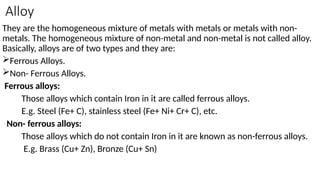
They are thehomogeneous mixture of metals with metals or metals with non-
metals. The homogeneous mixture of non-metal and non-metal is not called alloy.
Basically, alloys are of two types and they are:
Ferrous Alloys.
Non- Ferrous Alloys.
Ferrous alloys:
Those alloys which contain Iron in it are called ferrous alloys.
E.g. Steel (Fe+ C), stainless steel (Fe+ Ni+ Cr+ C), etc.
Non- ferrous alloys:
Those alloys which do not contain Iron in it are known as non-ferrous alloys.
E.g. Brass (Cu+ Zn), Bronze (Cu+ Sn)
8.
Importance of Alloys:
They are less rusting in nature in comparison to the pure metals. So, using alloys
we can save the loss from rusting.
Alloys are stronger than metal i.e. by making alloys we can increase the mechanical
strength of metals.
Alloys are useful for making colorful utensils and materials i.e. we can import color
if we make the alloy.
Amalgam
The homogeneous mixture of Mercury with metal is known as amalgam. Mercury
is in liquid form so by dissolving metal on Mercury we can obtain an Amalgam.
E.g. Hg+ Na, Na-Hg [Sodium amalgam],Na/Hg
Hg+Cu,Cu.Hg[Copper amalgam],Cu/Hg
Note: metals like Iron (Fe), Cobalt (Co) and Nickel(Ni) don’t form amalgam
because they do not dissolve in Mercury.
9.
Uses of Amalgam:
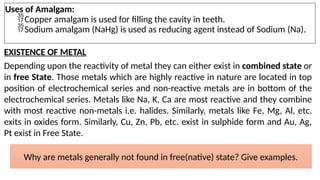
Copperamalgam is used for filling the cavity in teeth.
Sodium amalgam (NaHg) is used as reducing agent instead of Sodium (Na).
EXISTENCE OF METAL
Depending upon the reactivity of metal they can either exist in combined state or
in free State. Those metals which are highly reactive in nature are located in top
position of electrochemical series and non-reactive metals are in bottom of the
electrochemical series. Metals like Na, K, Ca are most reactive and they combine
with most reactive non-metals i.e. halides. Similarly, metals like Fe, Mg, Al, etc.
exits in oxides form. Similarly, Cu, Zn, Pb, etc. exist in sulphide form and Au, Ag,
Pt exist in Free State.
Why are metals generally not found in free(native) state? Give examples.
10.
Metallurgy:
The branch ofscience that deals with the study of extraction and purification of
metal is known as Metallurgy. Occurrence of minerals in
Nepal(learn yourself)
Different steps involved in metallurgical process.
Metallurgical process involves following steps.
1. Mining
2. Crushing and pulverization
3. Concentration
4. Preliminary treatment (calcination or roasting)
5. Reduction
6. Purification or refining
11.
1. Mining
The collectionof Ore from the mines is mining. It is 1st
step of Metallurgy.
2. Crushing and Pulverization
The process of converting big lumps of ore into smaller pieces by using crush mill is known
as crushing. The process of changing crushed ore into a fine powder by using ball mill is
known as pulverization.
3. Concentration of the ore.
This is the method of removing impurities present in powder ore in order to increase the
extent of ore. Depending upon the nature of ore and impurities present on given ore
concentration can be carried out by following ways:
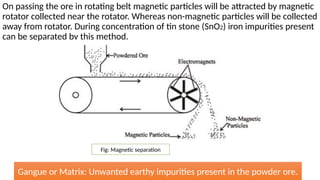
a. Magnetic separation:
If one of impurities or ore is magnetic and another is non-magnetic then such types of ores
can be concentrated by using electromagnetic separation. During this process powdered ore
is transferred into the rotating belt fitted with rotator or wheel where one of the rotator is
magnetic in nature.
12.
On passing theore in rotating belt magnetic particles will be attracted by magnetic
rotator collected near the rotator. Whereas non-magnetic particles will be collected
away from rotator. During concentration of tin stone (SnO2) iron impurities present
can be separated by this method.
Fig: Magnetic separation
Gangue or Matrix: Unwanted earthy impurities present in the powder ore.
13.
a) :
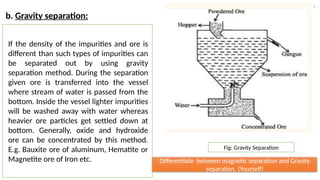
b. Gravityseparation:
If the density of the impurities and ore is
different than such types of impurities can
be separated out by using gravity
separation method. During the separation
given ore is transferred into the vessel
where stream of water is passed from the
bottom. Inside the vessel lighter impurities
will be washed away with water whereas
heavier ore particles get settled down at
bottom. Generally, oxide and hydroxide
ore can be concentrated by this method.
E.g. Bauxite ore of aluminum, Hematite or
Magnetite ore of Iron etc.
Fig: Gravity Separation
Differentiate between magnetic separation and Gravity
separation. (Yourself)
14.
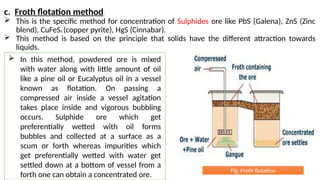
c. Froth flotationmethod:
This is the specific method for concentration of Sulphides ore like PbS (Galena), ZnS (Zinc
blend), CuFeS2 (copper pyrite), HgS (Cinnabar).
This method is based on the principle that solids have the different attraction towards
liquids.
In this method, powdered ore is mixed
with water along with little amount of oil
like a pine oil or Eucalyptus oil in a vessel
known as flotation. On passing a
compressed air inside a vessel agitation
takes place inside and vigorous bubbling
occurs. Sulphide ore which get
preferentially wetted with oil forms
bubbles and collected at a surface as a
scum or forth whereas impurities which
get preferentially wetted with water get
settled down at a bottom of vessel from a
forth one can obtain a concentrated ore.
Fig: Froth flotation
15.
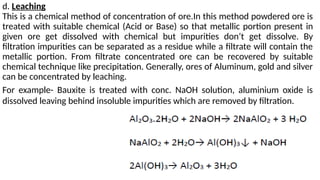
d. Leaching
This isa chemical method of concentration of ore.In this method powdered ore is
treated with suitable chemical (Acid or Base) so that metallic portion present in
given ore get dissolved with chemical but impurities don’t get dissolve. By
filtration impurities can be separated as a residue while a filtrate will contain the
metallic portion. From filtrate concentrated ore can be recovered by suitable
chemical technique like precipitation. Generally, ores of Aluminum, gold and silver
can be concentrated by leaching.
For example- Bauxite is treated with conc. NaOH solution, aluminium oxide is
dissolved leaving behind insoluble impurities which are removed by filtration.
16.
4. Preliminary treatment:
The process of extraction of metal from the concentrated ore depends
upon the nature of the ore as well as the nature of impurities present in
the ore. Before the concentrated ore is subjected to final metallurgical
operations in order to get the metal in the free state, the preliminary
chemical treatment may be necessary. The objective of this preliminary
chemical treatment is:
(a) to get rid of impurities which would cause difficulties in the later stages;
and
(b) to convert the ore into oxide of the metal because it is easier to reduce
an oxide than the carbonate or sulphide.
The processes employed for preliminary treatment are calcination and
roasting.
17.
Calcination:
It is theprocess of heating a concentrated ore in the absence or little
supply of air below the melting point of ore.
It is mainly carried out for hydroxides, carbonate and nitrates ores.
Decomposition of ore may take place.
ZnCO3 → ZnO + CO2
During calcination following changes takes place.
a. Moisture gets removed.
b. Volatile impurities gets removed.
c. Water of crystallization gets removed
Al2O3.2H2O → Al2O3+ 2H2O
18.
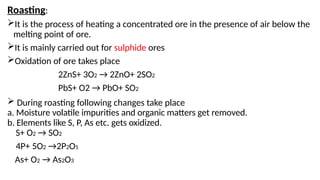
Roasting:
It is theprocess of heating a concentrated ore in the presence of air below the
melting point of ore.
It is mainly carried out for sulphide ores
Oxidation of ore takes place
2ZnS+ 3O2 → 2ZnO+ 2SO2
PbS+ O2 → PbO+ SO2
During roasting following changes take place
a. Moisture volatile impurities and organic matters get removed.
b. Elements like S, P, As etc. gets oxidized.
S+ O2 → SO2
4P+ 5O2 →2P2O5
As+ O2 → As2O3
19.
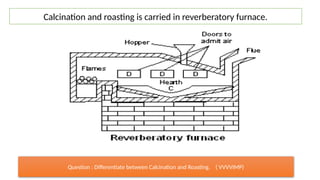
Calcination and roastingis carried in reverberatory furnace.
Question : Differentiate between Calcination and Roasting. ( VVVVIMP)
20.
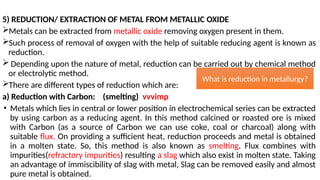
5) REDUCTION/ EXTRACTIONOF METAL FROM METALLIC OXIDE
Metals can be extracted from metallic oxide removing oxygen present in them.
Such process of removal of oxygen with the help of suitable reducing agent is known as
reduction.
Depending upon the nature of metal, reduction can be carried out by chemical method
or electrolytic method.
There are different types of reduction which are:
a) Reduction with Carbon: (smelting) vvvimp
• Metals which lies in central or lower position in electrochemical series can be extracted
by using carbon as a reducing agent. In this method calcined or roasted ore is mixed
with Carbon (as a source of Carbon we can use coke, coal or charcoal) along with
suitable flux. On providing a sufficient heat, reduction proceeds and metal is obtained
in a molten state. So, this method is also known as smelting. Flux combines with
impurities(refractory impurities) resulting a slag which also exist in molten state. Taking
an advantage of immiscibility of slag with metal, Slag can be removed easily and almost
pure metal is obtained.
What is reduction in metallurgy?
21.
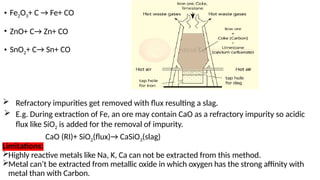
• Fe2O3+ C→ Fe+ CO
• ZnO+ C→ Zn+ CO
• SnO2+ C→ Sn+ CO
Refractory impurities get removed with flux resulting a slag.
E.g. During extraction of Fe, an ore may contain CaO as a refractory impurity so acidic
flux like SiO2 is added for the removal of impurity.
CaO (RI)+ SiO2(flux)→ CaSiO3(slag)
Limitations:
Highly reactive metals like Na, K, Ca can not be extracted from this method.
Metal can’t be extracted from metallic oxide in which oxygen has the strong affinity with
metal than with Carbon.
22.
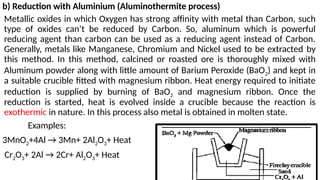
b) Reduction withAluminium (Aluminothermite process)
Metallic oxides in which Oxygen has strong affinity with metal than Carbon, such
type of oxides can’t be reduced by Carbon. So, aluminum which is powerful
reducing agent than carbon can be used as a reducing agent instead of Carbon.
Generally, metals like Manganese, Chromium and Nickel used to be extracted by
this method. In this method, calcined or roasted ore is thoroughly mixed with
Aluminum powder along with little amount of Barium Peroxide (BaO2) and kept in
a suitable crucible fitted with magnesium ribbon. Heat energy required to initiate
reduction is supplied by burning of BaO2 and magnesium ribbon. Once the
reduction is started, heat is evolved inside a crucible because the reaction is
exothermic in nature. In this process also metal is obtained in molten state.
Examples:
3MnO2+4Al → 3Mn+ 2Al2O3+ Heat
Cr2O3+ 2Al → 2Cr+ Al2O3+ Heat
23.
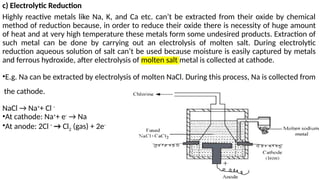
c) Electrolytic Reduction
Highlyreactive metals like Na, K, and Ca etc. can’t be extracted from their oxide by chemical
method of reduction because, in order to reduce their oxide there is necessity of huge amount
of heat and at very high temperature these metals form some undesired products. Extraction of
such metal can be done by carrying out an electrolysis of molten salt. During electrolytic
reduction aqueous solution of salt can’t be used because moisture is easily captured by metals
and ferrous hydroxide, after electrolysis of molten salt metal is collected at cathode.
•E.g. Na can be extracted by electrolysis of molten NaCl. During this process, Na is collected from
the cathode.
NaCl → Na+
+ Cl -
•At cathode: Na+
+ e-
→ Na
•At anode: 2Cl -
→ Cl2 (gas) + 2e-
24.
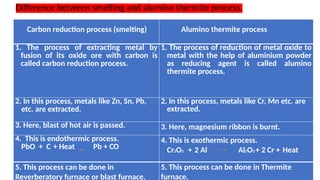
Carbon reduction process(smelting) Alumino thermite process
1. The process of extracting metal by
fusion of its oxide ore with carbon is
called carbon reduction process.
1. The process of reduction of metal oxide to
metal with the help of aluminium powder
as reducing agent is called alumino
thermite process.
2. In this process, metals like Zn, Sn, Pb,
etc. are extracted.
2. In this process, metals like Cr, Mn etc. are
extracted.
3. Here, blast of hot air is passed. 3. Here, magnesium ribbon is burnt.
4. This is endothermic process.
PbO + C + Heat Pb + CO
4. This is exothermic process.
Cr2O3 + 2 Al Al2O3 + 2 Cr + Heat
5. This process can be done in
Reverberatory furnace or blast furnace.
5. This process can be done in Thermite
furnace.
Difference between smelting and alumino thermite process.
25.
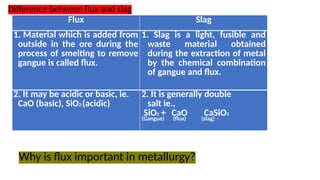
Difference between fluxand slag
Flux Slag
1. Material which is added from
outside in the ore during the
process of smelting to remove
gangue is called flux.
1. Slag is a light, fusible and
waste material obtained
during the extraction of metal
by the chemical combination
of gangue and flux.
2. It may be acidic or basic, ie.
CaO (basic), SiO2 (acidic)
2. It is generally double
salt ie.,
SiO2 + CaO CaSiO3
(Gangue) (flux) (slag)
Why is flux important in metallurgy?
26.
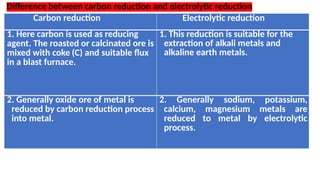
Difference between carbonreduction and electrolytic reduction
Carbon reduction Electrolytic reduction
1. Here carbon is used as reducing
agent. The roasted or calcinated ore is
mixed with coke (C) and suitable flux
in a blast furnace.
1. This reduction is suitable for the
extraction of alkali metals and
alkaline earth metals.
2. Generally oxide ore of metal is
reduced by carbon reduction process
into metal.
2. Generally sodium, potassium,
calcium, magnesium metals are
reduced to metal by electrolytic
process.
27.
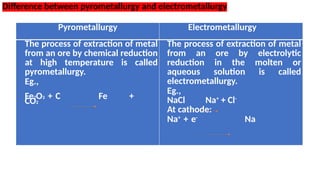
Difference between pyrometallurgyand electrometallurgy
Pyrometallurgy Electrometallurgy
The process of extraction of metal
from an ore by chemical reduction
at high temperature is called
pyrometallurgy.
Eg.,
Fe2O3 + C Fe +
CO2
The process of extraction of metal
from an ore by electrolytic
reduction in the molten or
aqueous solution is called
electrometallurgy.
Eg.,
NaCl Na+
+ Cl-
At cathode:
Na+
+ e-
Na
28.
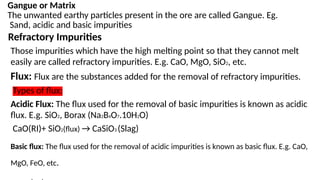
Gangue or Matrix
Theunwanted earthy particles present in the ore are called Gangue. Eg.
Sand, acidic and basic impurities
Refractory Impurities
Those impurities which have the high melting point so that they cannot melt
easily are called refractory impurities. E.g. CaO, MgO, SiO2, etc.
Flux: Flux are the substances added for the removal of refractory impurities.
Types of flux:
Acidic Flux: The flux used for the removal of basic impurities is known as acidic
flux. E.g. SiO2, Borax (Na2B4O7.10H2O)
CaO(RI)+ SiO2(flux) → CaSiO3 (Slag)
Basic flux: The flux used for the removal of acidic impurities is known as basic flux. E.g. CaO,
MgO, FeO, etc.
29.
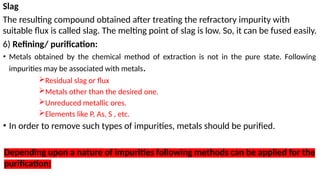
Slag
The resulting compoundobtained after treating the refractory impurity with
suitable flux is called slag. The melting point of slag is low. So, it can be fused easily.
6) Refining/ purification:
• Metals obtained by the chemical method of extraction is not in the pure state. Following
impurities may be associated with metals.
Residual slag or flux
Metals other than the desired one.
Unreduced metallic ores.
Elements like P, As, S , etc.
• In order to remove such types of impurities, metals should be purified.
Depending upon a nature of impurities following methods can be applied for the
purification:
30.
a) Polling:
In thisprocess molten metal is stirred with a pole of green wood. Hydro
carbon present in green wood acts as reducing agent so that oxide impurities
get reduced into respective metal. This method is specially used for
purification of Copper.
CuO+ C→ Cu+ CO
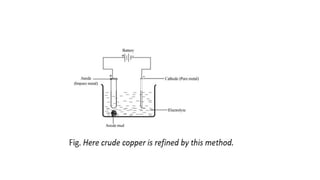
b) Electrolytic Refining:
This method is cheap and convenient. Metals like Cu, Ag, and Zn can be
refined electrolytically. The impure metal is made anode and a thin strip of
pure metal is made cathode in electrolytic cell. The cell is filled with solution
of suitable salt of concerned metal. On passing electricity, pure metal gets
deposited at cathode and the anode undergoes dissolution. Insoluble
impurities fall behind the anode in the form of anode mud and soluble
impurities go to the solution.
32.
SOLVED QUESTIONMS:
1 Whatare refractory materials?
Ans: The materials which can withstand very high temperature without melting or
softening are called refractory materials. Dolomite (MgCO3.CaCO3), Magnesium
oxide (MgO), silica (SiO2), alumina (Al2O3) are typical refractory materials.
2 Explain ‘All the ores are minerals but not all the minerals are ores.’
Ans: Those minerals from which the metals may be extracted conveniently and
economically are called ores. So, the ores are a type of mineral e.g. Bauxite (Al2O3
2H2O) and clay (Al2O32SiO3.2H2O). Both are minerals of aluminium. But, Al can
be economically extracted from the former while Al is difficult to be obtained
from the later. Hence, the former is also called ore but the later cannot. Thus, all
the ores are minerals but all the minerals are not ore.
33.
DO YOURSELF:
1 Alkaliand alkaline earth metals can not be obtained by a chemical reduction
method. Explain.
2 What is flux? How are they useful?
3 What is meant by slag? Why is it important in metallurgy?
4 Name the process used for the concentration of sulphide ore.
5 Why do some metals occur in the native state?
6 Define calcination and roasting?
7 What is gangue? Classify it.
8 What is metallurgy? Mentions its various types.
9 Define an alloy. What are the properties imparted to metal by the alloying
process?
10 What is meant by metallurgy? Describe briefly the various methods employed
for the general extraction of metals from their ore.

![Importance of Alloys:
They are less rusting in nature in comparison to the pure metals. So, using alloys
we can save the loss from rusting.
Alloys are stronger than metal i.e. by making alloys we can increase the mechanical
strength of metals.
Alloys are useful for making colorful utensils and materials i.e. we can import color
if we make the alloy.
Amalgam
The homogeneous mixture of Mercury with metal is known as amalgam. Mercury
is in liquid form so by dissolving metal on Mercury we can obtain an Amalgam.
E.g. Hg+ Na, Na-Hg [Sodium amalgam],Na/Hg
Hg+Cu,Cu.Hg[Copper amalgam],Cu/Hg
Note: metals like Iron (Fe), Cobalt (Co) and Nickel(Ni) don’t form amalgam
because they do not dissolve in Mercury.](https://image.slidesharecdn.com/metallurgicalprocessclassclass11-250429161902-09ae7ff9/85/Metallurgical-process-class-11_Govinda-Pathak-8-320.jpg)


![Polymer [ बहुलक ] Chemistry Notes PDF - Irfanullah Mehar - JJ Sir Chemistry.pdf](https://cdn.slidesharecdn.com/ss_thumbnails/polymerchemistrynotespdf-irfanullahmehar-jjsirchemistry-260210172118-3f9b37f7-thumbnail.jpg?width=640&height=640&fit=bounds)


