EXTRACTION TECHNIQUES AND
METALLURGY
BY
KOUSHIK KOSANAM
PUNEET C S
WHAT IS METALLURGY?
• Metallurgy is a domain of materials science
and engineering that studies the physical and
chemical behaviour of metallic elements, their
inter-metallic compounds, and their mixtures,
which are called alloys.
• Metallurgy comprises of 3 steps:
i. Concentration of Ore
ii. Isolation of metal from the concentrated Ore
iii. Purification of the metal
BASIC TERMINOLOGIES
• Mineral: A solid, naturally occurring inorganic
substance formed by geological processes
• Ore: A naturally occurring solid material from
which a metal or valuable mineral can be
extracted
• Flux: Its is a chemical cleaning agent used for
purification of the ores.
BASIC TERMINOLOGIES (contd…)

• Slag: Waste matter separated from metals during
the extraction of ores.
• Gangue: In mining, gangue is the commercially
worthless material that surrounds, or is closely
mixed with, a wanted mineral in an ore deposit. It is
thus distinct from overburden, which is the waste
rock or materials overlying an ore or mineral body
that are displaced during mining without being
processed.
• The separation of mineral from gangue is known
as mineral processing.
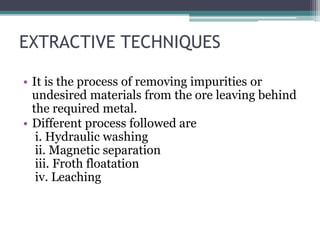
EXTRACTIVE TECHNIQUES
• It is the process of removing impurities or
undesired materials from the ore leaving behind
the required metal.
• Different process followed are
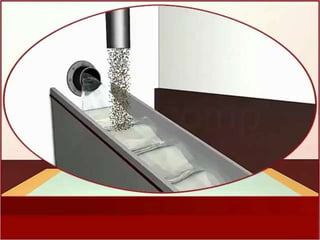
i. Hydraulic washing
ii. Magnetic separation
iii. Froth floatation
iv. Leaching
METALS AND THEIR ORES
• Aluminium
Bauxite AlOx(OH)3-2x [where 0 < x < 1]
Kaolinite (a form of clay) [Al2 (OH)4 Si2O5]
• Iron
Haematite Fe2O3
Magnetite Fe3O4
Siderite FeCO3
Iron pyrites FeS2
• Copper
Copper pyrites CuFeS2
Malachite CuCO3.Cu(OH)2
Cuprite Cu2O
Copper glance Cu2S
• Zinc
Zinc blend/Sphalerite ZnS
Calamine ZnCO3
Zincite ZnO
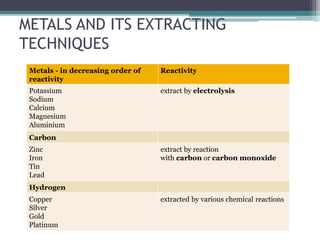
METALS AND ITS EXTRACTING
TECHNIQUES
Metals - in decreasing order of
reactivity
Reactivity
Potassium
Sodium
Calcium
Magnesium
Aluminium
extract by electrolysis
Carbon
Zinc
Iron
Tin
Lead
extract by reaction
with carbon or carbon monoxide
Hydrogen
Copper
Silver
Gold
Platinum
extracted by various chemical reactions
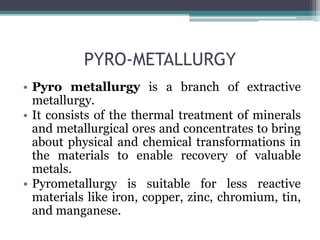
PYRO-METALLURGY
• Pyro metallurgy is a branch of extractive
metallurgy.
• It consists of the thermal treatment of minerals
and metallurgical ores and concentrates to bring
about physical and chemical transformations in
the materials to enable recovery of valuable
metals.
• Pyrometallurgy is suitable for less reactive
materials like iron, copper, zinc, chromium, tin,
and manganese.
CLASSIFICATION
Pyro metallurgy is classified into following
categories:
• Calcination
• Roasting
• Smelting
• Refining
CALCINATION
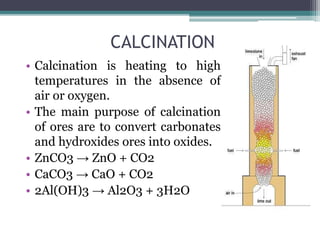
• Calcination is heating to high
temperatures in the absence of
air or oxygen.
• The main purpose of calcination
of ores are to convert carbonates
and hydroxides ores into oxides.
• ZnCO3 → ZnO + CO2
• CaCO3 → CaO + CO2
• 2Al(OH)3 → Al2O3 + 3H2O
•Purpose of calcination
i. Remove the volatile impurities
ii. To remove moisture
iii. Make the mass porous
ROASTING
• The processing of strong heating of the ore in
presence of excess amount of air below its melting
point.
• Purpose of roasting:
i. To convert the sulphide into oxide and sulphate
ii. To remove impurities like S, As, Sb.
iii. To remove moisture
iv. To Oxidise easily oxidisable substances
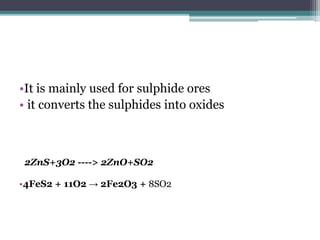
•It is mainly used for sulphide ores
• it converts the sulphides into oxides
•4FeS2 + 11O2 → 2Fe2O3 + 8SO2
2ZnS+3O2 ----> 2ZnO+SO2
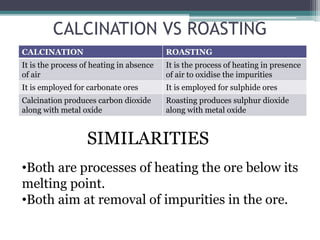
CALCINATION VS ROASTING
CALCINATION ROASTING
It is the process of heating in absence
of air
It is the process of heating in presence
of air to oxidise the impurities
It is employed for carbonate ores It is employed for sulphide ores
Calcination produces carbon dioxide
along with metal oxide
Roasting produces sulphur dioxide
along with metal oxide
•Both are processes of heating the ore below its
melting point.
•Both aim at removal of impurities in the ore.
SIMILARITIES
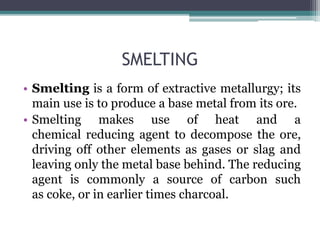
SMELTING
• Smelting is a form of extractive metallurgy; its
main use is to produce a base metal from its ore.
• Smelting makes use of heat and a
chemical reducing agent to decompose the ore,
driving off other elements as gases or slag and
leaving only the metal base behind. The reducing
agent is commonly a source of carbon such
as coke, or in earlier times charcoal.
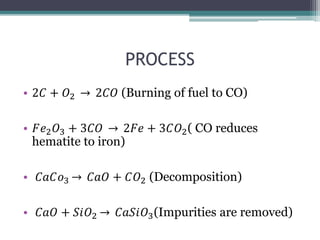
PROCESS
• 2𝐶 + 𝑂2 2𝐶𝑂 (Burning of fuel to CO)
• 𝐹𝑒2 𝑂3 + 3𝐶𝑂 2𝐹𝑒 + 3𝐶𝑂2( CO reduces
hematite to iron)
• 𝐶𝑎𝐶𝑜3 𝐶𝑎𝑂 + 𝐶𝑂2 (Decomposition)
• 𝐶𝑎𝑂 + 𝑆𝑖𝑂2 𝐶𝑎𝑆𝑖𝑂3(Impurities are removed)
HYDRO-METALLURGY
• Hydrometallurgy is a method for obtaining
metals from their ores. It is a
technique involving the use
of aqueous chemistry for the recovery of metals
from ores, concentrates, and recycled or residual
materials. Hydrometallurgy is typically divided
into three general areas:
i. Leaching
ii. Solution concentration and purification
iii. Metal or metal compound recovery
LEACHING
• It involves the use of aqueous solutions to
extract metal from metal bearing materials
which is brought into contact with a material
containing a valuable metal. The aqueous
solution conditions vary in terms of pH,
oxidation-reduction potential, presence of
chelating agents and temperature.
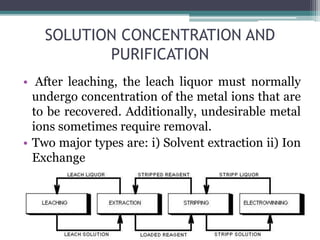
SOLUTION CONCENTRATION AND
PURIFICATION
• After leaching, the leach liquor must normally
undergo concentration of the metal ions that are
to be recovered. Additionally, undesirable metal
ions sometimes require removal.
• Two major types are: i) Solvent extraction ii) Ion
Exchange
METAL RECOVERY
• Sometimes, however, further refining is required
if ultra-high purity metals are to be produced.
• The primary types of metal recovery processes
are i) electrolysis, ii) gaseous reduction, and iii)
precipitation.
• For example, a major target of hydrometallurgy
is copper, which is conveniently obtained by
electrolysis. Cu2+ ions reduce at mild potentials,
leaving behind other contaminating metals such
as Fe2+ and Zn2+.
ELECTRO-METALLURGY
• Electrometallurgy is the field concerned with
the processes of metal electrode position There
are four categories of these processes:
• Electrowinning
• Electrorefining
• Electroplating
• Electroforming
• Electropolishing
• Electrowinning, the extraction of metal from
ores.
• Electrorefining, the purification of metals.
• Metal powder production by electrodeposition is
included in this category, or sometimes
electrowinning, or a separate category
depending on application.
• Electroplating, the deposition of a layer of one
metal on another.
• Electroforming, the manufacture of, usually
thin, metal parts through electroplating.
• Electropolishing, the removal of material from a
metallic workpiece.
Refining
• Primary Refining: Refining consists of
purifying an impure metal. It is to be
distinguished from other processes
like smelting and calcining in that those two
involve a chemical change to the raw material,
whereas in refining, the final material isidentical
chemically to the original one, only it is purer.
• Electro Refining: It is the process of using
electrolysis to increase the purity of a metal
extracted from its ore (compound or mixture of
compounds from which a metal can be extracted
commercially).
Refining (contd…)
• To use grey pig iron, a preliminary refining process
was necessary to remove silicon. The pig iron was
melted in a running out furnace and then run out
into a trough. This process oxidised the silicon to
form a slag, which floated on the iron and was
removed by lowering a dam at the end of the trough.
The product of this process was a white metal,
known as finers metal or refined iron.
Secondary Refining
• The purposes of secondary refining are many:
temperature homogenization or adjustment;
chemical adjustments for carbon, sulphur,
phosphorus, oxygen and precise alloying; inclusion
control; degassing, and others. The equipment and
processes are equally varied.
Electro-slag refining (ESR)
• The process of electro-slag refining (ESR) is well
known for production of high cleanliness steels.
It involves melting of an electrode by resistive
heating through a slag pool, and solidification of
the droplets at the bottom of the Pool.
• Steel of the desired overall chemical composition
is prepared before-hand and shaped in the form
of an electrode. This requires addition of the
necessary ferro-alloys to the liquid steel in order
to attain the aimed concentration of alloying
elements.
Wrought Iron
• Wrought iron: The product of the blast
furnace is pig iron, which contains 4–5% carbon and
usually some silicon. To produce a forgeable product
a further process was needed, usually described
as fining, rather than refining. At the end of the 18th
century, this began to be replaced by puddling (in
a puddling furnace.
Refined iron
• Refined iron: To use grey pig iron, a preliminary
refining process was necessary to remove silicon.
The pig iron was melted in a running out
furnace and then run out into a trough. This process
oxidised the silicon to form a slag, which floated on
the iron and was removed by lowering a dam at the
end of the trough. The product of this process was a
white metal, known as finers metal or refined iron.
Purpose of alloying
• Strengthening of the ferrite
• Improved corrosion resistance
• Better hardenability
• Grain size control
• Improved mechanical properties like ductility,
strength, toughness, etc.
• Improved Cutting ability
• Better wear resistance
Major alloying elements
• Carbon:
Imparts hardness
Tensile strength
Machinability
Melting point
• Nickel:
Increases toughness and resistance to impact.
Lessens distortion in quenching
Strengthens steel
• Chromium:
Joins with carbon to form chromium carbide,
thus adds to depth hardenability with improved
resistance to abrasion and wear.
Improves corrosion resistance.
• Silicon:
Improves oxidation resistance
Strengthens low alloy steels
Acts as deoxidisers
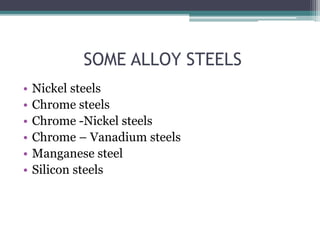
SOME ALLOY STEELS
• Nickel steels
• Chrome steels
• Chrome -Nickel steels
• Chrome – Vanadium steels
• Manganese steel
• Silicon steels
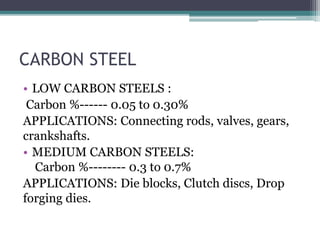
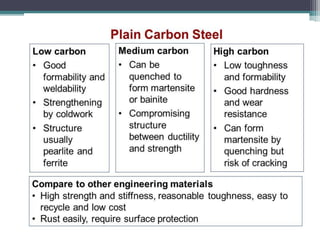
CARBON STEEL
• LOW CARBON STEELS :
Carbon %------ 0.05 to 0.30%
APPLICATIONS: Connecting rods, valves, gears,
crankshafts.
• MEDIUM CARBON STEELS:
Carbon %-------- 0.3 to 0.7%
APPLICATIONS: Die blocks, Clutch discs, Drop
forging dies.
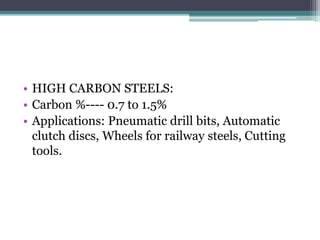
• HIGH CARBON STEELS:
• Carbon %---- 0.7 to 1.5%
• Applications: Pneumatic drill bits, Automatic
clutch discs, Wheels for railway steels, Cutting
tools.
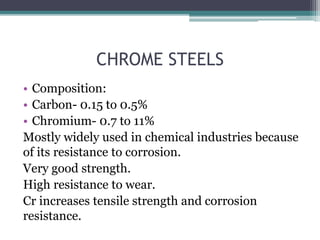
CHROME STEELS
• Composition:
• Carbon- 0.15 to 0.5%
• Chromium- 0.7 to 11%
Mostly widely used in chemical industries because
of its resistance to corrosion.
Very good strength.
High resistance to wear.
Cr increases tensile strength and corrosion
resistance.
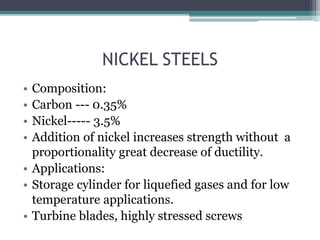
NICKEL STEELS
• Composition:
• Carbon --- 0.35%
• Nickel----- 3.5%
• Addition of nickel increases strength without a
proportionality great decrease of ductility.
• Applications:
• Storage cylinder for liquefied gases and for low
temperature applications.
• Turbine blades, highly stressed screws
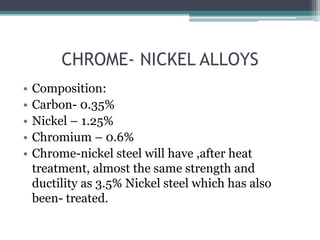
CHROME- NICKEL ALLOYS
• Composition:
• Carbon- 0.35%
• Nickel – 1.25%
• Chromium – 0.6%
• Chrome-nickel steel will have ,after heat
treatment, almost the same strength and
ductility as 3.5% Nickel steel which has also
been- treated.
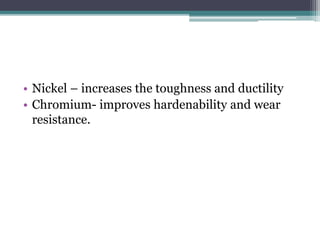
• Nickel – increases the toughness and ductility
• Chromium- improves hardenability and wear
resistance.
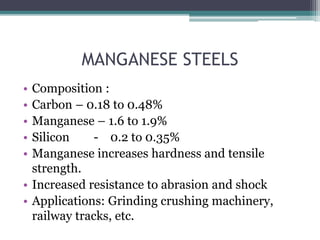
MANGANESE STEELS
• Composition :
• Carbon – 0.18 to 0.48%
• Manganese – 1.6 to 1.9%
• Silicon - 0.2 to 0.35%
• Manganese increases hardness and tensile
strength.
• Increased resistance to abrasion and shock
• Applications: Grinding crushing machinery,
railway tracks, etc.
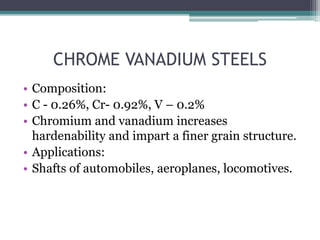
CHROME VANADIUM STEELS
• Composition:
• C - 0.26%, Cr- 0.92%, V – 0.2%
• Chromium and vanadium increases
hardenability and impart a finer grain structure.
• Applications:
• Shafts of automobiles, aeroplanes, locomotives.
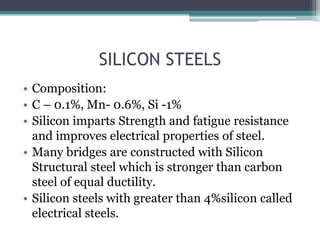
SILICON STEELS
• Composition:
• C – 0.1%, Mn- 0.6%, Si -1%
• Silicon imparts Strength and fatigue resistance
and improves electrical properties of steel.
• Many bridges are constructed with Silicon
Structural steel which is stronger than carbon
steel of equal ductility.
• Silicon steels with greater than 4%silicon called
electrical steels.
THANK YOU

Metallurgy

  • 1.
  • 2.
    WHAT IS METALLURGY? •Metallurgy is a domain of materials science and engineering that studies the physical and chemical behaviour of metallic elements, their inter-metallic compounds, and their mixtures, which are called alloys. • Metallurgy comprises of 3 steps: i. Concentration of Ore ii. Isolation of metal from the concentrated Ore iii. Purification of the metal
  • 3.
    BASIC TERMINOLOGIES • Mineral:A solid, naturally occurring inorganic substance formed by geological processes • Ore: A naturally occurring solid material from which a metal or valuable mineral can be extracted • Flux: Its is a chemical cleaning agent used for purification of the ores.
  • 4.
    BASIC TERMINOLOGIES (contd…) •Slag: Waste matter separated from metals during the extraction of ores. • Gangue: In mining, gangue is the commercially worthless material that surrounds, or is closely mixed with, a wanted mineral in an ore deposit. It is thus distinct from overburden, which is the waste rock or materials overlying an ore or mineral body that are displaced during mining without being processed. • The separation of mineral from gangue is known as mineral processing.
  • 5.
    EXTRACTIVE TECHNIQUES • Itis the process of removing impurities or undesired materials from the ore leaving behind the required metal. • Different process followed are i. Hydraulic washing ii. Magnetic separation iii. Froth floatation iv. Leaching
  • 7.
    METALS AND THEIRORES • Aluminium Bauxite AlOx(OH)3-2x [where 0 < x < 1] Kaolinite (a form of clay) [Al2 (OH)4 Si2O5] • Iron Haematite Fe2O3 Magnetite Fe3O4 Siderite FeCO3 Iron pyrites FeS2 • Copper Copper pyrites CuFeS2 Malachite CuCO3.Cu(OH)2 Cuprite Cu2O Copper glance Cu2S • Zinc Zinc blend/Sphalerite ZnS Calamine ZnCO3 Zincite ZnO
  • 8.
    METALS AND ITSEXTRACTING TECHNIQUES Metals - in decreasing order of reactivity Reactivity Potassium Sodium Calcium Magnesium Aluminium extract by electrolysis Carbon Zinc Iron Tin Lead extract by reaction with carbon or carbon monoxide Hydrogen Copper Silver Gold Platinum extracted by various chemical reactions
  • 9.
    PYRO-METALLURGY • Pyro metallurgyis a branch of extractive metallurgy. • It consists of the thermal treatment of minerals and metallurgical ores and concentrates to bring about physical and chemical transformations in the materials to enable recovery of valuable metals. • Pyrometallurgy is suitable for less reactive materials like iron, copper, zinc, chromium, tin, and manganese.
  • 10.
    CLASSIFICATION Pyro metallurgy isclassified into following categories: • Calcination • Roasting • Smelting • Refining
  • 11.
    CALCINATION • Calcination isheating to high temperatures in the absence of air or oxygen. • The main purpose of calcination of ores are to convert carbonates and hydroxides ores into oxides. • ZnCO3 → ZnO + CO2 • CaCO3 → CaO + CO2 • 2Al(OH)3 → Al2O3 + 3H2O
  • 12.
    •Purpose of calcination i.Remove the volatile impurities ii. To remove moisture iii. Make the mass porous
  • 13.
    ROASTING • The processingof strong heating of the ore in presence of excess amount of air below its melting point. • Purpose of roasting: i. To convert the sulphide into oxide and sulphate ii. To remove impurities like S, As, Sb. iii. To remove moisture iv. To Oxidise easily oxidisable substances
  • 14.
    •It is mainlyused for sulphide ores • it converts the sulphides into oxides •4FeS2 + 11O2 → 2Fe2O3 + 8SO2 2ZnS+3O2 ----> 2ZnO+SO2
  • 15.
    CALCINATION VS ROASTING CALCINATIONROASTING It is the process of heating in absence of air It is the process of heating in presence of air to oxidise the impurities It is employed for carbonate ores It is employed for sulphide ores Calcination produces carbon dioxide along with metal oxide Roasting produces sulphur dioxide along with metal oxide •Both are processes of heating the ore below its melting point. •Both aim at removal of impurities in the ore. SIMILARITIES
  • 16.
    SMELTING • Smelting isa form of extractive metallurgy; its main use is to produce a base metal from its ore. • Smelting makes use of heat and a chemical reducing agent to decompose the ore, driving off other elements as gases or slag and leaving only the metal base behind. The reducing agent is commonly a source of carbon such as coke, or in earlier times charcoal.
  • 17.
    PROCESS • 2𝐶 +𝑂2 2𝐶𝑂 (Burning of fuel to CO) • 𝐹𝑒2 𝑂3 + 3𝐶𝑂 2𝐹𝑒 + 3𝐶𝑂2( CO reduces hematite to iron) • 𝐶𝑎𝐶𝑜3 𝐶𝑎𝑂 + 𝐶𝑂2 (Decomposition) • 𝐶𝑎𝑂 + 𝑆𝑖𝑂2 𝐶𝑎𝑆𝑖𝑂3(Impurities are removed)
  • 18.
    HYDRO-METALLURGY • Hydrometallurgy isa method for obtaining metals from their ores. It is a technique involving the use of aqueous chemistry for the recovery of metals from ores, concentrates, and recycled or residual materials. Hydrometallurgy is typically divided into three general areas: i. Leaching ii. Solution concentration and purification iii. Metal or metal compound recovery
  • 19.
    LEACHING • It involvesthe use of aqueous solutions to extract metal from metal bearing materials which is brought into contact with a material containing a valuable metal. The aqueous solution conditions vary in terms of pH, oxidation-reduction potential, presence of chelating agents and temperature.
  • 20.
    SOLUTION CONCENTRATION AND PURIFICATION •After leaching, the leach liquor must normally undergo concentration of the metal ions that are to be recovered. Additionally, undesirable metal ions sometimes require removal. • Two major types are: i) Solvent extraction ii) Ion Exchange
  • 21.
    METAL RECOVERY • Sometimes,however, further refining is required if ultra-high purity metals are to be produced. • The primary types of metal recovery processes are i) electrolysis, ii) gaseous reduction, and iii) precipitation. • For example, a major target of hydrometallurgy is copper, which is conveniently obtained by electrolysis. Cu2+ ions reduce at mild potentials, leaving behind other contaminating metals such as Fe2+ and Zn2+.
  • 23.
    ELECTRO-METALLURGY • Electrometallurgy isthe field concerned with the processes of metal electrode position There are four categories of these processes: • Electrowinning • Electrorefining • Electroplating • Electroforming • Electropolishing
  • 24.
    • Electrowinning, theextraction of metal from ores. • Electrorefining, the purification of metals. • Metal powder production by electrodeposition is included in this category, or sometimes electrowinning, or a separate category depending on application.
  • 25.
    • Electroplating, thedeposition of a layer of one metal on another. • Electroforming, the manufacture of, usually thin, metal parts through electroplating. • Electropolishing, the removal of material from a metallic workpiece.
  • 26.
    Refining • Primary Refining:Refining consists of purifying an impure metal. It is to be distinguished from other processes like smelting and calcining in that those two involve a chemical change to the raw material, whereas in refining, the final material isidentical chemically to the original one, only it is purer. • Electro Refining: It is the process of using electrolysis to increase the purity of a metal extracted from its ore (compound or mixture of compounds from which a metal can be extracted commercially).
  • 27.
    Refining (contd…) • Touse grey pig iron, a preliminary refining process was necessary to remove silicon. The pig iron was melted in a running out furnace and then run out into a trough. This process oxidised the silicon to form a slag, which floated on the iron and was removed by lowering a dam at the end of the trough. The product of this process was a white metal, known as finers metal or refined iron.
  • 28.
    Secondary Refining • Thepurposes of secondary refining are many: temperature homogenization or adjustment; chemical adjustments for carbon, sulphur, phosphorus, oxygen and precise alloying; inclusion control; degassing, and others. The equipment and processes are equally varied.
  • 29.
    Electro-slag refining (ESR) •The process of electro-slag refining (ESR) is well known for production of high cleanliness steels. It involves melting of an electrode by resistive heating through a slag pool, and solidification of the droplets at the bottom of the Pool. • Steel of the desired overall chemical composition is prepared before-hand and shaped in the form of an electrode. This requires addition of the necessary ferro-alloys to the liquid steel in order to attain the aimed concentration of alloying elements.
  • 30.
    Wrought Iron • Wroughtiron: The product of the blast furnace is pig iron, which contains 4–5% carbon and usually some silicon. To produce a forgeable product a further process was needed, usually described as fining, rather than refining. At the end of the 18th century, this began to be replaced by puddling (in a puddling furnace.
  • 31.
    Refined iron • Refinediron: To use grey pig iron, a preliminary refining process was necessary to remove silicon. The pig iron was melted in a running out furnace and then run out into a trough. This process oxidised the silicon to form a slag, which floated on the iron and was removed by lowering a dam at the end of the trough. The product of this process was a white metal, known as finers metal or refined iron.
  • 32.
    Purpose of alloying •Strengthening of the ferrite • Improved corrosion resistance • Better hardenability • Grain size control • Improved mechanical properties like ductility, strength, toughness, etc. • Improved Cutting ability • Better wear resistance
  • 33.
    Major alloying elements •Carbon: Imparts hardness Tensile strength Machinability Melting point • Nickel: Increases toughness and resistance to impact. Lessens distortion in quenching Strengthens steel
  • 34.
    • Chromium: Joins withcarbon to form chromium carbide, thus adds to depth hardenability with improved resistance to abrasion and wear. Improves corrosion resistance. • Silicon: Improves oxidation resistance Strengthens low alloy steels Acts as deoxidisers
  • 35.
    SOME ALLOY STEELS •Nickel steels • Chrome steels • Chrome -Nickel steels • Chrome – Vanadium steels • Manganese steel • Silicon steels
  • 36.
    CARBON STEEL • LOWCARBON STEELS : Carbon %------ 0.05 to 0.30% APPLICATIONS: Connecting rods, valves, gears, crankshafts. • MEDIUM CARBON STEELS: Carbon %-------- 0.3 to 0.7% APPLICATIONS: Die blocks, Clutch discs, Drop forging dies.
  • 37.
    • HIGH CARBONSTEELS: • Carbon %---- 0.7 to 1.5% • Applications: Pneumatic drill bits, Automatic clutch discs, Wheels for railway steels, Cutting tools.
  • 39.
    CHROME STEELS • Composition: •Carbon- 0.15 to 0.5% • Chromium- 0.7 to 11% Mostly widely used in chemical industries because of its resistance to corrosion. Very good strength. High resistance to wear. Cr increases tensile strength and corrosion resistance.
  • 40.
    NICKEL STEELS • Composition: •Carbon --- 0.35% • Nickel----- 3.5% • Addition of nickel increases strength without a proportionality great decrease of ductility. • Applications: • Storage cylinder for liquefied gases and for low temperature applications. • Turbine blades, highly stressed screws
  • 41.
    CHROME- NICKEL ALLOYS •Composition: • Carbon- 0.35% • Nickel – 1.25% • Chromium – 0.6% • Chrome-nickel steel will have ,after heat treatment, almost the same strength and ductility as 3.5% Nickel steel which has also been- treated.
  • 42.
    • Nickel –increases the toughness and ductility • Chromium- improves hardenability and wear resistance.
  • 43.
    MANGANESE STEELS • Composition: • Carbon – 0.18 to 0.48% • Manganese – 1.6 to 1.9% • Silicon - 0.2 to 0.35% • Manganese increases hardness and tensile strength. • Increased resistance to abrasion and shock • Applications: Grinding crushing machinery, railway tracks, etc.
  • 44.
    CHROME VANADIUM STEELS •Composition: • C - 0.26%, Cr- 0.92%, V – 0.2% • Chromium and vanadium increases hardenability and impart a finer grain structure. • Applications: • Shafts of automobiles, aeroplanes, locomotives.
  • 45.
    SILICON STEELS • Composition: •C – 0.1%, Mn- 0.6%, Si -1% • Silicon imparts Strength and fatigue resistance and improves electrical properties of steel. • Many bridges are constructed with Silicon Structural steel which is stronger than carbon steel of equal ductility. • Silicon steels with greater than 4%silicon called electrical steels.
  • 46.