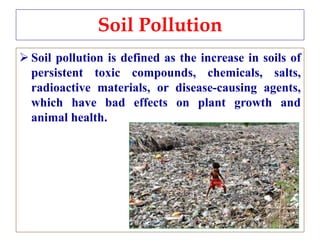
SOIL POLLUTION
Paper: CHEMISTRY FOR BIOLOGIST - II
Subject Code: 07AT02
http://www.healthpromotiontrust.org/
By
Dr. G. Balakrishnan
Assistant Professor
Department of Chemistry
Vivekananda College
Madurai, Tamil Nadu
Soil Pollution
 Soil pollution is defined as the increase in soils of
persistent toxic compounds, chemicals, salts,
radioactive materials, or disease-causing agents,
which have bad effects on plant growth and
animal health.
Importance (Functions) of soils
Soils are essential for life, in the sense
 Medium for plant growth:
(i) Soils support roots and keep them upright for growth.
(ii) Soils provide plants with essential minerals and nutrients
 Habitat for many insects and other organisms:
Insects and microbes (very tiny single-cell organisms) live in the
soils and depend on soils for food and air.
 A Filtration system for surface water:
Filtered water also provides plants with clean, unpolluted water
needed for growth.
 Carbon store and maintenance of atmospheric gases:
(i)Soils help regulate atmospheric Carbon dioxide (CO2) by acting
as a carbon store.
(ii)Nitrogen, phosphorus, and many other nutrients are stored,
transformed, and cycled in the soil.
pH of soil
 pH is a measure of hydrogen ion concentration, a measure
of the acidity or alkalinity of a solution.
pH = -log [H+]
 The pH scale ranges from 0 to 14, with pH 7.0 being
neutral. pH less than 7 are acidic, while those with a pH
greater than 7 are basic or alkaline.
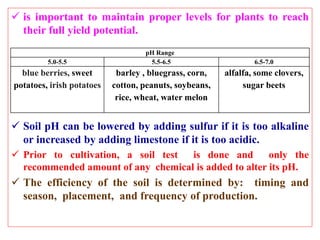
 The optimal pH range for most plants is between 5.5
and 7.0; however, many plants have adapted to thrive
at pH values outside this range.
 is important to maintain proper levels for plants to reach
their full yield potential.
 Soil pH can be lowered by adding sulfur if it is too alkaline
or increased by adding limestone if it is too acidic.
 Prior to cultivation, a soil test is done and only the
recommended amount of any chemical is added to alter its pH.
 The efficiency of the soil is determined by: timing and
season, placement, and frequency of production.
pH Range
5.0-5.5 5.5-6.5 6.5-7.0
blue berries, sweet
potatoes, irish potatoes
barley , bluegrass, corn,
cotton, peanuts, soybeans,
rice, wheat, water melon
alfalfa, some clovers,
sugar beets
Soil Pollution

Soil Pollution

  • 1.
    SOIL POLLUTION Paper: CHEMISTRYFOR BIOLOGIST - II Subject Code: 07AT02 http://www.healthpromotiontrust.org/ By Dr. G. Balakrishnan Assistant Professor Department of Chemistry Vivekananda College Madurai, Tamil Nadu
  • 2.
    Soil Pollution  Soilpollution is defined as the increase in soils of persistent toxic compounds, chemicals, salts, radioactive materials, or disease-causing agents, which have bad effects on plant growth and animal health.
  • 3.
    Importance (Functions) ofsoils Soils are essential for life, in the sense  Medium for plant growth: (i) Soils support roots and keep them upright for growth. (ii) Soils provide plants with essential minerals and nutrients  Habitat for many insects and other organisms: Insects and microbes (very tiny single-cell organisms) live in the soils and depend on soils for food and air.  A Filtration system for surface water: Filtered water also provides plants with clean, unpolluted water needed for growth.  Carbon store and maintenance of atmospheric gases: (i)Soils help regulate atmospheric Carbon dioxide (CO2) by acting as a carbon store. (ii)Nitrogen, phosphorus, and many other nutrients are stored, transformed, and cycled in the soil.
  • 4.
    pH of soil pH is a measure of hydrogen ion concentration, a measure of the acidity or alkalinity of a solution. pH = -log [H+]  The pH scale ranges from 0 to 14, with pH 7.0 being neutral. pH less than 7 are acidic, while those with a pH greater than 7 are basic or alkaline.  The optimal pH range for most plants is between 5.5 and 7.0; however, many plants have adapted to thrive at pH values outside this range.
  • 5.
     is importantto maintain proper levels for plants to reach their full yield potential.  Soil pH can be lowered by adding sulfur if it is too alkaline or increased by adding limestone if it is too acidic.  Prior to cultivation, a soil test is done and only the recommended amount of any chemical is added to alter its pH.  The efficiency of the soil is determined by: timing and season, placement, and frequency of production. pH Range 5.0-5.5 5.5-6.5 6.5-7.0 blue berries, sweet potatoes, irish potatoes barley , bluegrass, corn, cotton, peanuts, soybeans, rice, wheat, water melon alfalfa, some clovers, sugar beets