Chapter 10
Hydrogen
History
• Discovered about 200 years ago (1766)
Henry Cavendish (1731-1810)
Antoine Lavoisier (1743-1794)
History
• In 1931, hydrogen was discovered to have
isotopes
vs.
Harold C. Urey (1893-1981)
Nobel Laureate 1934
Frederick Soddy (1877-1956)
Nobel Laureate 1921
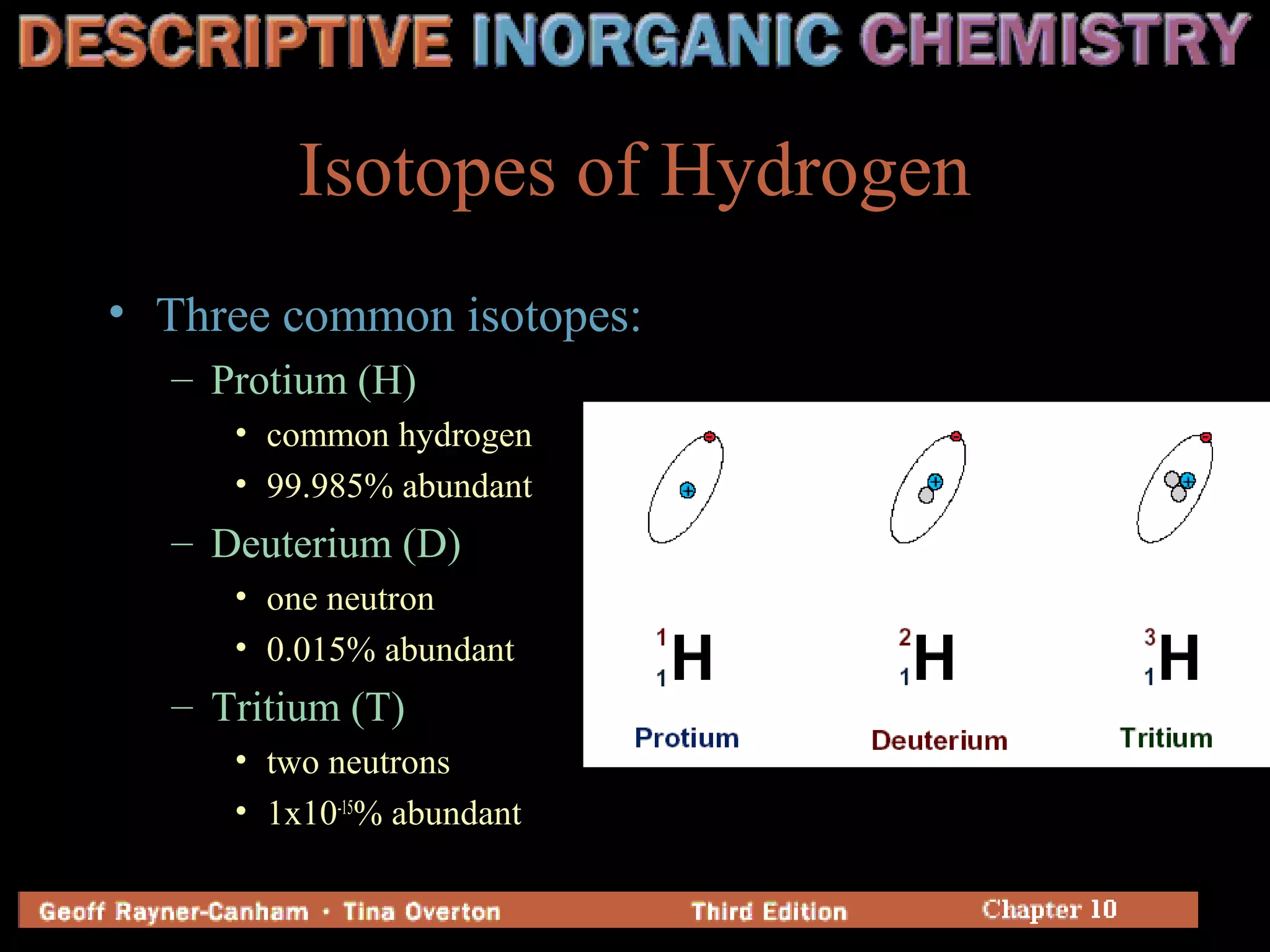
Isotopes of Hydrogen
• Three common isotopes:
– Protium (H)
• common hydrogen
• 99.985% abundant
– Deuterium (D)
• one neutron
• 0.015% abundant
– Tritium (T)
• two neutrons
• 1x10-15
% abundant
Physical Properties
• Vastly different among the three isotopes
Stability
• All are stable except for tritium
– synthesized in the universe and man-made by
neutron bombardment
– undergoes radioactive β decay
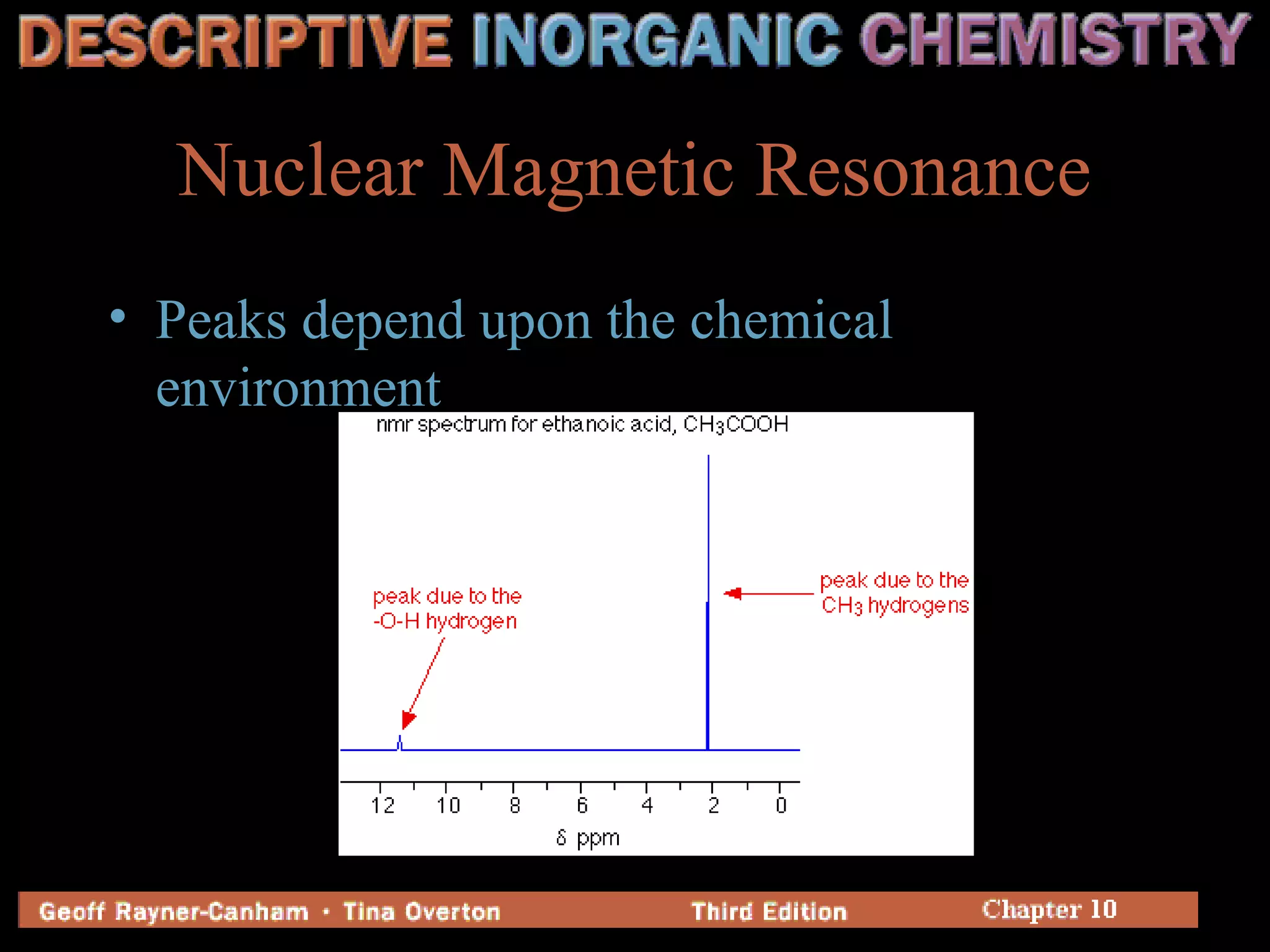
Nuclear Magnetic Resonance
• Studies nuclear spin
Nuclear Magnetic Resonance
• Peaks depend upon the chemical
environment
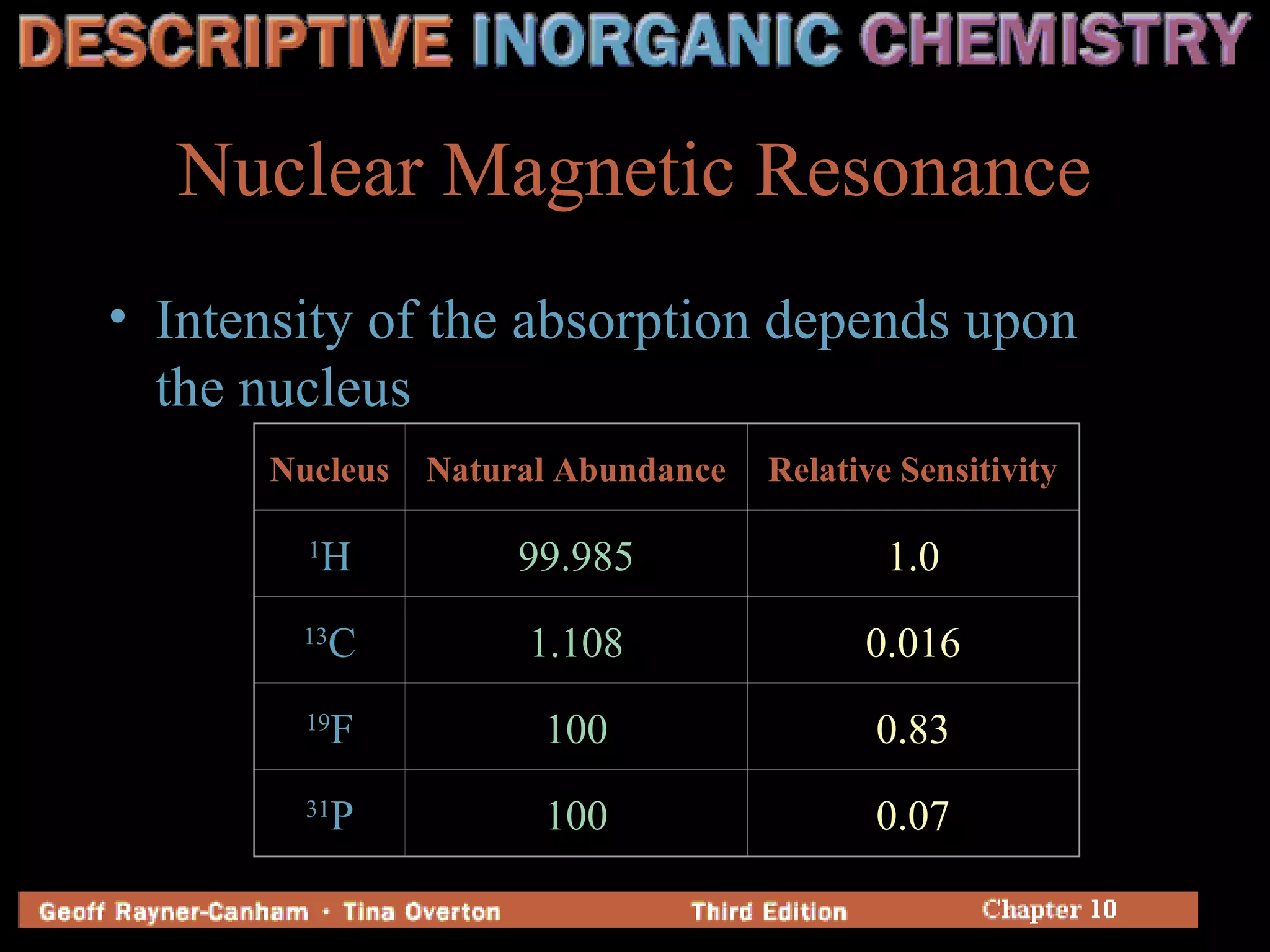
Nuclear Magnetic Resonance
• Intensity of the absorption depends upon
the nucleus
Nucleus Natural Abundance Relative Sensitivity
1
H 99.985 1.0
13
C 1.108 0.016
19
F 100 0.83
31
P 100 0.07
Magnetic Resonance Imaging
• Measures the 1
H nucleus in water
Properties of Hydrogen
• Periodic table placement
– reasons to place the element in both Group
1(alkali metals) and Group 17 (halogens)
Argument for Placement Argument Against
Placement
Alkali Metal Group forms monopositive ions is not a metal
has a single s electron does not react with water
Halogen Group is a nonmetal rarely forms a
mononegative ion
forms a diatomic
molecule
is comparatively
unreactive
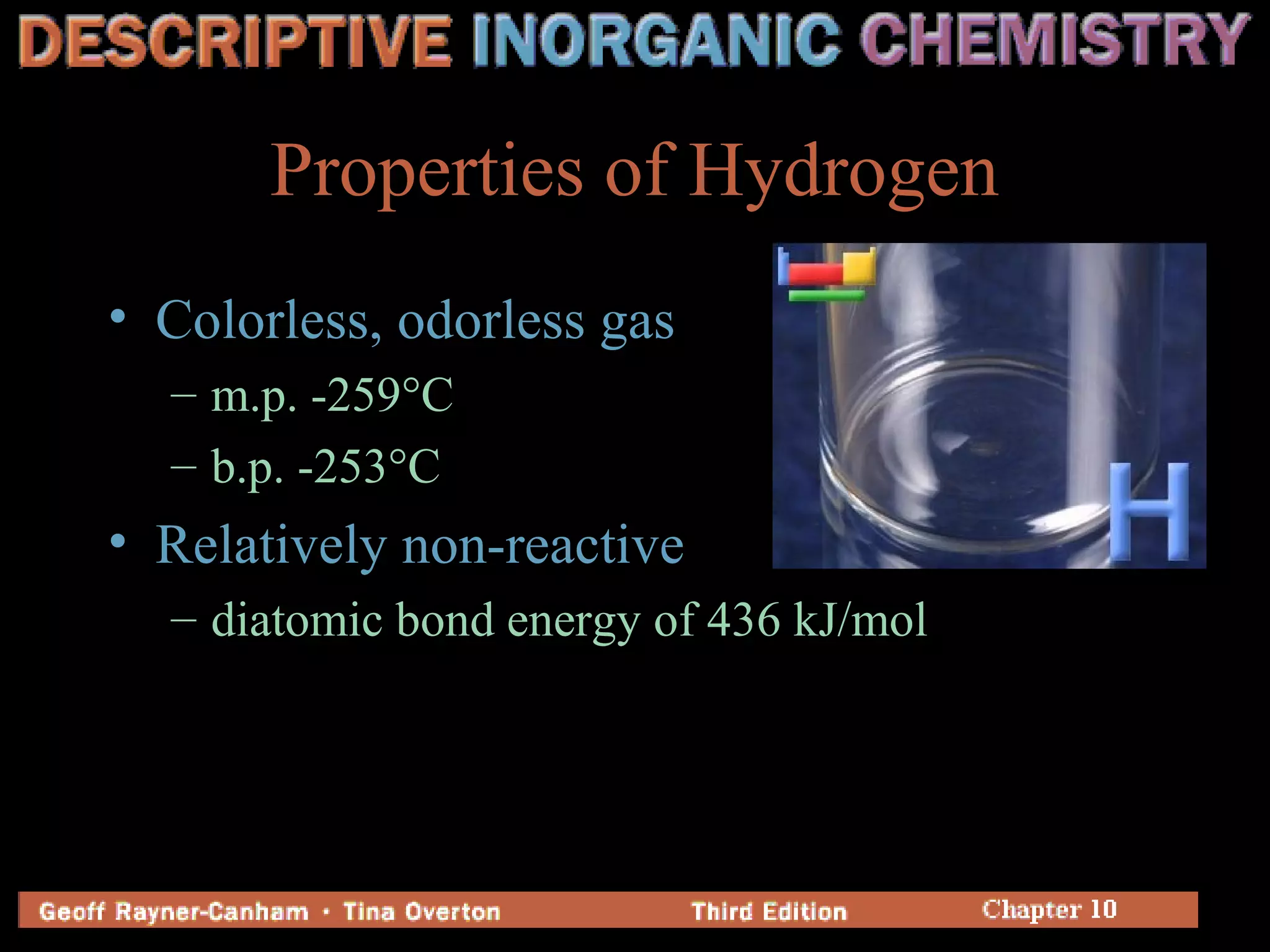
Properties of Hydrogen
• Colorless, odorless gas
– m.p. -259°C
– b.p. -253°C
• Relatively non-reactive
– diatomic bond energy of 436 kJ/mol
Reactions of Hydrogen with
Diatomics
2H2(g) + O2(g) → 2H2O(g) (very fast)
H2(g) + F2(g) → 2HF(g) (very fast)
3H2(g) + N2(g) → 2NH3(g) (very slow)
Reduction Reactions of
Hydrogen
• Acts to reduce many metallic elements
CuO(s) + H2(g) → Cu(s) + H2O(g)
• Can also reduce double and triple bonds
with a catalyst
H2C=CH2(g) + H2(g) → H3C—CH3(g)
Preparation of Dihydrogen
• Reaction of dilute acids on metals
Zn(s) + 2HCl(aq) → ZnCl2(aq) + H2(g)
Preparation of Dihydrogen
• Steam reformer process
CH4(g) + H2O(g) → CO(g) + 3H2(g)
CO(g) + H2O(g) → CO2(g) + H2(g)
K2CO3(aq) + CO2(g) + H2O(l) → 2KHCO3(aq)
Hydrides
• Binary compounds of hydrogen
– has an intermediate electronegativity
• ionic hydrides
– LiH
• covalent hydrides
– HF
• metallic hydrides
– NiH2
Ionic Hydrides
• white solids
• metal cation and hydride ion
• very reactive
LiH(s) + H2O(l) → LiOH(aq) + H2(g)
• reducing agents
CaH2(s) + H2O(l) → Ca(OH)2(s) + H2(g)
Covalent Hydrides
• covalently bonds with all nonmetals and
weakly electropositive metals
• gases at room temperature
– hydrogen can be:
• nearly neutral
• substantially positive
• slightly negative
Neutral Covalent Hydrides
• low polarity
– only dispersion forces
• Examples:
– PH3
– CH4
– Hexene
CH4(g) + 2O2(g) → CO2(g) + 2H2O(g)
Positive Covalent Hydrides
• high melting and boiling points
– protonic bridging
• Examples:
– ammonia
– water
– hydrogen fluoride
Negative Covalent Hydrides
• Contains hydridic hydrogens
• Very reactive towards oxygen
• Examples:
– B2H6
– SiH4
– GeH4
GeH4(g) + 2O2(g) → GeO2(s) + 2H2O(l)
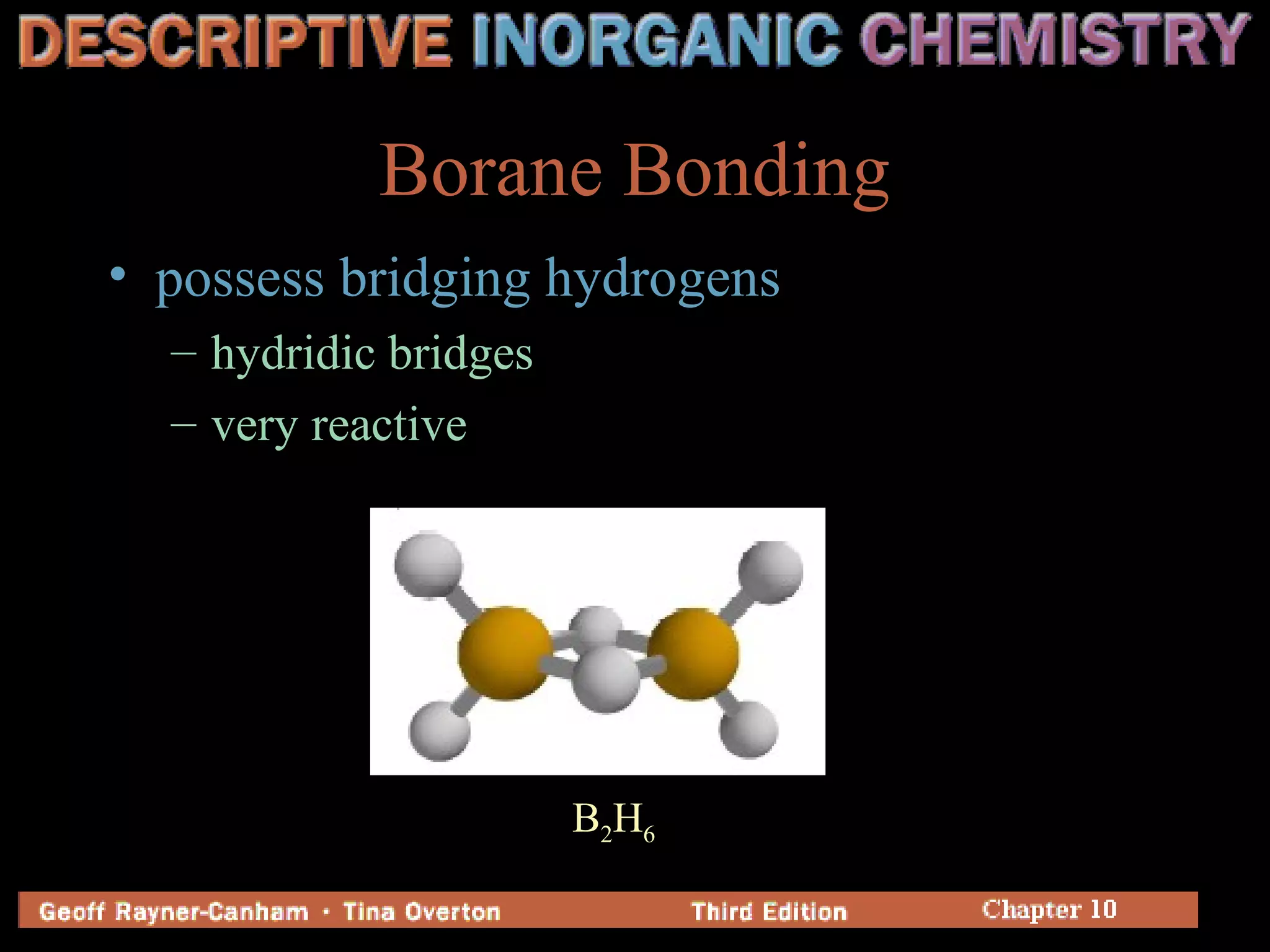
Borane Bonding
• possess bridging hydrogens
– hydridic bridges
– very reactive
B2H6
Borane Bonding
• Three-center, two-electron bond
– banana bonds
Borane Bonding
• MO Picture
+
B1 B2
σ
σ∗
σ
σ∗
σNB
H
Borane Bonding
• Other borane structures
Metallic Hydrides
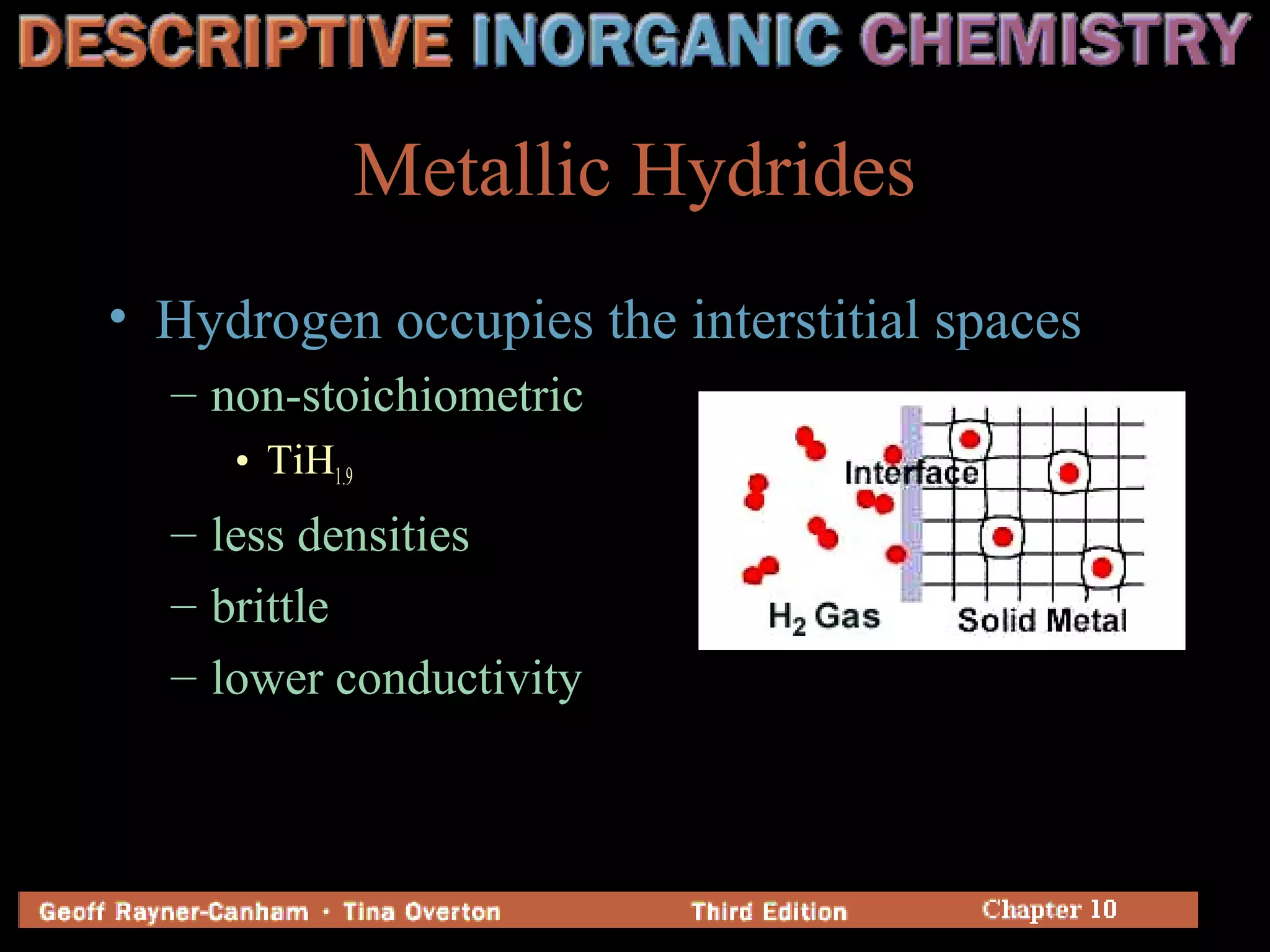
• Hydrogen occupies the interstitial spaces
– non-stoichiometric
• TiH1.9
– less densities
– brittle
– lower conductivity
Synthesis and Reactions of
Metallic Hydrides
Ti(s) + H2(g) + heat/pressure → TiH1.9(s)
TiH1.9(s) + heat → Ti(s) + H2(g)
• applications in hydrogen storage
Uses of Metallic Hydrides
• Batteries
Cathode: Ni(OH)2(s) + OH-
(aq) → NiO(OH)(s) + H2O(l) + e-
Anode: [Ni-alloy](s) + H2O(l) + e-
→ [Ni-alloy]H(s) + OH-
(aq)
Water and Hydrogen Bonding
• Without hydrogen bonding, water would
melt at -100°C and boil at -90°C
• Liquid is denser than the solid
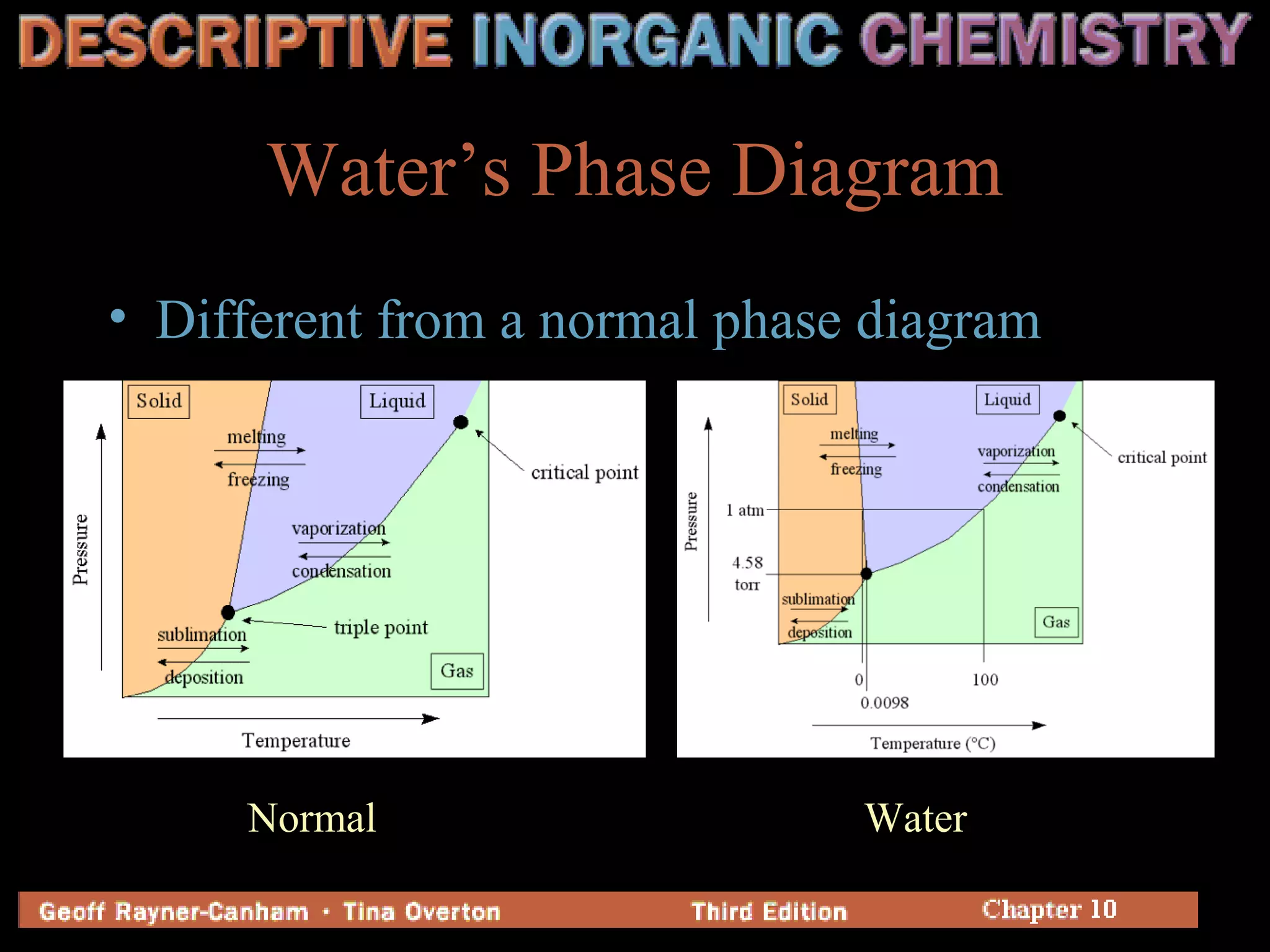
Water’s Phase Diagram
• Different from a normal phase diagram
Normal Water
Electrical Conductivity in Water
• highest for solutions of H3O+
and OH-
Clathrates
• a substance which is trapped in the crystal
lattice of another substance
– from “clathratus”
• enclosed behind bars
• gas hydrates
– methane
– noble gases
Biological Aspects of Hydrogen
Bonding
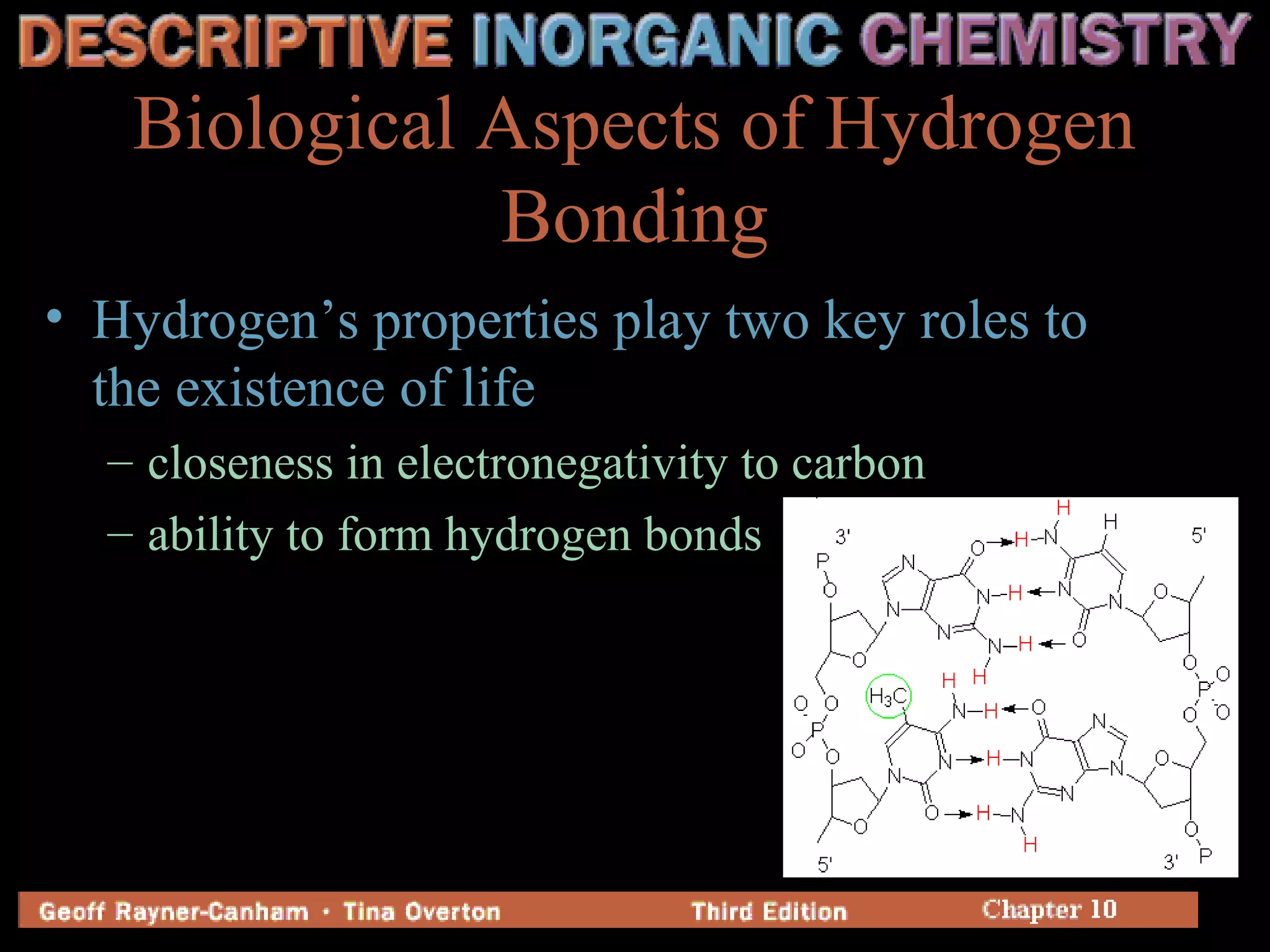
• Hydrogen’s properties play two key roles to
the existence of life
– closeness in electronegativity to carbon
– ability to form hydrogen bonds
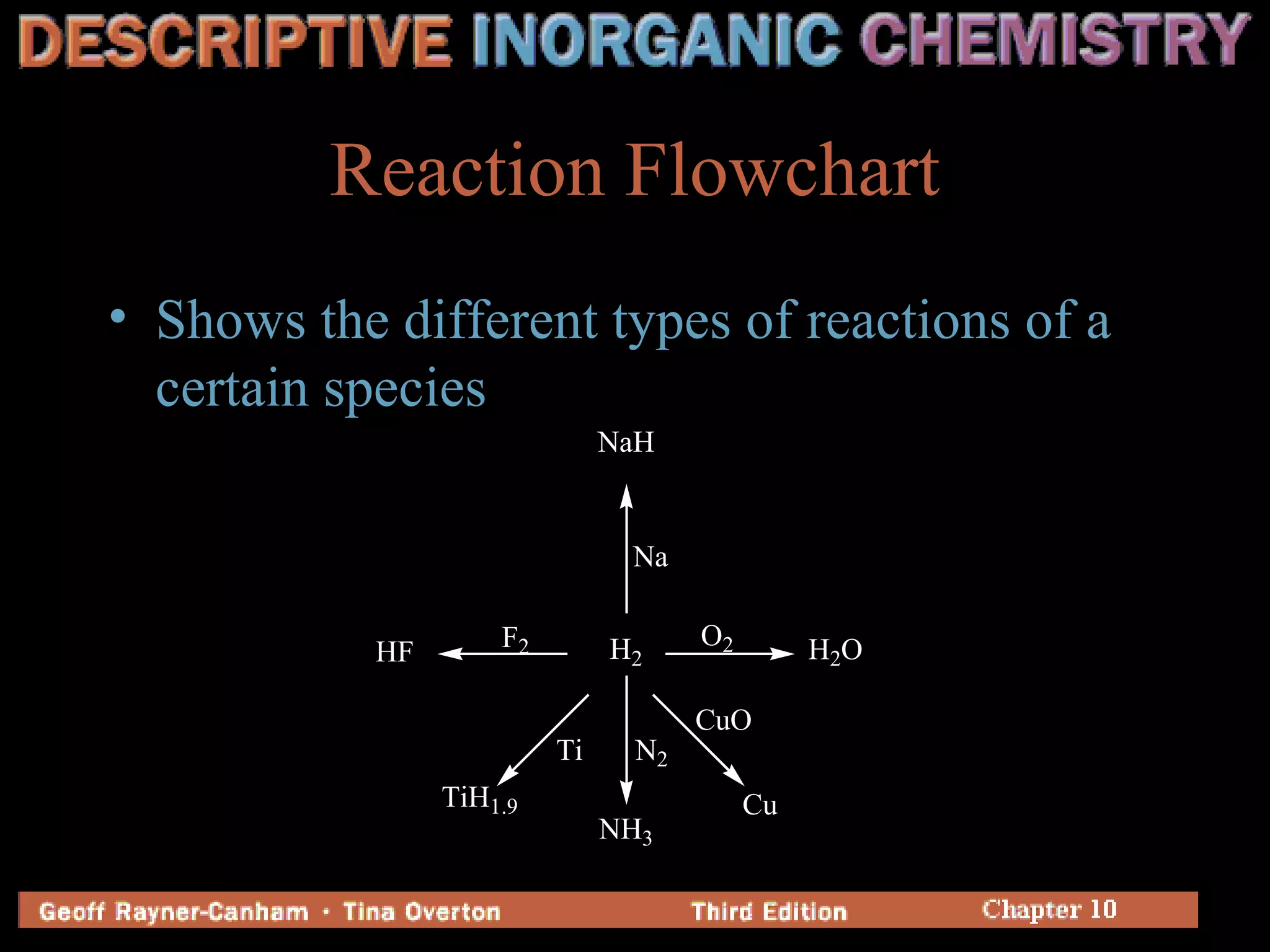
Reaction Flowchart
• Shows the different types of reactions of a
certain species
H2
NaH
NH3
Cu
H2OHF
TiH1.9
O2F2
Na
CuO
N2Ti

Hydrogen ppt

  • 1.
  • 2.
    History • Discovered about200 years ago (1766) Henry Cavendish (1731-1810) Antoine Lavoisier (1743-1794)
  • 3.
    History • In 1931,hydrogen was discovered to have isotopes vs. Harold C. Urey (1893-1981) Nobel Laureate 1934 Frederick Soddy (1877-1956) Nobel Laureate 1921
  • 4.
    Isotopes of Hydrogen •Three common isotopes: – Protium (H) • common hydrogen • 99.985% abundant – Deuterium (D) • one neutron • 0.015% abundant – Tritium (T) • two neutrons • 1x10-15 % abundant
  • 5.
    Physical Properties • Vastlydifferent among the three isotopes
  • 6.
    Stability • All arestable except for tritium – synthesized in the universe and man-made by neutron bombardment – undergoes radioactive β decay
  • 7.
  • 8.
    Nuclear Magnetic Resonance •Peaks depend upon the chemical environment
  • 9.
    Nuclear Magnetic Resonance •Intensity of the absorption depends upon the nucleus Nucleus Natural Abundance Relative Sensitivity 1 H 99.985 1.0 13 C 1.108 0.016 19 F 100 0.83 31 P 100 0.07
  • 10.
    Magnetic Resonance Imaging •Measures the 1 H nucleus in water
  • 11.
    Properties of Hydrogen •Periodic table placement – reasons to place the element in both Group 1(alkali metals) and Group 17 (halogens) Argument for Placement Argument Against Placement Alkali Metal Group forms monopositive ions is not a metal has a single s electron does not react with water Halogen Group is a nonmetal rarely forms a mononegative ion forms a diatomic molecule is comparatively unreactive
  • 12.
    Properties of Hydrogen •Colorless, odorless gas – m.p. -259°C – b.p. -253°C • Relatively non-reactive – diatomic bond energy of 436 kJ/mol
  • 13.
    Reactions of Hydrogenwith Diatomics 2H2(g) + O2(g) → 2H2O(g) (very fast) H2(g) + F2(g) → 2HF(g) (very fast) 3H2(g) + N2(g) → 2NH3(g) (very slow)
  • 14.
    Reduction Reactions of Hydrogen •Acts to reduce many metallic elements CuO(s) + H2(g) → Cu(s) + H2O(g) • Can also reduce double and triple bonds with a catalyst H2C=CH2(g) + H2(g) → H3C—CH3(g)
  • 15.
    Preparation of Dihydrogen •Reaction of dilute acids on metals Zn(s) + 2HCl(aq) → ZnCl2(aq) + H2(g)
  • 16.
    Preparation of Dihydrogen •Steam reformer process CH4(g) + H2O(g) → CO(g) + 3H2(g) CO(g) + H2O(g) → CO2(g) + H2(g) K2CO3(aq) + CO2(g) + H2O(l) → 2KHCO3(aq)
  • 17.
    Hydrides • Binary compoundsof hydrogen – has an intermediate electronegativity • ionic hydrides – LiH • covalent hydrides – HF • metallic hydrides – NiH2
  • 18.
    Ionic Hydrides • whitesolids • metal cation and hydride ion • very reactive LiH(s) + H2O(l) → LiOH(aq) + H2(g) • reducing agents CaH2(s) + H2O(l) → Ca(OH)2(s) + H2(g)
  • 19.
    Covalent Hydrides • covalentlybonds with all nonmetals and weakly electropositive metals • gases at room temperature – hydrogen can be: • nearly neutral • substantially positive • slightly negative
  • 20.
    Neutral Covalent Hydrides •low polarity – only dispersion forces • Examples: – PH3 – CH4 – Hexene CH4(g) + 2O2(g) → CO2(g) + 2H2O(g)
  • 21.
    Positive Covalent Hydrides •high melting and boiling points – protonic bridging • Examples: – ammonia – water – hydrogen fluoride
  • 22.
    Negative Covalent Hydrides •Contains hydridic hydrogens • Very reactive towards oxygen • Examples: – B2H6 – SiH4 – GeH4 GeH4(g) + 2O2(g) → GeO2(s) + 2H2O(l)
  • 23.
    Borane Bonding • possessbridging hydrogens – hydridic bridges – very reactive B2H6
  • 24.
    Borane Bonding • Three-center,two-electron bond – banana bonds
  • 25.
    Borane Bonding • MOPicture + B1 B2 σ σ∗ σ σ∗ σNB H
  • 26.
    Borane Bonding • Otherborane structures
  • 27.
    Metallic Hydrides • Hydrogenoccupies the interstitial spaces – non-stoichiometric • TiH1.9 – less densities – brittle – lower conductivity
  • 28.
    Synthesis and Reactionsof Metallic Hydrides Ti(s) + H2(g) + heat/pressure → TiH1.9(s) TiH1.9(s) + heat → Ti(s) + H2(g) • applications in hydrogen storage
  • 29.
    Uses of MetallicHydrides • Batteries Cathode: Ni(OH)2(s) + OH- (aq) → NiO(OH)(s) + H2O(l) + e- Anode: [Ni-alloy](s) + H2O(l) + e- → [Ni-alloy]H(s) + OH- (aq)
  • 30.
    Water and HydrogenBonding • Without hydrogen bonding, water would melt at -100°C and boil at -90°C • Liquid is denser than the solid
  • 31.
    Water’s Phase Diagram •Different from a normal phase diagram Normal Water
  • 32.
    Electrical Conductivity inWater • highest for solutions of H3O+ and OH-
  • 33.
    Clathrates • a substancewhich is trapped in the crystal lattice of another substance – from “clathratus” • enclosed behind bars • gas hydrates – methane – noble gases
  • 34.
    Biological Aspects ofHydrogen Bonding • Hydrogen’s properties play two key roles to the existence of life – closeness in electronegativity to carbon – ability to form hydrogen bonds
  • 35.
    Reaction Flowchart • Showsthe different types of reactions of a certain species H2 NaH NH3 Cu H2OHF TiH1.9 O2F2 Na CuO N2Ti