Intercalation Compounds
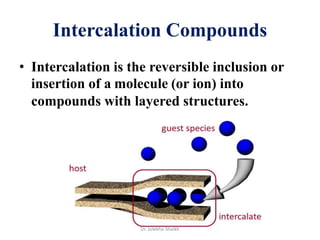
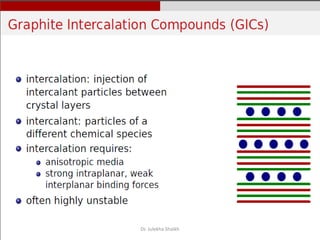
• Intercalation is the reversible inclusion or
insertion of a molecule (or ion) into
compounds with layered structures.
Dr. Julekha Shaikh
Dr. Julekha Shaikh
Dr. Julekha Shaikh
Dr. Julekha Shaikh
Dr. Julekha Shaikh
Dr. Julekha Shaikh
Dr. Julekha Shaikh
Dr. Julekha Shaikh
Dr. Julekha Shaikh
Dr. Julekha Shaikh
Dr. Julekha Shaikh
Dr. Julekha Shaikh
Dr. Julekha Shaikh
Dr. Julekha Shaikh
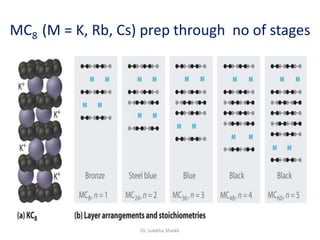
MC8 (M = K, Rb, Cs) prep through no of stages
Dr. Julekha Shaikh
• Intercalation Compounds of oxo acids
• Intercalation compounds of oxo acids are formed by treating graphite with strong
acids in the presence of oxidizing agents. Graphite bisulfate, [C24]+[HSO4]−
lamellar graphite salts
• 48 C + 0.25 O2 + 3 H2SO4 → [C24]+[HSO4]−·2H2SO4 + 0.5 H2O
• Intercalation Compounds of metal halides
• A number of metal halides intercalate into graphite. The chloride derivatives
have been most extensively studied. Examples include MCl2 (M = Zn, Ni, Cu, Mn),
MCl3 (M = Al, Fe, Ga), MCl4 (M = Zr, Pt), etc.
• e.g. [C27]+[AlCl4]−·2AlCl3, [C10]+[FeCl4]−·5FeCl3
• Intercalation Compounds of halogens, oxides and sulphides
• Chlorine and bromine reversibly intercalate into graphite. Iodine does not.
Fluorine reacts irreversibly. In the case of bromine, the following stoichiometries
are known: CnBr for n = 8, 12, 14, 16, 20, and 28.
• Because it forms irreversibly, carbon monofluoride is often not classified as an
intercalation compound. It has the formula (CF)x. It is prepared by reaction of
gaseous fluorine with graphitic carbon at 215–230°C. The color is greyish, white,
or yellow. The bond between the carbon and fluorine atoms is covalent. Carbon
monofluoride is not electrically conductive. It has been studied as
a cathode material in one type of primary (non-rechargeable) lithium batteries.
• A number of oxides and sulphides also intercalate into graphite.
• SO3, N2O5, CrO3, MoO3, V2S3, Cr2S3, PdS, WS2, Sb2S3 etc. Dr. Julekha Shaikh
• Intercalation Compounds of Metal dichalcogenides
• Another well-known family of intercalation hosts are the
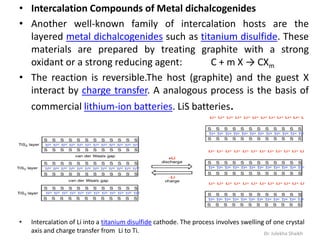
layered metal dichalcogenides such as titanium disulfide. These
materials are prepared by treating graphite with a strong
oxidant or a strong reducing agent: C + m X → CXm
• The reaction is reversible.The host (graphite) and the guest X
interact by charge transfer. A analogous process is the basis of
commercial lithium-ion batteries. LiS batteries.
• Intercalation of Li into a titanium disulfide cathode. The process involves swelling of one crystal
axis and charge transfer from Li to Ti. Dr. Julekha Shaikh
DNA intercalation
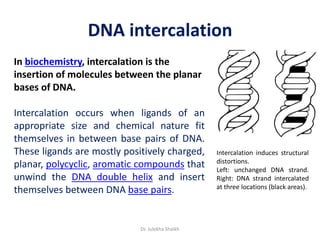
Intercalation induces structural
distortions.
Left: unchanged DNA strand.
Right: DNA strand intercalated
at three locations (black areas).
In biochemistry, intercalation is the
insertion of molecules between the planar
bases of DNA.
Intercalation occurs when ligands of an
appropriate size and chemical nature fit
themselves in between base pairs of DNA.
These ligands are mostly positively charged,
planar, polycyclic, aromatic compounds that
unwind the DNA double helix and insert
themselves between DNA base pairs.
Dr. Julekha Shaikh
Therapeutic applications
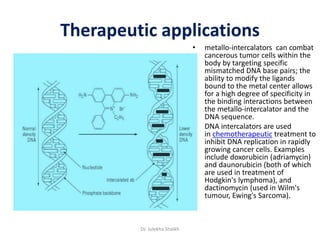
• metallo-intercalators can combat
cancerous tumor cells within the
body by targeting specific
mismatched DNA base pairs; the
ability to modify the ligands
bound to the metal center allows
for a high degree of specificity in
the binding interactions between
the metallo-intercalator and the
DNA sequence.
• DNA intercalators are used
in chemotherapeutic treatment to
inhibit DNA replication in rapidly
growing cancer cells. Examples
include doxorubicin (adriamycin)
and daunorubicin (both of which
are used in treatment of
Hodgkin's lymphoma), and
dactinomycin (used in Wilm's
tumour, Ewing's Sarcoma).
Dr. Julekha Shaikh
Properties and applications
• GICs exhibit diverse electronic and electrical properties.
• improves in-plane transport properties
• can change magnetic properties
• can produce superconductors (CaC6 exhibits the highest
critical temperature Tc = 11.5 K)
• Increases reactivity
• can dope other properties depending on electronic
mobility
intercalation is a powerful means of controlling physical
properties i. e obtain tailor made properties.
Dr. Julekha Shaikh

Intercalation Compounds by Dr. Julekha A. Shaikh

  • 2.
    Intercalation Compounds • Intercalationis the reversible inclusion or insertion of a molecule (or ion) into compounds with layered structures. Dr. Julekha Shaikh
  • 3.
  • 4.
  • 5.
  • 6.
  • 7.
  • 8.
  • 9.
  • 10.
  • 11.
  • 12.
  • 13.
  • 14.
  • 15.
  • 16.
    MC8 (M =K, Rb, Cs) prep through no of stages Dr. Julekha Shaikh
  • 17.
    • Intercalation Compoundsof oxo acids • Intercalation compounds of oxo acids are formed by treating graphite with strong acids in the presence of oxidizing agents. Graphite bisulfate, [C24]+[HSO4]− lamellar graphite salts • 48 C + 0.25 O2 + 3 H2SO4 → [C24]+[HSO4]−·2H2SO4 + 0.5 H2O • Intercalation Compounds of metal halides • A number of metal halides intercalate into graphite. The chloride derivatives have been most extensively studied. Examples include MCl2 (M = Zn, Ni, Cu, Mn), MCl3 (M = Al, Fe, Ga), MCl4 (M = Zr, Pt), etc. • e.g. [C27]+[AlCl4]−·2AlCl3, [C10]+[FeCl4]−·5FeCl3 • Intercalation Compounds of halogens, oxides and sulphides • Chlorine and bromine reversibly intercalate into graphite. Iodine does not. Fluorine reacts irreversibly. In the case of bromine, the following stoichiometries are known: CnBr for n = 8, 12, 14, 16, 20, and 28. • Because it forms irreversibly, carbon monofluoride is often not classified as an intercalation compound. It has the formula (CF)x. It is prepared by reaction of gaseous fluorine with graphitic carbon at 215–230°C. The color is greyish, white, or yellow. The bond between the carbon and fluorine atoms is covalent. Carbon monofluoride is not electrically conductive. It has been studied as a cathode material in one type of primary (non-rechargeable) lithium batteries. • A number of oxides and sulphides also intercalate into graphite. • SO3, N2O5, CrO3, MoO3, V2S3, Cr2S3, PdS, WS2, Sb2S3 etc. Dr. Julekha Shaikh
  • 18.
    • Intercalation Compoundsof Metal dichalcogenides • Another well-known family of intercalation hosts are the layered metal dichalcogenides such as titanium disulfide. These materials are prepared by treating graphite with a strong oxidant or a strong reducing agent: C + m X → CXm • The reaction is reversible.The host (graphite) and the guest X interact by charge transfer. A analogous process is the basis of commercial lithium-ion batteries. LiS batteries. • Intercalation of Li into a titanium disulfide cathode. The process involves swelling of one crystal axis and charge transfer from Li to Ti. Dr. Julekha Shaikh
  • 19.
    DNA intercalation Intercalation inducesstructural distortions. Left: unchanged DNA strand. Right: DNA strand intercalated at three locations (black areas). In biochemistry, intercalation is the insertion of molecules between the planar bases of DNA. Intercalation occurs when ligands of an appropriate size and chemical nature fit themselves in between base pairs of DNA. These ligands are mostly positively charged, planar, polycyclic, aromatic compounds that unwind the DNA double helix and insert themselves between DNA base pairs. Dr. Julekha Shaikh
  • 20.
    Therapeutic applications • metallo-intercalatorscan combat cancerous tumor cells within the body by targeting specific mismatched DNA base pairs; the ability to modify the ligands bound to the metal center allows for a high degree of specificity in the binding interactions between the metallo-intercalator and the DNA sequence. • DNA intercalators are used in chemotherapeutic treatment to inhibit DNA replication in rapidly growing cancer cells. Examples include doxorubicin (adriamycin) and daunorubicin (both of which are used in treatment of Hodgkin's lymphoma), and dactinomycin (used in Wilm's tumour, Ewing's Sarcoma). Dr. Julekha Shaikh
  • 21.
    Properties and applications •GICs exhibit diverse electronic and electrical properties. • improves in-plane transport properties • can change magnetic properties • can produce superconductors (CaC6 exhibits the highest critical temperature Tc = 11.5 K) • Increases reactivity • can dope other properties depending on electronic mobility intercalation is a powerful means of controlling physical properties i. e obtain tailor made properties. Dr. Julekha Shaikh