Dr.G.Rajkumar
Assistant Professor
Department of Chemistry
Vivekananda College
Tiruvedakam West – 625 234
Madurai
E-mail: rajkchem@gmail.com
f-Block Element
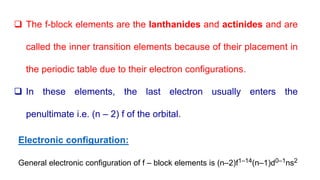
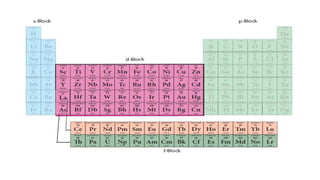
 The f-block elements are the lanthanides and actinides and are
called the inner transition elements because of their placement in
the periodic table due to their electron configurations.
 In these elements, the last electron usually enters the
penultimate i.e. (n – 2) f of the orbital.
Electronic configuration:
General electronic configuration of f – block elements is (n–2)f1–14(n–1)d0–1ns2
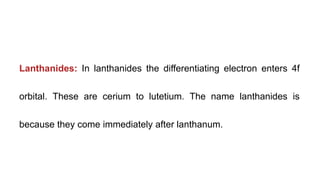
Lanthanides: In lanthanides the differentiating electron enters 4f
orbital. These are cerium to lutetium. The name lanthanides is
because they come immediately after lanthanum.
Electronic configuration:
•Lanthanides: [Xe]4f1–145d0–16s2
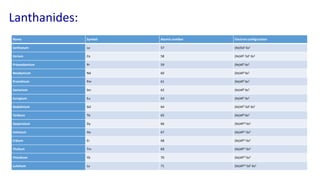
Name Symbol Atomic number Electron configuration
lanthanum La 57 (Xe)5d1 6s2
Cerium Ce 58 (Xe)4f1 5d1 6s2
Praseodymium Pr 59 (Xe)4f3 6s2
Neodymium Nd 60 (Xe)4f4 6s2
Promthium Pm 61 (Xe)4f5 6s2
Samarium Sm 62 (Xe)4f6 6s2
Europium Eu 63 (Xe)4f7 6s2
Gadolinium Gd 64 (Xe)4f7 5d1 6s2
Terbium Tb 65 (Xe)4f9 6s2
Dysprosium Dy 66 (Xe)4f10 6s2
Holmium Ho 67 (Xe)4f11 6s2
Erbium Er 68 (Xe)4f12 6s2
Thulium Tm 69 (Xe)4f13 6s2
Ytterbium Yb 70 (Xe)4f14 6s2
Lutetium Lu 71 (Xe)4f14 5d1 6s2
Lanthanides:
 The common oxidation state of lanthanoids is
+3.
 In addition to that some of the lanthanoids also
show either +2 or +4 oxidation states.
Oxidation state of lanthanoids:
Complex formation
•The lanthanides do not show much tendency to form complexes
due to low charge density because of their size.
•However, the tendency to form complex and their stability
increases with increasing atomic number.
 As we move across 4f series, the atomic and ionic radii
of lanthanoids show gradual decrease with increse in
atomic number.
 This decrease in ionic size is called lanthanoid
contraction.
LANTHANOID CONTRACTION:
 As we move from one element to another in 4f series ( Ce to Lu) the nuclear
charge increases by one unit and an additional electron is added into the
same inner 4f sub shell.
 We know that 4f sub shell have a diffused shapes and therefore the shielding
effect of 4f elelctrons relatively poor.
 Hence, with increase of nuclear charge, the valence shell is pulled slightly
towards nucleus.
 As a result, the effective nuclear charge experienced by the 4f elelctorns
increases and the size of Ln3+ ions decreases.
Causes of lanthanoid contraction
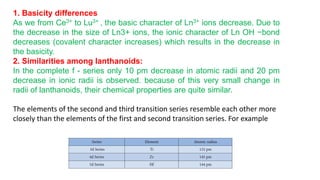
1. Basicity differences
As we from Ce3+ to Lu3+ , the basic character of Ln3+ ions decrease. Due to
the decrease in the size of Ln3+ ions, the ionic character of Ln OH −bond
decreases (covalent character increases) which results in the decrease in
the basicity.
2. Similarities among lanthanoids:
In the complete f - series only 10 pm decrease in atomic radii and 20 pm
decrease in ionic radii is observed. because of this very small change in
radii of lanthanoids, their chemical properties are quite similar.
The elements of the second and third transition series resemble each other more
closely than the elements of the first and second transition series. For example
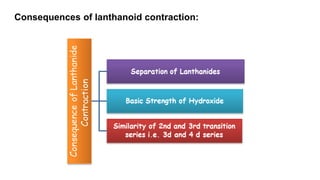
Consequences of lanthanoid contraction:
Similarity of 2nd and 3rd transition series i.e. 3d and 4 d series:
The atomic sizes of second row transition elements and third row transition
elements are almost similar. This is also an effect of lanthanide contraction. As we
move down the from form 4d to 5d series, the size must increase but it remains
almost same due to the fact that the 4f electrons present in the 5d elements show
poor shielding effect.
Consequences of lanthanoid contraction:
•Separation of Lanthanides: Without lanthanide contraction all the
lanthanides would have same size because of which if would have been very
difficult to separate them but due to lanthanide contraction their properties
slightly vary. The variation in the properties is utilized for separating them.
•Basic Strength of Hydroxide: Because of the lanthanide contraction, size of
M3+ ions decreases and there is increase in covalent character in M–OH and
hence basic character decreases.
Consequences of lanthanoid contraction:
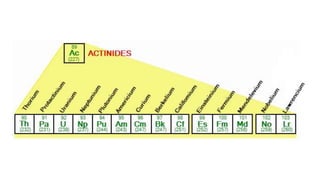
Actinides: In actinides the differentiating electron enters 5f orbitals.
These are thorium to lawrencium. These elements come immediately
after actinium.
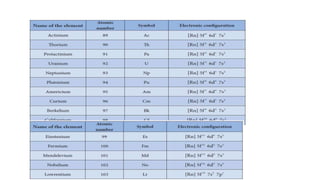
•Actinides: [Rn]5f1–146d0–17s2
Electronic configuration:
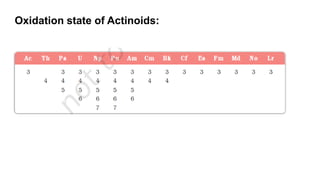
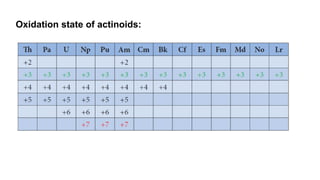
Oxidation state of Actinoids:
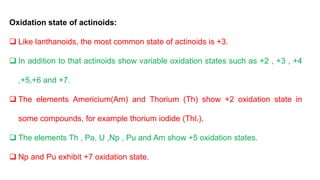
Oxidation state of actinoids:
 Like lanthanoids, the most common state of actinoids is +3.
 In addition to that actinoids show variable oxidation states such as +2 , +3 , +4
,+5,+6 and +7.
 The elements Americium(Am) and Thorium (Th) show +2 oxidation state in
some compounds, for example thorium iodide (ThI2).
 The elements Th , Pa, U ,Np , Pu and Am show +5 oxidation states.
 Np and Pu exhibit +7 oxidation state.
Oxidation state of actinoids:
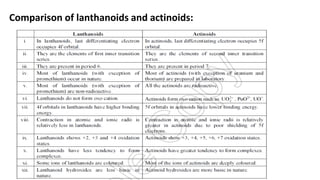
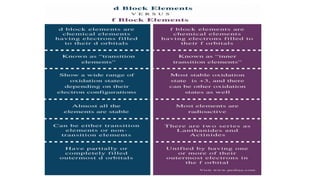
Comparison of lanthanoids and actinoids:
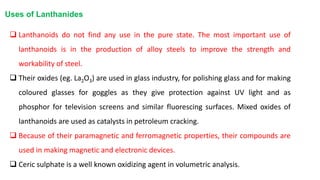
 Lanthanoids do not find any use in the pure state. The most important use of
lanthanoids is in the production of alloy steels to improve the strength and
workability of steel.
 Their oxides (eg. La2O3) are used in glass industry, for polishing glass and for making
coloured glasses for goggles as they give protection against UV light and as
phosphor for television screens and similar fluorescing surfaces. Mixed oxides of
lanthanoids are used as catalysts in petroleum cracking.
 Because of their paramagnetic and ferromagnetic properties, their compounds are
used in making magnetic and electronic devices.
 Ceric sulphate is a well known oxidizing agent in volumetric analysis.
Uses of Lanthanides
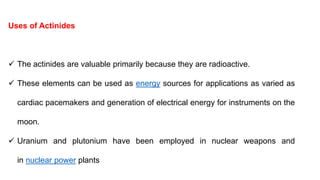
Uses of Actinides
 The actinides are valuable primarily because they are radioactive.
 These elements can be used as energy sources for applications as varied as
cardiac pacemakers and generation of electrical energy for instruments on the
moon.
 Uranium and plutonium have been employed in nuclear weapons and
in nuclear power plants
THANK YOU
Dr.G.Rajkumar
Assistant Professor
Department of Chemistry
Vivekananda College
Tiruvedakam West – 625 234
Madurai
E-mail: rajkchem@gmail.com

f- block elements

  • 1.
    Dr.G.Rajkumar Assistant Professor Department ofChemistry Vivekananda College Tiruvedakam West – 625 234 Madurai E-mail: rajkchem@gmail.com f-Block Element
  • 2.
     The f-blockelements are the lanthanides and actinides and are called the inner transition elements because of their placement in the periodic table due to their electron configurations.  In these elements, the last electron usually enters the penultimate i.e. (n – 2) f of the orbital. Electronic configuration: General electronic configuration of f – block elements is (n–2)f1–14(n–1)d0–1ns2
  • 4.
    Lanthanides: In lanthanidesthe differentiating electron enters 4f orbital. These are cerium to lutetium. The name lanthanides is because they come immediately after lanthanum.
  • 5.
  • 6.
    Name Symbol Atomicnumber Electron configuration lanthanum La 57 (Xe)5d1 6s2 Cerium Ce 58 (Xe)4f1 5d1 6s2 Praseodymium Pr 59 (Xe)4f3 6s2 Neodymium Nd 60 (Xe)4f4 6s2 Promthium Pm 61 (Xe)4f5 6s2 Samarium Sm 62 (Xe)4f6 6s2 Europium Eu 63 (Xe)4f7 6s2 Gadolinium Gd 64 (Xe)4f7 5d1 6s2 Terbium Tb 65 (Xe)4f9 6s2 Dysprosium Dy 66 (Xe)4f10 6s2 Holmium Ho 67 (Xe)4f11 6s2 Erbium Er 68 (Xe)4f12 6s2 Thulium Tm 69 (Xe)4f13 6s2 Ytterbium Yb 70 (Xe)4f14 6s2 Lutetium Lu 71 (Xe)4f14 5d1 6s2 Lanthanides:
  • 7.
     The commonoxidation state of lanthanoids is +3.  In addition to that some of the lanthanoids also show either +2 or +4 oxidation states. Oxidation state of lanthanoids:
  • 8.
    Complex formation •The lanthanidesdo not show much tendency to form complexes due to low charge density because of their size. •However, the tendency to form complex and their stability increases with increasing atomic number.
  • 9.
     As wemove across 4f series, the atomic and ionic radii of lanthanoids show gradual decrease with increse in atomic number.  This decrease in ionic size is called lanthanoid contraction. LANTHANOID CONTRACTION:
  • 10.
     As wemove from one element to another in 4f series ( Ce to Lu) the nuclear charge increases by one unit and an additional electron is added into the same inner 4f sub shell.  We know that 4f sub shell have a diffused shapes and therefore the shielding effect of 4f elelctrons relatively poor.  Hence, with increase of nuclear charge, the valence shell is pulled slightly towards nucleus.  As a result, the effective nuclear charge experienced by the 4f elelctorns increases and the size of Ln3+ ions decreases. Causes of lanthanoid contraction
  • 11.
    1. Basicity differences Aswe from Ce3+ to Lu3+ , the basic character of Ln3+ ions decrease. Due to the decrease in the size of Ln3+ ions, the ionic character of Ln OH −bond decreases (covalent character increases) which results in the decrease in the basicity. 2. Similarities among lanthanoids: In the complete f - series only 10 pm decrease in atomic radii and 20 pm decrease in ionic radii is observed. because of this very small change in radii of lanthanoids, their chemical properties are quite similar. The elements of the second and third transition series resemble each other more closely than the elements of the first and second transition series. For example
  • 12.
  • 13.
    Similarity of 2ndand 3rd transition series i.e. 3d and 4 d series: The atomic sizes of second row transition elements and third row transition elements are almost similar. This is also an effect of lanthanide contraction. As we move down the from form 4d to 5d series, the size must increase but it remains almost same due to the fact that the 4f electrons present in the 5d elements show poor shielding effect. Consequences of lanthanoid contraction:
  • 14.
    •Separation of Lanthanides:Without lanthanide contraction all the lanthanides would have same size because of which if would have been very difficult to separate them but due to lanthanide contraction their properties slightly vary. The variation in the properties is utilized for separating them. •Basic Strength of Hydroxide: Because of the lanthanide contraction, size of M3+ ions decreases and there is increase in covalent character in M–OH and hence basic character decreases. Consequences of lanthanoid contraction:
  • 16.
    Actinides: In actinidesthe differentiating electron enters 5f orbitals. These are thorium to lawrencium. These elements come immediately after actinium. •Actinides: [Rn]5f1–146d0–17s2 Electronic configuration:
  • 18.
  • 19.
    Oxidation state ofactinoids:  Like lanthanoids, the most common state of actinoids is +3.  In addition to that actinoids show variable oxidation states such as +2 , +3 , +4 ,+5,+6 and +7.  The elements Americium(Am) and Thorium (Th) show +2 oxidation state in some compounds, for example thorium iodide (ThI2).  The elements Th , Pa, U ,Np , Pu and Am show +5 oxidation states.  Np and Pu exhibit +7 oxidation state.
  • 20.
  • 21.
  • 22.
     Lanthanoids donot find any use in the pure state. The most important use of lanthanoids is in the production of alloy steels to improve the strength and workability of steel.  Their oxides (eg. La2O3) are used in glass industry, for polishing glass and for making coloured glasses for goggles as they give protection against UV light and as phosphor for television screens and similar fluorescing surfaces. Mixed oxides of lanthanoids are used as catalysts in petroleum cracking.  Because of their paramagnetic and ferromagnetic properties, their compounds are used in making magnetic and electronic devices.  Ceric sulphate is a well known oxidizing agent in volumetric analysis. Uses of Lanthanides
  • 23.
    Uses of Actinides The actinides are valuable primarily because they are radioactive.  These elements can be used as energy sources for applications as varied as cardiac pacemakers and generation of electrical energy for instruments on the moon.  Uranium and plutonium have been employed in nuclear weapons and in nuclear power plants
  • 25.
    THANK YOU Dr.G.Rajkumar Assistant Professor Departmentof Chemistry Vivekananda College Tiruvedakam West – 625 234 Madurai E-mail: rajkchem@gmail.com