By
Dr. G. Balakrishnan
Assistant Professor
Department of Chemistry
Vivekananda College
Madurai, Tamil Nadu
4/20/2020
Nucleic acids
BIOMOLECULES-(II B.Sc)
Subject Code: 07SB4A
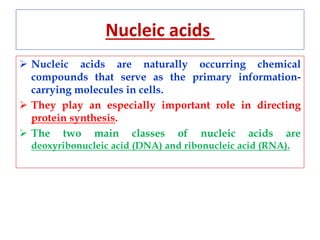
Nucleic acids
 Nucleic acids are naturally occurring chemical
compounds that serve as the primary information-
carrying molecules in cells.
 They play an especially important role in directing
protein synthesis.
 The two main classes of nucleic acids are
deoxyribonucleic acid (DNA) and ribonucleic acid (RNA).
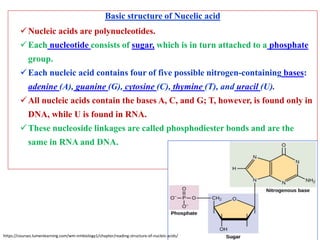
Basic structure of Nucelic acid
Nucleic acids are polynucleotides.
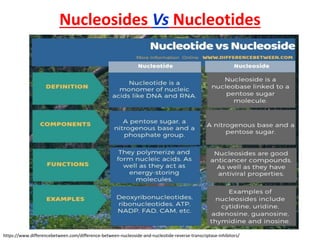
Each nucleotide consists of sugar, which is in turn attached to a phosphate
group.
Each nucleic acid contains four of five possible nitrogen-containing bases:
adenine (A), guanine (G), cytosine (C), thymine (T), and uracil (U).
All nucleic acids contain the bases A, C, and G; T, however, is found only in
DNA, while U is found in RNA.
These nucleoside linkages are called phosphodiester bonds and are the
same in RNA and DNA.
https://courses.lumenlearning.com/wm-nmbiology1/chapter/reading-structure-of-nucleic-acids/
Nucleosides Vs Nucleotides
https://www.differencebetween.com/difference-between-nucleoside-and-nucleotide-reverse-transcriptase-inhibitors/
Double helical structure of DNA
(Watson - Crick Model)
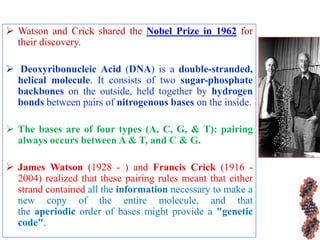
 Watson and Crick shared the Nobel Prize in 1962 for
their discovery.
 Deoxyribonucleic Acid (DNA) is a double-stranded,
helical molecule. It consists of two sugar-phosphate
backbones on the outside, held together by hydrogen
bonds between pairs of nitrogenous bases on the inside.
 The bases are of four types (A, C, G, & T): pairing
always occurs between A & T, and C & G.
 James Watson (1928 - ) and Francis Crick (1916 -
2004) realized that these pairing rules meant that either
strand contained all the information necessary to make a
new copy of the entire molecule, and that
the aperiodic order of bases might provide a "genetic
code".
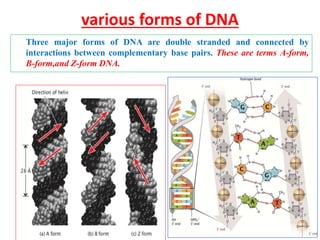
various forms of DNA
Three major forms of DNA are double stranded and connected by
interactions between complementary base pairs. These are terms A-form,
B-form,and Z-form DNA.
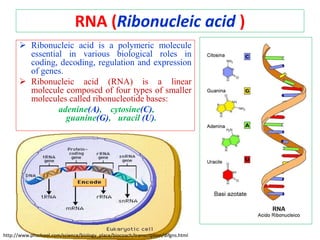
RNA (Ribonucleic acid )
 Ribonucleic acid is a polymeric molecule
essential in various biological roles in
coding, decoding, regulation and expression
of genes.
 Ribonucleic acid (RNA) is a linear
molecule composed of four types of smaller
molecules called ribonucleotide bases:
adenine(A), cytosine(C),
guanine(G), uracil (U).
http://www.phschool.com/science/biology_place/biocoach/transcription/difgns.html
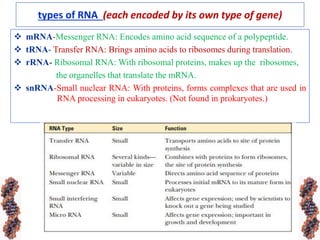
types of RNA (each encoded by its own type of gene)
 mRNA-Messenger RNA: Encodes amino acid sequence of a polypeptide.
 tRNA- Transfer RNA: Brings amino acids to ribosomes during translation.
 rRNA- Ribosomal RNA: With ribosomal proteins, makes up the ribosomes,
the organelles that translate the mRNA.
 snRNA-Small nuclear RNA: With proteins, forms complexes that are used in
RNA processing in eukaryotes. (Not found in prokaryotes.)
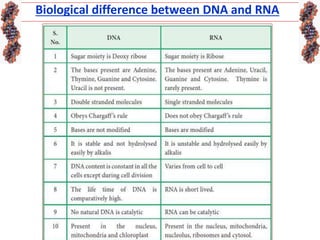
Biological difference between DNA and RNA
Nucleic acids

Nucleic acids

  • 1.
    By Dr. G. Balakrishnan AssistantProfessor Department of Chemistry Vivekananda College Madurai, Tamil Nadu 4/20/2020 Nucleic acids BIOMOLECULES-(II B.Sc) Subject Code: 07SB4A
  • 2.
    Nucleic acids  Nucleicacids are naturally occurring chemical compounds that serve as the primary information- carrying molecules in cells.  They play an especially important role in directing protein synthesis.  The two main classes of nucleic acids are deoxyribonucleic acid (DNA) and ribonucleic acid (RNA).
  • 3.
    Basic structure ofNucelic acid Nucleic acids are polynucleotides. Each nucleotide consists of sugar, which is in turn attached to a phosphate group. Each nucleic acid contains four of five possible nitrogen-containing bases: adenine (A), guanine (G), cytosine (C), thymine (T), and uracil (U). All nucleic acids contain the bases A, C, and G; T, however, is found only in DNA, while U is found in RNA. These nucleoside linkages are called phosphodiester bonds and are the same in RNA and DNA. https://courses.lumenlearning.com/wm-nmbiology1/chapter/reading-structure-of-nucleic-acids/
  • 4.
  • 5.
    Double helical structureof DNA (Watson - Crick Model)
  • 6.
     Watson andCrick shared the Nobel Prize in 1962 for their discovery.  Deoxyribonucleic Acid (DNA) is a double-stranded, helical molecule. It consists of two sugar-phosphate backbones on the outside, held together by hydrogen bonds between pairs of nitrogenous bases on the inside.  The bases are of four types (A, C, G, & T): pairing always occurs between A & T, and C & G.  James Watson (1928 - ) and Francis Crick (1916 - 2004) realized that these pairing rules meant that either strand contained all the information necessary to make a new copy of the entire molecule, and that the aperiodic order of bases might provide a "genetic code".
  • 7.
    various forms ofDNA Three major forms of DNA are double stranded and connected by interactions between complementary base pairs. These are terms A-form, B-form,and Z-form DNA.
  • 8.
    RNA (Ribonucleic acid)  Ribonucleic acid is a polymeric molecule essential in various biological roles in coding, decoding, regulation and expression of genes.  Ribonucleic acid (RNA) is a linear molecule composed of four types of smaller molecules called ribonucleotide bases: adenine(A), cytosine(C), guanine(G), uracil (U). http://www.phschool.com/science/biology_place/biocoach/transcription/difgns.html
  • 9.
    types of RNA(each encoded by its own type of gene)  mRNA-Messenger RNA: Encodes amino acid sequence of a polypeptide.  tRNA- Transfer RNA: Brings amino acids to ribosomes during translation.  rRNA- Ribosomal RNA: With ribosomal proteins, makes up the ribosomes, the organelles that translate the mRNA.  snRNA-Small nuclear RNA: With proteins, forms complexes that are used in RNA processing in eukaryotes. (Not found in prokaryotes.)
  • 10.