
Metagenomics : an overview

Jerome A

(c) JEROME
METAGENOMICS
 Metagenomics: analysis of metagenomes,
sequences from environmental samples
 The "metagenomics"
Handelsman in 1998.

was

first

used

by

 Study of communities of microbial organisms
directly in their natural environments, bypassing
the need for isolation and lab cultivation of
individual species

(c) JEROME
 Identification of microbes in a complex community
by exploiting universal and conserved targets
 Amplifying selected target regions within 16S rRNA
genes for microbial genus and species identification
(Petrosino et al., 2009)
 Microbes are ubiquitous – they are extremely
adaptable to conditions and survive everywhere
 99% microbes
cultivate

(c) JEROME

are

uncultivable/

difficult

to
 Metagenomics bypasses the requirement of
clonal cultures.

 Metagenomics novel tool for studying
uncultivable microbes (Bacteria, Archaea and
viruses).
 Responsible for substantial advances
microbial ecology, evolution, and diversity

(c) JEROME

in
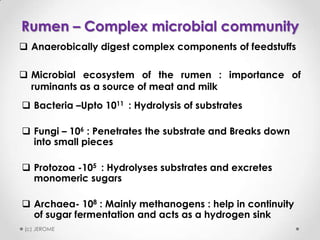
Rumen – Complex microbial community
 Anaerobically digest complex components of feedstuffs
 Microbial ecosystem of the rumen : importance of
ruminants as a source of meat and milk
 Bacteria –Upto 1011 : Hydrolysis of substrates
 Fungi – 106 : Penetrates the substrate and Breaks down
into small pieces
 Protozoa -105 : Hydrolyses substrates and excretes
monomeric sugars
 Archaea- 108 : Mainly methanogens : help in continuity
of sugar fermentation and acts as a hydrogen sink
(c) JEROME
Importance of rumen metagenomics
 Culture-based methods is difficult
 Link analysis of the community structure to ruminal
functions
 To manipulate feeding systems
efficiency of digestion in the rumen.

(c) JEROME

and

improve
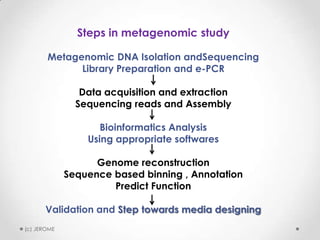
Steps in metagenomic study
Metagenomic DNA Isolation andSequencing
Library Preparation and e-PCR
Data acquisition and extraction
Sequencing reads and Assembly
Bioinformatics Analysis
Using appropriate softwares
Genome reconstruction
Sequence based binning , Annotation
Predict Function
Validation and Step towards media designing
(c) JEROME
Scope of metagenomics
 Milk metagenomics
 Viral metagenomics
 Soil metagenomics
 Sewage/sea metagenomics
 Extraterrestial metagenomics ……

(c) JEROME
Use of NGS in metagenomics
Allow access to largely unexplored microbial
system: Leading to a steep increase in
metagenomics.
Various platforms for NGS
 ABI SOLiD
 Illumina Hiseq/MiSeq
 Roche 454

 Ion Torrent PGM/PROTON
(c) JEROME
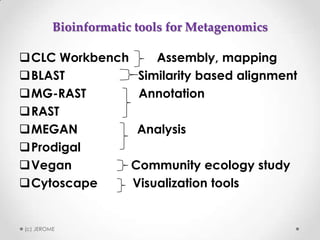
Bioinformatic tools for Metagenomics
CLC Workbench
Assembly, mapping
BLAST
Similarity based alignment
MG-RAST
Annotation
RAST
MEGAN
Analysis
Prodigal
Vegan
Community ecology study
Cytoscape
Visualization tools

(c) JEROME
THANKS

(c) JEROME

Metagenomics: An overview

  • 1.
    Metagenomics : anoverview Jerome A (c) JEROME
  • 2.
    METAGENOMICS  Metagenomics: analysisof metagenomes, sequences from environmental samples  The "metagenomics" Handelsman in 1998. was first used by  Study of communities of microbial organisms directly in their natural environments, bypassing the need for isolation and lab cultivation of individual species (c) JEROME
  • 3.
     Identification ofmicrobes in a complex community by exploiting universal and conserved targets  Amplifying selected target regions within 16S rRNA genes for microbial genus and species identification (Petrosino et al., 2009)  Microbes are ubiquitous – they are extremely adaptable to conditions and survive everywhere  99% microbes cultivate (c) JEROME are uncultivable/ difficult to
  • 4.
     Metagenomics bypassesthe requirement of clonal cultures.  Metagenomics novel tool for studying uncultivable microbes (Bacteria, Archaea and viruses).  Responsible for substantial advances microbial ecology, evolution, and diversity (c) JEROME in
  • 5.
    Rumen – Complexmicrobial community  Anaerobically digest complex components of feedstuffs  Microbial ecosystem of the rumen : importance of ruminants as a source of meat and milk  Bacteria –Upto 1011 : Hydrolysis of substrates  Fungi – 106 : Penetrates the substrate and Breaks down into small pieces  Protozoa -105 : Hydrolyses substrates and excretes monomeric sugars  Archaea- 108 : Mainly methanogens : help in continuity of sugar fermentation and acts as a hydrogen sink (c) JEROME
  • 6.
    Importance of rumenmetagenomics  Culture-based methods is difficult  Link analysis of the community structure to ruminal functions  To manipulate feeding systems efficiency of digestion in the rumen. (c) JEROME and improve
  • 7.
    Steps in metagenomicstudy Metagenomic DNA Isolation andSequencing Library Preparation and e-PCR Data acquisition and extraction Sequencing reads and Assembly Bioinformatics Analysis Using appropriate softwares Genome reconstruction Sequence based binning , Annotation Predict Function Validation and Step towards media designing (c) JEROME
  • 8.
    Scope of metagenomics Milk metagenomics  Viral metagenomics  Soil metagenomics  Sewage/sea metagenomics  Extraterrestial metagenomics …… (c) JEROME
  • 9.
    Use of NGSin metagenomics Allow access to largely unexplored microbial system: Leading to a steep increase in metagenomics. Various platforms for NGS  ABI SOLiD  Illumina Hiseq/MiSeq  Roche 454  Ion Torrent PGM/PROTON (c) JEROME
  • 10.
    Bioinformatic tools forMetagenomics CLC Workbench Assembly, mapping BLAST Similarity based alignment MG-RAST Annotation RAST MEGAN Analysis Prodigal Vegan Community ecology study Cytoscape Visualization tools (c) JEROME
  • 11.

Editor's Notes

  • #6 The absorption of fermentation products, mainly VFA, from the rumen into the blood, and outflow of microbial cells to the abomasum and small intestine provide the animal energy and protein, respectively. The rumen environment, created by interactions between the animal and the microbes, operates as an efficient continuous culture system with optimal physical and chemical conditions for microbial growth and activities, more or less continuous availability of substrate (atleast in grazing cattle), removal of end products (by absorption, eructation or passage), and passage of undigested feed.