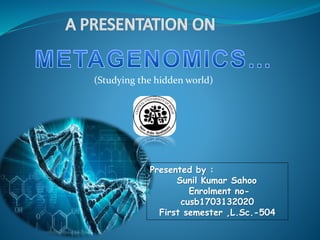
(Studying the hidden world)
Presented by :
Sunil Kumar Sahoo
Enrolment no-
cusb1703132020
First semester ,L.Sc.-504
CONTENTS-
 Introduction
 ‘Traditional Genomics’ Vs ‘Metagenomics’
 Historical Events
 Techniques used in Metagenomics
 Applications of Metagenomics
 Limitations
 Future Directions
INTRODUCTION-
‘Metagenomics’ is the study of metagenomes,
genetic material recovered directly from
environmental samples .
Total gene content of an organism is its genome, so
the total gene content of the organisms inhabiting an
environment is known as its metagenome.
Metagenomics is also referred as Environmental
Genomics, Ecogenomics or Community Genomics.
CONTINUED…
 Total no. of prokaryotic cells on earth is 4-6x1030 .
 Less than 0.1% are culturable .
 Yet to discover the correct culture conditions for culturing the rest 99.9%.
 Metagenomics presently offers a way to access unculturable
microorganism because it is a culture independent way to study them.
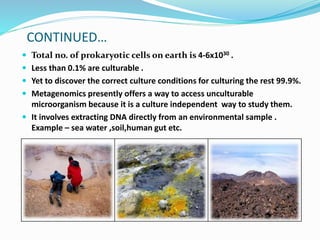
 It involves extracting DNA directly from an environmental sample .
Example – sea water ,soil,human gut etc.
•TRADITIONAL GENOMICS Vs METAGENOMICS
Traditional genomics-
Sequence the genome of one organism at a time
Use cultures to isolate microbe of interest .
Metagenomics-
Extract sequence data from microbial communities as
they exist in nature .
Bypass the need for culture techniques.
-Sequence all DNA in sample .
-Select DNA based on universal sequences.
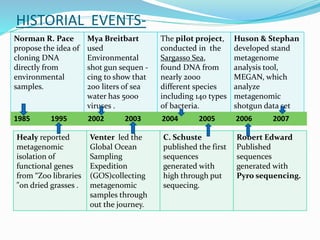
HISTORIAL EVENTS-
Norman R. Pace
propose the idea of
cloning DNA
directly from
environmental
samples.
Mya Breitbart
used
Environmental
shot gun sequen -
cing to show that
200 liters of sea
water has 5000
viruses .
The pilot project,
conducted in the
Sargasso Sea,
found DNA from
nearly 2000
different species
including 140 types
of bacteria.
Huson & Stephan
developed stand
metagenome
analysis tool,
MEGAN, which
analyze
metagenomic
shotgun data set
perform a1985 1995 2002 2003 2004 2005 2006 2007
Healy reported
metagenomic
isolation of
functional genes
from “Zoo libraries
"on dried grasses .
Venter led the
Global Ocean
Sampling
Expedition
(GOS)collecting
metagenomic
samples through
out the journey.
C. Schuste
published the first
sequences
generated with
high through put
sequecing.
Robert Edward
Published
sequences
generated with
Pyro sequencing.
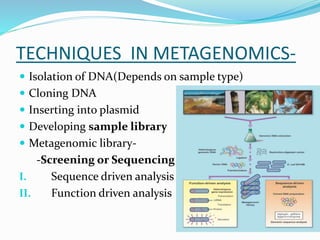
TECHNIQUES IN METAGENOMICS-
 Isolation of DNA(Depends on sample type)
 Cloning DNA
 Inserting into plasmid
 Developing sample library
 Metagenomic library-
-Screening or Sequencing
I. Sequence driven analysis
II. Function driven analysis
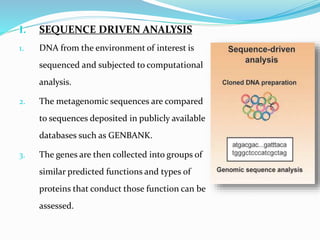
I. SEQUENCE DRIVEN ANALYSIS
1. DNA from the environment of interest is
sequenced and subjected to computational
analysis.
2. The metagenomic sequences are compared
to sequences deposited in publicly available
databases such as GENBANK.
3. The genes are then collected into groups of
similar predicted functions and types of
proteins that conduct those function can be
assessed.
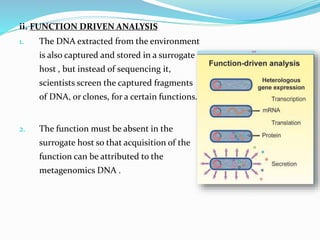
ii. FUNCTION DRIVEN ANALYSIS
1. The DNA extracted from the environment
is also captured and stored in a surrogate
host , but instead of sequencing it,
scientists screen the captured fragments
of DNA, or clones, for a certain functions.
2. The function must be absent in the
surrogate host so that acquisition of the
function can be attributed to the
metagenomics DNA .
LIMITATIONS OF TWO
APPROACHES-
 Sequence driven approach-
If a metagenomic gene dose not look like a gene of known
function deposited in the databases, then little can be
learned about the gene or its product from sequenced
alone .
 Function driven approach-
Most genes from organisms in wild communities can not
be expressed easily by a given surrogate host .
APPLICATIONS OF METAGENOMICS -
METAGENOMICS
Microbial diversity/Unculturable
Microorganisms.
Antibiotics Production.
Novel Enzymes Production By Using
Metagenomic Libraries.
Symbiotic Relationship .
Soil Fertility .
New Metabolites.
Microbial diversity/Unculturable
Microorganisms-
 16 S r-RNA(Phylogenetic Tags)
These studies focused on 16 S r-RNA sequences
 Relatively short
 Often conserved within a species
 Generally different between species
Many 16 S r-RNA sequences have been found which do
not belongs to any known cultured species, indicating
that there are numerous unisolated organism .
Antibiotics Production-
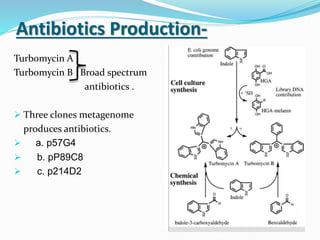
Turbomycin A
Turbomycin B Broad spectrum
antibiotics .
 Three clones metagenome
produces antibiotics.
 a. p57G4
 b. pP89C8
 c. p214D2
Novel Enzymes Production By
Using Metagenomic Libraries
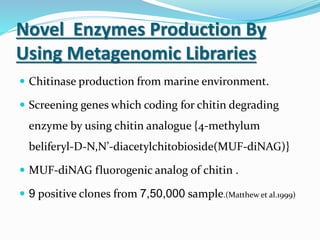
 Chitinase production from marine environment.
 Screening genes which coding for chitin degrading
enzyme by using chitin analogue {4-methylum
beliferyl-D-N,N’-diacetylchitobioside(MUF-diNAG)}
 MUF-diNAG fluorogenic analog of chitin .
 9 positive clones from 7,50,000 sample.(Matthew et al.1999)
Symbiotic Relationship .
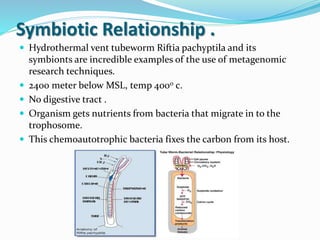
 Hydrothermal vent tubeworm Riftia pachyptila and its
symbionts are incredible examples of the use of metagenomic
research techniques.
 2400 meter below MSL, temp 4000 c.
 No digestive tract .
 Organism gets nutrients from bacteria that migrate in to the
trophosome.
 This chemoautotrophic bacteria fixes the carbon from its host.
Novel gene identification -
A. Novel Nickel resistance genes from the rhizosphere
metagenome of plants adapted to acid mine
drainage.(PMID:19159974)
B. Identification of genes conferring Arsenic resistance
to Escherichia coli from an effluent treatment plant
. (PMID:24801164)
C. Identification and cloning of endoglucanase from
rice straw compost. (PMID:20830571)
LIMITATIONS-
 But metagenomics is a global analysis many data
 We need more precise informations .
 A model organism is welcome .
FUTURE DIRECTIONS-
 To identify new enzymes & antibiotics.
 To access the effect of age ,diet and pathologic states(examples-
Obesity & Cancer etc) on the distal gut microbiome of humans
living in different environments .
 Study of exotic habitats.
 Study antibiotic resistance in soil microbes.
 Discoveries such as phylogenetic tags(r-RNA genes etc) will
give momentum to the growing field.
 Learning novel pathways will lead to knowledge about the
current nonculturable bacteria to then culture these system .
REFERENCES-
 BioMed Central
 https://www.ncbi.nlm.nih.gov>Pubmed
 M.authorstream.com
Metagenomics sk presentation 17.10.2017

Metagenomics sk presentation 17.10.2017

  • 1.
    (Studying the hiddenworld) Presented by : Sunil Kumar Sahoo Enrolment no- cusb1703132020 First semester ,L.Sc.-504
  • 2.
    CONTENTS-  Introduction  ‘TraditionalGenomics’ Vs ‘Metagenomics’  Historical Events  Techniques used in Metagenomics  Applications of Metagenomics  Limitations  Future Directions
  • 3.
    INTRODUCTION- ‘Metagenomics’ is thestudy of metagenomes, genetic material recovered directly from environmental samples . Total gene content of an organism is its genome, so the total gene content of the organisms inhabiting an environment is known as its metagenome. Metagenomics is also referred as Environmental Genomics, Ecogenomics or Community Genomics.
  • 4.
    CONTINUED…  Total no.of prokaryotic cells on earth is 4-6x1030 .  Less than 0.1% are culturable .  Yet to discover the correct culture conditions for culturing the rest 99.9%.  Metagenomics presently offers a way to access unculturable microorganism because it is a culture independent way to study them.  It involves extracting DNA directly from an environmental sample . Example – sea water ,soil,human gut etc.
  • 5.
    •TRADITIONAL GENOMICS VsMETAGENOMICS Traditional genomics- Sequence the genome of one organism at a time Use cultures to isolate microbe of interest . Metagenomics- Extract sequence data from microbial communities as they exist in nature . Bypass the need for culture techniques. -Sequence all DNA in sample . -Select DNA based on universal sequences.
  • 6.
    HISTORIAL EVENTS- Norman R.Pace propose the idea of cloning DNA directly from environmental samples. Mya Breitbart used Environmental shot gun sequen - cing to show that 200 liters of sea water has 5000 viruses . The pilot project, conducted in the Sargasso Sea, found DNA from nearly 2000 different species including 140 types of bacteria. Huson & Stephan developed stand metagenome analysis tool, MEGAN, which analyze metagenomic shotgun data set perform a1985 1995 2002 2003 2004 2005 2006 2007 Healy reported metagenomic isolation of functional genes from “Zoo libraries "on dried grasses . Venter led the Global Ocean Sampling Expedition (GOS)collecting metagenomic samples through out the journey. C. Schuste published the first sequences generated with high through put sequecing. Robert Edward Published sequences generated with Pyro sequencing.
  • 7.
    TECHNIQUES IN METAGENOMICS- Isolation of DNA(Depends on sample type)  Cloning DNA  Inserting into plasmid  Developing sample library  Metagenomic library- -Screening or Sequencing I. Sequence driven analysis II. Function driven analysis
  • 8.
    I. SEQUENCE DRIVENANALYSIS 1. DNA from the environment of interest is sequenced and subjected to computational analysis. 2. The metagenomic sequences are compared to sequences deposited in publicly available databases such as GENBANK. 3. The genes are then collected into groups of similar predicted functions and types of proteins that conduct those function can be assessed.
  • 9.
    ii. FUNCTION DRIVENANALYSIS 1. The DNA extracted from the environment is also captured and stored in a surrogate host , but instead of sequencing it, scientists screen the captured fragments of DNA, or clones, for a certain functions. 2. The function must be absent in the surrogate host so that acquisition of the function can be attributed to the metagenomics DNA .
  • 10.
    LIMITATIONS OF TWO APPROACHES- Sequence driven approach- If a metagenomic gene dose not look like a gene of known function deposited in the databases, then little can be learned about the gene or its product from sequenced alone .  Function driven approach- Most genes from organisms in wild communities can not be expressed easily by a given surrogate host .
  • 11.
    APPLICATIONS OF METAGENOMICS- METAGENOMICS Microbial diversity/Unculturable Microorganisms. Antibiotics Production. Novel Enzymes Production By Using Metagenomic Libraries. Symbiotic Relationship . Soil Fertility . New Metabolites.
  • 12.
    Microbial diversity/Unculturable Microorganisms-  16S r-RNA(Phylogenetic Tags) These studies focused on 16 S r-RNA sequences  Relatively short  Often conserved within a species  Generally different between species Many 16 S r-RNA sequences have been found which do not belongs to any known cultured species, indicating that there are numerous unisolated organism .
  • 13.
    Antibiotics Production- Turbomycin A TurbomycinB Broad spectrum antibiotics .  Three clones metagenome produces antibiotics.  a. p57G4  b. pP89C8  c. p214D2
  • 14.
    Novel Enzymes ProductionBy Using Metagenomic Libraries  Chitinase production from marine environment.  Screening genes which coding for chitin degrading enzyme by using chitin analogue {4-methylum beliferyl-D-N,N’-diacetylchitobioside(MUF-diNAG)}  MUF-diNAG fluorogenic analog of chitin .  9 positive clones from 7,50,000 sample.(Matthew et al.1999)
  • 15.
    Symbiotic Relationship . Hydrothermal vent tubeworm Riftia pachyptila and its symbionts are incredible examples of the use of metagenomic research techniques.  2400 meter below MSL, temp 4000 c.  No digestive tract .  Organism gets nutrients from bacteria that migrate in to the trophosome.  This chemoautotrophic bacteria fixes the carbon from its host.
  • 16.
    Novel gene identification- A. Novel Nickel resistance genes from the rhizosphere metagenome of plants adapted to acid mine drainage.(PMID:19159974) B. Identification of genes conferring Arsenic resistance to Escherichia coli from an effluent treatment plant . (PMID:24801164) C. Identification and cloning of endoglucanase from rice straw compost. (PMID:20830571)
  • 17.
    LIMITATIONS-  But metagenomicsis a global analysis many data  We need more precise informations .  A model organism is welcome .
  • 18.
    FUTURE DIRECTIONS-  Toidentify new enzymes & antibiotics.  To access the effect of age ,diet and pathologic states(examples- Obesity & Cancer etc) on the distal gut microbiome of humans living in different environments .  Study of exotic habitats.  Study antibiotic resistance in soil microbes.  Discoveries such as phylogenetic tags(r-RNA genes etc) will give momentum to the growing field.  Learning novel pathways will lead to knowledge about the current nonculturable bacteria to then culture these system .
  • 19.
    REFERENCES-  BioMed Central https://www.ncbi.nlm.nih.gov>Pubmed  M.authorstream.com