UNCULTURABLE
MICROORGANISMS
HOW DO WE KNOW THAT THERE ARE
UNCULTURABLE MICROORGANISMS
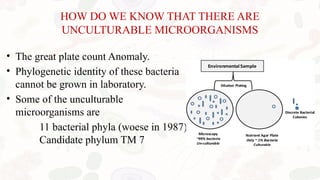
• The great plate count Anomaly.
• Phylogenetic identity of these bacteria
cannot be grown in laboratory.
• Some of the unculturable
microorganisms are
11 bacterial phyla (woese in 1987)
Candidate phylum TM 7
What are unculturable microorganisms?
• Some microbes cannot be grown under artificial medium
condition, they only grow in their natural conditions.
• More than 99% of the species cannot be cultured by traditional
technique.
• Bacteria that cannot be grown on any artificial non living
conditions.
Examples of unculturable bacteria….
1. Mycobacterium leprae
2. Treponema palladium
3. Acidobacteria
4. Verrucomicrobia
5. Proteobacteria
6. Lutibacteria
7. Acidovorax
8. Parvibaculum
9. Cupriavidus
10. Ralstonia
REASONS FOR PROBLEMS IN CULTURING
1. The metabolism of microbe
2. Change in climatic factors
3. Difficulty in mimicking the microbes habitat
4. Absence of signals
5. Absence of interactions
6. Many unknown reasons
Air conditions
• Incubation in the presence of air and hypoxic and anoxic atmosphere was used
to isolate various bacteria that line in different microhabitats in soil
• An elevated concentration of carbondioxide can be added for some bactreia
Temperature
• Because lower temperatures decreases metabolic rate, the productivity of
growth inhibiting materials decreases, inducing more colonies for more isolates
• In particular, if samples are obtained from cold regions, then the incubation
temperatures should be lowered
• Ex: Proteobacteria, Cytophaga,Flavobacteria
How to culture the unculturable microorganisms?
Incubation time
• Increased incubation periods are one of the most important factors when attempting to identify lower
growth and fastidious isolates
Modification to growth media
• The design of media for the growth of different microorganisms is a difficult task and a real challenge
for microbiologists
• This requires in depth insight into the nature and characterization of samples, including all factors
that are directly related to and mediate growth
• Ex: Acidobacteria, Actinobacteria
How to culture the unculturable microorganisms?
pH
• Adjusting the pH to acidic, extreme acidic and alkaline as like the microbes natural habitat
Community culture and co-culture
• Mixed cellular assemblages can perform multistep degradation of cellulose and the intermediates can
be utilized as carbon sources
• Community culture is an effective way to cultivate facultative or syntropic organisms and other
community members
How to culture the unculturable microorganisms?
METAGENOMICS
The study of all genomes of organisms isolated from a bulk
sample.
It is particularly useful for studying communities of
microorganisms in various environments
 It is often used to study a specific microorganisms community
such as those residing on human skin or in soil or water.
History
• The development of molecular techniques such as the use of 16S ribosomal RNA
(rRNA) sequencing allowed the study of microbial communities without the need for
cultivation. This built the foundation for metagenomics. The use of rRNA as molecular
marker was first proposed by Carl Woese in the late 1970s.
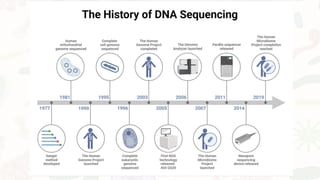
• In 1977, the development of the Sanger sequencing method by Frederick Sanger and
colleagues further helped in the study of microorganisms.
• Jo Handelsman and colleagues coined the term “metagenomics” in 1998 and defined it
as the study of the collective genomes of microorganisms in environmental samples.
History
• The early 2000s saw the development of high-throughput sequencing technologies which allowed the
rapid sequencing of entire microbial communities.
• In the mid-2000s, different specialized databases and bioinformatics tools were developed to manage
the growing volume of metagenomic data. Projects like CAMERA (Community Cyberinfrastructure
for Advanced Microbial Ecology Research and Analysis) and IMG/M (Integrated Microbial
Genomes with Microbiomes) provided platforms for storing and sharing metagenomic data.
• At present, metagenomics continues to advance along with other omics technologies. The field of
metagenomics is rapidly advancing with improvements in sequencing technologies and
bioinformatics tools.
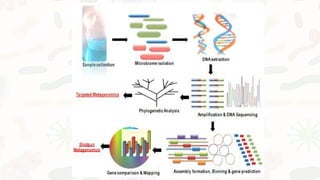
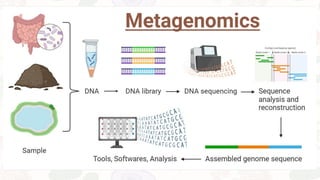
Principle of Metagenomics
 Involves studying the genome of microbial communities in bulk environmental
samples directly without culturing individual species.
 This allows detailed analysis of microbial communities and overcomes the limitations
of traditional laboratory culture methods.
 The process in metagenomics includes collecting environmental samples, extracting
DNA from the microorganisms present in the sample, sequencing using high-
throughput technologies, and analyzing the sequencing data with bioinformatics tools
to identify and characterize the microbial communities in their natural habitats.
Types of Metagenomics
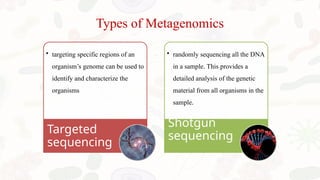
• targeting specific regions of an
organism’s genome can be used to
identify and characterize the
organisms
Targeted
sequencing
• randomly sequencing all the DNA
in a sample. This provides a
detailed analysis of the genetic
material from all organisms in the
sample.
Shotgun
sequencing
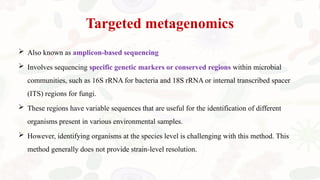
Targeted metagenomics
 Also known as amplicon-based sequencing
 Involves sequencing specific genetic markers or conserved regions within microbial
communities, such as 16S rRNA for bacteria and 18S rRNA or internal transcribed spacer
(ITS) regions for fungi.
 These regions have variable sequences that are useful for the identification of different
organisms present in various environmental samples.
 However, identifying organisms at the species level is challenging with this method. This
method generally does not provide strain-level resolution.
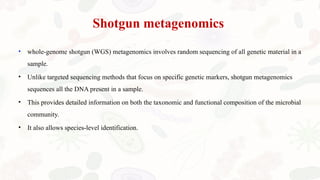
Shotgun metagenomics
• whole-genome shotgun (WGS) metagenomics involves random sequencing of all genetic material in a
sample.
• Unlike targeted sequencing methods that focus on specific genetic markers, shotgun metagenomics
sequences all the DNA present in a sample.
• This provides detailed information on both the taxonomic and functional composition of the microbial
community.
• It also allows species-level identification.
Sample Collection and Processing
• Proper sample collection, preservation, and processing are important to maintain the integrity of the
genetic material and ensure the accuracy of metagenomic analyses.
• The process starts with the collection of environmental or biological samples. Different protocols are
used for different sample types with the same purpose of maximizing DNA yield while maintaining
large DNA fragments.
• Once collected, the samples undergo processing to extract DNA. Different physical and chemical
methods are used for DNA extraction, depending on the sample type and the desired quality and
quantity of DNA.
• The cells are lysed to release the DNA and the cellular debris is removed using centrifugation or
filtration. The DNA is purified using methods like phenol-chloroform extraction and silica column-
based kits. The extracted DNA is then stored at appropriate temperatures.
Construction of Metagenomic Libraries
• After the extraction of microbial DNA, metagenomic libraries are created by cloning and
transforming them into suitable host cells.
• At first, the microbial DNA is cut or digested into specific sizes. These DNA fragments
undergo recombination with a suitable cloning vector. Some common vectors used for
cloning include plasmids, cosmids, bacterial artificial chromosomes (BAC), and phage.
• The recombinant DNA or vector is then transformed into suitable host cells. Escherichia
coli is the most commonly used host as it is easy to culture.
Screening of Metagenome Library
• Metagenomic libraries are screened to identify and isolate specific genes. Some of the screening methods include functional
screening, sequence analysis, substrate-induced gene expression screening (SIGEX), DNA microarray, and fluorescence in situ
hybridization (FISH).
• Functional screening identifies clones that express active products of genes based on visible changes or growth under
selective media. This method is fast and simple. However, it has a low success rate and requires the appropriate hosts.
• Sequence-based screening uses PCR and gene hybridization to find target genes. This method does not depend on host cell
expression and is effective for conserved sequence genes. However, it is limited to known sequences and cannot detect unknown
genes.
• SIGEX identifies genes in a metagenomic library that become active in the presence of specific substrates. It can be used to
derive the functions of unknown genes using the substrate.
DNA Sequencing
• The next step in the workflow is DNA sequencing. Sequencing technology has evolved from Sanger
sequencing to next-generation sequencing (NGS) methods.
• NGS technologies like 454/Roche and Illumina/Solexa have become widely used in metagenomics
due to their cost-effectiveness and high throughput.
• Other emerging sequencing technologies include Applied Biosystems SOLiD, Ion Torrent,
Pacific Biosciences (PacBio), and Complete Genomics
Sequence Assembly
• Assembling metagenomic data involves reconstructing genomes from short sequencing reads. This
process involves piecing together short DNA read fragments generated during sequencing to
construct longer genomic contigs. Longer sequences provide more information and better accuracy.
• There are two methods for metagenomic assembly: reference-based and de novo assembly.
• Reference-based assembly uses reference genomes and is suitable when the metagenomic dataset
contains sequences with close matches to reference genomes.
• De novo assembly constructs contigs without relying on reference genomes. It requires more
computational resources compared to reference-based assembly and may take longer to run.
Binning
• Binning is the process of grouping or sorting assembled DNA sequences into groups or bins that represent individual genomes
from closely related organisms in a microbial community.
• Various algorithms have been developed for binning that use different types of information contained within DNA sequences.
• Compositional-based binning algorithms use the conserved nucleotide composition of genomes. They analyze sequence fragments
for patterns in nucleotide composition such as GC content to group them into bins.
• Similarity-based binning algorithms rely on the similarity of DNA fragments to known genes in reference databases. These
algorithms compare query sequences to sequences in reference databases and assign them to taxonomic groups based on the similarity
scores.
• Some binning algorithms combine both compositional and similarity-based methods. They combine information on nucleotide
composition with sequence similarity to improve binning accuracy.
Annotation
• The genes within the assembled sequences are identified and annotated to predict their
functions using bioinformatics tools and databases.
• Annotation involves two main steps: feature prediction and functional annotation.
• Feature prediction identifies genes or other genomic elements within the DNA sequences.
It also identifies non-coding RNA, regulatory sequences, binding sites, structural motifs, and
other biologically relevant elements.
• Functional annotation identifies functions of the predicted genes. Metagenomic annotation
relies on homology searches against reference databases.
Experimental Design and Statistical Analysis
• Experimental design and statistical analysis are important in metagenomic studies to ensure valid and
interpretable results.
• Effective statistical methods interpret the vast amounts of metagenomic data generated and handle the
complexity of the data.
• Various statistical tools are used to analyze metagenomic data. The Primer-E package and web-based
tools like Metastats allow multivariate statistical analyses.
Data Storage and Sharing
• The vast amount of metagenomic data requires effective data storage and sharing.
Metagenomic data can be stored in standardized formats in repositories, such as the National
Center for Biotechnology Information (NCBI) Sequence Read Archive (SRA).
• Metagenomics involves more complex and voluminous datasets. Storing this vast amount of
sequence data in existing sequence databases is a significant challenge. Effective use of this
data requires specialized secondary databases.
• To facilitate this, different projects like IMG/M, CAMERA, and MG-RAST have been
developed. These platforms allow the sharing of both raw data and computational results.
Importance of Metagenomics
• The traditional pure culture method in microbiology isolates individual species and studies their responses to
specific chemicals in controlled environments. This method limits our understanding of microbial behavior
within complex communities.
• Metagenomics addresses these limitations of traditional microbiology by allowing the study of microbial
communities directly in their natural habitats. This provides information about the ecological roles and
interactions of microbes in these communities.
• Metagenomics allows the study of genetic material from entire microbial communities without the need
for culturing individual species.
• Metagenomics provides information about the composition, function, and interactions within microbial
communities
Applications of Metagenomics
• Metagenomics is used in the study of the human microbiome. This includes research on gut microbiota, skin microbiota, and their roles in
health and disease.
• Metagenomics can be used to identify pathogens in clinical samples which helps to diagnose and treat infectious diseases.
• Metagenomics helps in understanding the microbial diversity and functions in soil.
• Metagenomics can be used to monitor water quality and detect pollution by studying microbial communities in water samples.
• Metagenomics can also be used in bioremediation efforts by identifying microorganisms that are capable of degrading pollutants.
• Understanding the microbial communities associated with plants can improve crop health and productivity.
• Metagenomics helps to identify microorganisms that are capable of energy production which is useful for the production of biofuels and
other renewable energy sources.
• Metagenomics is also useful in discovering new enzymes, bioactive compounds, antibiotics, pharmaceuticals, and other beneficial
microbial products.
Limitations of Metagenomics
• Cloning biases can lead to the misrepresentation of microbial DNA in metagenomic libraries.
• Sampling biases can occur when collecting environmental samples which can also lead to misrepresentation of
the microbial community.
• Metagenomic sequencing can detect the presence of microorganisms but cannot easily determine if they are
pathogenic.
• The vast amount of metagenomic data requires faster and more scalable computational tools to handle the
data efficiently.
• Metagenomic datasets contain a mix of DNA from various organisms which often makes it difficult to
assemble genomes accurately.
• Contamination from host DNA or environmental sources can affect the accuracy of metagenomic analyses.
• It is also challenging to extract genes from microorganisms present in low abundance within a sample.
Recent advances in growing uncultivable microorganisms
• Coculture with other bacteria
• Recreating the environment in laboratory
• Combining both the techniques with microcultivation
technology
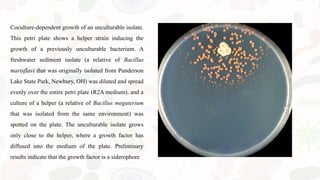
Coculture-dependent growth of an unculturable isolate.
This petri plate shows a helper strain inducing the
growth of a previously unculturable bacterium. A
freshwater sediment isolate (a relative of Bacillus
marisflavi that was originally isolated from Punderson
Lake State Park, Newbury, OH) was diluted and spread
evenly over the entire petri plate (R2A medium), and a
culture of a helper (a relative of Bacillus megaterium
that was isolated from the same environment) was
spotted on the plate. The unculturable isolate grows
only close to the helper, where a growth factor has
diffused into the medium of the plate. Preliminary
results indicate that the growth factor is a siderophore
IMPORTANCE
• Nutrient cycling and carbon cycling
• Disease management
• Secondary metabolites of microbes.
• Synthesizing novel natural products.
• Impacting the surrounding organisms and environment.
• Natural products released from them can be used (pharmacheuticals)
CHALLENGES IN CULTURING MICROORGANISMS
• Genetic complexion
• Specific environmental conditions
• Nutritional requirements
• Competition and Cooperation
• Lack of suitable growth media
• Fast growing organisms
• Cellular interactions
CONCLUSION
• Advance approaches like metagenomics are revealing interactions
between plant and their microbial partner.
• There are more than 99% of the microorganisms are uncultivable and
still there are many research is ongoing for their cultivation.
• Culturing of those microorganisms can be beneficial for mankind.
Thank you