Metagenomics: DNA extraction, library construction, and analysis – Tools and databases for microbial diversity assessment (QIIME, MG-RAST)
1.
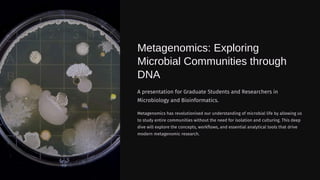
Metagenomics: Exploring
Microbial Communitiesthrough
DNA
A presentation for Graduate Students and Researchers in
Microbiology and Bioinformatics.
Metagenomics has revolutionised our understanding of microbial life by allowing us
to study entire communities without the need for isolation and culturing. This deep
dive will explore the concepts, workflows, and essential analytical tools that drive
modern metagenomic research.
2.
Chapter 1: Introductionto
Metagenomics
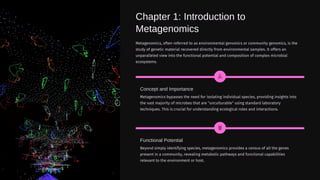
Metagenomics, often referred to as environmental genomics or community genomics, is the
study of genetic material recovered directly from environmental samples. It offers an
unparalleled view into the functional potential and composition of complex microbial
ecosystems.
Concept and Importance
Metagenomics bypasses the need for isolating individual species, providing insights into
the vast majority of microbes that are "unculturable" using standard laboratory
techniques. This is crucial for understanding ecological roles and interactions.
Functional Potential
Beyond simply identifying species, metagenomics provides a census of all the genes
present in a community, revealing metabolic pathways and functional capabilities
relevant to the environment or host.
3.
Two Core Approaches:Shotgun vs. Amplicon Metagenomics
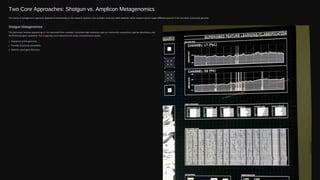
The choice of metagenomic approach depends fundamentally on the research question and available resources. Both methods utilise sequencing but target different aspects of the microbial community genome.
Shotgun Metagenomics
This technique involves sequencing all DNA extracted from a sample. It provides high-resolution data on community composition, species abundance, and
the functional gene repertoire. This is typically more expensive but yields comprehensive results.
Sequences entire genomes.
Provides functional annotation.
Ideal for novel gene discovery.
4.
Chapter 2: TheMetagenomic Study Workflow
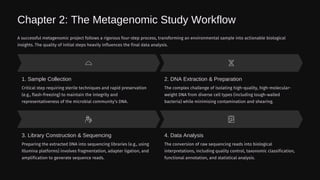
A successful metagenomic project follows a rigorous four-step process, transforming an environmental sample into actionable biological
insights. The quality of initial steps heavily influences the final data analysis.
1. Sample Collection
Critical step requiring sterile techniques and rapid preservation
(e.g., flash-freezing) to maintain the integrity and
representativeness of the microbial community’s DNA.
2. DNA Extraction & Preparation
The complex challenge of isolating high-quality, high-molecular-
weight DNA from diverse cell types (including tough-walled
bacteria) while minimising contamination and shearing.
3. Library Construction & Sequencing
Preparing the extracted DNA into sequencing libraries (e.g., using
Illumina platforms) involves fragmentation, adapter ligation, and
amplification to generate sequence reads.
4. Data Analysis
The conversion of raw sequencing reads into biological
interpretations, including quality control, taxonomic classification,
functional annotation, and statistical analysis.
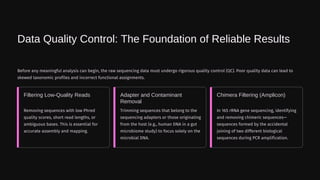
5.
Data Quality Control:The Foundation of Reliable Results
Before any meaningful analysis can begin, the raw sequencing data must undergo rigorous quality control (QC). Poor quality data can lead to
skewed taxonomic profiles and incorrect functional assignments.
Filtering Low-Quality Reads
Removing sequences with low Phred
quality scores, short read lengths, or
ambiguous bases. This is essential for
accurate assembly and mapping.
Adapter and Contaminant
Removal
Trimming sequences that belong to the
sequencing adapters or those originating
from the host (e.g., human DNA in a gut
microbiome study) to focus solely on the
microbial DNA.
Chimera Filtering (Amplicon)
In 16S rRNA gene sequencing, identifying
and removing chimeric sequences—
sequences formed by the accidental
joining of two different biological
sequences during PCR amplification.
6.
Chapter 3: EssentialAnalysis Tools and Databases
The vast quantity of metagenomic data necessitates the use of specialised, high-throughput bioinformatics tools and curated reference databases for accurate interpretation.
7.
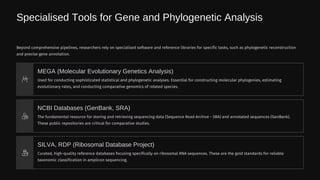
Specialised Tools forGene and Phylogenetic Analysis
Beyond comprehensive pipelines, researchers rely on specialised software and reference libraries for specific tasks, such as phylogenetic reconstruction
and precise gene annotation.
MEGA (Molecular Evolutionary Genetics Analysis)
Used for conducting sophisticated statistical and phylogenetic analyses. Essential for constructing molecular phylogenies, estimating
evolutionary rates, and conducting comparative genomics of related species.
NCBI Databases (GenBank, SRA)
The fundamental resource for storing and retrieving sequencing data (Sequence Read Archive - SRA) and annotated sequences (GenBank).
These public repositories are critical for comparative studies.
SILVA, RDP (Ribosomal Database Project)
Curated, high-quality reference databases focusing specifically on ribosomal RNA sequences. These are the gold standards for reliable
taxonomic classification in amplicon sequencing.
8.
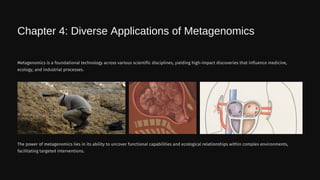
Chapter 4: DiverseApplications of Metagenomics
Metagenomics is a foundational technology across various scientific disciplines, yielding high-impact discoveries that influence medicine,
ecology, and industrial processes.
The power of metagenomics lies in its ability to uncover functional capabilities and ecological relationships within complex environments,
facilitating targeted interventions.
9.
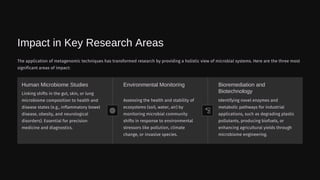
Impact in KeyResearch Areas
The application of metagenomic techniques has transformed research by providing a holistic view of microbial systems. Here are the three most
significant areas of impact:
Human Microbiome Studies
Linking shifts in the gut, skin, or lung
microbiome composition to health and
disease states (e.g., inflammatory bowel
disease, obesity, and neurological
disorders). Essential for precision
medicine and diagnostics.
Environmental Monitoring
Assessing the health and stability of
ecosystems (soil, water, air) by
monitoring microbial community
shifts in response to environmental
stressors like pollution, climate
change, or invasive species.
Bioremediation and
Biotechnology
Identifying novel enzymes and
metabolic pathways for industrial
applications, such as degrading plastic
pollutants, producing biofuels, or
enhancing agricultural yields through
microbiome engineering.
10.
Conclusion: The Futureis Microbial
Metagenomics continues to drive innovation at the intersection of biology and data science. The future of the field
promises:
Increased use of long-read sequencing technologies to generate full-length genomes from complex samples.
Integration of metatranscriptomics and metaproteomics to link community structure directly to ongoing functions.
Further development of AI and machine learning algorithms to handle petabytes of environmental sequencing data and predict ecological
outcomes.
"The environment is a vast, untapped genomic resource. Metagenomics provides the lens to discover its secrets."
Thank you. Your commitment to exploring these complex microbial ecosystems through advanced data analysis is paramount to the
advancement of life sciences.