

MODULE 8
RADIATION
• The radiative mode of heat transfer is
  characterized by energy transported in the form
  of electromagnetic waves. The waves travel at the
  speed of light.
• Both the wave theory and the particle theory are
  useful in helping to explain the behavior of
  thermal radiation. The wave theory states that
  radiation can be imagined to be a wave oscillating
  with a frequency ϑand a wavelength(λ). The
  product of the frequency and wavelength is the
  velocity of propagation, which is the velocity of
  light, c.
        c= λϑ
• The particle theory assumes that radiant energy is
  transported as packets of energy called photons. Each
  photons travels with the speed of light with a distinct
  energy level given by
 e=hϑ
Where h is Planck’s constant.
• There are ways other than heating a surface that can
  cause photons to be emitters from the body .at the
  short-wavelength end of spectrum, for example, are
  the x-rays, which can be produced by subjecting a
  piece of metal to a stream of electrons. On the other
  end of the spectrum are the radio waves, with long
  wavelengths, that can be produced by electronic
  equipments and crystals. The entire range of all
  wavelengths is called the electromagnetic spectrum.
• Thermal radiation that is emitted from a surface
  due solely to its temperature exists between
  wavelengths of 10-7 and 10-4m .
• The human eye is able to detect electromagnetic
  waves between wavelengths of approximately 3.8
  x 10-7 m and 7.6 x 10⁻⁷ m, and radiation between
  these wavelengths is called visible radiation.
• 1Å=1 angstrom=10-10m = 10-8 cm = 10-4 μm.
• 1 μm = 1 micrometer= 1 micron = 10-6 m= 10-4 cm
  = 104 Å
RADIATION PROPERTIES
• Radiative properties are those properties
  which quantitatively describe how radiant
  energy interacts with the surface of the
  material.
• In general, the radiative properties are
  functions of wavelength. For example, a
  surface may be good reflector in the visible
  wavelength range and a poor reflector in the
  infrared range.
TOTAL RADIATION PROPERTIES
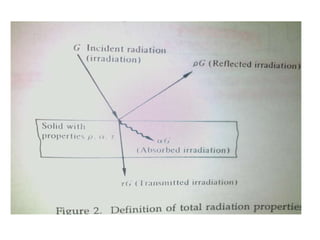
• The total incident energy is referred to as the total
  irradiation and is given the symbol G. when the
  irradiation strikes a surface, a portion of energy is
  absorbed within the material, a portion is reflected
  from the surface, and the remainder is transmitted
  through the body. Three of the radiative properties –
  the absorptivity, reflectivity, and the transmittivity
  describe how the incident energy is distributed into
  these three categories.
• The absorptivity, α, of the surface is the fraction of
  incident energy absorbed by the body . The
  reflectivity, ρ of the surface is defined as the fraction
  of incident energy reflected from the surface. The
  transmissivity,τ,of the body is the fraction of energy
  that is transmitted through the body
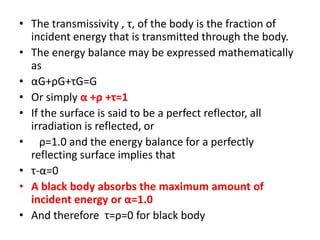
• The transmissivity , τ, of the body is the fraction of
  incident energy that is transmitted through the body.
• The energy balance may be expressed mathematically
  as
• αG+ρG+τG=G
• Or simply α +ρ +τ=1
• If the surface is said to be a perfect reflector, all
  irradiation is reflected, or
• ρ=1.0 and the energy balance for a perfectly
  reflecting surface implies that
• τ-α=0
• A black body absorbs the maximum amount of
  incident energy or α=1.0
• And therefore τ=ρ=0 for black body
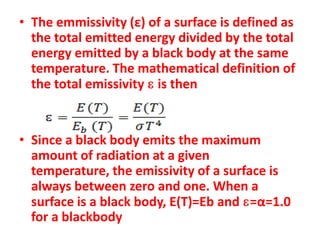
• The emmissivity (ε) of a surface is defined as
  the total emitted energy divided by the total
  energy emitted by a black body at the same
  temperature. The mathematical definition of
  the total emissivity ɛ is then


• Since a black body emits the maximum
  amount of radiation at a given
  temperature, the emissivity of a surface is
  always between zero and one. When a
  surface is a black body, E(T)=Eb and ɛ=α=1.0
  for a blackbody
PHYSICS OF RADIATION
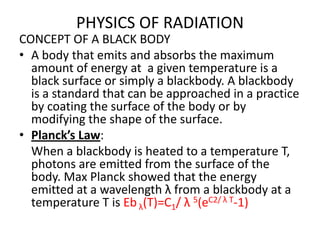
CONCEPT OF A BLACK BODY
• A body that emits and absorbs the maximum
  amount of energy at a given temperature is a
  black surface or simply a blackbody. A blackbody
  is a standard that can be approached in a practice
  by coating the surface of the body or by
  modifying the shape of the surface.
• Planck’s Law:
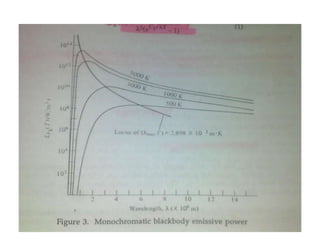
  When a blackbody is heated to a temperature T,
  photons are emitted from the surface of the
  body. Max Planck showed that the energy
  emitted at a wavelength λ from a blackbody at a
  temperature T is Eb λ(T)=C1/ λ 5(eC2/ λ T-1)
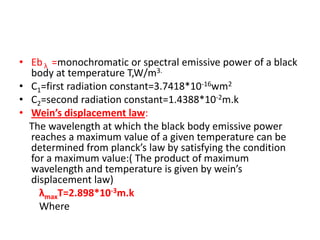
• Eb λ =monochromatic or spectral emissive power of a black
  body at temperature T,W/m3.
• C1=first radiation constant=3.7418*10-16wm2
• C2=second radiation constant=1.4388*10-2m.k
• Wein’s displacement law:
  The wavelength at which the black body emissive power
  reaches a maximum value of a given temperature can be
  determined from planck’s law by satisfying the condition
  for a maximum value:( The product of maximum
  wavelength and temperature is given by wein’s
  displacement law)
    λmaxT=2.898*10-3m.k
    Where
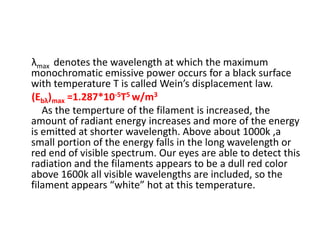
λmax denotes the wavelength at which the maximum
monochromatic emissive power occurs for a black surface
with temperature T is called Wein’s displacement law.
(Ebλ)max =1.287*10-5T5 w/m3
   As the temperture of the filament is increased, the
amount of radiant energy increases and more of the energy
is emitted at shorter wavelength. Above about 1000k ,a
small portion of the energy falls in the long wavelength or
red end of visible spectrum. Our eyes are able to detect this
radiation and the filaments appears to be a dull red color
above 1600k all visible wavelengths are included, so the
filament appears “white” hot at this temperature.
An example of an energy source that is at a high
  temperature is the sun.The outer surface of the sun has
  a temperature of approximately 5800k.According to
  Wein’s law the value of λmax at this temperautre is
  5.2*10-7m which lies in the range of visible wavelength.
Stefan boltzmann-law:
      The total amount of radiative energy per unit area
  leaving a surface with absolute temperature T overall
  wavelength is called the total emissive power.Eb(T)=σT4
  which is known as stefan boltzmann law.the symbol σ
  is stefan boltzmann constant σ=5.67*10-8 w/m2k4
Non black surfaces: A simple example is a small body that is
  non black surrounded by a black surface. Let the area of the
enclosed and surrounding surfaces be A1 and A2 respectively
     and let their temperature beT1 and T2,respectively.the
 radiation from surface A2 falling on surface A1 is Σa2f21t24.of
  this the fraction α1,the absorptivity of area A1for radiation
  from surface A2,is absorbed by surface A1.The remainder is
    reflected back to the black surrounding and completely
      reabsorbed by area A2.Surface A1 emits radiation in
   amountA1ε1T14.Where ε1 is the emissivity of surface A1.All
    this radiation is absorbed by the surface A2,and none is
returned by another reflection. The net energy loss by surface
                              A1 is
                     q12=σε1A1T14- σA2F21α1T24
But A2F21=A1
 q12=σA1(ε1T14- α1T24 )
If surface A1 is gray, ε1= α1 and
q12=σA1ε1 (T14- T24 )
In general for gray surfaces,
q12=σA1F12 (T14- T24 )= σA2F21 (T14- T24 )
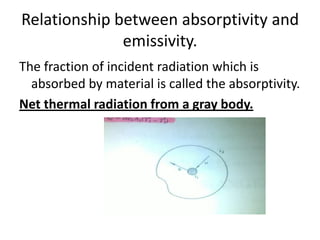
Relationship between absorptivity and
              emissivity.
The fraction of incident radiation which is
  absorbed by material is called the absorptivity.
Net thermal radiation from a gray body.
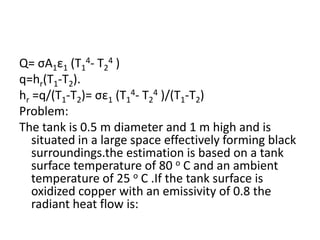
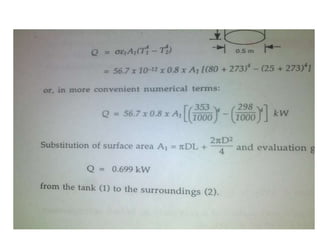
Q= σA1ε1 (T14- T24 )
q=hr(T1-T2).
hr =q/(T1-T2)= σε1 (T14- T24 )/(T1-T2)
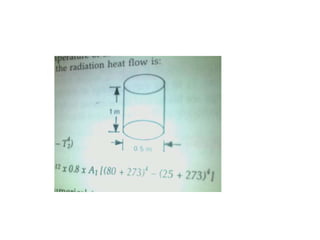
Problem:
The tank is 0.5 m diameter and 1 m high and is
   situated in a large space effectively forming black
   surroundings.the estimation is based on a tank
   surface temperature of 80 o C and an ambient
   temperature of 25 o C .If the tank surface is
   oxidized copper with an emissivity of 0.8 the
   radiant heat flow is:
MET 214 Module 8
MET 214 Module 8

MET 214 Module 8

  • 1.
  • 2.
    RADIATION • The radiativemode of heat transfer is characterized by energy transported in the form of electromagnetic waves. The waves travel at the speed of light. • Both the wave theory and the particle theory are useful in helping to explain the behavior of thermal radiation. The wave theory states that radiation can be imagined to be a wave oscillating with a frequency ϑand a wavelength(λ). The product of the frequency and wavelength is the velocity of propagation, which is the velocity of light, c. c= λϑ
  • 3.
    • The particletheory assumes that radiant energy is transported as packets of energy called photons. Each photons travels with the speed of light with a distinct energy level given by e=hϑ Where h is Planck’s constant. • There are ways other than heating a surface that can cause photons to be emitters from the body .at the short-wavelength end of spectrum, for example, are the x-rays, which can be produced by subjecting a piece of metal to a stream of electrons. On the other end of the spectrum are the radio waves, with long wavelengths, that can be produced by electronic equipments and crystals. The entire range of all wavelengths is called the electromagnetic spectrum.
  • 4.
    • Thermal radiationthat is emitted from a surface due solely to its temperature exists between wavelengths of 10-7 and 10-4m . • The human eye is able to detect electromagnetic waves between wavelengths of approximately 3.8 x 10⁻⁷ m and 7.6 x 10⁻⁷ m, and radiation between these wavelengths is called visible radiation. • 1Å=1 angstrom=10-10m = 10-8 cm = 10-4 μm. • 1 μm = 1 micrometer= 1 micron = 10-6 m= 10-4 cm = 104 Å
  • 5.
    RADIATION PROPERTIES • Radiativeproperties are those properties which quantitatively describe how radiant energy interacts with the surface of the material. • In general, the radiative properties are functions of wavelength. For example, a surface may be good reflector in the visible wavelength range and a poor reflector in the infrared range.
  • 6.
    TOTAL RADIATION PROPERTIES •The total incident energy is referred to as the total irradiation and is given the symbol G. when the irradiation strikes a surface, a portion of energy is absorbed within the material, a portion is reflected from the surface, and the remainder is transmitted through the body. Three of the radiative properties – the absorptivity, reflectivity, and the transmittivity describe how the incident energy is distributed into these three categories. • The absorptivity, α, of the surface is the fraction of incident energy absorbed by the body . The reflectivity, ρ of the surface is defined as the fraction of incident energy reflected from the surface. The transmissivity,τ,of the body is the fraction of energy that is transmitted through the body
  • 8.
    • The transmissivity, τ, of the body is the fraction of incident energy that is transmitted through the body. • The energy balance may be expressed mathematically as • αG+ρG+τG=G • Or simply α +ρ +τ=1 • If the surface is said to be a perfect reflector, all irradiation is reflected, or • ρ=1.0 and the energy balance for a perfectly reflecting surface implies that • τ-α=0 • A black body absorbs the maximum amount of incident energy or α=1.0 • And therefore τ=ρ=0 for black body
  • 9.
    • The emmissivity(ε) of a surface is defined as the total emitted energy divided by the total energy emitted by a black body at the same temperature. The mathematical definition of the total emissivity ɛ is then • Since a black body emits the maximum amount of radiation at a given temperature, the emissivity of a surface is always between zero and one. When a surface is a black body, E(T)=Eb and ɛ=α=1.0 for a blackbody
  • 10.
    PHYSICS OF RADIATION CONCEPTOF A BLACK BODY • A body that emits and absorbs the maximum amount of energy at a given temperature is a black surface or simply a blackbody. A blackbody is a standard that can be approached in a practice by coating the surface of the body or by modifying the shape of the surface. • Planck’s Law: When a blackbody is heated to a temperature T, photons are emitted from the surface of the body. Max Planck showed that the energy emitted at a wavelength λ from a blackbody at a temperature T is Eb λ(T)=C1/ λ 5(eC2/ λ T-1)
  • 12.
    • Eb λ=monochromatic or spectral emissive power of a black body at temperature T,W/m3. • C1=first radiation constant=3.7418*10-16wm2 • C2=second radiation constant=1.4388*10-2m.k • Wein’s displacement law: The wavelength at which the black body emissive power reaches a maximum value of a given temperature can be determined from planck’s law by satisfying the condition for a maximum value:( The product of maximum wavelength and temperature is given by wein’s displacement law) λmaxT=2.898*10-3m.k Where
  • 13.
    λmax denotes thewavelength at which the maximum monochromatic emissive power occurs for a black surface with temperature T is called Wein’s displacement law. (Ebλ)max =1.287*10-5T5 w/m3 As the temperture of the filament is increased, the amount of radiant energy increases and more of the energy is emitted at shorter wavelength. Above about 1000k ,a small portion of the energy falls in the long wavelength or red end of visible spectrum. Our eyes are able to detect this radiation and the filaments appears to be a dull red color above 1600k all visible wavelengths are included, so the filament appears “white” hot at this temperature.
  • 14.
    An example ofan energy source that is at a high temperature is the sun.The outer surface of the sun has a temperature of approximately 5800k.According to Wein’s law the value of λmax at this temperautre is 5.2*10-7m which lies in the range of visible wavelength. Stefan boltzmann-law: The total amount of radiative energy per unit area leaving a surface with absolute temperature T overall wavelength is called the total emissive power.Eb(T)=σT4 which is known as stefan boltzmann law.the symbol σ is stefan boltzmann constant σ=5.67*10-8 w/m2k4
  • 15.
    Non black surfaces:A simple example is a small body that is non black surrounded by a black surface. Let the area of the enclosed and surrounding surfaces be A1 and A2 respectively and let their temperature beT1 and T2,respectively.the radiation from surface A2 falling on surface A1 is Σa2f21t24.of this the fraction α1,the absorptivity of area A1for radiation from surface A2,is absorbed by surface A1.The remainder is reflected back to the black surrounding and completely reabsorbed by area A2.Surface A1 emits radiation in amountA1ε1T14.Where ε1 is the emissivity of surface A1.All this radiation is absorbed by the surface A2,and none is returned by another reflection. The net energy loss by surface A1 is q12=σε1A1T14- σA2F21α1T24
  • 16.
    But A2F21=A1 q12=σA1(ε1T14-α1T24 ) If surface A1 is gray, ε1= α1 and q12=σA1ε1 (T14- T24 ) In general for gray surfaces, q12=σA1F12 (T14- T24 )= σA2F21 (T14- T24 )
  • 17.
    Relationship between absorptivityand emissivity. The fraction of incident radiation which is absorbed by material is called the absorptivity. Net thermal radiation from a gray body.
  • 18.
    Q= σA1ε1 (T14-T24 ) q=hr(T1-T2). hr =q/(T1-T2)= σε1 (T14- T24 )/(T1-T2) Problem: The tank is 0.5 m diameter and 1 m high and is situated in a large space effectively forming black surroundings.the estimation is based on a tank surface temperature of 80 o C and an ambient temperature of 25 o C .If the tank surface is oxidized copper with an emissivity of 0.8 the radiant heat flow is: