PRESSURE
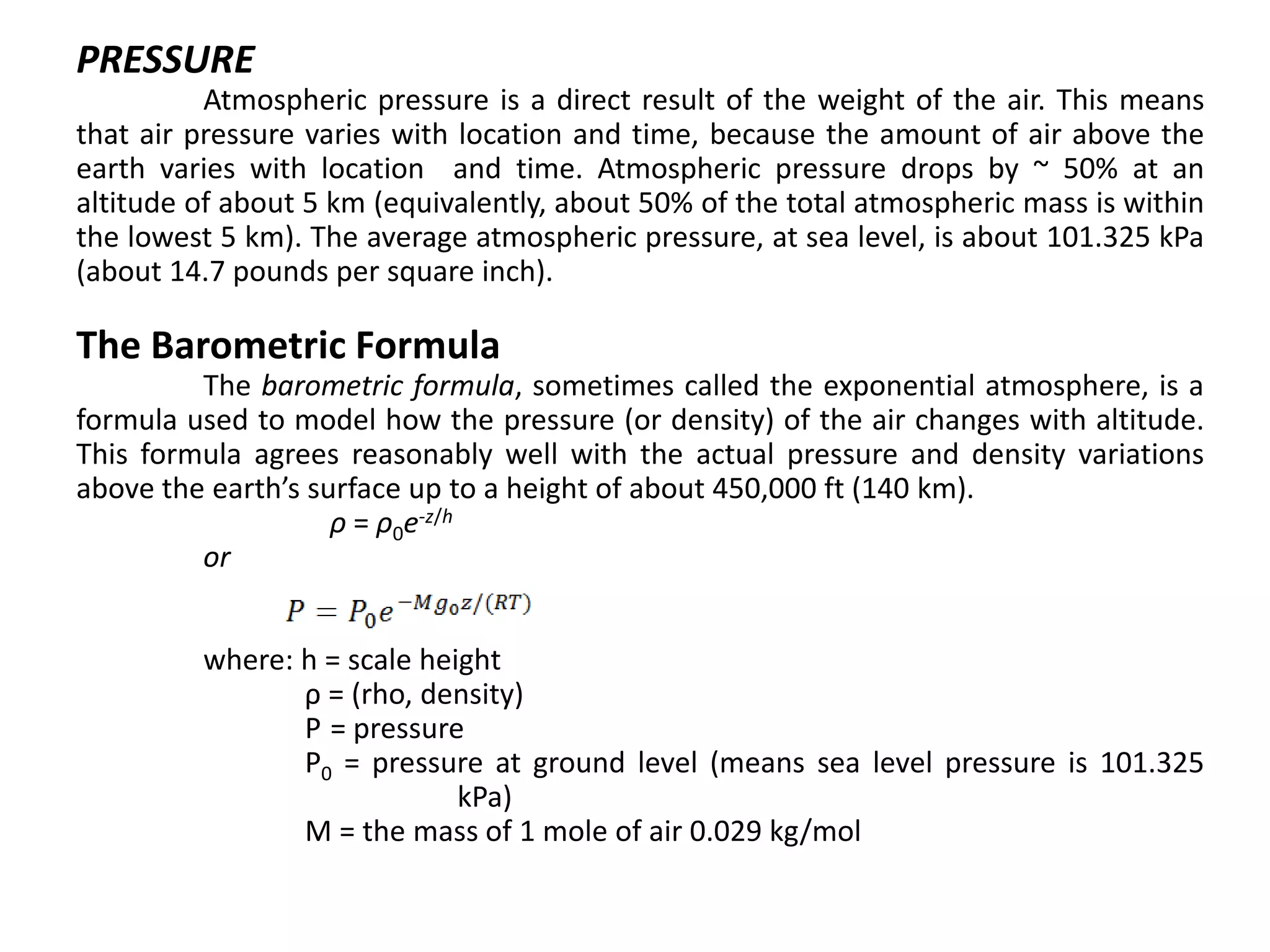
          Atmospheric pressure is a direct result of the weight of the air. This means
that air pressure varies with location and time, because the amount of air above the
earth varies with location and time. Atmospheric pressure drops by ~ 50% at an
altitude of about 5 km (equivalently, about 50% of the total atmospheric mass is within
the lowest 5 km). The average atmospheric pressure, at sea level, is about 101.325 kPa
(about 14.7 pounds per square inch).

The Barometric Formula
         The barometric formula, sometimes called the exponential atmosphere, is a
formula used to model how the pressure (or density) of the air changes with altitude.
This formula agrees reasonably well with the actual pressure and density variations
above the earth’s surface up to a height of about 450,000 ft (140 km).
                    ρ = ρ0e-z/h
         or


         where: h = scale height
                ρ = (rho, density)
                P = pressure
                P0 = pressure at ground level (means sea level pressure is 101.325
                             kPa)
                M = the mass of 1 mole of air 0.029 kg/mol
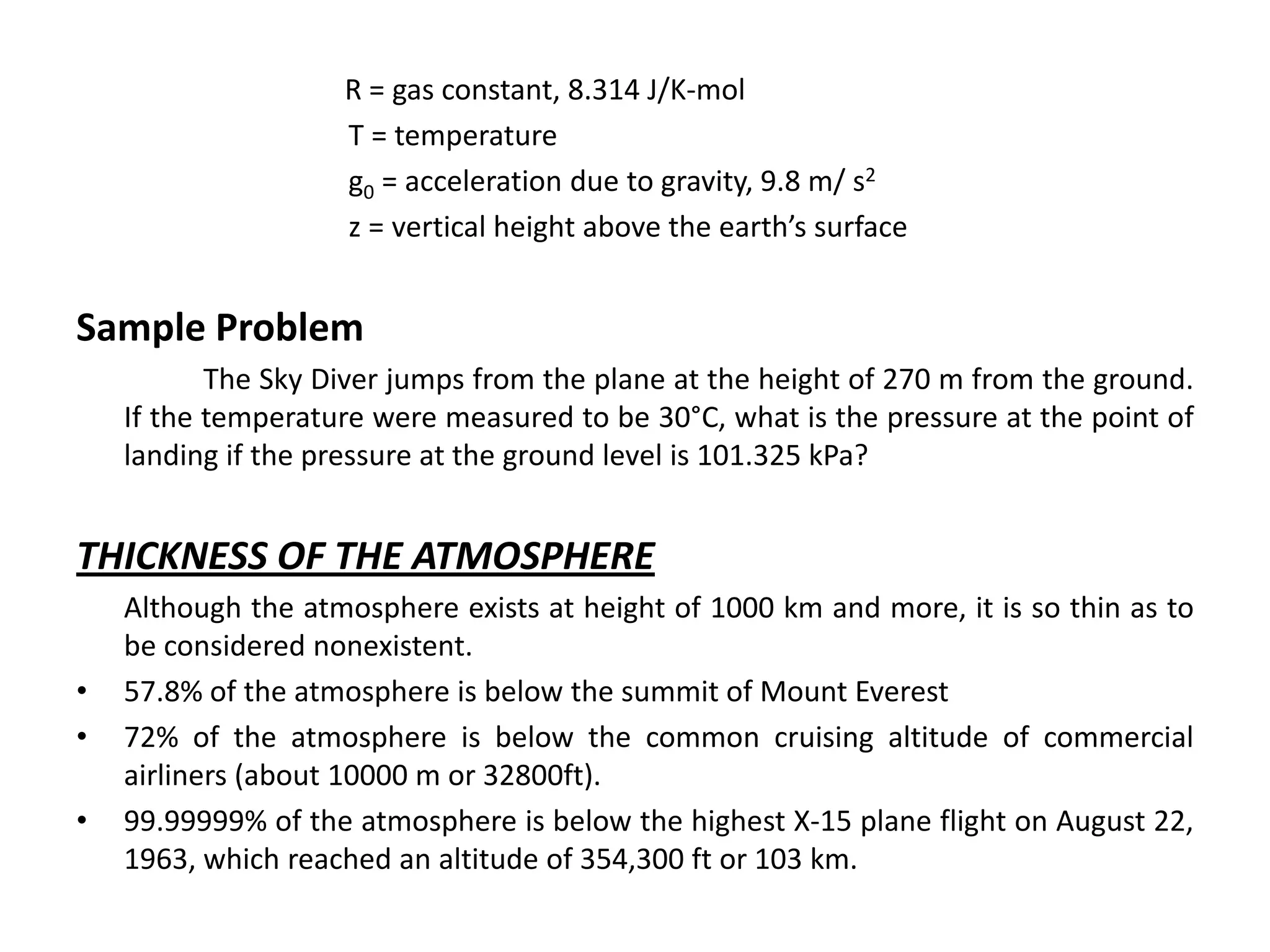
R = gas constant, 8.314 J/K-mol
                    T = temperature
                    g0 = acceleration due to gravity, 9.8 m/ s2
                    z = vertical height above the earth’s surface


Sample Problem
           The Sky Diver jumps from the plane at the height of 270 m from the ground.
    If the temperature were measured to be 30°C, what is the pressure at the point of
    landing if the pressure at the ground level is 101.325 kPa?


THICKNESS OF THE ATMOSPHERE
    Although the atmosphere exists at height of 1000 km and more, it is so thin as to
    be considered nonexistent.
•   57.8% of the atmosphere is below the summit of Mount Everest
•   72% of the atmosphere is below the common cruising altitude of commercial
    airliners (about 10000 m or 32800ft).
•   99.99999% of the atmosphere is below the highest X-15 plane flight on August 22,
    1963, which reached an altitude of 354,300 ft or 103 km.
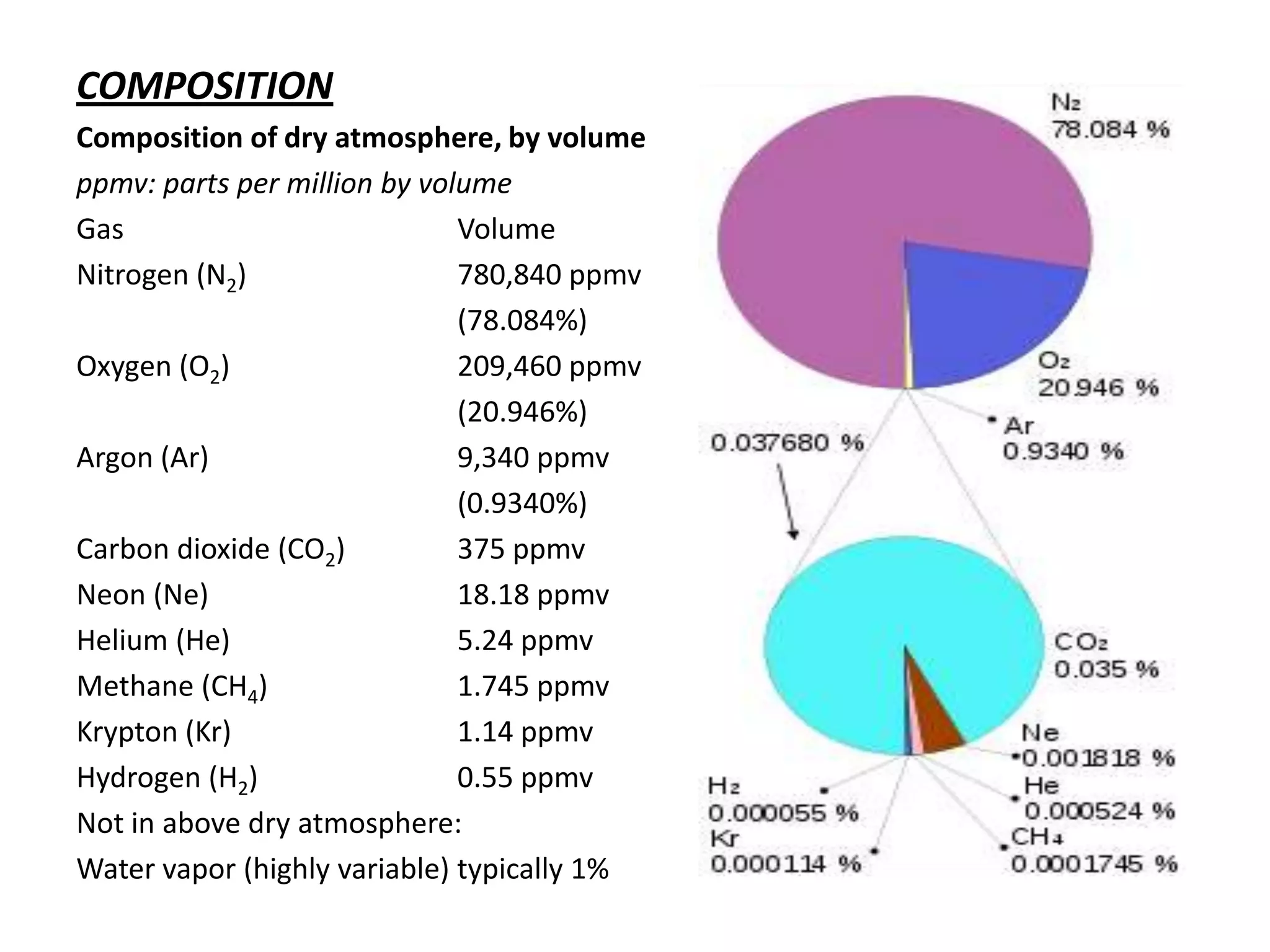
COMPOSITION
Composition of dry atmosphere, by volume
ppmv: parts per million by volume
Gas                           Volume
Nitrogen (N2)                 780,840 ppmv
                              (78.084%)
Oxygen (O2)                   209,460 ppmv
                              (20.946%)
Argon (Ar)                    9,340 ppmv
                              (0.9340%)
Carbon dioxide (CO2)          375 ppmv
Neon (Ne)                     18.18 ppmv
Helium (He)                   5.24 ppmv
Methane (CH4)                 1.745 ppmv
Krypton (Kr)                  1.14 ppmv
Hydrogen (H2)                 0.55 ppmv
Not in above dry atmosphere:
Water vapor (highly variable) typically 1%
DENSITY AND MASS
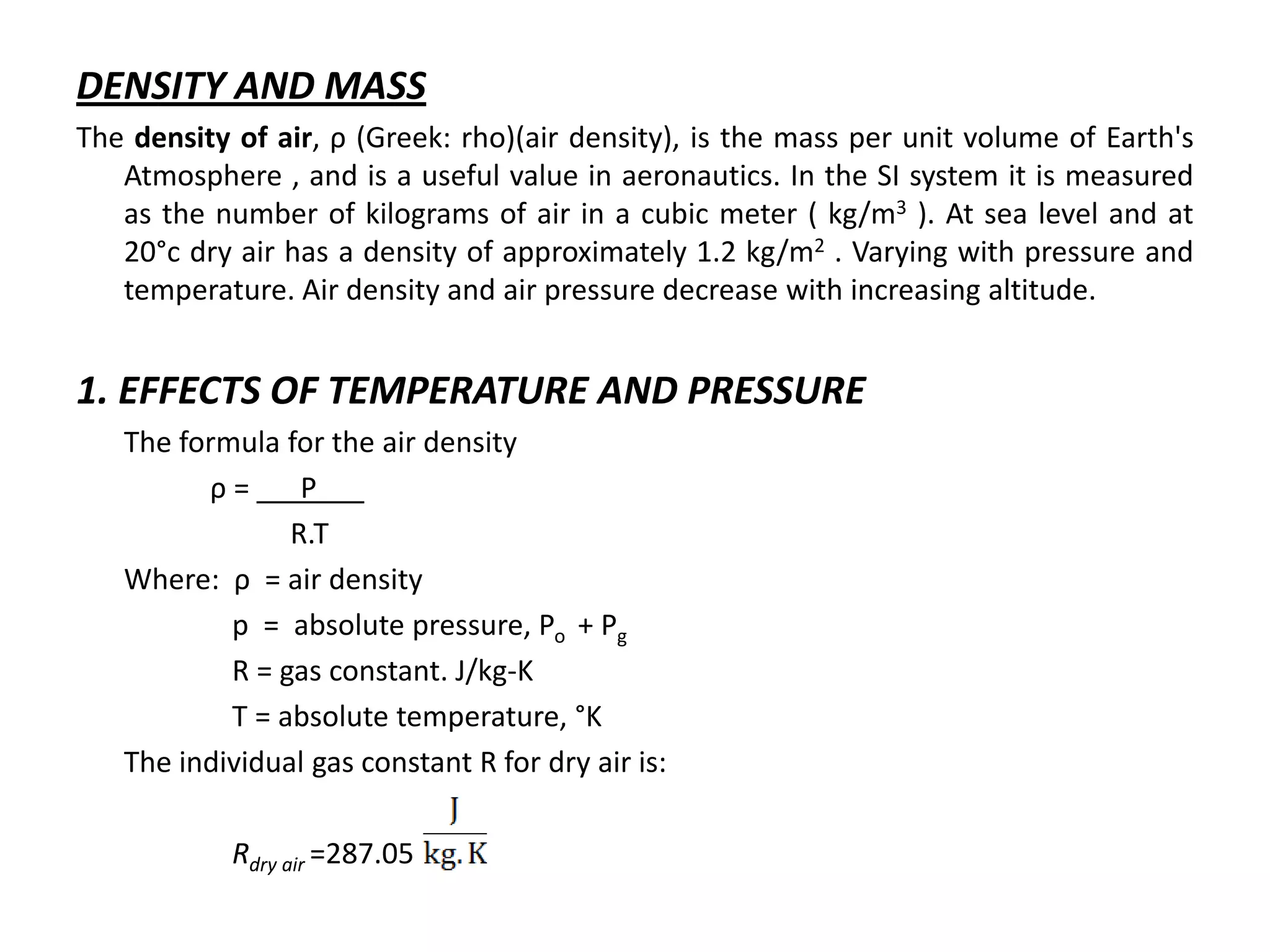
The density of air, ρ (Greek: rho)(air density), is the mass per unit volume of Earth's
   Atmosphere , and is a useful value in aeronautics. In the SI system it is measured
   as the number of kilograms of air in a cubic meter ( kg/m3 ). At sea level and at
   20°c dry air has a density of approximately 1.2 kg/m2 . Varying with pressure and
   temperature. Air density and air pressure decrease with increasing altitude.


1. EFFECTS OF TEMPERATURE AND PRESSURE
   The formula for the air density
         ρ=      P___
                R.T
   Where: ρ = air density
           p = absolute pressure, Po + Pg
           R = gas constant. J/kg-K
           T = absolute temperature, °K
   The individual gas constant R for dry air is:

            Rdry air =287.05
where:
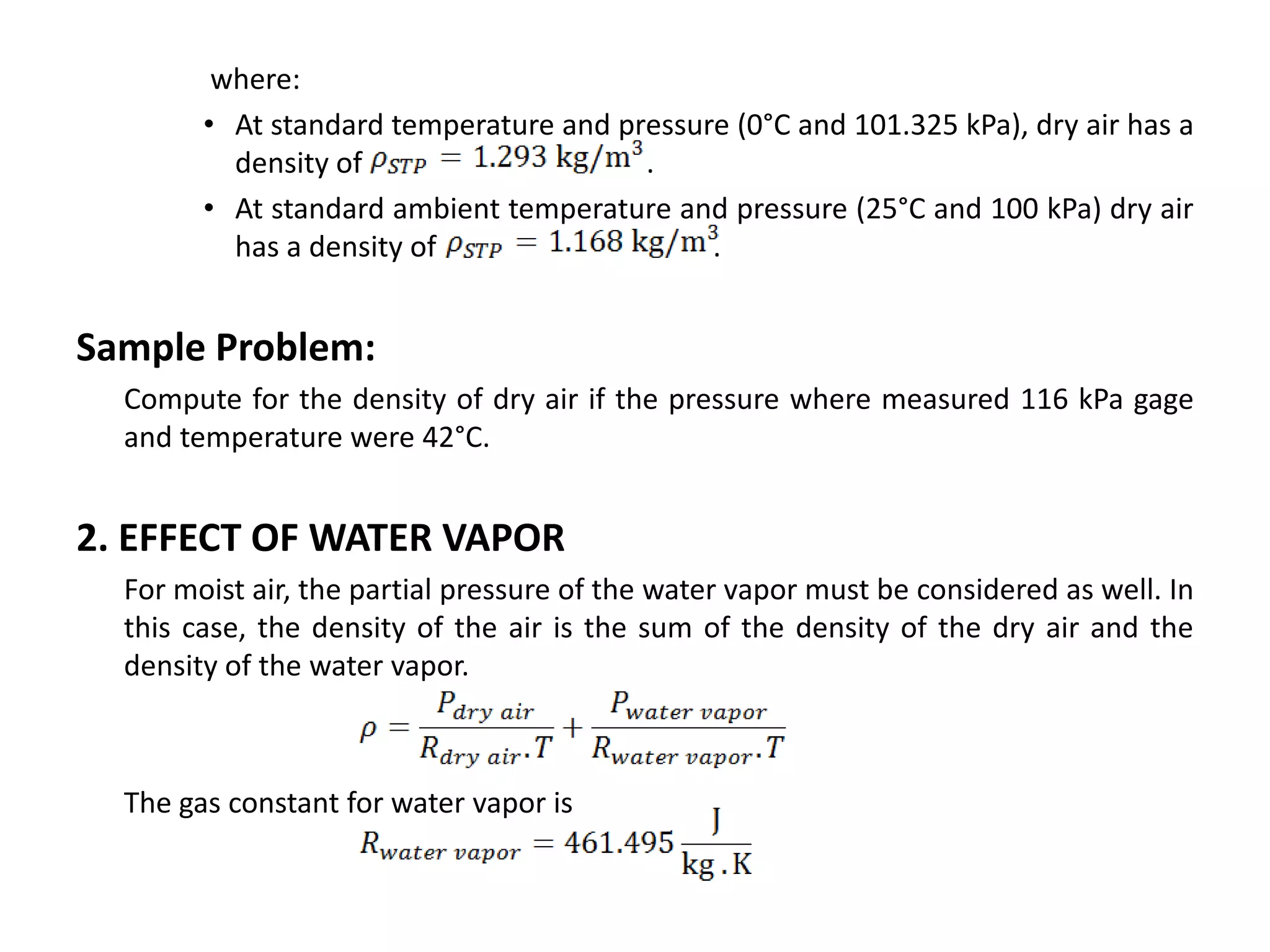
        • At standard temperature and pressure (0°C and 101.325 kPa), dry air has a
          density of                    .
        • At standard ambient temperature and pressure (25°C and 100 kPa) dry air
          has a density of                   .


Sample Problem:
  Compute for the density of dry air if the pressure where measured 116 kPa gage
  and temperature were 42°C.


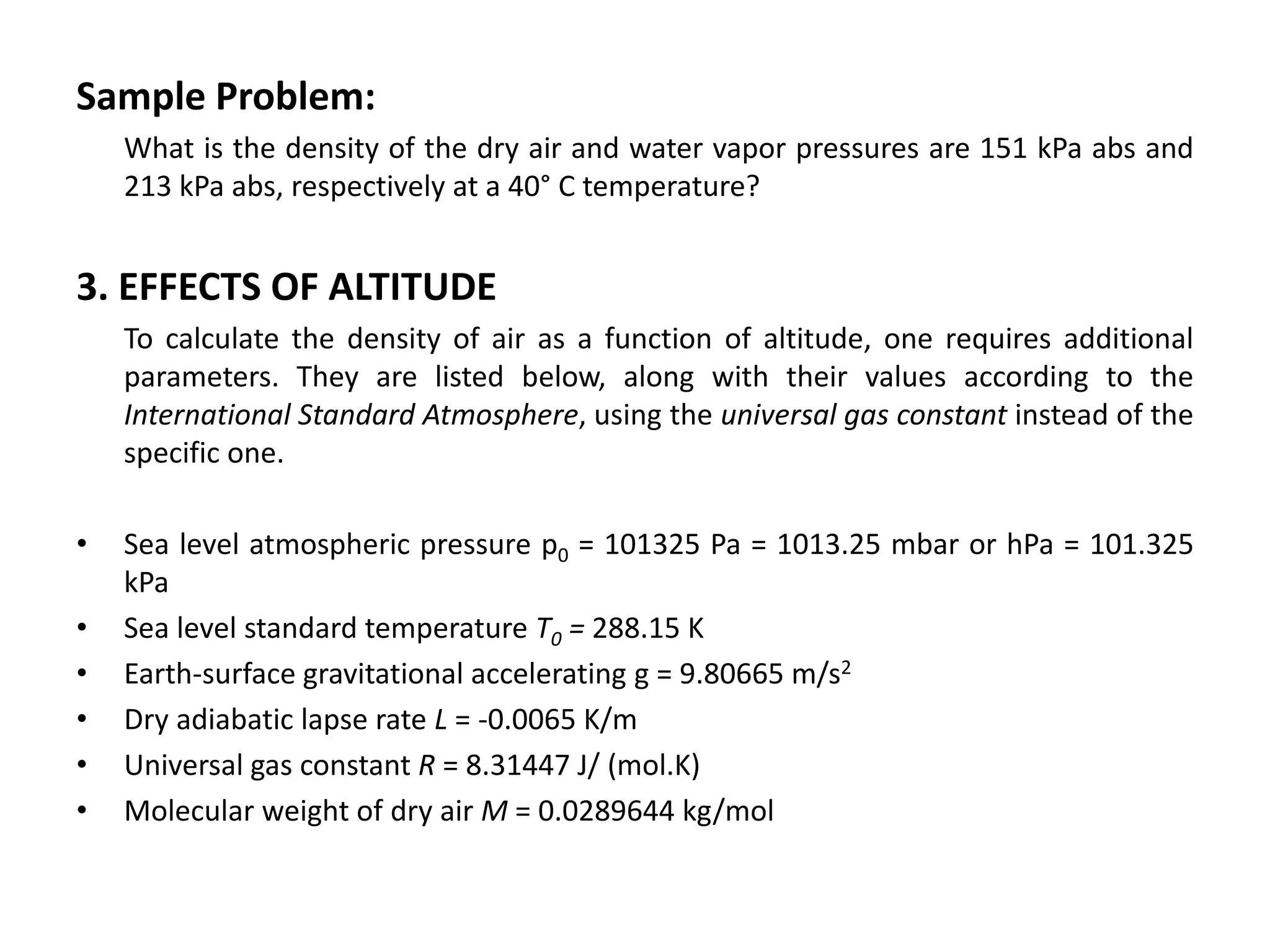
2. EFFECT OF WATER VAPOR
  For moist air, the partial pressure of the water vapor must be considered as well. In
  this case, the density of the air is the sum of the density of the dry air and the
  density of the water vapor.


  The gas constant for water vapor is
Sample Problem:
    What is the density of the dry air and water vapor pressures are 151 kPa abs and
    213 kPa abs, respectively at a 40° C temperature?


3. EFFECTS OF ALTITUDE
    To calculate the density of air as a function of altitude, one requires additional
    parameters. They are listed below, along with their values according to the
    International Standard Atmosphere, using the universal gas constant instead of the
    specific one.

•   Sea level atmospheric pressure p0 = 101325 Pa = 1013.25 mbar or hPa = 101.325
    kPa
•   Sea level standard temperature T0 = 288.15 K
•   Earth-surface gravitational accelerating g = 9.80665 m/s2
•   Dry adiabatic lapse rate L = -0.0065 K/m
•   Universal gas constant R = 8.31447 J/ (mol.K)
•   Molecular weight of dry air M = 0.0289644 kg/mol
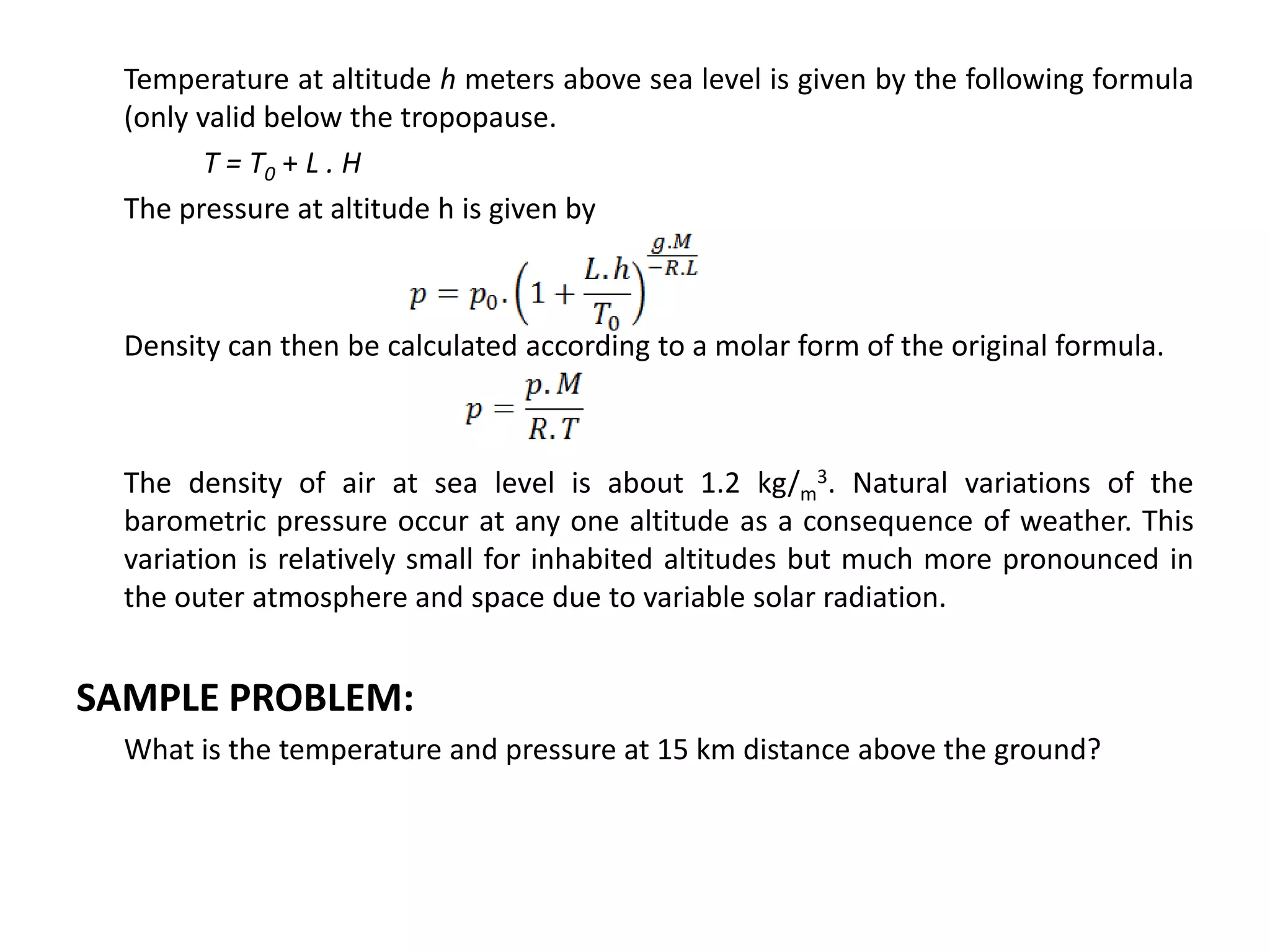
Temperature at altitude h meters above sea level is given by the following formula
  (only valid below the tropopause.
         T = T0 + L . H
  The pressure at altitude h is given by


  Density can then be calculated according to a molar form of the original formula.


  The density of air at sea level is about 1.2 kg/m3. Natural variations of the
  barometric pressure occur at any one altitude as a consequence of weather. This
  variation is relatively small for inhabited altitudes but much more pronounced in
  the outer atmosphere and space due to variable solar radiation.


SAMPLE PROBLEM:
  What is the temperature and pressure at 15 km distance above the ground?

Envi power point ko

  • 1.
    PRESSURE Atmospheric pressure is a direct result of the weight of the air. This means that air pressure varies with location and time, because the amount of air above the earth varies with location and time. Atmospheric pressure drops by ~ 50% at an altitude of about 5 km (equivalently, about 50% of the total atmospheric mass is within the lowest 5 km). The average atmospheric pressure, at sea level, is about 101.325 kPa (about 14.7 pounds per square inch). The Barometric Formula The barometric formula, sometimes called the exponential atmosphere, is a formula used to model how the pressure (or density) of the air changes with altitude. This formula agrees reasonably well with the actual pressure and density variations above the earth’s surface up to a height of about 450,000 ft (140 km). ρ = ρ0e-z/h or where: h = scale height ρ = (rho, density) P = pressure P0 = pressure at ground level (means sea level pressure is 101.325 kPa) M = the mass of 1 mole of air 0.029 kg/mol
  • 2.
    R = gasconstant, 8.314 J/K-mol T = temperature g0 = acceleration due to gravity, 9.8 m/ s2 z = vertical height above the earth’s surface Sample Problem The Sky Diver jumps from the plane at the height of 270 m from the ground. If the temperature were measured to be 30°C, what is the pressure at the point of landing if the pressure at the ground level is 101.325 kPa? THICKNESS OF THE ATMOSPHERE Although the atmosphere exists at height of 1000 km and more, it is so thin as to be considered nonexistent. • 57.8% of the atmosphere is below the summit of Mount Everest • 72% of the atmosphere is below the common cruising altitude of commercial airliners (about 10000 m or 32800ft). • 99.99999% of the atmosphere is below the highest X-15 plane flight on August 22, 1963, which reached an altitude of 354,300 ft or 103 km.
  • 3.
    COMPOSITION Composition of dryatmosphere, by volume ppmv: parts per million by volume Gas Volume Nitrogen (N2) 780,840 ppmv (78.084%) Oxygen (O2) 209,460 ppmv (20.946%) Argon (Ar) 9,340 ppmv (0.9340%) Carbon dioxide (CO2) 375 ppmv Neon (Ne) 18.18 ppmv Helium (He) 5.24 ppmv Methane (CH4) 1.745 ppmv Krypton (Kr) 1.14 ppmv Hydrogen (H2) 0.55 ppmv Not in above dry atmosphere: Water vapor (highly variable) typically 1%
  • 4.
    DENSITY AND MASS Thedensity of air, ρ (Greek: rho)(air density), is the mass per unit volume of Earth's Atmosphere , and is a useful value in aeronautics. In the SI system it is measured as the number of kilograms of air in a cubic meter ( kg/m3 ). At sea level and at 20°c dry air has a density of approximately 1.2 kg/m2 . Varying with pressure and temperature. Air density and air pressure decrease with increasing altitude. 1. EFFECTS OF TEMPERATURE AND PRESSURE The formula for the air density ρ= P___ R.T Where: ρ = air density p = absolute pressure, Po + Pg R = gas constant. J/kg-K T = absolute temperature, °K The individual gas constant R for dry air is: Rdry air =287.05
  • 5.
    where: • At standard temperature and pressure (0°C and 101.325 kPa), dry air has a density of . • At standard ambient temperature and pressure (25°C and 100 kPa) dry air has a density of . Sample Problem: Compute for the density of dry air if the pressure where measured 116 kPa gage and temperature were 42°C. 2. EFFECT OF WATER VAPOR For moist air, the partial pressure of the water vapor must be considered as well. In this case, the density of the air is the sum of the density of the dry air and the density of the water vapor. The gas constant for water vapor is
  • 6.
    Sample Problem: What is the density of the dry air and water vapor pressures are 151 kPa abs and 213 kPa abs, respectively at a 40° C temperature? 3. EFFECTS OF ALTITUDE To calculate the density of air as a function of altitude, one requires additional parameters. They are listed below, along with their values according to the International Standard Atmosphere, using the universal gas constant instead of the specific one. • Sea level atmospheric pressure p0 = 101325 Pa = 1013.25 mbar or hPa = 101.325 kPa • Sea level standard temperature T0 = 288.15 K • Earth-surface gravitational accelerating g = 9.80665 m/s2 • Dry adiabatic lapse rate L = -0.0065 K/m • Universal gas constant R = 8.31447 J/ (mol.K) • Molecular weight of dry air M = 0.0289644 kg/mol
  • 7.
    Temperature at altitudeh meters above sea level is given by the following formula (only valid below the tropopause. T = T0 + L . H The pressure at altitude h is given by Density can then be calculated according to a molar form of the original formula. The density of air at sea level is about 1.2 kg/m3. Natural variations of the barometric pressure occur at any one altitude as a consequence of weather. This variation is relatively small for inhabited altitudes but much more pronounced in the outer atmosphere and space due to variable solar radiation. SAMPLE PROBLEM: What is the temperature and pressure at 15 km distance above the ground?