Physics 1
Salah El-
Sheikh
Section 1
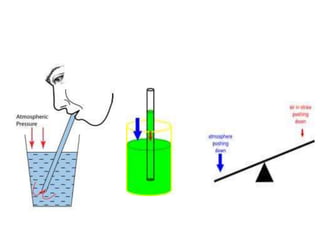
How a Straw Work
Section 2
Pressure
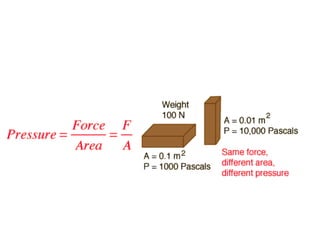
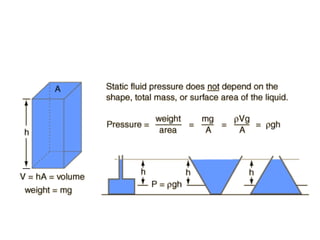
Pressure is defined as force per unit area. It is usually more
convenient to use pressure rather than force to describe
the influences upon fluid behavior.
The standard unit for pressure is the Pascal, which is a
Newton per square meter.
For an object sitting on a surface, the force pressing on the
surface is the weight of the object, but in different
orientations it might have a different area in contact with
the surface and therefore exert a different pressure
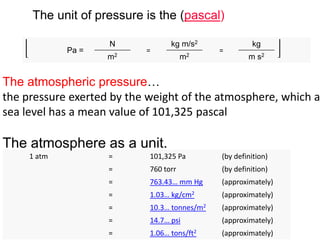
1 atm = 101,325 Pa (by definition)
= 760 torr (by definition)
= 763.43… mm Hg (approximately)
= 1.03… kg/cm2 (approximately)
= 10.3… tonnes/m2 (approximately)
= 14.7… psi (approximately)
= 1.06… tons/ft2 (approximately)
The atmospheric pressure…
the pressure exerted by the weight of the atmosphere, which at
sea level has a mean value of 101,325 pascal
The atmosphere as a unit.
⎡
⎣
Pa =
N
=
kg m/s2
=
kg ⎤
⎦m2 m2 m s2
The unit of pressure is the (pascal)
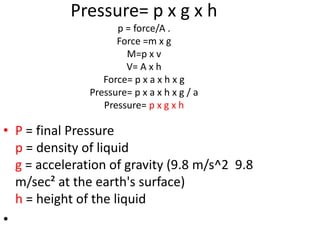
Pressure= p x g x h
p = force/A .
Force =m x g
M=p x v
V= A x h
Force= p x a x h x g
Pressure= p x a x h x g / a
Pressure= p x g x h
• P = final Pressure
p = density of liquid
g = acceleration of gravity (9.8 m/s^2 9.8
m/sec² at the earth's surface)
h = height of the liquid
•
depends only upon the depth of the fluid, the
density of the fluid, and the acceleration of
gravity.
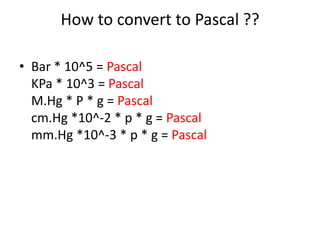
How to convert to Pascal ??
• Bar * 10^5 = Pascal
KPa * 10^3 = Pascal
M.Hg * P * g = Pascal
cm.Hg *10^-2 * p * g = Pascal
mm.Hg *10^-3 * p * g = Pascal
Practice Problems
• 1. Calculate the pressure produced by a force of 800 N acting
on an area of 2.0 m2.
2. A swimming pool of width 9.0 m and length 24.0 m is filled
with water to a depth of 3.0 m. Calculate pressure on the
bottom of the pool due to the water.(density of water 1000
kg/m^3)
Answers.
• 1. F = P A
• F = (300 * 0.5 )
• F = 150 N
2. ∆ P = P h g
• ∆ P = (1000 kg / m^3) (3.0 m) (9.8 m / s2)
• ∆ P = 29400 kg m^2 / m^3 /s^2
∆ P = 29400 pa
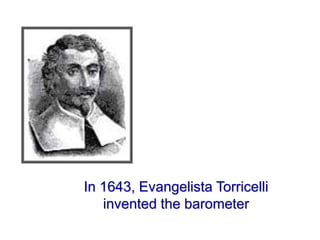
In 1643, Evangelista Torricelli
invented the barometer
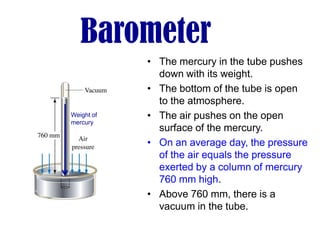
• The mercury in the tube pushes
down with its weight.
• The bottom of the tube is open
to the atmosphere.
• The air pushes on the open
surface of the mercury.
• On an average day, the pressure
of the air equals the pressure
exerted by a column of mercury
760 mm high.
• Above 760 mm, there is a
vacuum in the tube.
Weight of
mercury
Barometer
Manometer
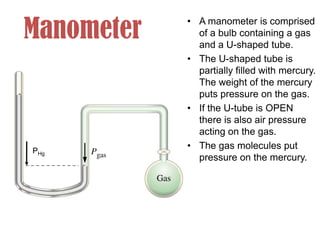
• A manometer is comprised
of a bulb containing a gas
and a U-shaped tube.
• The U-shaped tube is
partially filled with mercury.
The weight of the mercury
puts pressure on the gas.
• If the U-tube is OPEN
there is also air pressure
acting on the gas.
• The gas molecules put
pressure on the mercury.
PHg
Closed Manometers
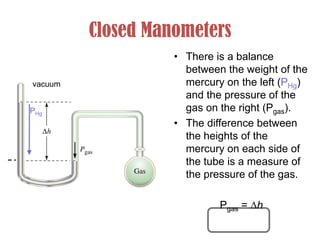
• There is a balance
between the weight of the
mercury on the left (PHg)
and the pressure of the
gas on the right (Pgas).
• The difference between
the heights of the
mercury on each side of
the tube is a measure of
the pressure of the gas.
Pgas = h
vacuum
PHg
Open Manometers
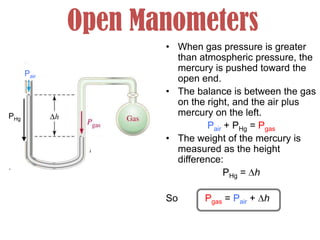
• When gas pressure is greater
than atmospheric pressure, the
mercury is pushed toward the
open end.
• The balance is between the gas
on the right, and the air plus
mercury on the left.
Pair + PHg = Pgas
• The weight of the mercury is
measured as the height
difference:
PHg = h
So Pgas = Pair + h
Pair
PHg
Open Manometers
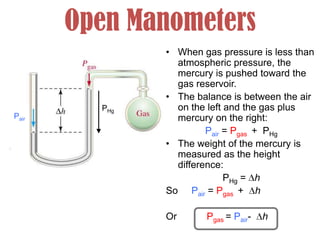
• When gas pressure is less than
atmospheric pressure, the
mercury is pushed toward the
gas reservoir.
• The balance is between the air
on the left and the gas plus
mercury on the right:
Pair = Pgas + PHg
• The weight of the mercury is
measured as the height
difference:
PHg = h
So Pair = Pgas + h
Or Pgas = Pair- h
PHg
Pair
Sample Problems
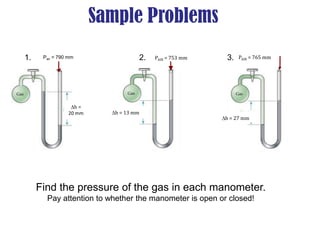
PAIR = 765 mm
h = 27 mm
h = 13 mm
PAIR = 753 mm
h =
20 mm
Pair = 790 mm
Find the pressure of the gas in each manometer.
Pay attention to whether the manometer is open or closed!
1. 2. 3.
Answers
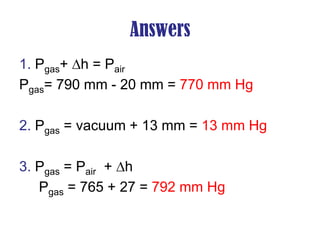
1. Pgas+ h = Pair
Pgas= 790 mm - 20 mm = 770 mm Hg
2. Pgas = vacuum + 13 mm = 13 mm Hg
3. Pgas = Pair + h
Pgas = 765 + 27 = 792 mm Hg
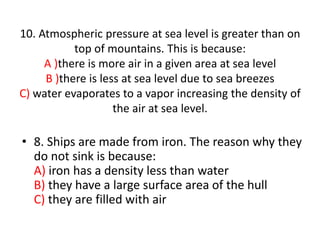
10. Atmospheric pressure at sea level is greater than on
top of mountains. This is because:
A )there is more air in a given area at sea level
B )there is less at sea level due to sea breezes
C) water evaporates to a vapor increasing the density of
the air at sea level.
• 8. Ships are made from iron. The reason why they
do not sink is because:
A) iron has a density less than water
B) they have a large surface area of the hull
C) they are filled with air
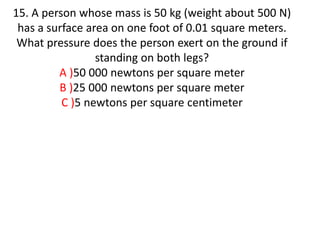
15. A person whose mass is 50 kg (weight about 500 N)
has a surface area on one foot of 0.01 square meters.
What pressure does the person exert on the ground if
standing on both legs?
A )50 000 newtons per square meter
B )25 000 newtons per square meter
C )5 newtons per square centimeter
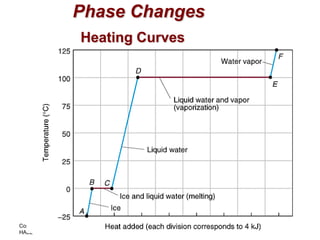
Latent Heat
When a solid melts or a liquid boils, energy
must be added but the temperature
remains constant! (This can be explained
by considering that it takes energy to break
the bonds holding the material together.)
The amount of energy it takes to melt or boil
a certain amount of material is called a
latent heat.
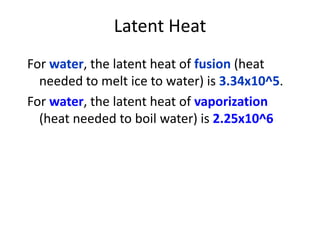
Latent Heat
For water, the latent heat of fusion (heat
needed to melt ice to water) is 3.34x10^5.
For water, the latent heat of vaporization
(heat needed to boil water) is 2.25x10^6
Copyright 1999, PRENTICE
HALL
Chapter 11 25
Phase Changes
Heating Curves
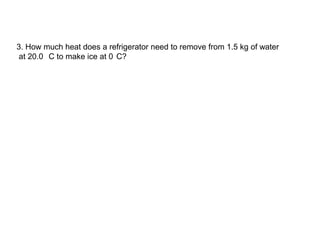
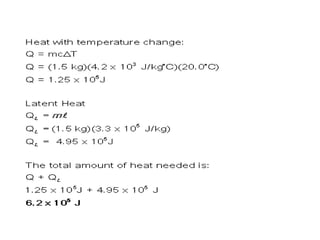
3. How much heat does a refrigerator need to remove from 1.5 kg of water
at 20.0 C to make ice at 0 C?
PH 0101 UNIT 4 LECTURE 9 28
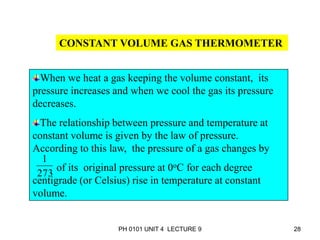
CONSTANT VOLUME GAS THERMOMETER
When we heat a gas keeping the volume constant, its
pressure increases and when we cool the gas its pressure
decreases.
The relationship between pressure and temperature at
constant volume is given by the law of pressure.
According to this law, the pressure of a gas changes by
of its original pressure at 0oC for each degree
centigrade (or Celsius) rise in temperature at constant
volume.
273
1
PH 0101 UNIT 4 LECTURE 9 29
CONSTANT VOLUME GAS THERMOMETER
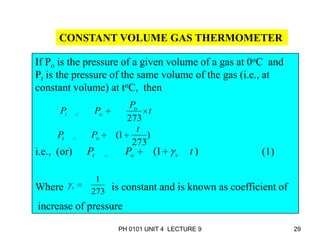
If Po is the pressure of a given volume of a gas at 0oC and
Pt is the pressure of the same volume of the gas (i.e., at
constant volume) at toC, then
i.e., (or) (1)
Where is constant and is known as coefficient of
increase of pressure
t
P
PP o
ot
273
)
273
1(
t
PP ot
)1( tPP vot
273
1
v
PH 0101 UNIT 4 LECTURE 9 30
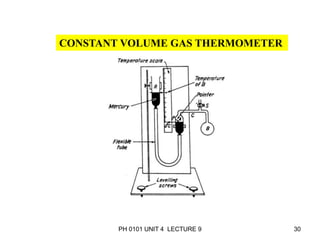
CONSTANT VOLUME GAS THERMOMETER
PH 0101 UNIT 4 LECTURE 9 31
MERITS
Gas thermometers are more sensitive when compared to
other thermometers.
They work uniformly and regularly over a wide range of
temperature.
They can be used to measure low and high temperatures
and have a wide range of operation. (–200oC to 1600oC)
Since the expansion of glass is negligible when
compared to the expansion of the gas the error due to
expansion of glass is negligible.
PH 0101 UNIT 4 LECTURE 9 32
DEMERITS
It takes time to measure the temperature and is not a
quick thermometer.
These thermometers can be used only in some cases
where the bodies can be brought in contact with the
bulb.
They are not easily portable.
Made By…..
•Salah Mohamed El-sheikh

Physics 1 salah el-sheikh

  • 1.
  • 2.
    Section 1 How aStraw Work
  • 4.
    Section 2 Pressure Pressure isdefined as force per unit area. It is usually more convenient to use pressure rather than force to describe the influences upon fluid behavior. The standard unit for pressure is the Pascal, which is a Newton per square meter. For an object sitting on a surface, the force pressing on the surface is the weight of the object, but in different orientations it might have a different area in contact with the surface and therefore exert a different pressure
  • 6.
    1 atm =101,325 Pa (by definition) = 760 torr (by definition) = 763.43… mm Hg (approximately) = 1.03… kg/cm2 (approximately) = 10.3… tonnes/m2 (approximately) = 14.7… psi (approximately) = 1.06… tons/ft2 (approximately) The atmospheric pressure… the pressure exerted by the weight of the atmosphere, which at sea level has a mean value of 101,325 pascal The atmosphere as a unit. ⎡ ⎣ Pa = N = kg m/s2 = kg ⎤ ⎦m2 m2 m s2 The unit of pressure is the (pascal)
  • 7.
    Pressure= p xg x h p = force/A . Force =m x g M=p x v V= A x h Force= p x a x h x g Pressure= p x a x h x g / a Pressure= p x g x h • P = final Pressure p = density of liquid g = acceleration of gravity (9.8 m/s^2 9.8 m/sec² at the earth's surface) h = height of the liquid •
  • 9.
    depends only uponthe depth of the fluid, the density of the fluid, and the acceleration of gravity.
  • 10.
    How to convertto Pascal ?? • Bar * 10^5 = Pascal KPa * 10^3 = Pascal M.Hg * P * g = Pascal cm.Hg *10^-2 * p * g = Pascal mm.Hg *10^-3 * p * g = Pascal
  • 11.
    Practice Problems • 1.Calculate the pressure produced by a force of 800 N acting on an area of 2.0 m2. 2. A swimming pool of width 9.0 m and length 24.0 m is filled with water to a depth of 3.0 m. Calculate pressure on the bottom of the pool due to the water.(density of water 1000 kg/m^3)
  • 12.
    Answers. • 1. F= P A • F = (300 * 0.5 ) • F = 150 N 2. ∆ P = P h g • ∆ P = (1000 kg / m^3) (3.0 m) (9.8 m / s2) • ∆ P = 29400 kg m^2 / m^3 /s^2 ∆ P = 29400 pa
  • 13.
    In 1643, EvangelistaTorricelli invented the barometer
  • 14.
    • The mercuryin the tube pushes down with its weight. • The bottom of the tube is open to the atmosphere. • The air pushes on the open surface of the mercury. • On an average day, the pressure of the air equals the pressure exerted by a column of mercury 760 mm high. • Above 760 mm, there is a vacuum in the tube. Weight of mercury Barometer
  • 15.
    Manometer • A manometeris comprised of a bulb containing a gas and a U-shaped tube. • The U-shaped tube is partially filled with mercury. The weight of the mercury puts pressure on the gas. • If the U-tube is OPEN there is also air pressure acting on the gas. • The gas molecules put pressure on the mercury. PHg
  • 16.
    Closed Manometers • Thereis a balance between the weight of the mercury on the left (PHg) and the pressure of the gas on the right (Pgas). • The difference between the heights of the mercury on each side of the tube is a measure of the pressure of the gas. Pgas = h vacuum PHg
  • 17.
    Open Manometers • Whengas pressure is greater than atmospheric pressure, the mercury is pushed toward the open end. • The balance is between the gas on the right, and the air plus mercury on the left. Pair + PHg = Pgas • The weight of the mercury is measured as the height difference: PHg = h So Pgas = Pair + h Pair PHg
  • 18.
    Open Manometers • Whengas pressure is less than atmospheric pressure, the mercury is pushed toward the gas reservoir. • The balance is between the air on the left and the gas plus mercury on the right: Pair = Pgas + PHg • The weight of the mercury is measured as the height difference: PHg = h So Pair = Pgas + h Or Pgas = Pair- h PHg Pair
  • 19.
    Sample Problems PAIR =765 mm h = 27 mm h = 13 mm PAIR = 753 mm h = 20 mm Pair = 790 mm Find the pressure of the gas in each manometer. Pay attention to whether the manometer is open or closed! 1. 2. 3.
  • 20.
    Answers 1. Pgas+ h= Pair Pgas= 790 mm - 20 mm = 770 mm Hg 2. Pgas = vacuum + 13 mm = 13 mm Hg 3. Pgas = Pair + h Pgas = 765 + 27 = 792 mm Hg
  • 21.
    10. Atmospheric pressureat sea level is greater than on top of mountains. This is because: A )there is more air in a given area at sea level B )there is less at sea level due to sea breezes C) water evaporates to a vapor increasing the density of the air at sea level. • 8. Ships are made from iron. The reason why they do not sink is because: A) iron has a density less than water B) they have a large surface area of the hull C) they are filled with air
  • 22.
    15. A personwhose mass is 50 kg (weight about 500 N) has a surface area on one foot of 0.01 square meters. What pressure does the person exert on the ground if standing on both legs? A )50 000 newtons per square meter B )25 000 newtons per square meter C )5 newtons per square centimeter
  • 23.
    Latent Heat When asolid melts or a liquid boils, energy must be added but the temperature remains constant! (This can be explained by considering that it takes energy to break the bonds holding the material together.) The amount of energy it takes to melt or boil a certain amount of material is called a latent heat.
  • 24.
    Latent Heat For water,the latent heat of fusion (heat needed to melt ice to water) is 3.34x10^5. For water, the latent heat of vaporization (heat needed to boil water) is 2.25x10^6
  • 25.
    Copyright 1999, PRENTICE HALL Chapter11 25 Phase Changes Heating Curves
  • 26.
    3. How muchheat does a refrigerator need to remove from 1.5 kg of water at 20.0 C to make ice at 0 C?
  • 28.
    PH 0101 UNIT4 LECTURE 9 28 CONSTANT VOLUME GAS THERMOMETER When we heat a gas keeping the volume constant, its pressure increases and when we cool the gas its pressure decreases. The relationship between pressure and temperature at constant volume is given by the law of pressure. According to this law, the pressure of a gas changes by of its original pressure at 0oC for each degree centigrade (or Celsius) rise in temperature at constant volume. 273 1
  • 29.
    PH 0101 UNIT4 LECTURE 9 29 CONSTANT VOLUME GAS THERMOMETER If Po is the pressure of a given volume of a gas at 0oC and Pt is the pressure of the same volume of the gas (i.e., at constant volume) at toC, then i.e., (or) (1) Where is constant and is known as coefficient of increase of pressure t P PP o ot 273 ) 273 1( t PP ot )1( tPP vot 273 1 v
  • 30.
    PH 0101 UNIT4 LECTURE 9 30 CONSTANT VOLUME GAS THERMOMETER
  • 31.
    PH 0101 UNIT4 LECTURE 9 31 MERITS Gas thermometers are more sensitive when compared to other thermometers. They work uniformly and regularly over a wide range of temperature. They can be used to measure low and high temperatures and have a wide range of operation. (–200oC to 1600oC) Since the expansion of glass is negligible when compared to the expansion of the gas the error due to expansion of glass is negligible.
  • 32.
    PH 0101 UNIT4 LECTURE 9 32 DEMERITS It takes time to measure the temperature and is not a quick thermometer. These thermometers can be used only in some cases where the bodies can be brought in contact with the bulb. They are not easily portable.
  • 33.