HEAT TRANSFER
Parag Jain
Assistant Professor 

Chhattrapati Shivaji Institute
of Pharmacy

Durg, Chhattisgarh
Presented by
Heat is a form of energy and is measured in units called Joules
symbol J. Fuels contain heat energy. For example, when 1 cubic
meter of natural gas is burned in air, the chemical reaction we call
combustion produces 37,000,000 joules of heat energy.
The joule is a small unit of energy.
1 kJ = 1000 J or 103 J 1 MJ = 1,000,000 J or 106 J
Heat
INTRODUCTION
Heat transfer is a physical process
involving the transfer of heat from hot area
to cold area.
■ Heat transfer occurs due to temperature
difference i.e. driving force between the points
where heat is received and where heat is
originating.
■ Heat always tend to flow from point of high
temperature to point of low temperature.
INTRODUCTION
■ It is a unit operation.
■ It is always accompanied by another unit
operation in practice such as…
Heating & cooling of liquid/solid/air
Refrigeration
Evaporation
Drying
Distillation
MECHANISM OF HEAT TRANSFER
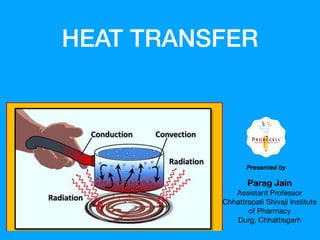
There are 3 basic mechanisms of heat
transfer.
▪ Conduction
▪ Convection
▪ Radiation
CONDUCTION
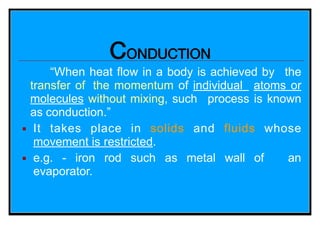
“When heat flow in a body is achieved by the
transfer of the momentum of individual atoms or
molecules without mixing, such process is known
as conduction.”
■ It takes place in solids and fluids whose
movement is restricted.
■ e.g. - iron rod such as metal wall of an
evaporator.
CONDUCTION
■ There is no actual movement of molecules.
On receiving energy from surface of heat,
molecules vibrates and pass on energy to
adjacent molecule.
■ When both end have same temperature,
heat transfer is stopped.
■ Driving force: Difference of temperature
between two end
CONVECTION
“When heat flow is achieved by actual
mixing of warmer portions and cooler
portions of the same material, the process
is known as convection.”
■ There is actual physical movement of
molecules.
■ It takes place in some fluids (i.e. liquids and
gases).
CONVECTION
e.g. If hot and cold liquids are mixed, the heat
can transfer from hot liquid to cold liquid by
physical movement
method of heat transfer is called
of molecules. This
as
convection.
RADIATION
heat flows through space by“When
means of electromagnetic waves, such
energy transfer is known as radiation.”
E.g. Black surface absorbs most of the
radiation received by it & simultaneously
the absorbed energy is quantitatively
transferred into heat.
RADIATION
■ In short…
The hot body emits radiant energy in all
direction. If this radiation strikes a receiver
then part of it may be absorbed and part of
it may be refracted. This method of heat
transfer is called as radiation.
RADIATION
Few examples in which radiation is utilized
for producing heat…
■ Solar water heaters
■ Solar cookers
■ Microwave ovens
■ Microwave cookers
CONDUCTION – Fourier’s law
• Heat can flow only when there is a temp. gradient i.e.
heat flow from a hot surface to a cold surface.

• Thus, basic law of heat transfer by conduction can be
written in the form of a rate equation as follows:

• Rate= Driving force
Thickness of the surface
Mean proportionality constant ×area of the surface
Resistance=
Resistance
FOURIER’S LAW
The rate of heat transfer through
homogenous solid body by conduction is..
-directly proportional to the temperature
difference across the body & cross sectional
area at right angle to the direction of heat
flow and
-inversely proportional to the length of the
path of flow.
FOURIER’S LAW
or
■ The Fourier‟s law may be mathematically expressed
as:
Rateof heatflow= area× temp.difference
thickness
∴q α AΔt
X
∴q = KmA Δt
X dθ dx
Where Km = mean proportionality constant (W / m.k)
∴dQ = -KA dt
∴dQ = -KA dt
dθ dx
dQ/dθ = rate of heat transfer (J/sec)
K
A
= thermal conductivity of material (Btu/ hour.ft.ºF)
= cross sectional area (m2)
-dt/dx = the rate change of temp (t) with respect to
length at path of heat flow (x)
The minus sign indicates the decrease in
temperature in the direction of flow.
CONVECTION
■ e.g. liquids and gases.
■ There is actual physical movement of molecules.
■ It is always accompanied by conduction.
■ Film concept: In convection heat transfer, mass of
hot fluid that transfers the heat through a static
film of fluid, is known as film concept.
H
Film of fluidHot fluid
Radiation
c
a
b
Heat
transfer
The hot body continuously emits radiation in all
direction. When this radiant energy strikes a
receiver body,
- some of the energy will be absorbed by the receiver (a),
- some may be reflected (b),
- some may pass through without affecting cold body when
substance is transparent (c).
■ The flow of heat from hot body to cold body
in this manner is known as heat transfer by
thermal radiation.
Radiation
Black body
■ Imagine a surface or small body, where all the
radiant energy striking on a surface is absorbed
and none is reflected or transmitted. Such
receiver is known as black body.
e.g. piece of rough black cloth
■ No physical substance is a perfect black body.
■ Thus,
Black body is defined as a body that radiates
maximum possible amount of energy at a given
temperature.
Rate of Radiation
■ A good absorber of heat is a good emitter too.
Conversely a poor absorber is a poor emitter.
■ Normally, hot bodies emit radiation.
■ Stefan Boltzmann law gives the total amount of
radiation emitted by a black body.
⎝ ⎠Q = 0.173A⎜100⎟
⎛ T ⎞4
RADIATION – Stefan Boltzmann’s law
The amount of heat radiation emitted by
a body increases rapidly with increase in its
temperature.
“the radiation heatAs per this
energy emitted
proportional to
law,
by a body is
the fourth power
directly
of the
absolute temp (T) of total body.”
What is a heat transfer equipment?
● An equipment that permits efficient transfer of heat
from a hot fluid to a cold fluid without any or with
direct contact of fluids
Such an equipment iscalled
Heat Exchanger
What is a HeatExchanger?
Technically speaking ……
A heat exchanger is a device that is used to
transfer thermal energy (enthalpy) between two
or more fluids, between a solid surface and a
fluid,
or between solid particulates and a fluid,
at different temperatures
and in thermal contact.
Heat exchangers are devices, which transfer heat from a hot fluid to
a cold fluid usually across a metal tube wall.
The most common heat exchangers used in the chemical industry are
the SHELL AND TUBE types. In their simplest form, these consist of
a bank, bundle, of small diameter tubes fitted inside a large diameter
tube, usually referred to as the SHELL.
One fluid flows through the tubes, while the other flows inside the
shell, circulating around and between the small diameter tubes. Heat
is transferred, from one fluid to the other, by CONDUCTION, across
the tube walls, and then by FORCED CONVECTION, through the
fluid.
There are several different designs of shell and tube exchangers. A
number of the more important ones are discussed in the following
sections.
Aim and Application of HE
● There could be internal thermal energy sourcesin
the exchangers, such as in electric heaters and
nuclear fuel elements.
● Combustion and chemical reaction may takeplace
within the exchanger, such as in boilers, fired
heaters, and fluidized-bed exchangers.
● Mechanical devices may be used in some
exchangers such as in scraped surfaceexchangers,
agitated vessels, and stirred tank reactors.
Aim and Application of HE
Heat exchanger found applications in almost all
● Chemical and petrochemical plants
● Air Conditioning Systems
● Power production
● Waste Heat recovery
● Automobile Radiator
● Central Heating System
● Electronic Parts
! DOUBLE PIPE HEATEXCHANGER
Oneofthesimplesttypesof heat exchangeristhedoublepipedesign.Itconsistsof two concentric pipes.
One fluid flows through the inner tube whilst the other flows through the annular space between
the tubes. Heat passes from one fluid to the other by conduction through the inner pipe wall
followed by forced convection through the fluid.
The main advantages of this type of heat exchanger are that they are simple and cheap to make.
They can often be made from standard diameter piping. Their main disadvantages
are that they have low thermal efficiencies, and cannot handle large quantities of process fluid.
Fluid A
in
Double pipe exchangers are sometimes referred to as ANNULAR or
CONCENTRIC tube heat exchangers.
The performance of the Double pipe Heat Exchanger type can
be improved by connecting two or more units together.
beSimple shell and
tube heat
exchanger
The major features of this type of heat exchangerare:
◦ A large number of small diameter TUBES fitted into a TUBE PLATE to form a BANK or BUNDLE oftubes.
◦ Alarge diameter tube called a SHELLinto which the bank of tubes fits.
◦ End covers or HEADERS, which are fitted over each end of the tubebundle.
◦ INLET and OUTLET pipes fitted to the shell to allow fluid into and out of the shell.
◦ INLET and OUTLET pipes fitted to each end of the cover to allow fluid to flow through the tubes.
◦ An EXPANSION JOINT, fitted to the shell. This is included to relieve stresses due to thermal expansion. It allows the shell
to expand and contract as the tube bundle expands and contracts.
◦ A set of BAFFLES, i.e. plates set at right angles to the tube bundle. Their function is to cause shell side fluid to flow at right
angles to the tubes. They also support the tubes within the bundle.
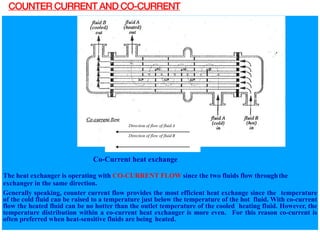
Direction of flow of fluid A
Direction of flow of fluid B
! SHELLANDTUBE HEATEXCHANGER
Co-Current heat exchange
The heat exchanger is operating with CO-CURRENT FLOW since the two fluids flow throughthe
exchanger in the same direction.
Generally speaking, counter current flow provides the most efficient heat exchange since the temperature
of the cold fluid can be raised to a temperature just below the temperature of the hot fluid. With co-current
flow the heated fluid can be no hotter than the outlet temperature of the cooled heating fluid. However, the
temperature distribution within a co-current heat exchanger is more even. For this reason co-current is
often preferred when heat-sensitive fluids are being heated.
Direction of flow of fluid A
Direction of flow of fluid B
COUNTER CURRENT AND CO-CURRENT
Website: www.probecell.com Email: probecellinfo@gmail.com
Ph: 7415211131
Office: Smriti Nagar, Bhilai, Chhattisgarh - 490020
https://youtube.com/c/ParagJainthunderpassionate https://www.facebook.com/thesisresearchwriting
Research article Review article Thesis Synopsis PhD Title Research guidance

Pharmaceutical engineering: Heat transfer

  • 1.
    HEAT TRANSFER Parag Jain AssistantProfessor Chhattrapati Shivaji Institute of Pharmacy Durg, Chhattisgarh Presented by
  • 2.
    Heat is aform of energy and is measured in units called Joules symbol J. Fuels contain heat energy. For example, when 1 cubic meter of natural gas is burned in air, the chemical reaction we call combustion produces 37,000,000 joules of heat energy. The joule is a small unit of energy. 1 kJ = 1000 J or 103 J 1 MJ = 1,000,000 J or 106 J Heat
  • 3.
    INTRODUCTION Heat transfer isa physical process involving the transfer of heat from hot area to cold area. ■ Heat transfer occurs due to temperature difference i.e. driving force between the points where heat is received and where heat is originating. ■ Heat always tend to flow from point of high temperature to point of low temperature.
  • 4.
    INTRODUCTION ■ It isa unit operation. ■ It is always accompanied by another unit operation in practice such as… Heating & cooling of liquid/solid/air Refrigeration Evaporation Drying Distillation
  • 5.
    MECHANISM OF HEATTRANSFER There are 3 basic mechanisms of heat transfer. ▪ Conduction ▪ Convection ▪ Radiation
  • 6.
    CONDUCTION “When heat flowin a body is achieved by the transfer of the momentum of individual atoms or molecules without mixing, such process is known as conduction.” ■ It takes place in solids and fluids whose movement is restricted. ■ e.g. - iron rod such as metal wall of an evaporator.
  • 7.
    CONDUCTION ■ There isno actual movement of molecules. On receiving energy from surface of heat, molecules vibrates and pass on energy to adjacent molecule. ■ When both end have same temperature, heat transfer is stopped. ■ Driving force: Difference of temperature between two end
  • 8.
    CONVECTION “When heat flowis achieved by actual mixing of warmer portions and cooler portions of the same material, the process is known as convection.” ■ There is actual physical movement of molecules. ■ It takes place in some fluids (i.e. liquids and gases).
  • 9.
    CONVECTION e.g. If hotand cold liquids are mixed, the heat can transfer from hot liquid to cold liquid by physical movement method of heat transfer is called of molecules. This as convection.
  • 10.
    RADIATION heat flows throughspace by“When means of electromagnetic waves, such energy transfer is known as radiation.” E.g. Black surface absorbs most of the radiation received by it & simultaneously the absorbed energy is quantitatively transferred into heat.
  • 11.
    RADIATION ■ In short… Thehot body emits radiant energy in all direction. If this radiation strikes a receiver then part of it may be absorbed and part of it may be refracted. This method of heat transfer is called as radiation.
  • 12.
    RADIATION Few examples inwhich radiation is utilized for producing heat… ■ Solar water heaters ■ Solar cookers ■ Microwave ovens ■ Microwave cookers
  • 13.
    CONDUCTION – Fourier’slaw • Heat can flow only when there is a temp. gradient i.e. heat flow from a hot surface to a cold surface. • Thus, basic law of heat transfer by conduction can be written in the form of a rate equation as follows: • Rate= Driving force Thickness of the surface Mean proportionality constant ×area of the surface Resistance= Resistance
  • 14.
    FOURIER’S LAW The rateof heat transfer through homogenous solid body by conduction is.. -directly proportional to the temperature difference across the body & cross sectional area at right angle to the direction of heat flow and -inversely proportional to the length of the path of flow.
  • 15.
    FOURIER’S LAW or ■ TheFourier‟s law may be mathematically expressed as: Rateof heatflow= area× temp.difference thickness ∴q α AΔt X ∴q = KmA Δt X dθ dx Where Km = mean proportionality constant (W / m.k) ∴dQ = -KA dt
  • 16.
    ∴dQ = -KAdt dθ dx dQ/dθ = rate of heat transfer (J/sec) K A = thermal conductivity of material (Btu/ hour.ft.ºF) = cross sectional area (m2) -dt/dx = the rate change of temp (t) with respect to length at path of heat flow (x) The minus sign indicates the decrease in temperature in the direction of flow.
  • 17.
    CONVECTION ■ e.g. liquidsand gases. ■ There is actual physical movement of molecules. ■ It is always accompanied by conduction. ■ Film concept: In convection heat transfer, mass of hot fluid that transfers the heat through a static film of fluid, is known as film concept. H Film of fluidHot fluid
  • 18.
    Radiation c a b Heat transfer The hot bodycontinuously emits radiation in all direction. When this radiant energy strikes a receiver body, - some of the energy will be absorbed by the receiver (a), - some may be reflected (b), - some may pass through without affecting cold body when substance is transparent (c).
  • 19.
    ■ The flowof heat from hot body to cold body in this manner is known as heat transfer by thermal radiation. Radiation
  • 20.
    Black body ■ Imaginea surface or small body, where all the radiant energy striking on a surface is absorbed and none is reflected or transmitted. Such receiver is known as black body. e.g. piece of rough black cloth ■ No physical substance is a perfect black body. ■ Thus, Black body is defined as a body that radiates maximum possible amount of energy at a given temperature.
  • 21.
    Rate of Radiation ■A good absorber of heat is a good emitter too. Conversely a poor absorber is a poor emitter. ■ Normally, hot bodies emit radiation. ■ Stefan Boltzmann law gives the total amount of radiation emitted by a black body. ⎝ ⎠Q = 0.173A⎜100⎟ ⎛ T ⎞4
  • 22.
    RADIATION – StefanBoltzmann’s law The amount of heat radiation emitted by a body increases rapidly with increase in its temperature. “the radiation heatAs per this energy emitted proportional to law, by a body is the fourth power directly of the absolute temp (T) of total body.”
  • 23.
    What is aheat transfer equipment? ● An equipment that permits efficient transfer of heat from a hot fluid to a cold fluid without any or with direct contact of fluids Such an equipment iscalled Heat Exchanger
  • 24.
    What is aHeatExchanger? Technically speaking …… A heat exchanger is a device that is used to transfer thermal energy (enthalpy) between two or more fluids, between a solid surface and a fluid, or between solid particulates and a fluid, at different temperatures and in thermal contact.
  • 25.
    Heat exchangers aredevices, which transfer heat from a hot fluid to a cold fluid usually across a metal tube wall. The most common heat exchangers used in the chemical industry are the SHELL AND TUBE types. In their simplest form, these consist of a bank, bundle, of small diameter tubes fitted inside a large diameter tube, usually referred to as the SHELL. One fluid flows through the tubes, while the other flows inside the shell, circulating around and between the small diameter tubes. Heat is transferred, from one fluid to the other, by CONDUCTION, across the tube walls, and then by FORCED CONVECTION, through the fluid. There are several different designs of shell and tube exchangers. A number of the more important ones are discussed in the following sections.
  • 26.
    Aim and Applicationof HE ● There could be internal thermal energy sourcesin the exchangers, such as in electric heaters and nuclear fuel elements. ● Combustion and chemical reaction may takeplace within the exchanger, such as in boilers, fired heaters, and fluidized-bed exchangers. ● Mechanical devices may be used in some exchangers such as in scraped surfaceexchangers, agitated vessels, and stirred tank reactors.
  • 27.
    Aim and Applicationof HE Heat exchanger found applications in almost all ● Chemical and petrochemical plants ● Air Conditioning Systems ● Power production ● Waste Heat recovery ● Automobile Radiator ● Central Heating System ● Electronic Parts
  • 28.
    ! DOUBLE PIPEHEATEXCHANGER Oneofthesimplesttypesof heat exchangeristhedoublepipedesign.Itconsistsof two concentric pipes. One fluid flows through the inner tube whilst the other flows through the annular space between the tubes. Heat passes from one fluid to the other by conduction through the inner pipe wall followed by forced convection through the fluid. The main advantages of this type of heat exchanger are that they are simple and cheap to make. They can often be made from standard diameter piping. Their main disadvantages are that they have low thermal efficiencies, and cannot handle large quantities of process fluid.
  • 29.
    Fluid A in Double pipeexchangers are sometimes referred to as ANNULAR or CONCENTRIC tube heat exchangers. The performance of the Double pipe Heat Exchanger type can be improved by connecting two or more units together.
  • 30.
    beSimple shell and tubeheat exchanger The major features of this type of heat exchangerare: ◦ A large number of small diameter TUBES fitted into a TUBE PLATE to form a BANK or BUNDLE oftubes. ◦ Alarge diameter tube called a SHELLinto which the bank of tubes fits. ◦ End covers or HEADERS, which are fitted over each end of the tubebundle. ◦ INLET and OUTLET pipes fitted to the shell to allow fluid into and out of the shell. ◦ INLET and OUTLET pipes fitted to each end of the cover to allow fluid to flow through the tubes. ◦ An EXPANSION JOINT, fitted to the shell. This is included to relieve stresses due to thermal expansion. It allows the shell to expand and contract as the tube bundle expands and contracts. ◦ A set of BAFFLES, i.e. plates set at right angles to the tube bundle. Their function is to cause shell side fluid to flow at right angles to the tubes. They also support the tubes within the bundle. Direction of flow of fluid A Direction of flow of fluid B ! SHELLANDTUBE HEATEXCHANGER
  • 31.
    Co-Current heat exchange Theheat exchanger is operating with CO-CURRENT FLOW since the two fluids flow throughthe exchanger in the same direction. Generally speaking, counter current flow provides the most efficient heat exchange since the temperature of the cold fluid can be raised to a temperature just below the temperature of the hot fluid. With co-current flow the heated fluid can be no hotter than the outlet temperature of the cooled heating fluid. However, the temperature distribution within a co-current heat exchanger is more even. For this reason co-current is often preferred when heat-sensitive fluids are being heated. Direction of flow of fluid A Direction of flow of fluid B COUNTER CURRENT AND CO-CURRENT
  • 32.
    Website: www.probecell.com Email:probecellinfo@gmail.com Ph: 7415211131 Office: Smriti Nagar, Bhilai, Chhattisgarh - 490020 https://youtube.com/c/ParagJainthunderpassionate https://www.facebook.com/thesisresearchwriting Research article Review article Thesis Synopsis PhD Title Research guidance