NATURAL
CONVECTION
Y U G M O D I 1 7 1 0 3 0 0 1 1 0 3 8 Student of IIT-RAM,
Ahmedabad
Guided by Dr. Ajitkumar
HEAT AND MASS TRANSFER
WHAT IS
CONVECTION??
• Convection is the transfer of heat by the
movement of a fluid (liquid or gas) between
of different temperature. Warm air is less dense
than cold air, and so convection currents can
form in the presence of a temperature gradient
• Newton’s law of Cooling:
Q = h·A·(Ts- T)
• Type of convection.
1. Free/natural convection
2. Force convection
 WHAT IS
FREE/NATURAL
CONVECTION?
• Natural convection is a mechanism,
or type of heat transport, in which
fluid motion is generated only by
density differences in the fluid
occurring due to temperature
gradients, not by any external source
(like a pump, fan, suction device,
DAILY LIFE EXAMPLE OF NATURAL CONVECTION
Boiling water - The heat passes from
the burner into the pot, heating the
water at the bottom. ...
Radiator - Puts warm air out at the
top and draws in cooler air at the
bottom.
Steaming cup of hot tea - The steam
is showing heat being transfered
into the air.
Ice melting - Heat moves to the ice
from the air.
Hot air balloon - A heater inside the
balloon heats the air and so the air
moves upward. This causes the
balloon to rise because the hot air
gets trapped inside.
Frozen material thawing - Frozen food
thaws more quickly under cold
running water that if it is placed in
water. The action of the running water
transfers heat into the food faster.
NATURAL CONVECTION
(THEORY)
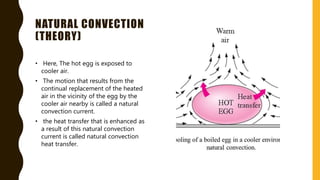
• Here, The hot egg is exposed to
cooler air.
• The motion that results from the
continual replacement of the heated
air in the vicinity of the egg by the
cooler air nearby is called a natural
convection current.
• the heat transfer that is enhanced as
a result of this natural convection
current is called natural convection
heat transfer.
BUOYANCY FORCE
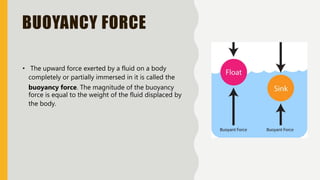
• The upward force exerted by a fluid on a body
completely or partially immersed in it is called the
buoyancy force. The magnitude of the buoyancy
force is equal to the weight of the fluid displaced by
the body.
VELOCITY & TEMPERATURE
PROFILE(THEORY)
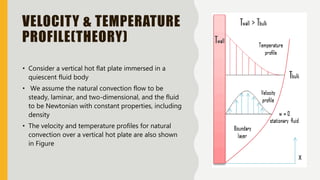
• Consider a vertical hot flat plate immersed in a
quiescent fluid body
• We assume the natural convection flow to be
steady, laminar, and two-dimensional, and the fluid
to be Newtonian with constant properties, including
density
• The velocity and temperature profiles for natural
convection over a vertical hot plate are also shown
in Figure
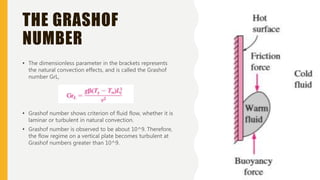
THE GRASHOF
NUMBER
• The dimensionless parameter in the brackets represents
the natural convection effects, and is called the Grashof
number GrL,
• Grashof number shows criterion of fluid flow, whether it is
laminar or turbulent in natural convection.
• Grashof number is observed to be about 10^9. Therefore,
the flow regime on a vertical plate becomes turbulent at
Grashof numbers greater than 10^9.
APPARATUS
Duct assembly
Duct traverse
probe(T3)
Duct inlet probe (T1) Heater
Pinned surface
Flat surface
Finned surface,
honeycomb structure
Versatile data
acquisition system
E X P E R I M E N T A L
S E T- U P
PROCEDUERE
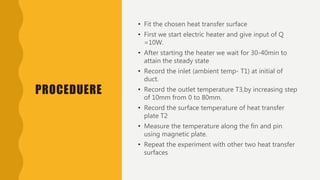
• Fit the chosen heat transfer surface
• First we start electric heater and give input of Q
=10W.
• After starting the heater we wait for 30-40min to
attain the steady state
• Record the inlet (ambient temp- T1) at initial of
duct.
• Record the outlet temperature T3,by increasing step
of 10mm from 0 to 80mm.
• Record the surface temperature of heat transfer
plate T2
• Measure the temperature along the fin and pin
using magnetic plate.
• Repeat the experiment with other two heat transfer
surfaces
FORMULAS
OBSERVATION
TABLE
Distance (mm) Flat plate Finned Pinned
0 36.7 37.7 36.2
10 38.7 38.1 36.4
20 37.9 37.9 34.9
30 36.9 37.6 34.7
40 35.2 36.7 34
50 34.3 35.9 33.6
60 33.3 34.5 33.2
70 31.9 33.9 33
80 31.5 32.9 32.4
Finned
plate
Pinned
plate
Flat plate
Power 10W 10W 10W
T1 32.9 31.3 32.2
Ts 68.3 50.7 54.6
To 34.49 34.128 37.7
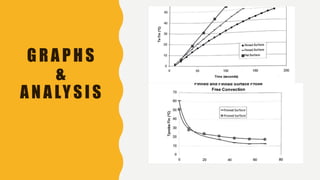
GRAPHS &
ANALYSIS
G R A P H S
&
A N A LY S I S
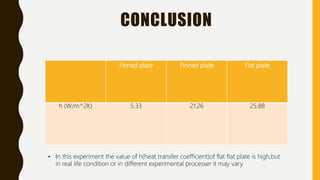
CONCLUSION
Finned plate Pinned plate Flat plate
h (W/m^2K) 5.33 21.26 25.88
• In this experiment the value of h(heat transfer coefficient)of flat flat plate is high,but
in real life condition or in different experimental processer it may vary.
THANK
YOU

NATURAL/FREE CONVECTION

  • 1.
    NATURAL CONVECTION Y U GM O D I 1 7 1 0 3 0 0 1 1 0 3 8 Student of IIT-RAM, Ahmedabad Guided by Dr. Ajitkumar HEAT AND MASS TRANSFER
  • 2.
    WHAT IS CONVECTION?? • Convectionis the transfer of heat by the movement of a fluid (liquid or gas) between of different temperature. Warm air is less dense than cold air, and so convection currents can form in the presence of a temperature gradient • Newton’s law of Cooling: Q = h·A·(Ts- T) • Type of convection. 1. Free/natural convection 2. Force convection
  • 3.
     WHAT IS FREE/NATURAL CONVECTION? •Natural convection is a mechanism, or type of heat transport, in which fluid motion is generated only by density differences in the fluid occurring due to temperature gradients, not by any external source (like a pump, fan, suction device,
  • 4.
    DAILY LIFE EXAMPLEOF NATURAL CONVECTION Boiling water - The heat passes from the burner into the pot, heating the water at the bottom. ... Radiator - Puts warm air out at the top and draws in cooler air at the bottom. Steaming cup of hot tea - The steam is showing heat being transfered into the air. Ice melting - Heat moves to the ice from the air.
  • 5.
    Hot air balloon- A heater inside the balloon heats the air and so the air moves upward. This causes the balloon to rise because the hot air gets trapped inside. Frozen material thawing - Frozen food thaws more quickly under cold running water that if it is placed in water. The action of the running water transfers heat into the food faster.
  • 6.
    NATURAL CONVECTION (THEORY) • Here,The hot egg is exposed to cooler air. • The motion that results from the continual replacement of the heated air in the vicinity of the egg by the cooler air nearby is called a natural convection current. • the heat transfer that is enhanced as a result of this natural convection current is called natural convection heat transfer.
  • 7.
    BUOYANCY FORCE • Theupward force exerted by a fluid on a body completely or partially immersed in it is called the buoyancy force. The magnitude of the buoyancy force is equal to the weight of the fluid displaced by the body.
  • 8.
    VELOCITY & TEMPERATURE PROFILE(THEORY) •Consider a vertical hot flat plate immersed in a quiescent fluid body • We assume the natural convection flow to be steady, laminar, and two-dimensional, and the fluid to be Newtonian with constant properties, including density • The velocity and temperature profiles for natural convection over a vertical hot plate are also shown in Figure
  • 9.
    THE GRASHOF NUMBER • Thedimensionless parameter in the brackets represents the natural convection effects, and is called the Grashof number GrL, • Grashof number shows criterion of fluid flow, whether it is laminar or turbulent in natural convection. • Grashof number is observed to be about 10^9. Therefore, the flow regime on a vertical plate becomes turbulent at Grashof numbers greater than 10^9.
  • 10.
    APPARATUS Duct assembly Duct traverse probe(T3) Ductinlet probe (T1) Heater Pinned surface Flat surface Finned surface, honeycomb structure Versatile data acquisition system
  • 11.
    E X PE R I M E N T A L S E T- U P
  • 12.
    PROCEDUERE • Fit thechosen heat transfer surface • First we start electric heater and give input of Q =10W. • After starting the heater we wait for 30-40min to attain the steady state • Record the inlet (ambient temp- T1) at initial of duct. • Record the outlet temperature T3,by increasing step of 10mm from 0 to 80mm. • Record the surface temperature of heat transfer plate T2 • Measure the temperature along the fin and pin using magnetic plate. • Repeat the experiment with other two heat transfer surfaces
  • 13.
  • 14.
    OBSERVATION TABLE Distance (mm) Flatplate Finned Pinned 0 36.7 37.7 36.2 10 38.7 38.1 36.4 20 37.9 37.9 34.9 30 36.9 37.6 34.7 40 35.2 36.7 34 50 34.3 35.9 33.6 60 33.3 34.5 33.2 70 31.9 33.9 33 80 31.5 32.9 32.4 Finned plate Pinned plate Flat plate Power 10W 10W 10W T1 32.9 31.3 32.2 Ts 68.3 50.7 54.6 To 34.49 34.128 37.7
  • 15.
  • 16.
    G R AP H S & A N A LY S I S
  • 17.
    CONCLUSION Finned plate Pinnedplate Flat plate h (W/m^2K) 5.33 21.26 25.88 • In this experiment the value of h(heat transfer coefficient)of flat flat plate is high,but in real life condition or in different experimental processer it may vary.
  • 18.