By
DR.Hussein Abdeldayem, MD
Professor of Pediatric Neurology Unit , Alex
University
Member of : AAN, ICNA, ACNA
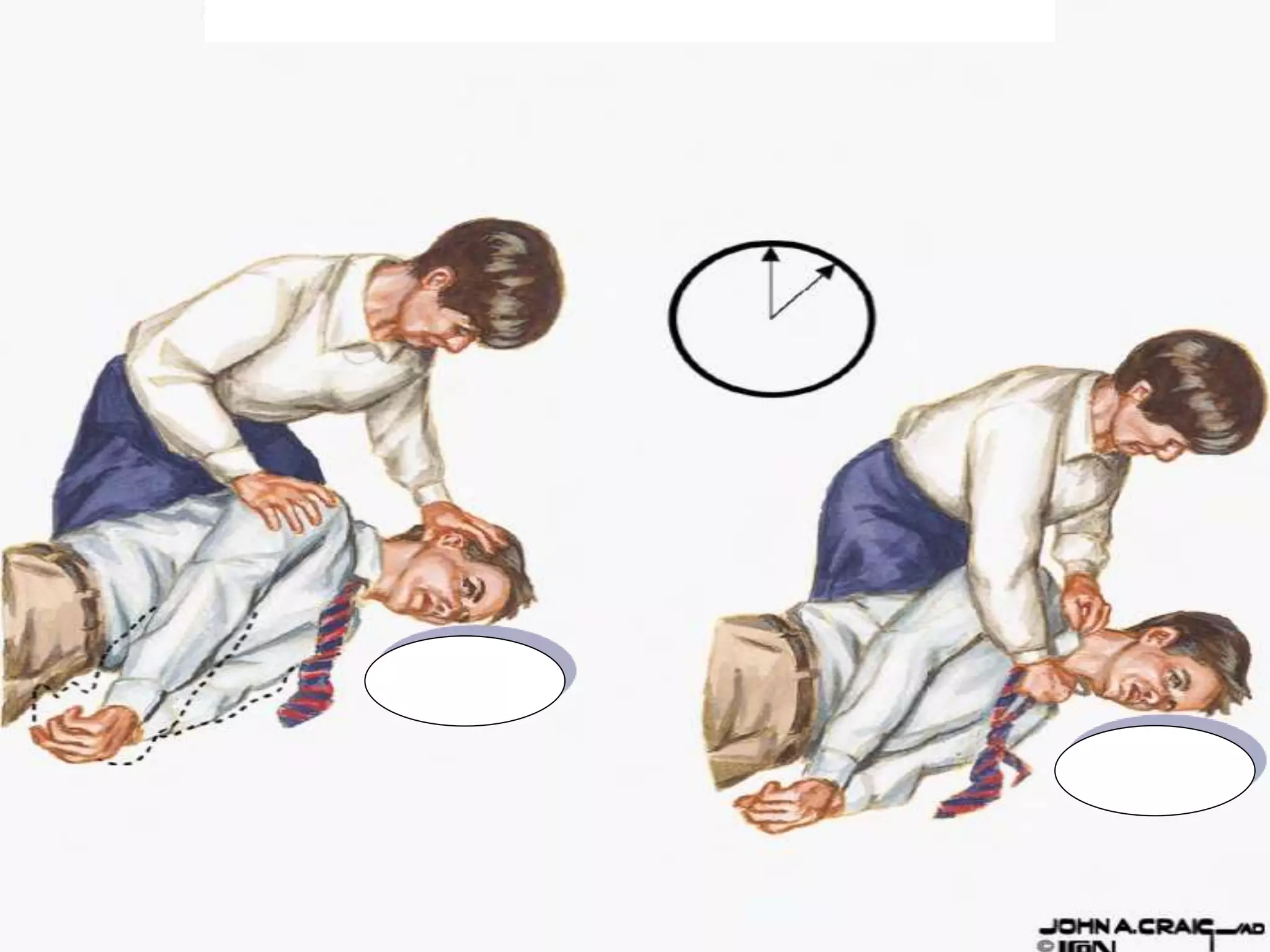
WHAT IS WRONG?
3
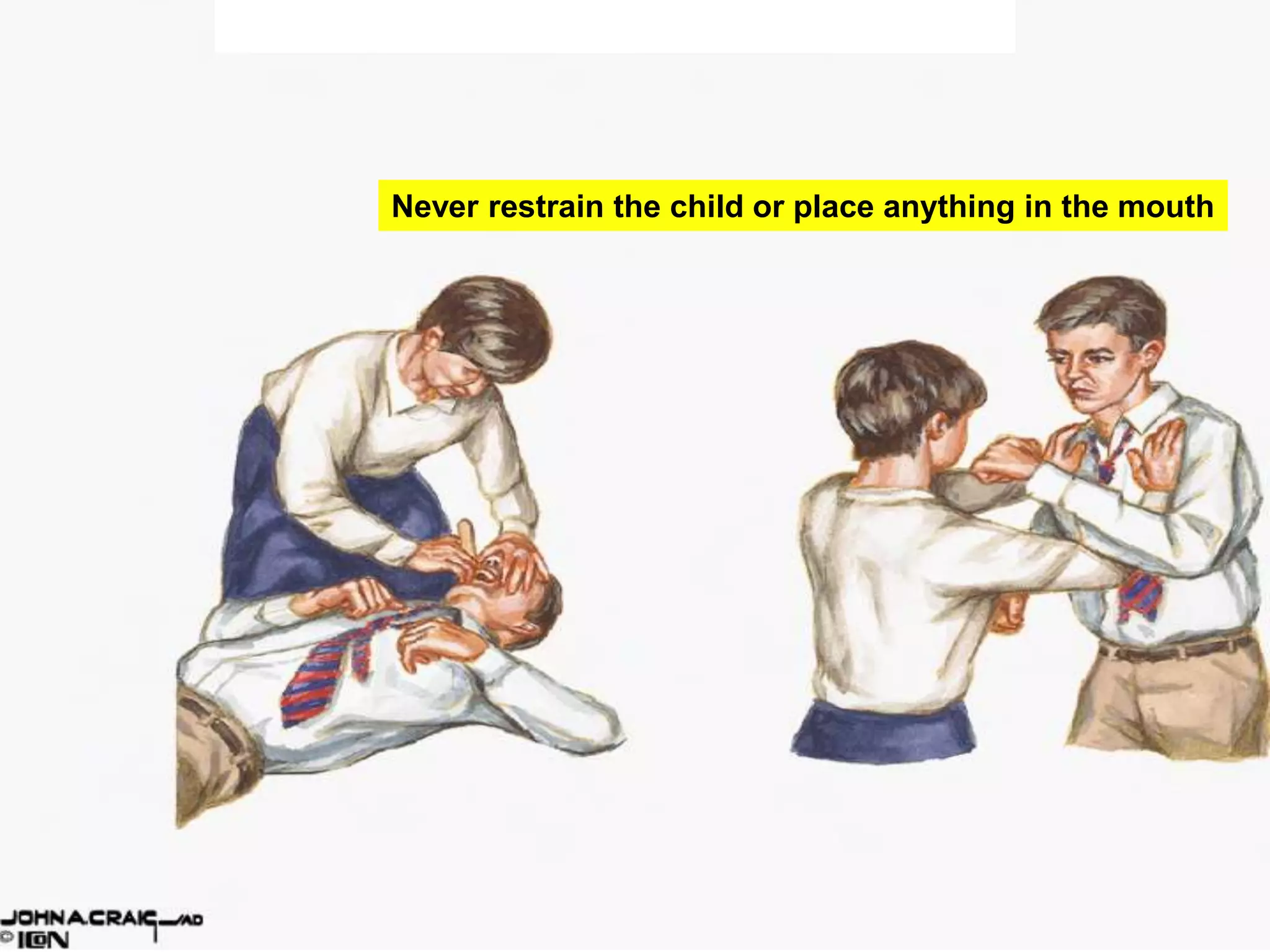
Never restrain the child or place anything in the mouth
LOOK FOR THE STAR
6
7
1. Epilepsy with brain dysfunction
(2ry) MOSTLY RESISTANT
as GDD, CP, postmeningitis ,etc
Prevalence up to 30-50%
Often intractable
Often mixed
Frequency and severity are proportion of
degree of the disorder
CT/MRI
Treatment is challenging
BROAD SPECTRUM AED
POLYTHERAPY
NEUROPROTECTIVE
ANTIEPILEPTOGENIC
8
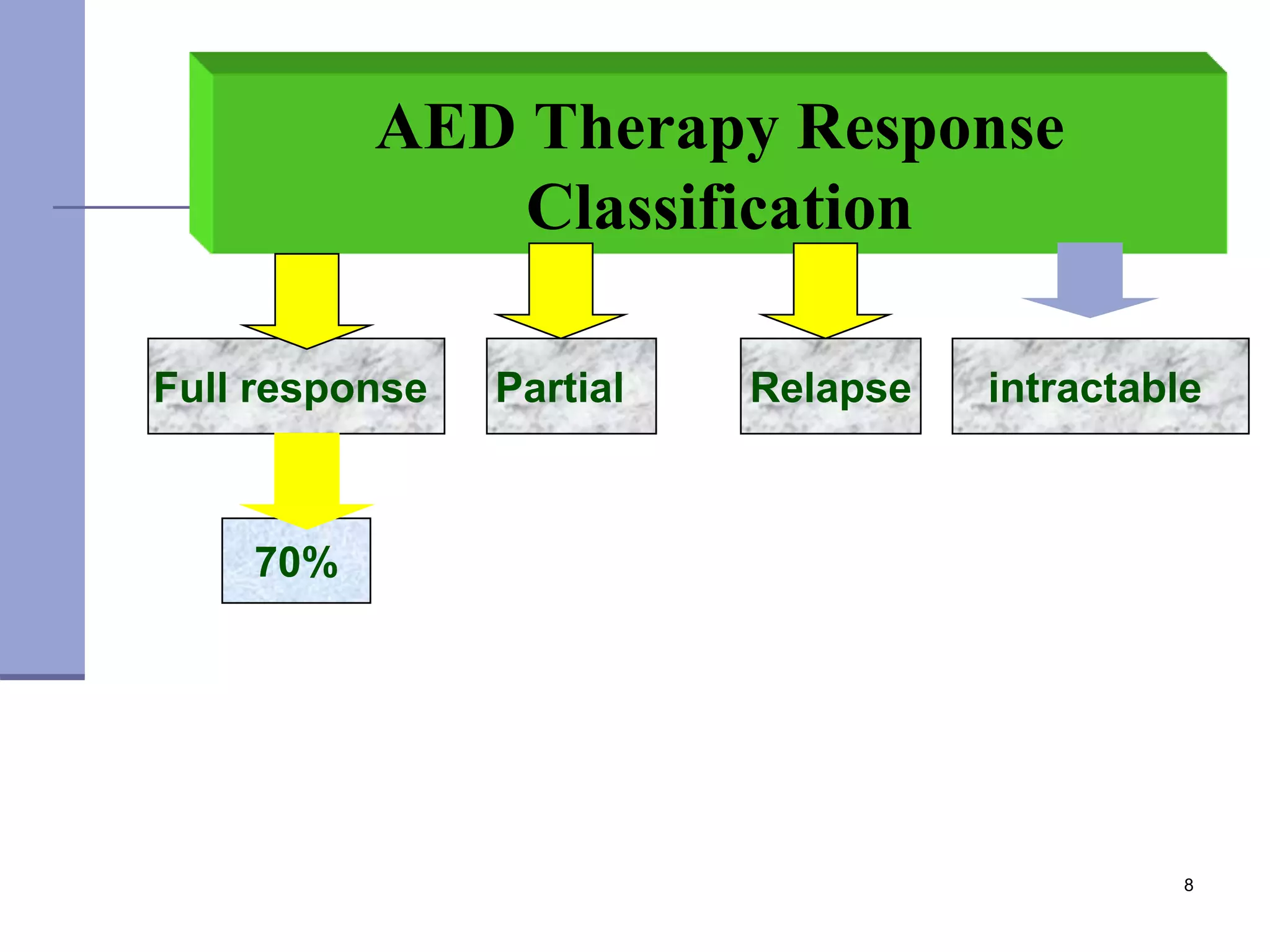
70%
RelapseFull response
AED Therapy Response
Classification
Partial intractable
9
2. NOT ALL ABN EEG IS
EPILEPSY OR FOR AED
10
 5- 10% of normal persons have
abnormal EEG
 10% of non epileptic persons have
abnormal EEG
 Migraine
 Anxiety
 Depression
 FC
 BHS
 Tension child
 ADHD
11
Up to 30% of epileptic patients with
normal EEG
 30-60 minutes
 Sleep deprivation,
 HV,
 IPS
 Generalized slowing
activity
12
 One normal EEG does not exclude epilepsy
 A second EEG performed during sleep in
sleep deprived patients reveals epileptiform
abnormalities in half of patients whose first
EEG was normal
13
3. When EEG is of valuable?
 Same day
 After 2 weeks from the attack
 After 4 weeks from the attack
14
 EEG is most valuable within 24 h of the
seizure
Arch Neurol. 2010 Jul 12.
Optimizing Electroencephalographic Studies for
Epilepsy Diagnosis in Children With New-Onset Seizures.
15
Describe EEG. ? Possible diagnosis
Drug of Choice?
16
Describe EEG ?possible diagnosis
Drug of choice ?
Some Seizure Onsets can be Focal or Generalized
Focal Onset Generalized Onset
atonic
clonic
epileptic spasms
myoclonic
tonic
tonic-clonic
atonic
clonic
epileptic spasms
myoclonic
tonic
tonic-clonic
Classification according to EEG
findings. ILAE 1981
Generalized Focal
Both Cerebral
Hemispheres
Only a part of a
hemisphere
Loss of Consciousness No loss of
consciousness
Treated by Valproate Treated by
Carbamazipine
MRI
Focal with
2ry G
Motor
Tonic-clonic
Other motor
Non-Motor (Absence)
Unknown Onset
Motor
Non-Motor
focal to bilateral tonic-clonic
Generalized OnsetFocal Onset
Motor
Tonic-clonic
Other motor
Non-Motor
ILAE 2017 Classification of Seizure Types Basic Version 1
Unclassified 2
1 Definitions, other seizure types and descriptors are listed in the accompanying paper & glossary of terms
2 Due to inadequate information or inability to place in other categories
Aware
Impaired
Awareness
From Fisher et al. Instruction manual for the ILAE 2017
operational classification of seizure types. Epilepsia doi:
10.1111/epi.13671
Motor
tonic-clonic
clonic
tonic
myoclonic
myoclonic-tonic-clonic
myoclonic-atonic
atonic
epileptic spasms2
Non-Motor (absence)
typical
atypical
myoclonic
eyelid myoclonia
Unknown Onset
Motor Onset
automatisms
atonic2
clonic
epileptic spasms2
hyperkinetic
myoclonic
tonic
Non-Motor Onset
autonomic
behavior arrest
cognitive
emotional
sensory
focal to bilateral tonic-clonic
Generalized OnsetFocal Onset
Aware
Impaired
Awareness
Motor
tonic-clonic
epileptic spasms
Non-Motor
behavior arrest
ILAE 2017 Classification of Seizure Types Expanded Version1
Unclassified3
1 Definitions, other seizure types and descriptors are listed in the
accompanying paper and glossary of terms.
2 These could be focal or generalized, with or without alteration of awareness
3 Due to inadequate information or inability to place in other categories
From Fisher et al. Instruction manual for the ILAE 2017
operational classification of seizure types. Epilepsia doi:
GENERALIZED FITS
Focal Fits
Focal with 2ry generalization FITS
Absence – Myoclonic - ES
22
4. Do you ask for Brain CT or MRI?
When?
23
Brain CT/MRI
1. every patient with a newly diagnosed focal
epilepsy should undergo CT/MRI
2. RESISTANT EPILEPSY
3. SECONDARY EPILEPSY
24
 Identify structural causes of epilepsy as
cortical malformation, traumatic brain injury,
brain cyst or tumour, and cerebrovascular
disease
 Repeat MRI in case of drug-resistant epilepsy
as a first step to explore surgical options
WHEN U START AED ?
 AFTER ONE SEIZURE
 AFTER TWO SEIZURES IN SAME DAY
 AFTER TWO SEIZURES WITH ONE DAY
APART
 AFTER THREE SEIZURES SAME DAY
 AFTER THREE SEIZURES A DAY APART
25
In adults , after one attack
Because of
• Driving
• Employability
27
Practical points
Aim : to stop attacks
 Monotherapy avoid polytherapy
 Treat fits but not blood serum level
 Start with minimal dose and increase gradually
 Stop if side effects appeared
 Don’t ask for SGOT ..ONLY If suspect hepatic
dysfunction so ask for SGPT
 Don’t withdraw AED suddenly but gradually
Treatment
Compliance :
dose, cost, availability
28
29
Principles of drug usage
 Monotherapy
 Least dosage
 First choice
 Compliance: cost, dosage division, formula
 Least S/E especially cognitive functions
30
Impact of Dosing Frequency
on Compliance
Cramer JA, et al. JAMA. 1989;261:3273-3277.
20
40
60
80
100
Patients(%)
QD BID TID QID
87%
81%
77%
39%
EpilepsyIn epilepsy patients
 Higher compliance rates
are associated with once-
or twice daily dosing
 Noncompliance with AEDs
is a major factor in:
 Breakthrough seizures
 Recurrence of seizures
N=24 patients followed for 2 to 37 weeks.
increase till max ( or S/E) before changing to other AED
31
5. WHEN TO Withdrawal of
AED?
 After 2 years of last attack REGARDELESS
EEG ?
 withdraw over 3 months
 Same period of AED if it will recur
 ?? 2ry epilepsy
32
AEDs
 First-generation AEDs include: phenobarbital,
phenytoin, carbamazepine, valproic acid,
clonazepam, and primidone
 Since early 1990’s: lamotrigine, gabapentin,
oxcarbazepine, levetiracetam, divalproex
sodium, topiramate, zonisamide, vigabatrin,
tiagabine, and felbamate
 The latest AEDs to become available are
pregabalin, lacosimide, and rufinimide.
6.WHICH ?
BROAD SPECTRUM IS THE EASIEST
33
34
AE S/E
5+1
 CNS S/E
 GIT S/E
 Dermal S/E
 BM S/E
 Teratogenic
 Specific S/E
35
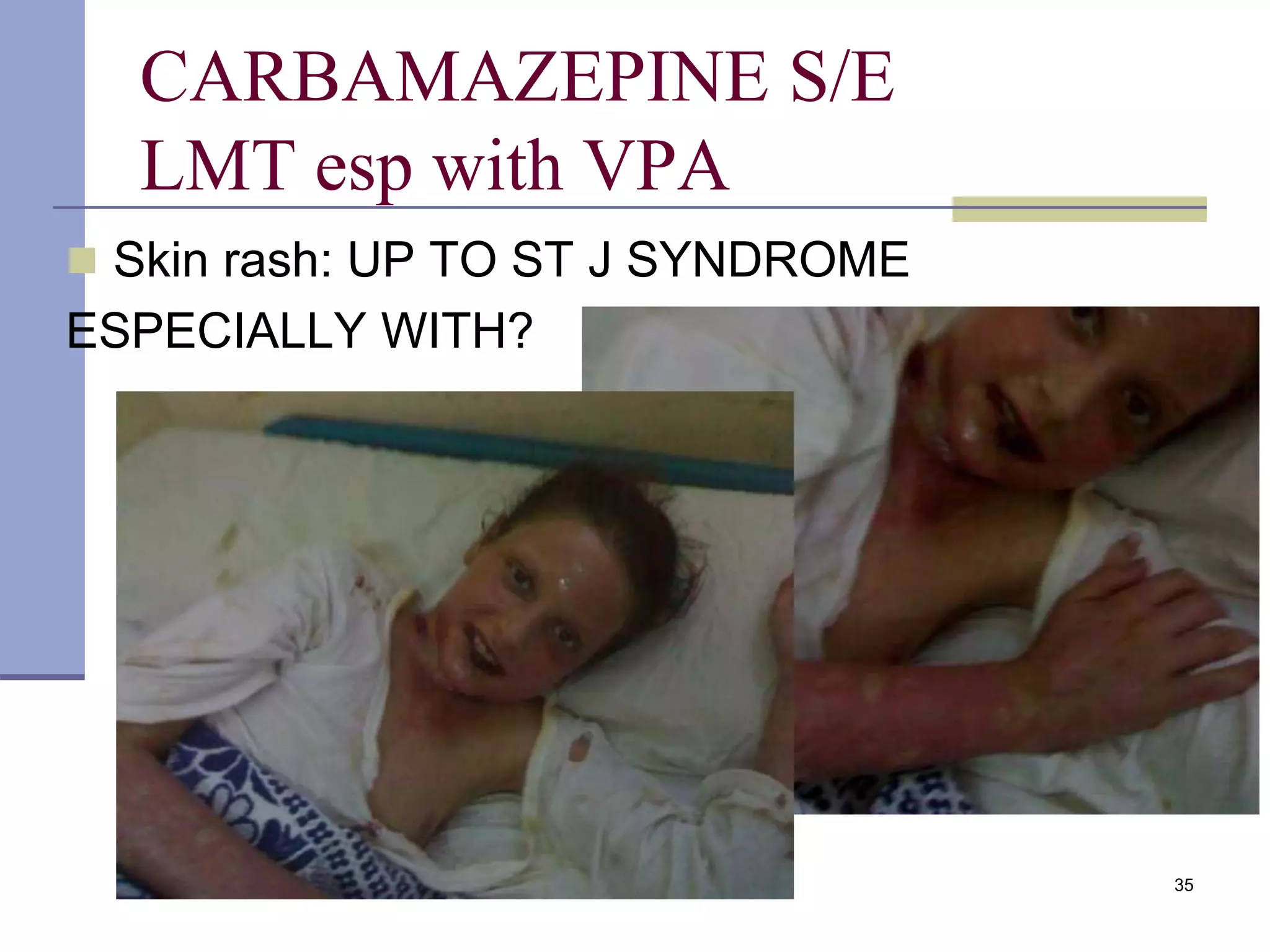
CARBAMAZEPINE S/E
LMT esp with VPA
 Skin rash: UP TO ST J SYNDROME
ESPECIALLY WITH?
36
Levetiracetam
 Dose
 Children: weight/10 ( ml) twice
,MAXIMUM x3
 {20 – 60 mg/kg/d}
 Therapeutic plasma concentration
 Not relevant
 Indicated for
NEARLY ALL
 Comments
 No drug interactions described
 Forms:
Oral: (100mg/1ml)
250, 500, 1000 mg tablets
AMPOULES
 Blood Follow up: NONE
 Onset of action 24-48HRS
 Monotherapy or Add on, no drug
interaction
(Levetiracetam)
January 26, 2012
FDA approval for levetiracetam
in infants and children from one
month of age with partial onset
seizures
 Quick onset of action
 No cognitive S/E
 Bind specific CNS areas only as hippocampus
 Not liver metabolism, not protein binding so not
interact with other AED
The starting dose of 20mg/kg/day was increased
at intervals of 1 week by 10mg/kg/day,
if necessary, up to a maximum dose of 60mg/kg/day.
Steady state: 8hX5
 Quick onset of action
 No cognitive S/E
 Not liver metabolism, not protein binding so not
interact with other AED
Steady state: 8hX5
42
Childhood Pharmako-dinamic
1- absorption : ↑ fast
2- distribution: ↓ protein binding*
3- metabolism: ↑
4- excretion: ↑ clearance
So higher dose > adults
43
Levetiracetam LVT
 Bind specific CNS areas only as hypocampus
 Pathogenesis:
SV2A* binding site so prevent vesicles
release of its stimulant contents
 Not liver metabolism, not protein binding so
not interact with other AED
Advantages
 Broad spectrum
 Not interfere with other AEDs
 Same day effect
 Prophylaxis after brain operation
 Prophylaxis after HIE
 Anti-epileptogenic
 Neuroprotective
 No cognitive S/E
44
NEUROPROTECTIVE LVT
 IN HIE / NEWBORN /PREMATURE
 POST BRAIN SURGICAL TREATMENT
 POST I C HGE
 NON CLINICAL SEIZURES AS AUTISM
45
S/E
47
DIAGNOSE AND TT
48
49
DIAGNOSE AND TT
Q
50
DIAGNOSE AND TT
51
DIAGNOSE AND TT
52
DIAGNOSE AND TT
53
DIAGNOSE AND TT
54
DIAGNOSE AND TT
55
Q & A
 CBZ,
 oxcarbazepine
 Phenytoin
 Gabapentin
May not work or may even exacerbate absence
or myoclonic seizures
56
DIAGNOSE AND TT
57
DIAGNOSE AND TT
58
DIAGNOSE AND TT
59
DIAGNOSE AND TT
60
Q & A
 LEV (levetiracetam)
Useful for both partial and generalized absence
or myoclonic seizures and unclassifiable
seizures
? LVT for absence
61
DIAGNOSE AND TT
62
DIAGNOSE AND TT
63
DIAGNOSE AND TT
64
DIAGNOSE AND TT
65
DIAGNOSE AND TT
66
ADD On / start with : LVT
except absence seizures
 GTC
 Absence
 Myoclonic
 ES
 ES withTS
 Focal
ETX,VPA
VPA
ACTH
VIGABATRIN
CZP
Never
CBZ,
SUMMARY
67
68
The End
“Words, words, words, I’m so sick of words!”
Eliza Doolittle, My Fair Lady
Partial Seizures (start in one place)
Simple (no loss of consciousness of memory)
Sensory
Motor
Sensory-Motor
Psychic (abnormal thoughts or perceptions)
Autonomic (heat, nausea, flushing, etc.)
Complex (consciousness or memory impaired)
With or without aura (warning)
With or without automatisms
Secondarily generalized
Generalized Seizures (apparent start over wide areas of brain)
Absence (petit mal)
Tonic-clonic (grand mal)
Atonic (drop seizures)
Myoclonic
Other
Unclassifiable seizures
Dreifuss et al. Proposal for revised clinical and
electroencephalographic classification of epileptic
seizures. From the Commission on Classification
and Terminology of the International League
Against Epilepsy. Epilepsia. 1981;22:489-501.
INTERNATIONAL CLASSIFICATION OF SEIZURES 1981
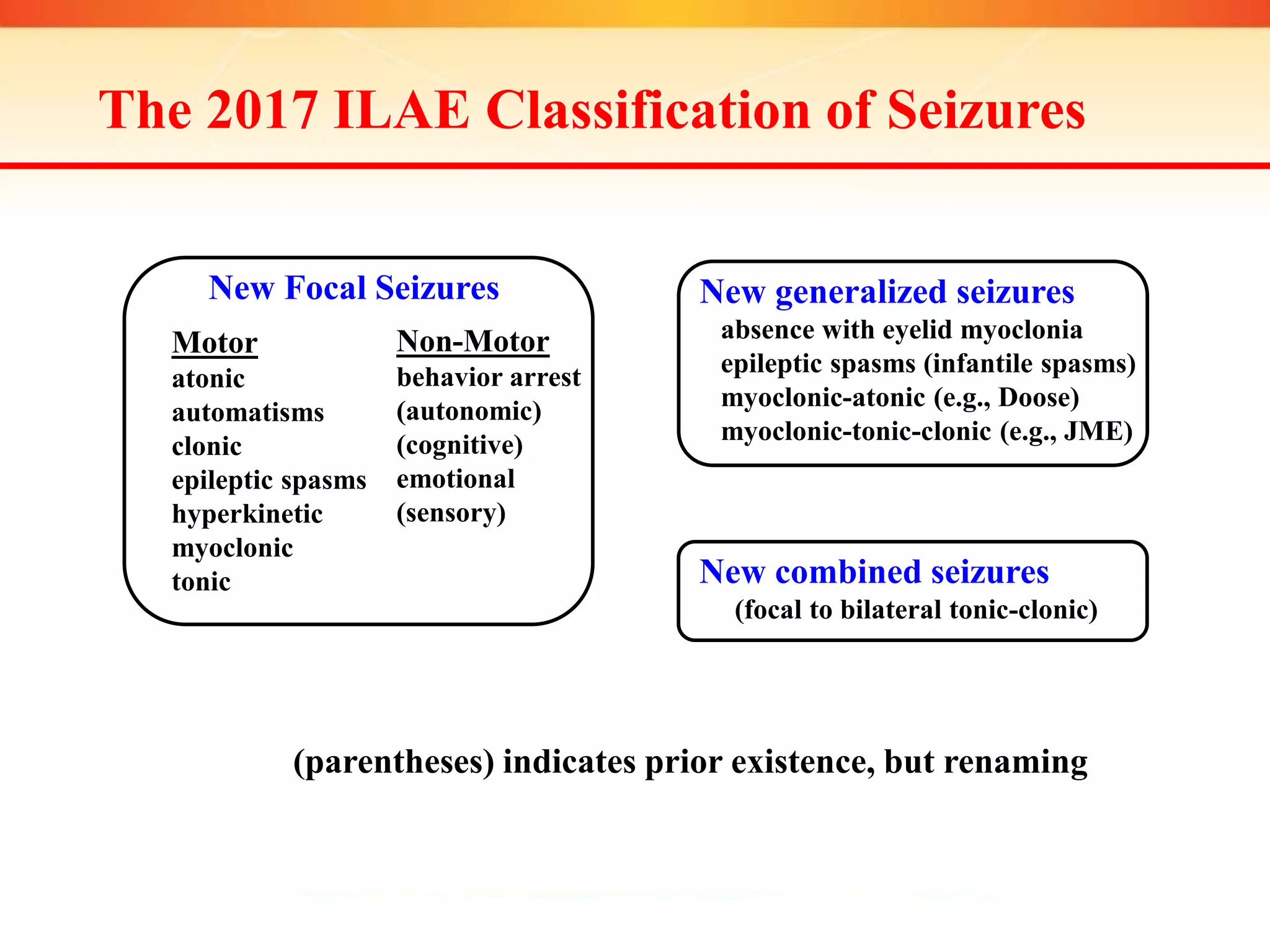
New generalized seizures
absence with eyelid myoclonia
epileptic spasms (infantile spasms)
myoclonic-atonic (e.g., Doose)
myoclonic-tonic-clonic (e.g., JME)
New combined seizures
(focal to bilateral tonic-clonic)
Non-Motor
behavior arrest
(autonomic)
(cognitive)
emotional
(sensory)
Motor
atonic
automatisms
clonic
epileptic spasms
hyperkinetic
myoclonic
tonic
New Focal Seizures
(parentheses) indicates prior existence, but renaming
The 2017 ILAE Classification of Seizures
O L D T E R M N E W T E R M
Unconscious (still used, not in name) Impaired awareness (surrogate)
Partial Focal
Simple partial Focal aware
Complex partial Focal impaired awareness
Dyscognitive (word discontinued) Focal impaired awareness
Psychic Cognitive
Secondarily generalized tonic-clonic Focal to bilateral tonic-clonic
Arrest, freeze, pause, interruption Behavior arrest
Wording Changes
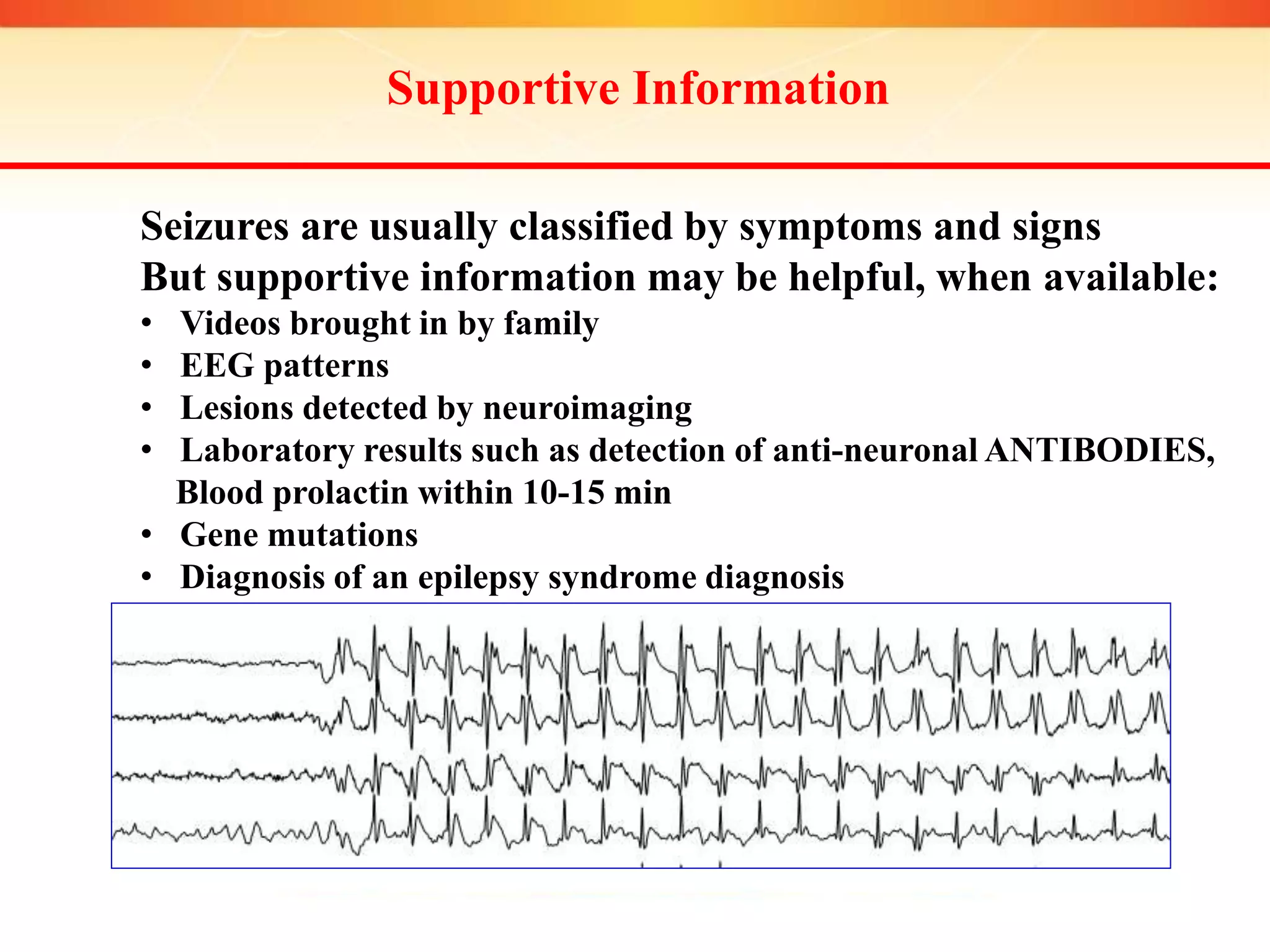
Supportive Information
Seizures are usually classified by symptoms and signs
But supportive information may be helpful, when available:
• Videos brought in by family
• EEG patterns
• Lesions detected by neuroimaging
• Laboratory results such as detection of anti-neuronal ANTIBODIES,
Blood prolactin within 10-15 min
• Gene mutations
• Diagnosis of an epilepsy syndrome diagnosis

Tips for treatment of childhood epilepsy

  • 1.
    By DR.Hussein Abdeldayem, MD Professorof Pediatric Neurology Unit , Alex University Member of : AAN, ICNA, ACNA
  • 2.
  • 3.
  • 4.
    Never restrain thechild or place anything in the mouth
  • 6.
  • 7.
    7 1. Epilepsy withbrain dysfunction (2ry) MOSTLY RESISTANT as GDD, CP, postmeningitis ,etc Prevalence up to 30-50% Often intractable Often mixed Frequency and severity are proportion of degree of the disorder CT/MRI Treatment is challenging BROAD SPECTRUM AED POLYTHERAPY NEUROPROTECTIVE ANTIEPILEPTOGENIC
  • 8.
    8 70% RelapseFull response AED TherapyResponse Classification Partial intractable
  • 9.
    9 2. NOT ALLABN EEG IS EPILEPSY OR FOR AED
  • 10.
    10  5- 10%of normal persons have abnormal EEG  10% of non epileptic persons have abnormal EEG  Migraine  Anxiety  Depression  FC  BHS  Tension child  ADHD
  • 11.
    11 Up to 30%of epileptic patients with normal EEG  30-60 minutes  Sleep deprivation,  HV,  IPS  Generalized slowing activity
  • 12.
    12  One normalEEG does not exclude epilepsy  A second EEG performed during sleep in sleep deprived patients reveals epileptiform abnormalities in half of patients whose first EEG was normal
  • 13.
    13 3. When EEGis of valuable?  Same day  After 2 weeks from the attack  After 4 weeks from the attack
  • 14.
    14  EEG ismost valuable within 24 h of the seizure Arch Neurol. 2010 Jul 12. Optimizing Electroencephalographic Studies for Epilepsy Diagnosis in Children With New-Onset Seizures.
  • 15.
    15 Describe EEG. ?Possible diagnosis Drug of Choice?
  • 16.
    16 Describe EEG ?possiblediagnosis Drug of choice ?
  • 17.
    Some Seizure Onsetscan be Focal or Generalized Focal Onset Generalized Onset atonic clonic epileptic spasms myoclonic tonic tonic-clonic atonic clonic epileptic spasms myoclonic tonic tonic-clonic
  • 18.
    Classification according toEEG findings. ILAE 1981 Generalized Focal Both Cerebral Hemispheres Only a part of a hemisphere Loss of Consciousness No loss of consciousness Treated by Valproate Treated by Carbamazipine MRI Focal with 2ry G
  • 19.
    Motor Tonic-clonic Other motor Non-Motor (Absence) UnknownOnset Motor Non-Motor focal to bilateral tonic-clonic Generalized OnsetFocal Onset Motor Tonic-clonic Other motor Non-Motor ILAE 2017 Classification of Seizure Types Basic Version 1 Unclassified 2 1 Definitions, other seizure types and descriptors are listed in the accompanying paper & glossary of terms 2 Due to inadequate information or inability to place in other categories Aware Impaired Awareness From Fisher et al. Instruction manual for the ILAE 2017 operational classification of seizure types. Epilepsia doi: 10.1111/epi.13671
  • 20.
    Motor tonic-clonic clonic tonic myoclonic myoclonic-tonic-clonic myoclonic-atonic atonic epileptic spasms2 Non-Motor (absence) typical atypical myoclonic eyelidmyoclonia Unknown Onset Motor Onset automatisms atonic2 clonic epileptic spasms2 hyperkinetic myoclonic tonic Non-Motor Onset autonomic behavior arrest cognitive emotional sensory focal to bilateral tonic-clonic Generalized OnsetFocal Onset Aware Impaired Awareness Motor tonic-clonic epileptic spasms Non-Motor behavior arrest ILAE 2017 Classification of Seizure Types Expanded Version1 Unclassified3 1 Definitions, other seizure types and descriptors are listed in the accompanying paper and glossary of terms. 2 These could be focal or generalized, with or without alteration of awareness 3 Due to inadequate information or inability to place in other categories From Fisher et al. Instruction manual for the ILAE 2017 operational classification of seizure types. Epilepsia doi:
  • 21.
    GENERALIZED FITS Focal Fits Focalwith 2ry generalization FITS Absence – Myoclonic - ES
  • 22.
    22 4. Do youask for Brain CT or MRI? When?
  • 23.
    23 Brain CT/MRI 1. everypatient with a newly diagnosed focal epilepsy should undergo CT/MRI 2. RESISTANT EPILEPSY 3. SECONDARY EPILEPSY
  • 24.
    24  Identify structuralcauses of epilepsy as cortical malformation, traumatic brain injury, brain cyst or tumour, and cerebrovascular disease  Repeat MRI in case of drug-resistant epilepsy as a first step to explore surgical options
  • 25.
    WHEN U STARTAED ?  AFTER ONE SEIZURE  AFTER TWO SEIZURES IN SAME DAY  AFTER TWO SEIZURES WITH ONE DAY APART  AFTER THREE SEIZURES SAME DAY  AFTER THREE SEIZURES A DAY APART 25
  • 26.
    In adults ,after one attack Because of • Driving • Employability
  • 27.
    27 Practical points Aim :to stop attacks  Monotherapy avoid polytherapy  Treat fits but not blood serum level  Start with minimal dose and increase gradually  Stop if side effects appeared  Don’t ask for SGOT ..ONLY If suspect hepatic dysfunction so ask for SGPT  Don’t withdraw AED suddenly but gradually Treatment
  • 28.
    Compliance : dose, cost,availability 28
  • 29.
    29 Principles of drugusage  Monotherapy  Least dosage  First choice  Compliance: cost, dosage division, formula  Least S/E especially cognitive functions
  • 30.
    30 Impact of DosingFrequency on Compliance Cramer JA, et al. JAMA. 1989;261:3273-3277. 20 40 60 80 100 Patients(%) QD BID TID QID 87% 81% 77% 39% EpilepsyIn epilepsy patients  Higher compliance rates are associated with once- or twice daily dosing  Noncompliance with AEDs is a major factor in:  Breakthrough seizures  Recurrence of seizures N=24 patients followed for 2 to 37 weeks. increase till max ( or S/E) before changing to other AED
  • 31.
    31 5. WHEN TOWithdrawal of AED?  After 2 years of last attack REGARDELESS EEG ?  withdraw over 3 months  Same period of AED if it will recur  ?? 2ry epilepsy
  • 32.
    32 AEDs  First-generation AEDsinclude: phenobarbital, phenytoin, carbamazepine, valproic acid, clonazepam, and primidone  Since early 1990’s: lamotrigine, gabapentin, oxcarbazepine, levetiracetam, divalproex sodium, topiramate, zonisamide, vigabatrin, tiagabine, and felbamate  The latest AEDs to become available are pregabalin, lacosimide, and rufinimide.
  • 33.
    6.WHICH ? BROAD SPECTRUMIS THE EASIEST 33
  • 34.
    34 AE S/E 5+1  CNSS/E  GIT S/E  Dermal S/E  BM S/E  Teratogenic  Specific S/E
  • 35.
    35 CARBAMAZEPINE S/E LMT espwith VPA  Skin rash: UP TO ST J SYNDROME ESPECIALLY WITH?
  • 36.
  • 37.
    Levetiracetam  Dose  Children:weight/10 ( ml) twice ,MAXIMUM x3  {20 – 60 mg/kg/d}  Therapeutic plasma concentration  Not relevant  Indicated for NEARLY ALL  Comments  No drug interactions described
  • 38.
     Forms: Oral: (100mg/1ml) 250,500, 1000 mg tablets AMPOULES  Blood Follow up: NONE  Onset of action 24-48HRS  Monotherapy or Add on, no drug interaction (Levetiracetam)
  • 39.
    January 26, 2012 FDAapproval for levetiracetam in infants and children from one month of age with partial onset seizures
  • 40.
     Quick onsetof action  No cognitive S/E  Bind specific CNS areas only as hippocampus  Not liver metabolism, not protein binding so not interact with other AED The starting dose of 20mg/kg/day was increased at intervals of 1 week by 10mg/kg/day, if necessary, up to a maximum dose of 60mg/kg/day. Steady state: 8hX5
  • 41.
     Quick onsetof action  No cognitive S/E  Not liver metabolism, not protein binding so not interact with other AED Steady state: 8hX5
  • 42.
    42 Childhood Pharmako-dinamic 1- absorption: ↑ fast 2- distribution: ↓ protein binding* 3- metabolism: ↑ 4- excretion: ↑ clearance So higher dose > adults
  • 43.
    43 Levetiracetam LVT  Bindspecific CNS areas only as hypocampus  Pathogenesis: SV2A* binding site so prevent vesicles release of its stimulant contents  Not liver metabolism, not protein binding so not interact with other AED
  • 44.
    Advantages  Broad spectrum Not interfere with other AEDs  Same day effect  Prophylaxis after brain operation  Prophylaxis after HIE  Anti-epileptogenic  Neuroprotective  No cognitive S/E 44
  • 45.
    NEUROPROTECTIVE LVT  INHIE / NEWBORN /PREMATURE  POST BRAIN SURGICAL TREATMENT  POST I C HGE  NON CLINICAL SEIZURES AS AUTISM 45
  • 47.
  • 48.
  • 49.
  • 50.
  • 51.
  • 52.
  • 53.
  • 54.
  • 55.
    55 Q & A CBZ,  oxcarbazepine  Phenytoin  Gabapentin May not work or may even exacerbate absence or myoclonic seizures
  • 56.
  • 57.
  • 58.
  • 59.
  • 60.
    60 Q & A LEV (levetiracetam) Useful for both partial and generalized absence or myoclonic seizures and unclassifiable seizures ? LVT for absence
  • 61.
  • 62.
  • 63.
  • 64.
  • 65.
  • 66.
    66 ADD On /start with : LVT except absence seizures  GTC  Absence  Myoclonic  ES  ES withTS  Focal ETX,VPA VPA ACTH VIGABATRIN CZP Never CBZ, SUMMARY
  • 67.
  • 68.
  • 69.
    The End “Words, words,words, I’m so sick of words!” Eliza Doolittle, My Fair Lady
  • 70.
    Partial Seizures (startin one place) Simple (no loss of consciousness of memory) Sensory Motor Sensory-Motor Psychic (abnormal thoughts or perceptions) Autonomic (heat, nausea, flushing, etc.) Complex (consciousness or memory impaired) With or without aura (warning) With or without automatisms Secondarily generalized Generalized Seizures (apparent start over wide areas of brain) Absence (petit mal) Tonic-clonic (grand mal) Atonic (drop seizures) Myoclonic Other Unclassifiable seizures Dreifuss et al. Proposal for revised clinical and electroencephalographic classification of epileptic seizures. From the Commission on Classification and Terminology of the International League Against Epilepsy. Epilepsia. 1981;22:489-501. INTERNATIONAL CLASSIFICATION OF SEIZURES 1981
  • 71.
    New generalized seizures absencewith eyelid myoclonia epileptic spasms (infantile spasms) myoclonic-atonic (e.g., Doose) myoclonic-tonic-clonic (e.g., JME) New combined seizures (focal to bilateral tonic-clonic) Non-Motor behavior arrest (autonomic) (cognitive) emotional (sensory) Motor atonic automatisms clonic epileptic spasms hyperkinetic myoclonic tonic New Focal Seizures (parentheses) indicates prior existence, but renaming The 2017 ILAE Classification of Seizures
  • 72.
    O L DT E R M N E W T E R M Unconscious (still used, not in name) Impaired awareness (surrogate) Partial Focal Simple partial Focal aware Complex partial Focal impaired awareness Dyscognitive (word discontinued) Focal impaired awareness Psychic Cognitive Secondarily generalized tonic-clonic Focal to bilateral tonic-clonic Arrest, freeze, pause, interruption Behavior arrest Wording Changes
  • 73.
    Supportive Information Seizures areusually classified by symptoms and signs But supportive information may be helpful, when available: • Videos brought in by family • EEG patterns • Lesions detected by neuroimaging • Laboratory results such as detection of anti-neuronal ANTIBODIES, Blood prolactin within 10-15 min • Gene mutations • Diagnosis of an epilepsy syndrome diagnosis