SUBMITTED TO
PRESENTED BY
Mrs.Premavathy Miss.S.Manju
Lecturer in nursing M.Sc (N) II yr
RMCON, AU RMCON, AU
Introduction
Although often called autism because it is through to
be present from birth, autism usually is not conclusively
diagnosed until after 12 months of age. The word
autism comes from the Greek word auto meaning “self”
and was first used by Dr.Leo Kanner in 1943 to describe
a group of behavioral symptoms in children. The term
pervasive developmental disorder was introduced in
1980 when the American psychiatric association revised
the terminology. Disorders in this category are
characterized by severe behavioral disturbance that
affects the practical use of language as a means of
communication, interpersonal interaction, attention,
perception, and motor activity.
Definition
Infantile autism is a pervasive developmental
disorder characterized by (1) a total lack of
responsiveness to people, (2) gross language
developmental deficits or distortions such as
echolalia ( a meaningless echoing of words),
pronominal reversal and metaphoric language , and
(3) bizarre responses to various aspects of the
environment such as resistance to change or peculiar
interest in an animate or inanimate object.
American Psychiatric Association (1980)
Incidence
Autism occurs in about 2- 5 of 10,000 births in 1980.
1 to 2 in 500 children in 2008.
Four times as often in males as in females and it has
higher incidence in first born males from well educated.
Etiology
Genetic Factors
Twins is consistent with an autosomal recessive pattern
of inheritance.
Very high concordance (60% - 90%) for monozygotic
(identical).
Less than 5% concordance for dizygotic (nonidentical)
twins.
Etiology contd…
Deletion and duplication in chromosome 15
Thimerosal – containing neither vaccines nor the measles
– mumps rubella (MMR) vaccine.
Maternal vaginal infection during pregnancy
Anorexia during pregnancy and delivery
Bio chemical problem involving neurotransmitters or
abnormalities in the central nervous system with
dopamine, catecholamine, and serotonin levels or
pathways implicated.
Language and cognitive abnormalities are common in
relatives of autistic children.
Pre or post natal brain injury
Associated conditions
 Fragile X syndrome
 Tuberous sclerosis(autosomal dominant)
 Metabolic disorders( PKU – autosomal recessive)
 Fetal rubella syndrome
 Haemophilus influenza meningitis
 Structural brain abnormalities
 Encephalitis
 Neonatal hyperbilirubinemia
Pathophysiology
Due to disturbance in the cerebral cortex
The occurrence of seizures more frequently in autistic children
than in normal population
Initial NMR (Nuclear Magnetic Resonance) spectroscopic studies,
PET and neurological studies have shown abnormalities in partial
and frontal association cortex
 Cerebellar hypoplasia
 Purkinje neuronal loss
 Loss of Cerebellar granule cells
 Loss of cells in Cerebellar nuclei
These finding should be considered preliminary of autism
Clinical Manifestations
Speech and language delay
Impairment of comprehension of language
Obviously limited activities and interest
Fluent but unintelligible jargon
Impairment of social interaction
Poor eye contact
Gaze avoidance
Lack of reciprocal social smile
Lack of imaginative play
Hyperactivity
Unusual interest in TV commercials
Repetitive compulsive play activities such
as spinning an object, flipping electrical switch on and off
Rocking
Clinical
Manifestations
contd…
Flapping of hands
Twirling
Toe walking
Violent tempertandrum
Irritable
Chronically unhappy
Making the parents life
absolutely miserable and
unbearable
Seizures
Totally lack of response to
other people
Differential Diagnosis
 Mental retardations
 Developmental language disorders high
functioning in autistic childrens
 Schizophrenia
 Asperger’s syndrome
 Rett’s syndrome
Diagnostic Evaluation
History collection
Collect natal and post natal history, including
developmental, nutrition and family dynamics.
Physical examination and neurological examination
needed. Including vision and hearing test, speech, and
language, psychological, educational, and psychiatric
evaluations important.
Electroencephalography when the seizure is present.
Neuroimaging – CT scans
MRI, PET
Radiographic studies of the skull.
Laboratory studies.
Urine screening
Diagnostic Criteria For Autistic
Spectrum Disorder
Total six (or more) items from (1), (2), and (3), with at least
two from (1), and one each from (2) and (3).
Quantitative impairment in social interaction, as
manifested by at least two of the following.
(a). Marked impairment in the use of multiple non verbal
behaviors such as eye to eye gaze, facial expression, body
postures, and gestures, to regulate social interactions.
(b). Failure to develop peer relationship appropriate to
developmental level.
(c).A lack of spontaneous seeking to share enjoyment,
interests, or achievements with other people (e.g. by a lack
of showing, bringing, or pointing out objects of interest)
(d).Lack of social or emotional reciprocity.
Diagnostic Criteria For Autistic
Spectrum Disorder
(2).Qualitative impairments in communication as manifested
by at least one of the following:
(a). delay in , or total lack of, the development of spoken
language( not accompanied by an attempt to compensate
through alternative modes of communication such as
gesture mime).
 (b). in individual with adequate speech, marked
impairment in the ability to initiate or sustain a conversation
with others.
 (c). stereotyped and respective use of language or
idiosyncratic language.
 (d).lack of varied, spontaneous make – believe play or
social imitative play appropriate to developmental level
(3).Restricted repetitive and stereotyped patterns of
the behavior, interests, and activities, as manifested
at least one of the following
(a). Encompassing preoccupation with one or
more stereotyped and restricted pattern of interest
that is abnormal either in intensity or focus
(b).Apparently inflexible adherence to specific,
non functional routines or rituals
(c). stereotyped and repetitive motor
mannerisms (e.g, hand or finger flapping or twisting,
or twisting, or complex whole – body movements)
(d). persistent preoccupation with parts of
objects.
B. Delay or abnormal functioning in at least one
of the following areas, with onset before age
3 years; (1) social interaction, (2) language as
used in social communication, or (3) symbolic
or imaginative play
C. The disturbance is not better accounted for
by rett disorder or child hood disintegrative
disorder.
Team Members Involved In
Autistic Child Treatment
 Audiologist
 Psychiatrist
 Psychologist
 Special education teachers
 Speech and language therapist
 Social workers
Drug Management
Neuroleptics – Risperidone, Olanzapine.
Clomipramine - a tricycle
antidepressant with serotonin reuptake
inhibitor action.
Serotonin reuptake inhibitor and
clonidine
Drugs are used for control of seizure and
hyperactivity.
Promotion of normal
development
Specific language
Social interaction
Learning
Individual
psychotherapy
NURSING MANAGEMENT
GOALS;
(1). To meet the basic human needs:
To meet hydration, nutrition, elimination, and rest.
These children cannot verbally communicate these needs.
The nurse needs to be aware of them and to set up a routine
for the basic care.
(2). To help them from a relationship with another person.
They should assigned a primary nurse with a regular schedule
The primary nurse can use behavior modification to begin to
reward the children for eye contact or other signs of
relatedness.
The nurse should plan deliberate intrusions into their solitude
to force beginning of social interaction.
(3). To help them establish a means of communication.
 To begin by using sign language.
 These children do not use words to communicate
 These children to establish a means of communication
without the extreme frustration of trying to use the
words.
(4). To prevent them from harming themselves or others.
 The nurse may have prescribed medication such as
chlorpromazine or thioridine
 Physical restraint to prevent such behavior.
FAMILY SUPPORT
Nurse can alleviate the guilt and shame often associate
with this disorder by stressing what is known by a biological
standpoint, as well as how little is known about the causes
of Autism.
Parent need to counseling early
Society provides information on education, treatment
programs and techniques,
There is also a sibling group called SHARE(sibling helping
persons with autism through resources and energy).
Family support programme
Families are often able to provide home care and assist with
the educational services the child needs.
The family may require assisting in locating a long – term
placement facility.
HOME CARE STUTTERING IN YOUNG
CHILDREN
Giving the child plenty of time and the impression that you
are not rushed or in a hurry.
Looking directly at the child while he or she is talking,
being patient and never ridiculing.
Setting a good example by speaking clearly and
articulating well.
Identifying situation when sturrering increases and
avoiding them or ignoring the hesitancy.
Minimizing stress, such as talking at the child’s eye level.
Avoiding frequent questions to prevent interruption while
child speaking.
Provide positive reinforcement
COURSE AND PROGNOSIS
 Prognosis of infantile autism is very poor.
 Factors favorable to a good prognosis are
normal intelligence, good communicative
skills (speech and language) at onset, and
absence of seizure.
 One in six of these children makes a adequate
social adjustment and is able to do some kind
of work by adulthood.
ATTENTION DEFICIT
HYPERACTIVITY DISORDER
CONTD. . .Introduction
 This disorder is characterized by poor ability to attend
to a task, motoric overactivity, and impulsivity. These
children are fidgety, have a difficult time remaining in
their seats in school, are easily distracted, have
difficulty awaiting their turn(impulsive blurt out
answers to questions), have difficulty following
instructions and sustaining attention, shift rapidly from
one uncompleted activity to another, talk excessively,
intrude on others, often seem not to listen to what is
being said, lose item regularly, and often engage in
physical dangerous activities without considering
possible consequences.
ATTENTION DEFICIT
HYPERACTIVITY DISORDER
CONTD. . .Definition
ADHD is defined as a
“persistent pattern of
inattention, hyperactivity
and impulsivity, that is
more frequent and severe
than is typically observed
at a comparable level of
development”.
ATTENTION DEFICIT
HYPERACTIVITY DISORDER
CONTD. . .Incidence
 ADHD affect 3- 4% of children in the USA.
 Boys are more affected than girls in a 6:1 ratio. ADHD
persists into adolescence and adult life.
 Age of onset is usually before 4 years but diagnosis is
made around 3- 4 years of age.
 Statistical data is not available for the Indian children,
experts agree that is roughly the same percentage as in
the western population.
Prevalence
 American academy of child and adolescent psychiatry
estimates10% in boys and 5% in girls of elementary
school age.
ATTENTION DEFICIT
HYPERACTIVITY DISORDER
CONTD. . .Etiology
 Genetic component
 Psychological issues and
neurodevelopmental insult
 Minimal brain damage
 Excess sugar or food additives (5%)
Predisposing factors
 Developmental disorders
 Alcohol abuse
 Conduct disorder
 Antisocial personality disorders have
been shown to be more common in 1st
degree relatives of children with ADHD
than in the general population.
ATTENTION DEFICIT
HYPERACTIVITY DISORDER
CONTD. . .Pathophysiology
Scientist have used PET( position emission
tomography) scanner to observe the brain at
work and have concluded that brain areas which
control attention use less glucose intake in
these parts of the brain which control attention
is proved to beneficial in some children.
Therefore, this is probably an acceptable theory
of the cause of ADHD.
ATTENTION DEFICIT
HYPERACTIVITY DISORDER
CONTD. . .Clinical manifestations
 Aggression and fears
 Poor relationship with peers
 Academic difficulty
 Anxiety disorder
 Academic difficulty
 Behavioral problems at school
Infancy
 “colicky,” temperamental difficulty
 Overactive from a very earlier age
 Sleep and feeding abnormalities
ATTENTION DEFICIT
HYPERACTIVITY DISORDER
CONTD. . .Clinical manifestations contd…
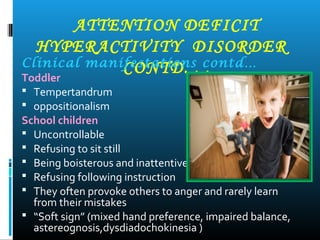
Toddler
 Tempertandrum
 oppositionalism
School children
 Uncontrollable
 Refusing to sit still
 Being boisterous and inattentive
 Refusing following instruction
 They often provoke others to anger and rarely learn
from their mistakes
 “Soft sign” (mixed hand preference, impaired balance,
astereognosis,dysdiadochokinesia )
ATTENTION DEFICIT
HYPERACTIVITY DISORDER
CONTD. . .The diagnosis of ADHD is based on the modified criteria of DSM- IV
on hyperactivity, impulsivity and attention deficit , Either (1) or (2)
Inattentions: At least six of the following symptoms to Inattention
leave persisted for at least six months to a degree that is
maladaptative and inconsistent with developmental level.
 Clearless errors, inattentive to details
 Sustains attention poorly
 Appears to be not listening
 Follows through poorly on obligations
 Disorganized
 Avoids or dislikes sustained mental effort
 Losses needed objects
 Forgetful
ATTENTION DEFICIT
HYPERACTIVITY DISORDER
CONTD. . .Hyperactivity/Impulsivity
 Fidgets or squirms
 Cannot stay seated
 Restlessness
 Loud, noisy
 Always “on the go”
 Talks excessively
 Blurts out
 Impatient
 intrusive
ATTENTION DEFICIT
HYPERACTIVITY DISORDER
CONTD. . . Some studies suggested that
hyperactivity children have higher
verbal score than performance
scores on the weschsler intelligence
scale and lower scores on the
attention concentration subtest.
 Psychometric test should cover four
essential areas language skills,
visuospatial skills, sequential analytic
skills, and motor planning and
execution skills.
ATTENTION DEFICIT
HYPERACTIVITY DISORDER
CONTD. . .
Differential Diagnoses
Medical conditions
 Hearing loss
 Thyroid dysfunction
 Visual disturbances
 Seizures disorders
 Allergic conditions
Mental disorders
 Oppositional defiant disorder
 Conduct disorder
 Anxiety and depressive disorder
 Pervasive developmental disorder
 Obsessive compulsive disorder
 Schizophrenia
ATTENTION DEFICIT
HYPERACTIVITY DISORDER
CONTD. . . 
Management (Medical treatment)
 Methylphenidate is commonly used stimulant 0.3 – 1.0 
mg/kg. It generally has an effect for 2 - 4 hr. Studies of 
plasma levels suggest that a dose of 0.3 mg/kg helps to 
improve attention. Whereas amelioration of behavior 
problems requires 0.7 mg/kg. it should be given at least 2- 3 
weeks.
 Dextroamphetamine 0.2 – 0.5 mg/kg .both drug should be 
given about 20 – 30 min before meals to avoid deactivation. 
They should not be given after 4.00 pm to avoid insomnia.
 Magnesium pemoline initial dose 18.75 mg later half tablet 
per week. 
ATTENTION DEFICIT
HYPERACTIVITY DISORDER
CONTD. . .
Other Treatment
 Cognitive  - behavioral  therapy
 Individual psychotherapy
 Parent training or education
 Social skills training
 Biofeedback
 Relaxation treatment 
ATTENTION DEFICIT HYPERACTIVITY
DISORDER CONTD. . .
Home Management
 These children need to be provide with outdoor activities
 Play with minimal instruction would be beneficial.
 These children need to organize to get adequate sleep and 
rest.
 A structured home schedule for daily activities like wakeup 
time, meal time, bed time etc.
 These children need a carefully planned discipline to be 
followed. Aggressive behavior should not be tolerated all risk 
must be enforced with non – physical punishment.
 Overwhelming situation such as big gatherings should be 
avoided till child learn to control himself.
 Structured behavioral modification program for increasing 
attention span, proper discipline should be adopted.
 Child on special program in school would be beneficial.
ATTENTION DEFICIT
HYPERACTIVITY DISORDER
CONTD. . .Dietary Management
 The idea that behavior disorder may be caused by 
food is largely suggested by Dr. Femigoid. He saw 
30 – 50% of hyperactivity children show a significant 
improvement when placed on a special elimination 
program of avoiding naturally occurring salicylates 
and artificial food additives particularly 
predetermine predisposition. 
 Although this has not been conclusively proved, it is 
worthwhile trying a diet based on wholesome food 
and avoiding foods with artificial color or flavor.
ATTENTION DEFICIT
HYPERACTIVITY DISORDER
CONTD. . .Nursing Management
 Impaired social interaction related to aggressive 
behavior
 Anxiety related to confusion about one’s own 
behavior
 Hyperactivity related to increase intake of glucose 
rich diet
 Ineffective coping mechanism related to behavior 
problem
 Bodily injury related to violence behavior due to 
aggressive behavior
 Sleep pattern disturbance related to hyperactivity
 Knowledge deficit regarding treatment regiment
ATTENTION DEFICIT
HYPERACTIVITY DISORDER
CONTD. . .Impaired social interaction related to
aggressive behavior
Interventions
 Assess the level of condition of the child aggressive behavior.
 Enhance the child to engage in normal daily activities to 
reduced hyperactivity and attentenion deficits. 
 Involve the child in play activity as like as normal child to 
reduce the fear.
 Allows the child to interact the peer groups.
 Provide lovable care to the child and maintain good 
conversation to the child.
 Provide behavior therapy to the child.
ATTENTION DEFICIT
HYPERACTIVITY DISORDER
CONTD. . .Hyperactivity related to increase
intake of glucose rich diet
Interventions
 Reduced the child diet pattern of high rich glucose diet.
 A structured home schedule for daily activities like 
wakeup time, meal time, bed time etc.
 Provide calm environment to the child
 These children need a carefully planned discipline to be 
followed. Aggressive behavior should not be tolerated all 
risk must be enforced with non – physical punishment
 Provide Parent training or education
 Psychological therapy should provide the child
ATTENTION DEFICIT
HYPERACTIVITY DISORDER
CONTD. . .Sleep pattern disturbance related to
hyperactivity
Interventions
 Provide the child to get adequate sleep and rest.
 Provide calm and quite environment to the child
 Before bed provide cup of milk to promote sleep 
pattern.
 Nutritional need should fulfill the child before bed 
time
 Parents should follow the regular time for food and 
sleep.
ATTENTION DEFICIT
HYPERACTIVITY DISORDER
CONTD. . .Knowledge deficit regarding
treatment regiment
Interventions
 Educate parents about the disease condition of the 
ADHD, and current treatment facilities of ADHD.
 Allow them to ask the doubts in the disease 
condition
 Provide psychological support to the child.
 Provide Parent training or education.
 Educate about low rich glucose diet benefits to the 
parents. 
 
ATTENTION DEFICIT
HYPERACTIVITY DISORDER
CONTD. . .complications
                                                                                                                                  criminal                             
                               
                                                                                                                                   behavior
                                                                                                                                    school                              
        
                                                                                                                                   exclusion
                                  challenging                  oppositional                  substance     
                                          behavior                          deficient                              misuse
   
              ADHD                                                                                                       teenage
                     Only         poor social skills         low self esteem            pregnancy                            
                                                                     
                                         Learning difficulties                                                conduct
                                                                                                                                  disorder
                                                                                         lack of 
                                                                                       motivation
ATTENTION DEFICIT
HYPERACTIVITY DISORDER
CONTD. . .prognosis
 Some anecdotal studies propose that 
hyperactivity continues into adolescence and 
adulthood and is associated with adult 
alcoholism, sociopathy, and hysteria.
 Other studies strongly suggested that 
hyperactivity children do well in adulthood if 
they are successfully employed

Adhd, autism

  • 2.
    SUBMITTED TO PRESENTED BY Mrs.PremavathyMiss.S.Manju Lecturer in nursing M.Sc (N) II yr RMCON, AU RMCON, AU
  • 3.
    Introduction Although often calledautism because it is through to be present from birth, autism usually is not conclusively diagnosed until after 12 months of age. The word autism comes from the Greek word auto meaning “self” and was first used by Dr.Leo Kanner in 1943 to describe a group of behavioral symptoms in children. The term pervasive developmental disorder was introduced in 1980 when the American psychiatric association revised the terminology. Disorders in this category are characterized by severe behavioral disturbance that affects the practical use of language as a means of communication, interpersonal interaction, attention, perception, and motor activity.
  • 4.
    Definition Infantile autism isa pervasive developmental disorder characterized by (1) a total lack of responsiveness to people, (2) gross language developmental deficits or distortions such as echolalia ( a meaningless echoing of words), pronominal reversal and metaphoric language , and (3) bizarre responses to various aspects of the environment such as resistance to change or peculiar interest in an animate or inanimate object. American Psychiatric Association (1980)
  • 5.
    Incidence Autism occurs inabout 2- 5 of 10,000 births in 1980. 1 to 2 in 500 children in 2008. Four times as often in males as in females and it has higher incidence in first born males from well educated. Etiology Genetic Factors Twins is consistent with an autosomal recessive pattern of inheritance. Very high concordance (60% - 90%) for monozygotic (identical). Less than 5% concordance for dizygotic (nonidentical) twins.
  • 6.
    Etiology contd… Deletion andduplication in chromosome 15 Thimerosal – containing neither vaccines nor the measles – mumps rubella (MMR) vaccine. Maternal vaginal infection during pregnancy Anorexia during pregnancy and delivery Bio chemical problem involving neurotransmitters or abnormalities in the central nervous system with dopamine, catecholamine, and serotonin levels or pathways implicated. Language and cognitive abnormalities are common in relatives of autistic children. Pre or post natal brain injury
  • 7.
    Associated conditions  FragileX syndrome  Tuberous sclerosis(autosomal dominant)  Metabolic disorders( PKU – autosomal recessive)  Fetal rubella syndrome  Haemophilus influenza meningitis  Structural brain abnormalities  Encephalitis  Neonatal hyperbilirubinemia
  • 8.
    Pathophysiology Due to disturbancein the cerebral cortex The occurrence of seizures more frequently in autistic children than in normal population Initial NMR (Nuclear Magnetic Resonance) spectroscopic studies, PET and neurological studies have shown abnormalities in partial and frontal association cortex  Cerebellar hypoplasia  Purkinje neuronal loss  Loss of Cerebellar granule cells  Loss of cells in Cerebellar nuclei These finding should be considered preliminary of autism
  • 9.
    Clinical Manifestations Speech andlanguage delay Impairment of comprehension of language Obviously limited activities and interest Fluent but unintelligible jargon Impairment of social interaction Poor eye contact Gaze avoidance Lack of reciprocal social smile Lack of imaginative play Hyperactivity Unusual interest in TV commercials Repetitive compulsive play activities such as spinning an object, flipping electrical switch on and off Rocking
  • 10.
    Clinical Manifestations contd… Flapping of hands Twirling Toewalking Violent tempertandrum Irritable Chronically unhappy Making the parents life absolutely miserable and unbearable Seizures Totally lack of response to other people
  • 12.
    Differential Diagnosis  Mentalretardations  Developmental language disorders high functioning in autistic childrens  Schizophrenia  Asperger’s syndrome  Rett’s syndrome
  • 13.
    Diagnostic Evaluation History collection Collectnatal and post natal history, including developmental, nutrition and family dynamics. Physical examination and neurological examination needed. Including vision and hearing test, speech, and language, psychological, educational, and psychiatric evaluations important. Electroencephalography when the seizure is present. Neuroimaging – CT scans MRI, PET Radiographic studies of the skull. Laboratory studies. Urine screening
  • 14.
    Diagnostic Criteria ForAutistic Spectrum Disorder Total six (or more) items from (1), (2), and (3), with at least two from (1), and one each from (2) and (3). Quantitative impairment in social interaction, as manifested by at least two of the following. (a). Marked impairment in the use of multiple non verbal behaviors such as eye to eye gaze, facial expression, body postures, and gestures, to regulate social interactions. (b). Failure to develop peer relationship appropriate to developmental level. (c).A lack of spontaneous seeking to share enjoyment, interests, or achievements with other people (e.g. by a lack of showing, bringing, or pointing out objects of interest) (d).Lack of social or emotional reciprocity.
  • 15.
    Diagnostic Criteria ForAutistic Spectrum Disorder (2).Qualitative impairments in communication as manifested by at least one of the following: (a). delay in , or total lack of, the development of spoken language( not accompanied by an attempt to compensate through alternative modes of communication such as gesture mime).  (b). in individual with adequate speech, marked impairment in the ability to initiate or sustain a conversation with others.  (c). stereotyped and respective use of language or idiosyncratic language.  (d).lack of varied, spontaneous make – believe play or social imitative play appropriate to developmental level
  • 16.
    (3).Restricted repetitive andstereotyped patterns of the behavior, interests, and activities, as manifested at least one of the following (a). Encompassing preoccupation with one or more stereotyped and restricted pattern of interest that is abnormal either in intensity or focus (b).Apparently inflexible adherence to specific, non functional routines or rituals (c). stereotyped and repetitive motor mannerisms (e.g, hand or finger flapping or twisting, or twisting, or complex whole – body movements) (d). persistent preoccupation with parts of objects.
  • 17.
    B. Delay orabnormal functioning in at least one of the following areas, with onset before age 3 years; (1) social interaction, (2) language as used in social communication, or (3) symbolic or imaginative play C. The disturbance is not better accounted for by rett disorder or child hood disintegrative disorder.
  • 18.
    Team Members InvolvedIn Autistic Child Treatment  Audiologist  Psychiatrist  Psychologist  Special education teachers  Speech and language therapist  Social workers
  • 19.
    Drug Management Neuroleptics –Risperidone, Olanzapine. Clomipramine - a tricycle antidepressant with serotonin reuptake inhibitor action. Serotonin reuptake inhibitor and clonidine Drugs are used for control of seizure and hyperactivity. Promotion of normal development Specific language Social interaction Learning Individual psychotherapy
  • 20.
    NURSING MANAGEMENT GOALS; (1). Tomeet the basic human needs: To meet hydration, nutrition, elimination, and rest. These children cannot verbally communicate these needs. The nurse needs to be aware of them and to set up a routine for the basic care. (2). To help them from a relationship with another person. They should assigned a primary nurse with a regular schedule The primary nurse can use behavior modification to begin to reward the children for eye contact or other signs of relatedness. The nurse should plan deliberate intrusions into their solitude to force beginning of social interaction.
  • 21.
    (3). To helpthem establish a means of communication.  To begin by using sign language.  These children do not use words to communicate  These children to establish a means of communication without the extreme frustration of trying to use the words. (4). To prevent them from harming themselves or others.  The nurse may have prescribed medication such as chlorpromazine or thioridine  Physical restraint to prevent such behavior.
  • 22.
    FAMILY SUPPORT Nurse canalleviate the guilt and shame often associate with this disorder by stressing what is known by a biological standpoint, as well as how little is known about the causes of Autism. Parent need to counseling early Society provides information on education, treatment programs and techniques, There is also a sibling group called SHARE(sibling helping persons with autism through resources and energy). Family support programme Families are often able to provide home care and assist with the educational services the child needs. The family may require assisting in locating a long – term placement facility.
  • 23.
    HOME CARE STUTTERINGIN YOUNG CHILDREN Giving the child plenty of time and the impression that you are not rushed or in a hurry. Looking directly at the child while he or she is talking, being patient and never ridiculing. Setting a good example by speaking clearly and articulating well. Identifying situation when sturrering increases and avoiding them or ignoring the hesitancy. Minimizing stress, such as talking at the child’s eye level. Avoiding frequent questions to prevent interruption while child speaking. Provide positive reinforcement
  • 24.
    COURSE AND PROGNOSIS Prognosis of infantile autism is very poor.  Factors favorable to a good prognosis are normal intelligence, good communicative skills (speech and language) at onset, and absence of seizure.  One in six of these children makes a adequate social adjustment and is able to do some kind of work by adulthood.
  • 26.
    ATTENTION DEFICIT HYPERACTIVITY DISORDER CONTD.. .Introduction  This disorder is characterized by poor ability to attend to a task, motoric overactivity, and impulsivity. These children are fidgety, have a difficult time remaining in their seats in school, are easily distracted, have difficulty awaiting their turn(impulsive blurt out answers to questions), have difficulty following instructions and sustaining attention, shift rapidly from one uncompleted activity to another, talk excessively, intrude on others, often seem not to listen to what is being said, lose item regularly, and often engage in physical dangerous activities without considering possible consequences.
  • 27.
    ATTENTION DEFICIT HYPERACTIVITY DISORDER CONTD.. .Definition ADHD is defined as a “persistent pattern of inattention, hyperactivity and impulsivity, that is more frequent and severe than is typically observed at a comparable level of development”.
  • 28.
    ATTENTION DEFICIT HYPERACTIVITY DISORDER CONTD.. .Incidence  ADHD affect 3- 4% of children in the USA.  Boys are more affected than girls in a 6:1 ratio. ADHD persists into adolescence and adult life.  Age of onset is usually before 4 years but diagnosis is made around 3- 4 years of age.  Statistical data is not available for the Indian children, experts agree that is roughly the same percentage as in the western population. Prevalence  American academy of child and adolescent psychiatry estimates10% in boys and 5% in girls of elementary school age.
  • 29.
    ATTENTION DEFICIT HYPERACTIVITY DISORDER CONTD.. .Etiology  Genetic component  Psychological issues and neurodevelopmental insult  Minimal brain damage  Excess sugar or food additives (5%) Predisposing factors  Developmental disorders  Alcohol abuse  Conduct disorder  Antisocial personality disorders have been shown to be more common in 1st degree relatives of children with ADHD than in the general population.
  • 30.
    ATTENTION DEFICIT HYPERACTIVITY DISORDER CONTD.. .Pathophysiology Scientist have used PET( position emission tomography) scanner to observe the brain at work and have concluded that brain areas which control attention use less glucose intake in these parts of the brain which control attention is proved to beneficial in some children. Therefore, this is probably an acceptable theory of the cause of ADHD.
  • 31.
    ATTENTION DEFICIT HYPERACTIVITY DISORDER CONTD.. .Clinical manifestations  Aggression and fears  Poor relationship with peers  Academic difficulty  Anxiety disorder  Academic difficulty  Behavioral problems at school Infancy  “colicky,” temperamental difficulty  Overactive from a very earlier age  Sleep and feeding abnormalities
  • 32.
    ATTENTION DEFICIT HYPERACTIVITY DISORDER CONTD.. .Clinical manifestations contd… Toddler  Tempertandrum  oppositionalism School children  Uncontrollable  Refusing to sit still  Being boisterous and inattentive  Refusing following instruction  They often provoke others to anger and rarely learn from their mistakes  “Soft sign” (mixed hand preference, impaired balance, astereognosis,dysdiadochokinesia )
  • 33.
    ATTENTION DEFICIT HYPERACTIVITY DISORDER CONTD.. .The diagnosis of ADHD is based on the modified criteria of DSM- IV on hyperactivity, impulsivity and attention deficit , Either (1) or (2) Inattentions: At least six of the following symptoms to Inattention leave persisted for at least six months to a degree that is maladaptative and inconsistent with developmental level.  Clearless errors, inattentive to details  Sustains attention poorly  Appears to be not listening  Follows through poorly on obligations  Disorganized  Avoids or dislikes sustained mental effort  Losses needed objects  Forgetful
  • 34.
    ATTENTION DEFICIT HYPERACTIVITY DISORDER CONTD.. .Hyperactivity/Impulsivity  Fidgets or squirms  Cannot stay seated  Restlessness  Loud, noisy  Always “on the go”  Talks excessively  Blurts out  Impatient  intrusive
  • 35.
    ATTENTION DEFICIT HYPERACTIVITY DISORDER CONTD.. . Some studies suggested that hyperactivity children have higher verbal score than performance scores on the weschsler intelligence scale and lower scores on the attention concentration subtest.  Psychometric test should cover four essential areas language skills, visuospatial skills, sequential analytic skills, and motor planning and execution skills.
  • 36.
    ATTENTION DEFICIT HYPERACTIVITY DISORDER CONTD.. . Differential Diagnoses Medical conditions  Hearing loss  Thyroid dysfunction  Visual disturbances  Seizures disorders  Allergic conditions Mental disorders  Oppositional defiant disorder  Conduct disorder  Anxiety and depressive disorder  Pervasive developmental disorder  Obsessive compulsive disorder  Schizophrenia
  • 37.
    ATTENTION DEFICIT HYPERACTIVITY DISORDER CONTD.. .  Management (Medical treatment)  Methylphenidate is commonly used stimulant 0.3 – 1.0  mg/kg. It generally has an effect for 2 - 4 hr. Studies of  plasma levels suggest that a dose of 0.3 mg/kg helps to  improve attention. Whereas amelioration of behavior  problems requires 0.7 mg/kg. it should be given at least 2- 3  weeks.  Dextroamphetamine 0.2 – 0.5 mg/kg .both drug should be  given about 20 – 30 min before meals to avoid deactivation.  They should not be given after 4.00 pm to avoid insomnia.  Magnesium pemoline initial dose 18.75 mg later half tablet  per week. 
  • 38.
    ATTENTION DEFICIT HYPERACTIVITY DISORDER CONTD.. . Other Treatment  Cognitive  - behavioral  therapy  Individual psychotherapy  Parent training or education  Social skills training  Biofeedback  Relaxation treatment 
  • 39.
    ATTENTION DEFICIT HYPERACTIVITY DISORDERCONTD. . . Home Management  These children need to be provide with outdoor activities  Play with minimal instruction would be beneficial.  These children need to organize to get adequate sleep and  rest.  A structured home schedule for daily activities like wakeup  time, meal time, bed time etc.  These children need a carefully planned discipline to be  followed. Aggressive behavior should not be tolerated all risk  must be enforced with non – physical punishment.  Overwhelming situation such as big gatherings should be  avoided till child learn to control himself.  Structured behavioral modification program for increasing  attention span, proper discipline should be adopted.  Child on special program in school would be beneficial.
  • 40.
    ATTENTION DEFICIT HYPERACTIVITY DISORDER CONTD.. .Dietary Management  The idea that behavior disorder may be caused by  food is largely suggested by Dr. Femigoid. He saw  30 – 50% of hyperactivity children show a significant  improvement when placed on a special elimination  program of avoiding naturally occurring salicylates  and artificial food additives particularly  predetermine predisposition.   Although this has not been conclusively proved, it is  worthwhile trying a diet based on wholesome food  and avoiding foods with artificial color or flavor.
  • 41.
    ATTENTION DEFICIT HYPERACTIVITY DISORDER CONTD.. .Nursing Management  Impaired social interaction related to aggressive  behavior  Anxiety related to confusion about one’s own  behavior  Hyperactivity related to increase intake of glucose  rich diet  Ineffective coping mechanism related to behavior  problem  Bodily injury related to violence behavior due to  aggressive behavior  Sleep pattern disturbance related to hyperactivity  Knowledge deficit regarding treatment regiment
  • 42.
    ATTENTION DEFICIT HYPERACTIVITY DISORDER CONTD.. .Impaired social interaction related to aggressive behavior Interventions  Assess the level of condition of the child aggressive behavior.  Enhance the child to engage in normal daily activities to  reduced hyperactivity and attentenion deficits.   Involve the child in play activity as like as normal child to  reduce the fear.  Allows the child to interact the peer groups.  Provide lovable care to the child and maintain good  conversation to the child.  Provide behavior therapy to the child.
  • 43.
    ATTENTION DEFICIT HYPERACTIVITY DISORDER CONTD.. .Hyperactivity related to increase intake of glucose rich diet Interventions  Reduced the child diet pattern of high rich glucose diet.  A structured home schedule for daily activities like  wakeup time, meal time, bed time etc.  Provide calm environment to the child  These children need a carefully planned discipline to be  followed. Aggressive behavior should not be tolerated all  risk must be enforced with non – physical punishment  Provide Parent training or education  Psychological therapy should provide the child
  • 44.
    ATTENTION DEFICIT HYPERACTIVITY DISORDER CONTD.. .Sleep pattern disturbance related to hyperactivity Interventions  Provide the child to get adequate sleep and rest.  Provide calm and quite environment to the child  Before bed provide cup of milk to promote sleep  pattern.  Nutritional need should fulfill the child before bed  time  Parents should follow the regular time for food and  sleep.
  • 45.
    ATTENTION DEFICIT HYPERACTIVITY DISORDER CONTD.. .Knowledge deficit regarding treatment regiment Interventions  Educate parents about the disease condition of the  ADHD, and current treatment facilities of ADHD.  Allow them to ask the doubts in the disease  condition  Provide psychological support to the child.  Provide Parent training or education.  Educate about low rich glucose diet benefits to the  parents.   
  • 46.
    ATTENTION DEFICIT HYPERACTIVITY DISORDER CONTD.. .complications                                                                                                                                   criminal                                                                                                                                                                                                 behavior                                                                                                                                     school                                                                                                                                                                           exclusion                                   challenging                  oppositional                  substance                                                behavior                          deficient                              misuse                   ADHD                                                                                                       teenage                      Only         poor social skills         low self esteem            pregnancy                                                                                                                                            Learning difficulties                                                conduct                                                                                                                                   disorder                                                                                          lack of                                                                                         motivation
  • 47.
    ATTENTION DEFICIT HYPERACTIVITY DISORDER CONTD.. .prognosis  Some anecdotal studies propose that  hyperactivity continues into adolescence and  adulthood and is associated with adult  alcoholism, sociopathy, and hysteria.  Other studies strongly suggested that  hyperactivity children do well in adulthood if  they are successfully employed