FORMULA FEEDINGFORMULA FEEDING
& WEANING& WEANING
Formula FeedingFormula Feeding
for clinicalfor clinical
pharmacypharmacy
Dr. Hussein AbdeldayemDr. Hussein Abdeldayem
Professor of pediatricsProfessor of pediatrics
Alex. EgyptAlex. Egypt
FORMULA FEEDINGFORMULA FEEDING
Breast-feeding isBreast-feeding is the bestthe best method ofmethod of
feeding for all newborn and infants,feeding for all newborn and infants,
even for premature infants and itseven for premature infants and its
constitution is suitable for prematureconstitution is suitable for premature
infants, but if it isinfants, but if it is not possiblenot possible, so a, so a
formula, which is close in itsformula, which is close in its
composition to breast milk, iscomposition to breast milk, is
indicatedindicated..
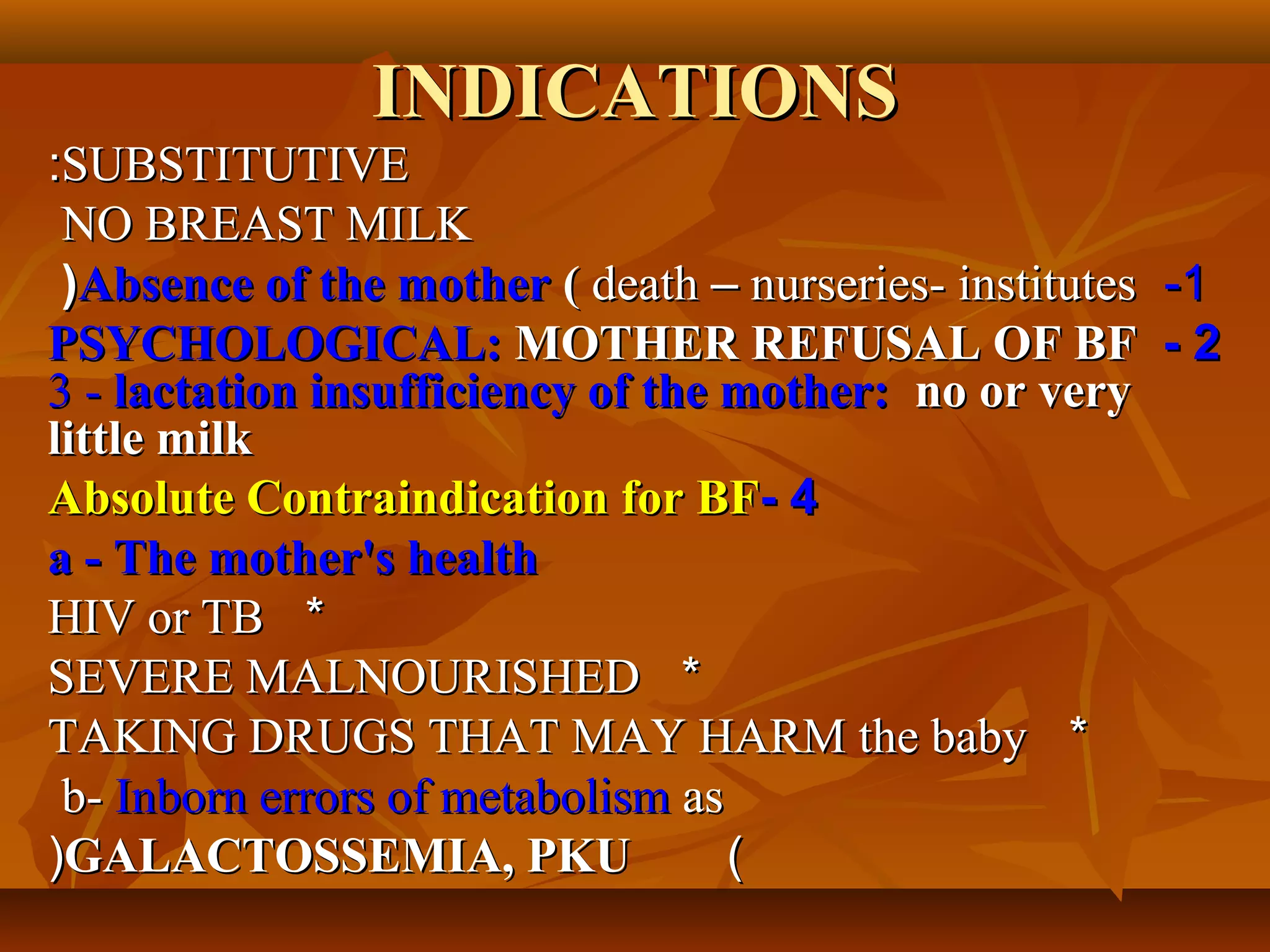
Types of formula feedingTypes of formula feeding
11--Complementary FeedingComplementary Feeding: Each feed, the breast: Each feed, the breast
is given first until it is emptied then formula is givenis given first until it is emptied then formula is given
to complete the feedto complete the feed..
22--Supplementary FeedingSupplementary Feeding: Formula is given to: Formula is given to
substitute one or more feeds, where some feeds aresubstitute one or more feeds, where some feeds are
completely breast milk and others are completelycompletely breast milk and others are completely
formula or bottleformula or bottle..
33--SubstitutiveSubstitutive: No breast-feeding is given and the: No breast-feeding is given and the
infant is fed on formula onlyinfant is fed on formula only..
INDICATIONSINDICATIONS
SUBSTITUTIVESUBSTITUTIVE::
NO BREAST MILKNO BREAST MILK
11--Absence of the motherAbsence of the mother (( deathdeath –– nurseries- institutesnurseries- institutes((
22--PSYCHOLOGICAL:PSYCHOLOGICAL: MOTHER REFUSAL OF BFMOTHER REFUSAL OF BF
3 -3 - lactation insufficiency of the mother:lactation insufficiency of the mother: no or veryno or very
little milklittle milk
44--Absolute Contraindication for BFAbsolute Contraindication for BF
a - The mother's healtha - The mother's health
**HIV or TBHIV or TB
**SEVERE MALNOURISHEDSEVERE MALNOURISHED
**TAKING DRUGS THAT MAY HARM the babyTAKING DRUGS THAT MAY HARM the baby
b-b- Inborn errors of metabolismInborn errors of metabolism asas
))GALACTOSSEMIA, PKUGALACTOSSEMIA, PKU((
INDICATIONSINDICATIONS
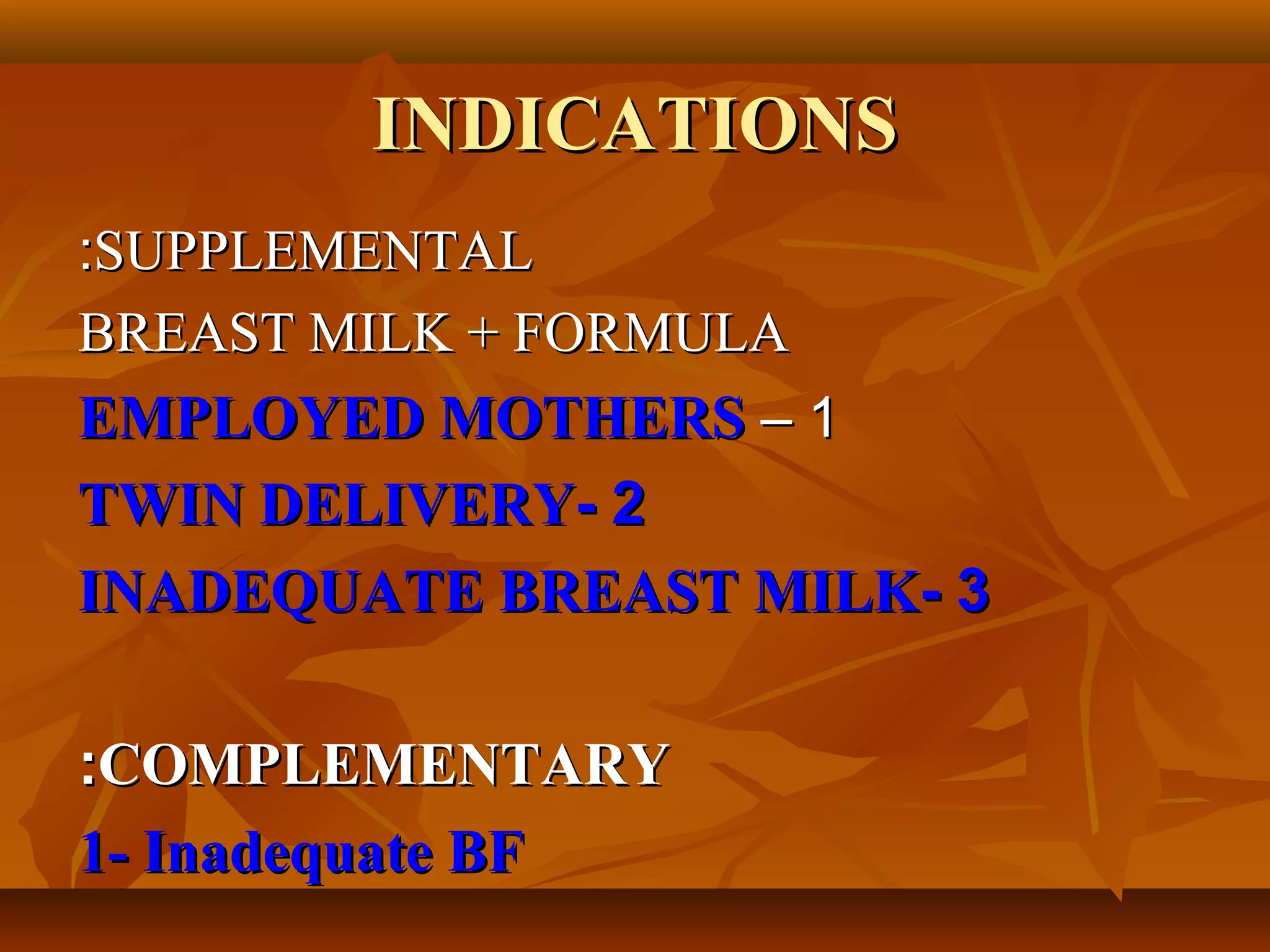
SUPPLEMENTALSUPPLEMENTAL::
BREAST MILK + FORMULABREAST MILK + FORMULA
11––EMPLOYED MOTHERSEMPLOYED MOTHERS
22--TWIN DELIVERYTWIN DELIVERY
33--INADEQUATE BREAST MILKINADEQUATE BREAST MILK
COMPLEMENTARYCOMPLEMENTARY::
1- Inadequate BF1- Inadequate BF
SHE
DOES NOT
BELONG
TO HERE
Per 100 ml of milk Human Cow Buffalo Goat Dried
milk
(S26(
Water gm
Proteins gm
Casein
87.65
1.2
0.3)30%(
78.25
3.5
2.7)80%(
83.2
4.1
3.3
2.5
90
1.5
0.6
Fats gm 3.8 3.8 7.4 4.5 3.6
Lactose gm
Calories cal
7
67
4.8
66.5
4.5
100
4.1
71
7.2
67
Minerals
 Calcium)mg/dl(.
 Phosphorus)mg/d
l(.
 Iron )mg/dl(.
35
15
1.5
115
95
1.0
46
33
1.2
CowCow’’s Versus Breast Milks Versus Breast Milk
3.3
1
3.83.8
7
4
0.8
0.2
0
1
2
3
4
5
6
7
8
BREAST COW
Protein
Fat
Lactose
Mineral
Difference in ProteinsDifference in Proteins
1.2%
3.3 %
Breast Milk
Cow’s Milk
Difference in ProteinsDifference in Proteins
20
70
80
30
0 20 40 60 80 100 120
BREAST
COW
Whey
Casein
Quality of ProteinQuality of Protein
0%
20%
40%
60%
80%
100%
Breast Cow
Immunoglobulins
Lactalb, Lactoferrin,
etc
B-lactoglobulin
Casein
30
40
30 80
13
7
Difference in ProteinsDifference in Proteins
PROTEIN BREAST COW
Lactalbumin 0.4 0.2
Serum globulin 0.15 0.05
Lactoferrin 0.15 Trace
B-lactoglobulin Absent 0.4
Difference in FatsDifference in Fats
3.8 %
Breast Milk
Cow’s Milk
3.8 %
0 2 4 6 8
Foremilk
Midmilk
Hindmilk
COW
BREAST
Differences in FatsDifferences in Fats
 According to stage of lactation:According to stage of lactation:
Amount isAmount is MOREMORE in early months of lactationin early months of lactation
 According to time of day:According to time of day:
Amount isAmount is 2.52.5 times more in mid-daytimes more in mid-day
 According to stage of suckling:According to stage of suckling:
Amount isAmount is 33 times more in hind milktimes more in hind milk
Differences in FatsDifferences in Fats
Breast milk containsBreast milk contains
 Lipase (digests 92 % of triglycerides)Lipase (digests 92 % of triglycerides)
 Higher cholesterolHigher cholesterol
 Higher Essential fatty acids:Higher Essential fatty acids:
 Linoleic ( 8 times more)Linoleic ( 8 times more)
 ArachidonicArachidonic
 Less volatile fatty acidsLess volatile fatty acids
Differences in FatsDifferences in Fats
Difference in CarbohydratesDifference in Carbohydrates
4.5 %
Breast Milk
Cow’s Milk
7 %
 Breast Milk:Breast Milk: DOUBLEDOUBLE lactose ( 7 : 4 )lactose ( 7 : 4 )
 Helps Calcium absorptionHelps Calcium absorption
 Constituent of Brain cerebrosidesConstituent of Brain cerebrosides
 Helps growth of lactobacilliHelps growth of lactobacilli
 Breast milk containsBreast milk contains BIFIDUSBIFIDUS factorfactor
 Breast milk containsBreast milk contains L-fucoseL-fucose
Differences in CarbohydratesDifferences in Carbohydrates
Difference in Minerals (AshDifference in Minerals (Ash((
0.2 %
0.8 %
Breast Milk
Cow’s Milk
60
15
118
34
100
16
0
20
40
60
80
100
120
140
BREAST COW
Sodium
Calcium
Posphate
Differences in MineralsDifferences in Minerals
PCaNa
Differences in IRONDifferences in IRON
50
50
10
90
0%
20%
40%
60%
80%
100%
Breast Milk Cow's Milk
In Breast milk: 0.05 mg/dl
In Cow's milk: 0.045 mg/dl
Absorbed Unabsorbed
In Breast-Fed: Less risk ofIn Breast-Fed: Less risk of
Iron DeficiencyIron Deficiency
anemia in 1st 6 months:anemia in 1st 6 months:
 Better Iron absorptionBetter Iron absorption
 Acidic mediumAcidic medium
 More Vit. C, EMore Vit. C, E
 More CopperMore Copper
 No Iron loss in stoolsNo Iron loss in stools
0 2 4 6 8 10 12
B,K
Nia
D
A
C,E
COW
BREAST
Differences in VitaminsDifferences in Vitamins
5 times
2 times
1/3 times?
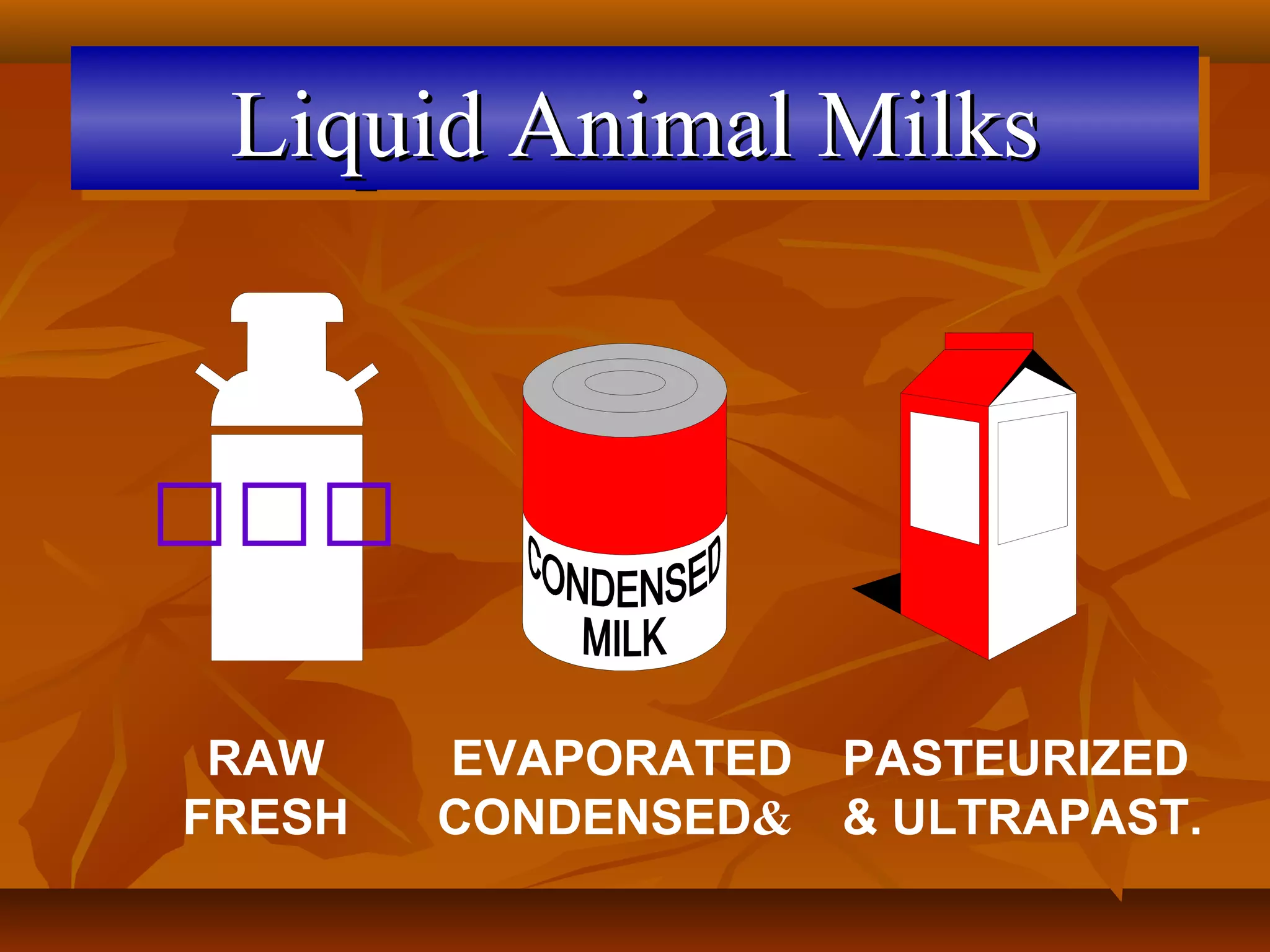
Forms of Animal MilksForms of Animal MilksForms of Animal MilksForms of Animal Milks
LIQUID DRIED
RAW
FRESH
EVAPORATED
&CONDENSED
PASTEURIZED
& ULTRAPAST.
Liquid Animal MilksLiquid Animal MilksLiquid Animal MilksLiquid Animal Milks
‫ننن‬
NOT SUITABLENOT SUITABLE
For youngFor young (<1year(<1year((
infant feedinginfant feeding
Unless ModifiedUnless Modified
((HumanizedHumanized))
Liquid Animal MilksLiquid Animal MilksLiquid Animal MilksLiquid Animal Milks
Types of milkTypes of milk
11––Modified liquid milkModified liquid milk**
22––Dried milkDried milk ( 4 types( 4 types((
Modified Liquid MilkModified Liquid Milk
Modification of Buffalo MilkModification of Buffalo MilkModification of Buffalo MilkModification of Buffalo Milk
+ +
50 ml
MILK
50 ml
WATER
5 g (spoon)
SUGAR
=
100 ml
Modified
Milk
M
* mixing well.* mixing well.
* boil for 15 minutes**.* boil for 15 minutes**.
* mixing well.* mixing well.
* boil for 15 minutes**.* boil for 15 minutes**.
BUFFALO
MILK
MODIFIED
BUFFALO
BREAST
MILK
Protein 4 2 1
Fat 7 3.5 3.8
Carboh. 4 lactose 7: 2 lactose.
+ 5 Sucrose
7 lactose
Ash 0.8 0.4 0.2
Calories 100 67 67
Modification of Buffalo MilkModification of Buffalo MilkModification of Buffalo MilkModification of Buffalo Milk
DRIED MILKDRIED MILK
 Sterile and highly solubleSterile and highly soluble
 Composition is constantComposition is constant
 Can be stored for long timeCan be stored for long time
 Heat makes protein more digestibleHeat makes protein more digestible
 Heat makes protein less allergenicHeat makes protein less allergenic
 Many forms are available to suit all childrenMany forms are available to suit all children
and situations.and situations.
Advantages of Dried MilksAdvantages of Dried MilksAdvantages of Dried MilksAdvantages of Dried Milks
 Whole milkWhole milk
 Humanized “adapted” milksHumanized “adapted” milks
 Follow-on milksFollow-on milks
 Modified special formulas:Modified special formulas:
 For low birth weight infantsFor low birth weight infants
 For certain diseasesFor certain diseases
Types of Dried MilksTypes of Dried MilksTypes of Dried MilksTypes of Dried Milks
Dried Milk*Dried Milk*
11--Dried Whole MilkDried Whole Milk
**cannot be used for feeding young infants unlesscannot be used for feeding young infants unless
modifiedmodified..
**not before 1 year of agenot before 1 year of age
**may be fortified with iron, vitamin Dmay be fortified with iron, vitamin D
**example : Nido , Cornationexample : Nido , Cornation
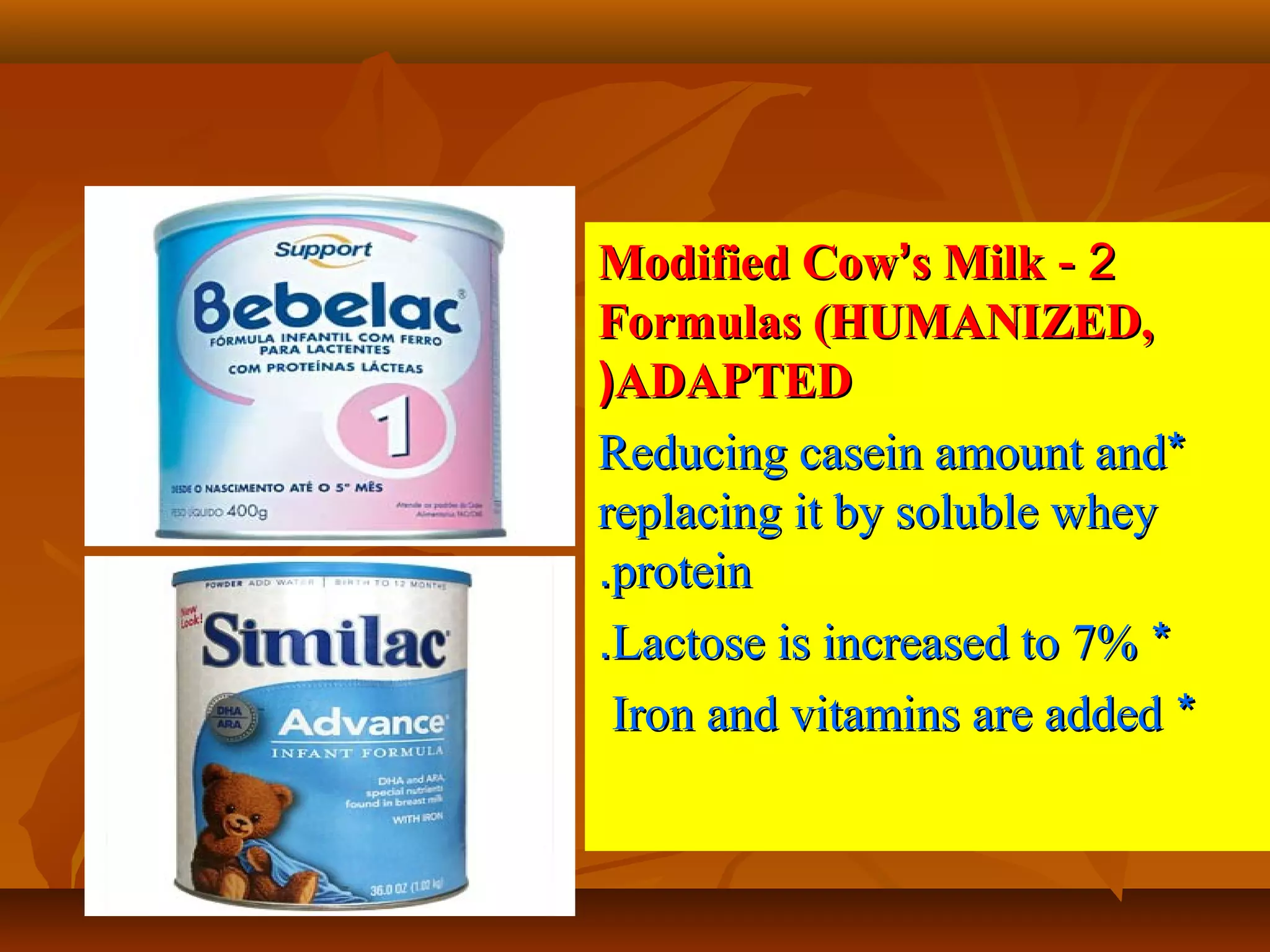
22--Modified CowModified Cow’’s Milks Milk
Formulas (HUMANIZED,Formulas (HUMANIZED,
ADAPTEDADAPTED((
**Reducing casein amount andReducing casein amount and
replacing it by soluble wheyreplacing it by soluble whey
proteinprotein..
**Lactose is increased to 7%Lactose is increased to 7%..
**Iron and vitamins are addedIron and vitamins are added
COW’S
MILK
ADAPTED
FORMULA
BREAST
MILK
Protein
Whey:Casein
3.3
20:80
1.5
60:40
1
70:30
Fat
Sat:Unsat.
3.8
40:60
3.8
45:55
3.8
40:60
Carboh. 4.5
lactose
7.2
lactose
7
lactose
Ash 0.8 0.3-0.4 0.2
Calories 67 67 67
Adapted FormulasAdapted FormulasAdapted FormulasAdapted Formulas
HumanizedHumanized ““AdaptedAdapted””FormulasFormulasHumanizedHumanized ““AdaptedAdapted””FormulasFormulas
European Formulas
HumanizedHumanized ““AdaptedAdapted””FormulasFormulasHumanizedHumanized ““AdaptedAdapted””FormulasFormulas
American Formulas
Other Special FormulasOther Special FormulasOther Special FormulasOther Special Formulas
C -C - Follow- on MilkFollow- on Milk
FormulasFormulas
**for Healthy Infants over 6for Healthy Infants over 6
Months and ChildrenMonths and Children
**contain more iron &proteincontain more iron &protein
but less fat thanbut less fat than
ADAPTED formsADAPTED forms
Follow-on Milk FormulasFollow-on Milk FormulasFollow-on Milk FormulasFollow-on Milk Formulas
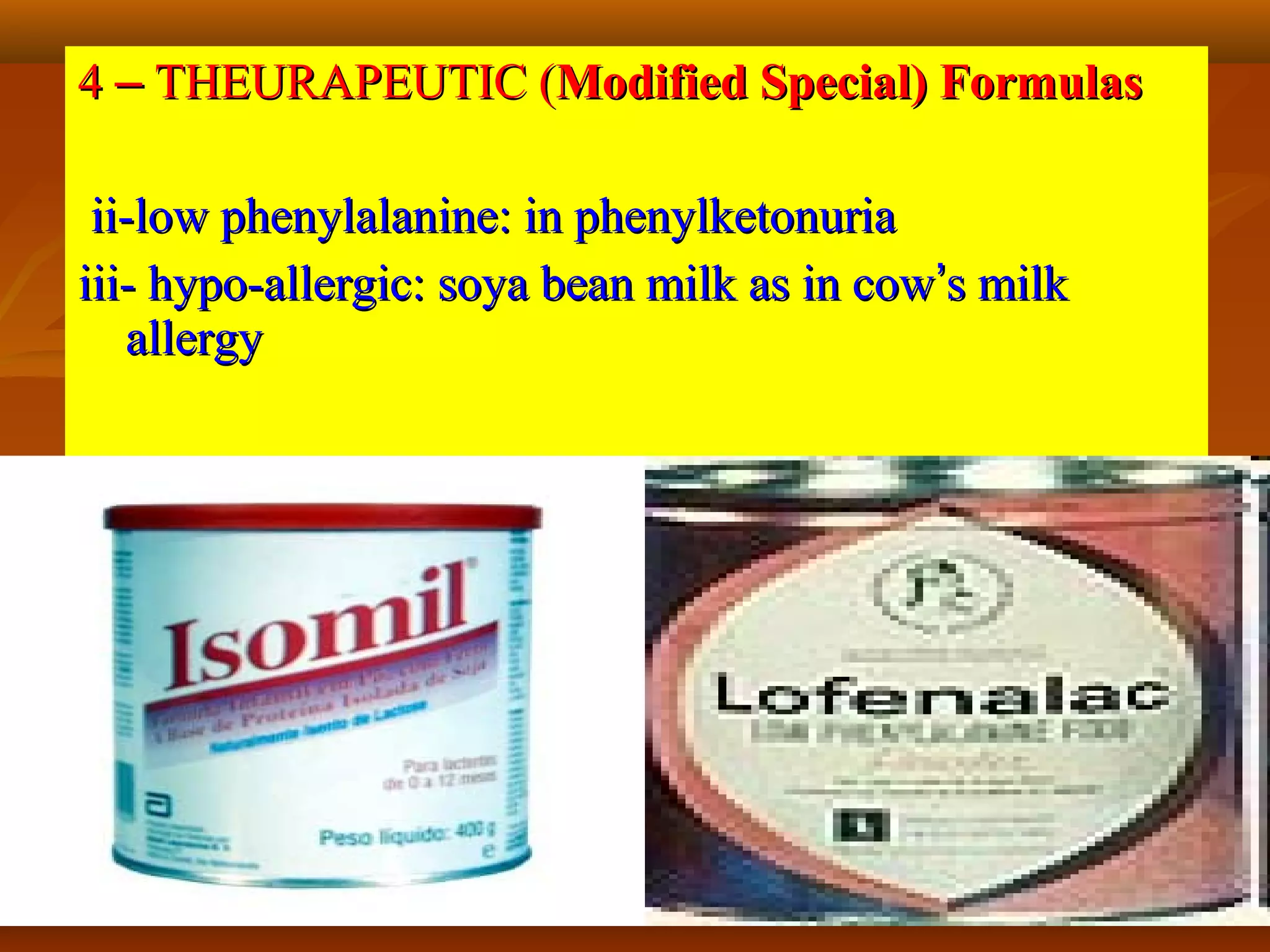
44 –– THEURAPEUTIC (THEURAPEUTIC (Modified Special) FormulasModified Special) Formulas
ii-low phenylalanine: in phenylketonuriaii-low phenylalanine: in phenylketonuria
iii- hypo-allergic: soya bean milk as in cowiii- hypo-allergic: soya bean milk as in cow’’s milks milk
allergyallergy
Lactose-free Milk-based FormulasLactose-free Milk-based FormulasLactose-free Milk-based FormulasLactose-free Milk-based Formulas
lactose free milk: in Galactosemia,lactose free milk: in Galactosemia,
Lactose intolerance after diarrhea or PEMLactose intolerance after diarrhea or PEM
Lactose-free Soy-based FormulasLactose-free Soy-based FormulasLactose-free Soy-based FormulasLactose-free Soy-based Formulas
Indications for Soy-Based Formula:Indications for Soy-Based Formula:
1. Lactose intolerance1. Lactose intolerance
 primary (congenital)primary (congenital)
 secondary to gastroenteritissecondary to gastroenteritis
2. Sucrase deficiency:2. Sucrase deficiency:
Sucrose freeSucrose free –– soy formulasoy formula
e.g. Isomile.g. Isomil
3. Galactosemia3. Galactosemia
Soy-Based FormulaSoy-Based Formula
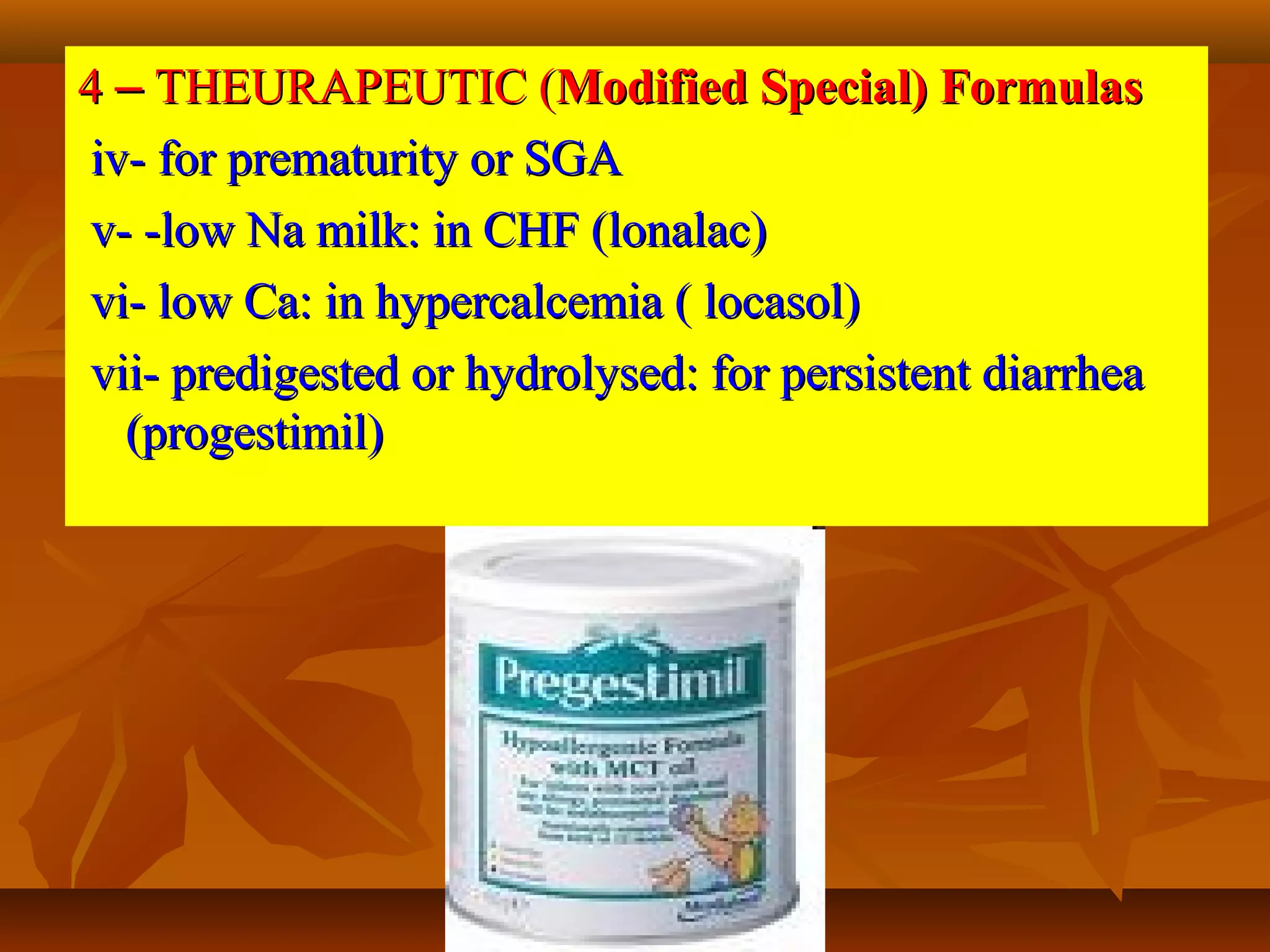
44 –– THEURAPEUTIC (THEURAPEUTIC (Modified Special) FormulasModified Special) Formulas
iv- for prematurity or SGAiv- for prematurity or SGA
v- -low Na milk: in CHF (lonalac)v- -low Na milk: in CHF (lonalac)
vi- low Ca: in hypercalcemia ( locasol)vi- low Ca: in hypercalcemia ( locasol)
vii- predigested or hydrolysed: for persistent diarrheavii- predigested or hydrolysed: for persistent diarrhea
(progestimil)(progestimil)
Daily needs:Daily needs: 150150 ml / kg / dayml / kg / day
150150mlml XX Body Weight in KgBody Weight in Kg
Number of feeds per dayNumber of feeds per day
ExampleExample: For a 4 kg Baby: For a 4 kg Baby
150150XX 4 = 600 =4 = 600 = 100100 ml /Feedml /Feed
6666
HOW MUCHHOW MUCH??HOW MUCHHOW MUCH??
22--According toAccording to
infantinfant’’s weights weight
Volume in cc/ feed =Volume in cc/ feed =
weight in gramsweight in grams
3636
HOW TO FEEDHOW TO FEED??HOW TO FEEDHOW TO FEED??
X 
Eructation (burping, driving off airEructation (burping, driving off air((
FiveFive CommonCommon MistakesMistakes in Bottle-in Bottle-
FeedingFeeding
11--Leaving the child with the feeding bottleLeaving the child with the feeding bottle
unattendedunattended..
22--Too large or too narrowToo large or too narrow holehole in the teatin the teat..
33--Use ofUse of anyany Available Bottle (non sterilizedAvailable Bottle (non sterilized(.(.
44--OverOver diluted feed or Over concentrateddiluted feed or Over concentrated..
55––excessiveexcessive HotHot milkmilk..
Techniques of FeedingTechniques of Feeding
Newborn and InfantNewborn and Infant
11--Obtain the formula bottle from theObtain the formula bottle from the
refrigerator andrefrigerator and warm it upwarm it up . Clean it and teats.. Clean it and teats.
Add milk and boiled waterAdd milk and boiled water**
22--Check theCheck the patencypatency of the nipple, and milkof the nipple, and milk
temperaturetemperature
33--Insure safe newborn/ infantInsure safe newborn/ infant’’ss positioningpositioning**
44--Feed the newborn/ infantFeed the newborn/ infant
55--BurpingBurping the newborn/ infantthe newborn/ infant
66--Discard theDiscard the unusedunused portion of formulaportion of formula
formula milk formula for clinical pharmacy students

formula milk formula for clinical pharmacy students

  • 1.
    FORMULA FEEDINGFORMULA FEEDING &WEANING& WEANING Formula FeedingFormula Feeding for clinicalfor clinical pharmacypharmacy Dr. Hussein AbdeldayemDr. Hussein Abdeldayem Professor of pediatricsProfessor of pediatrics Alex. EgyptAlex. Egypt
  • 3.
    FORMULA FEEDINGFORMULA FEEDING Breast-feedingisBreast-feeding is the bestthe best method ofmethod of feeding for all newborn and infants,feeding for all newborn and infants, even for premature infants and itseven for premature infants and its constitution is suitable for prematureconstitution is suitable for premature infants, but if it isinfants, but if it is not possiblenot possible, so a, so a formula, which is close in itsformula, which is close in its composition to breast milk, iscomposition to breast milk, is indicatedindicated..
  • 4.
    Types of formulafeedingTypes of formula feeding 11--Complementary FeedingComplementary Feeding: Each feed, the breast: Each feed, the breast is given first until it is emptied then formula is givenis given first until it is emptied then formula is given to complete the feedto complete the feed.. 22--Supplementary FeedingSupplementary Feeding: Formula is given to: Formula is given to substitute one or more feeds, where some feeds aresubstitute one or more feeds, where some feeds are completely breast milk and others are completelycompletely breast milk and others are completely formula or bottleformula or bottle.. 33--SubstitutiveSubstitutive: No breast-feeding is given and the: No breast-feeding is given and the infant is fed on formula onlyinfant is fed on formula only..
  • 5.
    INDICATIONSINDICATIONS SUBSTITUTIVESUBSTITUTIVE:: NO BREAST MILKNOBREAST MILK 11--Absence of the motherAbsence of the mother (( deathdeath –– nurseries- institutesnurseries- institutes(( 22--PSYCHOLOGICAL:PSYCHOLOGICAL: MOTHER REFUSAL OF BFMOTHER REFUSAL OF BF 3 -3 - lactation insufficiency of the mother:lactation insufficiency of the mother: no or veryno or very little milklittle milk 44--Absolute Contraindication for BFAbsolute Contraindication for BF a - The mother's healtha - The mother's health **HIV or TBHIV or TB **SEVERE MALNOURISHEDSEVERE MALNOURISHED **TAKING DRUGS THAT MAY HARM the babyTAKING DRUGS THAT MAY HARM the baby b-b- Inborn errors of metabolismInborn errors of metabolism asas ))GALACTOSSEMIA, PKUGALACTOSSEMIA, PKU((
  • 6.
    INDICATIONSINDICATIONS SUPPLEMENTALSUPPLEMENTAL:: BREAST MILK +FORMULABREAST MILK + FORMULA 11––EMPLOYED MOTHERSEMPLOYED MOTHERS 22--TWIN DELIVERYTWIN DELIVERY 33--INADEQUATE BREAST MILKINADEQUATE BREAST MILK COMPLEMENTARYCOMPLEMENTARY:: 1- Inadequate BF1- Inadequate BF
  • 8.
  • 9.
    Per 100 mlof milk Human Cow Buffalo Goat Dried milk (S26( Water gm Proteins gm Casein 87.65 1.2 0.3)30%( 78.25 3.5 2.7)80%( 83.2 4.1 3.3 2.5 90 1.5 0.6 Fats gm 3.8 3.8 7.4 4.5 3.6 Lactose gm Calories cal 7 67 4.8 66.5 4.5 100 4.1 71 7.2 67 Minerals  Calcium)mg/dl(.  Phosphorus)mg/d l(.  Iron )mg/dl(. 35 15 1.5 115 95 1.0 46 33 1.2
  • 10.
    CowCow’’s Versus BreastMilks Versus Breast Milk 3.3 1 3.83.8 7 4 0.8 0.2 0 1 2 3 4 5 6 7 8 BREAST COW Protein Fat Lactose Mineral
  • 11.
    Difference in ProteinsDifferencein Proteins 1.2% 3.3 % Breast Milk Cow’s Milk
  • 12.
    Difference in ProteinsDifferencein Proteins 20 70 80 30 0 20 40 60 80 100 120 BREAST COW Whey Casein
  • 13.
    Quality of ProteinQualityof Protein 0% 20% 40% 60% 80% 100% Breast Cow Immunoglobulins Lactalb, Lactoferrin, etc B-lactoglobulin Casein 30 40 30 80 13 7
  • 14.
    Difference in ProteinsDifferencein Proteins PROTEIN BREAST COW Lactalbumin 0.4 0.2 Serum globulin 0.15 0.05 Lactoferrin 0.15 Trace B-lactoglobulin Absent 0.4
  • 15.
    Difference in FatsDifferencein Fats 3.8 % Breast Milk Cow’s Milk 3.8 %
  • 16.
    0 2 46 8 Foremilk Midmilk Hindmilk COW BREAST Differences in FatsDifferences in Fats
  • 17.
     According tostage of lactation:According to stage of lactation: Amount isAmount is MOREMORE in early months of lactationin early months of lactation  According to time of day:According to time of day: Amount isAmount is 2.52.5 times more in mid-daytimes more in mid-day  According to stage of suckling:According to stage of suckling: Amount isAmount is 33 times more in hind milktimes more in hind milk Differences in FatsDifferences in Fats
  • 18.
    Breast milk containsBreastmilk contains  Lipase (digests 92 % of triglycerides)Lipase (digests 92 % of triglycerides)  Higher cholesterolHigher cholesterol  Higher Essential fatty acids:Higher Essential fatty acids:  Linoleic ( 8 times more)Linoleic ( 8 times more)  ArachidonicArachidonic  Less volatile fatty acidsLess volatile fatty acids Differences in FatsDifferences in Fats
  • 19.
    Difference in CarbohydratesDifferencein Carbohydrates 4.5 % Breast Milk Cow’s Milk 7 %
  • 20.
     Breast Milk:BreastMilk: DOUBLEDOUBLE lactose ( 7 : 4 )lactose ( 7 : 4 )  Helps Calcium absorptionHelps Calcium absorption  Constituent of Brain cerebrosidesConstituent of Brain cerebrosides  Helps growth of lactobacilliHelps growth of lactobacilli  Breast milk containsBreast milk contains BIFIDUSBIFIDUS factorfactor  Breast milk containsBreast milk contains L-fucoseL-fucose Differences in CarbohydratesDifferences in Carbohydrates
  • 21.
    Difference in Minerals(AshDifference in Minerals (Ash(( 0.2 % 0.8 % Breast Milk Cow’s Milk
  • 22.
  • 23.
    Differences in IRONDifferencesin IRON 50 50 10 90 0% 20% 40% 60% 80% 100% Breast Milk Cow's Milk In Breast milk: 0.05 mg/dl In Cow's milk: 0.045 mg/dl Absorbed Unabsorbed In Breast-Fed: Less risk ofIn Breast-Fed: Less risk of Iron DeficiencyIron Deficiency anemia in 1st 6 months:anemia in 1st 6 months:  Better Iron absorptionBetter Iron absorption  Acidic mediumAcidic medium  More Vit. C, EMore Vit. C, E  More CopperMore Copper  No Iron loss in stoolsNo Iron loss in stools
  • 24.
    0 2 46 8 10 12 B,K Nia D A C,E COW BREAST Differences in VitaminsDifferences in Vitamins 5 times 2 times 1/3 times?
  • 25.
    Forms of AnimalMilksForms of Animal MilksForms of Animal MilksForms of Animal Milks LIQUID DRIED
  • 26.
    RAW FRESH EVAPORATED &CONDENSED PASTEURIZED & ULTRAPAST. Liquid AnimalMilksLiquid Animal MilksLiquid Animal MilksLiquid Animal Milks ‫ننن‬
  • 27.
    NOT SUITABLENOT SUITABLE ForyoungFor young (<1year(<1year(( infant feedinginfant feeding Unless ModifiedUnless Modified ((HumanizedHumanized)) Liquid Animal MilksLiquid Animal MilksLiquid Animal MilksLiquid Animal Milks
  • 28.
    Types of milkTypesof milk 11––Modified liquid milkModified liquid milk** 22––Dried milkDried milk ( 4 types( 4 types((
  • 29.
  • 30.
    Modification of BuffaloMilkModification of Buffalo MilkModification of Buffalo MilkModification of Buffalo Milk + + 50 ml MILK 50 ml WATER 5 g (spoon) SUGAR = 100 ml Modified Milk M * mixing well.* mixing well. * boil for 15 minutes**.* boil for 15 minutes**. * mixing well.* mixing well. * boil for 15 minutes**.* boil for 15 minutes**.
  • 31.
    BUFFALO MILK MODIFIED BUFFALO BREAST MILK Protein 4 21 Fat 7 3.5 3.8 Carboh. 4 lactose 7: 2 lactose. + 5 Sucrose 7 lactose Ash 0.8 0.4 0.2 Calories 100 67 67 Modification of Buffalo MilkModification of Buffalo MilkModification of Buffalo MilkModification of Buffalo Milk
  • 32.
  • 33.
     Sterile andhighly solubleSterile and highly soluble  Composition is constantComposition is constant  Can be stored for long timeCan be stored for long time  Heat makes protein more digestibleHeat makes protein more digestible  Heat makes protein less allergenicHeat makes protein less allergenic  Many forms are available to suit all childrenMany forms are available to suit all children and situations.and situations. Advantages of Dried MilksAdvantages of Dried MilksAdvantages of Dried MilksAdvantages of Dried Milks
  • 34.
     Whole milkWholemilk  Humanized “adapted” milksHumanized “adapted” milks  Follow-on milksFollow-on milks  Modified special formulas:Modified special formulas:  For low birth weight infantsFor low birth weight infants  For certain diseasesFor certain diseases Types of Dried MilksTypes of Dried MilksTypes of Dried MilksTypes of Dried Milks
  • 35.
    Dried Milk*Dried Milk* 11--DriedWhole MilkDried Whole Milk **cannot be used for feeding young infants unlesscannot be used for feeding young infants unless modifiedmodified.. **not before 1 year of agenot before 1 year of age **may be fortified with iron, vitamin Dmay be fortified with iron, vitamin D **example : Nido , Cornationexample : Nido , Cornation
  • 36.
    22--Modified CowModified Cow’’sMilks Milk Formulas (HUMANIZED,Formulas (HUMANIZED, ADAPTEDADAPTED(( **Reducing casein amount andReducing casein amount and replacing it by soluble wheyreplacing it by soluble whey proteinprotein.. **Lactose is increased to 7%Lactose is increased to 7%.. **Iron and vitamins are addedIron and vitamins are added
  • 37.
  • 38.
  • 39.
  • 40.
    Other Special FormulasOtherSpecial FormulasOther Special FormulasOther Special Formulas
  • 41.
    C -C -Follow- on MilkFollow- on Milk FormulasFormulas **for Healthy Infants over 6for Healthy Infants over 6 Months and ChildrenMonths and Children **contain more iron &proteincontain more iron &protein but less fat thanbut less fat than ADAPTED formsADAPTED forms
  • 42.
    Follow-on Milk FormulasFollow-onMilk FormulasFollow-on Milk FormulasFollow-on Milk Formulas
  • 43.
    44 –– THEURAPEUTIC(THEURAPEUTIC (Modified Special) FormulasModified Special) Formulas ii-low phenylalanine: in phenylketonuriaii-low phenylalanine: in phenylketonuria iii- hypo-allergic: soya bean milk as in cowiii- hypo-allergic: soya bean milk as in cow’’s milks milk allergyallergy
  • 44.
    Lactose-free Milk-based FormulasLactose-freeMilk-based FormulasLactose-free Milk-based FormulasLactose-free Milk-based Formulas lactose free milk: in Galactosemia,lactose free milk: in Galactosemia, Lactose intolerance after diarrhea or PEMLactose intolerance after diarrhea or PEM
  • 45.
    Lactose-free Soy-based FormulasLactose-freeSoy-based FormulasLactose-free Soy-based FormulasLactose-free Soy-based Formulas
  • 46.
    Indications for Soy-BasedFormula:Indications for Soy-Based Formula: 1. Lactose intolerance1. Lactose intolerance  primary (congenital)primary (congenital)  secondary to gastroenteritissecondary to gastroenteritis 2. Sucrase deficiency:2. Sucrase deficiency: Sucrose freeSucrose free –– soy formulasoy formula e.g. Isomile.g. Isomil 3. Galactosemia3. Galactosemia Soy-Based FormulaSoy-Based Formula
  • 47.
    44 –– THEURAPEUTIC(THEURAPEUTIC (Modified Special) FormulasModified Special) Formulas iv- for prematurity or SGAiv- for prematurity or SGA v- -low Na milk: in CHF (lonalac)v- -low Na milk: in CHF (lonalac) vi- low Ca: in hypercalcemia ( locasol)vi- low Ca: in hypercalcemia ( locasol) vii- predigested or hydrolysed: for persistent diarrheavii- predigested or hydrolysed: for persistent diarrhea (progestimil)(progestimil)
  • 48.
    Daily needs:Daily needs:150150 ml / kg / dayml / kg / day 150150mlml XX Body Weight in KgBody Weight in Kg Number of feeds per dayNumber of feeds per day ExampleExample: For a 4 kg Baby: For a 4 kg Baby 150150XX 4 = 600 =4 = 600 = 100100 ml /Feedml /Feed 6666 HOW MUCHHOW MUCH??HOW MUCHHOW MUCH??
  • 49.
    22--According toAccording to infantinfant’’sweights weight Volume in cc/ feed =Volume in cc/ feed = weight in gramsweight in grams 3636
  • 50.
    HOW TO FEEDHOWTO FEED??HOW TO FEEDHOW TO FEED??
  • 54.
  • 55.
    Eructation (burping, drivingoff airEructation (burping, driving off air((
  • 56.
    FiveFive CommonCommon MistakesMistakesin Bottle-in Bottle- FeedingFeeding 11--Leaving the child with the feeding bottleLeaving the child with the feeding bottle unattendedunattended.. 22--Too large or too narrowToo large or too narrow holehole in the teatin the teat.. 33--Use ofUse of anyany Available Bottle (non sterilizedAvailable Bottle (non sterilized(.(. 44--OverOver diluted feed or Over concentrateddiluted feed or Over concentrated.. 55––excessiveexcessive HotHot milkmilk..
  • 57.
    Techniques of FeedingTechniquesof Feeding Newborn and InfantNewborn and Infant 11--Obtain the formula bottle from theObtain the formula bottle from the refrigerator andrefrigerator and warm it upwarm it up . Clean it and teats.. Clean it and teats. Add milk and boiled waterAdd milk and boiled water** 22--Check theCheck the patencypatency of the nipple, and milkof the nipple, and milk temperaturetemperature 33--Insure safe newborn/ infantInsure safe newborn/ infant’’ss positioningpositioning** 44--Feed the newborn/ infantFeed the newborn/ infant 55--BurpingBurping the newborn/ infantthe newborn/ infant 66--Discard theDiscard the unusedunused portion of formulaportion of formula

Editor's Notes

  • #29 1- RAW fresh cow milk, buffalo milk, goat milk ( curds, microorganisms) 2- pateurized milk ( less curd, kills some bacteria 3-ultrapasteurized, especially packed milk ( LA milk) To prepare 100 ml buffalo milk 50 ml milk + 50 ml water then add 5gm sugar, mix well, then boil for 15 min
  • #36 Evaporate water from milk, so reduce the amount by 1/8 of total volume ( 8 L becomes 1 L ). So to reconstitute each 1 gm milk powder: 8 ml water
  • #58 * Milk measure /30 or 60 cc water No air from bottle