Dr Hussein Abdeldayem, MD
Professor of Pediatrics and Pediatric
Neurology
Chief of Pediatric Neuro-Psychiatry Unit
PEDIATRIC NEUROLOGY
EXAMINATION: MAKE IT EASY
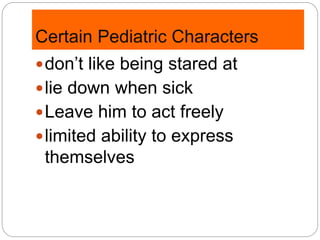
Certain Pediatric Characters
don’t like being stared at
lie down when sick
Leave him to act freely
limited ability to express
themselves
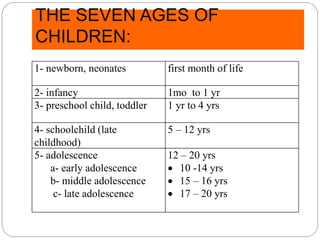
THE SEVEN AGES OF
CHILDREN:
1- newborn, neonates first month of life
2- infancy 1mo to 1 yr
3- preschool child, toddler 1 yr to 4 yrs
4- schoolchild (late
childhood)
5 – 12 yrs
5- adolescence
a- early adolescence
b- middle adolescence
c- late adolescence
12 – 20 yrs
 10 -14 yrs
 15 – 16 yrs
 17 – 20 yrs
HELLO
INRODUCE YOUR SELF
THEN
PERSONAL HISTORY:
 DON’T USE: “a male/female patient
aged … and his name is …”
 boy or girl ( not male or female)
 not use term “patient” THROUGHOUT
HISTORY
PERSONAL HISTORY:
LISTENING TO MOTHERS
be good listener : mother is right until
proved otherwise
Ask mother to define her terms (?
diarrhea, constipation, yellow skin,
seizures, etc….)
3 keys for present history
1- first: full C/O of the
suggested disease ( mentioned
or not)Second: DD of the suggested
disease
Third: complication, investigations
and treatment response of the
suggested disease
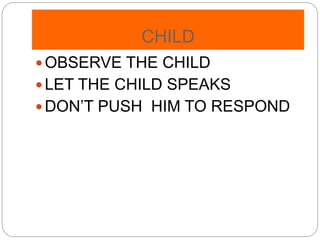
CHILD
OBSERVE THE CHILD
LET THE CHILD SPEAKS
DON’T PUSH HIM TO RESPOND
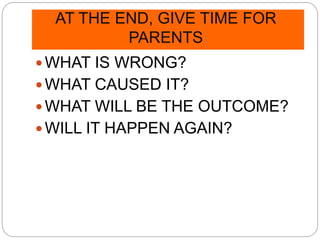
AT THE END, GIVE TIME FOR
PARENTS
WHAT IS WRONG?
WHAT CAUSED IT?
WHAT WILL BE THE OUTCOME?
WILL IT HAPPEN AGAIN?
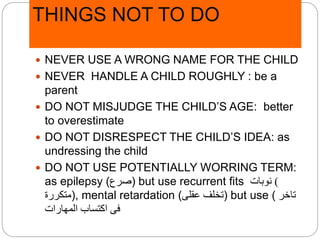
THINGS NOT TO DO
 NEVER USE A WRONG NAME FOR THE CHILD
 NEVER HANDLE A CHILD ROUGHLY : be a
parent
 DO NOT MISJUDGE THE CHILD’S AGE: better
to overestimate
 DO NOT DISRESPECT THE CHILD’S IDEA: as
undressing the child
 DO NOT USE POTENTIALLY WORRING TERM:
as epilepsy (‫)صرع‬ but use recurrent fits )‫نوبات‬
‫,)متكررة‬ mental retardation (‫عقلى‬ ‫)تخلف‬ but use ( ‫تاخر‬
‫المهارات‬ ‫اكتساب‬ ‫فى‬
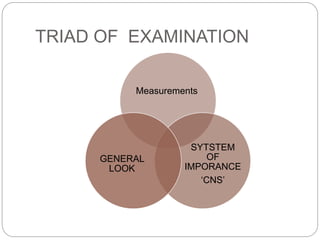
TRIAD OF EXAMINATION
Measurements
SYTSTEM
OF
IMPORANCE
‘CNS’
GENERAL
LOOK
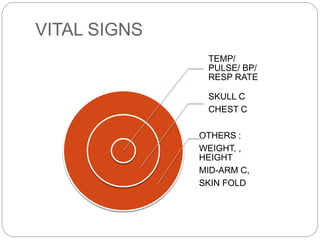
VITAL SIGNS
TEMP/
PULSE/ BP/
RESP RATE
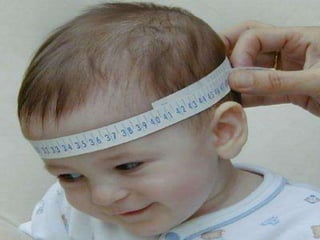
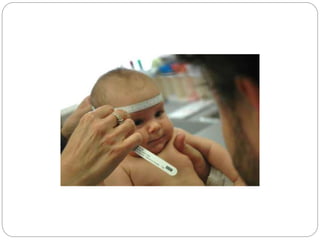
SKULL C
CHEST C
OTHERS :
WEIGHT, ,
HEIGHT
MID-ARM C,
SKIN FOLD
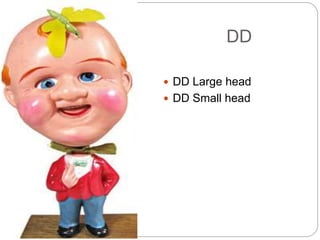
DD
 DD Large head
 DD Small head
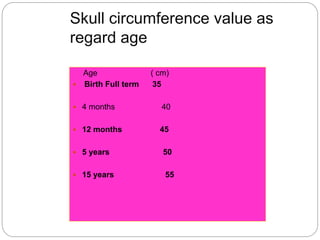
Skull circumference value as
regard age
Age ( cm)
 Birth Full term 35
 4 months 40
 12 months 45
 5 years 50
 15 years 55
2- Acquired:
1- GENETIC:
3- IDIOPATHIC:
IN ALL CNS
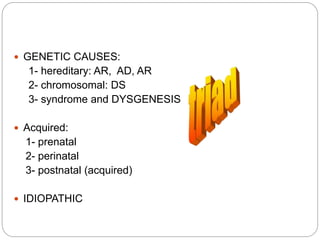
Aetiology
 GENETIC CAUSES:
1- hereditary: AR, AD, AR
2- chromosomal: DS
3- syndrome and DYSGENESIS
 Acquired:
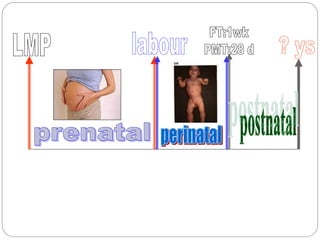
1- prenatal
2- perinatal
3- postnatal (acquired)
 IDIOPATHIC
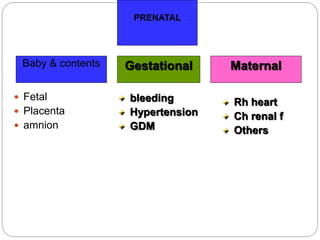
Baby & contents
PRENATAL
 Fetal
 Placenta
 amnion
Gestational Maternal
bleeding
Hypertension
GDM
Rh heart
Ch renal f
Others
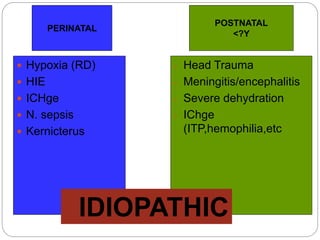
 Hypoxia (RD)
 HIE
 ICHge
 N. sepsis
 Kernicterus
- Head Trauma
- Meningitis/encephalitis
- Severe dehydration
- IChge
(ITP,hemophilia,etc
PERINATAL
POSTNATAL
<?Y
IDIOPATHIC
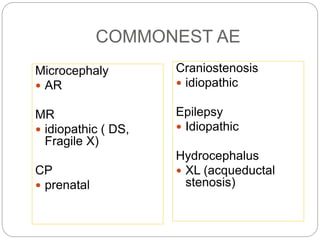
COMMONEST AE
Microcephaly
 AR
MR
 idiopathic ( DS,
Fragile X)
CP
 prenatal
Craniostenosis
 idiopathic
Epilepsy
 Idiopathic
Hydrocephalus
 XL (acqueductal
stenosis)
CNS DEFINITION
RFOM THE NAME ITSELF
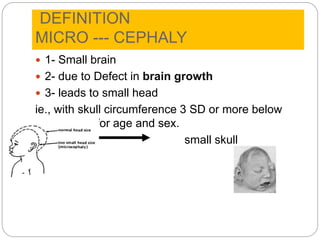
DEFINITION
MICRO --- CEPHALY
 1- Small brain
 2- due to Defect in brain growth
 3- leads to small head
ie., with skull circumference 3 SD or more below
the mean for age and sex.
Small Brain small skull
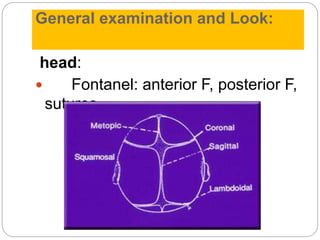
General examination and Look:
head:
 Fontanel: anterior F, posterior F,
sutures
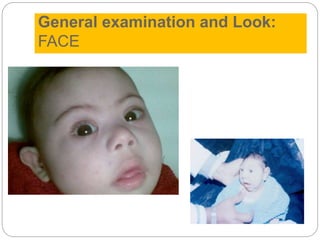
General examination and Look:
FACE
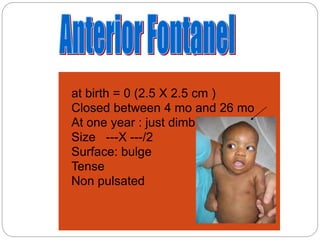
 at birth = 0 (2.5 X 2.5 cm )
 Closed between 4 mo and 26 mo
 At one year : just dimble
 Size ---X ---/2
 Surface: bulge
 Tense
 Non pulsated
DD large opened Posterior F
 Hydrocepahlus
 Cong hypothyroidism
 DS
 Infantile Rickets
1- head:
 Size: measure head
circumference:
- large head (macrocrania)
- small head (microcrania)
- normal head size
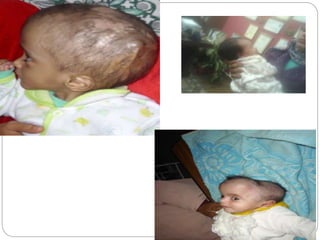
head:
Shape:
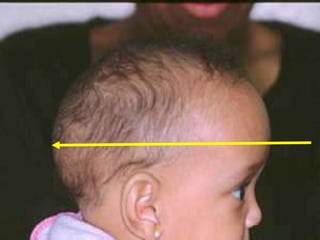
- abnormal shaped head:
craniosynostosis
- globular shape” hydrocephalus
(obstructive)
- occipital protrusion: Dandy Walker
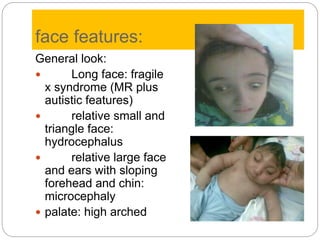
face features:
General look:
 Long face: fragile
x syndrome (MR plus
autistic features)
 relative small and
triangle face:
hydrocephalus
 relative large face
and ears with sloping
forehead and chin:
microcephaly
 palate: high arched
Face
Eye:
 sunset eyes, ptosis, slunting eyes (DS: up-
slanting, Noonan: down-slanting), epicanthus folds,
etc
Nose
 depressed bridge, wide bridge, beaked nose
upward turn of nostrils ( DS), short nose (DS)
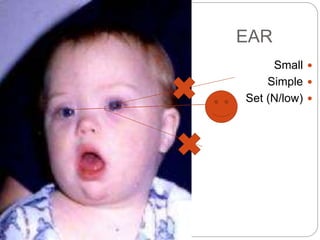
Ears
 Normal set or low set ears, auricles shape
(normal folds or simple folds as in DS or deformed as
stenosed), normal size auricles or small (DS), position
of auricles (normal, posterior rotated, bat ears), ear
tags ( check kidneys)
EAR
Small
Simple
Set (N/low)
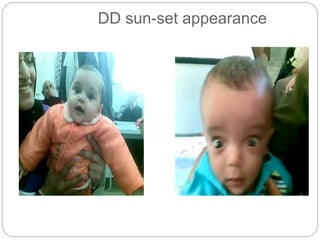
DD sun-set appearance
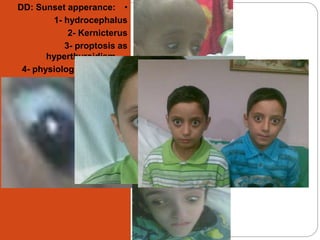
•DD: Sunset apperance:
1- hydrocephalus
2- Kernicterus
3- proptosis as
hyperthyroidism
4- physiological? familial
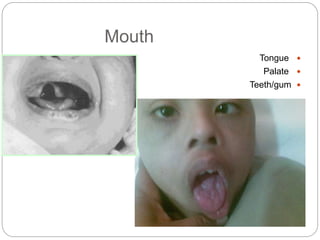
2- face features:
tongue and mouth
teeth
 palate
Mouth
Tongue
Palate
Teeth/gum
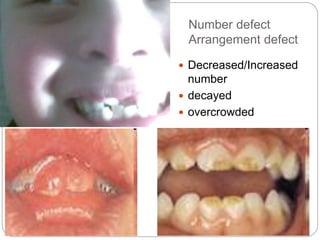
Number defect
Arrangement defect
 Decreased/Increased
number
 decayed
 overcrowded
2- cranial nerves
1-
CORTICAL
3- PNS
CNS
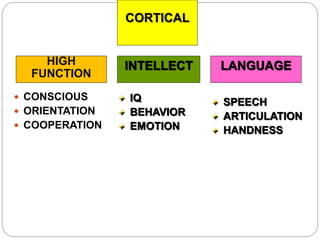
HIGH
FUNCTION
CORTICAL
 CONSCIOUS
 ORIENTATION
 COOPERATION
lNTELLECT LANGUAGE
IQ
BEHAVIOR
EMOTION
SPEECH
ARTICULATION
HANDNESS
Early Handedness (<2 YS)
cerebral : as CP hemiplegic
brachial plexus injury, ERB’S
PALSY
Joint: shoulder arthritis
bone: fracture clavicle or humerus
1- position
2- muscle state
3- invol movements
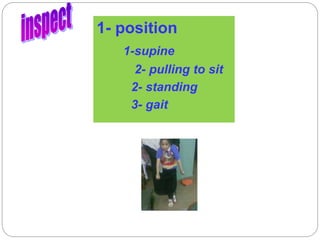
1- position
1-supine
2- pulling to sit
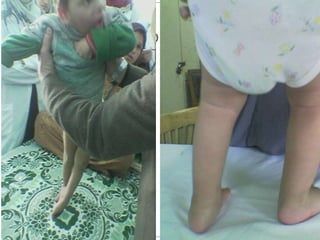
2- standing
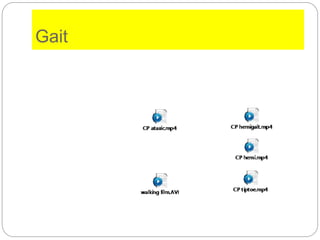
3- gait
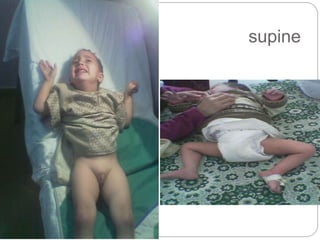
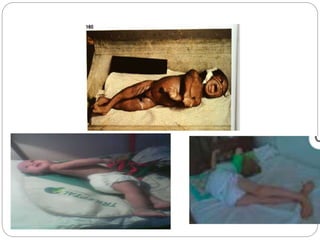
supine
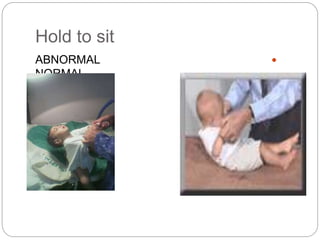
Hold to sit
ABNORMAL
NORMAL
hold to stand
Gait
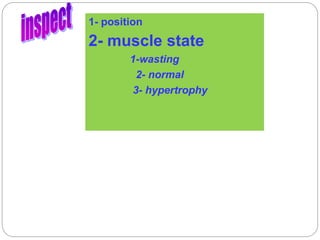
1- position
2- muscle state
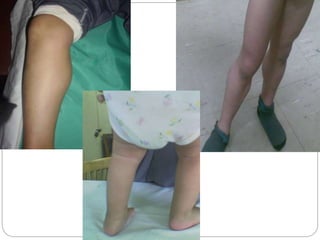
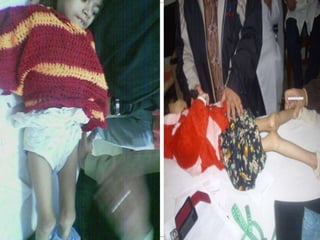
1-wasting
2- normal
3- hypertrophy
1- position
2- muscle state
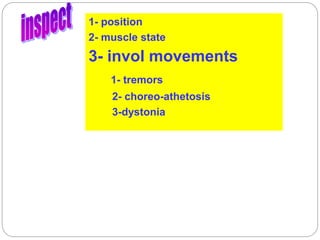
3- invol movements
1- tremors
2- choreo-athetosis
3-dystonia
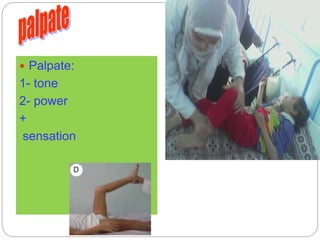
 Palpate:
1- tone
2- power
+
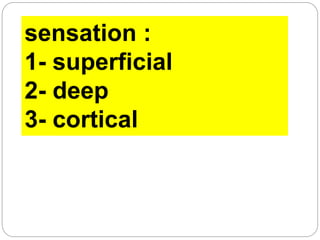
sensation
sensation :
1- superficial
2- deep
3- cortical
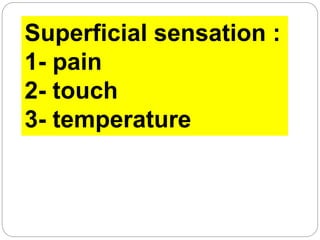
Superficial sensation :
1- pain
2- touch
3- temperature
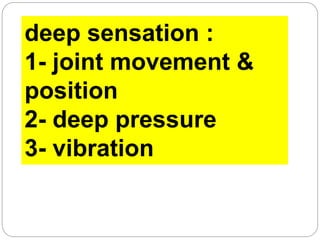
deep sensation :
1- joint movement &
position
2- deep pressure
3- vibration
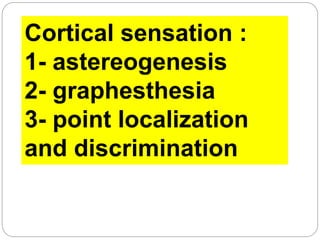
Cortical sensation :
1- astereogenesis
2- graphesthesia
3- point localization
and discrimination
Reflexes
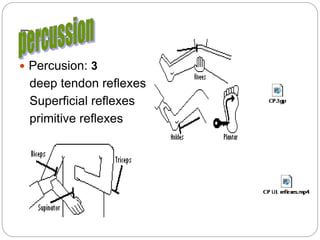
 Percusion: 3
deep tendon reflexes
Superficial reflexes
primitive reflexes
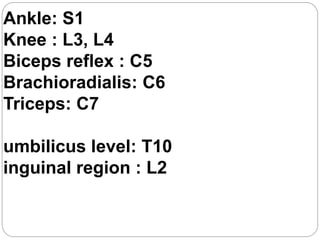
Ankle: S1
Knee : L3, L4
Biceps reflex : C5
Brachioradialis: C6
Triceps: C7
umbilicus level: T10
inguinal region : L2
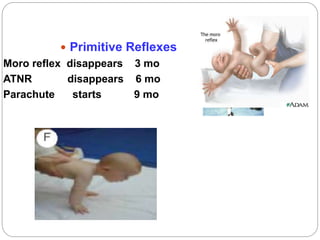
 Primitive Reflexes
Moro reflex disappears 3 mo
ATNR disappears 6 mo
Parachute starts 9 mo
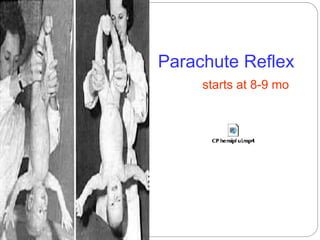
Parachute Reflex
starts at 8-9 mo
Investigation
one
othersystem
Treatment
specific
Prophylaxis
+
CPT tt
Non
specific
Thank You

Pediatric neurology examination make it easy