MOKGWANE EUTLWETSE SPARKS
5TH
YEAR MED STUD
UWI, BAHAMAS CAMPUS
• DEFINITION
• EPIDEMIOLOGY & DEMOGRAPHICS
• ETIOLOGY
• PHYSICAL FINDINGS & CLINICAL PRESENTATION
• DIFFERENTIAL DIAGNOSIS
• WORKUP
• TREATMENT
• PROGNOSIS
• REFERRAL
• PEARLS & CONSIDERATIONS
• EVIDENCE-BASED REFERENCE
• REFERENCE
 Encopresis is the voluntary or involuntary
passage of stool into inappropriate places, in
children over the developmental age of 4 yr,
with the absence of direct physiologic causes.
 Occurs at least once per month for at least 3
months.
 787.6 INCONTINENCE OF FECES
 307.7 ENCOPRESIS
 PEAK INCIDENCE: 4 to 5 yr of age
 PREVALANCE (IN U.S.): 1% to 1.5% of
children ages 5-8.
 PREDOMINANT SEX: Male > female (ratio of
4:1)
 PREDOMINANT AGE: 4 to 9 yr of age
 GENETICS: Factors that contribute to slow gut
motility may predispose to encopresis
• Children with encopresis exhibit abnormal anorectal
dynamics.
• Primary encopresis may be related to developmental
delay of sphincter control.
• Secondary encopresis develops in the setting of
constipation.
• Approximately 96% of children will have bowel movements
between three times daily to once every other day.

 When bowel movements are less frequent,
stool becomes drier and harder and much
more uncomfortable to pass.
 Soiling results from more liquid stool that leaks
around the main stool mass.
• Constipation may begin gradually as a result of
a slow decrease in elimination frequency or
more acutely after an illness, dehydration, or
prolonged bed rest.
• In encopresis without constipation and
overflow incontinence, soiling is often
intentional. This may occur in the setting of
oppositional-defiant disorder or conduct
disorder
 Harsh or inconsistent toilet training and
resultant anxiety may lead to retention of stool,
constipation, and eventually encopresis.
 Most children attain fecal continence by the
age of 4.
 In Primary encopresis, continence is never fully
established
 Secondary encopresis incontinence is
preceded by a year or more of continence.
 In primary encopresis, stool is more likely to be
normal in character.
 Soiling is intermittent and usually in a
prominent location.
 Coexisting oppositional-defiant or conduct
disorders are frequent.
• In secondary encopresis, constipation is generally
severe.
• Causes an overflow incontinence in which soft or
liquid stool flows around the retained feces, often
several times per day.
• Defecation is usually uncomfortable or painful, so
patient avoids defecation with consequent stool
retention.
 Stool is usually poorly formed and leakage is
continuous (occurring during sleep and
wakefulness).
 Encopresis resolves when the constipation is
resolved.
 Hirschsprung's disease
 Endocrine disease
(hypothyroidism)
 Cerebral palsy
 Myelomeningocele
 Pseudoobstruction
 Anorectal lesions (rectal
stenosis)
 Malformations
 Trauma
 Rectal prolapse
 Medications
 HISTORY:
 Pay particular attention to frequency of
elimination.
 Character of the stool.
 Associated pain.
 Presence of enuresis (with which it is frequently
associated).
 Evaluate child for other developmental or
psychiatric problems.
 PHYSICAL EXAMINATION:
 pay particular attention to the abdomen, anus,
rectum, and saddle sensation.
 CONSIDER:
 Thyroid function tests
 Electrolytes
 Calcium
 Urinalysis
 Culture
 Abdominal imaging to determine extent of
obstruction or megacolon (abdominal
radiograph).
 Anorectal manometric studies to
determine sphincter function if Hirschsprung's
disease is suspected;
 If abnormal, follow up with a barium enema
and rectal biopsy .
 It is a test that evaluates bowel function in
patients with constipation or stool leakage.
   It is done on an outpatient basis with mild
discomfort.
 The test measures the following parameters;
 Strength of the anal sphincter muscles
 Sensation of stooling in the rectum
 Reflexes that govern bowel
 Movements of the rectal and anal muscles
 Indicated to rule out the following conditions;
 Constipation, particularly difficulty with stool
evacuation (dyssynergic defecation)
 Stool leakage or fecal incontinence
 Hirshsprungs disease (a childhood disorder)
 Anorectal function before or after bowel
surgery
 The test takes about 60 minutes. 
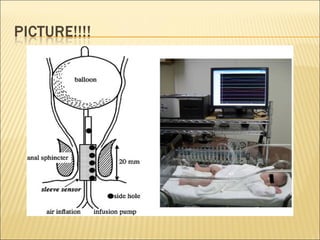
 A small, flexible sensor is placed in the rectum. 
 It is then connected to a computer and a
recording device that measures the pressure
and strength of the anal and rectal muscles. 
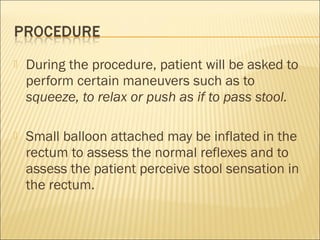
 During the procedure, patient will be asked to
perform certain maneuvers such as to
squeeze, to relax or push as if to pass stool.
 Small balloon attached may be inflated in the
rectum to assess the normal reflexes and to
assess the patient perceive stool sensation in
the rectum.
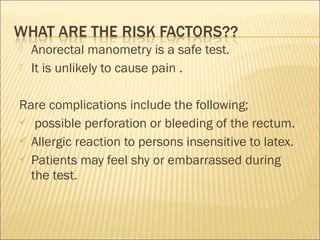
 Anorectal manometry is a safe test.
 It is unlikely to cause pain .
Rare complications include the following;
 possible perforation or bleeding of the rectum.
 Allergic reaction to persons insensitive to latex.
 Patients may feel shy or embarrassed during
the test.
 NONPHARMACOLOGIC THERAPY;
 Behavioral and/or individual psychotherapy
and family therapy.
 Biofeedback advocated by some to improve
sphincter function.
• In secondary encopresis, disimpaction with
isotonic saline enemas .
• Resistant cases: repeated instillation of 200 to
600 ml of milk of magnesia enemas .
• If child does not permit enemas: oral disimpaction
with large doses of mineral oil or lactulose until
stool mass is cleared (note: this is frequently more
painful and more uncomfortable than an enema)
• Prevention of recurrence of constipation by
increased dietary fiber, bulk agents and the
use of laxatives (Senokot) and stool softeners
(Colace).
• In primary encopresis, continue with
nonpunitive toilet training and encourage
regular toilet times (the latter is also helpful in
secondary encopresis)
• A systematic review found some evidence that
behavioral intervention plus laxative therapy, rather than
behavioral therapy or laxative therapy alone, improves
continence in children with primary and secondary
encopresis. There was no evidence that biofeedback
adds any benefit to conventional management of
encopresis and constipation in children.
Brazelli M, Griffiths P: Behavioural and cognitive
interventions with or without other treatments for
defaecation disorders in children. Cochrane Database
Syst Rev 2001;CD002240
 In most cases encopresis is self-limited
and of relatively brief duration.
 If patient is resistant to treatment.
 If complicated family factors are involved.
 If encopresis is purposeful.
 It is important to educate parents and children
as to the nature of the problem and to defuse
hostile or negative interactions between them.
 Medscape
 American Academy of Pediatrics
 Ferri's Clinical Advisor 2008, 10th ed
 http://www.gastroconsultantsqc.com/services/
procedures/anorectal-manometry/
Encopresis

Encopresis

  • 1.
    MOKGWANE EUTLWETSE SPARKS 5TH YEARMED STUD UWI, BAHAMAS CAMPUS
  • 2.
    • DEFINITION • EPIDEMIOLOGY& DEMOGRAPHICS • ETIOLOGY • PHYSICAL FINDINGS & CLINICAL PRESENTATION • DIFFERENTIAL DIAGNOSIS • WORKUP • TREATMENT • PROGNOSIS • REFERRAL • PEARLS & CONSIDERATIONS • EVIDENCE-BASED REFERENCE • REFERENCE
  • 3.
     Encopresis isthe voluntary or involuntary passage of stool into inappropriate places, in children over the developmental age of 4 yr, with the absence of direct physiologic causes.  Occurs at least once per month for at least 3 months.
  • 4.
     787.6 INCONTINENCEOF FECES  307.7 ENCOPRESIS
  • 5.
     PEAK INCIDENCE:4 to 5 yr of age  PREVALANCE (IN U.S.): 1% to 1.5% of children ages 5-8.  PREDOMINANT SEX: Male > female (ratio of 4:1)  PREDOMINANT AGE: 4 to 9 yr of age  GENETICS: Factors that contribute to slow gut motility may predispose to encopresis
  • 6.
    • Children withencopresis exhibit abnormal anorectal dynamics. • Primary encopresis may be related to developmental delay of sphincter control. • Secondary encopresis develops in the setting of constipation. • Approximately 96% of children will have bowel movements between three times daily to once every other day.
  • 7.
     When bowelmovements are less frequent, stool becomes drier and harder and much more uncomfortable to pass.  Soiling results from more liquid stool that leaks around the main stool mass.
  • 8.
    • Constipation maybegin gradually as a result of a slow decrease in elimination frequency or more acutely after an illness, dehydration, or prolonged bed rest. • In encopresis without constipation and overflow incontinence, soiling is often intentional. This may occur in the setting of oppositional-defiant disorder or conduct disorder
  • 9.
     Harsh orinconsistent toilet training and resultant anxiety may lead to retention of stool, constipation, and eventually encopresis.
  • 10.
     Most childrenattain fecal continence by the age of 4.  In Primary encopresis, continence is never fully established  Secondary encopresis incontinence is preceded by a year or more of continence.
  • 11.
     In primaryencopresis, stool is more likely to be normal in character.  Soiling is intermittent and usually in a prominent location.  Coexisting oppositional-defiant or conduct disorders are frequent.
  • 12.
    • In secondaryencopresis, constipation is generally severe. • Causes an overflow incontinence in which soft or liquid stool flows around the retained feces, often several times per day. • Defecation is usually uncomfortable or painful, so patient avoids defecation with consequent stool retention.
  • 13.
     Stool isusually poorly formed and leakage is continuous (occurring during sleep and wakefulness).  Encopresis resolves when the constipation is resolved.
  • 14.
     Hirschsprung's disease Endocrine disease (hypothyroidism)  Cerebral palsy  Myelomeningocele  Pseudoobstruction  Anorectal lesions (rectal stenosis)  Malformations  Trauma  Rectal prolapse  Medications
  • 15.
     HISTORY:  Payparticular attention to frequency of elimination.  Character of the stool.  Associated pain.  Presence of enuresis (with which it is frequently associated).
  • 16.
     Evaluate childfor other developmental or psychiatric problems.  PHYSICAL EXAMINATION:  pay particular attention to the abdomen, anus, rectum, and saddle sensation.
  • 17.
     CONSIDER:  Thyroidfunction tests  Electrolytes  Calcium  Urinalysis  Culture
  • 18.
     Abdominal imagingto determine extent of obstruction or megacolon (abdominal radiograph).  Anorectal manometric studies to determine sphincter function if Hirschsprung's disease is suspected;  If abnormal, follow up with a barium enema and rectal biopsy .
  • 19.
     It isa test that evaluates bowel function in patients with constipation or stool leakage.    It is done on an outpatient basis with mild discomfort.
  • 20.
     The testmeasures the following parameters;  Strength of the anal sphincter muscles  Sensation of stooling in the rectum  Reflexes that govern bowel  Movements of the rectal and anal muscles
  • 21.
     Indicated torule out the following conditions;  Constipation, particularly difficulty with stool evacuation (dyssynergic defecation)  Stool leakage or fecal incontinence  Hirshsprungs disease (a childhood disorder)  Anorectal function before or after bowel surgery
  • 22.
     The testtakes about 60 minutes.   A small, flexible sensor is placed in the rectum.   It is then connected to a computer and a recording device that measures the pressure and strength of the anal and rectal muscles. 
  • 23.
     During theprocedure, patient will be asked to perform certain maneuvers such as to squeeze, to relax or push as if to pass stool.  Small balloon attached may be inflated in the rectum to assess the normal reflexes and to assess the patient perceive stool sensation in the rectum.
  • 24.
     Anorectal manometryis a safe test.  It is unlikely to cause pain . Rare complications include the following;  possible perforation or bleeding of the rectum.  Allergic reaction to persons insensitive to latex.  Patients may feel shy or embarrassed during the test.
  • 26.
     NONPHARMACOLOGIC THERAPY; Behavioral and/or individual psychotherapy and family therapy.  Biofeedback advocated by some to improve sphincter function.
  • 27.
    • In secondaryencopresis, disimpaction with isotonic saline enemas . • Resistant cases: repeated instillation of 200 to 600 ml of milk of magnesia enemas . • If child does not permit enemas: oral disimpaction with large doses of mineral oil or lactulose until stool mass is cleared (note: this is frequently more painful and more uncomfortable than an enema)
  • 28.
    • Prevention ofrecurrence of constipation by increased dietary fiber, bulk agents and the use of laxatives (Senokot) and stool softeners (Colace). • In primary encopresis, continue with nonpunitive toilet training and encourage regular toilet times (the latter is also helpful in secondary encopresis)
  • 29.
    • A systematicreview found some evidence that behavioral intervention plus laxative therapy, rather than behavioral therapy or laxative therapy alone, improves continence in children with primary and secondary encopresis. There was no evidence that biofeedback adds any benefit to conventional management of encopresis and constipation in children. Brazelli M, Griffiths P: Behavioural and cognitive interventions with or without other treatments for defaecation disorders in children. Cochrane Database Syst Rev 2001;CD002240
  • 30.
     In mostcases encopresis is self-limited and of relatively brief duration.
  • 31.
     If patientis resistant to treatment.  If complicated family factors are involved.  If encopresis is purposeful.
  • 32.
     It isimportant to educate parents and children as to the nature of the problem and to defuse hostile or negative interactions between them.
  • 33.
     Medscape  AmericanAcademy of Pediatrics  Ferri's Clinical Advisor 2008, 10th ed  http://www.gastroconsultantsqc.com/services/ procedures/anorectal-manometry/

Editor's Notes

  • #17 1Saddle sensation is the sensation in the region around the buttocks and anus. It is supplied by the S3 to S5 nerve roots. It may be lost if there is a cauda equina lesion.
  • #24 To squeeze, you will be asked to tighten the anal sphincter muscles as if you are trying to prevent anything from coming out of your rectum.   To push or bear down, you are asked to strain down as if you are trying to pass a bowel movement.
  • #27 Biofeedback  is the process of gaining greater awareness of many physiological functions primarily using instruments that provide information on the activity of those same systems, with a goal of being able to manipulate them at will.
  • #28 Lactulose is a synthetic, non-digestible sugar used in the treatment of chronic constipation and hepatic encephalopathy a complication of liver disease. It is a disaccharide (double-sugar) formed from one molecule each of the simple sugars (monosaccharides) fructose and galactose. It is produced commercially by isomerization of lactose.