APPROACH TO
DEVELOPMENTAL
DELAY
NORMAL DEVELOPMETAL
MILESTONES
•The important developmental milestones in infants
and toddlers are grouped into the following:
•Gross motor
•Fine motor and vision
•Speech, language, and hearing
•Social, emotional, and behavioral.
•Activities in the above categories are summarized in
subsequent slides with respect to age of achievement.
DEVELOPMENTAL DELAY
• A child is considered developmentally delayed when they do
not reach developmental milestones at the expected age.
• Developmental delay is estimated to occur in 5-10% of the
population.
• Recognition at an early age achieves developmental
optimization than recognition at a later age.
• Several disabilities in the classification of developmental
delay are summarized in the following table (next slide)
DISABILITY DESCRIPTION
Gross motor delay Significant delay in fine or gross motor skills
with no impairment in other developmental
areas
Developmental language disorders Significant delay in receptive and/or expressive language skills
with no delay in other developmental domains
Global developmental delay Significant delay in two or more developmental
streams as measured by appropriate
standardized screening tests. This term is
reserved for children less than 5 years of age
Cerebral palsy Early-onset non-progressive motor impairment
with associated abnormalities in muscle tone
Visual sensory impairment An optically or medically diagnosable condition
in the eye(s) or visual system that affects the
development and normal use of vision, ranging
from slight to complete blindness
Hearing sensory impairment A reduction in the ability to hear sound, ranging
from slight to complete deafness
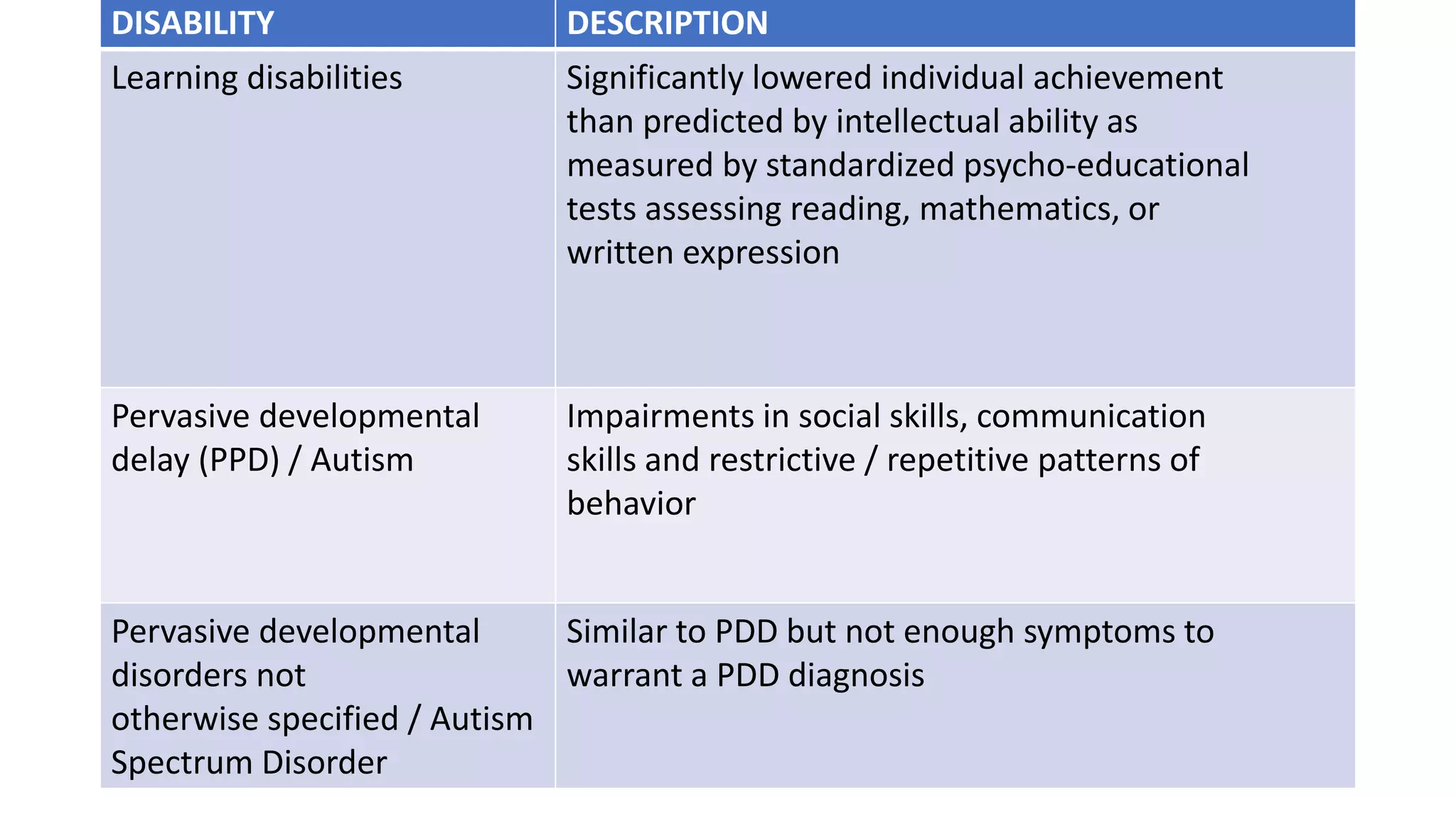
DISABILITY DESCRIPTION
Learning disabilities Significantly lowered individual achievement
than predicted by intellectual ability as
measured by standardized psycho-educational
tests assessing reading, mathematics, or
written expression
Pervasive developmental
delay (PPD) / Autism
Impairments in social skills, communication
skills and restrictive / repetitive patterns of
behavior
Pervasive developmental
disorders not
otherwise specified / Autism
Spectrum Disorder
Similar to PDD but not enough symptoms to
warrant a PDD diagnosis
ETIOLOGY/RISK FACTORS
•Genetic/syndromic e.g. Down’s syndrome, Fragile X, Velo-
cardio-facial syndrome, tuberous sclerosis, Duchenne
muscular dystrophy etc.
•Metabolic – phenylketonuria.
• Endocrine – congenital hypothyroidism.
• Traumatic – Acquired brain injury.
•Cerebral malformations – neuronal migration disorders.
• Cerebral palsy.
• Infections – TORCHES.
•Toxins – alcohol, lead toxicity etc.
ENVIRONMENTAL RISK FACTORS
•Lower socioeconomic levels
•Varied cultural backgrounds.
•Teenage mothers.
•Exposure to viruses, drugs and alcohol.
•other children with developmental delays.
•Pregnancy malnutrition.
•Mothers with DM, thyroid disorders, syphilis, other
viral infections
DEVELOPMENTAL ASSESSMENT
• Developmental assessment involves three aspects:
• Screening
• Surveillance and
• Definitive diagnostic assessment.
SCREENING
• Involves identifying children who may need more
comprehensive evaluation.
• Accomplished through thorough history taking +/- the use of
screening tools such as the Denver or Bayley Scales of infant
development.
SURVEILLANCE
• Involves following a child’s development trajectory over time to pick up
on subtle deficiencies.
• The components include:
• Eliciting and attending to parental concerns
• Obtaining a relevant developmental history
• Observing the child’s development in the office and
• Referring for further assessment of development by other relevant professionals
DIAGNOSTIC ASSESSMENT
• Performed on a child who has been identified as having a potential
problem.
• Requires extensive involvement of various team players such as a
psychologist, educator, social worker, developmental pediatrician,
geneticist etc.
HISTORY
• An underlying etiology for developmental delay should be sought through
attention to the following clues on history:
• Prenatal history
• Complications
• Prenatal diagnoses made (e.g. Down Syndrome)
• Infections (e.g. TORCH)
• Exposures (e.g. Fetal Alcohol Syndrome)
• Obstetrical history
• Complications
• APGAR scores
• Infections (e.g. Group B Strep)
• Seizures
• Newborn screening performed
• Past medical history and medications
• Ototoxic antibiotics e.g. Gentamicin
• Frequent ear infections may lead to effusions affecting hearing
• Behavior since birth
• Behavioral disturbances – aggression, self injury, defiance,
inattention, anxiety, depression, sleep disturbances, stereotypic
behaviors, poor social skills, hyperactivity, difficult temperaments
• Family history
• Relatives with developmental delay, genetic abnormalities, syndromes
• Consanguinity
• Social History
• Evidence of neglect or abuse which may have a negative influence on
development.
• In children with a previously identified delay it is important to assess
the resources already accessed to support the family such as personal
tutors in the educational system, OT/PT for speech and language
therapy, etc.
SCREENING TOOLS
•There are various screening instruments used for assessing
developmental.
•The Denver II assesses gross motor, fine motor, adaptive and
social skills. It is designed for children between the ages of 0
and 6 yrs.
• Similar tools are the “Ages and Stages” questionnaires and
the Bayley infant development scales.
PHYSICAL EXAMINATION
•Characteristic findings on physical exam may provide
clues as to the cause of the developmental delay.
•Some clinical signs and their corresponding clinical
significance are listed below:
GROWTH PARAMETERS:
• Microcephaly: eg in Rett’s Disorder
•Macrocephaly: eg in hydrocephalus
• Short stature: Turner syndrome, Williams syndrome
• Obesity: Prader-Willi syndrome, Beckwith-Wiedemann
syndrome
HEAD AND NECK
•Flat occiput: Down syndrome, Zellweger syndrome
•Prominent occiput: trisomy 18
•Craniosynostosis: Crouzon syndrome, Pfeiffer
syndrome
•Midface hypoplasia: Fetal Alcohol Syndrome (FAS),
Down syndrome
•Prominent nose and chin: Fragile X syndrome
•Round facies: Prader-Willi syndrome
•Triangular facies: Turner syndrome
•Hypertelorism: Fetal hydantoin syndrome
•Hypotelorism: maternal PKU effect
•Brushfield spots: Down syndrome
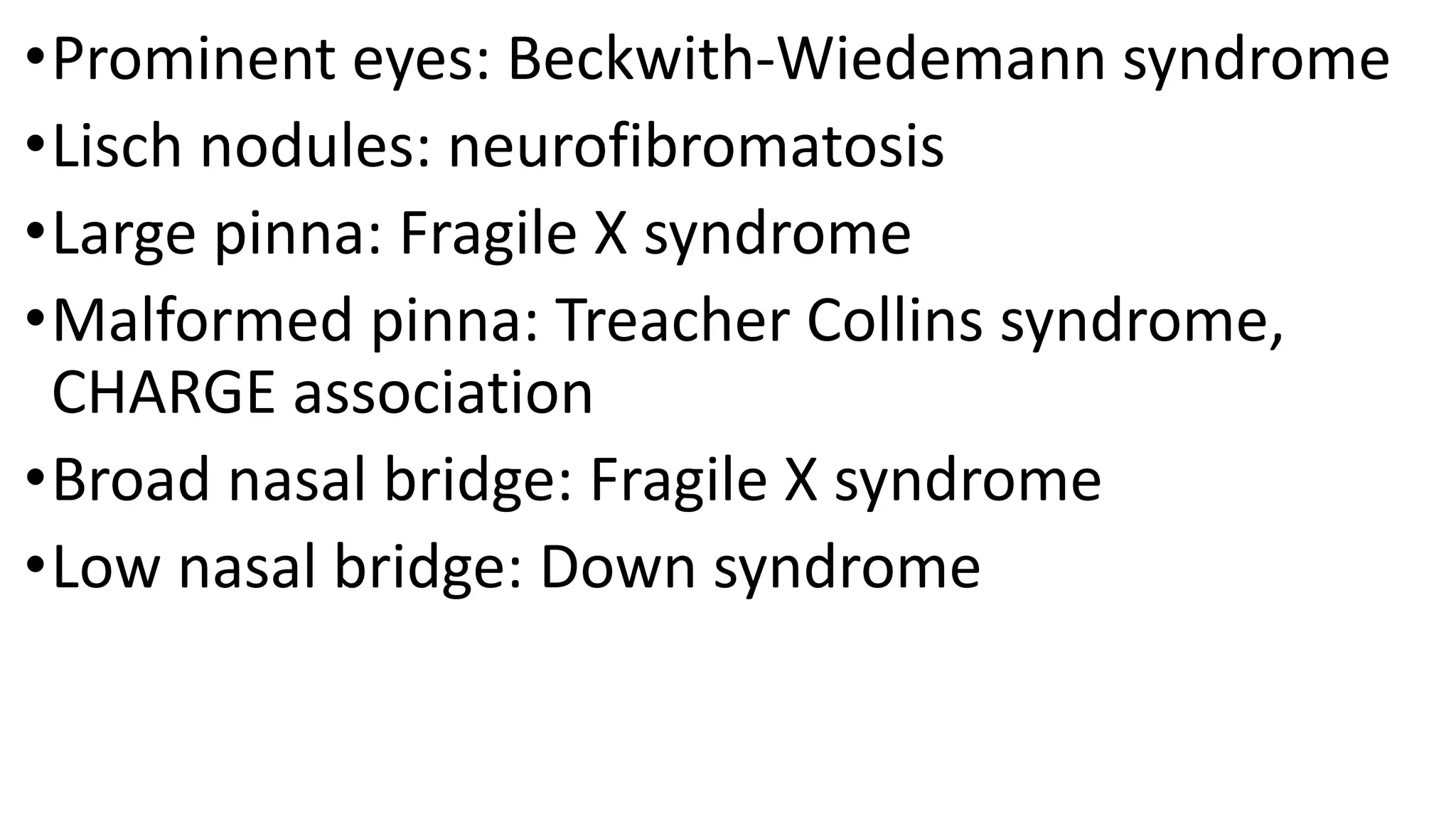
•Prominent eyes: Beckwith-Wiedemann syndrome
•Lisch nodules: neurofibromatosis
•Large pinna: Fragile X syndrome
•Malformed pinna: Treacher Collins syndrome,
CHARGE association
•Broad nasal bridge: Fragile X syndrome
•Low nasal bridge: Down syndrome
•Long philtrum: FAS
•Cleft lip and palate: may either be isolated or
part of a syndrome
•Micrognathia: Robin sequence
•Macroglossia: Beckwith-Wiedemann
syndrome
•Abnormal hair whorls: Down syndrome
•Webbed neck: Turner syndrome
GENITOURINARY
• Macroorchidism: Fragile X syndrome
• Hypogonadism: Prader-Willi syndrome
EXTREMITIES
• Small hands: Prader-Willi syndrome
• Clinodactyly: trisomies including Down syndrome
• Transverse palmer crease: Down syndrome
SKIN
• Nail hypoplasia or dysplasia: FAS
• Facial port wine hemangioma: Sturge-Weber syndrome
• Café au lait spots: Neurofibromatosis
• Ashleaf spots: Tuberous Sclerosis
NEUROLOGICAL EXAM
•Cranial nerves
•Specific vision tests
• Red reflex, normal fundi, response to visual stimuli, field of
vision.
•Specific auditory tests
• Response to auditory stimuli
•Receptive or expressive language delay
•Abnormal speech (e.g. articulation)
•Persistently present Babinski response (older than 2
years of age)
•Hyper- or Hypotonia
•Sensory
•Motor strength
•Gait
•Deep tendon reflexes
•Primitive reflexes – Moro, Gallant
•Postural reflexes – propping response
INVESTIGATIONS
• Endocrinology:
• TSH, free T4
• Metabolic:
• Metabolic screening – glucose, electrolytes, serum lactate, ammonia,
LFTs, pyruvate, albumin, TGs, uric acid, serum quantitative amino acids,
urine organic acids, acylcarnitines, CPK (if suspecting myopathy)
• Neurology:
• EEG
• Head CT
• Genetics:
• Karyotyping to assess for chromosomal abnormalities
• FISH analysis to assess for microdeletions
MANAGEMENT
•Specialized condition-related office visits, written care plans,
co-management with medical specialists, appropriate patient
education, and an effective system for monitoring and
tracking should be put in place
•Interventions include:
• Physical therapy
• Occupation therapy.
• Speech-language therapy
• Special instruction
• Counselling
• Family training
•Parent training or home based therapy for
generalization of skills.
•Medical treatment of tone anomalies (for CP) – IM
botulinum and IT baclofen.
•Psychopharmacological treatment of behavioral
disorders accompanying a communication or
intellectual disability such as:
•Stimulants for ADHD.
•Risperidone for aggression.
•The family can also be referred to community-based
support programmes (if any).
THE END
THANK YOU

APPROACH TO DEVELOPMENTAL DELAY.pptx

  • 1.
  • 2.
    NORMAL DEVELOPMETAL MILESTONES •The importantdevelopmental milestones in infants and toddlers are grouped into the following: •Gross motor •Fine motor and vision •Speech, language, and hearing •Social, emotional, and behavioral. •Activities in the above categories are summarized in subsequent slides with respect to age of achievement.
  • 5.
    DEVELOPMENTAL DELAY • Achild is considered developmentally delayed when they do not reach developmental milestones at the expected age. • Developmental delay is estimated to occur in 5-10% of the population. • Recognition at an early age achieves developmental optimization than recognition at a later age. • Several disabilities in the classification of developmental delay are summarized in the following table (next slide)
  • 6.
    DISABILITY DESCRIPTION Gross motordelay Significant delay in fine or gross motor skills with no impairment in other developmental areas Developmental language disorders Significant delay in receptive and/or expressive language skills with no delay in other developmental domains Global developmental delay Significant delay in two or more developmental streams as measured by appropriate standardized screening tests. This term is reserved for children less than 5 years of age Cerebral palsy Early-onset non-progressive motor impairment with associated abnormalities in muscle tone Visual sensory impairment An optically or medically diagnosable condition in the eye(s) or visual system that affects the development and normal use of vision, ranging from slight to complete blindness Hearing sensory impairment A reduction in the ability to hear sound, ranging from slight to complete deafness
  • 7.
    DISABILITY DESCRIPTION Learning disabilitiesSignificantly lowered individual achievement than predicted by intellectual ability as measured by standardized psycho-educational tests assessing reading, mathematics, or written expression Pervasive developmental delay (PPD) / Autism Impairments in social skills, communication skills and restrictive / repetitive patterns of behavior Pervasive developmental disorders not otherwise specified / Autism Spectrum Disorder Similar to PDD but not enough symptoms to warrant a PDD diagnosis
  • 8.
    ETIOLOGY/RISK FACTORS •Genetic/syndromic e.g.Down’s syndrome, Fragile X, Velo- cardio-facial syndrome, tuberous sclerosis, Duchenne muscular dystrophy etc. •Metabolic – phenylketonuria. • Endocrine – congenital hypothyroidism. • Traumatic – Acquired brain injury. •Cerebral malformations – neuronal migration disorders. • Cerebral palsy. • Infections – TORCHES. •Toxins – alcohol, lead toxicity etc.
  • 9.
    ENVIRONMENTAL RISK FACTORS •Lowersocioeconomic levels •Varied cultural backgrounds. •Teenage mothers. •Exposure to viruses, drugs and alcohol. •other children with developmental delays. •Pregnancy malnutrition. •Mothers with DM, thyroid disorders, syphilis, other viral infections
  • 10.
    DEVELOPMENTAL ASSESSMENT • Developmentalassessment involves three aspects: • Screening • Surveillance and • Definitive diagnostic assessment. SCREENING • Involves identifying children who may need more comprehensive evaluation. • Accomplished through thorough history taking +/- the use of screening tools such as the Denver or Bayley Scales of infant development.
  • 11.
    SURVEILLANCE • Involves followinga child’s development trajectory over time to pick up on subtle deficiencies. • The components include: • Eliciting and attending to parental concerns • Obtaining a relevant developmental history • Observing the child’s development in the office and • Referring for further assessment of development by other relevant professionals DIAGNOSTIC ASSESSMENT • Performed on a child who has been identified as having a potential problem. • Requires extensive involvement of various team players such as a psychologist, educator, social worker, developmental pediatrician, geneticist etc.
  • 12.
    HISTORY • An underlyingetiology for developmental delay should be sought through attention to the following clues on history: • Prenatal history • Complications • Prenatal diagnoses made (e.g. Down Syndrome) • Infections (e.g. TORCH) • Exposures (e.g. Fetal Alcohol Syndrome) • Obstetrical history • Complications • APGAR scores • Infections (e.g. Group B Strep) • Seizures • Newborn screening performed • Past medical history and medications • Ototoxic antibiotics e.g. Gentamicin • Frequent ear infections may lead to effusions affecting hearing
  • 13.
    • Behavior sincebirth • Behavioral disturbances – aggression, self injury, defiance, inattention, anxiety, depression, sleep disturbances, stereotypic behaviors, poor social skills, hyperactivity, difficult temperaments • Family history • Relatives with developmental delay, genetic abnormalities, syndromes • Consanguinity • Social History • Evidence of neglect or abuse which may have a negative influence on development. • In children with a previously identified delay it is important to assess the resources already accessed to support the family such as personal tutors in the educational system, OT/PT for speech and language therapy, etc.
  • 14.
    SCREENING TOOLS •There arevarious screening instruments used for assessing developmental. •The Denver II assesses gross motor, fine motor, adaptive and social skills. It is designed for children between the ages of 0 and 6 yrs. • Similar tools are the “Ages and Stages” questionnaires and the Bayley infant development scales.
  • 15.
    PHYSICAL EXAMINATION •Characteristic findingson physical exam may provide clues as to the cause of the developmental delay. •Some clinical signs and their corresponding clinical significance are listed below: GROWTH PARAMETERS: • Microcephaly: eg in Rett’s Disorder •Macrocephaly: eg in hydrocephalus • Short stature: Turner syndrome, Williams syndrome • Obesity: Prader-Willi syndrome, Beckwith-Wiedemann syndrome
  • 16.
    HEAD AND NECK •Flatocciput: Down syndrome, Zellweger syndrome •Prominent occiput: trisomy 18 •Craniosynostosis: Crouzon syndrome, Pfeiffer syndrome •Midface hypoplasia: Fetal Alcohol Syndrome (FAS), Down syndrome •Prominent nose and chin: Fragile X syndrome
  • 17.
    •Round facies: Prader-Willisyndrome •Triangular facies: Turner syndrome •Hypertelorism: Fetal hydantoin syndrome •Hypotelorism: maternal PKU effect •Brushfield spots: Down syndrome
  • 18.
    •Prominent eyes: Beckwith-Wiedemannsyndrome •Lisch nodules: neurofibromatosis •Large pinna: Fragile X syndrome •Malformed pinna: Treacher Collins syndrome, CHARGE association •Broad nasal bridge: Fragile X syndrome •Low nasal bridge: Down syndrome
  • 19.
    •Long philtrum: FAS •Cleftlip and palate: may either be isolated or part of a syndrome •Micrognathia: Robin sequence •Macroglossia: Beckwith-Wiedemann syndrome •Abnormal hair whorls: Down syndrome •Webbed neck: Turner syndrome
  • 20.
    GENITOURINARY • Macroorchidism: FragileX syndrome • Hypogonadism: Prader-Willi syndrome EXTREMITIES • Small hands: Prader-Willi syndrome • Clinodactyly: trisomies including Down syndrome • Transverse palmer crease: Down syndrome SKIN • Nail hypoplasia or dysplasia: FAS • Facial port wine hemangioma: Sturge-Weber syndrome • Café au lait spots: Neurofibromatosis • Ashleaf spots: Tuberous Sclerosis
  • 21.
    NEUROLOGICAL EXAM •Cranial nerves •Specificvision tests • Red reflex, normal fundi, response to visual stimuli, field of vision. •Specific auditory tests • Response to auditory stimuli •Receptive or expressive language delay •Abnormal speech (e.g. articulation) •Persistently present Babinski response (older than 2 years of age)
  • 22.
    •Hyper- or Hypotonia •Sensory •Motorstrength •Gait •Deep tendon reflexes •Primitive reflexes – Moro, Gallant •Postural reflexes – propping response
  • 23.
    INVESTIGATIONS • Endocrinology: • TSH,free T4 • Metabolic: • Metabolic screening – glucose, electrolytes, serum lactate, ammonia, LFTs, pyruvate, albumin, TGs, uric acid, serum quantitative amino acids, urine organic acids, acylcarnitines, CPK (if suspecting myopathy) • Neurology: • EEG • Head CT • Genetics: • Karyotyping to assess for chromosomal abnormalities • FISH analysis to assess for microdeletions
  • 24.
    MANAGEMENT •Specialized condition-related officevisits, written care plans, co-management with medical specialists, appropriate patient education, and an effective system for monitoring and tracking should be put in place •Interventions include: • Physical therapy • Occupation therapy. • Speech-language therapy • Special instruction • Counselling • Family training
  • 25.
    •Parent training orhome based therapy for generalization of skills. •Medical treatment of tone anomalies (for CP) – IM botulinum and IT baclofen. •Psychopharmacological treatment of behavioral disorders accompanying a communication or intellectual disability such as: •Stimulants for ADHD. •Risperidone for aggression. •The family can also be referred to community-based support programmes (if any).
  • 26.