APPROACH TO
DEVELOPMENTAL DELAY
PROF RAJKUMAR
DEPARTMENT OF PEDIATRICS
DSMCH
 Normal Development
 Developmental Testing
 Screening
 Formal Testing
 Differential Diagnosis of delay
• What is development?
Maturation of function, acquisition of skills
– Cephalocaudal
– Mass responses  specific
– Predictable sequence, stepwise
• Achievement of different functions  Milestones
• Tested in 4 areas :
– Gross motor
– Fine motor
– Language
– Social
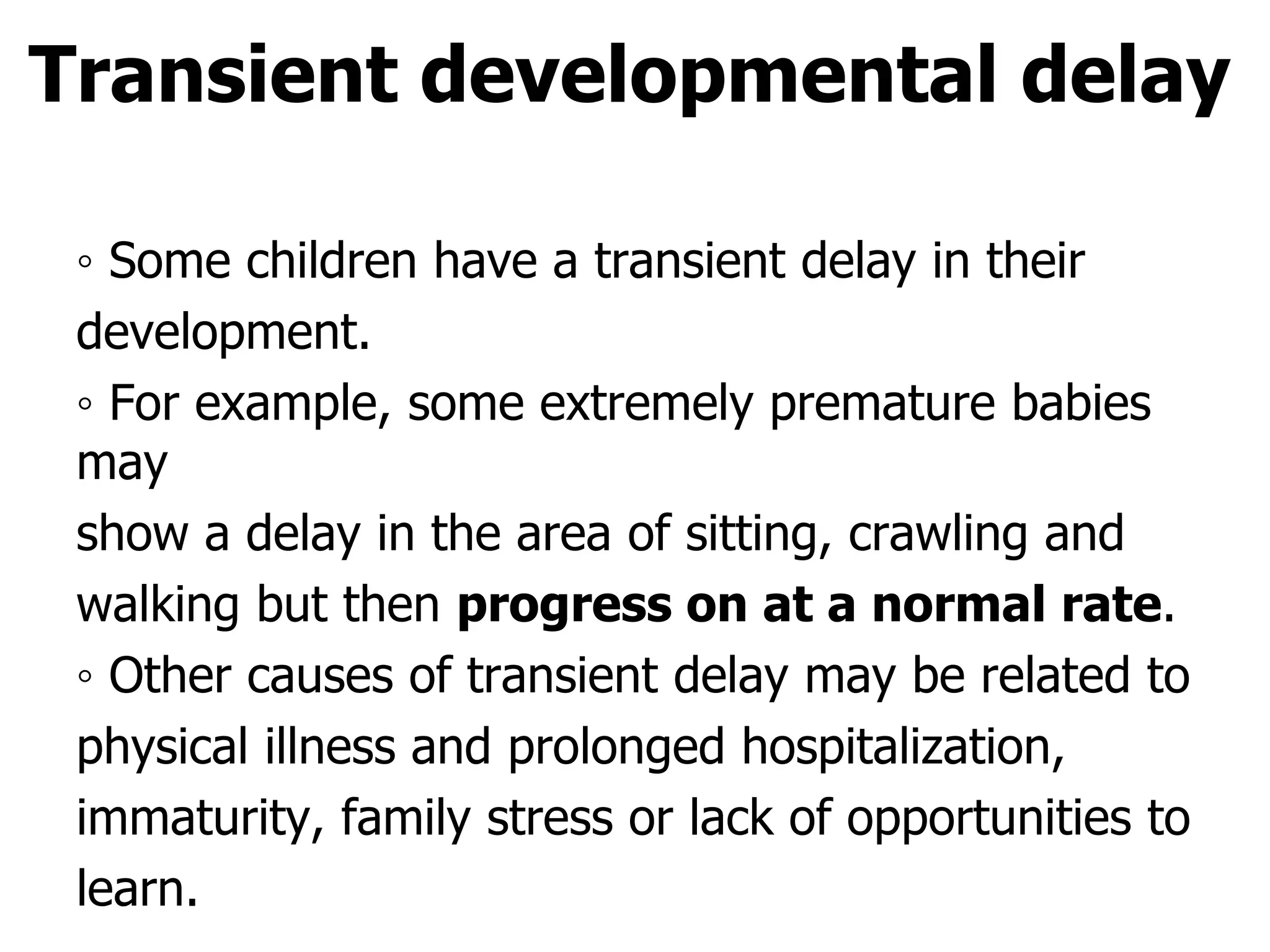
Transient developmental delay
◦ Some children have a transient delay in their
development.
◦ For example, some extremely premature babies
may
show a delay in the area of sitting, crawling and
walking but then progress on at a normal rate.
◦ Other causes of transient delay may be related to
physical illness and prolonged hospitalization,
immaturity, family stress or lack of opportunities to
learn.
Persistent developmental delay
◦ If the delay in development persists it is usually
related to
problems in one or more of the following areas:
understanding and learning
moving
communication
hearing
seeing.
◦ An assessment is often needed to determine what
area or areas are affected.
◦ Disorders which cause persistent developmental delay
are often termed developmental disabilities .
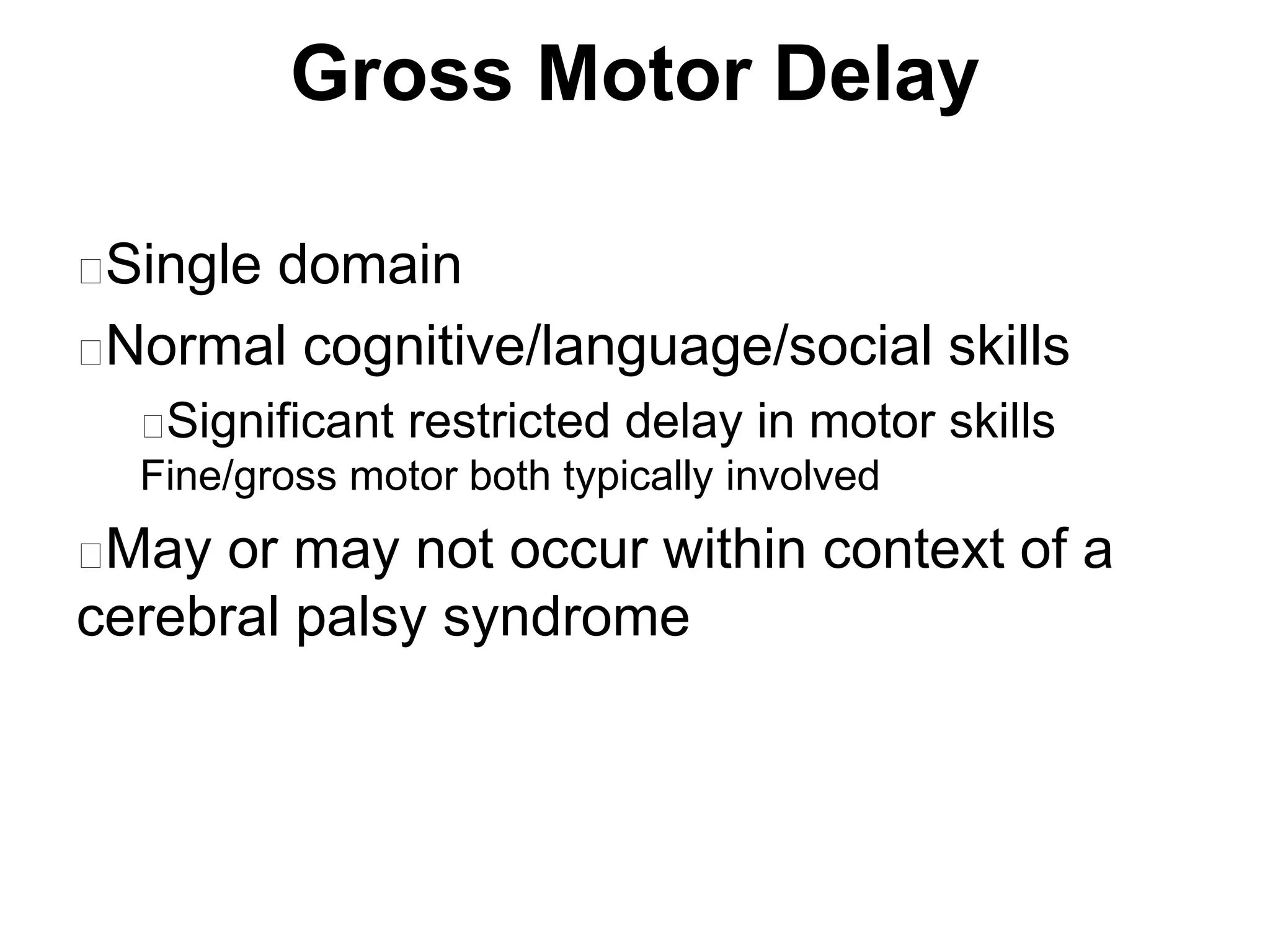
Gross Motor Delay
􀂾Single domain
􀂾Normal cognitive/language/social skills
􀂾Significant restricted delay in motor skills
Fine/gross motor both typically involved
􀂾May or may not occur within context of a
cerebral palsy syndrome
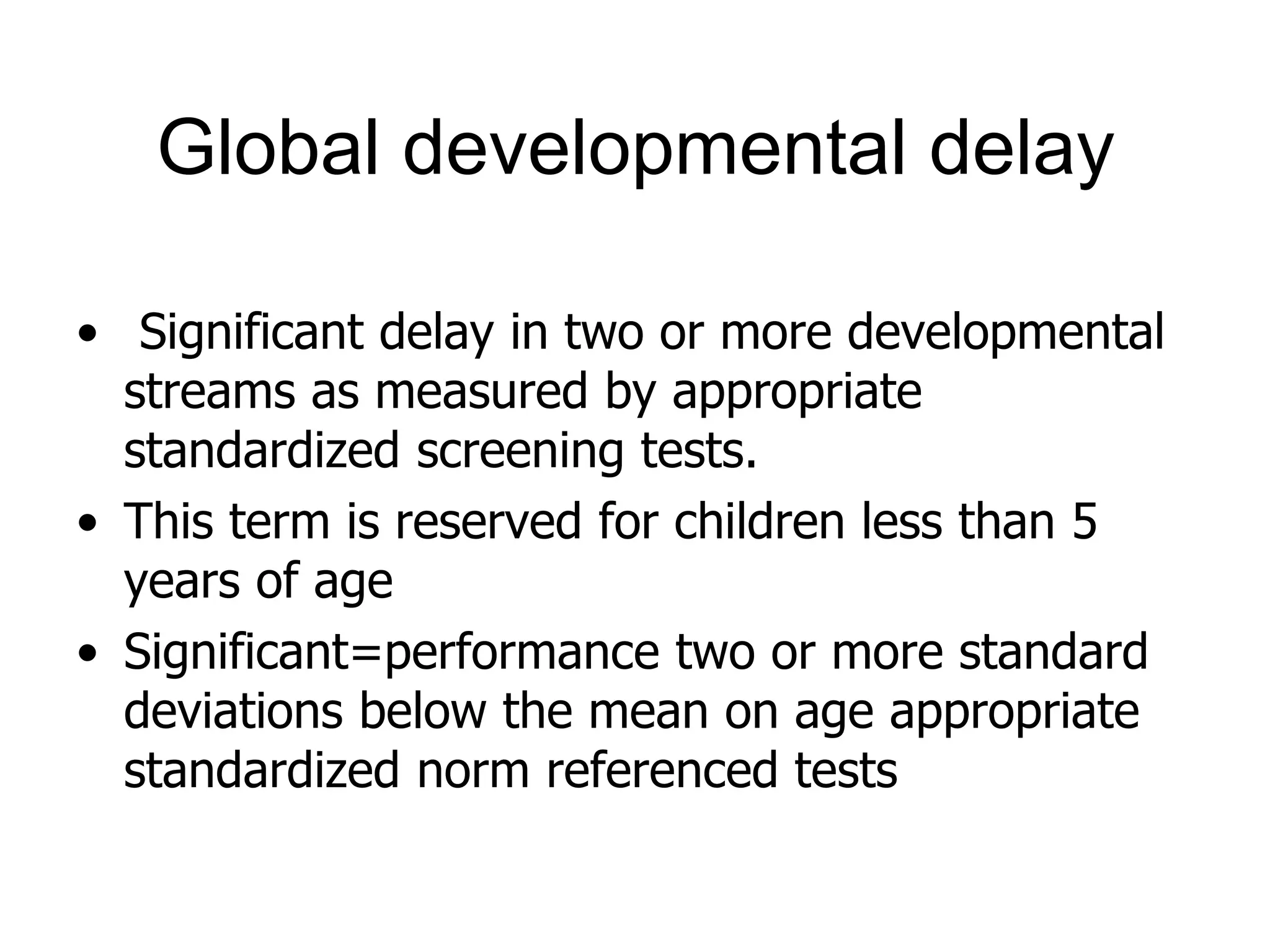
Global developmental delay
• Significant delay in two or more developmental
streams as measured by appropriate
standardized screening tests.
• This term is reserved for children less than 5
years of age
• Significant=performance two or more standard
deviations below the mean on age appropriate
standardized norm referenced tests
DDX of Delay:
• Late starter (outlier)
• MR - global delay
• Deprivation - social/emotional
• Motor defects - muscular / Cerebral palsy
• Hearing & vision defects
• Speech & language disorders
• Autism
• Specific learning disorders
• Attention deficit hyperactivity disorder
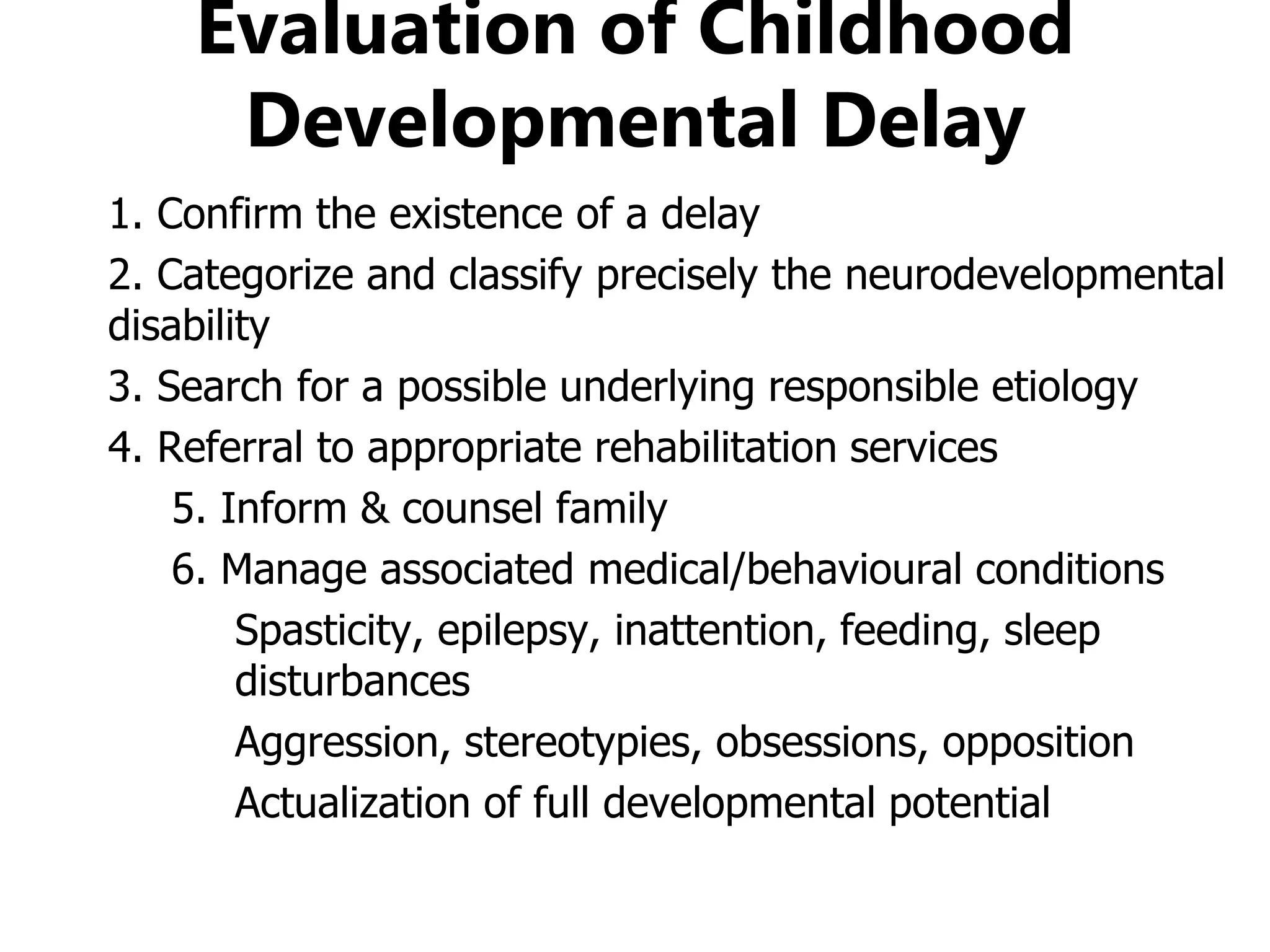
Evaluation of Childhood
Developmental Delay
1. Confirm the existence of a delay
2. Categorize and classify precisely the neurodevelopmental
disability
3. Search for a possible underlying responsible etiology
4. Referral to appropriate rehabilitation services
5. Inform & counsel family
6. Manage associated medical/behavioural conditions
Spasticity, epilepsy, inattention, feeding, sleep
disturbances
Aggression, stereotypies, obsessions, opposition
Actualization of full developmental potential
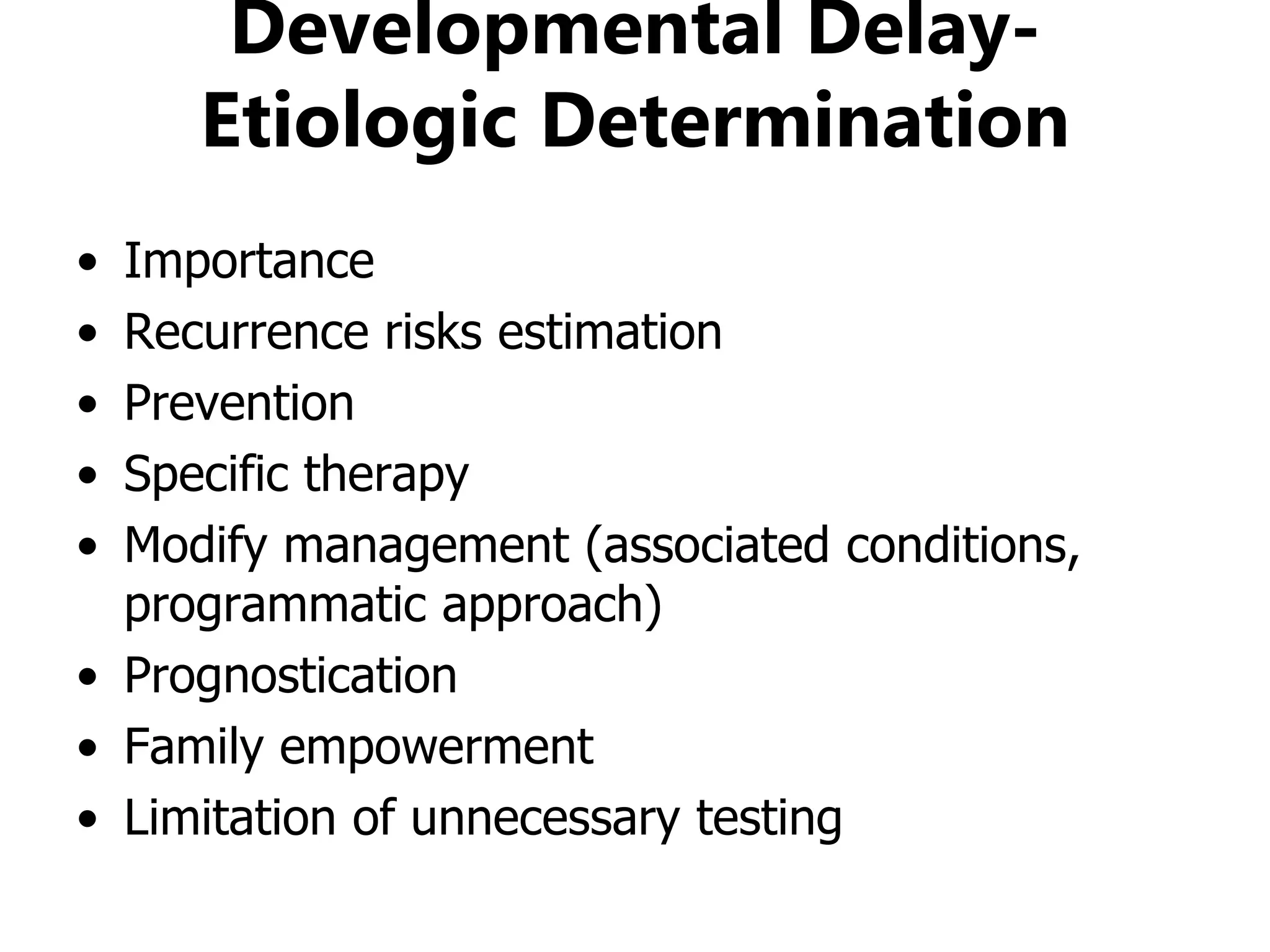
Developmental Delay-
Etiologic Determination
• Importance
• Recurrence risks estimation
• Prevention
• Specific therapy
• Modify management (associated conditions,
programmatic approach)
• Prognostication
• Family empowerment
• Limitation of unnecessary testing
Elements of Evaluation
History
Physical ExaminationGeneral
Neurological
Developmental
Laboratory Investigation
ReferralConsultations
Rehabilitation services
History
• Comprehensive Family History
– Developmental, health, school attainment status
of siblings, parents and other relatives
• Significant neurological
impairmentsCP/GDD/ASD/MR/DLI
• Epilepsy (convulsive disorders)
• Mental illness
• Neuromuscular disorders
– Parental consanguinity
– Ethnicity
Mother’s pregnancy/prenatal care
• PV bleeding
• Gestational diabetes
• Premature labour
• Medical conditions/medications
• Toxin exposure-alcohol, illicit drugs
• Intrauterine infections
• IUGR/Antenatal anomalies
• Labour/Delivery
– TimingPremature/Term
– ModeVaginal/Forceps/C-S (indication)
– Vertex/Breech presentation
• Meconium /FHR changes/APGAR scores (1/5
minutes & beyond)
• Birthweight
• Neonatal
– EncephalopathyInvariably occurs if intra-partum difficulties are
of neurologic relevance
• Seizures
• Feeding difficulties
• Associated conditions
• Developmental
• Age of initial concern
• Domain(s) of concern
• Progression in each domain
• Current capability in each domain
• Activities of daily living
• Play skills
– Any loss or regression of skills ?Possibility of a
neurodegenerative condition
Evaluation:
• Detailed history of events at birth, past illnesses
• Pattern of delay
• H/o Onset/regression
• Examine for motor problems
• Screening
• Formal developmental / IQ assessment
3 step process
Clinical evaluation
Screening
Formal assessment
Developmental Screening Tools: India
• Baroda Development Screening Test
• Trivandrum Development Screening Test
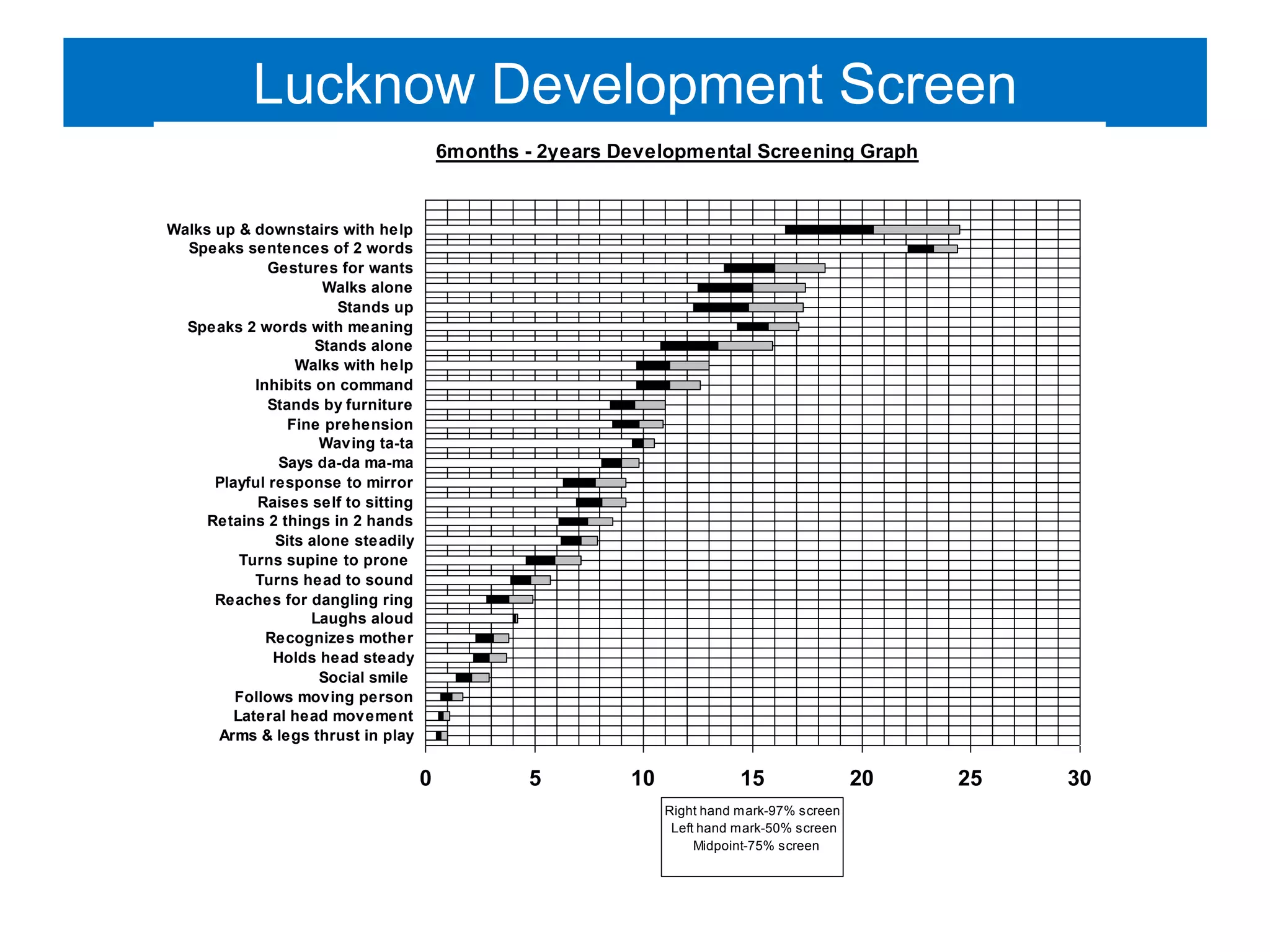
• Lucknow Development Screen
• Indian norms used
Lucknow Development Screen
6months - 2years Developmental Screening Graph
0 5 10 15 20 25 30
Arms & legs thrust in play
Lateral head movement
Follows moving person
Social smile
Holds head steady
Recognizes mother
Laughs aloud
Reaches for dangling ring
Turns head to sound
Turns supine to prone
Sits alone steadily
Retains 2 things in 2 hands
Raises self to sitting
Playful response to mirror
Says da-da ma-ma
Waving ta-ta
Fine prehension
Stands by furniture
Inhibits on command
Walks with help
Stands alone
Speaks 2 words with meaning
Stands up
Walks alone
Gestures for wants
Speaks sentences of 2 words
Walks up & downstairs with help
Right hand mark-97% screen
Left hand mark-50% screen
Midpoint-75% screen
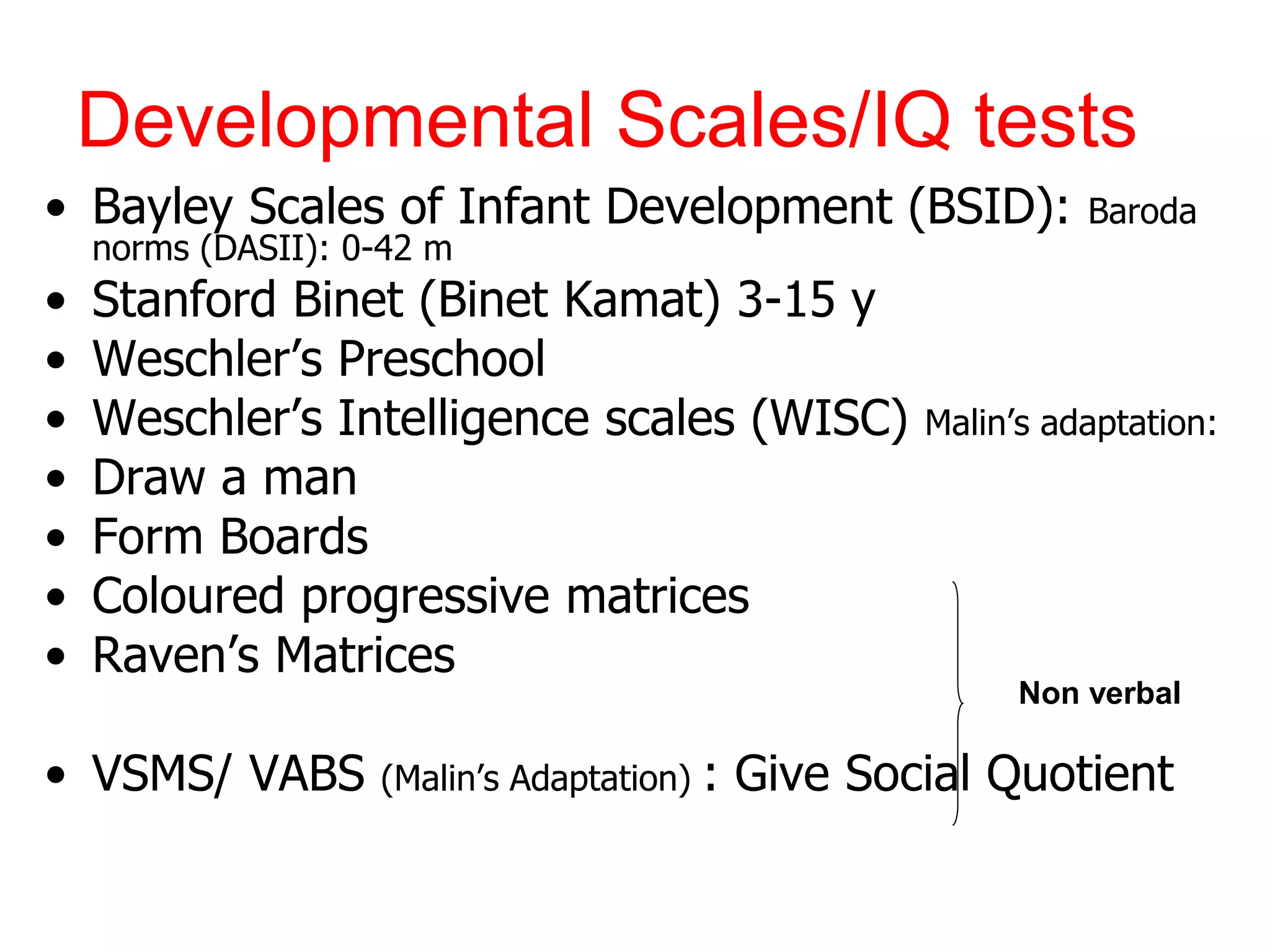
Developmental Scales/IQ tests
• Bayley Scales of Infant Development (BSID): Baroda
norms (DASII): 0-42 m
• Stanford Binet (Binet Kamat) 3-15 y
• Weschler’s Preschool
• Weschler’s Intelligence scales (WISC) Malin’s adaptation:
• Draw a man
• Form Boards
• Coloured progressive matrices
• Raven’s Matrices
• VSMS/ VABS (Malin’s Adaptation) : Give Social Quotient
Non verbal
Prenatal history
a. Complications-PIH, anemia
b. Prenatal diagnoses made (eg. Down Syndrome)
c. Infections (eg. TORCH)
d. Exposures (eg. Fetal Alcohol Syndrome)
Growth Parameters:
Microcephaly: eg in Rett’s Disorder,
Downs syndrome
Macrocephaly: eg in hydrocephalus
Short stature: Turner syndrome, Williams
syndrome
Obesity: Prader-Willi syndrome, Beckwith-
Wiedemann syndrome
Head and Neck
Flat occiput: Down syndrome, Zellweger syndrome
Prominent occiput: trisomy 18
Craniosynostosis: Crouzon syndrome, Pfeiffer syndrome
Midface hypoplasia: Fetal Alcohol Syndrome (FAS), Down
syndrome
Prominent nose and chin: Fragile X syndrome
Round facies: Prader-Willi syndrome
Triangular facies: Turner syndrome
Hypertelorism: Fetal hydantoin syndrome
Hypotelorism: maternal PKU effect
Brushfield spots: Down syndrome
Head and Neck
Prominent eyes: Beckwith-Wiedemann syndrome
Lisch nodules: neurofibromatosis
Large pinna: Fragile X syndrome
Malformed pinna: Treacher Collins syndrome, CHARGE
association
Broad nasal bridge: Fragile X syndrome
Low nasal bridge: Down syndrome
Long philtrum: FAS
Cleft lip and palate: may either be isolated or part of a
syndrome
Micrognathia: Robin sequence
Macroglossia: Beckwith-Wiedemann syndrome
Abnormal hair whorls: Down syndrome
Webbed neck: Turner syndrome
Genitourinary
Macroorchidism: Fragile X syndrome
Hypogonadism: Prader-Willi syndrome
Skin
Nail hypoplasia or dysplasia: FAS
Facial port wine hemangioma: Sturge-Weber
syndrome
Café au lait spots: Neurofibromatosis
Ashleaf spots: Tuberous Sclerosis
Extremities
Small hands: Prader-Willi syndrome
Clinodactyly: trisomies including Down
syndrome
Transverse palmer crease: Down
syndrome
MR – Treatable causes
• Cretinism
• Some inborn errors: Galactosemia, PKU etc
• Toxoplasma/syphilis: if detected early
• Hydrocephalus
Developmental Red Flags (1 to 3 months)
• Doesn't seem to respond to loud noises
• Doesn't follow moving objects with eyes by 2 to 3 months
• Doesn't smile at the sound of your voice by 2 months
• Doesn't grasp and hold objects by 3 months
• Doesn't smile at people by 3 months
• Cannot support head well at 3 months
• Doesn't reach for and grasp toys by 3 to 4 months
• Doesn't bring objects to mouth by 4 months
• Doesn't push down with legs when feet are placed on a firm
surface by 4 months
• Has trouble moving one or both eyes in all directions
• Crosses eyes most of the time (occasional crossing of the eyes
is normal in these first months)
Developmental Red Flags (4 to 7 months)
• Seems very stiff, tight muscles
• Seems very floppy, like a rag doll
• Head still flops back when body is pulled to sitting
position (by 5months still exhibits head lag)
• Shows no affection for the person who cares for them
• Doesn't seem to enjoy being around people
• One or both eyes consistently turn in or out
• Persistent tearing, eye drainage, or sensitivity to light
• Does not respond to sounds around them
Developmental Red Flags (4 to 7 months)
• Has difficulty getting objects to mouth
• Does not turn head to locate sounds by 4 months
• Doesn't roll over (stomach to back) by 6 months
• Cannot sit with help by 6 months (not by themselves)
• Does not laugh or make squealing sounds by 5 months
• Does not actively reach for objects by 6 months
• Does not follow objects with both eyes
• Does not bear some weight on legs by 5 months
Developmental Red Flags (8 to 12 months)
• Does not crawl
• Drags one side of body while crawling (for over one
month)
• Cannot stand when supported
• Does not search for objects that are hidden (10-12 mos.)
• Says no single words ("mama" or "dada")
• Does not learn to use gestures such as waving or shaking
head
• Does not sit steadily by 10 months
• Does not show interest in "peek-a-boo" or "patty cake" by
8 mos.
• Does not babble by 8 mos. ("dada," "baba," "mama")
Developmental Red Flags (12 to 24 months)
• Cannot walk by 18 months
• Fails to develop a mature heel-toe walking pattern
after several months of walking, or walks exclusively
on toes
• Does not speak at least 15 words by 18 months
• Does not use two-word sentences by age 2
• By 15 months does not seem to know the function of
common household objects (brush, telephone, bell,
fork, spoon)
• Does not imitate actions or words by 24 mos.
• Does not follow simple one-step instructions by 24
mos.
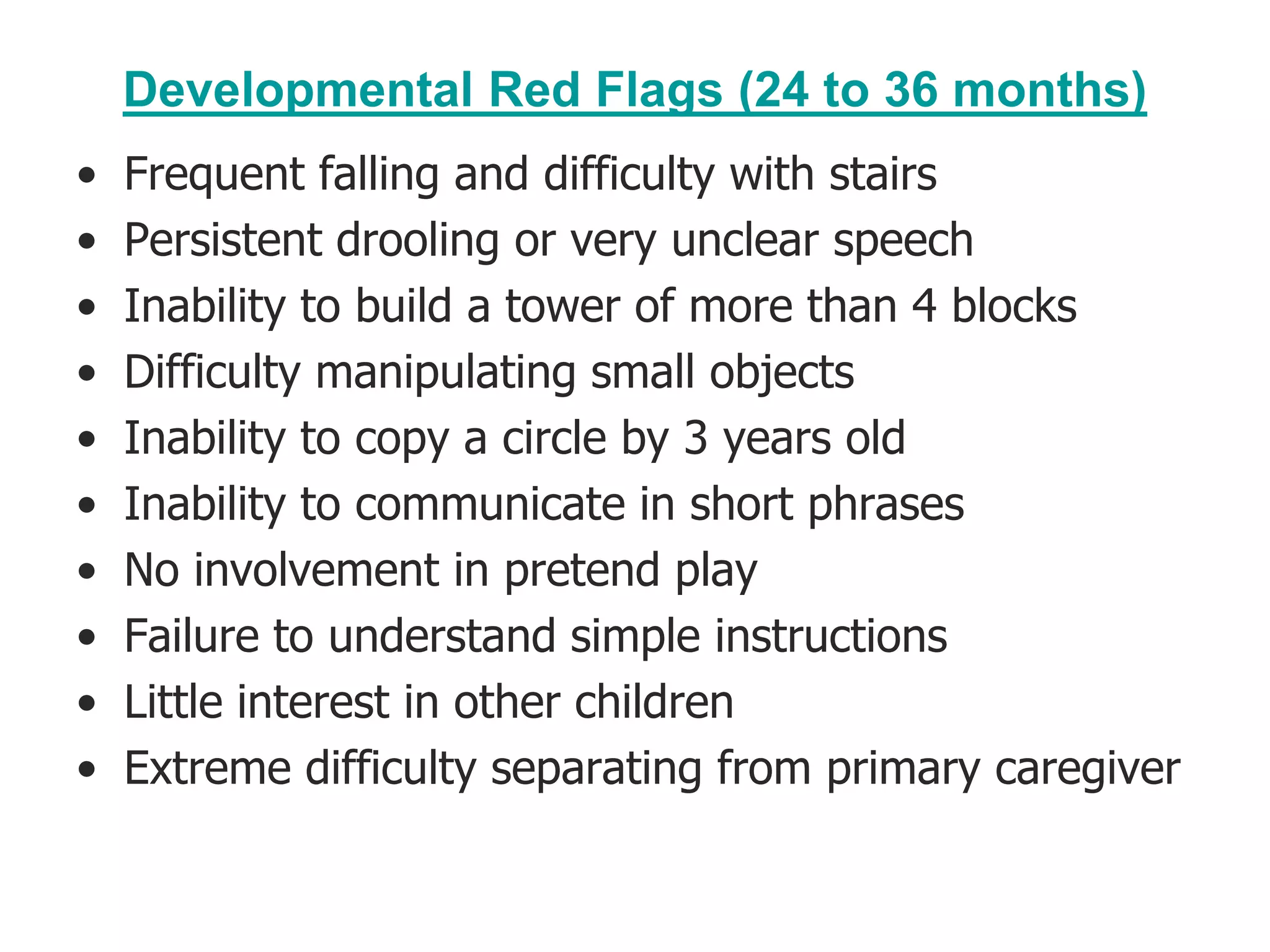
Developmental Red Flags (24 to 36 months)
• Frequent falling and difficulty with stairs
• Persistent drooling or very unclear speech
• Inability to build a tower of more than 4 blocks
• Difficulty manipulating small objects
• Inability to copy a circle by 3 years old
• Inability to communicate in short phrases
• No involvement in pretend play
• Failure to understand simple instructions
• Little interest in other children
• Extreme difficulty separating from primary caregiver
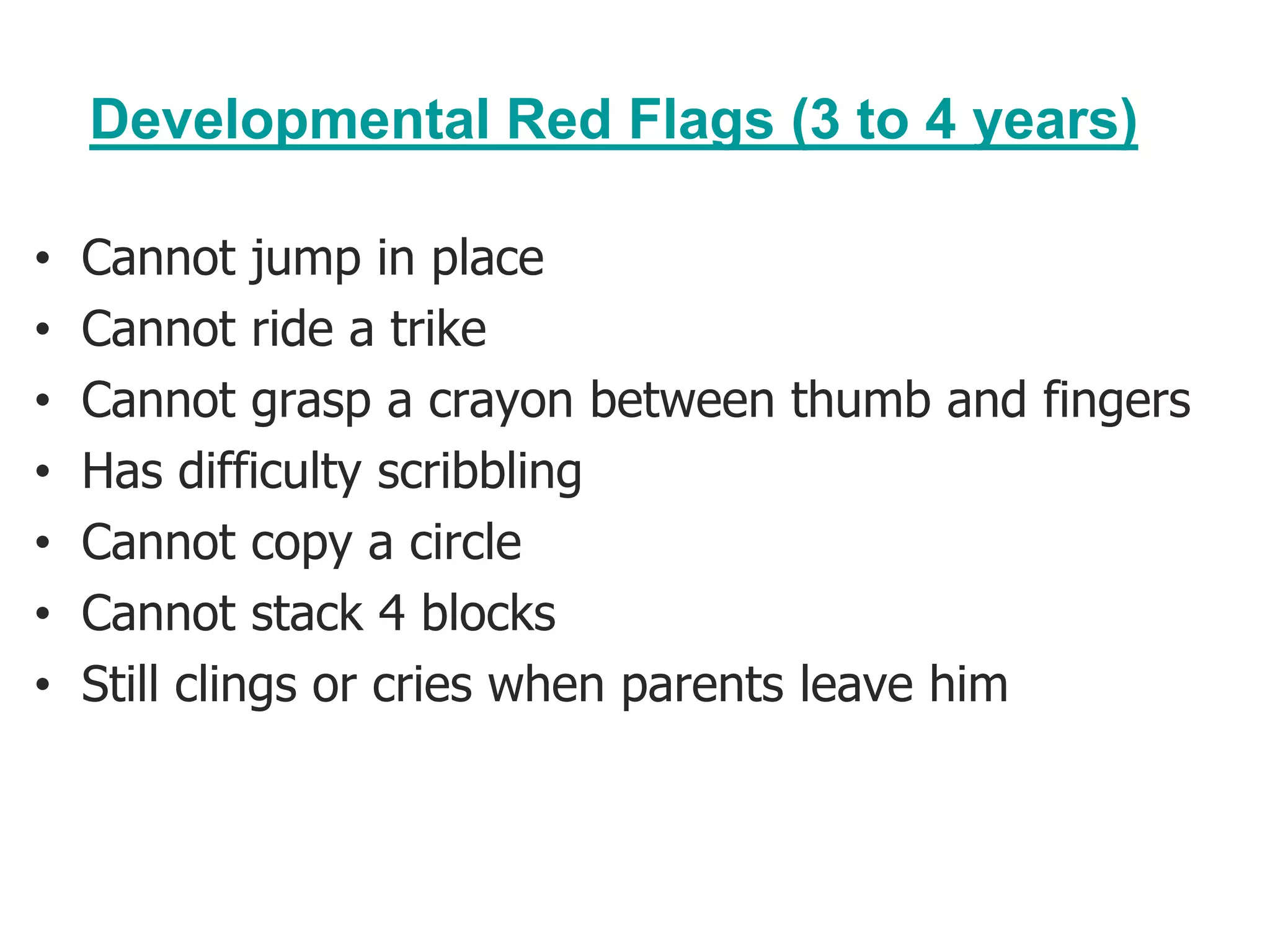
Developmental Red Flags (3 to 4 years)
• Cannot jump in place
• Cannot ride a trike
• Cannot grasp a crayon between thumb and fingers
• Has difficulty scribbling
• Cannot copy a circle
• Cannot stack 4 blocks
• Still clings or cries when parents leave him
Developmental Red Flags (3 to 4 years)
• Shows no interest in interactive games
• Ignores other children
• Doesn't respond to people outside the family
• Doesn't engage in fantasy play
• Resists dressing, sleeping, using the toilet
• Lashes out without any self-control when angry or
upset
• Doesn't use sentences of more than three words
• Doesn't use "me" or "you" appropriately

Approach to developmental_delay

  • 1.
    APPROACH TO DEVELOPMENTAL DELAY PROFRAJKUMAR DEPARTMENT OF PEDIATRICS DSMCH
  • 2.
     Normal Development Developmental Testing  Screening  Formal Testing  Differential Diagnosis of delay
  • 3.
    • What isdevelopment? Maturation of function, acquisition of skills – Cephalocaudal – Mass responses  specific – Predictable sequence, stepwise • Achievement of different functions  Milestones • Tested in 4 areas : – Gross motor – Fine motor – Language – Social
  • 4.
    Transient developmental delay ◦Some children have a transient delay in their development. ◦ For example, some extremely premature babies may show a delay in the area of sitting, crawling and walking but then progress on at a normal rate. ◦ Other causes of transient delay may be related to physical illness and prolonged hospitalization, immaturity, family stress or lack of opportunities to learn.
  • 5.
    Persistent developmental delay ◦If the delay in development persists it is usually related to problems in one or more of the following areas: understanding and learning moving communication hearing seeing. ◦ An assessment is often needed to determine what area or areas are affected. ◦ Disorders which cause persistent developmental delay are often termed developmental disabilities .
  • 6.
    Gross Motor Delay 􀂾Singledomain 􀂾Normal cognitive/language/social skills 􀂾Significant restricted delay in motor skills Fine/gross motor both typically involved 􀂾May or may not occur within context of a cerebral palsy syndrome
  • 7.
    Global developmental delay •Significant delay in two or more developmental streams as measured by appropriate standardized screening tests. • This term is reserved for children less than 5 years of age • Significant=performance two or more standard deviations below the mean on age appropriate standardized norm referenced tests
  • 8.
    DDX of Delay: •Late starter (outlier) • MR - global delay • Deprivation - social/emotional • Motor defects - muscular / Cerebral palsy • Hearing & vision defects • Speech & language disorders • Autism • Specific learning disorders • Attention deficit hyperactivity disorder
  • 9.
    Evaluation of Childhood DevelopmentalDelay 1. Confirm the existence of a delay 2. Categorize and classify precisely the neurodevelopmental disability 3. Search for a possible underlying responsible etiology 4. Referral to appropriate rehabilitation services 5. Inform & counsel family 6. Manage associated medical/behavioural conditions Spasticity, epilepsy, inattention, feeding, sleep disturbances Aggression, stereotypies, obsessions, opposition Actualization of full developmental potential
  • 10.
    Developmental Delay- Etiologic Determination •Importance • Recurrence risks estimation • Prevention • Specific therapy • Modify management (associated conditions, programmatic approach) • Prognostication • Family empowerment • Limitation of unnecessary testing
  • 11.
    Elements of Evaluation History PhysicalExaminationGeneral Neurological Developmental Laboratory Investigation ReferralConsultations Rehabilitation services
  • 12.
    History • Comprehensive FamilyHistory – Developmental, health, school attainment status of siblings, parents and other relatives • Significant neurological impairmentsCP/GDD/ASD/MR/DLI • Epilepsy (convulsive disorders) • Mental illness • Neuromuscular disorders – Parental consanguinity – Ethnicity
  • 13.
    Mother’s pregnancy/prenatal care •PV bleeding • Gestational diabetes • Premature labour • Medical conditions/medications • Toxin exposure-alcohol, illicit drugs • Intrauterine infections • IUGR/Antenatal anomalies
  • 14.
    • Labour/Delivery – TimingPremature/Term –ModeVaginal/Forceps/C-S (indication) – Vertex/Breech presentation • Meconium /FHR changes/APGAR scores (1/5 minutes & beyond) • Birthweight • Neonatal – EncephalopathyInvariably occurs if intra-partum difficulties are of neurologic relevance • Seizures • Feeding difficulties • Associated conditions
  • 15.
    • Developmental • Ageof initial concern • Domain(s) of concern • Progression in each domain • Current capability in each domain • Activities of daily living • Play skills – Any loss or regression of skills ?Possibility of a neurodegenerative condition
  • 17.
    Evaluation: • Detailed historyof events at birth, past illnesses • Pattern of delay • H/o Onset/regression • Examine for motor problems • Screening • Formal developmental / IQ assessment
  • 18.
    3 step process Clinicalevaluation Screening Formal assessment
  • 19.
    Developmental Screening Tools:India • Baroda Development Screening Test • Trivandrum Development Screening Test • Lucknow Development Screen • Indian norms used
  • 21.
    Lucknow Development Screen 6months- 2years Developmental Screening Graph 0 5 10 15 20 25 30 Arms & legs thrust in play Lateral head movement Follows moving person Social smile Holds head steady Recognizes mother Laughs aloud Reaches for dangling ring Turns head to sound Turns supine to prone Sits alone steadily Retains 2 things in 2 hands Raises self to sitting Playful response to mirror Says da-da ma-ma Waving ta-ta Fine prehension Stands by furniture Inhibits on command Walks with help Stands alone Speaks 2 words with meaning Stands up Walks alone Gestures for wants Speaks sentences of 2 words Walks up & downstairs with help Right hand mark-97% screen Left hand mark-50% screen Midpoint-75% screen
  • 22.
    Developmental Scales/IQ tests •Bayley Scales of Infant Development (BSID): Baroda norms (DASII): 0-42 m • Stanford Binet (Binet Kamat) 3-15 y • Weschler’s Preschool • Weschler’s Intelligence scales (WISC) Malin’s adaptation: • Draw a man • Form Boards • Coloured progressive matrices • Raven’s Matrices • VSMS/ VABS (Malin’s Adaptation) : Give Social Quotient Non verbal
  • 23.
    Prenatal history a. Complications-PIH,anemia b. Prenatal diagnoses made (eg. Down Syndrome) c. Infections (eg. TORCH) d. Exposures (eg. Fetal Alcohol Syndrome)
  • 24.
    Growth Parameters: Microcephaly: egin Rett’s Disorder, Downs syndrome Macrocephaly: eg in hydrocephalus Short stature: Turner syndrome, Williams syndrome Obesity: Prader-Willi syndrome, Beckwith- Wiedemann syndrome
  • 25.
    Head and Neck Flatocciput: Down syndrome, Zellweger syndrome Prominent occiput: trisomy 18 Craniosynostosis: Crouzon syndrome, Pfeiffer syndrome Midface hypoplasia: Fetal Alcohol Syndrome (FAS), Down syndrome Prominent nose and chin: Fragile X syndrome Round facies: Prader-Willi syndrome Triangular facies: Turner syndrome Hypertelorism: Fetal hydantoin syndrome Hypotelorism: maternal PKU effect Brushfield spots: Down syndrome
  • 26.
    Head and Neck Prominenteyes: Beckwith-Wiedemann syndrome Lisch nodules: neurofibromatosis Large pinna: Fragile X syndrome Malformed pinna: Treacher Collins syndrome, CHARGE association Broad nasal bridge: Fragile X syndrome Low nasal bridge: Down syndrome Long philtrum: FAS Cleft lip and palate: may either be isolated or part of a syndrome Micrognathia: Robin sequence Macroglossia: Beckwith-Wiedemann syndrome Abnormal hair whorls: Down syndrome Webbed neck: Turner syndrome
  • 27.
    Genitourinary Macroorchidism: Fragile Xsyndrome Hypogonadism: Prader-Willi syndrome
  • 28.
    Skin Nail hypoplasia ordysplasia: FAS Facial port wine hemangioma: Sturge-Weber syndrome Café au lait spots: Neurofibromatosis Ashleaf spots: Tuberous Sclerosis
  • 29.
    Extremities Small hands: Prader-Willisyndrome Clinodactyly: trisomies including Down syndrome Transverse palmer crease: Down syndrome
  • 30.
    MR – Treatablecauses • Cretinism • Some inborn errors: Galactosemia, PKU etc • Toxoplasma/syphilis: if detected early • Hydrocephalus
  • 31.
    Developmental Red Flags(1 to 3 months) • Doesn't seem to respond to loud noises • Doesn't follow moving objects with eyes by 2 to 3 months • Doesn't smile at the sound of your voice by 2 months • Doesn't grasp and hold objects by 3 months • Doesn't smile at people by 3 months • Cannot support head well at 3 months • Doesn't reach for and grasp toys by 3 to 4 months • Doesn't bring objects to mouth by 4 months • Doesn't push down with legs when feet are placed on a firm surface by 4 months • Has trouble moving one or both eyes in all directions • Crosses eyes most of the time (occasional crossing of the eyes is normal in these first months)
  • 32.
    Developmental Red Flags(4 to 7 months) • Seems very stiff, tight muscles • Seems very floppy, like a rag doll • Head still flops back when body is pulled to sitting position (by 5months still exhibits head lag) • Shows no affection for the person who cares for them • Doesn't seem to enjoy being around people • One or both eyes consistently turn in or out • Persistent tearing, eye drainage, or sensitivity to light • Does not respond to sounds around them
  • 33.
    Developmental Red Flags(4 to 7 months) • Has difficulty getting objects to mouth • Does not turn head to locate sounds by 4 months • Doesn't roll over (stomach to back) by 6 months • Cannot sit with help by 6 months (not by themselves) • Does not laugh or make squealing sounds by 5 months • Does not actively reach for objects by 6 months • Does not follow objects with both eyes • Does not bear some weight on legs by 5 months
  • 34.
    Developmental Red Flags(8 to 12 months) • Does not crawl • Drags one side of body while crawling (for over one month) • Cannot stand when supported • Does not search for objects that are hidden (10-12 mos.) • Says no single words ("mama" or "dada") • Does not learn to use gestures such as waving or shaking head • Does not sit steadily by 10 months • Does not show interest in "peek-a-boo" or "patty cake" by 8 mos. • Does not babble by 8 mos. ("dada," "baba," "mama")
  • 35.
    Developmental Red Flags(12 to 24 months) • Cannot walk by 18 months • Fails to develop a mature heel-toe walking pattern after several months of walking, or walks exclusively on toes • Does not speak at least 15 words by 18 months • Does not use two-word sentences by age 2 • By 15 months does not seem to know the function of common household objects (brush, telephone, bell, fork, spoon) • Does not imitate actions or words by 24 mos. • Does not follow simple one-step instructions by 24 mos.
  • 36.
    Developmental Red Flags(24 to 36 months) • Frequent falling and difficulty with stairs • Persistent drooling or very unclear speech • Inability to build a tower of more than 4 blocks • Difficulty manipulating small objects • Inability to copy a circle by 3 years old • Inability to communicate in short phrases • No involvement in pretend play • Failure to understand simple instructions • Little interest in other children • Extreme difficulty separating from primary caregiver
  • 37.
    Developmental Red Flags(3 to 4 years) • Cannot jump in place • Cannot ride a trike • Cannot grasp a crayon between thumb and fingers • Has difficulty scribbling • Cannot copy a circle • Cannot stack 4 blocks • Still clings or cries when parents leave him
  • 38.
    Developmental Red Flags(3 to 4 years) • Shows no interest in interactive games • Ignores other children • Doesn't respond to people outside the family • Doesn't engage in fantasy play • Resists dressing, sleeping, using the toilet • Lashes out without any self-control when angry or upset • Doesn't use sentences of more than three words • Doesn't use "me" or "you" appropriately