The word ‘emotion ,is derived from Latin word
‘emovere’ means ‘to stir up’ or ‘to excite’.
Definitions:-
1. Emotion is an acute disturbance of the organism
,as a whole psychological in origin involving
behaviour , conscious experience and visceral
functioning.
(P T Young)
2. Emotion is a mental & physiological state arises
spontaneously rather than through conscious
effort associated with a wide variety of
feelings,thoughts & behaviours.
(Kleinginna )
Emotion makes life pleasurable as well as
miserable.
Feeling:-Feeling is defined as pleasant or
unpleasant experience associated with an
idea.
Mood:-It is pleasant or unpleasant
experience associated with a real or
imaginary idea ,place or a situation.
Affect is the objective feeling as observed
by the examiner/expert.
COMPONENTS OF EMOTION:-
Dennis coon described 4 components of
emotion:-
1. Subjective feeling
2. Emotional expression
3. Physiological changes
4. Conscious experience
1. Subjective feeling:-
• It is conscious & an intellectual perception
of a situation .
• Subjective feelings are what you believe &
what you are feeling.
• Emotional feelings are experienced before
expression.
2. Emotional expression:-
There are 3 ways in which expression can be
expressed.
•Facial
•Vocal
•Bodily movements/gestures
Facial:-Face is believed to be the most expressive part
of the body.Some emotions like guilt ,joy,anger etc
can be perceived accurately through facial expression.
Vocal:-
Voice also tells us about an emotional state of an
individual.
A scream communicates fear ,surprise or pain.
A trembling voice means sorrow
A loud,sharp,high-pitched voice means anger
A slow monotonous voice means sadness.
Bodily movements:-
Bodily movements & gestures also indicate the
emotional state of an individual.
3.Physiological changes:-
•Physiological changes takes place during the
emotional state are caused mainly by the
autonomic nervous system.
•The autonomic nervous system has 2
subdivisions:-sympathetic & parasympathetic
division.
The sympathetic division prepares the body for
emergency action during aroused state by
discharging hormones ,which are responsible for
following physical changes:-
Increased BP& heart rate
Changes in rate of respiration
Dilation of pupils
Decreased secretion of saliva
Sweating
Increased blood sugar level
Erect hair on the skin
Muscular tension & tremors
When a period of intense emotion ends,the
physiological changes produced by the
parasympathetic nervous system are as follows:-
•Reduces heart rate & BP
•It regulates salt and water level of the body
•It helps to build up & conserve the body’s energy
4-conscious experience:-
An emotion is not only a pattern of bodily changes ,
but also an experience.
Emotional experience is generally a conscious
feeling.
THEORIES OF EMOTIONS:-
1. James –Lange theory in 1880
2. Canon-Bard theory in 1920s
3. Schachter-Singer theory in 1962
4. Lazarus theory in 1980s
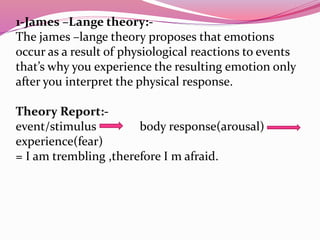
1-James –Lange theory:-
The james –lange theory proposes that emotions
occur as a result of physiological reactions to events
that’s why you experience the resulting emotion only
after you interpret the physical response.
Theory Report:-
event/stimulus body response(arousal)
experience(fear)
= I am trembling ,therefore I m afraid.
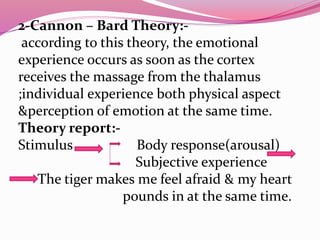
2-Cannon – Bard Theory:-
according to this theory, the emotional
experience occurs as soon as the cortex
receives the massage from the thalamus
;individual experience both physical aspect
&perception of emotion at the same time.
Theory report:-
Stimulus Body response(arousal)
Subjective experience
The tiger makes me feel afraid & my heart
pounds in at the same time.
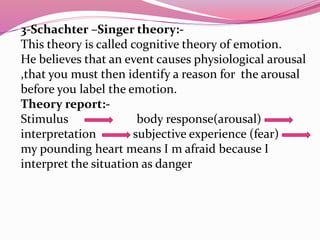
3-Schachter –Singer theory:-
This theory is called cognitive theory of emotion.
He believes that an event causes physiological arousal
,that you must then identify a reason for the arousal
before you label the emotion.
Theory report:-
Stimulus body response(arousal)
interpretation subjective experience (fear)
my pounding heart means I m afraid because I
interpret the situation as danger
Emotions

Emotions

  • 2.
    The word ‘emotion,is derived from Latin word ‘emovere’ means ‘to stir up’ or ‘to excite’. Definitions:- 1. Emotion is an acute disturbance of the organism ,as a whole psychological in origin involving behaviour , conscious experience and visceral functioning. (P T Young) 2. Emotion is a mental & physiological state arises spontaneously rather than through conscious effort associated with a wide variety of feelings,thoughts & behaviours. (Kleinginna )
  • 3.
    Emotion makes lifepleasurable as well as miserable. Feeling:-Feeling is defined as pleasant or unpleasant experience associated with an idea. Mood:-It is pleasant or unpleasant experience associated with a real or imaginary idea ,place or a situation. Affect is the objective feeling as observed by the examiner/expert.
  • 4.
    COMPONENTS OF EMOTION:- Denniscoon described 4 components of emotion:- 1. Subjective feeling 2. Emotional expression 3. Physiological changes 4. Conscious experience
  • 5.
    1. Subjective feeling:- •It is conscious & an intellectual perception of a situation . • Subjective feelings are what you believe & what you are feeling. • Emotional feelings are experienced before expression. 2. Emotional expression:- There are 3 ways in which expression can be expressed. •Facial •Vocal •Bodily movements/gestures
  • 7.
    Facial:-Face is believedto be the most expressive part of the body.Some emotions like guilt ,joy,anger etc can be perceived accurately through facial expression. Vocal:- Voice also tells us about an emotional state of an individual. A scream communicates fear ,surprise or pain. A trembling voice means sorrow A loud,sharp,high-pitched voice means anger A slow monotonous voice means sadness. Bodily movements:- Bodily movements & gestures also indicate the emotional state of an individual.
  • 8.
    3.Physiological changes:- •Physiological changestakes place during the emotional state are caused mainly by the autonomic nervous system. •The autonomic nervous system has 2 subdivisions:-sympathetic & parasympathetic division.
  • 9.
    The sympathetic divisionprepares the body for emergency action during aroused state by discharging hormones ,which are responsible for following physical changes:- Increased BP& heart rate Changes in rate of respiration Dilation of pupils Decreased secretion of saliva Sweating Increased blood sugar level Erect hair on the skin Muscular tension & tremors
  • 10.
    When a periodof intense emotion ends,the physiological changes produced by the parasympathetic nervous system are as follows:- •Reduces heart rate & BP •It regulates salt and water level of the body •It helps to build up & conserve the body’s energy 4-conscious experience:- An emotion is not only a pattern of bodily changes , but also an experience. Emotional experience is generally a conscious feeling.
  • 11.
    THEORIES OF EMOTIONS:- 1.James –Lange theory in 1880 2. Canon-Bard theory in 1920s 3. Schachter-Singer theory in 1962 4. Lazarus theory in 1980s
  • 12.
    1-James –Lange theory:- Thejames –lange theory proposes that emotions occur as a result of physiological reactions to events that’s why you experience the resulting emotion only after you interpret the physical response. Theory Report:- event/stimulus body response(arousal) experience(fear) = I am trembling ,therefore I m afraid.
  • 13.
    2-Cannon – BardTheory:- according to this theory, the emotional experience occurs as soon as the cortex receives the massage from the thalamus ;individual experience both physical aspect &perception of emotion at the same time. Theory report:- Stimulus Body response(arousal) Subjective experience The tiger makes me feel afraid & my heart pounds in at the same time.
  • 14.
    3-Schachter –Singer theory:- Thistheory is called cognitive theory of emotion. He believes that an event causes physiological arousal ,that you must then identify a reason for the arousal before you label the emotion. Theory report:- Stimulus body response(arousal) interpretation subjective experience (fear) my pounding heart means I m afraid because I interpret the situation as danger