BIOLOGY OF
BEHAVIOUR
PRESENTED BY:
Kshirabdhi Tanaya
MHN Tutor,SUM nursing college,SOA
DTU, BBSR
MEANING:-
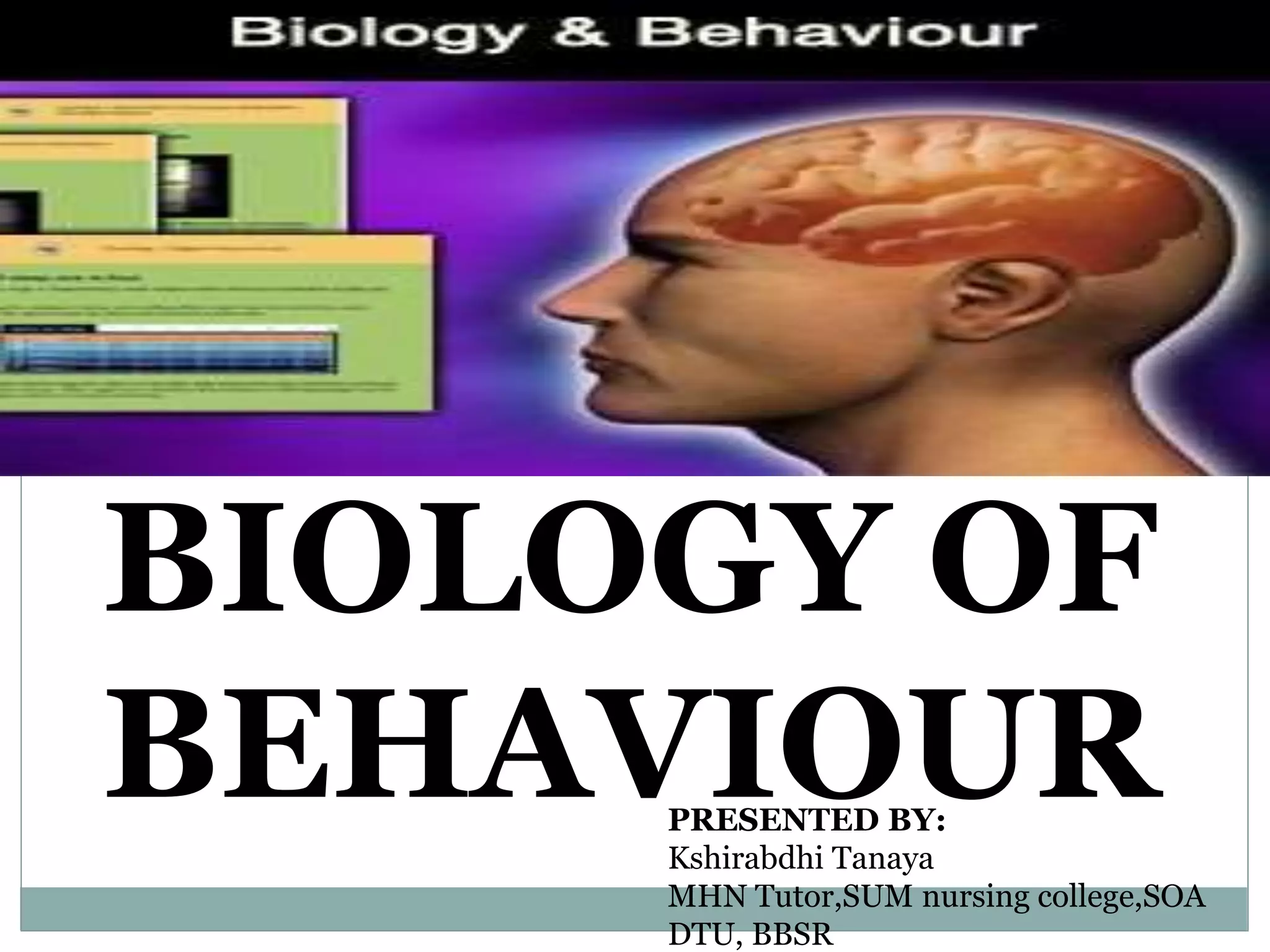
The biology of behaviour means the study of
behavioral functions of nervous system.
That determine the activities of nervous
system ,which is related to behavior & mind.
Body-mind relationship:-
Modulation process in health & illness:-
In psychology , we are studying about human
behaviour ; which involves both the body and
the mind.
Body and mind are two aspects of living
organisms.
Mind perform certain functions of the body &
it does not exist apart from the body.
Mind plays various roles in mental processes
such as observing , thinking , understanding ,
remembering , judging ,etc
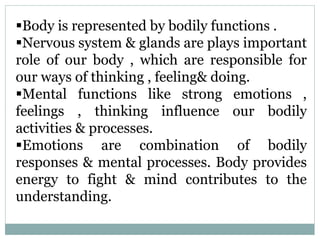
Body is represented by bodily functions .
Nervous system & glands are plays important
role of our body , which are responsible for
our ways of thinking , feeling& doing.
Mental functions like strong emotions ,
feelings , thinking influence our bodily
activities & processes.
Emotions are combination of bodily
responses & mental processes. Body provides
energy to fight & mind contributes to the
understanding.
EFFECTS OF BODILY CONDITIONS ON
MENTAL FUNCTIONING:-
Increased blood pressure causes mental excitement.
Severe pain reduces the concentration level.
Chronic illness causes depression.
Malfunctioning of the endocrine glands resulting in
lethargy,nervous tension,etc
Physical fatigue affects mood & reduces motivation,
interest & concentration.
Brain injury affects many psychological functions
EFFECTS OF MENTAL CONDITIONS ON
BODILY FUNCTIONING:-
Unpleasant emotions like fear, anger & worry
cause irritability, insomnia, headache, etc.
Emotional conflicts are responsible for peptic
ulcer, ulcerative colitis, etc.
Deep thinking & concentration can cause
physical strain.
Repressed feelings of hostility & aggression can
cause hypertension & cardiac diseases.
GENETICS AND BEHAVIOR:
HEREDITY & ENVIRONMENT:-
GENETICS:-
Genetics is the study of heredity. Heredity is a
biological process where a parent passes
certain genes onto their children or offspring.
Every child inherits genes from both of their
biological parents and these genes in turn express
specific traits
HEREDITY:-
The passing on of physical or mental characteristics
genetically from one generation to another.
HEREDITY:-(Acc. To Douglas and
Holland)
“One’s heredity consists of all the structures
,physical characteristics ,functions or
capacities derived from parents , other
ancestry or species”.
BEHAVIOR:-
The way in which one acts or conducts oneself,
especially towards others.
ENVIRONMENT:-
•Environment is everything that is around us. It
can be living or nonliving things.
•The environment is everything that affects the
individual except his genes.(Boring, langfield &
weld)
CHARACTRISTICS INFLUENCED
SIGNIFICANTLY BY GENETIC FACTORS:-
Physical characteristics:-
Height
Weight
Obesity
Tone of voice
Blood pressure
Tooth decay
Athletic ability
Age of death
Activity level
Intellectual characteristics:-
Memory
Intelligence
Age of language acquisition
Reading disability
Mental retardation
Emotional characteristics &
disorders:-
Shyness
Extraversion
Emotionality
Schizophrenia
Anxiety
Environment:-
Environment covers the social, moral,
economical, political, physical, and
intellectual factors, which influence the
development of the individual from time to
time.
Types of environment:-
•Intercellular environment
•Intrauterine environment
•External environment
Intercellular environment:-
•The cytoplasm is in the intercellular
environment & the genes are surrounded by
it.
•Endocrine glands & hormones produce
intercellular influence, so many congenital
deformities are the result of overactive or
underactive endocrine function.
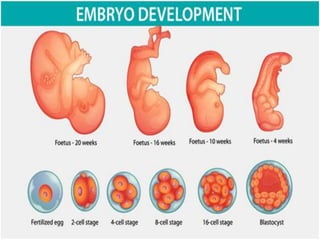
Intrauterine environment:-
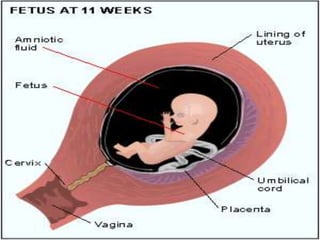
•In the womb the growing organism is
surrounded by amniotic fluid & attached to the
mother by the umbilical cord .
•Thus the growth of the embryo depends on the
nourishment provided by the mother.
External environment:-
It can be divided into 3 kinds
Physical environment
Biological environment
Psychosocial environment
1. PHYSICAL ENVIRONMENT
The physical environment is where individuals
live, learn, work, and play. People interact with
their physical environment through the air they
breathe, water they drink, houses they live in, and
the transportation they access to travel to work and
school.
The physical environment is the part of
the environment surrounding humans that
includes land, air, water, plants and animals,
buildings and other infrastructure, and all of the
natural resources that provide our basic needs and
opportunities for social and economic development.
2. Biological environment :
Biological environment consists of living things
like plants , animals, micro-organisms etc. The
natural biological factors such as animals and
plants or human beings or micro-organisms that
affect human life.
3. Psychosocial environment :
It is the interaction of the various sources of stress
in our lives and how we respond to them, both
individually and as communities.
Our psychosocial environment includes our
responses to stressors in our lives, from temporary
ones such as a traffic jam to major stressors such as
war, homelessness or major disease.
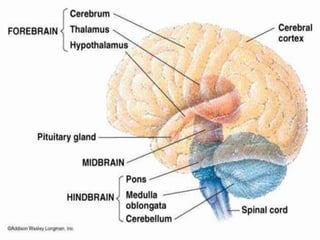
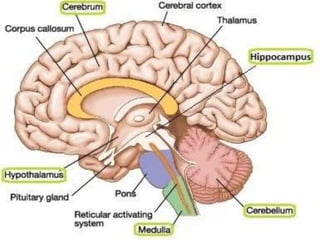
BRAIN AND
BEHAVIOUR:Nervous
system,Neurons &
Synapse
The human nervous system can be divided into 2
parts:-
•The central nervous system(CNS),Consisting of the
brain & spinal cord.
•The peripheral nervous system (PNS),consisting of
all the nerves outside the brain& spinal cord.
•The PNS comprises paired cranial & sacral nerves .
Some of these are sensory & some are motor &
others are mixed.
•The PNS has 2 functional parts:-
The sensory division
The motor division
The motor division has 2 parts:-
The somatic nervous system(controls
voluntary movement)
The autonomic nervous
system(controlling involuntary processes
such as heart beat, peristalsis, glandular
activity etc.)
The autonomic nervous system has 2
divisions:-
Sympathetic
parasympathetic
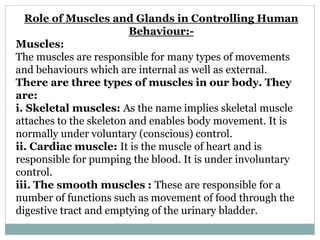
Role of Muscles and Glands in Controlling Human
Behaviour:-
Muscles:
The muscles are responsible for many types of movements
and behaviours which are internal as well as external.
There are three types of muscles in our body. They
are:
i. Skeletal muscles: As the name implies skeletal muscle
attaches to the skeleton and enables body movement. It is
normally under voluntary (conscious) control.
ii. Cardiac muscle: It is the muscle of heart and is
responsible for pumping the blood. It is under involuntary
control.
iii. The smooth muscles : These are responsible for a
number of functions such as movement of food through the
digestive tract and emptying of the urinary bladder.
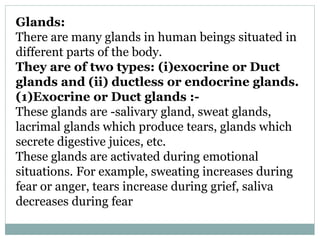
Glands:
There are many glands in human beings situated in
different parts of the body.
They are of two types: (i)exocrine or Duct
glands and (ii) ductless or endocrine glands.
(1)Exocrine or Duct glands :-
These glands are -salivary gland, sweat glands,
lacrimal glands which produce tears, glands which
secrete digestive juices, etc.
These glands are activated during emotional
situations. For example, sweating increases during
fear or anger, tears increase during grief, saliva
decreases during fear
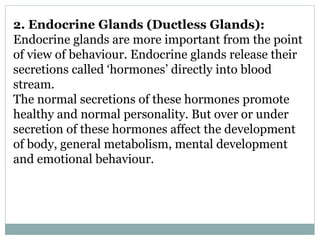
2. Endocrine Glands (Ductless Glands):
Endocrine glands are more important from the point
of view of behaviour. Endocrine glands release their
secretions called ‘hormones’ directly into blood
stream.
The normal secretions of these hormones promote
healthy and normal personality. But over or under
secretion of these hormones affect the development
of body, general metabolism, mental development
and emotional behaviour.
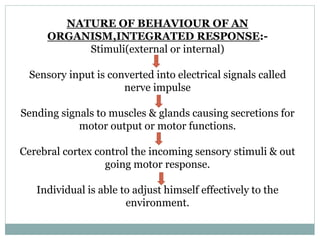
NATURE OF BEHAVIOUR OF AN
ORGANISM,INTEGRATED RESPONSE:-
Stimuli(external or internal)
Sensory input is converted into electrical signals called
nerve impulse
Sending signals to muscles & glands causing secretions for
motor output or motor functions.
Cerebral cortex control the incoming sensory stimuli & out
going motor response.
Individual is able to adjust himself effectively to the
environment.
Biology of behvior

Biology of behvior

  • 1.
    BIOLOGY OF BEHAVIOUR PRESENTED BY: KshirabdhiTanaya MHN Tutor,SUM nursing college,SOA DTU, BBSR
  • 2.
    MEANING:- The biology ofbehaviour means the study of behavioral functions of nervous system. That determine the activities of nervous system ,which is related to behavior & mind.
  • 3.
    Body-mind relationship:- Modulation processin health & illness:- In psychology , we are studying about human behaviour ; which involves both the body and the mind. Body and mind are two aspects of living organisms. Mind perform certain functions of the body & it does not exist apart from the body. Mind plays various roles in mental processes such as observing , thinking , understanding , remembering , judging ,etc
  • 4.
    Body is representedby bodily functions . Nervous system & glands are plays important role of our body , which are responsible for our ways of thinking , feeling& doing. Mental functions like strong emotions , feelings , thinking influence our bodily activities & processes. Emotions are combination of bodily responses & mental processes. Body provides energy to fight & mind contributes to the understanding.
  • 5.
    EFFECTS OF BODILYCONDITIONS ON MENTAL FUNCTIONING:- Increased blood pressure causes mental excitement. Severe pain reduces the concentration level. Chronic illness causes depression. Malfunctioning of the endocrine glands resulting in lethargy,nervous tension,etc Physical fatigue affects mood & reduces motivation, interest & concentration. Brain injury affects many psychological functions
  • 6.
    EFFECTS OF MENTALCONDITIONS ON BODILY FUNCTIONING:- Unpleasant emotions like fear, anger & worry cause irritability, insomnia, headache, etc. Emotional conflicts are responsible for peptic ulcer, ulcerative colitis, etc. Deep thinking & concentration can cause physical strain. Repressed feelings of hostility & aggression can cause hypertension & cardiac diseases.
  • 7.
    GENETICS AND BEHAVIOR: HEREDITY& ENVIRONMENT:- GENETICS:- Genetics is the study of heredity. Heredity is a biological process where a parent passes certain genes onto their children or offspring. Every child inherits genes from both of their biological parents and these genes in turn express specific traits HEREDITY:- The passing on of physical or mental characteristics genetically from one generation to another.
  • 8.
    HEREDITY:-(Acc. To Douglasand Holland) “One’s heredity consists of all the structures ,physical characteristics ,functions or capacities derived from parents , other ancestry or species”.
  • 9.
    BEHAVIOR:- The way inwhich one acts or conducts oneself, especially towards others. ENVIRONMENT:- •Environment is everything that is around us. It can be living or nonliving things. •The environment is everything that affects the individual except his genes.(Boring, langfield & weld)
  • 10.
    CHARACTRISTICS INFLUENCED SIGNIFICANTLY BYGENETIC FACTORS:- Physical characteristics:- Height Weight Obesity Tone of voice Blood pressure Tooth decay Athletic ability Age of death Activity level
  • 11.
    Intellectual characteristics:- Memory Intelligence Age oflanguage acquisition Reading disability Mental retardation
  • 12.
  • 13.
    Environment:- Environment covers thesocial, moral, economical, political, physical, and intellectual factors, which influence the development of the individual from time to time. Types of environment:- •Intercellular environment •Intrauterine environment •External environment
  • 14.
    Intercellular environment:- •The cytoplasmis in the intercellular environment & the genes are surrounded by it. •Endocrine glands & hormones produce intercellular influence, so many congenital deformities are the result of overactive or underactive endocrine function.
  • 16.
    Intrauterine environment:- •In thewomb the growing organism is surrounded by amniotic fluid & attached to the mother by the umbilical cord . •Thus the growth of the embryo depends on the nourishment provided by the mother.
  • 18.
    External environment:- It canbe divided into 3 kinds Physical environment Biological environment Psychosocial environment
  • 19.
    1. PHYSICAL ENVIRONMENT Thephysical environment is where individuals live, learn, work, and play. People interact with their physical environment through the air they breathe, water they drink, houses they live in, and the transportation they access to travel to work and school. The physical environment is the part of the environment surrounding humans that includes land, air, water, plants and animals, buildings and other infrastructure, and all of the natural resources that provide our basic needs and opportunities for social and economic development.
  • 20.
    2. Biological environment: Biological environment consists of living things like plants , animals, micro-organisms etc. The natural biological factors such as animals and plants or human beings or micro-organisms that affect human life. 3. Psychosocial environment : It is the interaction of the various sources of stress in our lives and how we respond to them, both individually and as communities. Our psychosocial environment includes our responses to stressors in our lives, from temporary ones such as a traffic jam to major stressors such as war, homelessness or major disease.
  • 21.
  • 22.
    The human nervoussystem can be divided into 2 parts:- •The central nervous system(CNS),Consisting of the brain & spinal cord. •The peripheral nervous system (PNS),consisting of all the nerves outside the brain& spinal cord. •The PNS comprises paired cranial & sacral nerves . Some of these are sensory & some are motor & others are mixed. •The PNS has 2 functional parts:- The sensory division The motor division
  • 23.
    The motor divisionhas 2 parts:- The somatic nervous system(controls voluntary movement) The autonomic nervous system(controlling involuntary processes such as heart beat, peristalsis, glandular activity etc.) The autonomic nervous system has 2 divisions:- Sympathetic parasympathetic
  • 32.
    Role of Musclesand Glands in Controlling Human Behaviour:- Muscles: The muscles are responsible for many types of movements and behaviours which are internal as well as external. There are three types of muscles in our body. They are: i. Skeletal muscles: As the name implies skeletal muscle attaches to the skeleton and enables body movement. It is normally under voluntary (conscious) control. ii. Cardiac muscle: It is the muscle of heart and is responsible for pumping the blood. It is under involuntary control. iii. The smooth muscles : These are responsible for a number of functions such as movement of food through the digestive tract and emptying of the urinary bladder.
  • 33.
    Glands: There are manyglands in human beings situated in different parts of the body. They are of two types: (i)exocrine or Duct glands and (ii) ductless or endocrine glands. (1)Exocrine or Duct glands :- These glands are -salivary gland, sweat glands, lacrimal glands which produce tears, glands which secrete digestive juices, etc. These glands are activated during emotional situations. For example, sweating increases during fear or anger, tears increase during grief, saliva decreases during fear
  • 34.
    2. Endocrine Glands(Ductless Glands): Endocrine glands are more important from the point of view of behaviour. Endocrine glands release their secretions called ‘hormones’ directly into blood stream. The normal secretions of these hormones promote healthy and normal personality. But over or under secretion of these hormones affect the development of body, general metabolism, mental development and emotional behaviour.
  • 35.
    NATURE OF BEHAVIOUROF AN ORGANISM,INTEGRATED RESPONSE:- Stimuli(external or internal) Sensory input is converted into electrical signals called nerve impulse Sending signals to muscles & glands causing secretions for motor output or motor functions. Cerebral cortex control the incoming sensory stimuli & out going motor response. Individual is able to adjust himself effectively to the environment.