JAYESH PATIDAR
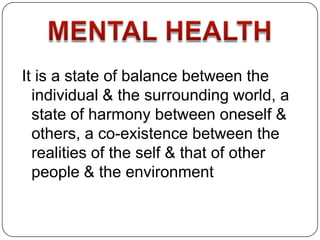
It is a state of balance between the
  individual & the surrounding world, a
  state of harmony between oneself &
  others, a co-existence between the
  realities of the self & that of other
  people & the environment
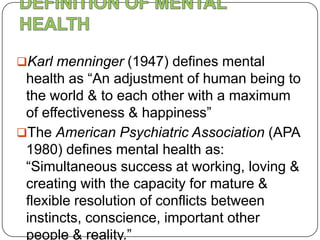
Karl menninger (1947) defines mental
 health as “An adjustment of human being to
 the world & to each other with a maximum
 of effectiveness & happiness”
The American Psychiatric Association (APA
 1980) defines mental health as:
 “Simultaneous success at working, loving &
 creating with the capacity for mature &
 flexible resolution of conflicts between
 instincts, conscience, important other
 people & reality.”
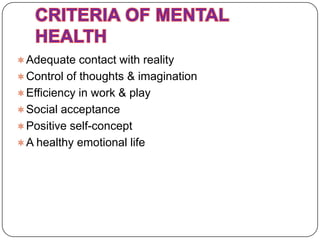
 Adequate contact with reality
 Control of thoughts & imagination
 Efficiency in work & play
 Social acceptance
 Positive self-concept
 A healthy emotional life
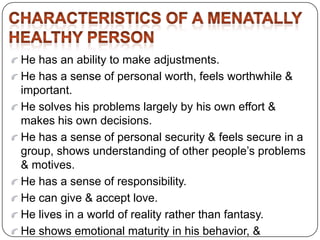
He has an ability to make adjustments.
He has a sense of personal worth, feels worthwhile &
important.
He solves his problems largely by his own effort &
makes his own decisions.
He has a sense of personal security & feels secure in a
group, shows understanding of other people’s problems
& motives.
He has a sense of responsibility.
He can give & accept love.
He lives in a world of reality rather than fantasy.
He shows emotional maturity in his behavior, &
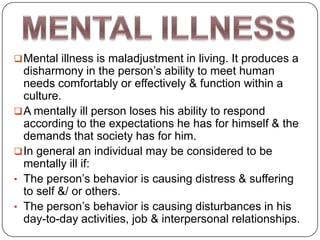
 Mental illness is maladjustment in living. It produces a
  disharmony in the person’s ability to meet human
  needs comfortably or effectively & function within a
  culture.
 A mentally ill person loses his ability to respond
  according to the expectations he has for himself & the
  demands that society has for him.
 In general an individual may be considered to be
  mentally ill if:
• The person’s behavior is causing distress & suffering
  to self &/ or others.
• The person’s behavior is causing disturbances in his
  day-to-day activities, job & interpersonal relationships.
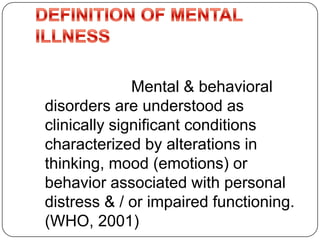
Mental & behavioral
disorders are understood as
clinically significant conditions
characterized by alterations in
thinking, mood (emotions) or
behavior associated with personal
distress & / or impaired functioning.
(WHO, 2001)
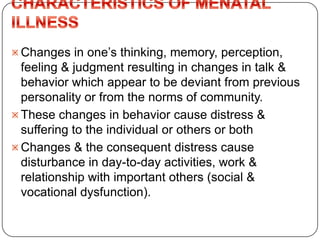
 Changes in one’s thinking, memory, perception,
  feeling & judgment resulting in changes in talk &
  behavior which appear to be deviant from previous
  personality or from the norms of community.
 These changes in behavior cause distress &
  suffering to the individual or others or both
 Changes & the consequent distress cause
  disturbance in day-to-day activities, work &
  relationship with important others (social &
  vocational dysfunction).
Mental health & illness

Mental health & illness

  • 1.
  • 2.
    It is astate of balance between the individual & the surrounding world, a state of harmony between oneself & others, a co-existence between the realities of the self & that of other people & the environment
  • 3.
    Karl menninger (1947)defines mental health as “An adjustment of human being to the world & to each other with a maximum of effectiveness & happiness” The American Psychiatric Association (APA 1980) defines mental health as: “Simultaneous success at working, loving & creating with the capacity for mature & flexible resolution of conflicts between instincts, conscience, important other people & reality.”
  • 4.
     Adequate contactwith reality  Control of thoughts & imagination  Efficiency in work & play  Social acceptance  Positive self-concept  A healthy emotional life
  • 5.
    He has anability to make adjustments. He has a sense of personal worth, feels worthwhile & important. He solves his problems largely by his own effort & makes his own decisions. He has a sense of personal security & feels secure in a group, shows understanding of other people’s problems & motives. He has a sense of responsibility. He can give & accept love. He lives in a world of reality rather than fantasy. He shows emotional maturity in his behavior, &
  • 6.
     Mental illnessis maladjustment in living. It produces a disharmony in the person’s ability to meet human needs comfortably or effectively & function within a culture.  A mentally ill person loses his ability to respond according to the expectations he has for himself & the demands that society has for him.  In general an individual may be considered to be mentally ill if: • The person’s behavior is causing distress & suffering to self &/ or others. • The person’s behavior is causing disturbances in his day-to-day activities, job & interpersonal relationships.
  • 7.
    Mental & behavioral disordersare understood as clinically significant conditions characterized by alterations in thinking, mood (emotions) or behavior associated with personal distress & / or impaired functioning. (WHO, 2001)
  • 8.
     Changes inone’s thinking, memory, perception, feeling & judgment resulting in changes in talk & behavior which appear to be deviant from previous personality or from the norms of community.  These changes in behavior cause distress & suffering to the individual or others or both  Changes & the consequent distress cause disturbance in day-to-day activities, work & relationship with important others (social & vocational dysfunction).