Reasoning
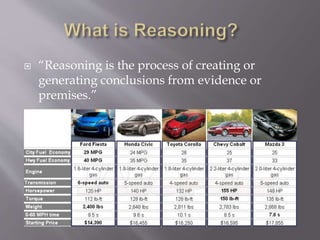
 “Reasoning is the process of creating or
generating conclusions from evidence or
premises.”
Types of Reasoning
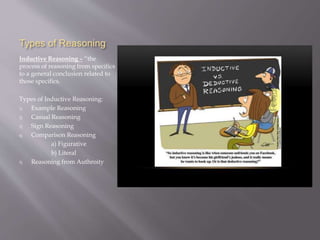
Inductive Reasoning – “the
process of reasoning from specifics
to a general conclusion related to
those specifics.
Types of Inductive Reasoning:
1) Example Reasoning
2) Casual Reasoning
3) Sign Reasoning
4) Comparison Reasoning
a) Figurative
b) Literal
5) Reasoning from Authroity
Types of Reasoning
Cont.
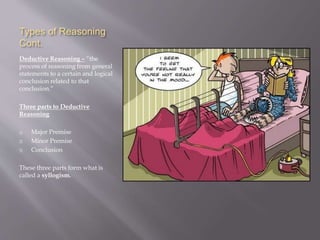
Deductive Reasoning – “the
process of reasoning from general
statements to a certain and logical
conclusion related to that
conclusion.”
Three parts to Deductive
Reasoning
1) Major Premise
2) Minor Premise
3) Conclusion
These three parts form what is
called a syllogism.
 What is a fallacy?
 “A fallacy is an error in reasoning.”
 “A fallacy is an argument in which the
premises given for the conclusion do not
provide the needed degree of support.”
Fallacy of the False
Dilemma
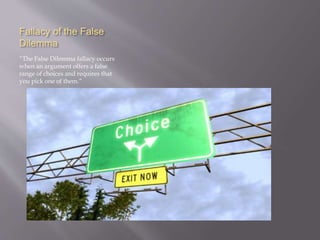
“The False Dilemma fallacy occurs
when an argument offers a false
range of choices and requires that
you pick one of them.”
Fallacy of Appeal to
Emotion
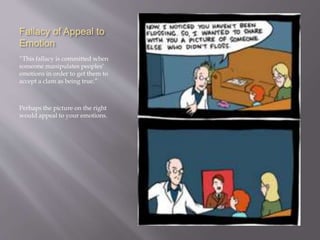
“This fallacy is committed when
someone manipulates peoples’
emotions in order to get them to
accept a clam as being true.”
Perhaps the picture on the right
would appeal to your emotions.
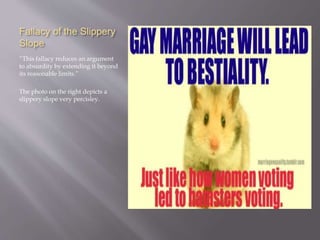
Fallacy of the Slippery
Slope
“This fallacy reduces an argument
to absurdity by extending it beyond
its reasonable limits.”
The photo on the right depicts a
slippery slope very percisley.
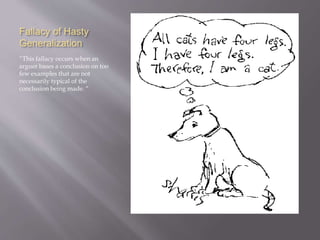
Fallacy of Hasty
Generalization
“This fallacy occurs when an
arguer bases a conclusion on too
few examples that are not
necessarily typical of the
conclusion being made. “
 There are more fallacies discussed in our
textbook, the following I did not discuss in this
powerpoint:
 Fallacy of non-sequitur
 Fallacy of ad hominem
 Fallacy of circular reasoning
 Fallacy of Appeal to Ignorance
 Bandwagon Fallacy
 Post hoc ergo propter hoc fallacy
 Fallacy of Appeal to Pity
 Straw-Man Fallacy

Chapter 12 Reasoning!

  • 1.
  • 2.
     “Reasoning isthe process of creating or generating conclusions from evidence or premises.”
  • 3.
    Types of Reasoning InductiveReasoning – “the process of reasoning from specifics to a general conclusion related to those specifics. Types of Inductive Reasoning: 1) Example Reasoning 2) Casual Reasoning 3) Sign Reasoning 4) Comparison Reasoning a) Figurative b) Literal 5) Reasoning from Authroity
  • 4.
    Types of Reasoning Cont. DeductiveReasoning – “the process of reasoning from general statements to a certain and logical conclusion related to that conclusion.” Three parts to Deductive Reasoning 1) Major Premise 2) Minor Premise 3) Conclusion These three parts form what is called a syllogism.
  • 5.
     What isa fallacy?  “A fallacy is an error in reasoning.”  “A fallacy is an argument in which the premises given for the conclusion do not provide the needed degree of support.”
  • 6.
    Fallacy of theFalse Dilemma “The False Dilemma fallacy occurs when an argument offers a false range of choices and requires that you pick one of them.”
  • 7.
    Fallacy of Appealto Emotion “This fallacy is committed when someone manipulates peoples’ emotions in order to get them to accept a clam as being true.” Perhaps the picture on the right would appeal to your emotions.
  • 8.
    Fallacy of theSlippery Slope “This fallacy reduces an argument to absurdity by extending it beyond its reasonable limits.” The photo on the right depicts a slippery slope very percisley.
  • 9.
    Fallacy of Hasty Generalization “Thisfallacy occurs when an arguer bases a conclusion on too few examples that are not necessarily typical of the conclusion being made. “
  • 10.
     There aremore fallacies discussed in our textbook, the following I did not discuss in this powerpoint:  Fallacy of non-sequitur  Fallacy of ad hominem  Fallacy of circular reasoning  Fallacy of Appeal to Ignorance  Bandwagon Fallacy  Post hoc ergo propter hoc fallacy  Fallacy of Appeal to Pity  Straw-Man Fallacy