Reflex Sympathetic
Dystrophy
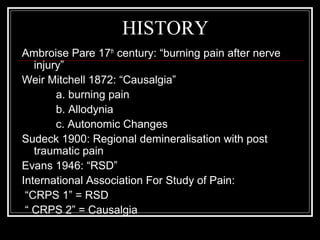
HISTORY
Ambroise Pare 17th
century: “burning pain after nerve
injury”
Weir Mitchell 1872: “Causalgia”
a. burning pain
b. Allodynia
c. Autonomic Changes
Sudeck 1900: Regional demineralisation with post
traumatic pain
Evans 1946: “RSD”
International Association For Study of Pain:
“CRPS 1” = RSD
“ CRPS 2” = Causalgia
CRPS
 RSD
 Algodystrophy
 Sudeck’s Atrophy
 Shoulder Hand Syndrome
 Causalgia
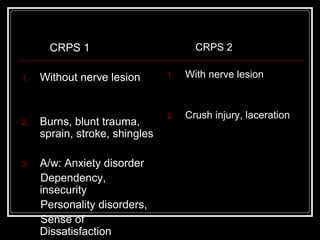
CRPS 1
1. Without nerve lesion
2. Burns, blunt trauma,
sprain, stroke, shingles
3. A/w: Anxiety disorder
Dependency,
insecurity
Personality disorders,
Sense of
Dissatisfaction
CRPS 2
1. With nerve lesion
2. Crush injury, laceration
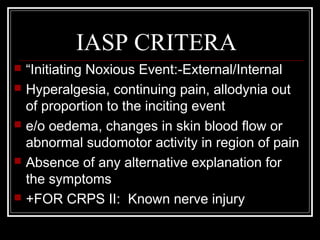
IASP CRITERA
 “Initiating Noxious Event:-External/Internal
 Hyperalgesia, continuing pain, allodynia out
of proportion to the inciting event
 e/o oedema, changes in skin blood flow or
abnormal sudomotor activity in region of pain
 Absence of any alternative explanation for
the symptoms
 +FOR CRPS II: Known nerve injury
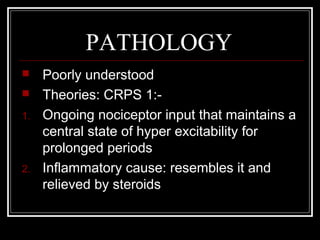
PATHOLOGY
 Poorly understood
 Theories: CRPS 1:-
1. Ongoing nociceptor input that maintains a
central state of hyper excitability for
prolonged periods
2. Inflammatory cause: resembles it and
relieved by steroids
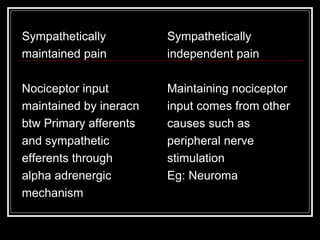
Sympathetically
maintained pain
Nociceptor input
maintained by ineracn
btw Primary afferents
and sympathetic
efferents through
alpha adrenergic
mechanism
Sympathetically
independent pain
Maintaining nociceptor
input comes from other
causes such as
peripheral nerve
stimulation
Eg: Neuroma
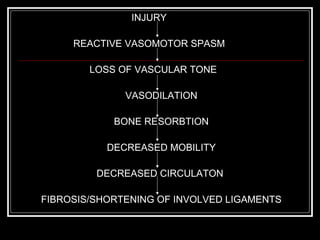
INJURY
REACTIVE VASOMOTOR SPASM
LOSS OF VASCULAR TONE
VASODILATION
BONE RESORBTION
DECREASED MOBILITY
DECREASED CIRCULATON
FIBROSIS/SHORTENING OF INVOLVED LIGAMENTS
SIGNS & SYMPTOMS
 Pain
 Vasomotor changes
 Trophic changes
Within
3 weeks – 6 months
of original injury
 AUTONOMIC
1. B/L temp. difference (Dynamic)
2. Skin Discoloration
3. Subcutaneous Thickening
4. Peripheral Oedema
 RADIOLOGIC: Osteopenia
 SENSORY
1. Sensitivity
2. Muscle belly
tenderness
3. Hyperalgesia over
bony prominences,
hyperpathia
 MOTOR
1. Muscle atrophy/
weakness
2. Joint stiffness
3. Muscle contractures
4. Mechanical allodynia
 3 Patterns of spreading Symptoms
1. Continuous type
2. Mirror Image type
3. Independent type
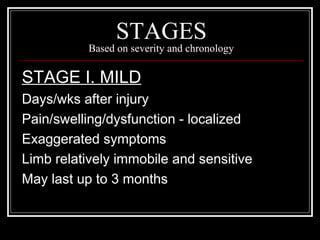
STAGES
Based on severity and chronology
STAGE I. MILD
Days/wks after injury
Pain/swelling/dysfunction - localized
Exaggerated symptoms
Limb relatively immobile and sensitive
May last up to 3 months
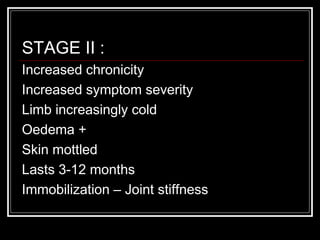
STAGE II :
Increased chronicity
Increased symptom severity
Limb increasingly cold
Oedema +
Skin mottled
Lasts 3-12 months
Immobilization – Joint stiffness
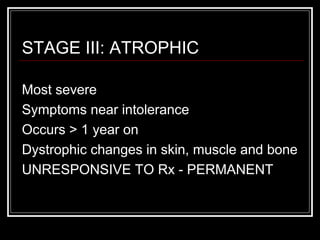
STAGE III: ATROPHIC
Most severe
Symptoms near intolerance
Occurs > 1 year on
Dystrophic changes in skin, muscle and bone
UNRESPONSIVE TO Rx - PERMANENT
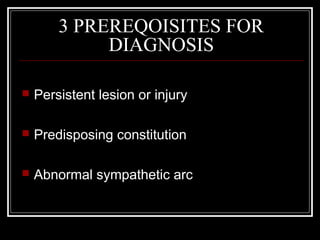
3 PREREQOISITES FOR
DIAGNOSIS
 Persistent lesion or injury
 Predisposing constitution
 Abnormal sympathetic arc
DIAGNOSTIC CRITERIA BY
KOZEN
 Persistent and
Diffuse pain
in the hand
 Loss of
function of the
hand
 Autonomic
Dysfunction
Relief by interruption
of Sympathetic reflex
 RADIOGRAPHY
1/3rd
pts. Normal X ray picture
Osteopenia in affected limb
(after 2-4 weeks of symptoms)
Increased Power Doppler Flow in RSD of
Lower Extrimity
 BONE SCAN / SCINTIGRAPHY
Preferred Diagnostic test
INCREASED UPTAKE—CRPS INDUCED
OSTEOPENIA
 MacKinnon & Holder-
 strictest criteria for diagnosis of RSD in hand
REQUIRED DIFFUSE INCREASE IN DELAYED
PERIARTICULAR UPTAKE IN ALL JOINTS OF
AFFECTED HAND
BEST DIAGNOSTIC &
PROGNOSTIC TEST
LA block of appropriate sympathetic ganglia
Novocain (5% Procaine hydrochloride) used as a
pharmacologic neural blocker
STELLATE GANGLION – UL
LUMBAR PARAVERTEBRAL GANGLIA – LL
Guanethadine: Initially symptoms increase then
decrease
Phentolamine test: Alpha adrenoceptors blocked
TREATMENT
 Educate regarding therapeutic goals
 Minimize pain
 Physiotherapy
 Determine contribution of SNS to the pain
 Physiotherapy
Elevation, massage, contrast baths, stockings
AIM: improve jt. ROM & muscle strength
 Acupuncture
 TENS- 1. Non invasive 2. No side effects
 Psychiatric treatment
 Alternative treatments
a. Qi emission b. Qi instruction
Thermal biofeedback, Relaxation training,
supportive psychotherapy
PHARMACOLOGY
1. Corticosteroids :-
 Prednisolone 30mg /day x 12 weeks
DECREASES: pain, edema, inflamn, ectopic
electrical activity after nerve injury
2. Bisphosphonates :-
7.5 mg/250 ml of saline daily x 3 days
INCREASES ROM
3. Mannitol 10%, 1000ml/24 hrs x 1 week
4. Dimethyl sulfoxide cream 50% on the skin
5. N-acetyl cysteine 600mg tid
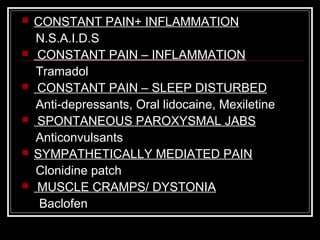
 CONSTANT PAIN+ INFLAMMATION
N.S.A.I.D.S
 CONSTANT PAIN – INFLAMMATION
Tramadol
 CONSTANT PAIN – SLEEP DISTURBED
Anti-depressants, Oral lidocaine, Mexiletine
 SPONTANEOUS PAROXYSMAL JABS
Anticonvulsants
 SYMPATHETICALLY MEDIATED PAIN
Clonidine patch
 MUSCLE CRAMPS/ DYSTONIA
Baclofen
SYMPATHETIC BLOCKS
 3-6 tries
 Diagnostic, therapeutic, prognostic
 Continuous sympathetic block preferred
over serial blocks
 Stellate ganglion block
 Axillary Sympathectomy
 Lower limb Sympathectomy
Effective Sympathetic Denervation
 Horner’s syndrome
 Skin temp 34 deg.
 50% increase in skin blood flow
 Abolition of skin resistance response
 Post sympathectomy pain
1. Proximal to original pain
2. Resolves on its own
OR
After sympathetic blocks
THANK YOU

Reflex sympathetic dystrophy (1)

  • 1.
  • 2.
    HISTORY Ambroise Pare 17th century:“burning pain after nerve injury” Weir Mitchell 1872: “Causalgia” a. burning pain b. Allodynia c. Autonomic Changes Sudeck 1900: Regional demineralisation with post traumatic pain Evans 1946: “RSD” International Association For Study of Pain: “CRPS 1” = RSD “ CRPS 2” = Causalgia
  • 3.
    CRPS  RSD  Algodystrophy Sudeck’s Atrophy  Shoulder Hand Syndrome  Causalgia
  • 4.
    CRPS 1 1. Withoutnerve lesion 2. Burns, blunt trauma, sprain, stroke, shingles 3. A/w: Anxiety disorder Dependency, insecurity Personality disorders, Sense of Dissatisfaction CRPS 2 1. With nerve lesion 2. Crush injury, laceration
  • 5.
    IASP CRITERA  “InitiatingNoxious Event:-External/Internal  Hyperalgesia, continuing pain, allodynia out of proportion to the inciting event  e/o oedema, changes in skin blood flow or abnormal sudomotor activity in region of pain  Absence of any alternative explanation for the symptoms  +FOR CRPS II: Known nerve injury
  • 6.
    PATHOLOGY  Poorly understood Theories: CRPS 1:- 1. Ongoing nociceptor input that maintains a central state of hyper excitability for prolonged periods 2. Inflammatory cause: resembles it and relieved by steroids
  • 7.
    Sympathetically maintained pain Nociceptor input maintainedby ineracn btw Primary afferents and sympathetic efferents through alpha adrenergic mechanism Sympathetically independent pain Maintaining nociceptor input comes from other causes such as peripheral nerve stimulation Eg: Neuroma
  • 8.
    INJURY REACTIVE VASOMOTOR SPASM LOSSOF VASCULAR TONE VASODILATION BONE RESORBTION DECREASED MOBILITY DECREASED CIRCULATON FIBROSIS/SHORTENING OF INVOLVED LIGAMENTS
  • 9.
    SIGNS & SYMPTOMS Pain  Vasomotor changes  Trophic changes Within 3 weeks – 6 months of original injury
  • 10.
     AUTONOMIC 1. B/Ltemp. difference (Dynamic) 2. Skin Discoloration 3. Subcutaneous Thickening 4. Peripheral Oedema  RADIOLOGIC: Osteopenia
  • 11.
     SENSORY 1. Sensitivity 2.Muscle belly tenderness 3. Hyperalgesia over bony prominences, hyperpathia  MOTOR 1. Muscle atrophy/ weakness 2. Joint stiffness 3. Muscle contractures 4. Mechanical allodynia
  • 12.
     3 Patternsof spreading Symptoms 1. Continuous type 2. Mirror Image type 3. Independent type
  • 13.
    STAGES Based on severityand chronology STAGE I. MILD Days/wks after injury Pain/swelling/dysfunction - localized Exaggerated symptoms Limb relatively immobile and sensitive May last up to 3 months
  • 14.
    STAGE II : Increasedchronicity Increased symptom severity Limb increasingly cold Oedema + Skin mottled Lasts 3-12 months Immobilization – Joint stiffness
  • 15.
    STAGE III: ATROPHIC Mostsevere Symptoms near intolerance Occurs > 1 year on Dystrophic changes in skin, muscle and bone UNRESPONSIVE TO Rx - PERMANENT
  • 16.
    3 PREREQOISITES FOR DIAGNOSIS Persistent lesion or injury  Predisposing constitution  Abnormal sympathetic arc
  • 17.
    DIAGNOSTIC CRITERIA BY KOZEN Persistent and Diffuse pain in the hand  Loss of function of the hand  Autonomic Dysfunction Relief by interruption of Sympathetic reflex
  • 18.
     RADIOGRAPHY 1/3rd pts. NormalX ray picture Osteopenia in affected limb (after 2-4 weeks of symptoms) Increased Power Doppler Flow in RSD of Lower Extrimity
  • 19.
     BONE SCAN/ SCINTIGRAPHY Preferred Diagnostic test INCREASED UPTAKE—CRPS INDUCED OSTEOPENIA  MacKinnon & Holder-  strictest criteria for diagnosis of RSD in hand REQUIRED DIFFUSE INCREASE IN DELAYED PERIARTICULAR UPTAKE IN ALL JOINTS OF AFFECTED HAND
  • 20.
    BEST DIAGNOSTIC & PROGNOSTICTEST LA block of appropriate sympathetic ganglia Novocain (5% Procaine hydrochloride) used as a pharmacologic neural blocker STELLATE GANGLION – UL LUMBAR PARAVERTEBRAL GANGLIA – LL Guanethadine: Initially symptoms increase then decrease Phentolamine test: Alpha adrenoceptors blocked
  • 21.
    TREATMENT  Educate regardingtherapeutic goals  Minimize pain  Physiotherapy  Determine contribution of SNS to the pain
  • 22.
     Physiotherapy Elevation, massage,contrast baths, stockings AIM: improve jt. ROM & muscle strength  Acupuncture  TENS- 1. Non invasive 2. No side effects
  • 23.
     Psychiatric treatment Alternative treatments a. Qi emission b. Qi instruction Thermal biofeedback, Relaxation training, supportive psychotherapy
  • 24.
    PHARMACOLOGY 1. Corticosteroids :- Prednisolone 30mg /day x 12 weeks DECREASES: pain, edema, inflamn, ectopic electrical activity after nerve injury 2. Bisphosphonates :- 7.5 mg/250 ml of saline daily x 3 days INCREASES ROM 3. Mannitol 10%, 1000ml/24 hrs x 1 week 4. Dimethyl sulfoxide cream 50% on the skin 5. N-acetyl cysteine 600mg tid
  • 25.
     CONSTANT PAIN+INFLAMMATION N.S.A.I.D.S  CONSTANT PAIN – INFLAMMATION Tramadol  CONSTANT PAIN – SLEEP DISTURBED Anti-depressants, Oral lidocaine, Mexiletine  SPONTANEOUS PAROXYSMAL JABS Anticonvulsants  SYMPATHETICALLY MEDIATED PAIN Clonidine patch  MUSCLE CRAMPS/ DYSTONIA Baclofen
  • 26.
    SYMPATHETIC BLOCKS  3-6tries  Diagnostic, therapeutic, prognostic  Continuous sympathetic block preferred over serial blocks
  • 27.
     Stellate ganglionblock  Axillary Sympathectomy  Lower limb Sympathectomy
  • 28.
    Effective Sympathetic Denervation Horner’s syndrome  Skin temp 34 deg.  50% increase in skin blood flow  Abolition of skin resistance response
  • 29.
     Post sympathectomypain 1. Proximal to original pain 2. Resolves on its own OR After sympathetic blocks
  • 30.