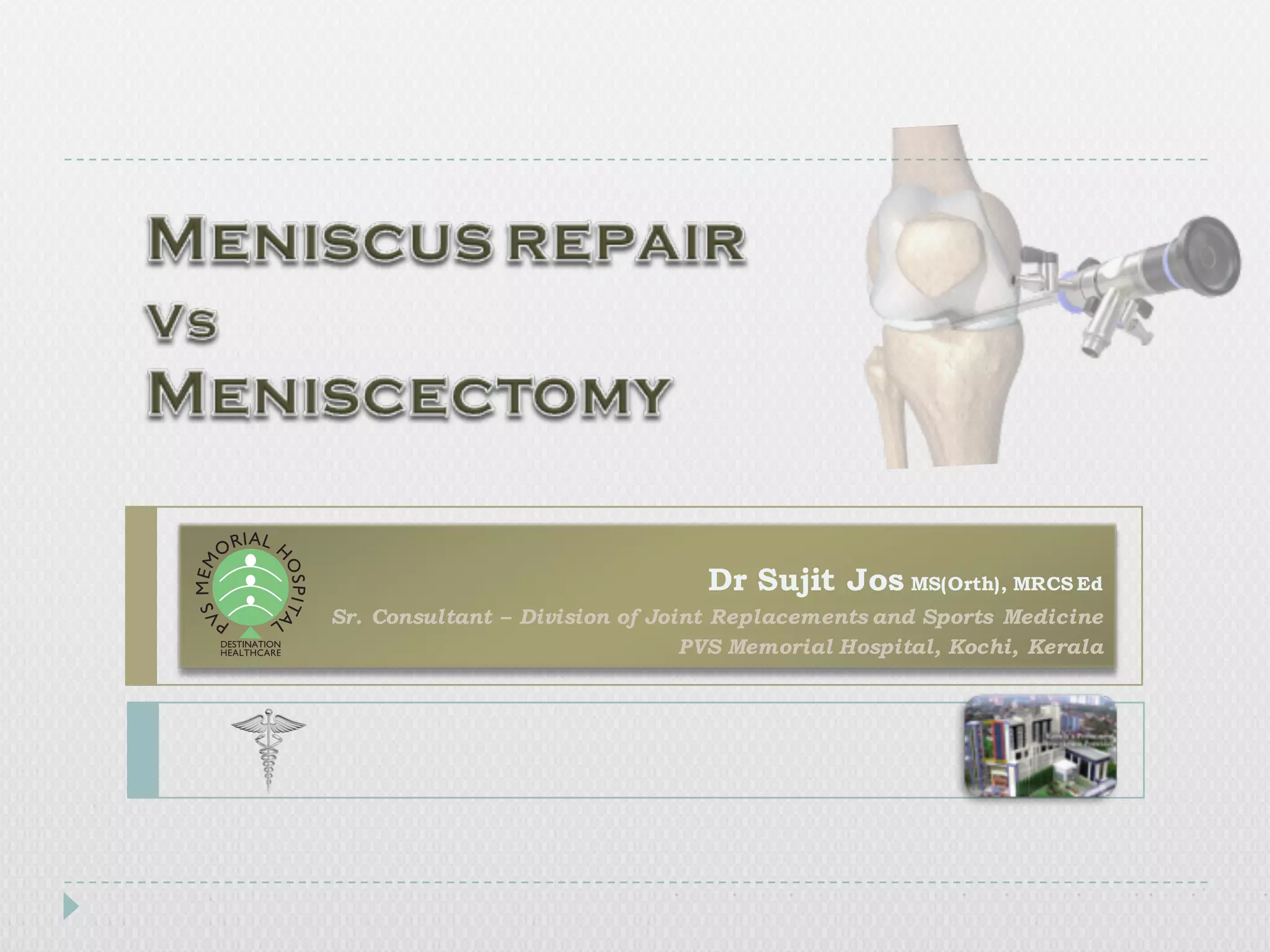
Dr Sujit Jos MS(Orth), MRCS Ed
Sr. Consultant – Division of Joint Replacements and Sports Medicine
PVS Memorial Hospital, Kochi, Kerala
Meniscal tears
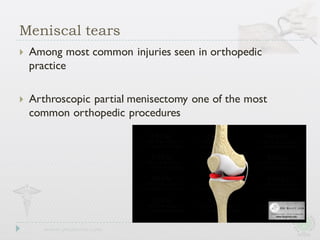
} Among most common injuries seen in orthopedic
practice
} Arthroscopic partial menisectomy one of the most
common orthopedic procedures
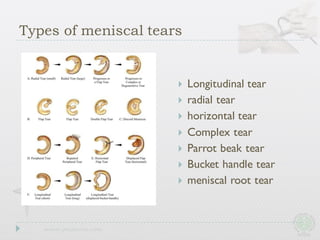
Types of meniscal tears
} Longitudinal tear
} radial tear
} horizontal tear
} Complex tear
} Parrot beak tear
} Bucket handle tear
} meniscal root tear
Pathoanatomy
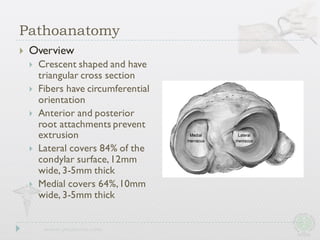
} Overview
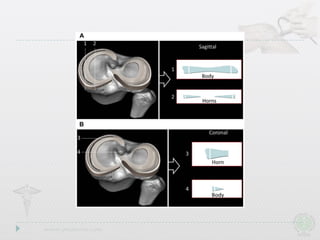
} Crescent shaped and have
triangular cross section
} Fibers have circumferential
orientation
} Anterior and posterior
root attachments prevent
extrusion
} Lateral covers 84% of the
condylar surface,12mm
wide, 3-5mm thick
} Medial covers 64%,10mm
wide, 3-5mm thick
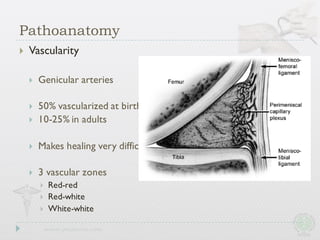
} Vascularity
} Genicular arteries
} 50% vascularized at birth
} 10-25% in adults
} Makes healing very difficult
} 3 vascular zones
} Red-red
} Red-white
} White-white
Pathoanatomy
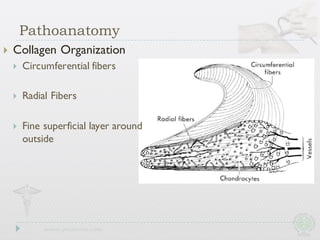
} Collagen Organization
} Circumferential fibers
} Radial Fibers
} Fine superficial layer around
outside
Pathoanatomy
} Load Sharing
} Increases contact area between femur and tibia
} Decreases contact stress on articular cartilage
} Increases congruity
} Provides stability
} Aids in lubrication
Meniscal function
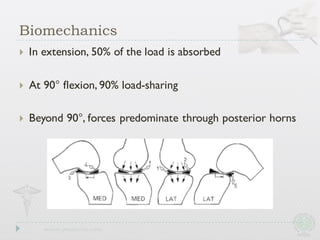
} In extension, 50% of the load is absorbed
} At 90° flexion, 90% load-sharing
} Beyond 90°, forces predominate through posterior horns
Biomechanics
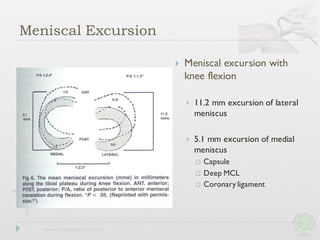
} Meniscal excursion with
knee flexion
} 11.2 mm excursion of lateral
meniscus
} 5.1 mm excursion of medial
meniscus
¨ Capsule
¨ Deep MCL
¨ Coronary ligament
Meniscal Excursion
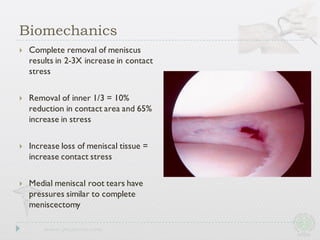
} Complete removal of meniscus
results in 2-3X increase in contact
stress
} Removal of inner 1/3 = 10%
reduction in contact area and 65%
increase in stress
} Increase loss of meniscal tissue =
increase contact stress
} Medial meniscal root tears have
pressures similar to complete
meniscectomy
Biomechanics
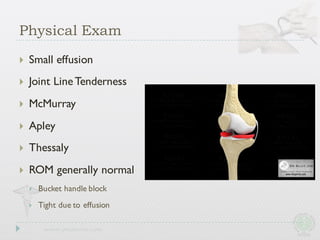
} Small effusion
} Joint LineTenderness
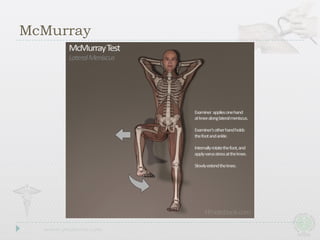
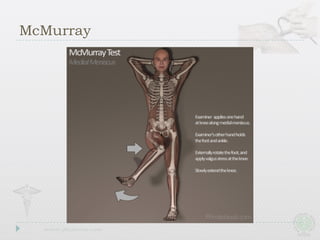
} McMurray
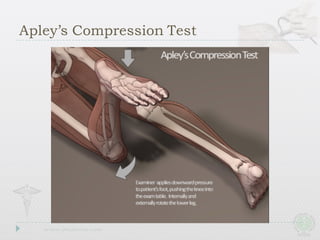
} Apley
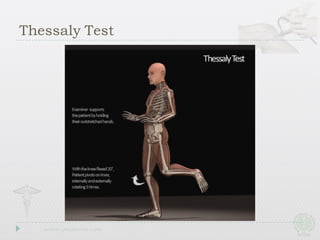
} Thessaly
} ROM generally normal
} Bucket handle block
} Tight due to effusion
Physical Exam
McMurray
McMurray
Apley’s Compression Test
Thessaly Test
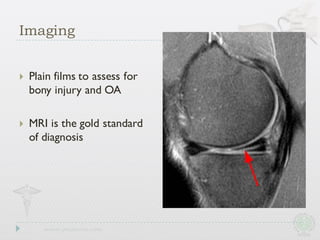
} Plain films to assess for
bony injury and OA
} MRI is the gold standard
of diagnosis
Imaging
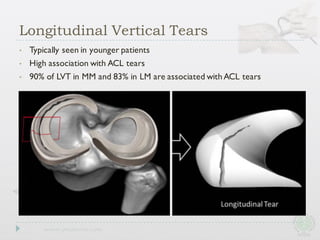
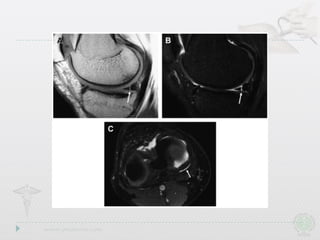
• Typically seen in younger patients
• High association with ACL tears
• 90% of LVT in MM and 83% in LM are associated withACL tears
Longitudinal Vertical Tears
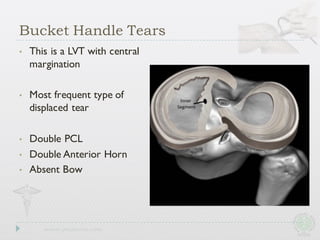
• This is a LVT with central
margination
• Most frequent type of
displaced tear
• Double PCL
• Double Anterior Horn
• Absent Bow
Bucket Handle Tears
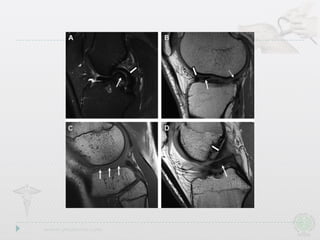
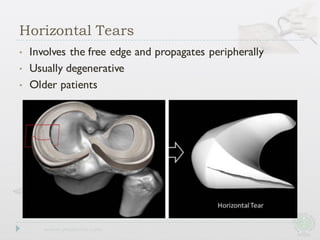
• Involves the free edge and propagates peripherally
• Usually degenerative
• Older patients
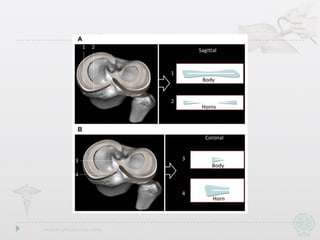
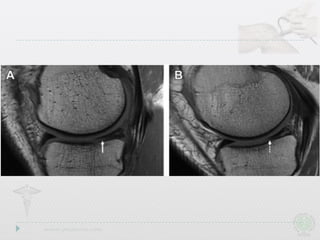
Horizontal Tears
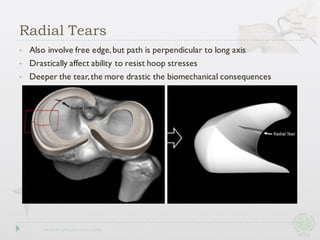
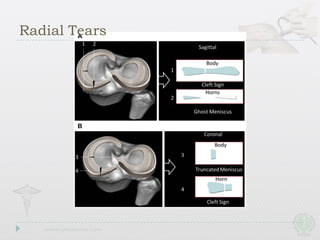
• Also involve free edge,but path is perpendicular to long axis
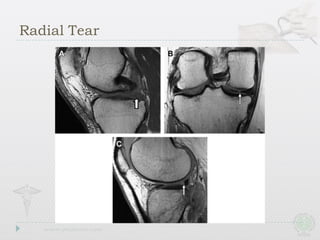
• Drastically affect ability to resist hoop stresses
• Deeper the tear,the more drastic the biomechanical consequences
Radial Tears
Radial Tears
Radial Tear
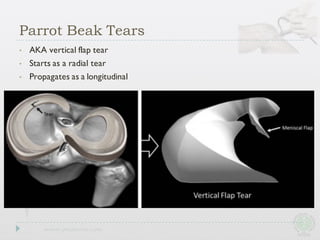
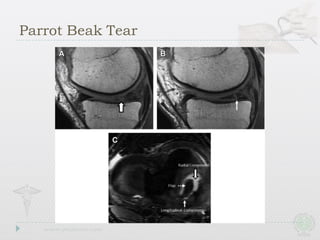
• AKA vertical flap tear
• Starts as a radial tear
• Propagates as a longitudinal
Parrot Beak Tears
Parrot Beak Tear
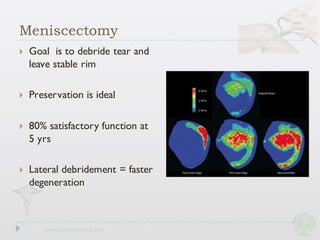
} Goal is to debride tear and
leave stable rim
} Preservation is ideal
} 80% satisfactory function at
5 yrs
} Lateral debridement = faster
degeneration
Meniscectomy
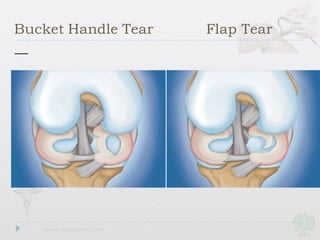
Bucket Handle Tear Flap Tear
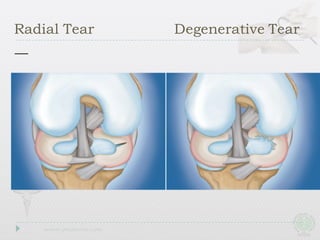
Radial Tear Degenerative Tear
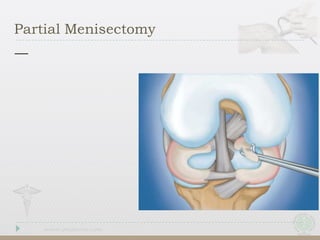
Partial Menisectomy
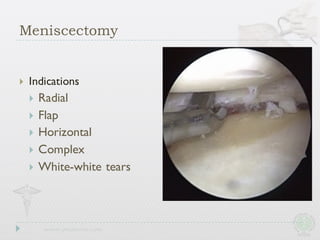
} Indications
} Radial
} Flap
} Horizontal
} Complex
} White-white tears
Meniscectomy
} Predictors of Positive Result
} < 40yo
} Normal alignment
} Minimal arthritis at initial scope
} Single fragment tear
Meniscectomy
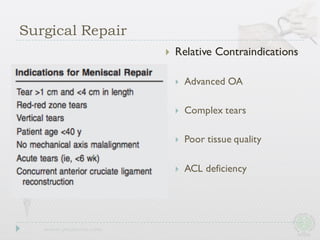
} Relative Contraindications
} Advanced OA
} Complex tears
} Poor tissue quality
} ACL deficiency
Surgical Repair
Open Repair
} Rarely used
} Numerous studies have proven reduced surgical
morbidity with arthroscopic repair
} Reserved for peripheral tears in the posterior horn
Inside–out meniscus repair
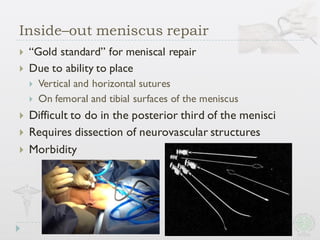
} “Gold standard” for meniscal repair
} Due to ability to place
} Vertical and horizontal sutures
} On femoral and tibial surfaces of the meniscus
} Difficult to do in the posterior third of the menisci
} Requires dissection of neurovascular structures
} Morbidity
Inside-out Repair
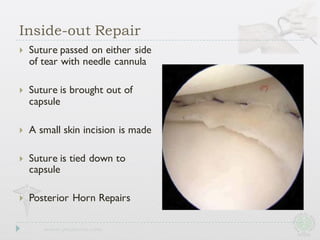
} Suture passed on either side
of tear with needle cannula
} Suture is brought out of
capsule
} A small skin incision is made
} Suture is tied down to
capsule
} Posterior Horn Repairs
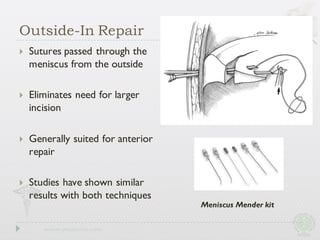
} Sutures passed through the
meniscus from the outside
} Eliminates need for larger
incision
} Generally suited for anterior
repair
} Studies have shown similar
results with both techniques
Outside-In Repair
Meniscus Mender kit
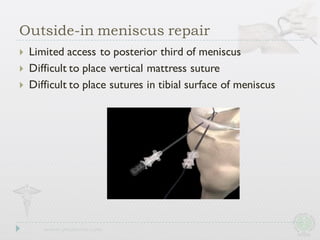
Outside-in meniscus repair
} Limited access to posterior third of meniscus
} Difficult to place vertical mattress suture
} Difficult to place sutures in tibial surface of meniscus
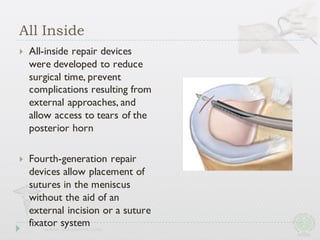
} All-inside repair devices
were developed to reduce
surgical time, prevent
complications resulting from
external approaches, and
allow access to tears of the
posterior horn
} Fourth-generation repair
devices allow placement of
sutures in the meniscus
without the aid of an
external incision or a suture
fixator system
All Inside
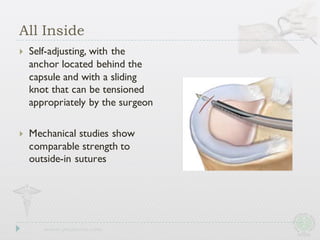
} Self-adjusting, with the
anchor located behind the
capsule and with a sliding
knot that can be tensioned
appropriately by the surgeon
} Mechanical studies show
comparable strength to
outside-in sutures
All Inside
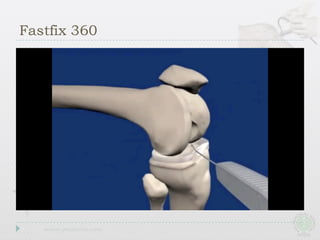
Fastfix 360
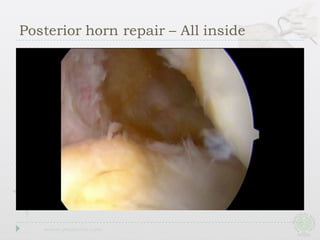
Posterior horn repair – All inside
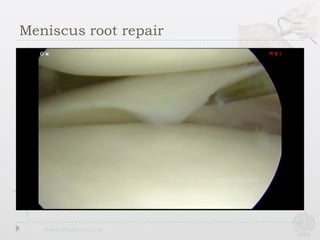
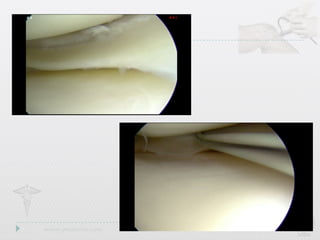
Meniscus root repair
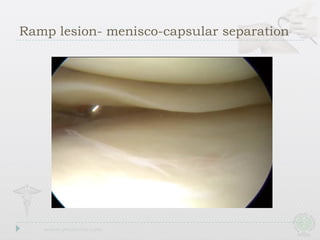
Ramp lesion- menisco-capsular separation
Tips for minimizing error
} Adequate joint distension and visualization of meniscus
} Prepare the meniscus tear site properly
} Choose the portal which allows the delivery needle to be
inserted perpendicular to the tear
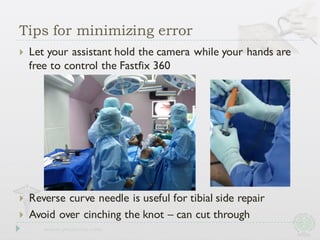
Tips for minimizing error
} Let your assistant hold the camera while your hands are
free to control the Fastfix 360
} Reverse curve needle is useful for tibial side repair
} Avoid over cinching the knot – can cut through
Outcomes
} Success rates for all techniques reported 70-95%
} Second-look scopes show lower success rates of 45-91%
} Ligamentous laxity decreases success rate to 30-70%
} 90% success reported in conjunction with ACL repair
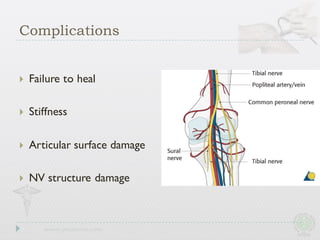
} Failure to heal
} Stiffness
} Articular surface damage
} NV structure damage
Complications
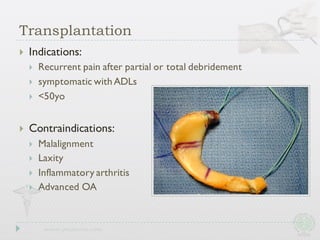
Transplantation
} Indications:
} Recurrent pain after partial or total debridement
} symptomatic with ADLs
} <50yo
} Contraindications:
} Malalignment
} Laxity
} Inflammatory arthritis
} Advanced OA
Outcomes
} Widely varying reports of success (Country differences)
} Subjective improvement in tibiofemoral pain
} No clear long-term benefit in preventing OA has been
established
} Grafts seem to do better when placed with a bone block
} Preserving some peripheral rim helps to avoid extrusion
} Variety of meniscal scaffold options being investigated in
animals
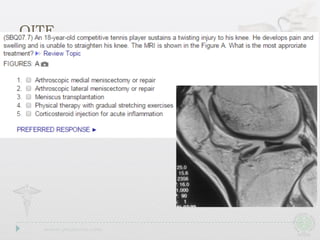
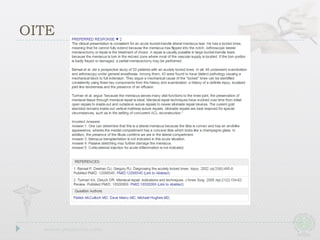
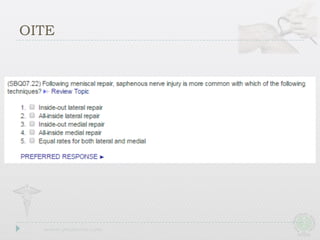
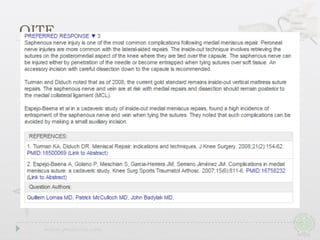
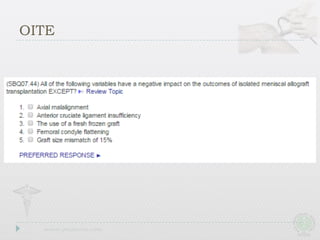
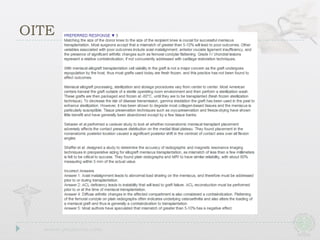
OITE
OITE
OITE
OITE
OITE
OITE
Take home
Dr Sujit Jos MS(Orth), MRCS Ed.
Sr. Consultant – Department of Orthopedic Surgery
Joint Replacements and Sports Medicine
PVS Memorial Hospital, Kaloor, Kochi
Email: docjoints@gmail.com
Web: www.docjoints.com

Meniscus repair vs meniscectomy

  • 1.
    Dr Sujit JosMS(Orth), MRCS Ed Sr. Consultant – Division of Joint Replacements and Sports Medicine PVS Memorial Hospital, Kochi, Kerala
  • 2.
    Meniscal tears } Amongmost common injuries seen in orthopedic practice } Arthroscopic partial menisectomy one of the most common orthopedic procedures
  • 3.
    Types of meniscaltears } Longitudinal tear } radial tear } horizontal tear } Complex tear } Parrot beak tear } Bucket handle tear } meniscal root tear
  • 4.
    Pathoanatomy } Overview } Crescentshaped and have triangular cross section } Fibers have circumferential orientation } Anterior and posterior root attachments prevent extrusion } Lateral covers 84% of the condylar surface,12mm wide, 3-5mm thick } Medial covers 64%,10mm wide, 3-5mm thick
  • 5.
    } Vascularity } Geniculararteries } 50% vascularized at birth } 10-25% in adults } Makes healing very difficult } 3 vascular zones } Red-red } Red-white } White-white Pathoanatomy
  • 6.
    } Collagen Organization }Circumferential fibers } Radial Fibers } Fine superficial layer around outside Pathoanatomy
  • 7.
    } Load Sharing }Increases contact area between femur and tibia } Decreases contact stress on articular cartilage } Increases congruity } Provides stability } Aids in lubrication Meniscal function
  • 8.
    } In extension,50% of the load is absorbed } At 90° flexion, 90% load-sharing } Beyond 90°, forces predominate through posterior horns Biomechanics
  • 9.
    } Meniscal excursionwith knee flexion } 11.2 mm excursion of lateral meniscus } 5.1 mm excursion of medial meniscus ¨ Capsule ¨ Deep MCL ¨ Coronary ligament Meniscal Excursion
  • 10.
    } Complete removalof meniscus results in 2-3X increase in contact stress } Removal of inner 1/3 = 10% reduction in contact area and 65% increase in stress } Increase loss of meniscal tissue = increase contact stress } Medial meniscal root tears have pressures similar to complete meniscectomy Biomechanics
  • 12.
    } Small effusion }Joint LineTenderness } McMurray } Apley } Thessaly } ROM generally normal } Bucket handle block } Tight due to effusion Physical Exam
  • 13.
  • 14.
  • 15.
  • 16.
  • 17.
    } Plain filmsto assess for bony injury and OA } MRI is the gold standard of diagnosis Imaging
  • 18.
    • Typically seenin younger patients • High association with ACL tears • 90% of LVT in MM and 83% in LM are associated withACL tears Longitudinal Vertical Tears
  • 21.
    • This isa LVT with central margination • Most frequent type of displaced tear • Double PCL • Double Anterior Horn • Absent Bow Bucket Handle Tears
  • 23.
    • Involves thefree edge and propagates peripherally • Usually degenerative • Older patients Horizontal Tears
  • 26.
    • Also involvefree edge,but path is perpendicular to long axis • Drastically affect ability to resist hoop stresses • Deeper the tear,the more drastic the biomechanical consequences Radial Tears
  • 27.
  • 28.
  • 29.
    • AKA verticalflap tear • Starts as a radial tear • Propagates as a longitudinal Parrot Beak Tears
  • 30.
  • 31.
    } Goal isto debride tear and leave stable rim } Preservation is ideal } 80% satisfactory function at 5 yrs } Lateral debridement = faster degeneration Meniscectomy
  • 32.
  • 33.
  • 34.
  • 35.
    } Indications } Radial }Flap } Horizontal } Complex } White-white tears Meniscectomy
  • 36.
    } Predictors ofPositive Result } < 40yo } Normal alignment } Minimal arthritis at initial scope } Single fragment tear Meniscectomy
  • 37.
    } Relative Contraindications }Advanced OA } Complex tears } Poor tissue quality } ACL deficiency Surgical Repair
  • 38.
    Open Repair } Rarelyused } Numerous studies have proven reduced surgical morbidity with arthroscopic repair } Reserved for peripheral tears in the posterior horn
  • 39.
    Inside–out meniscus repair }“Gold standard” for meniscal repair } Due to ability to place } Vertical and horizontal sutures } On femoral and tibial surfaces of the meniscus } Difficult to do in the posterior third of the menisci } Requires dissection of neurovascular structures } Morbidity
  • 40.
    Inside-out Repair } Suturepassed on either side of tear with needle cannula } Suture is brought out of capsule } A small skin incision is made } Suture is tied down to capsule } Posterior Horn Repairs
  • 41.
    } Sutures passedthrough the meniscus from the outside } Eliminates need for larger incision } Generally suited for anterior repair } Studies have shown similar results with both techniques Outside-In Repair Meniscus Mender kit
  • 42.
    Outside-in meniscus repair }Limited access to posterior third of meniscus } Difficult to place vertical mattress suture } Difficult to place sutures in tibial surface of meniscus
  • 43.
    } All-inside repairdevices were developed to reduce surgical time, prevent complications resulting from external approaches, and allow access to tears of the posterior horn } Fourth-generation repair devices allow placement of sutures in the meniscus without the aid of an external incision or a suture fixator system All Inside
  • 44.
    } Self-adjusting, withthe anchor located behind the capsule and with a sliding knot that can be tensioned appropriately by the surgeon } Mechanical studies show comparable strength to outside-in sutures All Inside
  • 45.
  • 46.
    Posterior horn repair– All inside
  • 47.
  • 49.
  • 50.
    Tips for minimizingerror } Adequate joint distension and visualization of meniscus } Prepare the meniscus tear site properly } Choose the portal which allows the delivery needle to be inserted perpendicular to the tear
  • 51.
    Tips for minimizingerror } Let your assistant hold the camera while your hands are free to control the Fastfix 360 } Reverse curve needle is useful for tibial side repair } Avoid over cinching the knot – can cut through
  • 52.
    Outcomes } Success ratesfor all techniques reported 70-95% } Second-look scopes show lower success rates of 45-91% } Ligamentous laxity decreases success rate to 30-70% } 90% success reported in conjunction with ACL repair
  • 53.
    } Failure toheal } Stiffness } Articular surface damage } NV structure damage Complications
  • 54.
    Transplantation } Indications: } Recurrentpain after partial or total debridement } symptomatic with ADLs } <50yo } Contraindications: } Malalignment } Laxity } Inflammatory arthritis } Advanced OA
  • 55.
    Outcomes } Widely varyingreports of success (Country differences) } Subjective improvement in tibiofemoral pain } No clear long-term benefit in preventing OA has been established } Grafts seem to do better when placed with a bone block } Preserving some peripheral rim helps to avoid extrusion } Variety of meniscal scaffold options being investigated in animals
  • 56.
  • 57.
  • 58.
  • 59.
  • 60.
  • 61.
  • 62.
  • 63.
    Dr Sujit JosMS(Orth), MRCS Ed. Sr. Consultant – Department of Orthopedic Surgery Joint Replacements and Sports Medicine PVS Memorial Hospital, Kaloor, Kochi Email: docjoints@gmail.com Web: www.docjoints.com